Key Takeaways
- A Mudra loan sanction letter is the written proof of bank approval, listing your loan amount, interest rate, EMI, tenure, conditions and validity period.
- Before signing, verify the interest rate type (fixed or floating), repayment schedule, security or guarantor requirements and all special conditions.
- The sanctioned amount in a MUDRA loan can range from ₹50,000 to ₹20,00,000, split across three categories: Shishu (up to ₹50,000), Kishore (₹50,001 to ₹5 lakh) and Tarun (₹5 lakh to ₹10 lakh).
- PM Mudra Loan terms differ from bank to bank (for example, Canara Bank vs SBI vs private lenders), so never copy assumptions from friends or relatives.
- This guide by CA Manish Gugliya (ProjectReportBank.com) walks you through every clause with simple language and practical tips so you can accept or negotiate with confidence.
Introduction to Mudra Loan Sanction Letters
Many borrowers treat the Mudra loan approval letter as a formality. They glance at the loan amount, nod at the EMI, and sign at the bottom. That single habit locks them into an interest rate, repayment structure and set of legal obligations for the next 3 to 7 years.
A Mudra loan sanction letter is a written offer from the bank telling you: how much loan, at what cost, for how long, and under what conditions. The Pradhan Mantri MUDRA Yojana (often shortened to Mantri Mudra Yojana PMMY) provides micro-financing to small enterprises, and the sanction letter is where the scheme’s broad promise becomes your specific deal.
The letter arrives after the bank completes eligibility assessment, verifies your documents (KYC, business proof, bank statement from the last six months, project report, income proof) and decides to sanction a loan under PM Mudra Yojana. Applicants must submit necessary forms and supporting documents, including a loan application form, before the bank begins its assessment.
Almost all banks and NBFCs, including Canara Bank, SBI, private banks and small finance banks, follow a similar basic format. The wording and charges differ, but the structure is predictable.
Here is what you will learn in this article: the full layout of a Mudra loan sanction letter format, a section-wise explanation of each clause, a checklist before signing, common mistakes, what can be negotiated, expert tips from 20+ years of CA practice, and focused FAQs.

Table of Contents
What Is a Mudra Loan Sanction Letter? (Meaning, Purpose, and Stages)
A Mudra loan sanction letter is the official written communication from the bank stating that your loan is sanctioned subject to terms and conditions. It is not the loan agreement itself, and it is not the final disbursement. It sits between approval and money-in-hand.
The letter serves three core purposes:
- Confirm the sanctioned loan amount and Mudra category (Shishu, Kishore or Tarun).
- Specify the type of facility: term loan, working capital loan, or cash credit.
- Record commercial terms: interest rate, processing fee, tenure, security, guarantor and conditions that must be met before the bank releases funds.
MUDRA loan has three stages: Shishu loans are up to ₹50,000, Kishore loans range from ₹50,001 to ₹5 lakh, and Tarun loans range from ₹5 lakh to ₹10 lakh. Loan amounts may vary based on business needs and MUDRA category specifications.
There is an important distinction between “loan approval in principle” (an oral or system-generated indication that the bank is willing to lend) and the printed sanction letter handed to the borrower with specific numbers.
Here is how the four stages of a Mudra loan process flow:
| Stage | What It Means | Key Documents | Can Bank Still Refuse Disbursement? |
|---|---|---|---|
| Application & In-Principle Approval | Bank reviews your application and indicates initial willingness | Application form, KYC, business proof, bank statement | Yes; this is not a commitment |
| Sanction Letter Issue | Bank issues written offer with all terms | Sanction letter with detailed conditions | Yes, if pre-disbursement conditions are not met |
| Loan Agreement Execution | Borrower signs formal agreement and security documents | Loan agreement, hypothecation deed, guarantee deed | Yes, if documents are incomplete or incorrect |
| Disbursement | Funds credited to borrower’s bank account | Receipt of funds, utilisation as per purpose | No (funds already released) |
Eligibility assessment is the first step in the loan process. Verification of application information occurs after submission. Even after the sanction letter is in your hands, disbursement can be delayed if pre-disbursement conditions like GST registration, shop licence or insurance are not fulfilled. Loan disbursement occurs only after acceptance of the sanction letter and completion of all formalities.
Typical Format of a Mudra Loan Sanction Letter (Section-wise Explanation)
Almost all banks, including PSU banks like Canara Bank, follow a broadly similar Mudra loan sanction letter format with standard headings. The sections below mirror what you will find on your own letter. Wherever banking terms appear, the plain-English meaning follows in the same sentence.
Borrower Details Block
The top portion of a sanction letter contains the applicant details: borrower name, father’s or spouse’s name, full address, business name, constitution (proprietorship, partnership or company) and the Mudra category (Shishu, Kishore or Tarun).
Verify every character. The spelling of your name must match your Aadhaar and PAN exactly. These details flow into the loan agreement, hypothecation deed and your CIBIL credit report. A mismatch in name or address causes delays in disbursement, disputes in legal documents and errors in credit history.
You need a valid photo identity proof for a MUDRA loan, and the name on that proof must match what the bank has printed. A current address proof is also required for MUDRA loan applications.
Example: “Mr. Rajesh Kumar, Proprietor of M/s Rajesh Mobile Repair, Address: 12, Main Market, Jaipur, Rajasthan, 302001.”
If there are joint borrowers, co-applicants or a guarantor, their names, PAN and Aadhaar details appear separately. Confirm that those details are also correct.
Loan Amount and Type of Facility
This portion states the sanctioned amount clearly, for example “Rs. 3,00,000 under Mudra Kishore.” Sometimes the letter shows both “requested amount” and “sanctioned amount.” If the bank has given a partial sanction (less than what you asked for), the reason is usually one or more of these: low repayment capacity visible in your bank statement, a weaker CIBIL score, insufficient margin money from your side, or internal risk guidelines of the bank.
The facility type will read as “Term Loan,” “Working Capital Loan,” “Cash Credit (CC)” or “OD against current account.” Each type affects how you repay. A term loan has fixed EMIs. Working capital has a drawing power limit tied to stock or receivables, with annual renewal.
Check whether the limit is “fresh” or “takeover” from another lender. A takeover carries specific conditions, and the bank may require a no-dues certificate from the previous lender.
Purpose of Mudra Loan
The sanction letter includes a line describing the purpose, such as “For purchase of 1 no. delivery vehicle for dairy supply” or “For working capital for readymade garments shop.”
Common mudra loans purposes include working capital for trading shops, purchase of machinery or equipment, small manufacturing units, vehicles for commercial use, beauty parlours, repair workshops, small restaurants and service units.
The loan amount must be strictly utilized for the stated business purpose and cannot be diverted for personal use. This is not just a moral guideline; it is a contractual condition. If the bank later discovers that funds were used for a different purpose, it can treat that as a violation of terms, accelerate repayment, or take legal action.
Future inspections or stock and asset verification by the bank will be based on this stated purpose. Make sure your project report, quotations and invoices match.
Interest Rate Clause
A typical interest rate line reads: “Interest: 9.15% p.a. (BRLLR + 2.00%) floating, subject to change from time to time as per bank guidelines.”
Here is what that means. “BRLLR” is the bank’s internal benchmark lending rate. “2.00%” is the spread the bank adds on top. “Floating” means the rate can change whenever the bank revises its benchmark. A “fixed” rate, by contrast, stays the same for the entire tenure.
Most PM Mudra Loan interest rates are floating. When the Reserve Bank of India changes the repo rate, banks adjust their benchmark, and your EMI or tenure may change.
The “reset clause” specifies how often this adjustment happens: quarterly, half-yearly, or annually. If your sanction letter says “reset every quarter,” your EMI could move up or down four times a year.
Interest rates vary across lenders. According to Paisabazaar data, Bank of Baroda charges roughly 8.40% to 11.10%, Canara Bank charges about 8.70% to 14%, and Axis Bank charges around 15% to 19.35%. If your profile is strong (good CIBIL score, stable business income, clean repayment history), you can sometimes negotiate a lower spread.
Repayment Period and Moratorium
A sample repayment line: “Repayment: 60 EMIs (5 years) including moratorium of 3 months on principal.”
“Tenure” is the total repayment period. Common tenures for Mudra term loans are 3, 5 or 7 years. A longer tenure means a lower monthly EMI but higher total interest payment over the life of the loan.
“Moratorium” is a holiday on principal repayment. During this period (typically 1 to 6 months), you pay only interest. The principal portion is deferred to later EMIs. Confirm whether interest is payable during moratorium; in most banks, it is.
Check whether your business cash flow realistically supports the EMI for the full tenure. If your business is seasonal, ask the bank whether step-up EMI or balloon payment is possible.
Repayment Schedule and EMI Details
Many sanction letters attach a separate annexure with the month-wise repayment schedule: first EMI date, EMI amount, total number of EMIs and last EMI date.
Cross-check the EMI amount using a standard EMI calculator with the sanctioned amount, interest rate and tenure from the letter. A software error at the bank’s end, though rare, can produce an incorrect EMI figure.
For working capital Mudra limits, repayment is often “on demand” or with annual renewal, not fixed EMIs. Understand which structure applies to your facility.
Ensure the EMI due date (for example, the 7th of every month) aligns with your typical monthly cash-in cycle. If most of your payment from customers comes by the 15th, set the EMI date after the 15th to avoid bounced debits.
Processing Charges and Other Fees
The sanction letter states the processing fee. For many public sector banks under PMMY, the processing fee for MUDRA loans can be nil or vary according to bank policy. You may see “Processing fee: NIL under PMMY” or “Processing fee: 0.50% of sanctioned amount + GST.”
Look beyond the processing fee line. Additional charges can include documentation charges, inspection charges, valuation charges (for vehicle or equipment), legal opinion fee and insurance premium if bundled with the loan.
Ask for a written break-up of all one-time and recurring charges before signing. Generic wording like “as per bank norms” should be questioned. Get the actual rupee figure in writing.
Security, Collateral and Guarantor Details
One block of the sanction format states whether the Mudra loan is “collateral-free” as per PMMY guidelines or whether additional security is taken. MUDRA loans do not require collateral under certain guidelines set by the Ministry of MSME. For loans up to ₹10 lakh, banks are mandated not to insist on collateral.
“Hypothecation of movable assets” means the bank places a charge over your stock, receivables, equipment or vehicle, while those assets remain in your possession. You use them daily but cannot sell or dispose of them without the bank’s consent.
When a guarantor is required, the sanction letter shows the guarantor’s name, PAN and address. The guarantor carries full financial responsibility if the borrower defaults. Some banks, despite the collateral-free mandate, insist on a third-party guarantee or comfort of a spouse or relative. Understand the implications before agreeing, and confirm whether the guarantor’s own assets are at risk.

Conditions Before Disbursement (Pre-Disbursement Conditions)
This block lists every action you must complete before the bank credits the Mudra loan amount to your account. Typical requirements include:
- Submitting original quotations for machinery or equipment
- Completing KYC with valid photo identity proof and address proof
- Signing the loan agreement and all annexures
- Submitting post-dated cheques or an ECS/NACH mandate
- Obtaining Udyam Registration
- Obtaining GST registration (if turnover exceeds the threshold)
- Securing a trade licence or shop act licence
- Taking vehicle or machine insurance
- Depositing margin money (if applicable)
Latest Income Tax Return is necessary for income proof. A bank statement from the last six months is required. Ownership proof of residence or office is needed for MUDRA loans. You must submit a loan application form with your documents along with any additional documents the bank may seek.
If these conditions are not fulfilled within the validity period, the sanction may lapse or need fresh approval.
Prepare most of these documents in advance using guidance from your CA or consultant. Last-minute scrambling is the most common reason for sanction lapse.
Validity of Sanction Letter
Every sanction letter mentions a validity period, for example: “This sanction is valid for 60 days from the date of issue” or “Offer to be accepted within 30 days.”
If you sign acceptance after the validity date or fail to comply with conditions in time, the bank may re-appraise your application, revise the terms, or cancel the sanction entirely.
For seasonal businesses, request an extension of validity in advance with a written application giving the reason for delay in availing the loan. Any extension or revalidation should be obtained in writing to avoid future disputes.
Special Conditions and Covenants
This is the fine print section. Banks include specific do’s and don’ts: maintaining a current account with the same bank, routing all sales through that account, not availing a similar facility from another lender without consent and more.
Common covenants include timely submission of stock statements, financial statements, GST returns, insurance renewals and permission for site inspection. Borrowers must maintain proper books of accounts and comply with operational norms for working capital loans.
Default events are defined here: continuous overdue beyond a certain number of days, penal interest rates (often 2% to 4% above the regular rate) and the bank’s right to recall the entire loan if covenants are breached.
Read these lines slowly. Ask the branch staff to explain any unclear legal language before signing acceptance. A 15-minute conversation at the branch can prevent months of disputes later.
Sample Layout of a Mudra Loan Sanction Letter
Below is a realistic text-based layout showing the typical order of a Mudra loan sanction letter sample. Match each field against your own letter:
[Bank Name & Logo] [Branch Address] Date: DD/MM/YYYY Sanction Ref. No.: MUDRA/BR/2026/XXXX
To: Mr./Ms. [Borrower Name] [Business Name] [Full Address]
Subject: Sanction of Mudra Loan under [Shishu/Kishore/Tarun] Category
| Field | Details | What to Check |
|---|---|---|
| Sanctioned Amount | Rs. __ | Does it match what you discussed with the bank? |
| Purpose | __ | Does it match your project report? |
| Type of Facility | Term Loan / Working Capital / CC | Understand repayment nature |
| Interest Rate | _% p.a. (Fixed/Floating) | Fixed or floating? What benchmark? |
| Tenure | _ months / years | Does EMI fit your cash flow? |
| Moratorium | _ months | Is interest payable during moratorium? |
| EMI Amount | Rs. __ | Cross-check with EMI calculator |
| Processing Fee | Rs. __ or NIL | Get written break-up of all charges |
| Security | Collateral-free / Hypothecation of [assets] | Confirm no hidden collateral demand |
| Guarantor | [Name] or Not Required | Guarantor must give informed consent |
| Validity | _ days from date of letter | Note the deadline clearly |
Pre-Disbursement Conditions: [List of conditions]
Special Conditions / Covenants: [Bank-specific clauses]
Acceptance: I/We have read and understood all terms and conditions. I/We accept the above sanction.
Signature of Borrower: __ Date: __
For a downloadable example with filled-in numbers, refer to the Sample Mudra Loan Sanction Letter on ProjectReportBank.com.
Sections Applicants Usually Ignore (But Shouldn’t)
Most Mudra borrowers check the loan amount and EMI, then skip the rest. That habit creates problems months or years later.
Here are the clauses that deserve your attention:
- Floating interest change clause. If the repo rate rises by 0.50%, your EMI could increase by ₹200 to ₹500 per month on a ₹5 lakh loan, depending on remaining tenure.
- Compulsory insurance bundling. Some banks add group insurance or credit shield insurance automatically. You can discuss opting out if it is not mandatory under the sanction terms.
- Prepayment or part-payment penalty. Check whether paying off the loan early attracts a charge. Many PSU banks do not charge prepayment penalty on floating-rate loans to individuals, but confirm in writing.
- Cheque or ECS bounce charges. A single bounced EMI can cost ₹300 to ₹750 per instance, plus penal interest.
- Right of set-off. This clause allows the bank to use your savings or fixed deposits held with them to adjust an overdue loan EMI without asking your permission first.
- Cross-default clause. If you default on any other loan with the same bank, this Mudra loan can also be treated as defaulted.
- Change of business place or constitution. You must inform the bank in writing before shifting your shop or changing from proprietorship to partnership.
Important Things to Check Before Accepting the Sanction Letter
Use this checklist while reading your Mudra loan approval letter:
Loan basics:
- ✓ Sanctioned amount matches your requirement
- ✓ Correct Mudra category (Shishu, Kishore or Tarun)
- ✓ Interest rate and whether it is fixed or floating
- ✓ EMI amount cross-checked with EMI calculator
- ✓ Total tenure and moratorium period
- ✓ Date of first EMI and last EMI
Charges:
- ✓ Processing fee (nil or actual amount)
- ✓ Documentation fee
- ✓ Insurance premium
- ✓ Inspection and valuation charges
- ✓ Legal charges
- ✓ Annual renewal fee (for working capital limits)
Security and guarantor:
- ✓ Whether the loan is truly collateral-free
- ✓ What assets are hypothecated
- ✓ Who is named as guarantor
- ✓ Whether the guarantor has given written, informed consent
Other terms:
- ✓ Validity period of the sanction letter
- ✓ All pre-disbursement conditions are achievable within the deadline
- ✓ Requirement to open or maintain a current account with the same bank
- ✓ Restrictions on withdrawing cash or using funds for non-business purposes
Common Mistakes Borrowers Make with Mudra Sanction Letters
Most mistakes happen because of hurry, over-trust in verbal assurances, or simply not having the habit of reading formal paperwork.
- Signing without reading. The single most common mistake. If you do nothing else, at least read every printed line once.
- Ignoring the floating interest clause. Borrowers assume the EMI is fixed forever. It is not, if the rate is floating.
- Assuming processing fee is zero. Some banks charge 0.25% to 1% even under PMMY; check the letter.
- Misunderstanding moratorium. Moratorium does not mean “no payment.” Interest usually accrues and is payable.
- Missing the validity period. If you do not accept within 30 or 60 days, the bank may cancel or revise terms.
- Skipping special conditions. Clauses about stock statements, account routing and inspections are enforceable.
- Accepting guarantor role casually. A guarantor is fully liable if the borrower defaults. This is not a “formality.”
- Using funds for non-approved purposes. Diverting a business loan to personal expenses is a contractual breach.
- Not keeping a signed copy. Always take a photocopy or scan of the signed sanction letter for your records.
- Not clarifying prepayment penalties. Paying off the loan early can attract charges with some lenders.
- Not updating the bank about address changes. All legal notices go to the address on file. If you have moved, update it.
- Ignoring default and penal interest clauses. Penal interest of 2% to 4% above the normal rate adds up fast on overdue amounts.
Sit with your CA or a trusted advisor for 15 to 20 minutes to review the sanction letter before signing. That small investment of time can prevent years of confusion.

Can You Request Changes in the Mudra Loan Sanction Letter?
Many entrepreneurs think sanction terms are set in stone. Some points can be discussed, especially before you sign acceptance.
Generally negotiable:
- Processing fee (waiver or reduction)
- Small reduction in spread over base rate, if your profile is strong
- Change of EMI due date to match your cash flow cycle
- Slight adjustment in tenure
- Choice of insurance plan (your own insurer vs the bank’s bundled option)
Usually non-negotiable:
- The base rate itself (set by the bank’s treasury, not the branch)
- Core security requirements guided by head-office policy
- Major relaxation in documentation requirements
Timing matters. Raise any change request immediately after receiving the sanction letter and before signing acceptance. Once acceptance is signed, banks rarely modify terms.
Approach the branch manager politely with a written application. Attach evidence of strong repayment capacity (clean bank statement, rising turnover, good CIBIL score). For public sector banks under PM Mudra Yojana, concession schemes may be centrally fixed, leaving branch staff limited room. Still, clarifications and minor adjustments are possible when you ask with paperwork in hand.
Expert Guidance from CA Manish Gugliya (ProjectReportBank.com)
Over 20 years of reviewing Mudra and MSME sanction letters across different banks, I have seen patterns that trip up borrowers repeatedly.
How professionals review a sanction letter:
A CA cross-checks the sanction letter against the project report and CMA data. The working capital assessment should match your actual business cycle (stock holding period, debtor collection period, creditor payment period). If the bank has sanctioned a working capital limit based on a 90-day stock cycle but your micro business actually turns stock in 30 days, the limit may be inflated, and the interest cost unnecessary.
Common banking mistakes I have seen:
- Incorrect spelling of borrower name (one letter difference creates two CIBIL profiles)
- Wrong EMI amount due to a data-entry error in the bank’s software
- Mismatch between the sanctioned purpose (“purchase of machinery”) and the security description (“hypothecation of stock-in-trade”)
- Sanction letter showing a guarantor who was never informed
If you spot any of these, ask the branch to issue a corrected sanction letter before you sign.
Documents to preserve:
Keep originals or certified copies of the sanction letter, any revised sanction letters, the loan agreement, security documents, insurance policies and all major correspondence or clarification emails from the bank. Store digital scans in a separate folder.
Questions to ask the bank before signing:
- How will interest change in the future, and how will I be notified?
- How do I get a loan statement and interest certificate at year-end?
- What happens if my EMI is delayed by a few days?
- Whom do I contact for restructuring if my business faces a difficult period?
For first-time entrepreneurs:
Do basic cash-flow planning before finalising EMI. Keep buffer savings of at least 3 EMIs. Avoid over-borrowing; a ₹3 lakh loan at a manageable EMI is better than a ₹7 lakh loan that strains your account every month. As of March 2026, PMMY has disbursed over ₹40.07 lakh crore across 57.79 crore loan accounts; the process is tested and accessible, but your individual terms depend on reading your own sanction letter carefully.
Use the support resources at ProjectReportBank.com, including document checklists, process guides and the step-by-step guide on how to download your Mudra loan sanction letter online, before you start the application.
Frequently Asked Questions on Mudra Loan Sanction Letter Format
Is a Mudra loan sanction letter legally binding on the bank and the borrower?
The sanction letter is a conditional offer. It becomes binding only after the borrower accepts it in writing and fulfills all pre-disbursement conditions. The final binding document is the loan agreement, read together with the sanction letter. Until you sign acceptance, you can walk away or request changes. After acceptance and successful verification of all conditions, both sides are expected to honour the written terms unless fresh written amendments are made by mutual consent.
Can I download my Mudra loan sanction letter online?
Some banks provide digital copies through net banking, mobile app or email. Others still hand over physical printouts at the branch. The procedure varies by lender. For bank-specific steps and screenshots, follow the dedicated guide on How to Download Your Mudra Loan Sanction Letter Online at ProjectReportBank.com.
What should I do if there is a mistake in my Mudra sanction letter?
Point out any error in spelling, address, loan amount, interest rate, EMI or security description to the branch in writing before signing acceptance. Do not accept a letter with known errors. The bank will issue a corrected or revised sanction letter. Corrected details are essential because these entries flow into your CIBIL report, legal documents and all future correspondence. Even small issues, like the nature of your business or an incorrect PAN, should be fixed before you proceed.
Can the bank change the sanction terms later, after I have signed?
Core terms like the sanctioned amount, base interest structure and tenure cannot be changed unilaterally once both parties have signed. The exception is where the letter explicitly allows rate revisions under a floating-rate clause; those adjustments follow the bank’s published benchmark changes. In rare cases involving regulatory shifts or serious default, the bank may revise conditions or recall the loan, but it must give written notice. Keep all sanction letters, subsequent revision letters and related paperwork to protect your understanding of the agreed terms.
Can I have more than one Mudra loan sanction at the same time?
PM Mudra Yojana is designed to support small borrowers within defined limits. Banks generally do not allow overlapping Mudra loans that exceed the overall ceiling for a single borrower or business. If you need additional funds after repaying or partly repaying an existing Mudra loan, the bank may upgrade your category (Shishu to Kishore, or Kishore to Tarun) or offer a different MSME product. Each such change comes with a fresh sanction letter and revised terms. Utility bills and other proof of business continuity may be sought as part of the fresh analysis and risk assessment before a new sanction is availed.
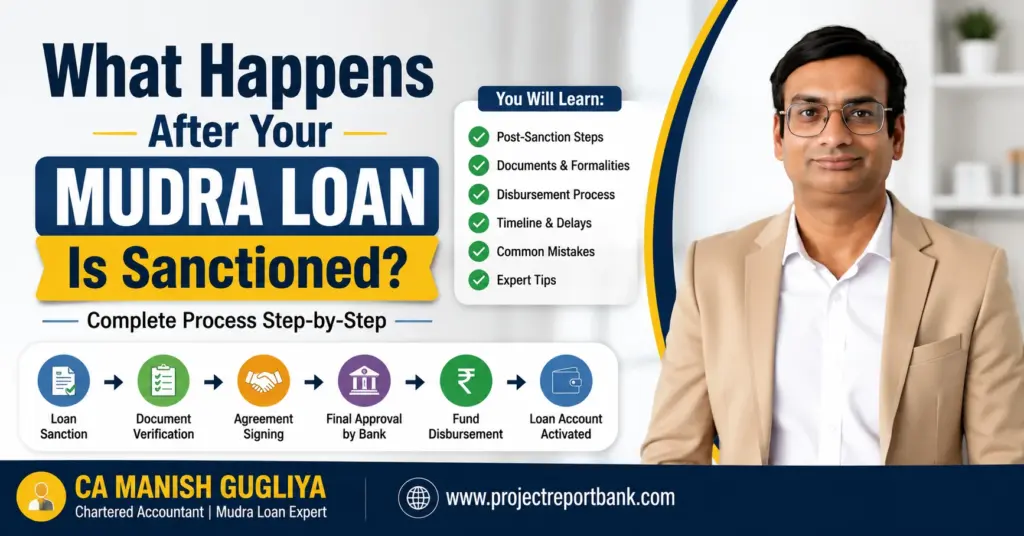
- What Happens After Your Mudra Loan Is Sanctioned?

- Can a Sanctioned Mudra Loan Be Cancelled by the Bank? Complete Guide (2026)
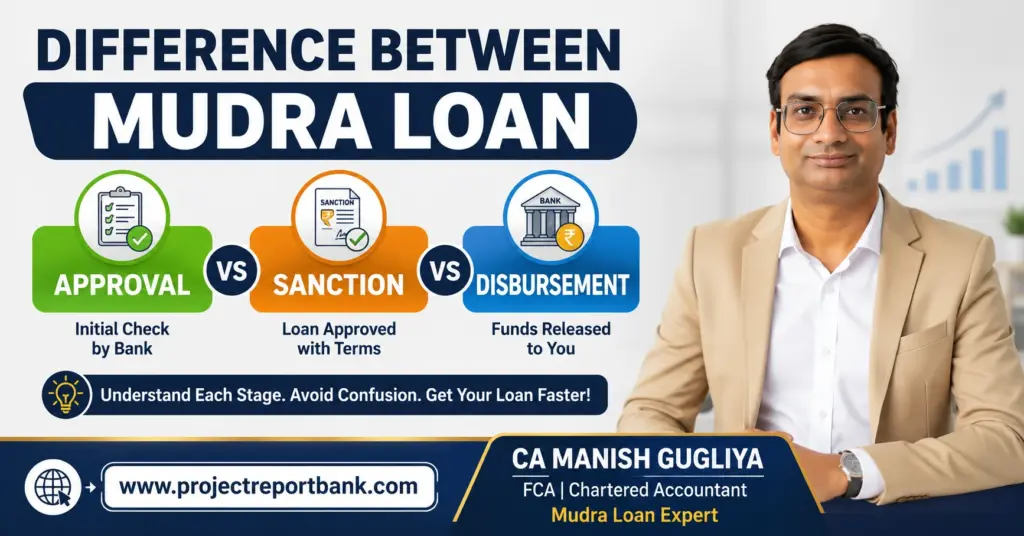
- Difference Between Mudra Loan Approval, Sanction and Disbursement
- Mudra Loan Sanction Letter Format: Every Section Explained
- Mudra Loan Sanction Letter Download – Complete Step‑by‑Step Guide