Key Takeaways
- The loan approval status does not guarantee funds have been disbursed. “Disbursement approved” in the bank’s system means an internal step is complete – the money may still be in transit or queued for processing.
- Typical timelines range from same day to 2–3 working days. If more than 5 working days pass without any update, this is abnormal and requires a written follow-up.
- Your immediate steps: check your passbook or account statement, confirm your account and IFSC details with the branch, and ask for the UTR or transaction reference number.
- Always collect a stamped written status note from the bank showing exactly where the process stands.
- In most genuine cases, delays are procedural and temporary. Proper documentation and a calm escalation – from branch manager to regional office to the Banking Ombudsman – resolves the issue.
Introduction: Why Your Mudra Loan Amount Is Not Yet Credited
As a practising Chartered Accountant with over 20 years of experience in MSME finance, I regularly hear this from Mudra loan borrowers: “The bank told me my loan is disbursed, but there is no money in my account.” This panic is understandable – but almost always, there is a logical explanation.
Under Pradhan Mantri Mudra Yojana (PMMY), the flagship scheme for income generating micro enterprises in the non farm sector, approval and disbursement of loans are separate steps. Mudra Ltd acts as a refinance agency – individual borrowers get the loan from their bank or financial institution, not from the government directly. The scheme supports micro enterprises through collateral free funding covering loans upto rs 10 lakh (and now up to ₹20 lakh under Tarun Plus for those who have successfully repaid previous loans). Eligible borrowers include individuals and partnership firms engaged in non-farm income generating activities like manufacturing, trading, services, and food processing.
Here is a quick example: a Shishu loan of ₹50,000 approved for disbursement on 04-08-2026 may only show in the borrower’s passbook on 06-08-2026 because of internal batch processing. That 1–2 day gap is perfectly normal.
This article walks you through every reason for the delay, normal timelines, how to verify your transaction, and exactly what to do. For a deeper understanding of how these stages differ, read our guide on the difference between Mudra loan approval, sanction and disbursement.
Table of Contents
Difference Between Disbursement Approval and Amount Credit
Banks use internal terms like “disbursement approved”, “voucher passed”, and “entry pending for authorisation” that most borrowers never see. Understanding these terms prevents unnecessary worry.
Disbursement approval means the bank has internally decided, inside its Core Banking System (CBS), to release the mudra loan amount. All sanction conditions and documents required have been verified. But the money has not left the bank yet.
Actual fund transfer means the loan amount is posted to your savings or current account – or to a term loan or cash credit account – and shows as a real balance you can withdraw.
Why are these different? Because of the maker–checker process (one officer enters the transaction, another authorises it), internal compliance checks, and the fact that NEFT or RTGS transfers run in batches rather than instantly at every moment.
The common misunderstanding: seeing “disbursed” on a portal, SMS, or sanction letter and assuming the money should appear that very minute. In reality, the next phase involves several technical steps.
| Aspect | Disbursement Approval | Amount Credited to Account |
|---|---|---|
| What it means | Internal bank decision to release funds | Money actually available in your account |
| Who sees it | Bank staff on CBS screen | Borrower in passbook/statement |
| Typical evidence | Internal system status, voucher reference | Passbook entry, SMS alert, bank statement |
| Time after sanction | Hours to 1 day | Hours to 2–3 working days after approval |
| Can you withdraw? | No | Yes |
This distinction applies to every business loan, but Mudra loan borrowers feel it more because the amounts are small and the money is often needed urgently for a micro unit or small business.
What Happens After a Mudra Loan Is Approved for Disbursement?
After the branch tells you “your Mudra loan disbursement is approved”, several back-office steps still remain before the amount appears in your account.

Here is the typical sequence:
- Final authorisation by the branch manager or authorised officer for the specific mudra loan account.
- CBS entry by maker: A bank officer (the “maker”) enters the disbursement voucher into the Core Banking System.
- Checker approval: A second officer reviews and authorises the entry. Without this, funds do not move.
- Loan account activation: The bank opens your new Mudra loan account number under the relevant category – Shishu, Kishore, or Tarun – with sanctioned limit, interest rate, and repayment terms configured.
- Fund transfer: The bank chooses the mode – internal transfer to your account in the same branch, or NEFT/RTGS if your account is in another bank. NEFT now operates 24×7 with half-hourly batches, but the bank’s internal cut-off times and holiday calendars still matter.
- UTR generation: For external transfers, a Unique Transaction Reference number is generated – this is your proof that funds have actually left the bank.
- Alerts and updates: You receive an SMS or email once the posting is complete. Your passbook and online banking will reflect the credit.
If none of these alerts appear, credit has probably not yet been posted. For the complete stage-wise journey, see our Mudra loan processing stage timeline and the guide on what happens after a Mudra loan is sanctioned.
Why Is the Mudra Loan Amount Not Credited Even After Disbursement Approval?
In practice, most delays happen because of internal banking procedures – not because your loan has been cancelled. Here are the real reasons:
Internal banking delay. Branch staff may be handling dozens of PMMY loans on the same date. End-of-month rushes or year-end targets create backlogs. Your file simply waits in the queue.
Pending maker–checker authorisation. The loan entry was made by one officer, but the second-level checker has not yet approved it in the CBS. Until this happens, funds stay locked.
CBS or server downtime. System issues during end-of-day (EOD) or start-of-day (SOD) processing push your posting to the next working day. Bank employees often cite “system downtime” in these situations.
Bank holiday or weekend. Public holidays can delay disbursement of approved loans significantly. If your disbursement was approved on a Saturday evening, actual transfer may happen only on Monday – or Tuesday if Monday is a holiday.
Technical transaction failure. NEFT or RTGS can fail if the IFSC code or account number is incorrect. Errors in bank details can prevent funds from being credited entirely. The amount gets reversed to the lending bank’s internal account.
Incorrect account details. Verify bank account and IFSC details carefully. Even a single digit wrong can send funds to a wrong account or cause a rejection.
Loan account not activated. The system may show “sanctioned” but the actual loan account – with product code, limits, and interest configuration – has not been opened yet.
Pending documentation. A KYC mismatch, unsigned agreement, missing hypothecation deed, or outdated MSME/Udyam registration can hold everything. The applicant should ensure all required formalities are completed before fund disbursement.
Disbursement batch pending. Many PSU banks release Mudra loans in daily batches. If your file misses the cut-off, it rolls to the next batch.
Branch-level or regional office approval pending. For higher Kishore or Tarun loans (₹5 lakh to ₹10 lakh), regional office verification of CIBIL reports or site inspection findings can add 1–3 extra working days. Each application is assessed based on the borrower’s profile and business viability.
Real examples: A ₹3 lakh Kishore loan was delayed by 4 working days because the borrower had not submitted updated GST registration. Once the document was provided, the checker authorised the voucher and NEFT cleared the same day. In another case, a ₹9 lakh Tarun business loan was held because the wrong IFSC was entered on the form – the NEFT failed, reversed, and had to be re-initiated after correction.
Until a UTR or transaction ID is generated and visible in bank logs, the money has not technically been “released” – regardless of what the branch verbally assured you.
How Long Does It Normally Take After Disbursement Approval?
Timelines vary by bank type and transfer mode. Electronic fund transfers can take from 24 to 72 working hours after clearance, but many go through faster. Here is a practical reference point:

| Indicative Time | Typical Situation | What You Should Do |
|---|---|---|
| Same working day | Internal transfer, same branch; Shishu loans (up to ₹50,000) via STP | Check mobile banking or passbook by evening |
| Within 24 hours | Internal transfer across branches; NEFT within same bank | Wait till next working day before raising concern |
| 24–48 hours | PSU banks with batched NEFT uploads; Kishore loans (₹50,001 to ₹5 lakh) | Visit branch if no SMS or entry after 2 full working days |
| 3–5 working days | Pending documentation, maker–checker delay, or minor compliance issues | Ask for written status note and a committed date |
| Beyond 5 working days | Abnormal – likely a problem needs escalation | Meet branch manager; email regional office or nodal officer |
Saturdays (especially second and fourth), Sundays, and RBI holidays extend the calendar even if the status shows “disbursement approved.” For Shishu loans, same-day or next-day credit is the norm. For larger Tarun loans, 2–3 working days is common due to additional checks.
For a complete stage-wise chart, refer to our Mudra loan processing stage timeline.
How to Check Whether the Money Has Actually Been Released
Before assuming any problem, verify systematically whether the loan amount has been credited or at least released from the bank’s side.
Bank passbook: Update your passbook at the branch or ATM. Look for entries like “MUDRA LOAN DISB” or a transfer matching your sanctioned amount.
Account statement: Download or request your statement for the last 7–10 days. Sometimes the SMS fails but the entry exists in the statement.
Mobile or internet banking: Check both your deposit account (savings or current) and the new Mudra loan account (term loan or overdraft account). Take a screenshot for your records.
SMS and email alerts: Banks usually send a message when the loan is disbursed. Check your spam folder. Ensure your registered mobile number is correct.
Branch confirmation: Visit the branch and ask the staff to show you the status on their screen – whether the loan account is opened, whether the disbursement voucher is passed, and whether NEFT/RTGS has been triggered. A Unique Transaction Reference number may be needed to trace pending funds sent to another bank.
If the branch confirms NEFT was successful and provides a UTR, but the beneficiary bank still hasn’t credited the amount, visit the beneficiary bank with that UTR for tracing.
Always keep printed or PDF copies of statements and screenshots – they become essential if you need to lodge a formal complaint later.
What Should You Do If the Amount Is Still Not Credited?
Calm, documented follow-up works far better than repeated verbal requests. Here is a step-by-step plan:
Step 1: Wait at least till the end of the next full working day after you hear “Mudra loan disbursement approved.” Unless funds are urgently needed for a time-bound purchase.
Step 2: Collect your sanction letter, Mudra loan application copy, KYC documents (applicants need ID proof and address proof to apply), disbursement request form, passbook or statement, and any SMS or email from the bank.
Step 3: Visit the branch and meet the loan officer handling PMMY accounts. Politely ask for the exact status on their system.
Key questions to ask: Is the loan account opened? Is the disbursement voucher authorised by the checker? Was NEFT/RTGS initiated? Is there any “pending documentation” warning?
What to request:
- A stamped and signed written note of the current status with expected credit date
- The UTR or transaction reference if funds have been sent
- A clear list of any missing documents (GST registration, Udyam certificate, shop license, property tax receipt, liability statement) holding back disbursement
Escalation path:
- Branch Manager – submit a short written request letter describing the issue with dates, loan amount, and copies of key documents.
- Regional Office / Nodal Officer – send an email or letter if there is no resolution within 3–5 working days after meeting the branch manager.
- Banking Ombudsman / RBI Complaint System – escalate issues to the bank’s grievance redressal mechanism first. If the bank fails to respond in 30 days, file an online complaint with the Banking Ombudsman mentioning the mudra scheme and PMMY clearly.
Maintain a simple follow-up log: date, person met, what was said, and promised date. This strengthens your case at every level. For detailed escalation strategies, read our guide on Mudra loan disbursement delay: reasons and solutions.
Can the Bank Reverse or Hold the Disbursement?
Once a mudra loan amount is actually credited to the borrower’s account, banks cannot simply reverse it without a valid reason and usually need the borrower’s consent or a clear legal mandate.
However, banks can legally hold or stop disbursement even after “approval” in these situations:
- Documentation incomplete: missing signatures on the loan agreement, post-dated cheques not deposited, KYC mismatch, or incomplete hypothecation documents.
- Compliance issue: new adverse CIBIL information, mismatch between declared and actual business address found during site inspection, or suspicion of third-party misuse of funds.
- Account frozen: borrower’s account marked frozen due to court order, income tax attachment, or suspicious transaction alerts under AML guidelines.
Technical reversals also happen – NEFT/RTGS can bounce due to a wrong IFSC or closed beneficiary account. In such cases, the amount auto-reverses to the lending bank, and the borrower has every right to request immediate re-initiation after correcting details.
Banks can delay disbursement for risk or compliance reasons before funds leave, but cannot permanently deny the loan after formal sanction without giving written reasons. The Ministry of Finance does not charge upfront fees for Mudra loan disbursement – if anyone asks for money to “release” your loan, that is a red flag.
Common Mistakes Borrowers Make
Some delays are entirely avoidable. Here are the most frequent mistakes I see:
Assuming that a sanction letter or SMS saying “disbursement approved” means money will automatically appear within minutes – and therefore not checking with the branch about cut-off times or mode of transfer.
Not verifying the beneficiary account number and IFSC on the disbursement request form. Even a small error leads to failed NEFT or credit to a wrong account.
Ignoring bank SMS or emails requesting additional documents – like an updated electricity bill, shop license, or Udyam registration – thereby keeping the loan file stuck in “pending” status.
Failing to carry original KYC and business proof (rent agreement, GST registration, registration certificate, voter’s id card as address proof) on the day of expected disbursement.
Waiting 10–15 days without any written follow-up, assuming the bank will “do the needful.” This weakens your position for later escalation.
For small business loans under the mudra yojana, proactive communication and timely submission of documents required before Mudra loan disbursement can save several days.
Expert Tips from CA Manish Gugliya to Avoid Mudra Disbursement Problems
Based on 20+ years of working with MSME and Mudra loan cases across multiple banks, here is my practical advice:
Tip 1: At the time of sanction itself, ask the branch exactly how disbursement will happen – internal transfer, NEFT, or supplier payment – and what date or time you should expect the credit. This removes guesswork.
Tip 2: Prepare a complete documentation file – KYC, business registrations, quotations, rent agreement, photographs, educational qualification certificates if relevant – in advance. Cross-check with the bank’s Mudra checklist so nothing remains pending.
Tip 3: Immediately after hearing “disbursement approved”, send a polite email to the branch summarising the date, loan amount, and expected credit account number. This creates a written trail that protects you.
Tip 4: For Tarun and high-end Kishore loans, clarify upfront whether regional office approval or site inspection is needed so you are prepared for a slightly longer timeline.
Tip 5: Keep your existing bank accounts clean in the weeks before disbursement. Avoid cheque bounces, unexplained cash deposits, or suspicious transfers – these trigger compliance flags that can stall your disbursement.
Tip 6: Use professional, written communication. Banks respond better to clear letters stating facts, dates, the loan amount, and specific requests – not emotional arguments.
Tip 7: Once the mudra loan is credited, immediately save your sanction letter, disbursement memo, and first statement. These are useful when availing loan top-ups or applying for higher financial assistance later. Also verify the interest rate applied – interest rates for Mudra loans are determined by banks, with the current RLLR around 9.05% per annum, and may vary based on the loan category.

If your issue is at an earlier stage – say, stuck after internal bank approval or during credit appraisal – our detailed guides cover those situations as well.
Frequently Asked Questions on Mudra Loan Amount Not Credited After Disbursement Approval
These FAQs address common doubts not fully covered in the sections above, focusing on very practical borrower questions.
My Mudra loan status shows ‘disbursed’ in the system, but my balance has not increased. What does this mean?
In many bank systems, “disbursed” can mean the disbursement voucher has been passed but the actual transfer is queued for batch processing. Wait till the end of the working day, then check your passbook and ask the branch for confirmation and UTR. If still not visible, the credit has likely not yet been posted, and you should request a written status from the branch.
The bank says my Mudra loan amount was sent by NEFT on a specific date, but my other bank has not credited it. What should I do?
Obtain the UTR number from the lending bank. Visit the receiving bank’s branch or call their customer care with that UTR and request a trace. If the NEFT transaction failed – due to wrong IFSC or a closed account – it normally auto-reverses to the sending bank within 1–2 working days. You then need to correct the details and request re-initiation.
Can the bank cancel my Mudra loan after disbursement approval if I decide to postpone my business plan?
Before funds are credited, the borrower and the bank can mutually agree not to proceed. Once credited, the usual way to cancel is to prepay the loan in full, possibly with minimal interest for the days the money was availed. Submit a written request and keep a signed copy. Note that applicants must not be defaulters to any bank or other legal entity when applying for fresh Mudra credit.
Will checking my Mudra loan status frequently at the branch or portal negatively affect my CIBIL score?
No. Merely checking status or making enquiries does not affect your CIBIL score. Only actual credit pulls done by the bank during sanction and your repayment behaviour after disbursement impact your credit history. A satisfactory credit track record after availing the loan is what matters.
I have signed all documents, but the bank says regional office approval is still pending. How long can this take?
For larger Kishore or Tarun limits, 3–7 working days for regional office verification is common. The file sent to regional office guide explains this process in detail. Ask the branch for an expected date, the email ID of the regional office contact, and a written note if the delay exceeds one week. The applicant should be aged between 18 to 65 years and should have the necessary skills or experience for the proposed activity – these are sometimes re-verified at this stage.
For problems occurring before the disbursement stage – such as why a Mudra loan is sanctioned but not disbursed – our detailed guides cover each scenario separately. Mudra Yojana offers loans up to ₹20 lakh for small businesses through a Tarun Plus category for those who have availed and repaid Tarun loans. Processing fees can vary by bank, and Mudra loans can be applied online or at bank branches, where an application number is generated after submission. The application process includes generating an OTP for verification. A mudra card may also be issued for working capital needs. The scheme covers proprietary concern, public company, non corporate entities, and any other legal entity engaged in activities allied to the service sector, small manufacturing units, or khadi activity across the non farm sector – providing financial support for income generation and employment creation across the country.
Conclusion
In Mudra loans, “disbursement approval” is an internal banking step. The actual credit to your account may take anywhere from a few hours to a couple of working days under normal conditions. This applies whether you hold a Shishu, Kishore, or Tarun loan from any financial institution participating in PMMY.
Most delays are procedural – maker–checker approvals, technical glitches, holidays, or missing documents. They resolve efficiently when you systematically check your statements, confirm UTR or transaction details with the branch, and maintain proper written communication.
You have clear rights under PMMY and RBI guidelines. The bank must provide written reasons for any hold or reversal. If your issue remains unresolved, escalation to the branch manager, regional office, and finally the Banking Ombudsman is available to every borrower.
Plan ahead. Keep your documents ready. Stay proactive. And refer to our in-depth guides on every stage of the Mudra loan journey so your next business loan experience – whether for trading, manufacturing, or any other non-farm activity – is smoother, faster, and stress-free.
- Can You Delay Accepting Mudra Loan Disbursement? Everything Borrowers Should Know


- What Happens on Mudra Loan Disbursement Day? (Practical Guide by CA Manish Gugliya)

- Partial Mudra Loan Disbursement: Reasons and Next Steps

- Can Banks Release Mudra Loan in Installments? (Practical Guide by CA Manish Gugliya)

- Does the Bank Verify Documents Again Before Disbursement?

- Can a Sanctioned Mudra Loan Be Cancelled Before Disbursement? (Practical Guide by CA Manish Gugliya)
- How to Check Mudra Loan Disbursement Status Online
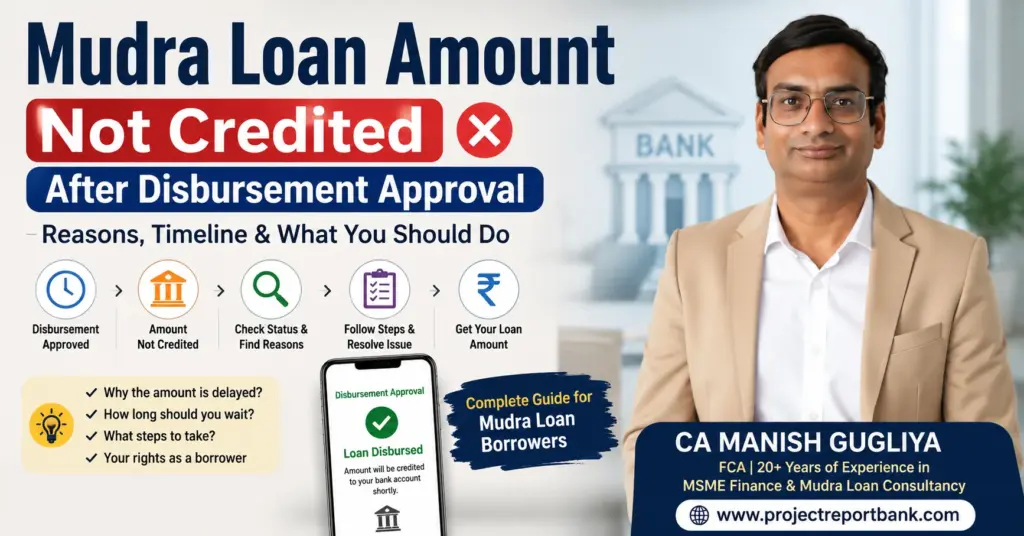
- Mudra Loan Amount Not Credited After Disbursement Approval: Reasons, Timeline & What You Should Do
- Documents Required Before Mudra Loan Disbursement: Complete Post‑Sanction Checklist