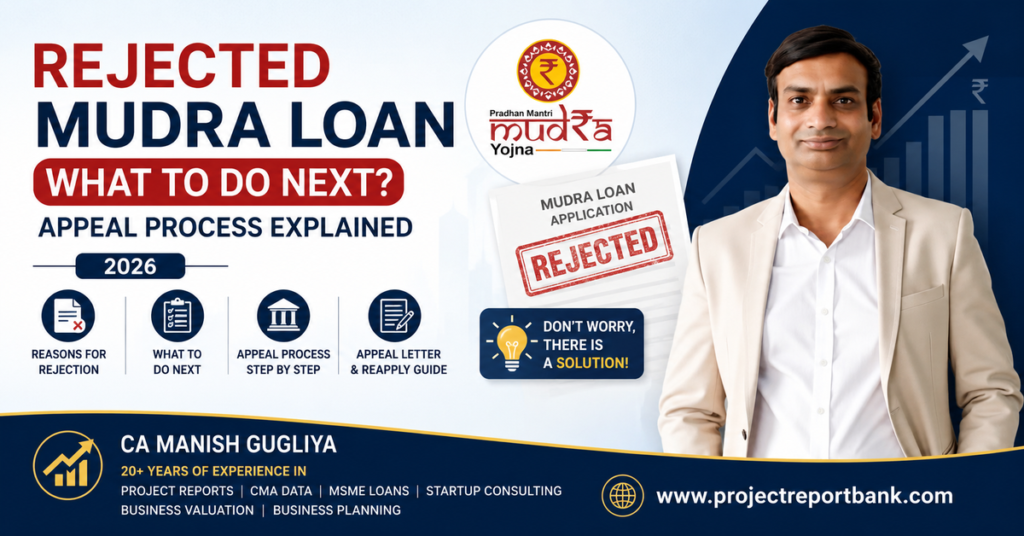
Key Takeaways
- A rejected mudra loan is common in 2026 and usually happens due to incomplete or mismatched documents, a low CIBIL score (below 650), a weak business plan, or policy issues – not because the scheme is “closed.”
- You have every right to ask the bank for written reasons for rejection. Once you know the exact cause, you can fix your documents, improve your credit history, strengthen your project report, and either appeal or reapply.
- There is a clear mudra loan appeal path: Branch Manager → Regional Office / Nodal Officer → Bank Grievance Cell → RBI Integrated Ombudsman → CPGRAMS. Each level is explained step-by-step later in this guide.
- Rejection is not permanent. Many applicants get their mudra loan approved on the second or third attempt after correcting their file.
- Professional project reports and CMA Data from experts like CA Manish Gugliya significantly improve mudra loan approval chances. Explore resources at projectreportbank.com.
Introduction: Rejected Mudra Loan in 2026 – Don’t Panic
Every year, lakhs of Shishu, Kishore, Tarun, and Tarun Plus mudra applications are submitted across India. And a significant number get rejected. If yours was one of them, take a deep breath. You are not alone, and this is not a personal failure.
When a bank rejects your mudra loan application, it simply means the bank found some risk – maybe in your documents, your CIBIL score, your business plan, or a policy fit issue. They are not rejecting you as a person or saying your business idea is worthless. They are flagging specific problems that can almost always be fixed.
This guide, written from the practical experience of CA Manish Gugliya (FCA, 20+ years in Mudra and MSME finance), walks you through every step – from understanding why banks reject mudra loans, to the exact appeal process, reapplication strategy, and documents you need. Whether you are a first-time entrepreneur, a woman starting a home-based business, a student with a startup idea, a shop owner, manufacturer, or trader – even a first rejection can be turned into an eventual approval.

Table of Contents
What Is PM Mudra Loan? Updated Overview for 2026
Pradhan Mantri Mudra Yojana (PMMY), launched in April 2015, is a government backed scheme that provides collateral-free business loans for non-farm, non-corporate micro units and small businesses. Loans are given through banks, non banking financial companies (NBFCs), microfinance institutions, and regional rural banks – not directly by MUDRA or SIDBI.
The Mudra loan categories include Shishu, Kishor, and Tarun, plus a newer fourth category:
- Shishu: Up to ₹50,000. For very small setups – tea stalls, mobile repair, tailoring, e rickshaws, auto rickshaws.
- Kishore: ₹50,001 to ₹5 lakh. For growing businesses needing working capital or small machinery.
- Tarun: ₹5 lakh to ₹10 lakh. For established MSMEs needing expansion funding.
- Tarun Plus: ₹10 lakh to ₹20 lakh. Introduced in FY 2024-25 for borrowers who have successfully repaid a previous Tarun loan. Backed by the Credit Guarantee Fund for Micro Units (CGFMU).
Mudra loans offer up to ₹20 lakh for small businesses under the expanded categories. Since inception, over 51.41 crore loans totalling approximately ₹32.36 lakh crore have been sanctioned.
Collateral-free means no property or gold security is needed. But banks still assess your repayment capacity, credit history, banking conduct, and business viability before approval.
Basic eligibility criteria: Indian citizen, applicants must be between 18 to 65 years old, engaged in a non-farm income-generating activity (trading, manufacturing, services, allied agricultural activities like dairy or poultry, agro processing), with or without formal business registration. Udyam Registration is recommended for better approval chances, especially for kishore and tarun loans.
For detailed category-wise guidance, check the Mudra Loan Eligibility resource.
Top Reasons Why Banks Reject Mudra Loans in 2026
Banks reject mudra loan applications primarily to control NPAs (Non-Performing Assets). Even for a government backed scheme, they must follow RBI norms and internal credit policies. Here are the major reasons:
- Incomplete or mismatched documents – PAN/Aadhaar name mismatch, different address on documents, missing photographs or signatures. Incomplete or mismatched documents cause most Mudra loan rejections.
- Weak or missing business plan – Especially for Kishore, Tarun, and Tarun Plus. Not having a clear business plan can cause loan application failure. A simple business plan is required for Kishore and Tarun loans.
- Poor CMA Data – Incorrect financial projections that don’t match bank statements or GST returns.
- Low repayment capacity – When projected EMI plus existing obligations exceed 50-60% of income (FOIR limit).
- Existing loan defaults or NPA status – Past loan defaults on any loan (personal loan, vehicle, credit card, earlier Mudra) are a major red flag. Existing debt can affect a borrower’s application for Mudra loans.
- Low CIBIL score – A CIBIL score below 650 often leads to loan rejection. Most banks treat scores below 650 as high risk for Kishore and Tarun category loans. Mudra loan rejections often result from poor credit history.
- Business activity not eligible – Pure agriculture (crop loans on farmland), speculative trading, real estate, or liquor trade are excluded under PMMY.
- No proof of business existence – Lack of proof of business operations can result in rejection. No invoices, no rent agreement, no shop photos, no Udyam or licence.
- Wrong category or unjustified loan amount – Applying for an unjustified loan amount (say ₹10 lakh for a brand-new, untested business) raises red flags.
- Cash flow issues in bank statements – Negative bank statements can impact Mudra loan approval chances. Frequent cheque bounces, low average balance, heavy cash-only operations.
- Fake or inflated quotations – Submitting inflated machinery quotes breaks trust instantly.
- Udyam or GST registration issues – Name/PAN mismatch, inactive registration, or missing GST where turnover mandates it.
- Multiple simultaneous applications – Applying to many banks with the same PAN creates suspicion and extra hard enquiries.
- Poor banking history – No current account, irregular deposits, cash-heavy transaction history with no digital trail.
| Reason for Mudra Loan Rejection | Why It Happens | Practical Solution |
|---|---|---|
| Low CIBIL Score (<650) | Past defaults, late EMIs, high credit utilisation | Clear dues, pay EMIs on time for 6 months, target 700+ |
| Incomplete Documents | Missing KYC, expired ID, address mismatch | Submit complete document checklist before applying, cross-verify all details |
| No Business Plan / Weak Project Report | Bank cannot assess viability or repayment | Get a professional Mudra Loan Project Report |
| Existing NPA or Default | Unpaid personal loan, credit card, or earlier Mudra | Settle or close old dues, get NOC from previous lender |
| Unjustified Loan Amount | Requesting more than business turnover supports | Match loan amount to actual need and projected cash flow |
| Business Not Eligible | Crop farming, real estate, speculation | Confirm your business activity falls under PMMY-approved list |
| Cash-heavy Banking | Low digital transactions, bounced cheques | Open a current account, route all sales through bank for 6 months |
| Udyam / GST Issues | Mismatch, inactive, or missing registration | Update or register on Udyam portal; get GST if applicable |
| Multiple Applications | Too many hard enquiries, same PAN at multiple banks | Apply to one well-chosen bank at a time |
| Fake Quotations | Inflated or fabricated machinery/stock quotes | Use genuine, GST-compliant quotations from actual suppliers |
Policy-based rejections may differ slightly across banks such as SBI, HDFC Bank, Canara Bank, and small finance banks, but the core risk logic remains similar. Before reapplying, get your cibil report and bank statements analysed by a professional.
How to Know the Exact Reason for Your Mudra Loan Rejection
Banks often give vague verbal reasons like “policy issue” or “low score.” Don’t accept vague answers. You have the right to know.
Here is what to do:
- Visit or call the branch manager – Politely ask for a specific explanation. A calm, respectful conversation works far better than an argument.
- Request a written rejection note – Under RBI’s Master Circular on Customer Service, banks should communicate reasons for rejecting any loan application. Ask for this in writing or email.
- Ask about the specific issue – Is it CIBIL, documents, business viability, internal exposure limit, or sector policy?
- Review the appraisal note – If the manager is willing, ask about DSCR (Debt Service Coverage Ratio – measures if your business income can cover loan repayment) or FOIR (Fixed Obligation to Income Ratio – checks if your EMIs eat up too much of your income).
- Cross-check your submitted documents – PAN, Aadhaar, bank statements, ITR, GST, Udyam, rental agreement, shop licence. Look for mismatches or missing pages.
- Download your credit report – Check CIBIL, Experian, or Equifax for past defaults, write-offs, or high unsecured loans.
Example dialogue: “Sir, I respect your decision. Could you kindly tell me the specific reason – was it my CIBIL score, my documents, or something about my business plan? I want to correct it before my next attempt.”
Understanding the exact rejection remark (like “CIBIL – 612” or “Insufficient Income Proof”) is the essential first step before any appeal or reapplication.
Immediate Action Plan After Mudra Loan Rejection
Follow this step-by-step checklist after your mudra loan rejection:
Step 1 – Stay calm. Anger or argument with the bank branch will not help. Focus on facts and corrections, not emotions.
Step 2 – Confirm rejection reason in writing. Get this from branch managers or via the bank’s complaint email. This documentation matters for any future appeal.
Step 3 – Collect all missing or incorrect documents. KYC, business address proof, bank statements (a 6-month bank statement is required for Mudra loans), ITR, GST filings, Udyam, licences – everything.
Step 4 – Correct mistakes. Fix name/address mismatches, update your Aadhaar if it shows a different address, rectify Udyam or GST errors, clear bounced ECS mandates.
Step 5 – Improve your financial profile. Reduce credit card dues, regularise overdue EMIs, increase regular transactions through a current account. Maintaining a consistent financial record enhances loan approval chances.
Step 6 – Strengthen your business plan and project report. Clarify your business activity, justify the loan amount, show realistic monthly sales, expenses, profit, and repayment plan. Create a solid business plan for loans above ₹50,000.
Step 7 – Decide your next move. Reapply at the same bank with a corrected file, or approach a different lender – a regional rural bank, small finance bank, NBFC, or MFI.
Need a Bank-Ready Mudra Project Report or CMA Data? CA Manish Gugliya has helped thousands of entrepreneurs prepare professionally designed project reports for Mudra Loans, MSME Loans, and Startup Funding across India. Visit: projectreportbank.com
Mudra Loan Appeal Process in 2026 – Complete Guide
An appeal is useful when you believe your mudra loan rejection was unfair – your documents are complete, your business is viable, but the bank is citing “scheme closed” or rejecting without a valid reason. Banks cannot refuse at their sole discretion without proper evaluation.
There is no separate central “Mudra appeal office.” Appeals follow the normal bank grievance and RBI Ombudsman framework.
Level 1 – Branch Manager: Request reconsideration in writing. Submit corrected documents, an improved project report, and ask for an internal review. Many cases get resolved here.
Level 2 – Regional Office / Zonal Office: If the bank branch is unresponsive or keeps saying “no Mudra quota,” send a written complaint with file copies to the Regional or Zonal Office.
Level 3 – Bank Nodal Officer and Centralised Grievance Cell: Use the bank’s online complaint portal or email. Include your application reference number and specific facts.
Level 4 – RBI Integrated Ombudsman Scheme: If the bank doesn’t respond satisfactorily within 30 days, file a complaint online detailing unfair rejection, non-acceptance of application, or false statements about the scheme being closed.
Level 5 – CPGRAMS: For public sector banks and government-related grievances, the Centralised Public Grievance Redress and Monitoring System is available if all other levels fail.
Appeal Flowchart:
Applicant submits Mudra application → Bank Branch rejects → Branch Manager Review → Regional Office / Nodal Officer → Bank Grievance Cell → RBI Integrated Ombudsman → CPGRAMS (PSU banks, if issue persists)
Appeals cannot force a bank to approve a clearly high-risk loan (heavy NPAs, very low income). But they can stop illegal refusals and ensure fair, reasoned evaluation. Keep all communications polite, factual, and documented – save emails and speed post receipts.
How to Write a Strong Mudra Loan Appeal Letter (With Sample)
A clear, respectful appeal letter makes a real difference. Here are the key components:
- Applicant details: Full name, PAN, last 4 digits of Aadhaar, contact number, address.
- Loan details: Category (Shishu/Kishore/Tarun), loan amount, date of application, bank branch name.
- Reference to rejection: Date, written reason, application reference number.
- Explanation: Corrections made, updated documents attached, why the business is now a safer proposal.
- Request: Clear request for reconsideration or review by a higher authority.
- Attachments list: Project report, CMA Data, bank statements, income proof, Udyam, GST, KYC copies.
Sample Appeal Letter:
Date: 15 July 2026
To, The Branch Manager, State Bank of India, Vijay Nagar Branch, Indore
Subject: Request for Reconsideration of Mudra Loan Application (Kishore – ₹3,50,000)
Respected Sir/Madam,
I, Ravi Sharma (PAN: ABCPS1234R, Aadhaar: XXXX-XXXX-5678), had applied for a Kishore Mudra Loan of ₹3,50,000 on 10 March 2026 (Application Ref: MUD/2026/4521). My application was rejected on 28 March 2026 citing “insufficient documentation and low CIBIL score.”
I have since taken the following corrective steps: 1. Cleared my overdue personal loan EMIs and improved my CIBIL score to 695. 2. Filed Income Tax Returns for FY 2024-25 and 2025-26. 3. Obtained Udyam Registration (Udyam-MP-XX-XXXXXXX). 4. Prepared a professional project report and CMA Data with CA assistance. 5. Maintained regular business transactions through my current account for the last 6 months.
I request you to kindly reconsider my application or forward it to the Regional Office for review. All updated documents are attached.
Thanking you, Ravi Sharma Mobile: 98XXXXXXXX
You can adapt this letter for escalation to the Regional Office, Nodal Officer, or RBI Ombudsman by changing the addressee. Professional help from a Chartered Accountant ensures the annexed project report and CMA Data align with the appeal content.
Can You Reapply After Mudra Loan Rejection? When and How
Yes, you can absolutely reapply for a Mudra loan after rejection. But do not reapply blindly with the same problems. Borrowers should apply for loans that match their business needs – not just repeat the same application.
Waiting periods:
- Some banks allow immediate reapplication once issues (documents, score, basic business plan) are fixed.
- If rejection was due to a low cibil score or income level, waiting 3–6 months lets improvements reflect in your cibil report and bank statements.
Each reapplication creates a fresh appraisal. Multiple hard enquiries in a short time can marginally affect your score, so quality matters more than quantity. Follow up weekly after submitting your application to stay on top of progress.
Best practices for reapplication:
- Reapply only after you have a stronger file – correct documents, better CIBIL, clean banking, improved project report.
- Consider moving to a bank branch with better MSME focus. Regional rural banks and small finance banks are often more receptive for first-time entrepreneurs than large private banks.
- Maintain the same or slightly revised loan amount justified by your updated clear business plan. Avoid unexplained jumps.
NBFCs and MFIs participating under PMMY can also give small shishu loans and Kishore loans, though interest rates may be slightly higher. Women entrepreneurs and housewives can definitely reapply – some banks have special interest concessions for women when documentation is proper. Startups without prior business history can qualify too, with the right project report.
Documents Checklist Before Reapplying for a Mudra Loan
Submit a complete document checklist before applying. Keep everything neat and organised in one file – it makes a strong first impression on branch managers.
KYC & Identity: You need a PAN and Aadhaar for Mudra loan applications. Also carry recent photographs, voter ID or driving licence. You must submit proof of identity and address for Mudra loans.
Address & Business Place Proof: Utility bill (electricity), rental agreement, property tax receipt, shop act licence, MSME registration with correct business address proof.
Business Proof: Proof of business continuity is necessary for Mudra loan applications. Udyam Registration, GST registration (if turnover warrants it), trade licence, partnership deed or company incorporation, invoices, purchase bills, shop/factory photos. This is your business proof – without it, banks question if the business exists.
Financial Documents: Last 12 months’ bank statements (current account and savings account used for business), latest 2–3 years’ ITRs where available, basic P&L and balance sheet or CA-certified income statement.
Project & Financial Data: Updated business plan or project report, realistic loan amount breakup (term loan vs working capital), CMA Data for Kishore, Tarun, and Tarun Plus, quotations for machinery/stock with correct GST details.
| Document Type | Examples / Notes | Mandatory or Recommended |
|---|---|---|
| PAN Card | Must match name on all documents | Mandatory |
| Aadhaar Card | Updated address required | Mandatory |
| Bank Statements | Last 6–12 months, current account preferred | Mandatory |
| Udyam Registration | Correct PAN, business name, activity | Highly Recommended |
| GST Certificate | Required if turnover above threshold | Conditional |
| Project Report / CMA Data | Professional quality for Kishore/Tarun | Mandatory for higher categories |
| ITR | Last 2–3 years | Recommended |
| Quotations | From actual suppliers, GST-compliant | Mandatory for equipment loans |
| Business Photos | Shop/factory, signboard, stock | Recommended |
For deeper guidance, see Documents Required for Mudra Loan.
How to Increase Your Mudra Loan Approval Chances Next Time
Banks assess applicants’ creditworthiness for Mudra loan approvals. They approve well-prepared proposals quickly. Your goal is to look like a low-risk, organised entrepreneur – on paper and in person.
- Professional Project Report: Clearly show your business model, market, expected monthly sales, expenses, profit, and how the loan will be used. A clear business plan is required for Kishore and Tarun loans. Get expert help from projectreportbank.com.
- Accurate CMA Data: CMA (Credit Monitoring Arrangement) is a structured financial statement and projection sheet. Correct ratios like DSCR and current ratio tell the bank your business can repay. Learn more about CMA Data Preparation.
- Correct Loan Amount & Tenure: Justify the loan amount based on quotations and turnover. Keep EMI below 40% of monthly net profit. A repayment plan that matches your cash flow avoids FOIR problems.
- Strong Banking History: Route regular transactions through a current account. Avoid cash-only operations. Minimise cheque bounces. Show a healthy transaction history and maintain an average balance. Banks look at your business transactions closely.
- Improve CIBIL Score: A CIBIL score above 700 improves approval chances. Pay EMIs and credit card dues on time for at least 6 months. Clear small pending loans. Avoid too many enquiries.
- Business Registration & Compliance: Register your business on the Udyam portal for credibility. Get GST if applicable, shop licence, and proper business registration. This builds trust.
- Income Proof & ITR: Even small business owners should file ITRs. Consistent returns strongly support loan approval.
| Parameter | Weak Application | Strong Application |
|---|---|---|
| CIBIL Score | 580 (defaults visible) | 710 (clean record) |
| Business Plan | Verbal, no written plan | Professional project report with CMA |
| Banking | Cash-only, savings account only | Current account, 6+ months regular transactions |
| Documents | Missing Udyam, no ITR | Complete file with Udyam, GST, ITR |
| Loan Amount | ₹10 lakh for a brand-new business | ₹3 lakh justified by 1 year turnover |
Applicants should be prepared to explain their business plan to lenders clearly and confidently during the personal discussion.

Common Mistakes Entrepreneurs Make After a Mudra Loan Rejection
Many applicants repeat the same errors after rejection, leading to second and third refusals. Here are 20 mistakes to avoid:
- Applying again immediately without correcting documents or CIBIL issues.
- Submitting the same weak project report with zero changes.
- Inflating turnover or profits unrealistically in the second application.
- Taking fresh informal loans at high interest to show “margin money,” creating extra burden.
- Using agents or unverified consultants who promise “100% guarantee” and charge large fees.
- Not maintaining proper banking history – still doing mostly cash business.
- Frequently changing business activity in forms to “fit” perceived eligibility criteria.
- Applying in multiple banks simultaneously with the same PAN for the same loan amount.
- Not reading or understanding the rejection reasons properly.
- Ignoring small errors like spelling mistakes in name or PAN–Aadhaar mismatches.
- Avoiding ITR filing despite having taxable income, which weakens financial proof.
- Asking for a very high loan without own contribution or realistic cash flow – essentially an unjustified loan request.
- Assuming Mudra loan is an entitlement and arguing aggressively with bank staff.
- Not updating Udyam or GST data when address or nature of business changes.
- Giving verbal information different from documents (claimed turnover vs bank statement turnover).
- Using someone else’s bank account for business instead of their own current account.
- Not keeping copies of all documents submitted and not noting acknowledgement numbers.
- Changing signature style between PAN, Aadhaar, and bank forms causing KYC confusion.
- Failing to prepare for basic questions in personal discussion with the manager about business viability.
- Ignoring professional help even after multiple rejections – this is the biggest mistake of all.
Review this list carefully before your next mudra loan application. If 2–3 of these apply to you, seek expert guidance before reapplying.
Case Study: From Rejected Mudra Loan to Approval – A Realistic 2026 Example
Meet Ravi – a 29-year-old mobile repair shop owner from Indore.
Initial Rejection: In early 2026, Ravi walked into a public sector bank branch to apply for a mudra loan of ₹4 lakh under the Kishore category. He carried only his PAN, Aadhaar, and a few shop photos. No ITR, no Udyam, no project report. His cibil score was 620 (a low CIBIL score below 650 is a red flag for lenders), and his savings account showed irregular deposits with several ATM withdrawals. The bank rejected his application within two weeks.
Corrections & Preparation: Instead of panicking, Ravi consulted a CA and took these steps over 6 months:
- Opened a proper current account and routed all sales through it, building consistent business transactions.
- Filed ITR for the previous two years with professional help.
- Cleared his small overdue personal loan EMIs, improving his CIBIL to 695.
- Got Udyam Registration and basic GST registration.
- Obtained a professional project report and CMA Data from projectreportbank.com.
Second Application & Approval: Ravi reapplied at a small finance bank with better MSME focus. He submitted a complete file, answered questions about his business history and income confidently, and received sanction for ₹3.5 lakh Kishore Mudra loan with a 4-year tenure. The processing fee was minimal. His mudra loan approved within 3 weeks.
Lessons: Compliance, clean banking, a realistic loan amount, and professional documentation turned a rejection into an approval. Ravi’s story is not unusual – many applicants get their mudra loan approved after fixing exactly these gaps.
Expert Advice from CA Manish Gugliya on Avoiding Future Mudra Rejections
CA Manish Gugliya is a practising Chartered Accountant (FCA) with over 20 years of experience in project reports, CMA Data, Mudra loans, MSME finance, business valuation, and bank loan documentation.
Here is how professionally prepared documents change a bank’s view:
- Project Report: Gives the manager a clear picture of your business model, revenue drivers, risks, and repayment plan in a bank-friendly format. It answers questions before they are asked.
- CMA Data & Financial Projections: Help credit officers quickly understand ratios, cash flows, and stress scenarios. This reduces suspicion and follow-up queries.
- Proper Loan Proposal & Documentation File: An organised file with checklists, index page, and all latest documents makes the application look serious and cuts processing time.
- Alignment with Bank Policy: An expert understands what different banks (PSU, private, SFB, RRB) look for and can guide applicants on suitable lender and loan structure. Most banks follow similar core criteria, but nuances matter.
Need a Bank-Ready Mudra Project Report or CMA Data? CA Manish Gugliya and his team at ProjectReportBank.com help entrepreneurs across India prepare professional project reports and CMA Data for Mudra Loans, MSME Loans, and Startup Funding. Visit: https://projectreportbank.com
If you are exploring business ideas or manufacturing business ideas and need a bank-ready plan, expert guidance makes the difference between rejection and approval.
Frequently Asked Questions on Rejected Mudra Loans (2026)
Can I apply for a Mudra loan again after rejection?
Yes, there is no limit on attempts. But fix the issues first – reapplying with the same problems leads to the same result.
Will a rejected Mudra loan hurt my CIBIL score permanently?
The rejection itself does not lower your score. However, each hard enquiry from the bank may reduce it by a few points temporarily. Multiple enquiries in a short period can add up.
Can another bank approve my Mudra loan after one bank rejected it?
Absolutely. Different banks have different internal policies. A bank branch with strong MSME focus or a small finance bank may approve what a large private bank refused.
Can NBFCs or MFIs give Mudra loans when a bank refused?
Yes. Many non banking financial companies and microfinance institutions participate under PMMY, especially for shishu category and small Kishore loans. Interest rates may be slightly higher.
Is there a minimum CIBIL score required for Mudra loans in 2026?
There is no official minimum, but practically a CIBIL score below 650 may lead to loan rejection for Kishore and Tarun categories. For small shishu loans, some lenders are more flexible.
Do I need a current account before applying?
It is not strictly mandatory for Shishu, but for Kishore and Tarun loans, most banks expect a current account with at least 6 months of regular transactions.
Can women entrepreneurs reapply if their first Mudra loan was rejected?
Yes. Women borrowers are a priority under PMMY. Many applicants who are housewives or first-time women entrepreneurs get approved on the second attempt with better documentation.
Can startups without prior business history qualify after initial rejection?
Yes, but they need a strong project report, realistic projections, and at least some proof of business activity or preparation. Check the Mudra Loan for Startups guide.
How long should I wait before reapplying?
If the issue was documents, you can reapply immediately after corrections. If it was CIBIL or income, wait 3–6 months to let improvements reflect.
Can changing the project report really change the decision?
Yes. A professionally prepared project report with accurate CMA Data, realistic projections, and proper loan justification has turned around many rejections.
What if the bank says “no Mudra quota” or “scheme closed”?
The scheme is active and ongoing. If a bank refuses citing this, escalate to the Regional Office or Nodal Officer. You may also approach the RBI Integrated Ombudsman.
Is it safe to apply through agents promising guaranteed Mudra approval?
No. No one can guarantee loan approval. Banks evaluate at their sole discretion based on merit. Avoid paying large fees to agents making such promises.
Does rejection of Mudra loan affect future home or car loan eligibility?
The rejection itself does not appear on your credit report. But the enquiry does. If your credit history is otherwise clean, it will not significantly impact future applications.
Can I appeal directly to Mudra or SIDBI for a rejected loan?
No. MUDRA/SIDBI refinance the banks – they do not directly sanction loans. Your appeal goes through the bank’s grievance mechanism and then RBI Ombudsman.
Can I increase or decrease the loan amount when I reapply?
Yes. In fact, adjusting to a realistic, justified amount improves your chances significantly.
Is GST mandatory for all Mudra loan applicants?
Not for all. Shishu applicants often don’t need it. For Kishore and Tarun, banks may require it where turnover or sector mandates. Read more about Mudra Loan Without GST.
Can students or fresh graduates apply again without income proof?
They can, especially for Shishu. But they need at least a basic business plan and proof that the business exists or is being set up. Applicants can also apply online through the Jan Samarth portal.
Is Udyam Registration compulsory before reapplying?
Not officially compulsory for Shishu, but it is strongly recommended. For Kishore and Tarun, many banks treat it as de facto mandatory.
How can I track my corrected Mudra application status online?
Most banks allow tracking through their net banking portal, mobile app, or the Jan Samarth portal. You can also visit the bank branch for updates.
What is the processing fee for a Mudra loan?
For Shishu, it is usually nil. For Kishore and Tarun, a small processing fee (typically 0.5–1% of the loan amount) may be charged depending on the bank.
Conclusion: Rejection Is Feedback, Not the End of Your Business Journey
A rejected mudra loan feels discouraging, but it is almost always fixable. The vast majority of rejections come down to weak documents, a poor business plan, low CIBIL, or banking gaps – all of which are within your control to correct.
The right steps are simple: understand the exact reasons, fix the root issues, get professional support where needed, and then appeal or reapply with confidence. Banks want to lend money to viable small businesses – your job is to make their decision easy.
If you are a first-generation entrepreneur, a woman starting her first venture, a young person with a dream, or a small business owner looking to grow – remember this: loans are tools, not rewards. Building a disciplined business and strong financial track record will keep doors open far beyond Mudra – term loans, cash credit, working capital limits, and more will follow.
Your business journey does not end with one “no.” It begins with learning from it.
Ready to turn your rejection into an approval? Explore professional project reports, CMA Data, and bank documentation resources at https://projectreportbank.com.
- Atta Chakki Plant Project Report – A Professional DPR & Business Plan Guide


- Atta Chakki Plant ROI, IRR, Payback & Sensitivity Analysis

- Atta Chakki Plant Feasibility Study & Project Viability

- Atta Manufacturing Financial Projections, Working Capital & DSCR

- Atta Chakki Plant Project Cost & Means of Finance (India Focus)

- Atta Chakki Plant Land, Building & Layout Requirements

- Atta Chakki Plant Capacity Planning – TPD & Production Capacity

- Atta Manufacturing Process & Flour Mill Flow Chart (Expert Guide for Plant Promoters)

- Atta Chakki Machine Price & Automatic Atta Plant Machinery Cost – A Practical Guide for Entrepreneurs

- Atta Chakki Plant Setup Cost in India – Practical Cost Guide by CA Manish Gugliya

- Roller Flour Mill Project Report & DPR: Complete Guide for Bank Finance and Project Planning

- Roller Flour Mill ROI, IRR, Payback & Sensitivity Analysis: A Practical Guide for Investors and Bankers

- Roller Flour Mill Feasibility Study & Project Viability

- Roller Flour Mill Financial Projections & Working Capital

- Roller Flour Mill Project Cost & Means of Finance