Most entrepreneurs assume their mudra loan application gets stuck because of “slow banks” or “bad luck.” In my 20+ years of helping MSME clients across India, I can tell you that the real reason is almost always paperwork. Let me walk you through what actually goes wrong and how to fix it.
Key Takeaways
Between 2024 and 2026, the vast majority of mudra loan approval delays trace back to avoidable documentation mistakes-not because the loan scheme is closed or funds are unavailable. Here is what matters most:
- Incomplete application forms can cause delays in verification right at the front desk. Missing KYC documents can delay mudra loan approval by weeks before any credit assessment even begins.
- A single name or address mismatch across Aadhaar, PAN, and bank account is enough to push your file into “pending for clarification.”
- Missing business proof, outdated bank statements, and weak or absent project reports are the top reasons Kishore and Tarun files get stuck.
- Poor-quality photocopies, overwritten corrections, and unsigned declarations create unnecessary back-and-forth with the bank branch.
- Documentation issues are common reasons for delays in mudra loan processing. Reviewing the application for completeness before submission is the single most effective way to speed things up.
Check every document required for mudra loan-KYC, address proof, business proof, bank statements, Udyam, GST, quotations, project report, photographs, and signatures-before visiting the bank. This alone can bring your approval time down to 7–10 working days. The rest of this article is a practical checklist and guidance from my experience handling real mudra loan files for small business owners across the country.

Why Documentation Quality Decides Mudra Loan Approval Speed
Under the Pradhan Mantri Mudra Yojana, the government of india designed this refinance agency-backed loan scheme to help micro units development and small enterprises grow without collateral. Mudra loans are available for individuals and MSMEs, and applicants must be aged between 18 to 65 years. Only one active mudra loan is allowed per PAN number. Businesses related to agriculture are not eligible for mudra loans.
The scheme has four categories: Shishu loans provide up to ₹50,000 for startups, Kishore loans range from ₹50,000 to ₹5 lakh for expansion, Tarun loans offer ₹5 lakh to ₹10 lakh for established businesses, and Tarun Plus loans range from ₹10 lakh to ₹20 lakh for expanded businesses. While these are collateral free, they are absolutely not “document-free.” Banks, non banking financial companies, micro finance institutions, small finance banks, regional rural banks, and private sector banks-all lenders use documents as the first level of credit appraisal to assess identity, business viability, and repayment capacity.
Here is how the process works inside a bank. The branch receives your mudra loan application form. The front desk checks if all papers are present. A loan officer then verifies authenticity-PAN-Aadhaar status, Udyam, GST, quotations. Verification departments validate business existence (sometimes through a field visit), cross-check bank statements with declared income, and pull your credit report. Only then does the sanctioning authority approve.
Any discrepancy at any stage sends your file back. A Kishore mudra loan of ₹3.50 lakh for a readymade garment shop in Jaipur was delayed by 18 days simply because the PAN spelling did not match the current account name. A fresh PAN copy had to be obtained. According to NITI Aayog’s 2024 impact assessment, “lack of documentation or faulty documentation” is a primary factor behind mudra loan approval delays. Good documentation can even compensate for a thin credit history, especially for shishu loan and lower Kishore applicants.
Table of Contents
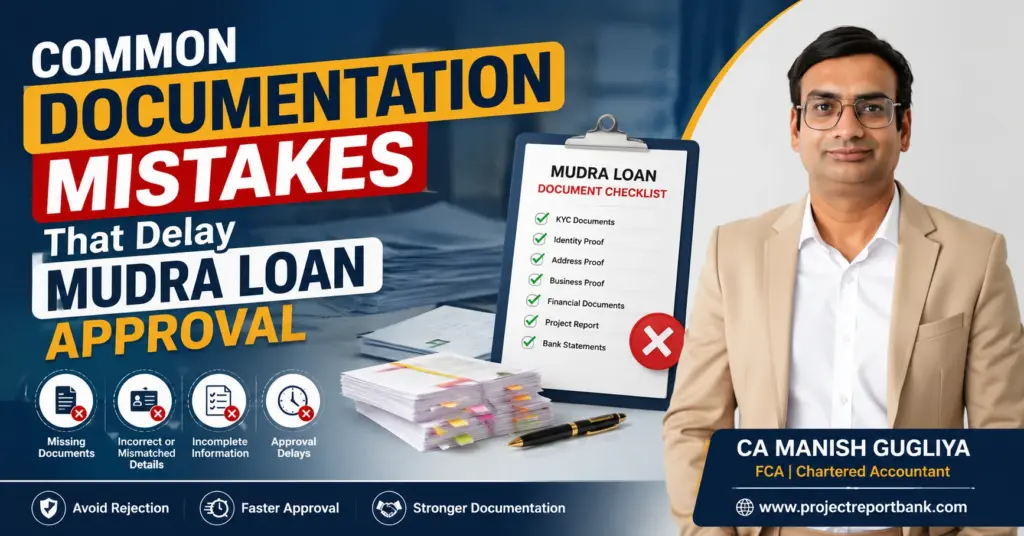
Common KYC Document Mistakes (PAN, Aadhaar, Identity & Address Proof)
The most frequent mudra loan documentation mistakes happen at the KYC stage-identity proof for mudra loan not matching address proof, expired documents, or unclear copies.
Typical identity proof errors:
- Different spelling of applicant name on PAN vs Aadhaar card (e.g., “Rajesh K” vs “K Rajesh”). Discrepancies in name spelling trigger automated verification holds.
- Wrong date of birth on one document. Mismatched KYC details can trigger additional checks during verification.
- Old photograph on ID or submitting a laminated copy that hides the QR code.
Address proof problems:
- Aadhaar showing a village address while your current account and shop are in another city.
- Utility bills older than 3 months, or rent agreement address not matching the shop board.
- Outdated address proof can lead to application rejections outright.
PAN-Aadhaar linking: Since April 2023, PAN must be linked to Aadhaar for it to remain operative. An inoperative PAN makes KYC impossible. Outdated documents may require resubmission during the application process.
Practical tips:
- Always carry originals along with self-attested photocopies.
- Check spelling and DOB across all documents before applying.
- Update your Aadhaar address online before visiting the bank.
- Clear, high-quality copies of documents are necessary to avoid rejection-never submit blurred or partial scans.
Incorrect documents for mudra loan at the KYC level can stop your file on Day 1, even before the bank looks at your business plan or cash flow.
Errors in Mudra Loan Application Form, Photographs and Signatures
Most banks still rely on physical mudra application form submissions. Small form-filling errors are among the most common mudra loan application errors I see. Incorrectly filled application forms cause significant delays.
Common form mistakes:
- Leaving mandatory fields blank-business address, GST number, Udyam registration, loan amount breakup, existing loans.
- Not ticking declaration boxes or not specifying the correct loan category.
- Not mentioning whether you apply online or offline, or skipping the processing fee details.
Photograph issues:
- Not attaching two passport-size colour photographs per applicant.
- Using very old photos or forgetting the co-applicant’s photo.
Signature problems:
- Signing in Hindi on some documents and English on others. Document consistency is crucial across all forms for loan applications.
- Using thumb impression without a proper witness.
Date problems: Undated applications, or dates not matching the rental agreement or quotation date.
Incomplete or incorrect documentation leads to immediate rejection at many branch managers’ desks. Fill the form slowly, preferably in block letters, and cross-check every entry.
Do’s and Don’ts:
- Use the same blue ink pen for all signatures.
- Never use whitener for corrections-ask for a fresh form instead.
- Have the loan officer review your form before final submission.
Business Proof, Registration, Udyam & GST – Missing or Incorrect Details
For Kishore and Tarun loans, banks must see valid business proof for mudra loan applications. Missing business-related documents can cause processing delays of weeks.
New business mistakes:
- Applying without Udyam Registration, shop and establishment licence, trade licence, or FSSAI (for food businesses). Not registering a business on the Udyam portal can lead to rejection.
- No rent agreement or property papers for business premises.
Existing business errors:
- Business name on the current account reads “Shree Balaji Electronics” while GST shows “Shri Balaji Electronic”-inconsistent business information can lead to additional scrutiny and repeated queries.
- Udyam registration done with home address instead of shop address, or GST registration inactive due to non-filing.
Weak business proof can lead to rejection of non-Shishu loans. Prepare a neat folder with all business registration documents and your Udyam and GST documentation guide before visiting the bank.
A small mobile repair shop owner in Indore applied for ₹2 lakh Kishore loan without Udyam. After registering on the Udyam portal and updating details, his loan was mudra loan approved in 9 working days.
Financial Documents, Bank Statements, and Project Report Problems
From the Kishore category onwards, financial documents for mudra loan become critical. A business owner who ignores this section is asking for delay.
Bank statement mistakes:
- Submitting only savings account statements when business runs through a current account. Incomplete bank statements can delay loan approvals.
- Statements older than 6 months or missing the period of peak sales. Most banks ask for 6–12 months of bank statement requirements.
ITR and accounting errors:
- ITR not filed despite turnover above basic limit. Financial figures must align across GST returns, income tax returns, and bank statements-mismatches raise red flags.
- No profit and loss statement or balance sheet for Kishore and Tarun applications above ₹2 lakh. Recent financial records are often required for loan approval activities. Check the financial documents required for Mudra Loan for a complete list.
Project report mistakes:
- Generic project reports can mismatch actual business capacity and requested loan tier. Realistic project reports are expected for larger mudra loans. Banks want to see actual market data, not copy-pasted internet templates. Lack of a clear business plan can lead to loan rejection. See detailed guidance on project report for Mudra Loan.
Quotation issues:
- Handwritten, outdated, or from vendors without GST registration. Missing model numbers, tax breakup, or vendor address. Follow machinery quotation guidelines for the right format.
A CIBIL score below 650 can result in rejection, though CIBIL score is preferred but not mandatory for mudra loans-especially for Shishu. Applying for an amount your business can’t justify through its cash flow and working capital needs may also cause rejection. Keep income projections honest and your money trail clean.

Photocopies, Scans, Overwriting and Other Technical Document Issues
Even when all documents required are present, poor quality document copies can prevent verification from being completed. Common documentation errors can stall or derail a mudra loan application at this simple stage.
Photocopy problems: Very light or dark copies, cut-off corners hiding account numbers, or documents reduced to unreadable sizes. For online mudra applications, uploading sideways or heavily compressed images makes signatures and stamps unclear.
Overwriting: Banks reject forms corrected with whitener. Any correction on name, date of birth, or loan amount requires proper authentication-many branch managers simply ask for a fresh form.
Self-attestation mistakes: Forgetting to sign and date each photocopy, or signing in a different style than on the application. Submitting outdated documents can result in application delays even at this stage.
Tips: Use clear A4-size copies, label each document, carry a pen to sign and date copies in front of the bank officer. These small improvements convert “query raised” files into “ready for processing” in a single visit.
New vs Existing Business: Typical Documentation Mistakes and How to Avoid Them
Documentation requirements may differ based on loan category and amount. Mudra loan documentation mistakes look different depending on whether you are a new or existing business.
New business applicants often submit mudra applications without any business plan, cost estimate, shop photos, or quotations for stock and equipment. Even for a small shishu loan, carry a one-page note on proposed business, estimated monthly sales, expenses, and repayment plan. Banks and lenders need something to assess business viability-street vendors, small enterprises, and home-based businesses included.
Existing business owners make different errors: cash-only operations with no banking trail, not filing ITR despite years of operations, Udyam not updated, or multiple personal loans and home loans across NBFCs not disclosed in the form. Not providing proof of business continuity can lead to rejection. Many applicants in this category apply for business financing without disclosing existing liabilities, which banks catch during CIBIL checks.
A proper pre-check with an experienced CA or mudra loan consultant can significantly reduce approval time. If you require funds and want to qualify for a growing number of business loan products, disciplined documentation is your best security.
Pre-Submission Checklist, Bank Verification Process and Expert Tips for Faster Approval
Before submitting any mudra loan application, run through this checklist:
- PAN–Aadhaar match confirmed, both operative
- Current address proof (latest electricity bill or utility bills within 3 months)
- Business registration and Udyam certificate printed and verified
- 6–12 months bank statements of current account
- Concise, realistic project report with cost breakup
- Valid machinery/stock quotations from GST-registered vendors
- Passport-size photographs and consistent signatures for all applicants
After submission, the bank runs KYC validation, CIBIL check, internal scoring, field visit (where applicable), GST/Udyam portal verification, and cross-checks bank statement entries against declared turnover. Interest rates and other documents may also be discussed at this stage.
Expert tips from my practice:
- Visit the bank branch in the first half of the day.
- Carry one extra set of copies.
- Write your mobile number on every document.
- Be honest about existing loans-the bank will find out anyway.
- Ask the loan officer to point out every missing paper in one go, so you don’t make multiple trips.
Different banks may ask for additional documents beyond the standard checklist. This is normal. Professional help in preparing project reports and CMA data can convert a weak file into an approvable one-especially for Kishore and Tarun loans where the loan amount is above ₹3–5 lakh and the process demands more detail. Money and time saved on rework is worth the small investment.
Conclusion and How ProjectReportBank.com Can Help
Most delays in mudra loan approval come down to avoidable documentation mistakes-missing KYC, mismatched details, weak business proof, and incomplete forms. Careful preparation of every document, a realistic project report, and clean bank statements can convert a stressful process into a smooth 7–10 working day approval.
After reviewing hundreds of mudra loan applications since 2015, I can say confidently: the biggest success factor is disciplined documentation, not “connections” or “agents.” At ProjectReportBank.com, we prepare professional project reports tailored to Shishu, Kishore, and Tarun loans, guide you on CMA data and financial projections, and help compile a complete mudra loan document checklist before you visit the bank.
If you want error-free documents, strong financials, and faster mudra loan approval-whether you are a first-time applicant or an existing business owner looking for business financing in India-contact CA Manish Gugliya through ProjectReportBank.com today. With correct documents and a genuine business idea, the mudra scheme and mudra yojana remain one of the most effective ways for small businesses to get disbursed funds and grow in 2026 and beyond.
FAQs on Documentation Mistakes and Mudra Loan Approval Delay
These FAQs address specific questions that many applicants raise during the documentation stage.
Which documentation mistakes delay Mudra loan approval the most?
The most damaging errors are mismatched KYC-different name or address on PAN, Aadhaar, and bank account-incomplete mudra loan application form with missing fields or signatures, missing business proof for existing units, and outdated bank statements or ITR for Kishore and Tarun loans. These issues trigger repeated queries and can stretch processing time from 7–10 working days to 3–4 weeks or more.
Can a single missing document put my Mudra loan on hold?
Yes. Even one missing key document-like a PAN card copy, latest address proof, or 6-month bank statement-can stop the file at the verification stage. Ask the loan officer for a clear list of pending documents and submit all of them together in your next visit to avoid multiple rounds of follow-up.
What if my Aadhaar and PAN details do not match?
Banks follow strict KYC norms. If Aadhaar and PAN show different names, spellings, or dates of birth, the bank will not proceed until the discrepancy is corrected. Update your details on the UIDAI portal or through PAN correction, keep acknowledgement receipts, and then provide updated documents to the bank.
Do all banks ask for the same Mudra loan documents?
While RBI and PMMY provide a broad mudra loan document checklist covering KYC, business proof, financials, and project report, each bank and even each branch can add requirements based on internal credit policy and risk profile. Always check with your chosen branch beforehand to get the latest document list for your specific loan category and business type.
Can documentation mistakes lead to outright Mudra loan rejection?
Most documentation issues first cause delay rather than direct rejection. However, if you do not respond to queries, cannot correct major discrepancies, or submit suspicious or fake-looking documents, the bank can and will reject the application. Honest, timely correction and full cooperation during verification usually converts a problematic file into an approvable one-provided your business and repayment capacity are otherwise satisfactory.
- Why a CA-Prepared Project Report Improves Mudra Loan Approval Chances
- How to Arrange Your Mudra Loan File Before Visiting the Bank

- Common Documentation Mistakes That Delay Mudra Loan Approval
- Udyam Registration for Mudra Loan: Complete Document Guide by CA Manish Gugliya

- Is Project Report Mandatory for Mudra Loan?
- Quotations Required for Machinery and Equipment Under Mudra Loan

- Bank Statement Requirements for Mudra Loan

- Financial Documents Required for Mudra Loan Approval

- Documents Required for New Business vs Existing Business Under Mudra Loan: Complete Comparison Guide