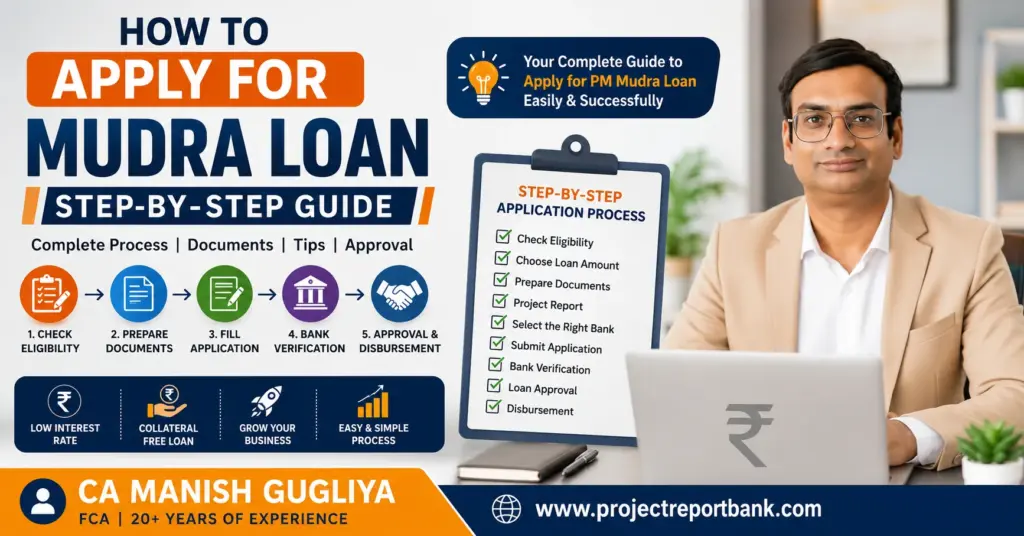
Choosing the right bank for your Mudra loan is almost as important as preparing the right documents. Most entrepreneurs spend weeks getting their paperwork ready but pick a bank in minutes – often based on nothing more than the nearest branch or the lowest interest rate they heard about. That approach leads to delays, rejections, and frustration.
The truth is, every bank or financial institution offering mudra loans processes applications differently. Service quality, documentation expectations, processing speed, officer guidance, and branch-level experience vary significantly between bank types. A bank that works perfectly for a retailer in Delhi may be the wrong choice for a rural manufacturer in Madhya Pradesh.
This guide, based on my 20+ years of practical experience in MSME finance and Mudra loan consultancy, will help you compare bank types objectively and choose the one that genuinely fits your business, your location, and your financial profile.
The short answer: For most small businesses, especially first-time borrowers and those in semi-urban or rural areas, public sector banks offer the best overall combination – lower interest rates (approximately 9–13% p.a.), the widest branch network, deep MSME experience, and strong documentation guidance. However, if you run a formal, urban business with clean credit and need speed, private banks or small finance banks can be a better fit. There is no single “best bank” – the right choice depends on your specific situation.
Why Bank Selection Matters for Mudra Loan Success
I have seen hundreds of Mudra loan applications over the years. The ones that get sanctioned smoothly almost always share one thing in common: the borrower chose the right bank before applying.
Here is what bank selection directly affects:
- Approval speed. Some branches sanction Shishu loans in 7–10 days. Others take 4–6 weeks for the same loan amount. The difference is not the scheme – it is the bank’s internal process and branch workload.
- Documentation guidance. A good bank officer will tell you exactly what documents to prepare, how to present them, and what gaps to fix. A poorly staffed branch will simply reject your file without explanation.
- Existing customer advantage. If you already hold a savings or current account with a bank, your transaction history is visible. This reduces scrutiny, speeds up verification, and often results in better terms. Existing relationships with banks can genuinely expedite Mudra loan applications.
- Local market understanding. A branch that regularly handles businesses in your industry understands your cash flow patterns, seasonal income, and working capital needs. This matters when the loan officer assesses your repayment capacity.
- Post-loan support. Your relationship with the bank does not end at disbursement. You may need to renew, top up, or resolve account issues. Choosing a bank that provides ongoing support saves significant trouble later.
The Pradhan Mantri Mudra Yojana (PMMY), scheme launched on April 8, 2015, was designed to provide financial assistance to non corporate small enterprises in the non farm sector. But while the scheme is uniform, the experience of applying through various financial institutions is anything but uniform.
Table of Contents
Types of Banks Offering Mudra Loans: Quick Overview
Banks that participate in the PMMY loan scheme include public sector, private sector, and small finance banks, along with Regional Rural Banks, NBFCs, MFIs, and cooperative banks. Let me briefly position each.
Public Sector Banks (PSBs) – Government-owned institutions like SBI, PNB, Bank of Baroda, and Canara Bank. They have the largest branch network across India, extensive MSME lending experience, and Priority Sector Lending obligations that give them strong incentive to process Mudra applications. They are typically the first reference point for most borrowers.
Private Banks – Institutions like HDFC Bank, ICICI Bank, Axis Bank, and Kotak Mahindra Bank. They offer modern digital platforms, often faster processing for well-documented applications, and personalized service – but may be stricter on eligibility criteria and documentation.
Regional Rural Banks (RRBs) – Banks like Baroda UP Gramin Bank or Kerala Gramin Bank that focus specifically on rural and semi-urban areas. They have strong local understanding, particularly for agriculture-related and allied agricultural activities, and are comfortable with informal business models.
Small Finance Banks (SFBs) – Institutions like AU Small Finance Bank or Equitas Small Finance Bank. They are digital-first, process smaller loans quickly, and serve the underbanked segment. However, their branch presence in remote areas is limited.
Cooperative Banks – Local cooperative institutions that operate in specific regions. They can offer Mudra loans but availability varies widely. Always verify whether your local cooperative bank is registered as a Member Lending Institution under PMMY before applying.
NBFCs and MFIs – These serve the most informal segment and offer the fastest access but at the highest cost. Mudra loans can be applied through banks, NBFCs, and MFIs, but the trade-offs are significant.
Bank Types Comparison: How They Stack Up at a Glance
| Factor | Public Sector Banks | Private Banks | Regional Rural Banks | Small Finance Banks | NBFCs / MFIs |
|---|---|---|---|---|---|
| Best For | First-time borrowers, rural/semi-urban, manufacturing, trading | Urban, formal businesses, service sector, tech-savvy borrowers | Rural entrepreneurs, agriculture-allied businesses | Digitally comfortable, small loan amounts | Urgent funding, rejected by other banks |
| Interest Rates | 9–13% p.a. | 9–18% p.a. | 9–14% p.a. | 11–16% p.a. | 12–24% p.a. |
| Processing Time (Shishu) | 7–10 days | 5–14 days | 7–14 days | 5–10 days | 3–10 days |
| Branch Network | Excellent nationwide | Strong urban, limited rural | Strong rural | Moderate, mostly urban | Agent-based, limited branches |
| MSME Experience | Very strong | Moderate to strong | Strong for rural businesses | Moderate | Limited |
| Documentation Flexibility | Moderate | Strict | Flexible for local businesses | Moderate | Most flexible |
The key takeaway: public sector banks win on the combination of low rates, wide network, and MSME experience, while private banks and SFBs win on speed and digital convenience for urban, well-documented businesses.
Interest Rates and Loan Terms
Interest rates for Mudra loans are deregulated by banks – meaning each financial institution sets its own rate based on internal policies, risk assessment, borrower profile, and cost of funds. There is no single government-fixed rate.
Here is what the numbers actually look like:
- Public sector banks: Approximately 9–13% per annum. For Shishu loans, rates can be as low as 9–10%. For Kishore and Tarun tiers, expect 9.5–12% in most PSBs like SBI, Bank of Baroda, or Canara Bank.
- Private banks: Wider range of 9–18% per annum. Interest rates for Mudra loans can range from 19% to 21% at the upper end with certain private lenders, depending on the borrower’s credit profile and business risk.
- RRBs: Around 9–14%, often competitive for rural borrowers with local business understanding.
- Small finance banks: Roughly 11–16%, competitive for low-risk borrowers with formal documentation.
- NBFCs / MFIs: The most expensive at 12–24%, justified only when other banks are not accessible or have rejected your application.
Beyond the headline interest rate, watch for:
- Processing fees: Processing fees for Shishu loans up to ₹50,000 are often waived. But some private banks and NBFCs charge upfront processing or administrative fees that can add to your effective cost.
- Foreclosure/prepayment charges: Generally nil under most MLIs for Mudra loans, but always confirm in writing before signing.
- Loan repayment tenure: Loan repayment tenure for MUDRA loans can range from 5 to 7 years depending on the lender, loan amount, and business purpose.
If you want to understand exactly how interest is calculated on your Mudra loan, I have explained the complete method separately.
Winner: Public Sector Banks – They consistently offer the lowest interest rates for eligible borrowers. Public sector banks typically offer lower interest rates for MUDRA loans compared to private banks. The trade-off is slightly slower processing, but the long-term savings on interest can be substantial, especially on Kishore and Tarun tier loans.
Processing Speed and Documentation Support
Processing speed is where bank types differ most visibly.
Public sector banks process Shishu loan applications in approximately 7–10 days after submission of complete documents. For Kishore and Tarun tiers, expect 2–4 weeks. PSBs now offer Straight-Through Processing (STP) for Shishu loans, especially for existing customers – digital KYC via Aadhaar/OTP, auto-populated forms, and faster approvals without branch visits. Digital applications and portals facilitate MUDRA loan processes through platforms like “PSB Loans in 59 Minutes.”
Private banks often process faster – Kishore and Tarun tier applications can be processed in 1–2 weeks if your documents and credit profile are clean. However, they are stricter on what they accept. If your business lacks formal bookkeeping, GST registration, or ITR filings, private banks may reject your application or demand additional documentation.
RRBs process at speeds similar to PSBs but may experience delays in branches with limited staff capacity.
Small finance banks handle small loans quickly, often within 5–10 days, with good digital capability.
NBFCs/MFIs are typically the fastest – sometimes disbursing within days – but at significantly higher cost.
On documentation guidance, PSB branch staff generally have more experience explaining what documents are needed and how to present them. They are accustomed to dealing with informal business records and can guide you through the process. Applicants must submit a business plan and KYC documents – identity proof is required for Mudra loan applications, address proof is necessary, and proof of income must be submitted. The quality of guidance you receive in preparing these documents varies enormously between banks.
If you want to avoid common pitfalls, read about documentation mistakes that delay Mudra loan approval.
Winner: Private Banks for speed; Public Sector Banks for guidance. If your documents are already perfect and your credit is strong, private banks get you funded faster. If you need hand-holding and work with informal records, PSBs offer significantly better support. The trade-off is clear: speed versus guidance.
Branch Network and Accessibility
For Mudra loans, branch proximity matters more than you might think. Unlike a home loan where you visit the bank a few times, a Mudra loan – especially Kishore and Tarun – requires multiple interactions: document submission, verification meetings, site visits, and follow-ups.
Public sector banks have the most extensive branch network across India, covering remote villages, small towns, semi-urban areas, and metros. This means easier face-to-face meetings, quicker document submissions, and bank officers who understand local business conditions.
RRBs and cooperative banks have strong penetration specifically in rural India. If your business is in a village or small town, an RRB branch may be within walking distance while the nearest private bank could be 30 km away.
Private banks have strong urban and metro presence but limited rural branches. If you are in a Tier-2 or Tier-3 city, check whether the nearest private bank branch actually handles Mudra loans – not all branches do.
Small finance banks are mostly concentrated in urban and semi-urban areas. Their digital capability partially compensates for limited physical presence, but for borrowers who prefer in-person interactions, this can be a limitation.
Winner: Public Sector Banks – Their unmatched national network makes them the most accessible option for the majority of Indian entrepreneurs. RRBs are a close second specifically for rural businesses.
MSME Experience and Business Understanding
This factor is often overlooked, but in my experience, it decides more loan outcomes than interest rates.
Public sector banks have decades of experience lending to micro enterprises and small and micro enterprises. Their branch staff are trained on Mudra loan processes, understand informal income patterns, and can assess business viability based on local market knowledge. They have Priority Sector Lending obligations that specifically include Mudra loans, creating institutional incentive to support these applications.
For example, Canara Bank in Karnataka is one of the major Mudra loan disbursers, with branch staff in high-volume areas processing applications efficiently. Their documentation requirements for Mudra are lighter than for other MSME credit products.
Private banks may have more advanced underwriting systems and better risk assessment tools, but they often lack flexibility in handling informal businesses. A street food vendor or a village potter may struggle to meet the documentation standards that private banks expect.
RRBs excel in understanding rural businesses, seasonal income patterns, and agriculture-allied enterprises. Their officers often have personal familiarity with local markets.
Small finance banks are still building their MSME expertise. They handle small loans efficiently but may not have the depth of understanding needed for complex manufacturing or trading businesses.
Winner: Public Sector Banks – Their depth of MSME experience, understanding of informal economies, and institutional commitment to micro units makes them the strongest choice. Private banks have advantages in assessing formal, urban service businesses and tech-enabled ventures.
Which Bank Type Should You Choose?
Based on everything discussed above, here are clear recommendations:
- Choose Public Sector Banks if: You are a first-time borrower, your business is in a rural or semi-urban area, you need documentation guidance, you want the lowest interest rates, or you run a manufacturing trading business. PSBs are the strongest all-around option for most eligible borrowers.
- Choose Private Banks if: You are tech-savvy, located in an urban area, need fast processing, have a strong credit profile with a satisfactory credit track record, and run a service or professional business with formal documentation.
- Choose Regional Rural Banks if: You are a rural entrepreneur, your business involves allied agricultural activities, you need a lender who understands village-level economics, or you need a branch within your immediate area.
- Choose Small Finance Banks if: You prefer digital-first applications, need quick approval for a small loan amount (Shishu or small Kishore), and are comfortable with slightly higher rates in exchange for convenience.
- Avoid NBFCs/MFIs unless: You have been rejected by commercial banks or need very urgent, small funding and are willing to pay premium rates. The cost difference over a full loan tenure can be significant.
Overall strongest recommendation: For the majority of small business owners applying for a Mudra loan in India, a public sector bank where you already hold an account remains the best starting point. The combination of lower rates, MSME expertise, branch accessibility, and documentation support is hard to beat.
Best Bank Recommendations for Different Business Types
Retail Shop – Public sector banks like SBI, PNB, or Bank of Baroda. They understand retail cash flows, shop lease documentation, and working capital needs for trading businesses.
Manufacturing Unit – Public sector banks, without question. They have extensive experience with machinery financing, can evaluate quotations for capital assets, and understand the stage of growth development and funding needs of manufacturing enterprises. If you need machinery quotations assessed, learn about quotations required for machinery and equipment under Mudra Loan.
Trading Business – Public sector banks or established private banks. The proposed activity in trading and services is well understood by most commercial banks. Ensure the bank officer understands your supply chain and payment cycles.
Women Entrepreneurs – Public sector banks often offer concessions (approximately 0.25% to 0.50% rate reductions) and have specific schemes supporting women-owned micro units. Ask specifically about women entrepreneur benefits at your branch.
Home-based Business – Private banks or small finance banks may be more convenient for home-based service businesses. Their digital application channels reduce the need for repeated branch visits.
Professional Services – Private banks for consultants, freelancers, and IT professionals. They understand service-sector cash flows and formal income documentation better.
Food Business – Public sector banks experienced with food processing, restaurant, and catering businesses. The business plan assessment for food businesses requires understanding of licenses, health permits, and seasonal demand.
Transport Business – Public sector banks with dedicated vehicle finance departments. They have expertise in evaluating transport business viability, vehicle costs, and route-based income generation.
New Startup – Public sector banks or RRBs for new entrepreneurs. Eligible borrowers must demonstrate business viability and documentation for MUDRA loan approval, but PSBs are generally more patient with first-time borrowers who show genuine intent and preparation.
Existing Business Expansion – If you have successfully repaid previous loans with your current bank, apply there first. Your track record is your strongest asset. Businesses looking to move to the next phase of growth can benefit significantly from an established banking relationship.
Common Mistakes While Choosing a Bank
Over 20 years of practice, I have seen entrepreneurs repeat the same mistakes. Here are the most damaging ones:
1. Choosing only by interest rate. A bank offering 9% that takes 6 weeks to process costs you more in lost business opportunity than one offering 11% that disburses in 10 days. Always look at total cost, not just the headline rate.
2. Ignoring branch location. Applying at a branch 15 km away because it has a “good reputation” means every follow-up visit costs you half a day. Choose a nearby branch where you can meet officers easily.
3. Not leveraging existing relationships. Your current bank already knows your transaction history. Starting fresh at a new bank means proving everything from scratch. Use your existing relationship unless there is a compelling reason not to.
4. Ignoring documentation support. Some branches have experienced Mudra nodal officers. Others have staff unfamiliar with the scheme. Visit the branch, ask how many Mudra loans they process monthly, and judge their capability before applying.
5. Applying without a project report. Even when not explicitly asked, a well-prepared project report dramatically improves your chances. It shows the bank you are serious. Learn why a CA-prepared project report improves Mudra loan approval.
6. Assuming all banks offer all categories. MUDRA loan categories include Shishu, Kishore, Tarun, and Tarun Plus – but not every branch or every financial institution processes all categories. Tarun Plus, introduced in October 2024, allows the maximum loan to be extended up to ₹20 lakh for certain enterprises, but verify availability at your specific branch.
7. Applying to multiple banks simultaneously without strategy. This can trigger multiple credit inquiries, potentially lowering your credit score. Instead, research thoroughly, shortlist 2–3 banks, and apply sequentially.
How to Compare Banks Before Applying: Practical Checklist
Before you submit a single document, spend a few days comparing banks. Here is my recommended process:
Step 1: List banks within 5 km of your business location. Include PSBs, private banks, RRBs, and SFBs. Visit each branch and ask if they handle Mudra loans.
Step 2: Ask for the applicable interest rate for your tier and business type. Rates are assessed based on your credit history, business type, and documentation quality. Get a specific quote, not a range.
Step 3: Ask about processing time. “How long will it take from complete document submission to disbursement?” Get a realistic timeline.
Step 4: Ask for the complete document list. Some banks need GST registration, ITR, and bank statements. Others accept simpler documentation for Shishu loans. Know what is mandatory versus optional.
Step 5: Ask about fees. Processing fees, stamp duty, administrative charges, inspection fees. Request a written breakdown of all charges.
Step 6: Ask about prepayment and foreclosure terms. For loans up to ₹10 lakh, no collateral is required – the Reserve Bank of India mandates no collateral for loans up to ₹10 lakh. But verify there are no hidden charges for early repayment.
Step 7: Assess staff quality. Is the loan officer knowledgeable about Mudra? Can they explain the process clearly? Do they seem interested in helping? This soft factor often determines your experience more than any policy.
Step 8: Calculate your EMI before applying. Know your monthly repayment obligation and confirm it fits your business cash flow. Seasonal businesses should specifically ask about repayment flexibility or moratorium options.
Step 9: Check digital capability. Does the bank offer online application or only offline processing? For Shishu loans, some PSBs offer STP-based digital approvals that significantly reduce processing time.
Step 10: Evaluate concession eligibility. Women entrepreneurs, SC/ST category borrowers, and businesses in aspirational districts often qualify for rate reductions. Ask specifically.
Expert Tips from CA Manish Gugliya
Based on my two decades of working with small business owners on MSME finance and Mudra loan consultancy, here are my professional recommendations:
Meet the branch manager before applying. A 15-minute conversation will tell you more about your chances than any website. Ask about their Mudra loan volume, processing timeline, and the documents they prioritize.
Prepare your project report regardless of loan size. Even for Shishu loans upto Rs 50,000, a simple one-page project summary showing your proposed activity, expected income, and repayment plan creates a strong impression. For Kishore and Tarun loans, a professional project report is practically essential.
Do not chase the lowest interest rate blindly. In my experience, borrowers who choose banks based on service quality, branch proximity, and documentation support end up with smoother experiences than those who chase a 0.5% rate difference.
Build a long-term banking relationship. Your first Mudra loan is the beginning, not the end. If you maintain a good account, make timely repayments, and demonstrate business growth, the same bank will offer you better terms when you need to expand. The beneficiary micro unit entrepreneur who builds trust with their lender has a significant advantage.
Keep your credit needs realistic. Banks evaluate how much loan amount is appropriate for your business. Applying for ₹10 lakh when your business only justifies ₹3 lakh leads to rejection. Be honest about what your business needs and can repay.
Use digital platforms where available. Platforms like “PSB Loans in 59 Minutes” now cover Mudra loans and can provide in-principle approval quickly. If you are digitally comfortable, this saves significant time.
Understand the difference between loan categories. Shishu Loans are for amounts up to ₹50,000. Kishore Loans range from ₹50,001 to ₹5 lakh. Tarun Loans range from ₹5 lakh to ₹10 lakh. Tarun+ Loans range from ₹10 lakh to ₹20 lakh. Your eligibility, documentation requirements, and processing timeline differ for each category. Choose the right tier based on your actual credit needs and the development and funding needs of your business.
Verify everything locally. Policies on websites are guidelines. What actually happens at your local branch may differ. Confirm rates, fees, timelines, and document requirements directly with the branch you plan to apply at.
Frequently Asked Questions
Which bank is best for Mudra Loan?
There is no single best bank. For most individual borrowers and first-time entrepreneurs, public sector banks like SBI, Bank of Baroda, or PNB offer the best combination of low rates, MSME experience, and branch support. But the “best” bank for you depends on your business type, location, existing banking relationship, and documentation readiness.
Should I apply through SBI or a private bank like HDFC?
If you already bank with SBI and have regular transaction history, apply there. Your existing relationship gives you an advantage. If you bank with HDFC and have a strong credit profile with formal documentation, HDFC may process faster. The loan extended through either institution covers the same PMMY scheme – the difference is in the experience.
Can I apply to multiple banks simultaneously?
Technically, yes. But multiple credit inquiries can affect your credit score. A better approach: research and compare 2–3 banks, then apply to the strongest option first. Only try the second bank if the first rejects or delays significantly.
Does every bank offer all Mudra loan categories?
Not necessarily. While most commercial banks offer Shishu, Kishore, and Tarun categories, the newer Tarun Plus (loans under PMMY range up to ₹20,00,000) may not be available at every branch. Always confirm category availability before applying.
Which bank approves Mudra Loan fastest?
For Shishu loans, PSBs with STP capability can approve in 7–10 days. Private banks may be faster for Kishore/Tarun if your profile is clean. NBFCs are typically fastest overall but charge the highest rates. Speed also depends heavily on how complete your documentation is.
Can existing customers get faster approval?
Yes, significantly. Banks can verify your transaction history, income patterns, and previous loans internally. If you have successfully repaid previous loans with a bank, that satisfactory credit track record reduces processing time and may secure better terms.
Is interest rate the most important selection factor?
No. Processing quality, documentation support, branch accessibility, and business understanding are equally – sometimes more – important. A low rate means nothing if the bank takes months to disburse or rejects your application due to documentation gaps.
Should new businesses choose public or private banks?
New businesses, especially those without formal financial records, typically do better at public sector banks. PSBs have more experience evaluating informal income sources and assessing business viability for micro enterprises engaged in the non farm sector. An educational qualification alone is not required – what matters are the necessary skills and a viable business plan.
Which bank is better for rural businesses?
RRBs and public sector banks are the strongest options for rural entrepreneurs. They have rural branch presence, understand agricultural and allied business models, and their staff are familiar with local market conditions. Mudra Loans support microenterprises in the non-farm sector, but many rural businesses in manufacturing trading and services qualify.
Does branch manager experience matter?
Absolutely. An experienced branch manager who has processed multiple Mudra applications can guide you through the process efficiently, identify documentation gaps early, and provide realistic expectations on timeline and loan amount. This is one of the most underrated factors in bank selection.
What documents do I need regardless of the bank?
All banks require identity proof, address proof, and proof of income. Beyond these, applicants must submit a business plan and KYC documents. For Kishore and Tarun tiers, banks may additionally require business registration, GST registration, bank statements, and a project report. The specific list varies by lender, so always get the exact requirements from your chosen branch.
Is collateral required for Mudra loans?
Loans up to ₹10 lakh do not require collateral security. This is mandated under the scheme and supported by the Credit Guarantee Fund for Micro Units (CGFMU). Mudra loans are available for non-corporate small enterprises without the need to pledge assets created or existing security. However, some lenders may request additional documentation or guarantees for higher amounts – always clarify upfront.
Can I switch banks after loan approval?
Switching banks after sanction but before disbursement is generally possible but creates delays. After disbursement, you cannot transfer a Mudra loan between banks. Choose carefully before applying.
What if my preferred bank rejects my application?
Rejection from one bank does not disqualify you from others. Review the rejection reason, fix documentation gaps, and apply to a different bank or financial institution. Sometimes the issue is branch-specific, not scheme-specific.
Are small finance banks a good option for Mudra loans?
Small finance banks are a reasonable choice for digitally comfortable borrowers seeking Shishu loans or small Kishore loans in urban areas. Their rates (11–16% p.a.) fall between PSBs and NBFCs. They are particularly suitable for borrowers who prefer quick, digital-first processing and have formal documentation.
How do I know if a bank has Mudra loan experience?
Visit the branch and ask three questions: How many Mudra loans has this branch processed in the last year? Is there a dedicated Mudra nodal officer? What is the typical processing time? The answers will tell you everything about their capability.
Do women entrepreneurs get special benefits?
Yes. Many public sector banks offer rate concessions of approximately 0.25% to 0.50% for women entrepreneurs. Some branches also have dedicated schemes for women-led micro units. Always ask about employment creation incentives and special category benefits.
What is the role of the Udyam portal in bank selection?
Udyam registration strengthens your application at any bank. It validates your enterprise status and is increasingly referenced during Mudra loan processing. Having Udyam registration can reduce documentation requirements and improve your credibility as a beneficiary micro unit.
Should I prepare a project report before choosing a bank?
Yes. Preparing a project report before approaching any bank helps you understand your own funding needs, demonstrate business viability, and present a professional application. It also helps you accurately determine how much Mudra loan you should apply for.
What if I need a term loan and working capital both?
Many banks offer composite Mudra loans covering both term loan for capital assets and working capital for daily operations. PSBs are generally better at structuring composite facilities for manufacturing and trading businesses. Discuss your complete credit needs with the bank officer during your initial meeting.
There is no universally “best” bank for Mudra loans. The ideal bank depends on your business type, documentation readiness, existing banking relationship, branch proximity, project report quality, loan amount, and overall financial profile. Spend time comparing banks wisely, meet branch officers before applying, and choose the bank that understands your business – not just the one with the lowest advertised rate. That single decision can make the difference between a smooth sanction and months of frustration.
- Common Mistakes While Filling a Mudra Loan Application Form

- What to Do Before Applying for a Mudra Loan

- Which Bank Should You Choose for Your Mudra Loan Application?

- Online vs Offline Mudra Loan Application: Which Method Is Better for Faster Approval?
- How to Fill the Mudra Loan Application Form Correctly

- How to Apply for a Mudra Loan: Step-by-Step Guide (By CA Manish Gugliya, FCA)