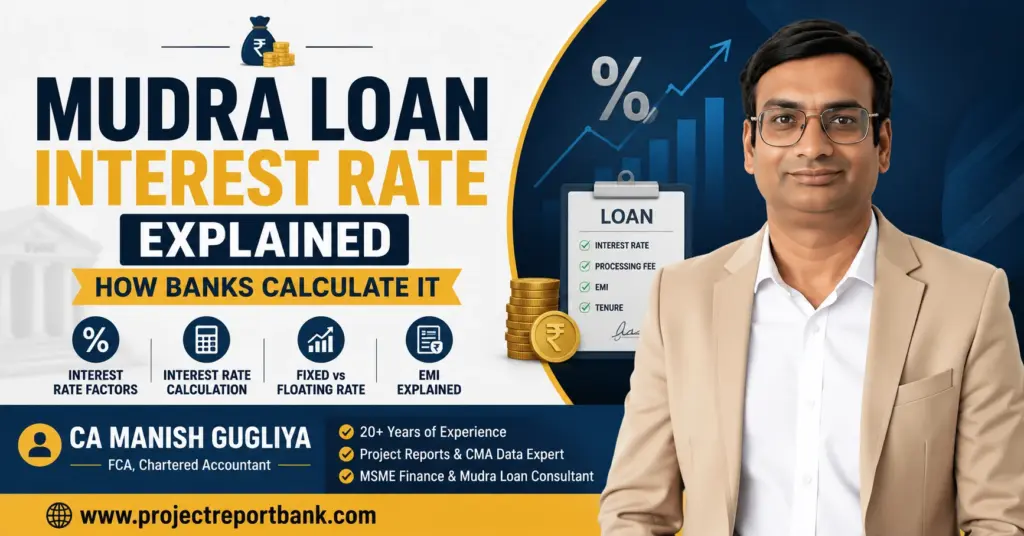
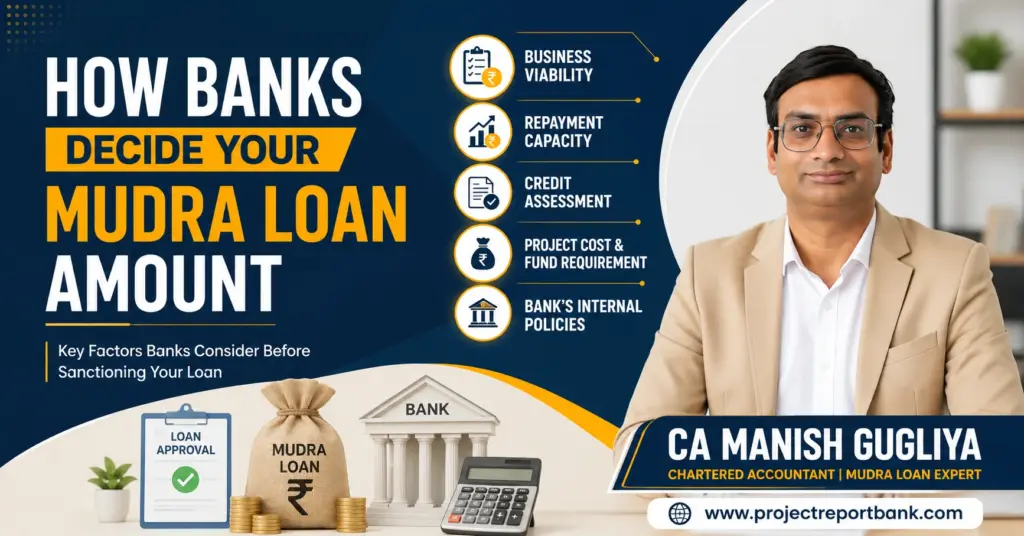
Key Takeaways
- Banks never decide Mudra loan amounts randomly. Every lender follows a structured credit appraisal process that evaluates project cost, own contribution, business cash flow, and repayment capacity before arriving at the sanctioned figure.
- Under Pradhan Mantri Mudra Yojana (PMMY), banks can sanction up to Rs 10 lakh (or Rs 20 lakh under Tarun Plus), but the final sanctioned amount depends entirely on the specific business proposal, not just on the maximum loan limit of the scheme.
- Two borrowers with similar businesses can receive different Mudra loan amounts because of differences in experience, documents, banking history, CIBIL score, and household obligations.
- A realistic project report, properly arranged documents, and clear justification of every rupee of loan usage increase the chances of getting the desired loan amount.
- This article is written from the practical perspective of CA Manish Gugliya (FCA), with 20+ years of experience in project reports, CMA data, MSME finance, and Mudra loan consultancy.
Introduction: How Banks Really Decide Your Mudra Loan Amount
“I applied for Rs 10 lakh but the bank sanctioned only Rs 3 lakh. Why?”
This is one of the most common frustrations I hear from entrepreneurs. Many applicants assume the bank decides the Mudra loan amount based on mood, connections, or some hidden formula. The reality is different. Every bank must justify the sanctioned amount internally through a structured credit appraisal before releasing even one rupee.
Mudra loans under Pradhan Mantri Mudra Yojana (PMMY), launched on April 8, 2015, are business loans designed to provide financial assistance to non corporate small businesses across India. Mudra stands for Micro Units Development and Refinance Agency. The scheme supports micro enterprises and helps create employment in sectors ranging from trading and manufacturing to services and allied agricultural activities. Mudra Yojana offers loans up to Rs 20 lakh, and these loans are collateral free. But the amount you actually receive is a different story.
As a practising Chartered Accountant who prepares project reports and CMA data for Mudra loan applicants, I see from the inside how banks assess proposals. This article will walk you through the complete process, from requested amount to sanctioned amount, with concrete examples, banker calculations, and practical tips. We will cover factors like project cost, working capital, income, CIBIL, documents, and how to improve your eligibility before you apply.
Table of Contents
What Does “Loan Amount Assessment” Mean in Mudra Loans?
“Loan amount assessment” is the process through which banks calculate how much Mudra loan they are comfortable sanctioning to a specific borrower for a specific business purpose.
Under the Pradhan Mantri MUDRA Yojana, banks evaluate the financial needs of the micro-enterprise through multiple lenses:
- Credit appraisal is the bank’s way of checking whether the proposed business and borrower are safe enough for the bank to recover its money with interest within the chosen tenure. Banks examine character, capacity, capital, conditions, and purpose.
- Financial assessment involves a review of sales, profit margins, expenses, bank statements, and cash flow to estimate how much EMI the business can safely pay every month.
- Business requirement assessment matches the requested Mudra loan amount with actual needs like machinery cost, shop setup, furniture, stock, and working capital. The bank will not fund requirements that cannot be verified with quotations or market data.
- Repayment capacity checks whether the net surplus (business profit plus other stable income, minus household expenses and existing EMIs) can support the proposed EMI comfortably.
- Risk evaluation covers sector risk (small manufacturing vs trading), location risk, borrower profile, and past repayment behaviour. Banks internally assign risk ratings before finalising the amount.
The flow looks like this: Business Need → Project Cost → Cash Flow → Repayment Capacity → Eligible Mudra Loan Amount.
Requested vs Eligible vs Sanctioned vs Disbursed Amount
One of the biggest confusions in mudra loans is mixing up four distinct figures. Each means something different, and understanding them helps you interpret bank decisions correctly.
Requested amount is the figure the borrower writes in the Mudra loan application form. For example, Rs 8 lakh under the Tarun category, based on their own expectation of business need.
Eligible amount is the internal figure the bank calculates after credit appraisal. It factors in project cost, own contribution, income, and repayment capacity. This figure may be higher or lower than what you requested.
Sanctioned amount is the final Mudra loan amount approved by the bank’s sanctioning authority and mentioned in the sanction letter. It is usually equal to or less than the eligible amount, adjusted for risk and policy.
Disbursed amount is the actual money released into the borrower’s account or paid directly to vendors. Banks sometimes disburse in stages; for example, the term loan portion for fixed assets first, then working capital after stock verification.
Here is a concrete example: a trader requests Rs 7 lakh. The bank calculates eligibility at Rs 5.5 lakh. The sanctioning authority approves Rs 5 lakh. The bank initially disburses Rs 4 lakh for machinery, with the balance released later for working capital after verification.
Understanding these four terms helps you plan your next steps if the sanctioned amount is lower than expected.
Major Factors Banks Consider Before Deciding Mudra Loan Amount
Banks do not use a single formula. They combine multiple financial and non-financial factors to arrive at the final Mudra loan amount. Even under the same PMMY framework (Shishu, Kishore, Tarun), each bank has its own internal credit policies and risk appetite, which influence the final sanction.
Below are the major factors, broken down one by one.
Business Type and Nature of Activity
Banks classify Mudra loan proposals by business type, and risk and margin expectations differ for each.
Trading businesses (kirana stores, readymade garments, wholesale) usually need more working capital and less machinery. Margins tend to be thinner, so the bank aligns the loan amount with realistic stock turnover and inventory cycles rather than just project cost.
Manufacturing units (agarbatti making, food processing, fabrication) often require higher fixed assets like machines and shed. Banks examine technical feasibility and projected production capacity before fixing the amount.
Service businesses like beauty parlours, mobile repair shops, and coaching centres carry moderate ticket sizes. The loan amount is linked to local demand, competitive pricing, and the applicant’s skill level.
Retail and home businesses are assessed for stability: rented vs own premises, consistency of customer base, and seasonal impact on cash flow.
From my experience, for higher loan amounts within the Tarun category, manufacturing and asset-backed services sometimes receive better consideration than pure trading because banks perceive higher value creation and asset security.
Purpose of Mudra Loan
For every Mudra loan, the bank asks “purpose of loan” in detail. The purpose must always be business-related, not personal.
- Machinery and equipment: Banks rely on vendor quotations to decide funding for items like atta chakki, printing machines, lathe machines, or salon equipment. Inflated quotations get trimmed.
- Working capital: For stock and day-to-day expenses, banks estimate requirements based on projected monthly sales, credit period offered to customers, and credit received from suppliers.
- Shop renovation and furniture: Display racks, counters, lighting, signage. Banks verify whether the cost mentioned is reasonable for the locality and shop size.
- Commercial vehicle: For autos, goods vehicles, and e-rickshaws, banks match the loan amount with invoice price, margin money, and expected monthly earnings.
- Business expansion: Adding a second outlet or increasing production capacity. Banks verify past performance before deciding increased funding.
Linking every rupee of the requested loan to a valid business purpose improves the chances that the bank will sanction closer to the requested amount.
Total Project Cost and Its Impact on Loan Amount
Total project cost is the sum of fixed assets (machinery, furniture, computers, renovation, vehicle) plus initial working capital requirement (stock, raw material, initial expenses).
Under the mudra scheme, banks usually finance a percentage of the total project cost, not 100%. They expect some margin from the promoter.
Consider a small readymade garment shop: Rs 3 lakh shop setup (racks, counter, branding) + Rs 4 lakh initial inventory = Rs 7 lakh project cost. The bank may consider 75-80% as the Mudra loan, with the balance as own contribution.
Banks assess project cost and financial documentation to finalize the loan amount. If costs look unrealistic compared to local market rates, the bank trims the amount. Using realistic rates and attaching supporting quotations for machinery and other assets strengthens your proposal.
Applicant’s Own Contribution (Margin Money)
Own contribution is the amount the applicant invests from personal savings, family, or internal accruals. This is also called promoter contribution or margin money.
Even though Mudra loans are collateral free, banks still expect minimum margin. Shishu loans usually require 0% margin, while other tiers often require a 10% to 20% margin. Margin money or promoter contribution is typically required for higher-tier loans.
Higher own contribution signals commitment and lowers risk, which can support a higher loan amount up to the eligible limit.
Example: For a Rs 6 lakh project, if the applicant invests Rs 1.5 lakh from savings, the bank may be more comfortable sanctioning Rs 4.5 lakh rather than capping at a lower figure.
Banks verify claimed own contribution through bank statements and cash-in-hand explanations. Claiming margin money that does not actually exist in your account reduces the bank’s confidence.
Business Experience and Track Record
Banks strongly value prior experience in the same or related line of business when deciding the Mudra loan amount.
A shopkeeper running the same kirana for 5 years with stable sales data will likely get a higher sanction than a completely new entrant with no experience. Experience can be demonstrated through old GST registration, earlier shop licence, Udyam registration, previous ITRs, and earlier bank statements in the business name.
First-time entrepreneurs can still get good mudra loans, but banks may start with a lower amount or shorter tenure unless strong supporting factors (qualification, family background in similar business, clear project report) are present.
Existing Business Income and Cash Flow
For existing businesses, the bank studies sales, gross profit, net profit, and cash flow pattern before fixing the loan amount.
Documents used include the last 6-12 months’ bank statements, GST returns, ITRs, and in some cases, stock and debtor details. Past financial turnovers and future cash flow projections influence the bank’s loan approval decision.
Banks focus more on cash generation and stability rather than only turnover. A smaller but stable profit can sometimes support a reasonable Mudra loan.
Simple example: if a grocery shop shows average monthly sales of Rs 4 lakh and net surplus of Rs 40,000, the bank calculates backward to see what maximum EMI (and hence loan amount) fits safely.
Sudden, unexplained spikes in deposits just before applying for a Mudra loan are treated cautiously. Banks compare bank statement credits with declared GST turnover and ITR income. Mismatches raise red flags.
Repayment Capacity and Household Obligations
Cash flow and repayment capacity are critical factors for loan approval. Even a strong project cost may not get full funding if net surplus income is low.
Here is how banks calculate surplus:
- Total regular income (business + salary + rental) = Rs 60,000/month
- Household expenses = Rs 25,000
- Existing EMIs = Rs 10,000
- Net surplus = Rs 25,000
- Bank may keep EMI around Rs 12,000-15,000 (roughly 40-50% of surplus)
From this EMI figure, the bank works backward using the tenure and prevailing interest rates to derive the maximum loan amount the business can support.
Most banks apply a Fixed Obligation to Income Ratio (FOIR) threshold below 50-65%. Hiding existing EMIs or understating expenses leads to future stress and should be avoided. Banks verify through CIBIL and bank statements.
Credit History, CIBIL Score and Banking Behaviour
Lenders review the applicant’s credit history to evaluate creditworthiness, even for collateral free loans.
What banks look for: score range, existing loans, credit card usage, overdue status, written-off accounts, and repayment track record. A CIBIL score of 650 to 700+ is often required for loan approval.
A good CIBIL score (above 700) improves comfort level and can help in sanctioning the upper side of the eligible amount. But a good CIBIL alone does not guarantee maximum loan. Weak income, a poor project, or weak documents can still lead to low sanction.
Strong banking habits, including regular savings, consistent business credits through your current account, and zero cheque bounces, build trust and indirectly support a higher sanctioned amount.
Documents Submitted and Their Quality
Mudra loans require proper KYC, business proof, income proof, and banking proof. Incomplete or weak documentation often forces the bank to reduce the sanctioned amount.
You need seven documents to apply for a Mudra loan. These typically include:
- Valid photo identity proof (Aadhaar, passport, voter ID)
- Address proof
- Business registration documents (Udyam registration, GST registration, trade licence)
- Income proof, which must include the latest Income Tax Return
- A bank statement from the last six months
- Quotations for machinery/equipment
- Other documents like rent agreement, partnership deed, or any sector-specific licence
When documents clearly support the project cost, own contribution, and income, the credit officer gains confidence to sanction closer to the requested amount. Missing or inconsistent financial documents force the bank to assume lower incomes and increase the risk buffer.
Project Report Quality and Business Viability
A realistic, professionally prepared project report is often the deciding factor when the bank is unsure about how much Mudra loan to sanction. A well-structured project report is treated as mandatory by most banks for Kishore and Tarun category loans.
A good project report contains:
- Business profile and promoter profile
- Detailed project cost with realistic figures
- Means of finance (loan + own contribution)
- Projected sales, expenses, profit, and cash flow for 3-5 years
- Breakeven analysis
Banks evaluate business viability by checking local market demand, competition level, pricing strategy, and growth potential. When projections match ground reality (reasonable sales assumptions, realistic margins), credit officers are far more comfortable sanctioning the higher required amount.
From my experience, CA-prepared project reports are often preferred by banks because they contain verifiable financial logic, proper ratio analysis, and assumptions that can withstand scrutiny.
How Banks Calculate the Actual Mudra Loan Requirement
Banks move step-by-step from project cost to eligible Mudra loan amount using both numbers and judgement. Here is the process:
Step 1: Calculate total project cost. Sum up all fixed assets (machinery Rs 2 lakh, furniture Rs 80,000, renovation Rs 50,000, billing machine Rs 20,000) plus initial working capital (stock Rs 3 lakh, preliminary expenses Rs 50,000). Suppose total = Rs 7 lakh.
Step 2: Deduct own contribution. If the promoter brings Rs 1.75 lakh (25%), net funding required from the bank = Rs 5.25 lakh.
Step 3: Decide working capital requirement. Based on projected monthly sales, the bank estimates stock levels and operational expenses for 1-3 months using turnover method or cash budget method.
Step 4: Prepare projected income and expenses. A basic monthly projection: sales Rs 4 lakh, cost of goods Rs 3 lakh, gross profit Rs 1 lakh, operating expenses Rs 50,000, net profit Rs 50,000.
Step 5: Assess repayment capacity. Net profit Rs 50,000 minus household expenses Rs 20,000 minus existing EMIs Rs 5,000 = surplus Rs 25,000. Bank may allow EMI of Rs 12,000-15,000.
Step 6: Derive eligible loan amount. At ~11% interest and 5-year tenure, an EMI of Rs 15,000/month supports a principal of approximately Rs 6.8-7 lakh. But since project need after margin is Rs 5.25 lakh, the bank may sanction around Rs 5-5.25 lakh.
Step 7: Cross-check with PMMY category limits. Final sanctioned amount must fit within Shishu, Kishore, or Tarun category ceilings. In this case, Rs 5.25 lakh falls within Tarun (Rs 5,00,001 to Rs 10,00,000).
Most banks also expect a Debt Service Coverage Ratio (DSCR) of at least 1.25x for MSME project loans, meaning the business must generate 25% more surplus than the annual loan repayment obligation.

Practical Example: How a Grocery Shop’s Mudra Loan Amount Is Decided
Meet Rajesh, a 35-year-old who has worked in a grocery shop for 4 years and now wants to expand his own small kirana store in a semi-urban town.
Applicant profile: Married, one child, rented shop (Rs 8,000/month), 4 years of experience in grocery, existing small shop with Rs 2 lakh monthly sales, wants to upgrade interiors, add refrigeration, and increase stock.
Project cost breakdown:
| Item | Amount (Rs) |
|---|---|
| Display racks and counter | 80,000 |
| Commercial refrigerator | 60,000 |
| Billing machine and POS | 20,000 |
| Shop renovation and branding | 40,000 |
| Additional inventory (stock) | 3,00,000 |
| Preliminary expenses | 25,000 |
| Total project cost | 5,25,000 |
Own contribution: Rajesh has Rs 1,25,000 in savings (about 24% of project cost). Loan requirement: Rs 4,00,000.
Projected monthly figures after expansion:
- Sales: Rs 4,00,000
- Cost of goods sold: Rs 3,20,000
- Gross profit: Rs 80,000
- Rent + electricity + salary + other overheads: Rs 35,000
- Net business surplus: Rs 45,000
- Household expenses: Rs 18,000
- Net surplus available for EMI: Rs 27,000
Bank’s calculation: At 11% interest over 5 years, Rs 4 lakh loan requires an EMI of approximately Rs 8,700. Rajesh’s surplus of Rs 27,000 comfortably supports this. DSCR is well above 1.25x.
Bank’s decision: The bank sanctions Rs 4,00,000 under the Kishore category. Initial disbursement of Rs 1.25 lakh for fixed assets (against verified invoices), remaining Rs 2.75 lakh for stock after verification.
Had Rajesh requested Rs 7 lakh without adequate project cost justification, the bank would have cut it down. What helped here: realistic project cost, verified own contribution, stable income history, and a well-prepared project report.

Why Banks Sometimes Reduce the Requested Mudra Loan Amount
A reduced sanction is not a rejection. It usually means the bank is keeping the EMI manageable and risk under control.
Common reasons banks reduce the requested amount:
- Inflated project cost: If machinery or renovation costs look unrealistic compared to local market rates, banks trim the amount to what they believe is genuinely required.
- Poor repayment capacity: If net income after expenses does not safely support the proposed EMI, the bank reduces the amount or proposes a longer tenure.
- Weak or incomplete documents: When income cannot be properly evidenced through ITRs or bank statements, banks prefer a conservative figure.
- Existing liabilities: Multiple ongoing loans or high credit card usage force the bank to keep the new Mudra loan smaller to avoid over-leverage.
- Low business experience or high-risk sector: For first-time entrepreneurs or sectors with high failure rates, banks may initially sanction a lower amount and increase later based on performance.
- Negative or borderline credit history: Past delays, settlements, or written-off loans result in lower sanction even if the CIBIL score is technically acceptable.
Can You Request a Higher Mudra Loan Amount and When?
Borrowers can request reassessment if they believe the sanctioned amount is too low compared to genuine business need. This is not about emotional arguments; it requires data.
Situations where revision is practical:
- You have improved documentation (latest ITR, updated bank statements showing higher turnover)
- The original project cost calculation had errors that you have now corrected in a revised project report
- You can bring additional own contribution that was not shown earlier
Banks may also consider enhancement or additional Mudra loan after 6-12 months of good repayment and improved business turnover. Under the Tarun Plus category, introduced on October 24, 2024, entrepreneurs who have successfully repaid a previous Tarun loan can apply for loans between Rs 10,00,001 and Rs 20,00,000, representing the next phase of growth under PMMY.
Approach the same branch first. They already know your business. Present updated figures, not just verbal requests. The bank retains sole discretion over the final decision, but a well-documented case for reconsideration gets a fair hearing.
Common Mistakes That Reduce Mudra Loan Eligibility
Here is a practical checklist of errors I see repeatedly in Mudra loan applications:
- Incomplete or inconsistent documents: Address mismatch across Aadhaar, PAN, and bank account. Missing signatures on application form. Banks reject or delay such files.
- Overstated project cost: Including non-business items or exaggerated renovation expenses. A Rs 2 lakh furniture quote for a 100 sq ft shop does not pass scrutiny.
- Unrealistic sales and profit projections: Showing 40% net margin in a kirana store or projecting revenue doubling in year one without basis. Banks benchmark against industry norms.
- Ignoring household expenses and existing EMIs: Claiming Rs 5,000 monthly household expenses for a family of four. Banks know this is impractical and it erodes trust.
- Frequent cheque bounces and irregular banking: Multiple returned cheques or ECS failures in the last 6 months hurt the bank’s confidence.
- Applying at the last moment: Rushing to the bank without proper file arrangement, project report, or supporting documents leads to repeated queries and lower sanction.
- Not clarifying business model: Failing to explain how the business will acquire customers, price products, and compete locally.
Avoiding these common documentation mistakes alone can improve both the speed and amount of your Mudra loan sanction.
Tips to Increase Your Chances of Getting the Desired Mudra Loan Amount
These are actionable steps, not theory.
Prepare a complete project report. Include detailed project cost, means of finance, realistic projections, and a short note on market potential. Banks use this as a reference point for the entire appraisal.
Organise your file neatly. Create separate sections for KYC (identity proof, address proof), business proof, financial documents, quotations, and project report.
Strengthen banking history. For a few months before applying, route as many business transactions as possible through your bank account. This shows actual turnover and cash discipline.
Improve CIBIL and clear small overdues. Pay off credit card minimums and small pending EMIs. Avoid fresh defaults. Give 2-3 months of clean track before applying.
Show genuine own contribution. Keep margin money visible in bank statements or fixed deposits. Be ready to explain the source.
Choose the correct Mudra category. Mudra loans are classified into four categories: Shishu loans are up to Rs 50,000, Kishore loans range from Rs 50,001 to Rs 5,00,000, Tarun loans range from Rs 5,00,001 to Rs 10,00,000, and Tarun Plus loans range from Rs 10,00,001 to Rs 20,00,000. Each stage of funding has different requirements. Applying under the right slab aligned to project size looks more credible.
Finalise a realistic EMI. Use an EMI calculator beforehand so that the requested tenure and amount match your real repayment capacity. You can compare interest rates across lenders to estimate your costs.
Consider professional help. Taking guidance from an experienced CA or Mudra loan consultant helps align your proposal with actual bank expectations. Many individuals and entrepreneurs who availed professional assistance received sanctions closer to their requested amounts because their proposals were already bank-ready.
Myths vs Reality About Mudra Loan Amount
Many borrowers base their expectations on myths heard from friends or social media. Here is what actually happens:
| Myth | Reality |
|---|---|
| Good CIBIL guarantees the maximum Mudra loan | CIBIL is only one factor. Income, project cost, documents, and repayment capacity are equally important in deciding the loan amount. |
| Every applicant can get Rs 10 lakh if they just ask | The maximum loan under standard PMMY is Rs 10 lakh, but the bank sanctions only what is justified by project cost and repayment capacity. |
| Banks randomly decide the Mudra loan amount | Each bank follows a structured credit appraisal with internal calculations and approval matrix. Nothing is random. |
| Bigger project report means bigger loan | Quality and realism of data matter more than page count. Inflated or copy-paste reports can actually reduce the sanctioned amount. |
| Existing business always gets higher sanction than new business | An existing business with weak financials may get less than a well-prepared first-time entrepreneur with a viable project and strong documentation. |

Frequently Asked Questions About How Banks Decide Mudra Loan Amount
Does my income alone decide how much Mudra loan I will get?
Income is a major factor but not the only one. Banks combine income with project cost, own contribution, business viability, and credit history.
Even if income is high, the bank will not sanction unnecessarily large loans because every rupee must be linked to genuine business use. Conversely, a reasonable income backed by a strong, well-documented project can still get a good sanction within PMMY limits.
Mudra loans are available for non corporate small businesses only; the loan must fund genuine credit needs of a beneficiary micro unit, not personal expenses.
Is project cost more important than CIBIL score for Mudra loan amount?
For deciding the loan amount, realistic project cost and repayment capacity usually carry more weight than CIBIL alone.
CIBIL is mainly used to judge repayment behaviour and credit discipline. A very poor score can lead to outright rejection, while a good score supports the case but cannot replace a solid project. Focus first on preparing correct project cost and cash flow projections, and maintain a clean credit history in parallel.
Can a first-time entrepreneur get a higher Mudra loan without past ITRs?
First-time entrepreneurs can get Mudra loans. Banks examine alternative strengths: technical qualification, family background in similar business, and the strength of the project report.
Banks may start with a moderate amount and consider higher enhancement after 12-18 months of good repayment and actual business performance. You can submit projected cash flow with realistic assumptions and any available alternative income proof (salary slips, rental income details) to support the requested amount.
This flagship scheme of the government was designed to extend funding to individuals who may not have a long credit history but have viable business ideas. Mudra loans are available through commercial banks, small finance banks, NBFCs, and MFIs across India. You can also apply online through the Mudra portal or individual bank sites.
Do all banks use the same process to decide Mudra loan amount?
While PMMY guidelines are common, each bank has its own internal credit policy, risk norms, and documentation checklist.
Some banks are more conservative with certain sectors or geographies. This means identical applications can receive different sanctioned amounts across lenders. If one bank is conservative, you may explore other eligible institutions while keeping expectations realistic.
The facility for processing Mudra loans exists at every bank branch; however, the risk appetite and internal scoring models differ. No subsidy is attached to Mudra loans, so each lender must recover its money through interest and principal repayments.
Can I negotiate the Mudra loan amount and interest rate with the bank?
There is limited scope for negotiation on interest rates, as banks follow board-approved pricing. However, a strong profile can sometimes get slightly better terms within the policy band. You can understand how Mudra loan interest rate calculation works to set realistic expectations.
On the loan amount side, you can present additional documents, clarify doubts, and request reconsideration. Approach the bank with updated data (latest sales figures, additional own contribution, corrected project report) rather than only verbal arguments. Banks respond to numbers, not pressure.
To learn more about the maximum Mudra loan amount you can get under each category, review the current PMMY guidelines and match them with your business stage and growth plans.
Conclusion
The Mudra loan amount is the result of a structured assessment. Banks evaluate project cost, own contribution, income, repayment capacity, documentation quality, and credit history before arriving at the sanctioned figure. No single factor decides the outcome in isolation.
Instead of focusing only on the maximum PMMY limit, borrowers should focus on preparing a realistic, well-documented business proposal. Fill the application form with accurate details. Signify clearly how the loan will expand your business. Complete every document requirement. A well-prepared Mudra loan application, built on real numbers rather than wishful thinking, not only improves approval chances but helps the business grow in a disciplined and sustainable manner.
If you need help preparing a project report, CMA data, or arranging your loan file before visiting the bank, consider working with a professional who understands both bank requirements and small business realities.
About CA Manish Gugliya
CA Manish Gugliya (FCA) is a Chartered Accountant with more than 20 years of practical experience in Project Reports, CMA Data, MSME Finance, Startup Advisory, Business Loans, and Mudra Loan Consultancy. Through ProjectReportBank.com, he has helped entrepreneurs across India prepare professional project reports and financial documents that align with bank requirements for Mudra loans and other MSME finance.
His mission is to simplify complex banking and finance concepts into practical, easy-to-understand guidance for small business owners, shopkeepers, women entrepreneurs, and startup founders.
- Prepayment of Mudra Loan: Rules, Benefits & Practical Advice (2026 Guide)


- Total Cost of a Mudra Loan: Interest, EMI & Hidden Charges
- Mudra Loan Interest Calculation Explained with Examples

- How Much Mudra Loan Should You Apply for Your Business?

- Minimum Mudra Loan Amount: Is There Any Lower Limit?

- How Banks Decide Your Mudra Loan Amount
- Which Bank Offers the Lowest Interest Rate on Mudra Loan? A CA’s Expert Comparison

- How to Calculate Mudra Loan EMI Before Applying

- Mudra Loan Interest Rate Explained: How Banks Calculate It