Key Takeaways
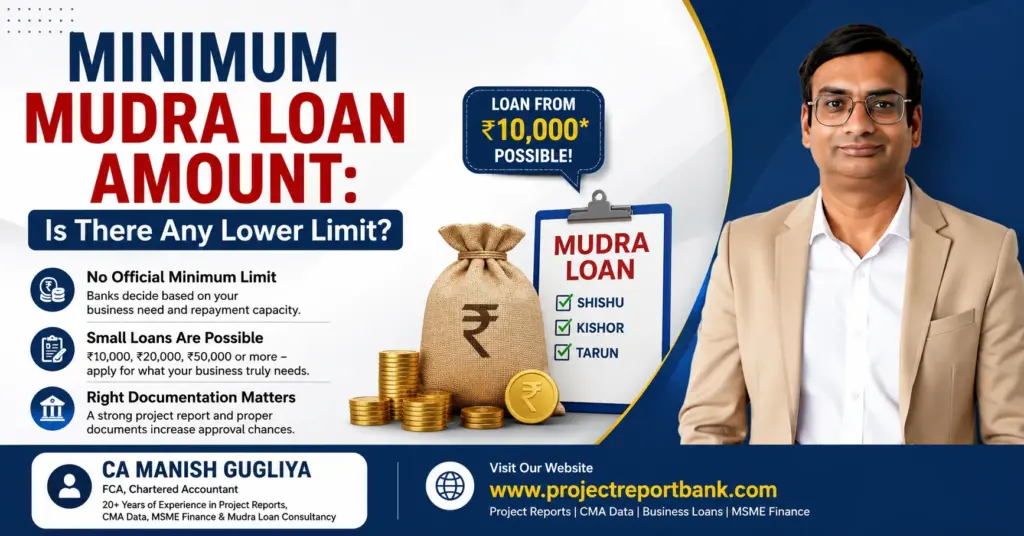
- There is no officially prescribed minimum Mudra loan amount under the Pradhan Mantri Mudra Yojana. The government defines only maximum ceilings for each category, not mandatory starting amounts.
- Very small amounts like ₹10,000, ₹20,000, ₹30,000, or ₹50,000 can be sanctioned if the business requirement is genuinely justified and the borrower is eligible.
- The practical lower limit usually comes from each bank’s internal policy, documentation effort, and viability assessment of the micro business being funded.
- Banks like IDBI and Bank of Baroda have explicitly confirmed “no minimum loan amount” under their Mudra products.
- Expert help – such as CA-prepared project reports from ProjectReportBank.com – can significantly improve approval chances even for small mudra loans.
Introduction: Why Everyone Asks About the Minimum Mudra Loan Amount
If you are a first-time borrower or run a very small business in India, chances are you have wondered: “Can I get a Mudra loan for ₹10,000 or ₹20,000?” or “Is ₹50,000 the minimum Mudra loan?” These are among the most common questions I receive from entrepreneurs who approach me for loan documentation help.
The confusion is understandable. Most information you find online talks about maximum limits – up to ₹10 lakh earlier, now up to ₹20 lakh with the new Tarun Plus category. The four categories under Pradhan Mantri Mudra Yojana (Shishu, Kishore, Tarun, Tarun Plus) all define upper ceilings. But almost nobody explains the lower limit clearly.
I am CA Manish Gugliya (FCA), and I have spent over 20 years working on MSME finance, project reports, CMA data, and Mudra loan files. In this article, I will share practical, bank-level insights on what is the minimum amount for Mudra loan, how banks look at very small tickets, and how you should decide the right amount to apply for.
Direct Answer: Is There Any Official Minimum Mudra Loan Amount?
Let me give you the straight answer first: there is no official minimum loan amount under the Pradhan Mantri MUDRA Yojana. The PMMY scheme guidelines published by the Department of Financial Services, Government of India, define only upper limits for each category – not any mandatory starting amount.
The PMMY framework specifies these ceilings:
- Shishu loans: up to ₹50,000
- Kishore loans: ₹50,001 to ₹5 lakh
- Tarun loans: ₹5 lakh to ₹10 lakh
- Tarun Plus loans: ₹10 lakh to ₹20 lakh (for eligible borrowers who have successfully repaid previous Tarun loans)
None of these categories state a minimum Mudra loan for new business or existing units. PMMY loans are designed for non-farm, non-corporate micro-enterprises in specific sectors like manufacturing, trading, and services.
The smallest Mudra loan available in practice depends on each lending institution’s internal circulars, cost of processing, and whether the business need can be reasonably justified at that ticket size. In my experience, many banks are comfortable starting from ₹25,000–₹50,000, but some branches do sanction even ₹10,000–₹20,000 where the case is strong and documentation is complete.
Think of the “bank minimum Mudra loan amount” as a practical, policy-based lower limit – not a legal one fixed by the government.
Table of Contents
Purpose of Mudra Loans and Why Very Small Amounts Are Allowed
The mantri mudra yojana pmmy was a scheme launched with a clear objective: promoting financial inclusion and supporting micro enterprises and small businesses that are usually outside the formal credit system. MUDRA – the micro units development and refinance agency – was established to provide funding support to various financial institutions so they could extend credit to the smallest entrepreneurs.
The target segments include:
- Street vendors and hawkers
- Small shopkeepers and traders
- Home-based enterprises (food, tailoring, crafts)
- Service providers like electricians, plumbers, beauticians
- Small manufacturing and trading units
- Women-led businesses and minority entrepreneurs
- Self-employed individuals and first-time borrowers
PMMY supports diverse groups including women-led businesses and minority entrepreneurs seeking to start or expand their ventures.
Many such micro units need very low capital – sometimes just ₹15,000–₹40,000 – for stock purchase, tools, or a small machine. A rigid Mudra loan minimum limit would go against the scheme’s intent of reaching the last-mile borrower. That is exactly why the scheme lets banks tailor the Mudra loan starting amount to the true business requirement instead of forcing a high minimum loan under PMMY.
Mudra loans are available for non-corporate, non-farm enterprises, and applicants must generally be between 18 and 65 years old. Both new and existing small businesses can apply, so the minimum Mudra loan for new business can also be small if backed by a clear, practical plan.
Official Guidelines vs Practical Lower Limit in Banks
PMMY and Mudra official circulars from the government and MUDRA Ltd. talk about maximum limits and categories, but do not prescribe any Mudra Shishu loan minimum amount or PM Mudra loan minimum amount. The scheme documents are silent on any lower bound.
However, each bank – SBI, Bank of Baroda, PNB, private banks, RRBs, small finance banks, cooperative banks – may internally define a minimum loan under PMMY for operational convenience. This is where practice diverges from policy.
Banks try to balance the cost of processing (verification, documentation, staff time) with the interest income on a small ticket. That is why some branches avoid extremely small amounts like ₹5,000 or ₹8,000 – the administrative cost simply does not justify the effort for such tiny tickets.
In real files I have worked on, the smallest sanctioned Mudra loan amounts often fall between ₹15,000 and ₹30,000 for simple working capital needs. Some MFIs and business correspondent channels go even lower depending on internal policy.
Here is the key distinction to understand:
- Official PMMY framework: No lower limit written anywhere. You can theoretically request any non-zero amount.
- Bank practice: Each branch operates with an internal comfort zone based on processing cost, staff workload, and local business profile. This creates a de facto – but not legal – minimum.
IDBI Bank explicitly states its Mudra product has “Minimum – None.” Bank of Baroda confirms: “No minimum loan amount: There is no lower limit on the amount you can borrow under the scheme.”
If you want to understand the upper ceilings in detail, you can read about the maximum Mudra loan amount you can get.
How Banks Decide Small Mudra Loan Amounts in Real Life
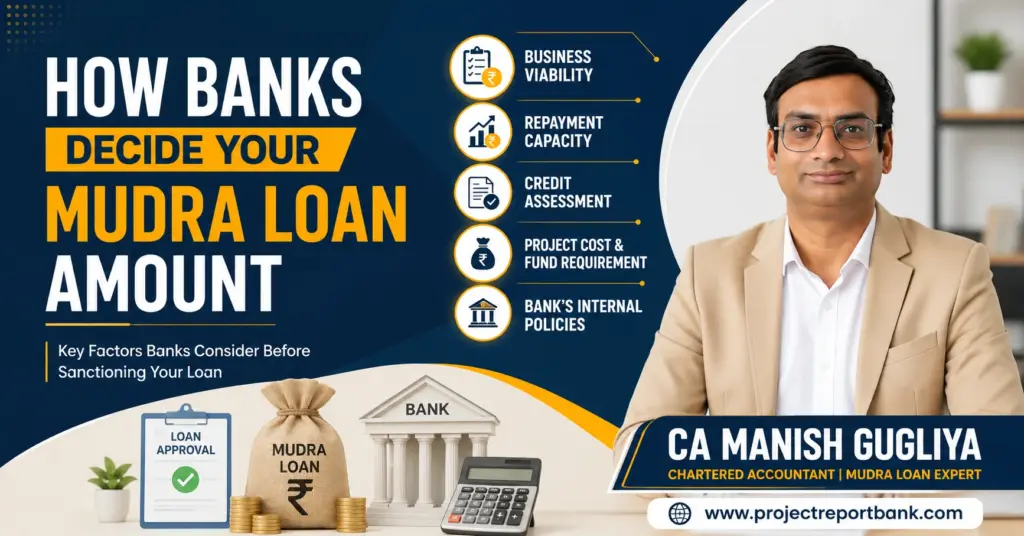
When you ask for any amount – whether ₹10,000 or ₹5 lakh – the bank checks whether that amount makes sense for your business plan and repayment capacity. The eligibility criteria logic is the same for small and large tickets. The difference is that for smaller amounts, the bank looks for simple but clear justification.
Key decision factors include:
- Purpose of loan: stock, tools, raw material, machine, working capital
- Cost estimates and quotations: actual price documentation for what you plan to buy
- Own contribution: how much you are putting in from your own savings
- Existing income sources: salary, other business, family income
- Bank statement pattern: regularity of deposits and withdrawals
- Credit history: CIBIL score or other bureau records
Identity proof, address proof, and income proof are required documents for all Mudra loan applications regardless of the amount. Interest rates for Mudra loans are deregulated, meaning banks set their own rates. In practice, Mudra loan interest rates typically range from 19% to 21% depending on the bank and borrower profile. You can understand how banks calculate Mudra loan interest rates to plan your repayment better.
Branches have some discretion. Based on the project report and discussion with the borrower, they may slightly increase or decrease the requested amount to match realistic business needs.
A well-prepared, CA-certified project report and properly arranged loan file significantly improve approval chances even for small amounts. Understanding how banks decide your Mudra loan amount helps you prepare a stronger application.
Can You Get a Mudra Loan of ₹10,000, ₹20,000, ₹30,000, ₹50,000 or ₹75,000?
All these amounts fall within the Shishu or lower Kishore range, so they are theoretically allowed. There is no rule that the minimum amount for Mudra loan must be ₹50,000.
Very small tickets (₹10,000–₹20,000) are more common with micro vendors and home-based businesses. Amounts between ₹30,000–₹75,000 are typical for small shops and basic machinery or tool requirements.
Here are some concrete examples:
- ₹20,000 – A tea stall owner needs utensils, a gas connection, and first stock of supplies. Simple, clear requirement that a Shishu loan can cover.
- ₹30,000 – A mobile repair shop needs a toolkit, basic spare parts inventory, and a small display counter.
- ₹50,000 – A tailoring business needs two sewing machines, a pressing iron, thread stock, and basic shop furniture.
- ₹75,000 – A small beauty parlour needs chairs, mirrors, basic equipment, and initial product inventory.
Banks may suggest a marginally higher amount than you requested if cost estimates show your business actually needs a bit more to be viable and cash-flow positive.
In terms of relative approval chances: small amounts are usually easier where documentation is proper and the business activity is straightforward. However, some commercial banks prefer at least ₹25,000–₹50,000 due to the processing effort involved. Processing fees are typically low or waived for smaller loan tiers like Shishu, which makes them attractive for both borrowers and lenders.
Mudra Loan Categories and Why They Are Maximum Ranges, Not Minimums
The scheme under Pradhan Mantri Mudra Yojana classifies loans into four categories based on the stage of the business and funding needs:
| Category | Loan Range | Typical Borrower Profile |
|---|---|---|
| Shishu | Up to ₹50,000 | Very small micro units, first-time entrepreneurs, street vendors |
| Kishore | ₹50,001 to ₹5 lakh | Growing small businesses needing equipment or higher working capital |
| Tarun | ₹5 lakh to ₹10 lakh | Established units looking to expand operations |
| Tarun Plus | ₹10 lakh to ₹20 lakh | Borrowers who have repaid previous Tarun loans successfully |
The new Tarun Plus category was introduced on October 24, 2024, and the loan limit was raised to ₹20 lakh from the earlier ₹10 lakh. The maximum funding limit under PMMY is now ₹20 lakh. A clean repayment track record is typically preferred for higher loan tiers like Tarun Plus.
These categories signify maximum bands, not mandatory starting amounts. Even within Shishu, banks can and do sanction varied amounts like ₹12,000, ₹25,000, or ₹40,000 as long as the business requirement supports it. Loans up to ₹10 lakh require no collateral security, which makes these categories accessible to eligible borrowers who may not have assets to pledge.
The simple way to remember: Category = maximum band. Actual sanction = bank’s assessment of your requirement and eligibility.
Factors That Improve Approval Chances for Small Mudra Loan Amounts
Even when you apply for very small amounts (₹10,000–₹50,000), banks expect seriousness and clarity. In my advisory practice, I have seen that well-prepared small-ticket applications often get sanctioned faster than poorly documented large ones.
Factors that strengthen your case:
- A clear business purpose with a realistic cost breakup
- A simple project report showing what you will buy and how the business will generate income
- Basic cash flow estimation proving you can handle EMI payments
- Supportive documents: KYC, address proof, recent bank statements
- Good repayment track record from earlier loans, SHG, or JLG participation
- An existing stable income source (salary, other business, family support)
Even for low-ticket shishu loans, a properly prepared project report and CMA-style estimates make your file stand out. Understanding whether a project report is mandatory for Mudra loan and knowing why a CA-prepared project report improves approval chances can give you a real edge.
Applications can also be submitted online via the JanSamarth portal, which simplifies the initial application process for all categories.
Common Reasons Banks Refuse Very Small Loan Requests
Rejections for tiny amounts usually happen because of weak justification, not because the amount itself is small. Here are the most common issues I see:
- Applicants asking a “random” amount without any cost calculation or quotation
- Wanting to use the loan for personal consumption – marriage expenses, old dues, gadgets – which violates Mudra guidelines
- Planning to repay from non-business sources without any actual business activity
- Incomplete KYC or no proper proof of residence
- Irregular bank statements showing no consistent financial activity
- Poor credit history or unresolved defaults, even at small ticket sizes
- Requesting an amount too small (say ₹5,000) to realistically start or run the stated business, making the banker doubt seriousness
Branches may decline amounts they feel are too low to make the proposed business workable. Instead, they may suggest a more suitable higher figure with proper justification.
Getting professional help to structure the requirement and arrange financial documents required for Mudra loan approval and meeting bank statement requirements can convert a borderline case into an acceptable one.
Myths and Realities About Minimum Mudra Loan Amount
Many borrowers come to me with strong beliefs about Mudra loans that turn out to be completely wrong. Let me clear up the most common ones:
Myth: “The minimum Mudra loan is ₹50,000. Banks never give less.” Reality: Many Shishu loans are sanctioned below ₹50,000. According to a micro enterprise financing report, approximately 88% of all Mudra loans fall under the Shishu category (up to ₹50,000), with the average loan size around ₹52,400 – confirming that many disbursements happen at small ticket sizes.
Myth: “Shishu loans always start from ₹50,000.” Reality: ₹50,000 is the ceiling for Shishu, not the floor. Banks routinely sanction ₹15,000, ₹25,000, or ₹35,000 under this category.
Myth: “New businesses cannot get small loans.” Reality: Mudra was designed specifically for individuals wanting to start micro enterprises. First-time entrepreneurs are core eligible borrowers.
Myth: “Only existing traders are eligible for Mudra loans.” Reality: The scheme covers manufacturing, services, and trading activities – not just existing traders. Anyone with a viable non-farm, non-corporate business idea can apply.
Myth: “All banks follow the same minimum limit.” Reality: Each financial institution – commercial banks, RRBs, small finance banks, NBFCs, MFIs – sets its own internal comfort level. Product offerings vary across various financial institutions.
Instead of chasing a fixed “scheme minimum,” focus on proving your genuine business need and repayment ability.
Practical Examples of Small Mudra Loan Requirements
Concrete examples help borrowers estimate realistic amounts instead of guessing a random figure. Here are real-world scenarios from my practice:
Tea stall (₹20,000–₹25,000): Utensils ₹5,000 + gas setup ₹3,000 + initial stock (tea, sugar, milk, snacks) ₹5,000 + small table and bench ₹4,000 + working capital for first month ₹5,000.
Tailoring unit (₹35,000–₹60,000): One or two sewing machines ₹15,000–₹25,000 + pressing iron ₹3,000 + thread and fabric stock ₹8,000 + basic furniture ₹5,000 + working capital ₹5,000–₹10,000.
Mobile repair shop (₹30,000–₹50,000): Toolkit and soldering equipment ₹10,000 + spare parts inventory ₹10,000 + small display counter ₹5,000 + shop deposit ₹5,000 + working capital ₹5,000.
Beauty parlour (₹60,000–₹75,000): Chairs and mirrors ₹15,000 + hair dryer, straightener, basic equipment ₹15,000 + product inventory ₹10,000 + furniture ₹10,000 + shop rent deposit ₹10,000.
Electrician’s toolkit (₹25,000–₹40,000): Professional tool kit ₹12,000 + testing equipment ₹8,000 + wiring stock ₹5,000 + two-wheeler fuel and working capital ₹5,000.
In my practice, many successful PMMY cases that achieve growth for the beneficiary micro unit fall in the ₹30,000–₹1,00,000 range, especially for first-time entrepreneurs who start small and then enhance limits later.
Think in terms of “what does my business actually need?” instead of “what is the smallest Mudra loan available?” You can calculate your Mudra loan EMI before applying to ensure the repayment fits your expected cash flow.

Typical Mistakes Applicants Make While Deciding the Loan Amount
Borrowers often harm their own chances by choosing the wrong amount – either inflated or unrealistically low – without proper planning.
Common mistakes I regularly see:
- Picking a round figure without costing: Asking for ₹1,00,000 because it “sounds good” without listing what exactly the money will fund
- Underestimating working capital: Budgeting only for equipment but forgetting that running expenses for 1–2 months also need funding
- Not including basic necessities: Ignoring costs like shop furniture, branding, initial rent deposit, or packaging material
- Asking for an unrealistically tiny amount: Requesting ₹5,000 for a business that clearly needs ₹30,000, making the banker question the seriousness of the proposal
- No quotations for machines or equipment: Banks need documentary proof of what you plan to purchase and at what cost
- Inconsistent information: Saying one thing in the application form and different numbers in the project report
- Missing documents: Incomplete KYC, no Udyam registration or GST documents, or outdated financial records
The right approach is to consult a professional – a CA or experienced consultant – to prepare a simple but realistic project report and properly costed requirement.
Expert Advice from CA Manish Gugliya on Choosing the Right (Minimum) Mudra Loan Amount
In over 20 years of dealing with banks and MSME loans including hundreds of Mudra cases, I have learned one simple principle: apply only for the amount your business genuinely needs and you can comfortably repay.
Do not chase the highest possible sanction. Do not worry about a rigid Mudra loan lower limit either. A slightly higher but well-justified amount is often safer than an unrealistically small ticket that leaves you short of working capital and leads to stress in repayment.
Here is my simple 3-step approach for deciding your ideal Mudra loan amount:
- List all startup costs and working capital – equipment, raw material, rent deposit, initial stock, and at least 1–2 months of operating expenses
- Deduct your own contribution – whatever you can invest from personal savings
- Keep a modest safety margin – add 10–15% buffer for unexpected costs
The balance is your ideal loan amount. This is the number you should put in your application and support with a professional project report.
Loans under PMMY are categorized into Shishu, Kishore, Tarun, and Tarun Plus – your calculated amount will naturally fall into one of these categories. The facility of covering loans across these categories gives you flexibility. Interest rates are deregulated, so it pays to compare rates and find which banks offer the lowest interest rate on Mudra loan.
Whether you need Rs 20,000 for a fruit cart or Rs 10 lakh for a small manufacturing unit, the key to approval is clarity, honesty, and proper documentation.
Conclusion: There Is No Fixed Minimum, Only a Sensible Amount for Your Business
There is no officially fixed minimum Mudra loan amount under PMMY. The government and the ministry overseeing the scheme define only upper slabs and categories, while banks decide practical lower limits based on internal policy, processing cost, and business viability. The scheme’s core intent is entrepreneurship support and financial inclusion, which means even small tickets are part of the design.
Amounts like ₹10,000, ₹20,000, ₹30,000, ₹50,000, or ₹75,000 can absolutely be sanctioned when backed by a clear business plan, proper documents, and reasonable repayment capacity. Mudra loans are available for amounts up to ₹20 lakh, and loans up to ₹10 lakh do not require collateral security – making the scheme accessible to the smallest non corporate entrepreneurs across India.
The right approach is to calculate what your business truly requires, prepare a simple but solid project report, and then approach the bank confidently with a well-structured file. Updated information and professional guidance make all the difference.
Need help preparing your Mudra loan file? Visit ProjectReportBank.com for CA-prepared project reports, financial statements, and complete loan documentation – tailored to your specific business and ticket size, whether you need a small Shishu loan or a larger Tarun facility.
Frequently Asked Questions on Minimum Mudra Loan Amount
Can I increase or decrease my requested Mudra loan amount after the bank reviews my file?
Yes, this happens regularly. During appraisal, bankers may suggest a different amount based on project viability and their assessment of your actual business needs. Borrowers can agree to a revised sanction if it better matches real requirements. Major changes usually need updated cost estimates or a revised project report, but small adjustments of a few thousand rupees are common and acceptable. My advice is to stay flexible and focus on a sustainable figure instead of insisting on the exact original number – the goal is to get a workable sanction, not win an argument over ₹5,000.
Is it possible to first take a small Shishu loan and later enhance it under Kishor or Tarun?
Absolutely. Many banks allow enhancement or a fresh higher-limit Mudra loan once the borrower has a good repayment track record and proven business growth. A clean history of timely EMIs under your first loan dramatically improves your chances of moving from Shishu to Kishore or Tarun categories over the years. However, enhancement is still subject to fresh appraisal, an updated project report, and revised documentation as per bank policy at that time. Starting small and building credit trust is actually one of the smartest strategies for entrepreneurs.
Can a housewife, student, or retired person get a very small Mudra loan to start a side business?
Mudra loans are for income-generating micro enterprises, so if such applicants have a clear business plan – like home tiffin services, tailoring, tuition classes, or online reselling – they can definitely be considered as individuals eligible under the scheme. Banks will look closely at family income support, repayment capacity, and whether the activity is genuinely commercial. I advise such applicants to prepare a simple project plan showing how even ₹20,000–₹40,000 will translate into regular business income and provide for comfortable loan repayment.
If my bank refuses a very small Mudra loan, can I approach another bank or NBFC?
Yes. Borrowers are generally free to approach other eligible lending institutions under PMMY – other commercial banks, RRBs, small finance banks, MFIs, or NBFCs that extend Mudra credit. Each institution has its own comfort level regarding minimum ticket size, so another lender may accept a case that one bank declined purely on operational or policy grounds. I recommend strengthening the project report and documentation before reapplying to start with a stronger application at the next lender.
Does a very small Mudra loan still require a project report and bank statements?
While some lenders keep documentation slightly simpler for low-ticket Shishu loans, most still want at least a basic business plan and recent bank statement to judge repayment capacity. Having even a simple, CA-prepared project note and clean bank statement history makes it easier for the branch manager to support the proposal in internal approvals. Do not skip documentation simply because the amount is small – proper paperwork is often the difference between sanction and rejection. Loan amounts may range from small to ₹20 lakh, but the need for clear documentation applies across the board.
- Prepayment of Mudra Loan: Rules, Benefits & Practical Advice (2026 Guide)


- Total Cost of a Mudra Loan: Interest, EMI & Hidden Charges
- Mudra Loan Interest Calculation Explained with Examples

- How Much Mudra Loan Should You Apply for Your Business?

- Minimum Mudra Loan Amount: Is There Any Lower Limit?
- How Banks Decide Your Mudra Loan Amount
- Which Bank Offers the Lowest Interest Rate on Mudra Loan? A CA’s Expert Comparison

- How to Calculate Mudra Loan EMI Before Applying

- Mudra Loan Interest Rate Explained: How Banks Calculate It