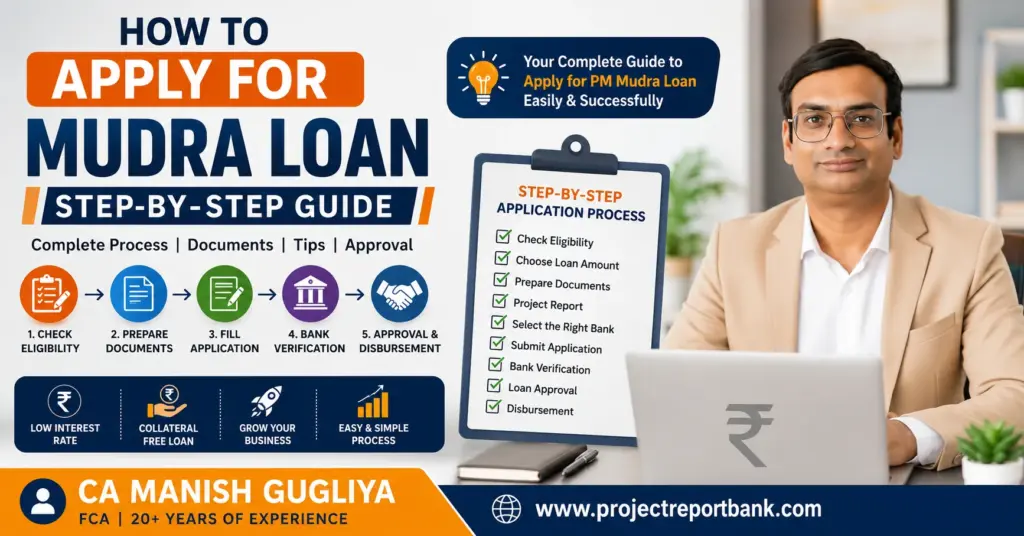
Filling out a Pradhan Mantri MUDRA Yojana application requires precise information – and most delays happen not because of scheme rules, but because of avoidable mistakes on the form itself. This guide walks you through every section of the Mudra loan application form, line by line, so you can submit it with full confidence.
Key Takeaways
This article gives you a complete, line-by-line guide on how to fill the Mudra loan application form correctly – written in simple English that anyone can follow.
- Most mudra loan delays happen due to wrong or incomplete form details, not because of the loan amount or scheme issues.
- This guide is written by CA Manish Gugliya (FCA), a Chartered Accountant with 20+ years of hands-on experience in MSME finance and Mudra loan consultancy, in very simple English.
- Before picking up the pen, keep all documents ready: Aadhaar, PAN, bank passbook, business proof, project report, and quotations.
- Fill all mandatory fields, match every detail with your Aadhaar and PAN, justify your requested loan amount with a clear breakup, and re-check everything before submitting.
- By following this guide step by step, even a first-time applicant or a small shopkeeper can fill the Mudra loan form without a single mistake.
Table of Contents
Why Filling the Mudra Loan Application Form Correctly Matters
The Pradhan Mantri Mudra Yojana (PMMY) was launched by the government of India in 2015 to provide collateral-free funding to micro enterprises and small businesses. As of March 2026, more than 57.79 crore loan accounts have been sanctioned with disbursements of approximately ₹40.07 lakh crore. The scheme is massive, the money is available, and the process is straightforward.
Yet, thousands of applications get delayed or rejected every month. Not because the scheme is difficult, but because the form was filled incorrectly.
Banks must record every detail exactly as it appears in your Aadhaar, PAN, and bank records. Even a small spelling difference, a wrong date of birth, or an incomplete address can trigger extra verification – adding days or weeks to your approval. Here are the most common reasons for delay:
- Blank mandatory fields that the applicant forgot to fill
- Overwriting or use of whitener that makes entries unclear
- Different signatures on different pages of the form
- Mismatched address between Aadhaar, bank passbook, and the form
- Incorrect or vague loan amount and purpose description
This article will walk you through each section of the Mudra loan application form, field by field, so that even a Class 5 student can understand and fill it correctly. The same basic form format is used by public sector banks, private banks, RRBs, Small Finance Banks, and NBFCs under PMMY – whether you apply offline or online.

What is the Mudra Loan Application Form?
The Mudra loan application form is the standard PMMY form used by banks and lending institutions across India to collect all necessary information before approving a loan. The maximum loan amount under PMMY is ₹10,00,000. The form captures your personal details, business information, loan requirement, financial position, and bank account details – everything the lender needs to make a decision.
Mudra loans are available for non corporate small businesses. So who fills this form? Small shopkeepers, street vendors, manufacturers, service providers, transport operators, women entrepreneurs, and any other non-farm micro and small business owner. Applicants must check their eligibility before applying – you need to be running or planning to start a legitimate business activity.
Almost all scheduled commercial banks, regional rural banks, cooperative banks, MFIs, and NBFCs use this PMMY form. Some banks add their logo and a few extra fields, but the core structure remains the same. The Mudra loan application can be started online through bank websites, Jan Samarth portal, or Udyami Mitra. Even when submitted online, the fields required are almost identical. Offline forms are typically 2–4 printed pages filled in blue or black pen.
MUDRA does not use external agents to process applications. You deal directly with the bank or institution.
The basic PMMY application process works like this:
- Collect all your documents
- Fill the Mudra loan application form carefully
- Submit the form with documents at the bank branch
- Bank verifies your details and may conduct a site visit
- Sanction letter is issued and loan is disbursed
For a more detailed walkthrough of the entire application journey, read the separate step-by-step guide on how to apply for a Mudra loan.
Checklist: Information and Documents to Keep Ready Before Filling the Form
Before you start writing on the form, gather every piece of information you will need. This one step prevents most cutting, overwriting, and mistakes. Think of it like cooking – lay out all your ingredients before you start.
Personal and identity documents:
- Aadhaar Card – for identity, address, and KYC verification
- PAN Card – required for all loan amounts; essential for credit checks
- Latest address proof – electricity bill (not older than 2–3 months), rental agreement, voter ID, driving licence, or passport
- 2–4 recent passport-size colour photographs
- Active mobile number – preferably the one linked to your Aadhaar
- Working email ID – for communication from the bank
Bank-related details:
- Existing bank account passbook – with bank name, branch, account number, and IFSC code
- Updated bank statement – check the bank statement requirements for Mudra loan to know exactly how many months are needed
Business documents:
- Shop or business address proof (electricity bill, rent agreement, property document)
- Udyam Registration certificate, if available
- GST registration and GST number, if applicable
- Business registration papers – partnership deed, MSME registration, company incorporation, etc.
- Shop establishment licence or trade licence
Financial and project documents:
- Basic project report with cost sheet and profitability estimates
- Machinery and equipment quotations – read the guide on machinery and equipment quotations required for Mudra loan for details
- Details of existing loans – sanction letters and EMI schedules
- Last 6–12 months bank statement
- Simple financial statements as described in the article on financial documents required for Mudra loan approval
Having all these ready also helps when you need to arrange your Mudra loan file before visiting the bank.
Step-by-Step Guide to Fill Every Section of the Mudra Loan Form
Now we come to the core of this guide. We will go field by field through the typical PMMY form, as used in most banks, using simple examples.
A few general rules before you start:
- Use BLOCK or CAPITAL letters wherever boxes are provided
- Use only blue or black ball pen – avoid gel pens, pencils, or red ink
- Write clearly inside the boxes; do not write outside the lines
- Never use whitener or correction fluid
While the exact layout may differ between banks, almost all forms have these sections: Personal Information, Business Details, Loan Requirement, Financial Information, Bank Account Details, Security/Guarantor, and Declaration.
Personal Information Section
This section is used by the bank to identify you as the applicant. Every entry here must match exactly with your Aadhaar, PAN, and bank records.
Fields to fill:
- Applicant’s Full Name – Write your name exactly as it appears on your Aadhaar card. If your Aadhaar says “RAMESH KUMAR,” do not write “R. Kumar” or “Ramesh K.”
- Father’s / Husband’s Name – Again, match with Aadhaar or PAN. Basic details required for the application include name and date of birth, and these must be accurate.
- Date of Birth – Write in DD/MM/YYYY format (e.g., 12/08/1989). Make sure this matches your Aadhaar and PAN exactly.
- Gender – Tick Male, Female, or Other as applicable.
- Marital Status – Single, Married, Widowed, or Divorced.
- Category – Tick SC, ST, OBC, General, or Minority. If you belong to a reserved category, attach a valid certificate.
- Aadhaar Number – Write all 12 digits carefully in the boxes, with spaces as per the form pattern. Even one wrong digit can block the loan.
- PAN Number – Write all 10 characters in uppercase (e.g., ABCDE1234F). Double-check each character.
- Mobile Number – Write your active mobile number, preferably the one linked to your Aadhaar. This number is used for OTPs and bank calls.
- Email ID – Write a simple, working email. If you do not have one, it is better to create one before applying.
- Address – Fill present address and permanent address completely, including house/room/shop number, street, area, city, PIN code, state, and district. If both addresses are the same, tick “Same as permanent address.”
Common mistakes in this section:
- Spelling your name differently on the form vs. Aadhaar or PAN
- Writing the wrong date of birth
- Using someone else’s mobile number
- Writing an incomplete address without PIN code
- Missing the house or room number
Make sure that the signature you will give later in the form matches the signature on your bank account exactly.
Business Details Section
This section tells the bank what type of business will use the Mudra loan and whether it is new or already running.
Fields to fill:
- Business Name – Write your firm name or shop name (e.g., “Ramesh Kirana Store” or “Sai Beauty Parlour”).
- Constitution – Indicate business structure as Proprietorship, Partnership, or Company in the application. Most small business owners will select “Proprietorship.”
- New or Existing Business – Tick “Existing” if your business is already running and mention the date of commencement. Tick “New / Proposed” if you are starting fresh.
- Nature of Business / Activity Type – Select Manufacturing, Trading, or Services. For example:
- “Ramesh Kirana Store” → Trading → Retail grocery shop
- “Sai Beauty Parlour” → Services → Ladies beauty salon
- “Kumar Furniture Works” → Manufacturing → Wooden furniture
- Business Address – Shop number, street, area, city, PIN code. Mention whether the premises is rented or owned, and attach proof.
- Industry Category – Food processing, Retail trade, Transport, Textile, Repair services, etc.
- Registration Numbers – Udyam Registration number and GSTIN, if available. Having these strengthens your case. Read the detailed guide on Udyam Registration, GST and business documents for Mudra loan.
- Years in Business – Write the number of years you have been operating.
- Number of Employees – Include yourself and any workers. This helps the bank judge experience and employment generation.
Loan Requirement Section
This is one of the most important sections. Here you mention the mudra loan amount you need and the purpose of the loan.
Selecting the correct category:
MUDRA loan tiers include Shishu, Kishor, and Tarun based on the loan amount:
| Category | Loan Amount Range |
|---|---|
| Shishu | Up to ₹50,000 |
| Kishore | ₹50,001 to ₹5,00,000 |
| Tarun | ₹5,00,001 to ₹10,00,000 |
There is also a newer category called Tarun Plus – Tarun Plus loans can go up to ₹20 lakh for eligible borrowers who have successfully repaid earlier Tarun loans.
How to fill this section:
- Total Loan Amount – Write clearly in both figures and words (e.g., “₹3,00,000 – Rupees Three Lakh Only”). Double-check every digit.
- Purpose of Loan – Be specific. Do not just write “business.” Break it down:
- Working capital (for daily stock and expenses)
- Machinery or equipment purchase
- Shop renovation, furniture, fixtures
- Vehicle purchase (goods carrier, e-rickshaw – where eligible)
Example breakup:
| Purpose | Amount |
|---|---|
| Working capital (stock) | ₹1,00,000 |
| Machinery (deep freezer) | ₹1,50,000 |
| Shop renovation (racks, painting) | ₹50,000 |
| Total Mudra Loan Amount | ₹3,00,000 |
Justify the amount with a simple cost estimate or project report. Attach quotations for machinery items. You can learn how to prepare one with the guide on getting your Mudra loan approved with a perfect project report.
Common mistakes:
- Asking for a very high amount without proper justification
- Not matching loan purpose with actual business activity (e.g., requesting a machinery loan for a trading shop)
- Leaving the “purpose” line blank or writing only one vague word like “business”
- Selecting the wrong category – for example, ticking Tarun when you only need ₹40,000
Financial Information Section
Banks use this section to check whether you can repay the loan from your current or future income.
- Monthly Sales – For existing businesses, write your approximate current monthly sales (e.g., ₹1,50,000). This should be honest and close to what your bank statement and GST returns reflect.
- Annual Turnover – Multiply monthly sales by 12 (e.g., ₹18,00,000). For new businesses, write “Proposed” and base it on your project report estimates. Keep projections realistic.
- Existing Income – Salary from job, other business, rental income, or household income. This shows the bank you have backup sources to support repayment.
- Existing Liabilities – List every current loan: house loan, personal loan, vehicle loan, credit card dues, and any earlier business loans. Write the EMI amount, outstanding balance, and bank name for each.
- Repayment Capacity – Some forms ask how much monthly EMI you can comfortably pay. Base this on your income minus expenses and existing EMIs.
Financial documentation may be minimal for Shishu loans but extensive for Kishor and Tarun loans. For amounts above ₹2 lakh, banks typically want last two years’ balance sheets or financial statements.
Why honesty matters here: Credit history review is important, and applicants should not be defaulters. The bank will check your CIBIL report. If you hide an existing loan and the bank finds it in your credit report, it creates distrust and can lead to rejection. Always declare all liabilities honestly.
For a detailed understanding, refer to the article on financial documents required for Mudra loan approval.
Bank Account Details Section
The Mudra loan amount is credited directly into your existing current or savings account. These details must be 100% correct.
- Name of Bank – e.g., State Bank of India
- Branch Name – e.g., Jaipur Main Branch
- IFSC Code – 11 characters, like SBIN0001234. Copy this exactly from your passbook or bank statement.
- Account Number – Write every digit carefully. Double-check by reading aloud.
- Type of Account – Savings or Current
If you do not have an account in the bank where you are applying, the bank may first open a new account and then process the loan.
Tick any field asking about “existing relationship with bank” – account holder since which year, earlier loans, fixed deposits. Long-standing relationships generally help your case.
Writing a wrong account number can seriously delay disbursement or cause the credit to go to a wrong account. Check it twice.
Security / Guarantor Section
Loans up to ₹10,00,000 under PMMY do not require collateral security. This is one of the biggest advantages of the Mudra scheme. But banks may still ask for a guarantor in some cases, especially for higher loan amounts in Kishore and Tarun categories. This is at the bank’s sole discretion based on your profile and credit history.
If a guarantor is required, fill:
- Full name, relationship with you, address, mobile number
- PAN and Aadhaar of the guarantor
- Occupation and income details of the guarantor
For most Shishu loans, banks do not insist on a guarantor. But this depends on the lender’s internal policy.
Never write someone’s name as guarantor without their knowledge and consent. Their signatures and KYC documents must be provided properly.
Where the form has a “Security” column and no collateral is needed, simply write: “No collateral – loan under PMMY / Mudra scheme.”
Even though collateral is generally not taken, the loan must still be repaid on time to build good credit history.
Declaration and Signature Section
This is the legal part where you confirm that all information in the form is true and correct.
- Read the declaration carefully – Even if it looks long and is printed in small letters, read every line before signing. It typically includes your consent for the bank to verify your details and share information with the RBI or credit bureaus.
- Sign in the designated space – Your signature must match exactly with your bank account signature. If the business is a partnership or company, all required partners or directors must sign in their respective boxes.
- Date and Place – Fill clearly (e.g., “Date: 06/08/2026, Place: Jaipur”). The date should match the day you actually submit the form.
- Avoid overwriting – If you make a mistake, neatly cancel it and sign near the correction as per the bank’s instructions.
- Do not sign blank pages – Sign only after you have fully filled and reviewed the entire form.

How to Fill the Mudra Loan Form for Different Types of Businesses
While the same PMMY form is used for all applicants, the way you fill the business and financial sections will differ slightly depending on whether you are starting new or running an existing business, and whether you are in manufacturing, trading, or services.
New Business Applicants
If your business has not started yet, you will write “Proposed” or “New” in the business status field. Your projected sales and expenses will be estimates, not actual past figures.
- Write the expected opening date (e.g., “Proposed start date: 01/11/2026”)
- Base projected monthly sales and expenses on a simple project report
- Clearly write the purpose: “For setting up new mobile repair shop – purchase of tools, equipment, and initial working capital”
- Attach machinery and equipment quotations to support the loan amount
For new businesses, a well-prepared project report makes a significant difference. Check whether a project report is mandatory for Mudra loan and how to prepare one.
Existing Business Applicants
For existing businesses, mention the year you started, your current turnover, and why you need additional funding – expansion, renovation, more stock, or a second vehicle.
- Turnover and profit figures should match your bank statements and GST returns
- If you are shifting from cash to digital payments, mention this in remarks to show growth
- Declare any existing loans for the same business and show repayment status
- Attach last 6–12 months bank statement and a brief note on how the new loan will increase sales
Manufacturing Units
Manufacturing applicants must be very clear about what they manufacture – plastic containers, wooden furniture, metal grills, bakery products, etc.
- Break up the loan amount into machinery, tools, raw material, labour, and working capital
- Fill these details exactly in the “purpose/loan requirement” section
- Attach detailed machinery and equipment quotations – the brand, model, and price in quotes should roughly match what you describe in the form
Example: A small flour mill owner requesting ₹5,00,000 could break it down as: ₹3,00,000 for flour mill machinery, ₹1,00,000 for initial raw material (wheat), and ₹1,00,000 for working capital.
Service Businesses
Service businesses – beauty parlours, coaching classes, mobile repair shops, cyber cafes, tailoring units, travel agents – usually need more for furniture, equipment, and initial marketing than for heavy machinery.
- Describe the service clearly: “Ladies beauty parlour and bridal makeup services”
- Show realistic monthly capacity (e.g., 15 customers per day × average billing ₹300 = ₹1,35,000 monthly)
- List specific items: beauty chairs, mirrors, facial steamer, air conditioner, computer, signage board, plus working capital
Trading Businesses
Trading businesses like kirana shops, readymade garment stores, mobile shops, and stationery shops mainly need stock and sometimes minor fixtures.
- Highlight “working capital for stock” clearly as the main purpose
- Show how much average stock you hold and how often it rotates
- Be reasonable – a small grocery shop cannot justify ₹10,00,000 in stock
Example: A small grocery shop requesting ₹3,00,000 – with ₹2,50,000 for stock and ₹50,000 for new shelving and a display fridge. Attaching simple purchase invoices from suppliers can strengthen the application.
Women Entrepreneurs
Women applicants should ensure they correctly tick any “Women entrepreneur” box on the form. Many banks offer special interest rates or priority processing for women under the Mudra scheme.
- Housewives starting new micro businesses (tiffin service, tailoring, home boutique, homemade snacks) should write their own name as the main applicant
- KYC and bank account should ideally be in the woman’s own name
- Attach any training certificates, self-help group records, or past informal business records
Example: A woman starting a home-based tiffin service could write: Business name – “Anu’s Home Kitchen,” Activity – “Food Services / Tiffin delivery,” Loan purpose – “Purchase of utensils, gas stove, packaging materials, and initial groceries.”

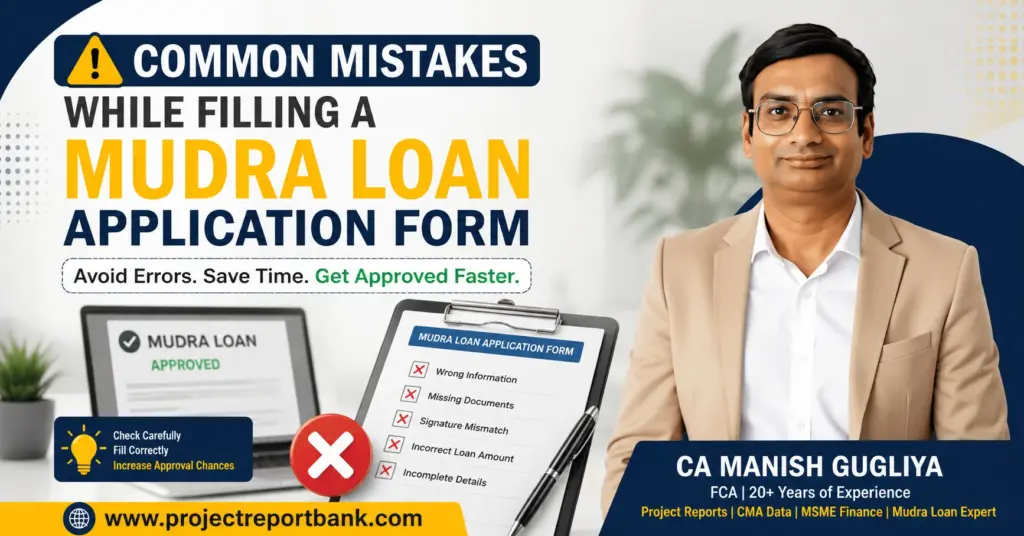
Common Mistakes While Filling the Mudra Loan Application Form
After reviewing hundreds of Mudra loan files over the years, I have seen the same avoidable mistakes over and over again. Each one can delay your approval by weeks or lead to outright rejection.
Identity and document errors:
- Wrong or incomplete Aadhaar number – even one digit off blocks KYC
- Mismatch in name spelling between documents and form – “SURESH” on Aadhaar but “SURESH KUMAR” on the form
- Wrong PAN number – extra verification calls, wasted time
Form-filling errors:
- Leaving mandatory fields blank – bank cannot process an incomplete form
- Overwriting without initials or using whitener – looks unprofessional, raises suspicion
- Different signatures on different pages – triggers verification issues
- Writing wrong or inactive mobile number – bank cannot send OTPs or call you
Business and financial errors:
- Writing unrealistic loan amount without a proper breakup
- Wrong business activity (writing “Manufacturing” when you run a retail shop)
- Inflated turnover figures not supported by bank statements – the bank will cross-check
- Hiding existing loans – the CIBIL report will reveal them anyway
- Not updating address changes – old address that does not match any proof
Each of these mistakes results in either extra verification rounds, requests for re-submission, or in some cases, suspicion of incorrect information leading to rejection.
For a deeper checklist of what can go wrong, read about common documentation mistakes that delay Mudra loan approval.
Expert Tips from CA Manish Gugliya for Error-Free Mudra Forms
Based on 20+ years of preparing project reports, CMA data, and Mudra loan files for MSMEs across manufacturing, trading, and service sectors, here are my most practical tips:
- Fill in clear CAPITAL letters wherever boxes are given. Use only blue or black ball pen. Avoid gel pens – they smudge.
- Never leave mandatory fields blank. If a field does not apply to you, write “N.A.” (Not Applicable). An empty field looks like you forgot.
- Match every detail with supporting documents. Ensure all information matches with supporting documents to avoid rejection. Use the same spelling for your name everywhere – on Aadhaar, PAN, bank passbook, GST certificate, Udyam registration, and the Mudra form.
- Double-check mobile number and email by reading them aloud, digit by digit. A wrong number means missed OTPs and bank calls.
- Attach identity proof such as Aadhaar and PAN card – both sides photocopied – with every application. Self-attest each photocopy.
- Keep photocopies of everything – the fully filled form, all attached documents, and quotations – before submission. You may need them for follow-up or for applying at another branch.
- Review the form calmly once yourself and once with a trusted family member or advisor before signing the declaration. Fresh eyes catch mistakes you might miss.
Documents to Attach Along With the Mudra Loan Application Form
Even a perfectly filled form will not be processed if required documents are missing. Here is a clear checklist, organized by category:
Identity Proof:
- Aadhaar Card (both sides)
- PAN Card
- For partnerships or companies: PAN and Aadhaar of all key partners or directors
Address Proof:
- Aadhaar card, voter ID, driving licence
- Electricity bill, water bill, or gas bill (recent, not older than 2–3 months)
- Rental agreement or property tax receipt
- The address on proof must match the address on the form
Business Proof:
- Shop establishment licence or trade licence
- GST registration certificate
- Udyam Registration certificate
- Partnership deed or company incorporation certificate
- Rent agreement of shop or office
- Any professional licences relevant to your business
Financial Documents:
- Last 6–12 months bank statement
- Latest Income Tax Return (ITR), if filed
- Simple financial statements (profit/loss, balance sheet) – especially for Kishore and Tarun loans
- Existing loan sanction letters and repayment track
- Project report with cost sheet and profitability estimates
Other Supporting Documents:
- Machinery and equipment quotations from suppliers
- 2–4 passport-sized colour photographs
- Photographs of shop or factory, if the bank requests
- Any additional document the bank branch specifically lists
For the complete document checklist, read the detailed guide on Mudra loan documents required.
What Happens After You Submit the Mudra Loan Application Form?
Once you submit the properly filled form with all documents, the bank follows a clear internal process. Understanding this process helps you stay patient and prepared.
Step 1: Bank Receipt and Basic Scrutiny The branch officer checks that the form is fully filled, signatures are done, and all photocopies are attached. If anything is missing, they may ask you to correct it on the spot.
Step 2: KYC and Document Verification The bank matches your Aadhaar, PAN, photographs, address, and business proof with their records. Online verification is done for Aadhaar-based KYC.
Step 3: Credit Appraisal The bank analyses your financial information, checks your CIBIL report, reviews your bank statement and project report, and evaluates your repayment capacity. Clean credit history and stable income help faster approval. Mudra loans support small and micro enterprises, but the lender still needs to be confident you can repay.
Step 4: Site Visit For many loans – especially Kishore and Tarun amounts – a bank officer may visit your shop, factory, or proposed business location to verify the activity or readiness.
Step 5: Sanction The bank issues a sanction letter mentioning the sanctioned loan amount, interest rates, tenure, EMI amount, repayment schedule, and any conditions. This letter is an important document – keep it safely.
Step 6: Documentation and Disbursement You sign the loan agreement, standing instructions, or ECS forms. Then the Mudra loan amount is credited to your bank account. For specific purposes like machinery purchase, the bank may release funds in stages or directly to the supplier’s account after verifying the invoice.
The entire process from submission to disbursement can be availed faster when your application is complete from day one.
Practical Example: How a Small Shop Owner Fills the Mudra Loan Form
A real-life style example makes it easier to see how all sections link together.
Meet Mr. Ramesh Kumar. He is 32 years old and runs “Ramesh Kirana Store” in Jaipur. He needs a Mudra loan of ₹3,00,000 to expand his stock and add a deep freezer and new display racks.

Personal Information:
- Name: RAMESH KUMAR (as per Aadhaar)
- Father’s name: SHRI MOHAN LAL
- Date of birth: 15/03/1994
- Gender: Male
- Category: OBC
- Aadhaar: 1234 5678 9012
- PAN: ABCPK1234R
- Mobile: 98765 43210 (linked to Aadhaar)
- Address: H.No. 45, Gali No. 3, Shastri Nagar, Jaipur, Rajasthan – 302016
Business Details:
- Business name: Ramesh Kirana Store
- Constitution: Proprietorship
- Activity: Retail grocery trading
- Status: Existing since 2019
- Business address: Shop No. 12, Main Market, Shastri Nagar, Jaipur – 302016 (Rented)
- Udyam Registration: UDYAM-RJ-01-0012345
Loan Requirement:
- Category: Kishore
- Loan amount: ₹3,00,000 (Rupees Three Lakh Only)
- Purpose breakup: Stock – ₹2,00,000; Deep freezer – ₹60,000; Display racks – ₹40,000
- Attached: Quotation from freezer supplier, quotation from rack fabricator
Financial Information:
- Current monthly sales: ₹1,80,000
- Annual turnover: ₹21,60,000
- Existing liabilities: Bike loan EMI ₹2,500 per month (with ABC Bank)
- No other loans
- Expected increase in sales after expansion: 20–25%
Bank Account Details:
- Bank: State Bank of India, Jaipur Main Branch
- IFSC: SBIN0031234
- Account: 3456 7890 1234
- Type: Savings
- Account holder since: 2018
Security: No collateral – loan under PMMY scheme. No guarantor required as per bank policy.
Declaration: Ramesh reads the full declaration, signs with the same signature as on his bank account, writes the date as 06/08/2026 and place as Jaipur. He submits the form in a neat file with all documents.
Do’s and Don’ts While Filling the Mudra Loan Form
This quick reference list serves as your final checklist before handing over the application to the bank officer.
| Do ✅ | Don’t ❌ |
|---|---|
| Fill every field neatly and completely | Don’t leave mandatory fields blank |
| Use CAPITAL letters where boxes are given | Don’t write in cursive or unclear handwriting |
| Use blue or black ball pen only | Don’t use pencil, red ink, or gel pen |
| Match name spelling with Aadhaar and PAN | Don’t use nicknames or short forms |
| Write loan amount in both figures and words | Don’t guess the amount – calculate and justify it |
| Keep a photocopy of the filled form | Don’t submit the only copy without keeping a backup |
| Attach all required documents | Don’t submit the form with missing papers |
| Sign consistently on every page | Don’t use different signature styles |
| Read the declaration before signing | Don’t sign without reading the fine print |
| Declare all existing loans honestly | Don’t hide liabilities – the CIBIL report will show them |
| Ask bank staff if you have any doubt | Don’t guess and write wrong information |
Frequently Asked Questions About Filling the Mudra Loan Form
These are practical questions that first-time Mudra loan applicants ask repeatedly in real consultations. Answers are brief and focused on the form-filling process. For deeper questions about the scheme, documents, or eligibility, explore the internal links provided throughout this article.
Can someone else fill my Mudra loan application form for me?
Yes, a family member, friend, CA, or advisor can help write the details on the form. But the applicant is fully responsible for the correctness of every entry. Only the applicant’s own signature and thumb impression are valid. Before signing, personally check every line – especially name, Aadhaar, PAN, mobile number, loan amount, and business details. Wrong information submitted in your name can cause rejection or legal issues.
What should I do if I realise a mistake after submitting the form?
If the bank has not yet processed the application, you can request to correct errors by submitting a written request and, if needed, a fresh corrected form. For small mistakes like a wrong mobile number or minor spelling error, banks may correct it in their system after getting a signed correction request and valid proof. For bigger changes – like loan amount, business type, or category – a new form may be required.
Is it compulsory to fill the Mudra loan form online, or can I submit a handwritten form?
Many banks still accept neatly handwritten PMMY forms filled in blue or black pen. Some banks also offer online forms on their websites, and some branches enter data into the system from your handwritten form. Check with your chosen bank branch about their preferred mode. In all cases, the information required is almost the same whether you apply online or offline.
Do I need to have GST and Udyam Registration before filling the form?
Very small businesses may get Mudra loans even without GST and Udyam Registration, depending on turnover and bank policy. However, having them strengthens your case and is recommended for growing MSMEs. If you plan to expand, consider obtaining these registrations. Read the detailed guide on Udyam Registration, GST and business documents for Mudra loan.
How long does it usually take after I submit a correctly filled Mudra loan form?
Timelines vary by bank, branch workload, and loan amount. For Shishu and Kishore loans with complete documents, many banks process within 7–15 working days. Delays usually happen due to missing documents, need for extra clarifications, or pending site visits. A clean, complete, correctly filled form – with all documents attached at the right stage – helps the bank decide faster. The ministry has extended guidelines to banks for timely processing, but each lender works based on its own internal terms and workflow.
Conclusion: Fill Your Mudra Loan Form Carefully and Confidently
Understanding how to fill the Mudra loan application form correctly is not just a paperwork exercise – it is a key part of getting timely approval for loan amounts up to ₹10,00,000 under the Mudra scheme. The types of errors that cause delays are almost always preventable with a little care and preparation.
The main message is simple: keep your documents ready, write all details neatly in CAPITAL letters, match each entry with your Aadhaar, PAN, and bank statements, justify your loan amount with a clear breakup and project report, and double-check everything before signing. These steps apply equally whether you are in manufacturing, trading, or services.
If you feel unsure about financial projections, project reports, or document arrangement, seek professional help. Experienced advisors like CA Manish Gugliya can help you build a strong Mudra loan file that leaves no room for doubt.
With accurate information, honest figures, and a well-prepared application, even first-time borrowers – small shopkeepers, street vendors, service providers, and women entrepreneurs – can successfully get their Mudra loans sanctioned and move their businesses to the next stage. The funding is there. The scheme is there. All you need to do is fill the form right.
- Common Mistakes While Filling a Mudra Loan Application Form
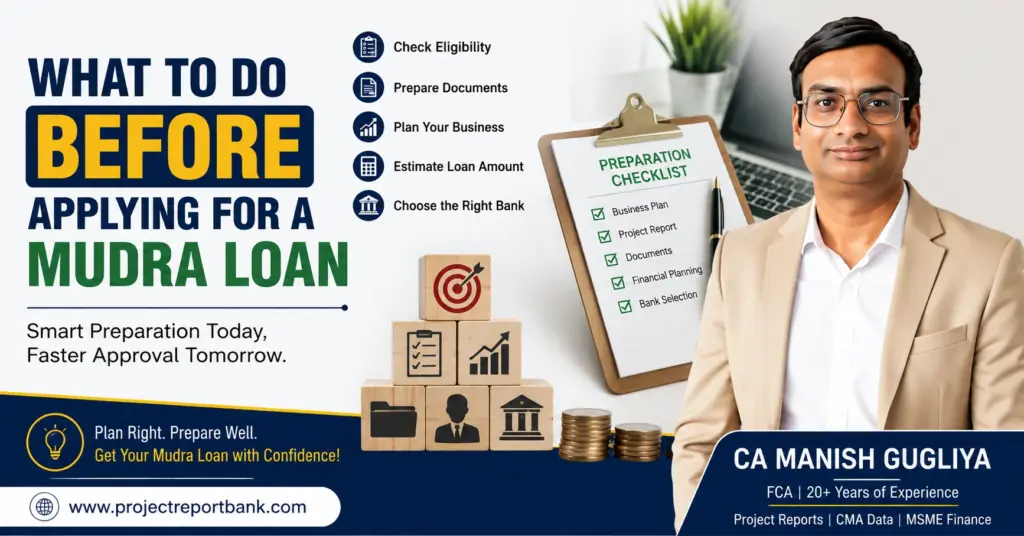
- What to Do Before Applying for a Mudra Loan
- Which Bank Should You Choose for Your Mudra Loan Application?

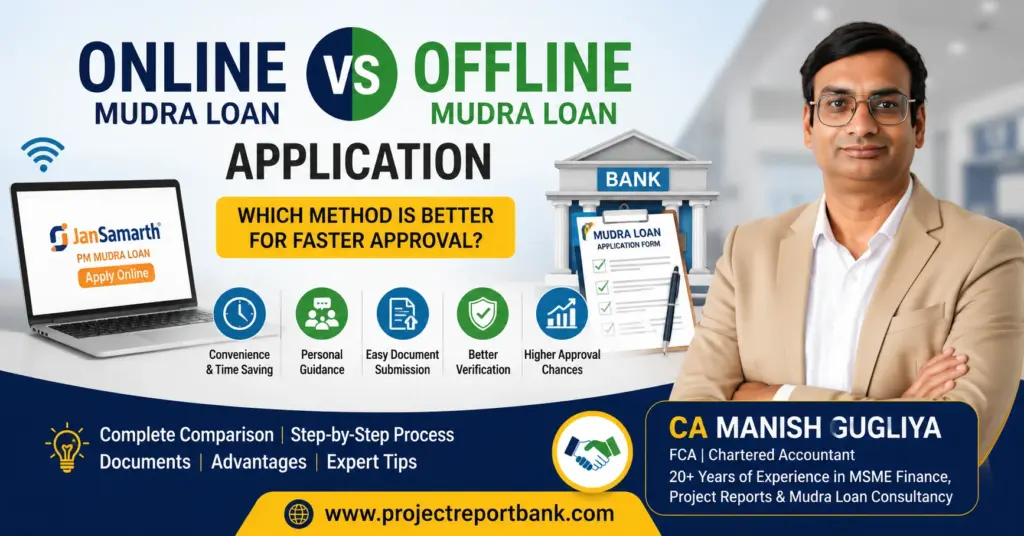
- Online vs Offline Mudra Loan Application: Which Method Is Better for Faster Approval?
- How to Fill the Mudra Loan Application Form Correctly
- How to Apply for a Mudra Loan: Step-by-Step Guide (By CA Manish Gugliya, FCA)