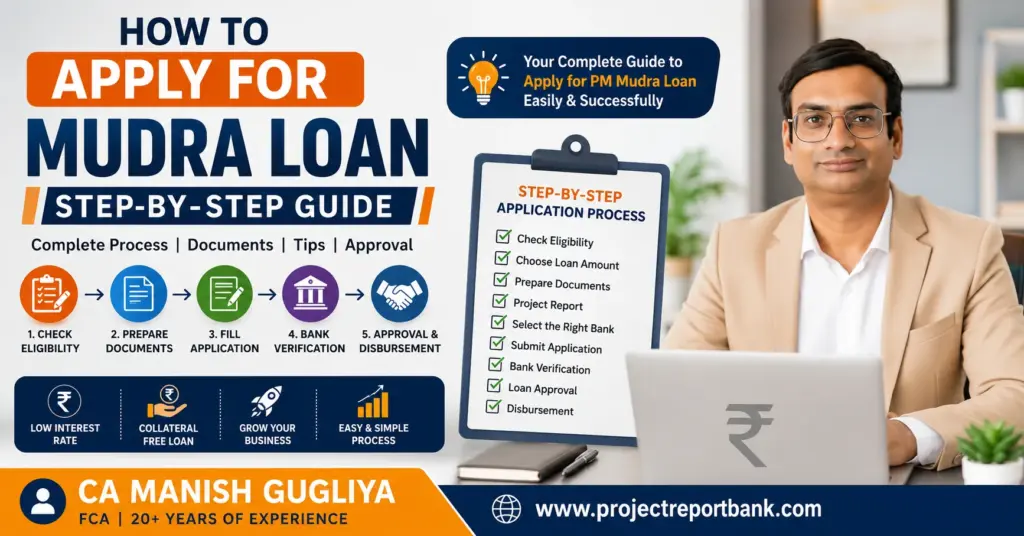
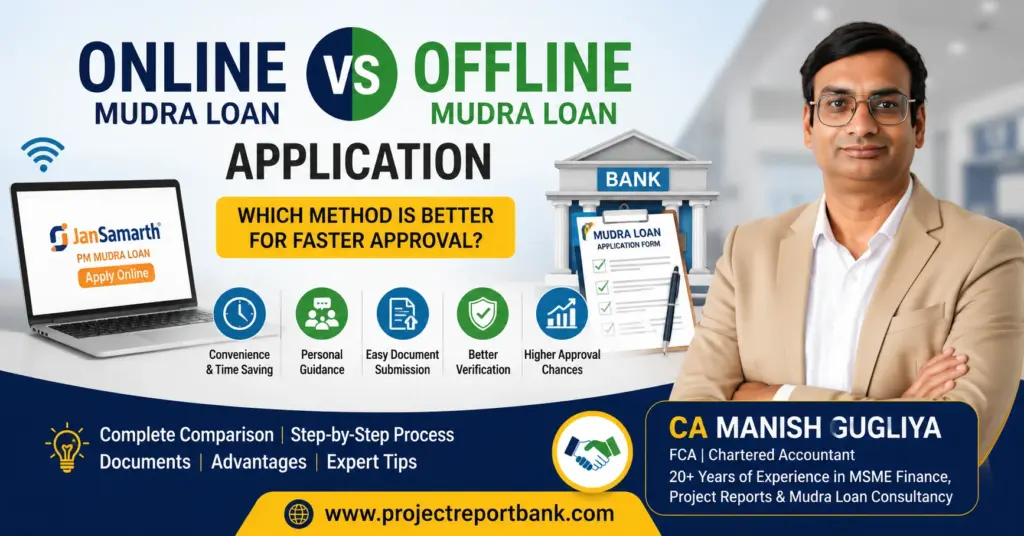
If you are planning to apply for a Pradhan Mantri Mudra Yojana (PMMY) loan, you have two clear paths: submit your application online through the JanSamarth portal or a bank website, or walk into a bank branch and apply in person. Both methods use the same eligibility criteria, require the same documents, and lead to the same loan products. The difference lies in how you submit, how fast the process moves, and how much guidance you receive along the way.
The short answer: Online applications through JanSamarth are faster for borrowers who have complete documentation and are comfortable with digital tools, especially for Shishu loans upto Rs 50,000 where Straight Through Processing (STP) can deliver in-principle approval within hours. Offline applications suit first-time borrowers, those with complex business plans, or applicants who need personal guidance from a loan officer. Approval itself depends on your documents, credit profile, business viability, and project report quality; not on whether you clicked “Submit” or handed over a file at a branch counter.
I am CA Manish Gugliya (FCA), and over 20+ years of helping entrepreneurs with project reports, CMA data, and MSME finance, I have seen both methods work and both methods fail. This guide shares what I have observed across hundreds of Mudra loan applications.
What Is Online Mudra Loan Application?
An online Mudra loan application means using a digital platform to apply for financial assistance under PMMY without physically visiting a bank or financial institution. The primary government portal for this is JanSamarth, launched on 6 June 2022, which integrates 14 credit-linked government schemes including Mudra loans. Applicants can also apply through individual bank websites or lending platforms.
The process involves registering with your mobile number and Aadhaar, filling out an application form with personal and business details, uploading scanned copies of KYC documents, bank statements, quotations, and a business plan or project report. The portal connects to verification databases for Aadhaar (UIDAI), PAN (NSDL), GST, Udyam registration, and credit bureaus like CIBIL, which means much of the authentication happens automatically.
Key features of the online route:
- 24/7 availability. You can start, save, and submit your application at any hour. No need to wait for banking hours.
- Real-time application tracking. JanSamarth provides a “My Applications” dashboard where you can see whether your application is Under Review, Digitally Approved, or requires additional documents.
- Digital record keeping. All uploaded documents are stored electronically. Many banks now use Aadhaar OTP-based e-signing and digital stamping for loan agreements.
- Lender selection. Over 200 financial institutions, including commercial banks, small finance banks, NBFCs, and MFIs, are onboarded on JanSamarth. You can compare and select a lender based on your location and preference.
Online applications do have clear limitations. Applicants using online channels should have digital literacy and a stable internet connection. Document uploads in online applications should meet strict format constraints to avoid rejections; blurry scans, wrong file types, or partially cropped documents are common reasons for delays. Online applications may limit personal guidance to online support and chatbots. If your business model is complex or you need help structuring your project report, the online channel offers little room for discussion.
Table of Contents
What Is Offline Mudra Loan Application?
Offline applications require visiting a bank branch and submitting physical copies of documents. You collect or download the application form, fill it out, attach photocopies of your identity proof, address proof, business registration, bank statements, quotations, and project report, and hand everything to the loan officer.
Face-to-face assistance is available for offline applications to clarify any questions. This is where the offline method holds a genuine advantage. The loan officer can review your business plan on the spot, point out weaknesses in your financial estimates, suggest whether you should apply under the Shishu, Kishore, or Tarun category, and guide you on the correct loan amount based on your proposed activity and stage of growth development.
Here is what offline brings to the table:
- Personal guidance. A loan officer can walk you through eligibility criteria, help you understand what a beneficiary micro unit entrepreneur needs to demonstrate, and advise on preparing a stronger application.
- Immediate error correction. If a document is missing or your application form has an error, you find out right there, not days later through a portal notification you might miss.
- Relationship building. Having a branch manager who understands your business can help in future dealings, whether you need a larger loan extended in the next phase or want to discuss working capital needs.
The drawbacks are equally clear. Branch visits consume time, especially if the nearest branch is far from your location. You may need multiple visits: once to collect forms, once to submit, and possibly more for follow-ups. Offline processing involves manual verification that generally takes longer. Internal branch reviews, physical document handling, and in some cases site inspections add days or weeks to the timeline. Branch capacity also varies; some branches process loans efficiently while others are understaffed and slow.
Online vs Offline Mudra Loan Application: How They Compare at a Glance
| Factor | Online Application | Offline Application |
|---|---|---|
| Best for | Digitally comfortable, experienced borrowers with documents ready | First-time borrowers, complex businesses, applicants needing guidance |
| Processing time | Faster; STP for Shishu loans can give in-principle approval in hours | Slower; typically 7 to 14 days for Shishu, 2 to 4 weeks for larger loans |
| Convenience | 24/7 access from anywhere with internet | Banking hours only; requires physical visits |
| Document submission | Digital scans uploaded on portal | Physical copies submitted at branch |
| Guidance available | Online help, chatbots, helplines | Direct discussion with loan officer |
| Application tracking | Real-time dashboard on JanSamarth | Requires branch visits or phone calls |
| Error correction | Slower cycle; depends on portal notifications | Immediate; corrected on the spot |
The core trade-off: online saves time and travel but removes the personal interaction that helps weaker applications become stronger.
Convenience and Accessibility
For micro enterprises engaged in manufacturing, trading and services, time spent away from the business is time lost on income generation. Online applications provide convenience and 24/7 access to applicants. An entrepreneur in a small town can apply at 11 PM after closing shop, without taking a day off to visit a branch.
Offline applications restrict you to banking hours, typically 10 AM to 4 PM on weekdays. If the branch is in a district headquarters and your micro unit is in a rural block, you may spend half a day on travel alone. Multiply that by two or three visits, and the opportunity cost adds up.
That said, not every borrower has reliable internet or a smartphone capable of handling document uploads. For applicants in areas with poor connectivity, or those who are unfamiliar with scanning documents and navigating web portals, the branch remains the more accessible option. Several of my clients in rural India prefer walking into their nearest regional rural bank or small finance bank branch simply because they trust the process more when they can see the person handling their file.
Winner: Online. The ability to apply from anywhere, at any time, without travel costs gives online a clear edge on convenience. The trade-off is that offline remains more accessible for borrowers who lack digital literacy or stable internet.
Processing Speed and Application Timeline
Pradhan Mantri MUDRA Yojana loans can be applied for online or offline, but the speed differs based on how verification happens.
Online processing is typically faster due to automated verification. For Shishu loans upto Rs 50,000, JanSamarth enables Straight Through Processing (STP). If your Aadhaar, PAN, credit bureau check, and Udyam registration all verify automatically, the system can generate an in-principle approval without manual intervention. Some applicants report receiving approval within a few business days when documentation is complete.
Offline applications for the same Shishu category typically take 7 to 14 days at best, because each document must be physically reviewed, internal checklists completed, and the branch must queue your file alongside other applications. For Kishore loans (₹50,001 to ₹5 lakh) and Tarun loans (₹5 lakh to ₹10 lakh), offline processing can stretch to 2 to 4 weeks or longer, especially if site inspections are required or quotations need verification.
A common misconception: submitting online does not guarantee fast approval. If your scanned documents are unclear, if there is a mismatch between your PAN name and bank account name, or if the bank demands a physical project report even after online submission, your application will stall. For Kishore and Tarun categories, many banks still require a branch visit for physical verification or document signing regardless of how you applied. Speed ultimately depends on document completeness and the lender’s internal workflow, not just the submission channel.
Winner: Online, particularly for Shishu loans where STP is enabled. For larger loan categories, the speed advantage narrows because manual steps often re-enter the process. The trade-off: offline applicants benefit from having their documents verified on the spot, which can prevent the back-and-forth delays that plague incomplete online submissions.
Personal Guidance and Support
This is where offline pulls ahead, and the gap is substantial for certain borrower profiles.
When a first-time borrower walks into a branch to apply for a Mudra loan for, say, a small manufacturing unit producing jute bags, the loan officer can ask targeted questions: What is your monthly raw material cost? Do you have quotations for machinery? What is your expected monthly revenue? This conversation shapes a stronger application. If the borrower’s project report has unrealistic revenue projections, the officer can flag it before submission rather than after rejection.
Online portals offer generic instructions. JanSamarth has help sections and some banks provide chatbot support, but these cannot evaluate whether your business plan makes sense for your local market. They cannot tell you that your quotation is outdated or that your financial estimates are missing the cost of rent and utilities.
I have seen many applications through my practice where the difference between approval and rejection was a 30-minute conversation with a good loan officer. For non-corporate small enterprises applying for Kishore or Tarun loans, where the bank needs to assess the viability of the proposed activity and the applicant’s necessary skills, personal interaction matters. A CA-prepared project report helps bridge this gap for online applicants, but it does not fully replace the dialogue that happens in a branch.
Winner: Offline. Direct interaction with a loan officer provides guidance that no portal currently replicates. The trade-off: online is sufficient for experienced borrowers who have a satisfactory credit track record, have successfully repaid previous loans, and know exactly what the bank expects.
Document Submission and Verification
Eligibility and documentation requirements remain the same whether applying online or offline. Here is what both methods require:
| Document | Online Submission | Offline Submission |
|---|---|---|
| Aadhaar Card | Digital scan / e-KYC via OTP | Physical photocopy + original for verification |
| PAN Card | Uploaded file; auto-verified via NSDL | Physical photocopy |
| Address Proof | Scanned upload | Physical copy |
| Bank Statements (3-6 months) | PDF or scanned upload | Printed statements, stamped by bank |
| Business Proof / Udyam Registration | Digital certificate uploaded | Printed certificate |
| GST Registration (if applicable) | Uploaded; auto-verified | Physical copy |
| Quotations for machinery / assets | Scanned copies | Physical originals or photocopies |
| Project Report / Business Plan | PDF upload | Printed, bound copy |
| Passport Photographs | Scanned | Physical photographs |
| Existing Loan Details | Declared in form; credit bureau auto-check | Declared in form; manual credit check |
Required documents include identity proof and business plan for both channels.
The online verification process integrates with Aadhaar (UIDAI), PAN (NSDL), income tax (CBDT), Udyam registration, and credit bureau databases. This pre-population of data reduces human error in data entry. But the quality of your scanned documents becomes the weak link. I have seen applications rejected because an applicant uploaded a photograph of their PAN card taken at an angle with part of the number cut off.
Offline submission lets you show original documents. The bank officer verifies them against photocopies right there, stamps “verified against original,” and returns your originals. If something is missing, you know immediately. The downside: human errors still occur. Branch staff can misfile documents, lose a page from your project report, or record incorrect figures.
For a detailed guide on organizing your documents before submission, refer to how to arrange your Mudra loan file before visiting the bank.
Winner: Tie, with different failure modes. Online is more efficient when documents are clean and properly scanned; offline is more forgiving when documents need explanation or on-the-spot correction. The best approach: prepare documents to avoid common documentation mistakes regardless of which channel you use.
Application Tracking and Communication
Online portals give you a clear advantage in knowing where your application stands. JanSamarth’s dashboard shows status updates: Applied, Under Review, Digitally Approved, Disbursed, or Additional Documents Required. Some banks send SMS or email notifications at each stage.
Offline applicants have no such dashboard. To check status, you call the branch, and the person who answers may or may not know where your file is. Or you visit in person, which costs another half-day. I have had clients who submitted their files offline and heard nothing for three weeks, only to discover that one document was missing and nobody had informed them.
This transparency gap creates real problems. When a bank needs additional information, online applicants receive portal alerts (though they must check regularly). Offline applicants may miss the bank’s phone call and lose days before they realize follow-up is needed.
Winner: Online. Real-time tracking and digital notifications give online applicants a clear view of their application’s progress. Offline tracking depends entirely on the branch’s communication culture, which varies from bank to bank.
Online vs Offline Mudra Loan Application: Which Should You Choose?
Choose online if:
- You are comfortable using web portals and scanning documents.
- You have an existing business with a satisfactory credit track record and have successfully repaid previous loans.
- Your documentation is complete and you know exactly how much Mudra loan you should apply for.
- You are applying for a Shishu loan (upto Rs 50,000) where STP can speed up approval.
- You are in an urban area with good internet access.
- You want to save time and avoid multiple branch visits.
Choose offline if:
- You are a first-time borrower who needs guidance on eligibility criteria and loan categories.
- Your business model is complex (manufacturing, allied agricultural activities, large-scale trading) and needs explanation.
- You are applying for a Kishore (₹50,001 to ₹5 lakh) or Tarun (₹5 lakh to ₹10 lakh) loan where a detailed business plan and project report discussion with a bank officer improves your chances.
- You are in a rural location with unreliable internet.
- You prefer face-to-face interaction and want the bank officer as a reference point for future credit needs.
The hybrid approach works well too. Several of my clients start on JanSamarth to check eligibility and identify which bank or financial institution to approach, then visit the branch to submit the project report in person and discuss their proposed activity. This combines the convenience of online with the guidance of offline.
Mudra loans are offered by banks, NBFCs, and MFIs across various financial institutions. Whether you go online or offline, the loan is assessed based on the same parameters: business viability, repayment capacity, credit profile, and completeness of documentation. Eligible loan amounts range from ₹50,000 to ₹10,00,000, and no collateral is required for loans up to ₹10,00,000. Eligible borrowers include proprietorship and partnership firms. Loans are provided for income-generating activities only.
The strongest all-around pick for most borrowers: if you have your documents ready and are applying for a smaller loan, go online. If your application needs a strong project report and you want someone to review your numbers before submission, go offline or use a hybrid approach.
Common Mistakes in Online Applications
Over the years, I have seen the same errors derail online applications repeatedly:
- Poor quality scans. Blurry, partially cropped, or low-resolution images of Aadhaar, PAN, or bank statements get flagged and rejected. Use a scanner app that produces clear PDFs.
- Incorrect data entry. A mismatch between the name on your PAN card and the name in your application form triggers verification failures. Check every field before submission.
- Wrong business category selection. Selecting the wrong sector (manufacturing trading vs services) or wrong loan category (Shishu vs Kishore) creates confusion and delays.
- Missing or outdated quotations. If you are purchasing capital assets like machinery, the bank needs current quotations. A quotation from six months ago may not be accepted.
- Ignoring portal notifications. When the bank requests additional documents through JanSamarth, you have a limited window to respond. Applicants who do not check the portal regularly lose time.
- Skipping the project report. For Kishore and Tarun categories, a project report is often mandatory. Submitting without one almost guarantees rejection.
- Not responding to bank calls. Even after online submission, the lender may call to verify details. Unanswered calls delay processing.
Common Mistakes in Offline Applications
Offline applications have their own set of recurring problems:
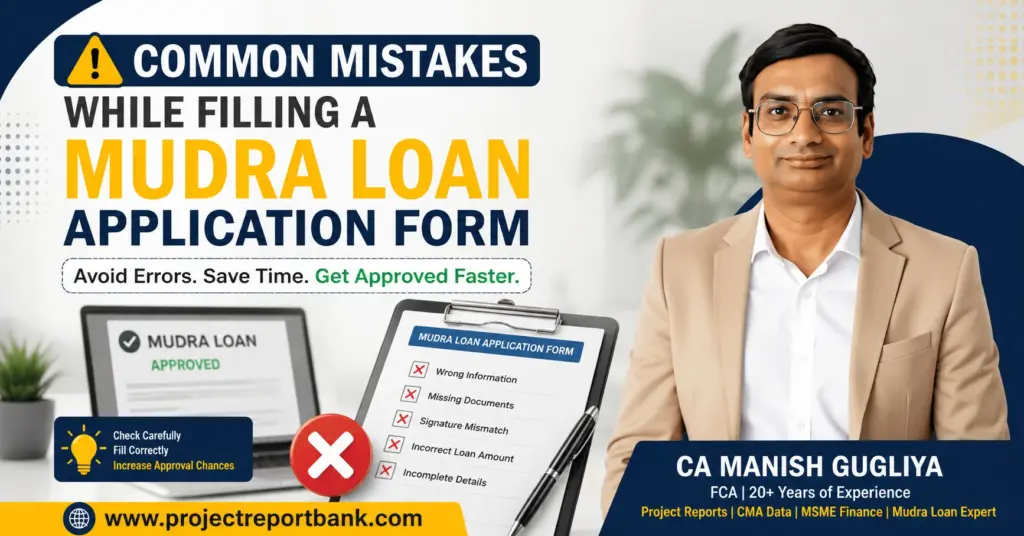
- Incomplete forms. Leaving fields blank or filling in approximate figures (especially annual turnover or existing loan obligations) creates issues during processing.
- Missing documents. Arriving at the branch without bank statements, or without the correct number of passport photographs, means another visit.
- Disorganized file. A loose pile of unstapled, unsorted documents frustrates the loan officer and increases the chance that a page gets lost. Refer to this guide on arranging your Mudra loan file for a systematic approach.
- No quotations for assets. If you need a term loan for purchasing equipment, you must provide vendor quotations. Arriving without them wastes the visit.
- Weak project report. Unrealistic revenue projections, missing expense categories, or no break-even analysis makes the bank question whether the business is viable. The quality of your project report directly influences how banks decide your Mudra loan amount.
- Delayed responses. If the bank asks you to bring an additional document or revised financials and you take two weeks to respond, your file moves to the bottom of the pile.
Expert Tips from CA Manish Gugliya
Based on my experience preparing project reports and CMA data for entrepreneurs across India, here is what I recommend:
- Prepare all documents before you start. Whether you choose online or offline, gather every document first. Half-prepared applications waste everyone’s time.
- Get a professionally prepared project report. For Kishore and Tarun loans, a well-prepared project report with realistic cash flow projections, break-even analysis, and clear cost estimates makes a measurable difference in approval outcomes.
- Choose the right loan amount. Do not apply for the maximum loan of ₹10 lakh if your business needs ₹3 lakh. Banks evaluate whether the requested amount matches the proposed activity. Overborrowing raises red flags. Use a proper assessment to determine how much Mudra loan you should apply for.
- Respond to bank queries within 24 to 48 hours. Speed of response signals seriousness. Whether the query comes via portal notification or a phone call from the branch, treat it as urgent.
- Maintain a clean repayment history. If you have previous loans, ensure they are current. Individual borrowers who have successfully repaid previous loans and maintain a satisfactory credit track record are viewed more favourably during credit assessment.
- Keep both digital and physical copies. Even if you apply online, keep printed copies of everything you uploaded. Some banks ask for physical verification even after digital submission.
- Understand your EMI obligations before applying. The repayment period typically ranges from one to five years. Interest rates for Mudra loans are deregulated; current interest rates range from 9.05% to 21%. Interest rates are fixed for Mudra loans, and banks are advised to charge reasonable interest rates. Calculate your EMI and make sure your business cash flow can support it.
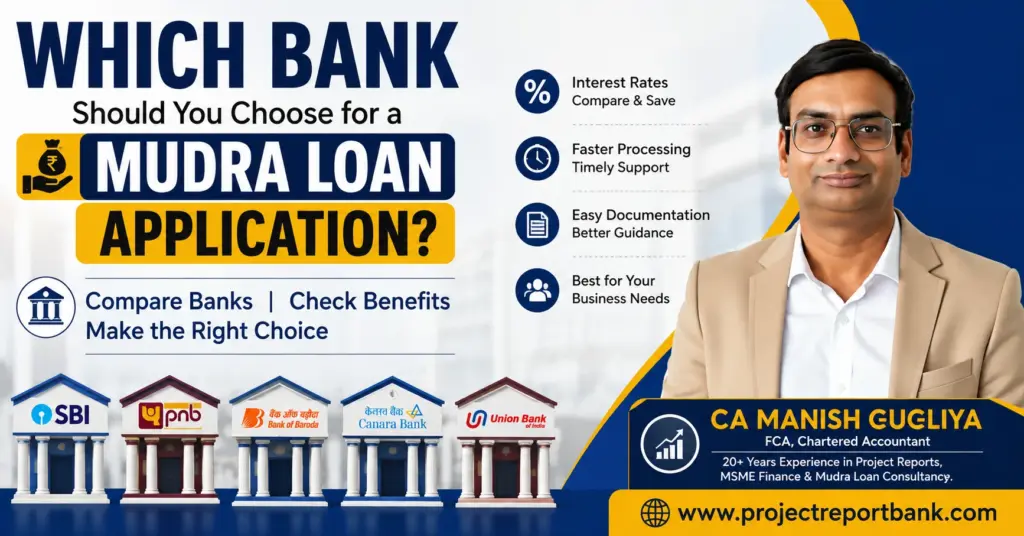
- Choose a responsive lender. Not all branches process at the same speed. Ask other entrepreneurs in your area which bank or financial institution handles Mudra loans efficiently. The choice of lender matters as much as the choice of application method.
Frequently Asked Questions
Can I apply for Mudra Loan completely online without visiting a bank?
For Shishu loans upto Rs 50,000, several banks process applications end-to-end on JanSamarth, including e-signing loan documents via Aadhaar OTP. For Kishore and Tarun categories, most banks still require at least one branch visit for physical document verification or agreement signing. Applicants can apply online through the JanSamarth portal, but complete avoidance of branch interaction is not guaranteed for larger loans.
Is JanSamarth portal better than applying directly on a bank’s website?
JanSamarth aggregates over 200 lenders in one place, lets you compare options, and integrates multiple verification databases (Aadhaar, PAN, Udyam, GST, credit bureau). A direct bank application limits you to that one lender. JanSamarth is a better starting point for most borrowers because it widens your choices and provides a unified tracking dashboard.
Can I switch from online to offline application mid-process?
There is no formal mechanism to “convert” an online application to offline. However, if your online application stalls or gets rejected, you can walk into the same or a different branch and apply offline with physical documents. Several of my clients have done this successfully. The reverse is also common: start on JanSamarth, then visit the branch to complete the process.
Which method has better approval rates?
Neither. Approval depends on documentation completeness, business viability, repayment capacity, credit profile, and project report quality. There is no published data showing that online or offline applications have higher approval rates for the same loan category and documentation quality.
Do banks charge different fees for online vs offline applications?
No. Mudra loans are available for non-corporate small enterprises under the same scheme launched by the government. There is no evidence that banks charge extra fees based on the application channel. The total cost of a Mudra loan includes interest, processing fees (where applicable), and stamp duty, all of which remain consistent regardless of how you apply.
Can I track my offline application online?
Not through a unified portal. Some banks offer loan tracking on their own websites if they assign a reference number at the time of submission. For most offline applications, you will need to call the branch or visit in person to check status.
Which method is recommended for first-time borrowers?
Offline, in most cases. First-time individual borrowers benefit from personal guidance on eligibility, loan categories (Shishu, Kishore, Tarun), document preparation, and project report structuring. The loan officer serves as a reference point who can help shape a stronger application. Once you have been through the process once and understand what banks look for, online becomes a faster option for subsequent applications.
Are document requirements different for online and offline applications?
No. Eligibility and documentation requirements remain the same whether applying online or offline. The difference is format: online requires clear digital scans in specified file formats; offline requires physical photocopies with originals for verification. The documents themselves (Aadhaar, PAN, bank statements, business proof, quotations, project report) are identical.
Which Mudra loan categories are available, and what are the eligible amounts?
Mudra loans support income generation and employment creation across three categories for non-corporate small enterprises: Shishu loans are up to ₹50,000; Kishore loans range from ₹50,001 to ₹5 lakh; Tarun loans range from ₹5 lakh to ₹10 lakh. Mudra loans are available up to ₹10 lakh. These cover micro enterprises and small and micro enterprises in the non farm sector, including manufacturing, trading, and services, as well as allied agricultural activities. No collateral or security is required, and there is no minimum educational qualification for eligible borrowers.
Conclusion
Neither online nor offline application guarantees Mudra loan approval. The method is the delivery channel; the substance is your documentation, your business viability, and your preparedness.
Online works best when your documents are complete, your credit profile is clean, and you are applying for a smaller loan where automated processing can save you days. Offline works best when you need guidance, your business plan requires explanation, or your application involves larger amounts where a face-to-face discussion strengthens your case.
The factors that actually determine approval remain constant across both channels: complete and accurate documentation, a realistic and professionally prepared project report, genuine income generation potential, adequate repayment capacity, and timely response to bank queries.
Choose the method that matches your comfort level and situation. If you need help with your Mudra loan application or project report preparation, work with a qualified professional who understands what banks look for and can help you put your best application forward.
- Common Mistakes While Filling a Mudra Loan Application Form

- What to Do Before Applying for a Mudra Loan

- Which Bank Should You Choose for Your Mudra Loan Application?
- Online vs Offline Mudra Loan Application: Which Method Is Better for Faster Approval?
- How to Fill the Mudra Loan Application Form Correctly

- How to Apply for a Mudra Loan: Step-by-Step Guide (By CA Manish Gugliya, FCA)