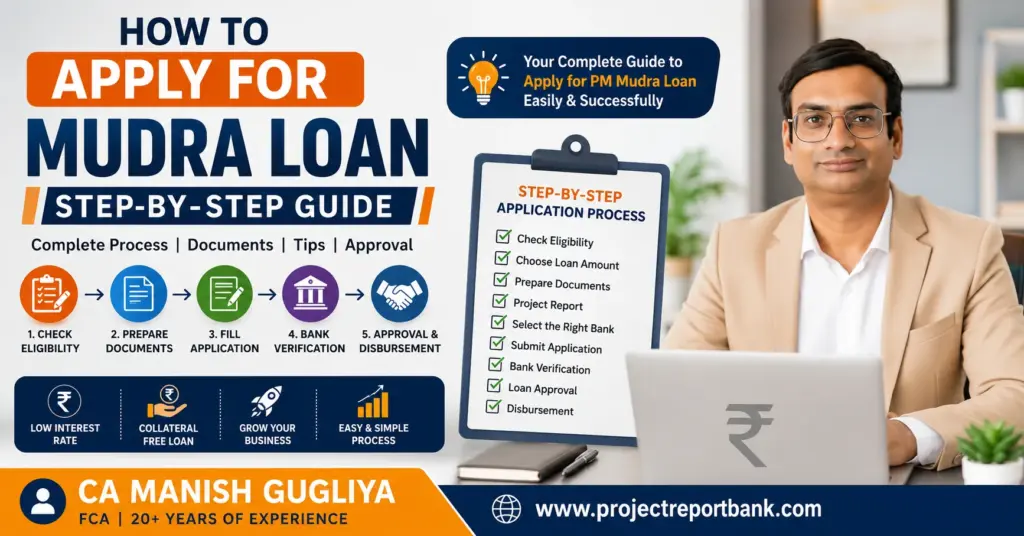
Key Takeaways
- Most Mudra loan delays and rejections come from avoidable form errors, not from the scheme being “closed” or lack of collateral.
- Mismatches in Aadhaar, PAN, spelling of name, address, and signature are among the top reasons files get stuck during verification.
- Choosing the wrong Mudra loan category (Shishu, Kishore, or Tarun) and an unrealistic loan amount reduces approval chances right away.
- An incomplete project report and weak business information make the bank doubt repayment capacity, especially for Kishore and Tarun loans.
- Using a checklist and reviewing the Mudra loan application form twice before visiting the bank branch can save 2 to 3 extra trips and weeks of delay.
Introduction
A small food stall owner in Varanasi waited six weeks for his Mudra loan. The reason was not policy or collateral. It was a wrong digit in his PAN number, a missing signature on page 3, and a blurred Aadhaar photocopy. Three mistakes, three extra visits to the bank, and over a month lost.
While the Mudra loan is collateral-free and government-supported, bank officers still follow strict verification rules before loan approval. Incomplete or incorrect documentation leads to immediate rejection. Mismatches and incomplete forms are common reasons for Mudra loan application rejection across branches.
As a practising Chartered Accountant who has reviewed hundreds of Mudra loan files across regional rural banks, small finance banks, and microfinance institutions, I see the same avoidable mistakes repeating. The problems are rarely about policy or eligibility criteria. They are about how applicants fill the loan application form and attach documents.
This article walks you through every common mistake in Mudra loan applications and shows exactly how to avoid them, whether you mudra loan apply online or through a physical bank branch. Mudra loans can be applied online or offline; the form errors are the same in both modes.
Table of Contents
Why Filling the Mudra Loan Form Correctly Matters
A clean, correctly filled Mudra loan application form makes the banker’s job easier and directly improves your approval chances. When all fields match Aadhaar, PAN, current account, and business documents, the branch can complete KYC and credit appraisal in one go.
Accurate documentation is essential for processing Mudra loans without delays. Loan approval typically takes 7 to 30 working days when the file is complete; errors can stretch this to 60 days or more.
Practical benefits of a well-filled form:
- Fewer visits to the bank branch
- Faster movement from “file received” to “sanction”
- Fewer chances of silent rejection or long “under process” mudra loan application status
- Better credibility with branch managers who handle dozens of files daily
If you want a walkthrough of the entire application process, read this step-by-step guide on how to fill the Mudra loan application form correctly.
Top Mistakes Applicants Make While Filling the Mudra Loan Application Form
This section covers the key form-level and information-level mistakes I commonly see in mudra applications. These errors apply to both physical forms filled at the bank branch and digital forms when you apply online through portals like the udyamimitra portal or JanSamarth.
Selecting the Wrong Mudra Loan Category
The three Mudra categories are:
| Category | Loan Amount Range |
|---|---|
| Shishu | Up to ₹50,000 |
| Kishore | ₹50,001 to ₹5,00,000 |
| Tarun | ₹5,00,001 to ₹10,00,000 |
Many applicants wanting ₹3 to 4 lakh tick Shishu, or those needing only ₹40,000 working capital apply under Kishore to “get more money.” Wrong loan category selection confuses the credit officer because eligibility criteria, documents, and assessment depth differ across categories.
A tailoring unit needing ₹1.8 lakh for new machines marked Shishu. The application was returned, the form had to be refilled under Kishore, and the delay stretched to 15 days. Select the right loan category based on business scale and turnover. If you are unsure, read about how banks decide your Mudra loan amount or how much Mudra loan you should apply for.
Applying for an Unrealistic Loan Amount
Two common extremes: asking for the maximum ₹10 lakh even when business can justify only ₹2 to 3 lakh, and requesting an amount too small to cover the actual project cost. Providing inflated cost estimates can lead to rejection of loan applications. Banks may reject applications due to low business viability assessments when turnover and the requested loan amount do not align.
A tea stall owner with monthly sales of ₹40,000 applied for a ₹7 lakh tarun loans category without a clear expansion plan or supporting bank statements. The file was rejected. Under-estimating the amount creates a different problem: working capital shortage later, making repayment difficult. Use realistic projections of sales, margins, and repayment to decide the right figure. You can also check the minimum Mudra loan amount to understand the lower end.
Leaving Mandatory Fields Blank
Fields often left blank by many applicants:
- Full residential address and current address
- Mobile number and email
- Aadhaar number and PAN card details
- Type of business entity (proprietorship, partnership, etc.)
- Existing bank account details
Bankers cannot proceed with CIBIL check, KYC, or loan appraisal if any of these fields are missing. You need Aadhaar and PAN cards for Mudra loan applications; leaving those fields empty means the form goes straight to the bottom of the pile. Submit valid identity proof and other mandatory documents. If you are unsure what to write in a particular field, ask bank staff rather than leaving it empty. Every box marked with an asterisk must be filled, even if the answer is “Not Applicable.”
Spelling Mistakes in Personal Details
Minor spelling differences in name or father’s name between Aadhaar, PAN, bank passbook, and the form cause KYC mismatch alerts. “Sanjay Kumar” on Aadhaar, “Sanjai Kumar” on PAN, “Sanjay Kumr” on the form; enough to make the system flag the identity. Common mistakes include mismatched personal details and vague business plans in applications.
Cross-verify all spellings against official government IDs to avoid KYC verification issues. Keep Aadhaar and PAN in front of you while filling the form. Copy spellings exactly as printed, including initials and middle names. If a spelling is wrong on any government document, correct the document first or attach a clarification letter.
Entering Incorrect Aadhaar or PAN Number
Even a single wrong digit in Aadhaar or PAN results in instant verification failure when the branch uploads the application to the bank system. PAN is used to check cibil score, existing loans, and whether another Mudra loan is already active. A CIBIL score below 650 may result in application denial, but a wrong PAN means the check cannot even begin.
In one case, a Kishore loan stayed pending for 20 days because one PAN digit was wrong; the file had to be re-processed after correction. In online modes, incorrect Aadhaar or PAN may prevent OTP validation or e-KYC from completing entirely. Read Aadhaar and PAN numbers from original cards, not from memory. Verify twice before signing.
Giving Wrong or Confusing Business Information
Typical errors: writing “business” or “shop” instead of clear nature of business activity, using the wrong NIC code, or mixing up manufacturing and trading. Applying as an individual instead of a business entity causes confusion at the appraisal stage. Neglecting proof of active business operations can lead to Mudra loan rejection. Applying without business registration can also lead to rejection.
An applicant claimed to run a 3-year-old mobile repair shop but wrote “new start-up” elsewhere in the form and gave no past turnover or income details. The branch doubted business viability. Business proof like Udyam or GST registration is necessary. Keep your Udyam registration, shop act licence, and business plan handy while filling this section. Correct business details help the bank assess sector risk, working capital cycle, and the right Mudra loan category.

Using Different Signatures on Different Pages
Signature mismatch is one of the most frustrating reasons for return of Mudra loan applications. Bankers compare signatures on the application form with those on the existing savings or current account, Aadhaar, PAN, and specimen signature card.
An applicant signed in full on the application form but only initials on the KYC documents. The bank called them back for re-signing, adding a week to the process. Use the same, consistent signature everywhere as per your bank account records. If you have recently updated your signature in the bank, inform the credit officer and ensure the system is updated before loan processing begins.
Uploading or Submitting Unclear or Invalid Documents
Blurred photocopies, cut-off pages, Aadhaar printed on an old address, expired shop licence, or unreadable scanned bank statements all stall the file. In online Mudra loan applications, low-resolution uploads get rejected during manual scrutiny. A 6-month bank statement is required for Kishore loans; missing pages halt underwriting. Passport-sized photos are also part of the required documents; attaching old or unclear photos creates avoidable friction.
Use clear, full-page photocopies, preferably self-attested with date. Before visiting the bank, arrange your Mudra loan file in logical order so that KYC, business proof, bank statements, and project report are easy to locate.
Ignoring the Project Report or Business Plan
For Shishu category, many banks accept a simple note. For Kishore and Tarun, a project report or basic business plan is practically necessary. Failing to provide a clear business plan can hinder approval chances. A simple business plan may be needed for higher loan categories.
Submitting only the bare loan application form without explaining how the money will be used, without turnover projections, or without a repayment plan makes the bank doubt business viability. Provide realistic project reports to prevent rejection of Mudra loan applications.
A simple Mudra project report should cover: business profile, promoter background, investment required, expected sales, margins, monthly EMI, and supporting assumptions. If you are not comfortable preparing financial projections, consider getting a CA-prepared project report for Mudra loan. You can also read about whether a project report is mandatory for Mudra loan.
Submitting the Form Without Reviewing It
Many applicants fill the form in a hurry at the bank counter, sign quickly, and submit without reading it once. This leads to repeated small mistakes: wrong date, missing signature on one page, unchecked declaration boxes, or mismatched loan amount written in numbers and words.
A simple 2-step review process:
- Check that every field is filled and signatures are in place on all pages.
- Cross-match main details (name, Aadhaar, PAN, address, loan amount) with your documents.
Keep a photocopy or scanned copy of the final signed form and documents before handing them over to the bank. This helps if corrections are needed later.
Mistakes That Can Specifically Delay Mudra Loan Approval
Many Mudra loan files are not rejected outright; they keep moving slowly due to small issues that trigger additional verification.
Typical delay-causing mistakes:
- Missing supporting documents like bank statements, utility bills, rental agreement, or business proof
- Unsigned declarations about existing loans or old dues; existing loan disclosures must be made honestly when applying
- Address mismatch between Aadhaar, electricity bill, rent agreement, and the form triggers field visits
- Wrong or inactive mobile number; not linking the mobile number to Aadhaar delays OTP verifications
- Undisclosed cheque returns or credit history issues; a CIBIL score below 650 can result in loan denial
- Lack of awareness about eligibility criteria causes many rejections that applicants mistake for “scheme unavailability”
For a deeper dive into documentation-specific errors, read about common documentation mistakes that delay Mudra loan approval.
Mudra Loan Application Checklist Before Submission
Use this checklist while sitting in front of the form:
Personal Details:
- Full name, date of birth, father’s/spouse’s name exactly as per Aadhaar/PAN
- Current mobile number and email ID written clearly
Aadhaar & PAN:
- Numbers verified digit by digit from originals
- Clear, self-attested copies with date and signature
Business Details:
- Nature of business, NIC code, years of experience, and business address match business registration, shop licence, or GST registration
- Business entities type (proprietorship/partnership/company) correctly mentioned
Loan Details:
- Loan amount in words and figures match
- Category (Shishu/Kishore/Tarun) correctly ticked
- Purpose of loan (working capital, machinery, vehicle) clearly written
Project Report:
- Basic business plan or project report attached for Kishore and Tarun with realistic sales and repayment estimates
Banking Details:
- Existing savings or current account numbers, IFSC code verified
- Bank statements for required months attached fully
Signatures & Photographs:
- All signature spots signed in the same style as bank records
- Recent passport-size photographs affixed
Final Verification:
- Flip through all pages in submission order; confirm nothing is missing
- Mudra loan applications should be submitted directly through banks or official portals; online applications require registration on the official Mudra portal

Expert Tips from CA Manish Gugliya for Error-Free Mudra Loan Applications
These tips come from more than 20 years of practical experience helping micro entrepreneurs and small business owners secure bank finance, including Mudra loans across various banks, NBFCs, and lenders.
- Never rush form filling at the bank counter. Take the form home, fill it calmly with all documents around, then return with a complete file.
- Keep originals of Aadhaar, PAN, address proof, business proof, and tax returns on the table while filling the form to avoid guessing details.
- Double-check all numbers: Aadhaar, PAN, mobile number, bank account, IFSC, loan amount. These are the most common points of error.
- Prepare a realistic, data-backed project report. A clear business plan with a realistic processing fee structure and income projections strengthens your case, especially for Tarun-level loans.
- Match information across all places: the same turnover range, same start date of business, same business activity in Udyam, GST, project report, and the Mudra loan form.
- Always keep one full photocopy set of the entire application before handing over to the bank branch.
- If any column is confusing, ask the credit officer. You can also refer to a detailed guide on how to apply for a Mudra loan.
- Applicants can track their mudra loan application status and application reference number on the UdyamiMitra portal after submission.
- Before you apply, understand what to do before applying for a Mudra loan so your preparation covers every base.
The scheme aims to support small businesses and growing number of entrepreneurs across India. Most banks, regional rural banks, and small finance banks do not provide direct loans without verifying the form thoroughly. Making their job easier is the fastest way to get your mudra loan approved.
Frequently Asked Questions
These FAQs cover practical doubts that come up after someone has already tried filling a Mudra loan application form.
Can I correct my Mudra loan application form after submitting it to the bank branch?
Small corrections like spelling errors, wrong digits in Aadhaar or PAN, or missing signatures can usually be rectified by visiting the branch again and re-signing or giving a written correction request. Major changes like changing loan amount, category (Shishu to Kishore), or business details might require a fresh form. Ask the credit officer whether a correction letter or a fresh application is needed based on the stage of processing.
Will one or two spelling mistakes in my address or father’s name lead to rejection?
Minor spelling differences may not automatically cause rejection, but they slow down KYC and may require additional address proof or clarification. If the variation is large (completely different spelling or missing part of the name), the bank might ask for document correction or additional affidavits. Proactively inform the bank in writing if your Aadhaar and PAN spellings differ, and attach extra supporting documents with consistent details.
Do I need a current account before applying for a Kishore or Tarun Mudra loan?
A current account is often required for Kishore and Tarun loans because these direct loans are meant for business transactions. Not having a current account can lead to application rejection at some branches. Some branches allow opening the current account along with the loan process, while others ask for an existing one before accepting the application. Clarify this with your chosen bank branch in advance. You can also compare online vs offline Mudra loan application processes to understand which route suits your situation.
Is a project report compulsory for all Mudra loan applications?
For very small Shishu loans (below ₹50,000), some banks accept a simple application with a brief description of business needs and purpose. For higher Shishu amounts, Kishore, and Tarun, most banks in practice expect at least a basic project report because it helps them verify business viability and repayment capacity. Even for Shishu, preparing a simple 4 to 6 page business plan smooths the process.
How can I be sure that my Mudra loan application will not be rejected due to form mistakes?
No consultant or bank can guarantee mudra loan approval, but you can reduce the chances of rejection by avoiding the mistakes listed in this article and following the submission checklist. Three final checks: verify all personal and document numbers, ensure consistent business information across all papers, and attach a clear project report with realistic figures. An extra 30 minutes of calm review before going to the bank branch can save several weeks of delay. Prepare a complete, error-free Mudra loan application with a professionally prepared project report, and qualify for the loan amount your business truly needs.
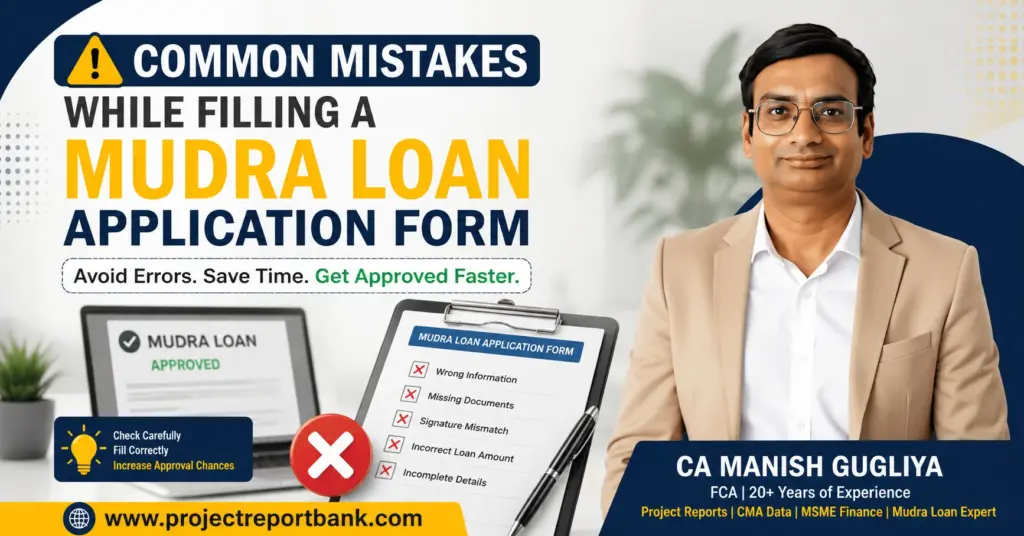
- Common Mistakes While Filling a Mudra Loan Application Form
- What to Do Before Applying for a Mudra Loan

- Which Bank Should You Choose for Your Mudra Loan Application?

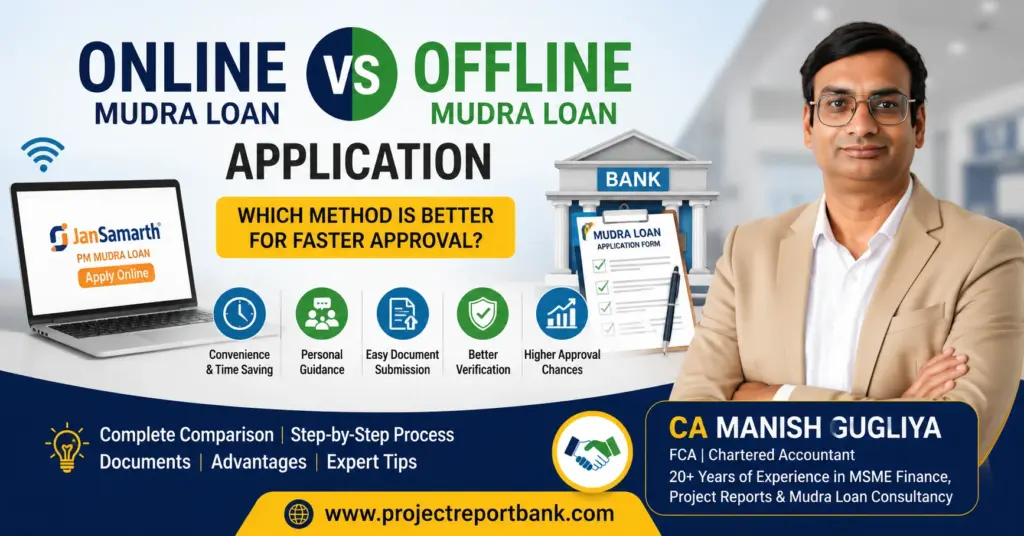
- Online vs Offline Mudra Loan Application: Which Method Is Better for Faster Approval?
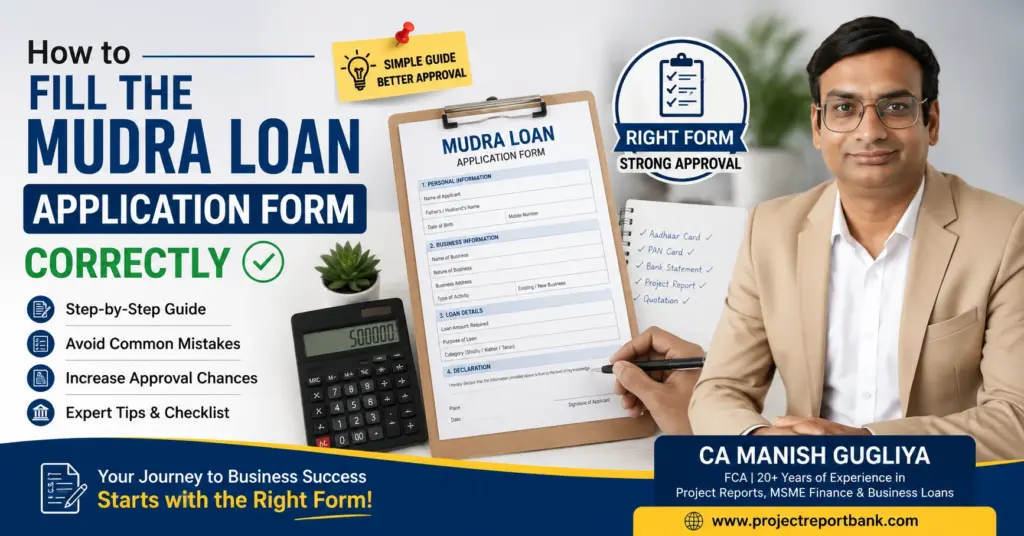
- How to Fill the Mudra Loan Application Form Correctly
- How to Apply for a Mudra Loan: Step-by-Step Guide (By CA Manish Gugliya, FCA)