Key Takeaways
- Machinery details in a Mudra Loan project report must show what is being purchased, why it is required for the business activity, exact cost (including GST, freight, installation), and how it connects to production capacity and loan requirement.
- Banks use machinery details to judge project cost, technical feasibility, and repayment capacity-not merely as a list of fixed assets.
- A proper machinery schedule should reconcile with overall project cost, means of finance, and financial projections in a bank ready project report.
- Requirements may vary by bank and loan size, but a clear, item-wise machinery list with supporting quotations is generally expected for manufacturing and equipment-heavy service units.
- This article is written from the professional perspective of CA Manish Gugliya (ProjectReportBank.com), with practical examples suitable for first-time Mudra Loan and other small business loan applicants.
Introduction: Why Machinery Details Need More Than “Machinery – ₹5,00,000”
For Mudra Loan and other bank loans, plant and machinery often forms the largest part of project cost-especially for manufacturing, processing, fabrication, food processing, printing, and certain service businesses. A Mudra loan project report outlines business plans and financial needs, and typically covers 10 to 15 pages of detailed information including business description, market analysis, financial projections, and a repayment plan.
Writing “Machinery – ₹5,00,000” in a loan project report is not sufficient for bank appraisal. Bankers need clarity on what equipment is being purchased, its role in the business, and whether the cost and capacity look reasonable. A professional project report should show: name of each machine, basic specification, quantity, cost break-up, supplier or quotation basis, and related expenses such as GST, transport, and installation. Accurate financial projections enhance loan approval chances significantly.
The exact level of detail may differ depending on nature of business, Mudra category-Mudra loans are categorized into Shishu, Kishore, and Tarun schemes, and can provide up to ₹10 lakhs for business funding-the loan amount, and bank policy. There is no single fixed RBI-prescribed format for machinery details. Machinery selection should align with the proposed business activity; readers may also refer to the article on business activity and project description in a Mudra Loan project report for guidance on connecting machines with operations.
Why Machinery & Equipment Details Matter in a Mudra Loan Project Report
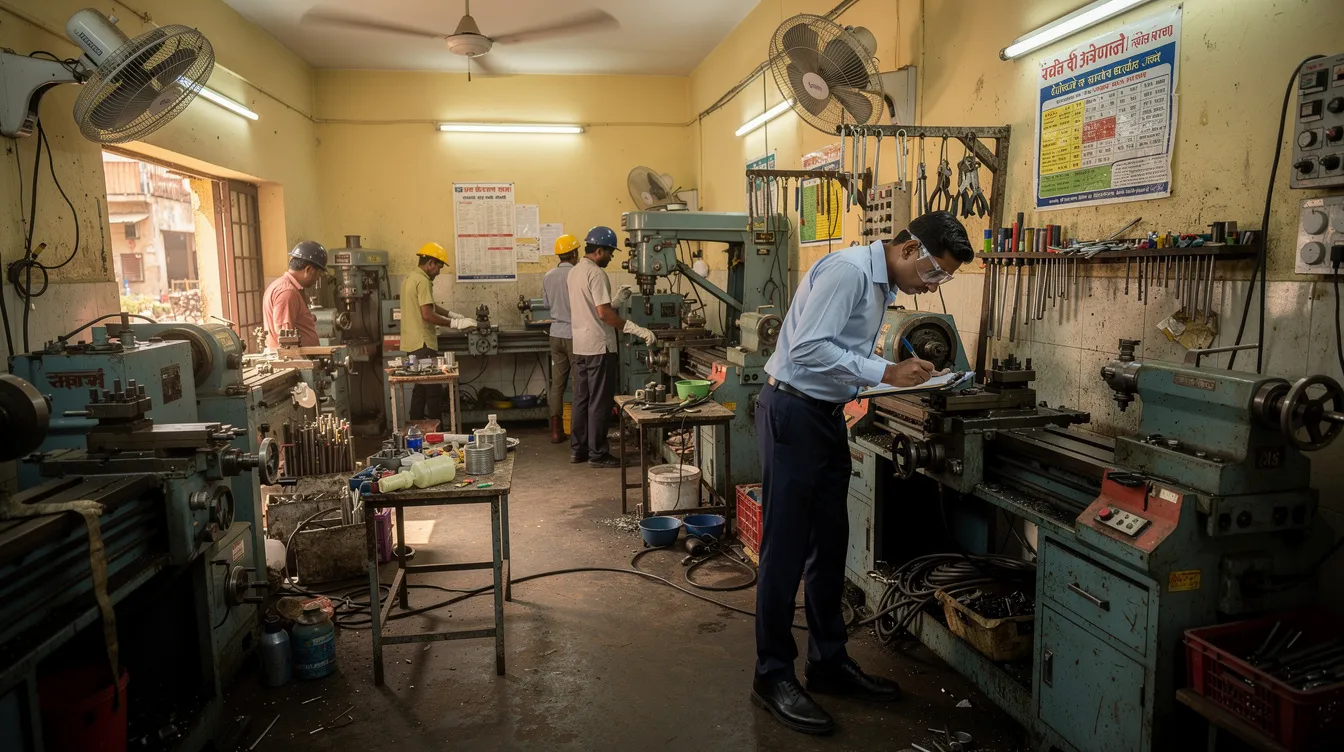
From a bank appraisal point of view, machinery and equipment details in a Mudra Loan project report serve multiple purposes. Banks require a detailed project report for Mudra loan approval, and the machinery section of a PMMY loan project report verifies technical feasibility and end-use of funds.
A clear machinery list helps the bank understand:
- Purpose of finance – what exactly the bank loan is funding and whether it is going toward productive equipment
- Nature of the business – whether the enterprise is manufacturing, service-oriented, or trading, and whether the equipment matches
- Reasonableness of project cost – whether the amounts quoted are market-compatible for the proposed scale
Machinery details directly influence assessment of production or service capacity, which links to projected sales, cash flow, and debt service coverage ratio used to judge repayment capacity. DSCR indicates repayment capacity, and the project report must include financial projections and repayment plans. Financial projections include Profit & Loss, Balance Sheet, and Cash Flow, with projections typically covering a period of three to five years. The report must include a repayment schedule for the loan, and a projected Profit & Loss Account is essential.
Machinery figures must be consistent with the overall project cost in a Mudra Loan project report, the means of finance in a Mudra Loan project report, business activity description, and financial projections. Inconsistent numbers create doubt during bank appraisal. In practice, some lenders may ask for project reports even for smaller Mudra amounts, while others insist only for Kishore and Tarun categories. Requirements may vary depending on Mudra Loan amount and project report requirements and when a bank asks for a project report for Mudra Loan.
Table of Contents
What Machinery & Equipment Details Should Be Included?
Here is the practical checklist of fields to capture for plant and machinery details in a Mudra Loan project report or any report for bank loan purposes. Banks often look for details about machinery, costs, and supplier information in project reports, and the project report should explain the necessity of each machine for business operations.
Key fields for every machine or equipment item:
- Name of machinery – e.g., “Turbo Flour Mill” or “Spice Grinding Machine”
- Functional description – what the machine does in business operations
- Key specification – capacity (kg/hour), HP, size, model
- Quantity – number of units
- Unit price – ex-factory or supplier’s quoted basic price
- Basic value – unit price × quantity
- GST amount – applicable rate and tax amount
- Freight/transport – cost to bring equipment from supplier to site
- Installation and erection – mounting, alignment, foundation
- Electrification – wiring, panel, motor connections where relevant
- Supplier/vendor name – with address for verification
- Quotation reference/date – for the banker to cross-check
- Total landed/installed cost – sum of all components
A clear tabular list of required machinery is necessary for project reports. Not all projects need every field-very small tools may not require detailed specs-but for major machines financed under Mudra Loan, these details build confidence during appraisal.
Recommended machinery schedule format:
| Particulars | Specification | Qty. | Unit Cost (₹) | Basic Cost (₹) | GST/Taxes (₹) | Freight & Installation (₹) | Total Cost (₹) |
|---|
This machinery schedule should appear as a separate annexure or section in a Mudra Loan project report format in Excel or PDF. Column headings should be clear and banker-friendly.
Example of Machinery Details in a Mudra Loan Project Report
Consider a small flour milling unit (atta chakki) with a Mudra Loan requirement of approximately ₹7–₹8 lakh. Below is an illustrative machinery schedule:
| Particulars | Specification | Qty. | Unit Cost (₹) | Basic Cost (₹) | GST @18% (₹) | Freight & Installation (₹) | Total Cost (₹) |
|---|---|---|---|---|---|---|---|
| Flour Mill Machine | 200 kg/hr, 10 HP | 1 | 2,50,000 | 2,50,000 | 45,000 | 25,000 | 3,20,000 |
| Cleaning/Sifter Unit | 200 kg/hr | 1 | 50,000 | 50,000 | 9,000 | 5,000 | 64,000 |
| Weighing & Packing Machine | 50 kg capacity | 1 | 60,000 | 60,000 | 10,800 | 6,000 | 76,800 |
| Sealing Machine | Semi-automatic | 1 | 40,000 | 40,000 | 7,200 | 3,000 | 50,200 |
| Electrical Panel & Wiring | For all machines | 1 | 30,000 | 30,000 | 5,400 | 4,000 | 39,400 |
| Total Plant & Machinery | 4,30,000 | 77,400 | 43,000 | 5,50,400 |
(All figures are illustrative and for understanding purposes only.)
This total machinery cost of ₹5,50,400 flows into the project cost statement under “Plant & Machinery” alongside furniture, pre-operative expenses, and working capital margin. The projected production and monthly sales in the financial projection must be achievable from the given machinery capacity and working days-a point banks cross-check during appraisal.
How to Present Machinery Quotations and Supplier Details
Supplier quotations help in verifying the authenticity of machinery costs in project reports. While not claiming quotations are compulsory in every case, most lenders expect them for Kishore and Tarun category proposals.
A good machinery quotation for Mudra Loan or bank loan should include:
- Supplier name and address
- Machinery name, model, and technical specification
- Quantity and basic price per unit
- GST rate and amount
- Freight, packing, and forwarding charges
- Installation and commissioning charges
- Quotation date and validity period
- Basic payment terms
Proforma quotations from certified equipment vendors must be attached to the project report. For small, widely available items, a formal quotation may be replaced by price lists or online catalogue printouts. For customised or higher-value machines, proper supplier quotations are expected.
Reference quotations inside the project report clearly-for example: “As per quotation dated 15 May 2026 from XYZ Engineering, Ahmedabad, enclosed as Annexure–M1.” Before starting, entrepreneurs should collect key quotations and other information required for a Mudra Loan project report, because missing quotes often delay processing.
Should GST Be Included in Machinery Cost in the Project Report?
There is no one-size-fits-all rule. Treatment of GST on plant and machinery depends on whether the business is or will be GST-registered and whether input tax credit is available.
- GST-inclusive approach: If the business is not GST-registered or cannot claim input credit, GST becomes part of capital cost. The total project cost should include the full invoice value.
- Net-of-GST approach: If input tax credit is available, GST may be shown separately. However, the actual cash outflow still includes GST (claimable later), so the funding requirement should account for this.
Numeric example: Basic machinery price ₹4,00,000 + GST @18% = ₹72,000 + Freight ₹10,000 + Installation ₹8,000. Total invoice and setup = ₹4,90,000. This figure appears in the machinery schedule and project cost accordingly.
Whatever approach is adopted, numbers must be consistent between machinery schedule, project cost, and means of finance in a Mudra Loan project report. Applicants should follow their accountant’s advice and the bank’s guidance, especially for existing business units already registered under GST.
Freight, Installation & Other Machinery-Related Costs
In practice, equipment cost in a Mudra Loan project report should consider not just the ex-factory machine price but all reasonable costs required to make the machine operational at the business location. Omitting these costs leads to understated total project cost and potential funding shortages later.
Key additional charges to consider:
- Transportation/freight from supplier to site
- Loading, unloading, packing, and forwarding
- Installation, erection, and alignment
- Civil foundation for heavy machines
- Electrical cabling, panel connection, and wiring
- Commissioning, trial runs, and calibration
- Minor tools and accessories essential for operation
These costs can be shown as part of each machine’s “Freight & Installation” column or as a separate line in the project cost. Double counting must be avoided. Applicants should obtain approximate figures for transport and installation while collecting the equipment quotation for Mudra Loan so that bank queries on cost reasonableness are minimised.
How Machinery Cost Connects With Total Project Cost
The machinery schedule total must reconcile with the “Fixed Assets” or “Project Cost” summary in the main project report. It should detail the total project cost and means of finance clearly. Depreciation calculations depend on the total value of plant and machinery, so accuracy here flows through the entire report.
Illustrative reconciliation:
| Project Cost Head | Amount (₹) |
|---|---|
| Plant & Machinery (as per schedule) | 6,50,000 |
| Furniture & Fixtures | 75,000 |
| Computer & Printer | 25,000 |
| Pre-operative & Contingencies | 50,000 |
| Working Capital Margin | 2,00,000 |
| Total Project Cost | 10,00,000 |
Any difference between machinery schedule total and the Plant & Machinery figure in the project cost must have a clear explanation. Before finalising the entire report, entrepreneurs should cross-check that machinery totals, project cost totals, and fixed-asset schedules in projected balance sheets all match.
Machinery Cost and Means of Finance
The difference between “what we are spending” (project cost) and “how we are arranging money” (means of finance) is fundamental. In the context of machinery and equipment financed under Mudra Loan or other business loan arrangements, the two tables must reconcile exactly.
Illustrative means of finance:
| Source | Amount (₹) |
|---|---|
| Promoter’s Contribution (Margin Money) | 2,00,000 |
| Proposed Mudra/Bank Term Loan | 8,00,000 |
| Total Means of Finance | 10,00,000 |
The bank will not necessarily finance 100% of machinery or total project cost. Margin money requirements and how much loan is available differ by lender and the mudra scheme. It is common practice to separate machinery costs from working capital in financial projections-the term loan typically finances fixed assets including machinery, while working capital loans or working capital limit covers operating expenses and operating costs.
Applicants using a Mudra Loan project report format in Excel can link machinery totals to project cost and means of finance sheets so that any change automatically updates all related totals.
Machinery Capacity vs Projected Production & Sales
This is where the machinery schedule moves beyond cost into the story of the business model. A good project report connects machinery capacity to projected sales and operational hours. The installed capacity must connect machinery output to projected production numbers.
Key concepts:
- Installed capacity – maximum output per hour or day at full utilisation
- Practical capacity – after accounting for downtime, maintenance, startup
- Capacity utilisation – typically 60–70% in Year 1 for new units
Illustrative calculation: A machine with capacity 100 kg/hour, operating 8 hours per day and 25 days per month, gives installed capacity of 20,000 kg/month. At 60% capacity utilisation in Year 1, production = 12,000 kg/month. This must be consistent with monthly sales quantity in the projected P&L. Financial projections should reflect realistic sales and expense estimates.
DSCR measures cash available to cover loan payments. It is calculated using net profit, depreciation, and interest. A DSCR above 1.5 is preferred by banks for manufacturing projects, and a DSCR above 1.75 indicates strong repayment ability. DSCR is crucial for assessing repayment capacity. During bank appraisal, officers cross-check whether sales projections are reasonable compared to machinery capacity-projecting 150% utilisation weakens credibility of the entire loan project report.
New vs Used Machinery in a Mudra Loan Project Report
Mudra loans and other bank loans can, in many cases, be considered for both new and used machinery, subject to lender policy. Applicants should present the two types differently.
New Machinery
Show fresh supplier quotations, model numbers, warranties, expected delivery time, installation support, and whether prices are ex-factory or inclusive of freight. This is straightforward and most banks prefer new machinery for easier assessment.
Used Machinery
Banks typically expect additional details: year of manufacture, usage history, current condition, approximate remaining useful life, ownership proof, valuation compared to new machine cost, and any planned refurbishment. Some banks may be cautious about financing used machinery under Mudra Loan-requirements may vary depending on the lender, risk policy, and type of business.
In the machinery schedule, new and used machinery should be clearly labelled. Depreciation and useful life used in financial projections should reflect each machine’s actual condition.
Machinery for Manufacturing vs Service Businesses
Many small business owners assume “machinery” only means large factory equipment. For Mudra Loan project reports, it also covers professional equipment for service businesses. The machinery list should be customized to the specific business type for loan applications.
Manufacturing units – typical items include production machinery (lathe machines, grinders, mixers), processing equipment (pulverisers, extruders), packaging machinery, testing equipment, and handling equipment.
Service businesses – relevant assets might include salon equipment (chairs, dryers), diagnostic or medical equipment, computers and servers, high-end printers, camera and lighting equipment, or cleaning machines.
The terminology used should match the actual business activities and the narrative under business activity and project description in a Mudra Loan project report. For some service units, items like laptops or POS machines may fall under “Office Equipment” rather than “Plant & Machinery,” but they still need proper description in project reports for bank loans.
Common Mistakes When Showing Machinery Details in Mudra Loan Project Reports
Many otherwise-viable proposals face repeated bank queries because of avoidable errors in the machinery section. Here are the typical mistakes:
- One lump-sum figure – no item-wise breakup makes it impossible for the bank to assess cost reasonableness
- Quotation mismatch – machinery quotation figures not matching the project report table
- Omitting freight, GST, or installation – leads to understated total project cost and under-funded projects
- Unrealistic or outdated prices – using old quotations or inflated figures raises red flags
- Capacity contradiction – projecting production far beyond what machinery can deliver
- Reconciliation failure – project cost table not matching machinery schedule totals
- Mixing machinery with working capital – confusing capital expenditure with operating expenses
- Inflating the machinery list – adding unnecessary machines only to increase the loan amount
- Irrelevant specifications – machine specs unrelated to the actual business idea or commercial manufacturing processes
- Not updating figures – failing to revise when quotations change over time
These mistakes reduce banker confidence, affect financial ratios like DSCR, and may delay sanction. Using a structured Mudra Loan project report format helps minimise such inconsistencies. Always do a final review before sharing the project report submitted to the bank.
Practical Checklist Before Submitting Machinery Details to the Bank
Run through this checklist once the machinery section is drafted:
- ☐ Item-wise machinery list completed with specifications
- ☐ Quantities verified against business plan requirements
- ☐ Unit rates updated from latest quotations
- ☐ GST rate and amount confirmed per item
- ☐ Freight and installation charges included
- ☐ Total for each item recalculated
- ☐ Grand total cross-checked with project cost table
- ☐ Promoter contribution and bank loan shares aligned with means-of-finance table
- ☐ Machinery capacity matched against production and sales projections
- ☐ DSCR recalculated after any change in machinery cost
- ☐ All quotations, printouts, and vendor emails kept in one folder
Following this checklist reduces repeated corrections and makes the project report for bank appraisal look considerably more professional.
Expert View of CA Manish Gugliya on Machinery Details in Mudra Loan Project Reports
In my experience preparing project reports, CMA data, and financial projections for small business owners across India, the machinery schedule is where many first-time entrepreneur plans stumble-not because the business idea is weak, but because the numbers are presented loosely. A machinery schedule should not be treated as just a list of fixed assets. It has to tell the same financial story as the project cost, loan requirement, production plan, and projected profit figures.
I recommend three simple tests for every machinery schedule:
- Cost Test – Are item-wise costs reasonable and supported by quotations or market references? Can the bank verify these against third party details?
- Consistency Test – Do totals match the project cost, means of finance, balance sheet, and depreciation schedules across the entire report? Do the financial statements, financial documents, and financial analysis all reflect the same machinery figures?
- Capacity Test – Given the machinery and working hours, does the projected turnover look achievable? Is the DSCR credible from a cash flow statement and repayment schedule perspective? A DSCR above 1.75 indicates sufficient income for loan repayment.
Incomplete machinery details often lead to follow-up questions from bank credit teams at institutions like HDFC Bank, ICICI Bank, or Axis Bank. A clear, well-structured machinery annexure provides comfort even when the applicant is a first-time business owner with limited company’s background or education qualification. Professional guidance or a robust project report format can help avoid typical machinery-related mistakes and address key areas that banks evaluate, including project commercial aspects, project logistics details, project profile, space or land requirement, advertising strategies, related services, and project company profile.
Frequently Asked Questions
These FAQs address practical doubts about machinery details in Mudra Loan project reports. Requirements can vary by lender and branch, so answers reflect general project-report practice.
Is machinery quotation compulsory for a Mudra Loan?
In practice, most banks prefer at least one quotation per major machine for term loans and Mudra proposals, especially under Kishore and Tarun categories, but it is not a universal RBI-mandated rule. The need depends on lender policy, complexity of machinery, and loan size. Small, standard items may be accepted based on market rates or online prices. Keep at least one recent supplier quotation for each key machine.
How many machinery quotations should I collect before preparing the project report?
Generally 1–2 quotations per major machine are adequate-one from the preferred supplier and another for comparison-unless the bank asks for more. For very small amounts or standard equipment, a single quotation or online printout often suffices. Quotations should be reasonably recent, ideally not older than 3–6 months, so that machinery cost reflects current market levels. Reports generated using a structured format make updating easier.
What if the final machinery price changes after the project report is submitted?
Small differences due to minor discounts or transport changes are usually manageable. Significant changes should be communicated to the bank with a revised quotation and updated project cost and means-of-finance statement so that bank appraisal, DSCR, interest rate calculations, and sanction terms remain accurate. An editable Excel format makes it easier to update machinery cost and automatically recalculate affected financial projections, break even point, turnover certificate requirements, and balance sheets.
Can I include very small tools and accessories in the machinery schedule?
Small tools, dies, jigs, and accessories essential for operating main machinery can be included as separate lines or grouped under “Tools & Accessories” with a reasonable lump-sum amount. For very low-value items, excessive detail is unnecessary, but the amount should be realistic. Avoid artificial inflation of tool cost to increase the loan amount, as this raises concerns during appraisal and affects the primary objective of demonstrating complete financial information and sales figure credibility.
Should I show computer, printer, and office equipment along with plant & machinery?
Computers, printers, CCTV, and POS machines are often shown under a separate head such as “Office Equipment” or “Computer & Peripherals” in the project cost rather than under “Plant & Machinery.” Banks are mainly concerned that all fixed assets are properly accounted for somewhere. These items should still have basic specification, quantity, and cost details, with totals reconciling with the fixed-assets section. This applies whether you are preparing a Mudra Loan project report, a PMEGP project report, a PMEGP loan application, or a bank ready project report for any business performance assessment by the bank. A project report is essential for Mudra loan applications and similar bank loans, regardless of the specific mudra loan project or existing business context, and a well-prepared report increases chances of loan approval under Mudra schemes.
Conclusion
A good machinery schedule in a Mudra Loan project report must clearly establish three things: what the business intends to purchase, how much the machinery and related costs are expected to be, and how the selected equipment supports the proposed operations, capacity, and projected turnover.
Machinery totals should reconcile with overall project cost, means of finance, and production and sales assumptions so that DSCR and other financial ratios remain credible for bank loans and Mudra Loan proposals. Treat machinery and equipment details not as mere formality but as a core part of explaining your business idea in numbers to the bank-possibly with support from a structured Mudra Loan project report format or professional guidance that covers the technical feasibility and manufacturing processes relevant to your enterprise.
CA Manish Gugliya Chartered Accountant | Project Report & Business Finance Professional ProjectReportBank.com
- How to Present Sales & Revenue Projections in a Mudra Loan Project Report


- How to Present Working Capital Requirement in a Mudra Loan Project Report

- How to Present Machinery Details in Mudra Loan Project Report
- How to Write Business Profile in a Mudra Loan Project Report

- Mudra Loan Project Report Format: Complete Guide