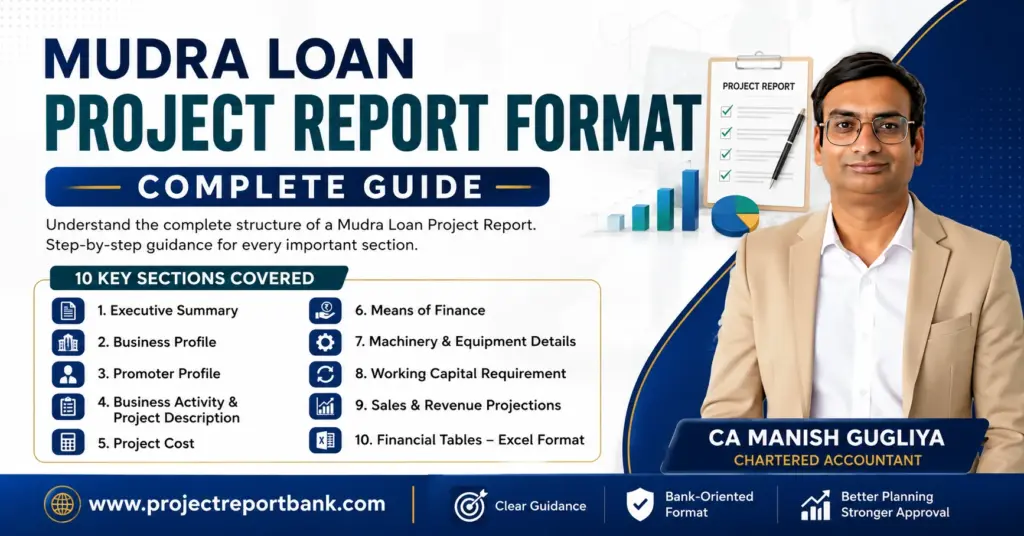
A Mudra Loan Project Report is a structured business and financial document that presents the proposed business activity, investment requirement, funding arrangement, expected sales, operating costs and financial projections before a lender considers the loan proposal. A well-prepared report helps present the business idea in an organised manner and enables the bank or lending institution to better understand the project’s financial requirements and commercial viability.
The Mudra Loan Project Report format is important because all sections of the report should be logically connected. For example, machinery requirements influence project cost, project cost affects the means of finance, and expected business activity influences sales projections and working capital requirements. Inconsistent figures or unrealistic assumptions across these sections can make the proposal difficult to evaluate.
However, there is no single project report format that will necessarily apply identically to every Mudra Loan proposal. The nature and level of information required may vary depending on the type of business, proposed loan amount, purpose of finance, whether the business is new or existing, and the specific appraisal requirements of the lender.
In this guide, I explain the major sections of a Mudra Loan Project Report one by one, from the executive summary and business profile to project cost, means of finance, working capital and sales projections. Each section also connects to a detailed supporting guide, allowing you to explore any particular part of the project report in greater depth when required.
— CA Manish Gugliya
Chartered Accountant | Project Report & Business Finance Professional
Mudra Loan Project Report Format at a Glance
Understand the major sections of a Mudra Loan project report and what each section generally covers. Click any section to read the detailed guide.
| Section | What It Generally Covers |
|---|---|
| Executive Summary → | Snapshot of the business, proposed project and financing requirement. |
| Business Profile → | Basic business details, nature of activity and business background. |
| Promoter Profile → | Promoter's background, qualifications, experience and capabilities. |
| Business Activity & Project Description → | What the business proposes to do and how the proposed activity will operate. |
| Project Cost → | Total estimated investment required for setting up or expanding the project. |
| Means of Finance → | How the project cost is proposed to be funded through promoter contribution and finance. |
| Machinery & Equipment → | Machinery and equipment requirements, quantity and estimated cost. |
| Working Capital Requirement → | Funds required for inventory, receivables and day-to-day business operations. |
| Sales & Revenue Projections → | Expected sales, turnover and revenue based on reasonable business assumptions. |
| Financial Tables / Excel Format → | Structured financial projections, statements, calculations and supporting schedules. |
Complete Mudra Loan Project Report Format: Section by Section
A Mudra Loan Project Report format generally consists of several interconnected business and financial sections. Each section serves a different purpose, but the information presented across the report should remain consistent. The following section-by-section guide will help you understand what should generally be covered and where you can learn about each component in detail.
1. Executive Summary
The executive summary provides a concise overview of the entire project proposal. It generally introduces the business, promoter, proposed activity, project cost, loan requirement, means of finance and key financial expectations. Although it appears at the beginning of the report, it is often easier to finalise it after completing the detailed financial calculations.
Detailed Guide → How to Write the Executive Summary of a Mudra Loan Project Report
2. Business Profile
The business profile explains the basic identity and nature of the enterprise. Depending on whether the business is new or existing, this section may include the constitution of the business, location, nature of activity, products or services, existing operations and other relevant business information. It gives the lender a clear understanding of the enterprise for which finance is proposed.
Detailed Guide → How to Write Business Profile in a Mudra Loan Project Report
3. Promoter Profile
The promoter profile introduces the person or persons responsible for establishing and managing the business. It may include educational qualifications, technical knowledge, business experience, industry exposure and relevant skills. The purpose is to demonstrate whether the promoter’s background and capabilities are reasonably aligned with the proposed business activity.
Detailed Guide → How to Write Promoter Profile in a Mudra Loan Project Report
4. Business Activity & Project Description
This section explains what the proposed business will actually do. It should clearly describe the products or services, operating model, manufacturing or service process where relevant, target customers, location and proposed scale of operations. The description should be practical and consistent with the machinery, investment, working-capital and sales assumptions used elsewhere in the project report.
Detailed Guide → How to Write Business Activity & Project Description in a Mudra Loan Project Report
5. Project Cost
The project cost represents the total estimated investment required for the proposed project. Depending on the nature of the business, it may include machinery and equipment, furniture and fixtures, computers, renovation or other setup costs, preliminary expenses and working-capital requirements, where applicable. Each cost should preferably be supported by a reasonable basis or estimate.
Detailed Guide → How to Present Project Cost in a Mudra Loan Project Report
6. Means of Finance
After calculating the project cost, the report should explain how that cost is proposed to be financed. The means of finance may include the promoter’s own contribution and the proposed bank finance, along with other legitimate funding sources where applicable. The total means of finance should correspond logically with the total project cost presented in the report.
Detailed Guide → How to Show Means of Finance in a Mudra Loan Project Report
7. Machinery & Equipment Details
For businesses requiring machinery or equipment, the project report should clearly present the description, quantity and estimated cost of major assets proposed to be purchased. Supplier quotations may provide useful support for the estimates. The machinery requirement should also be reasonable considering the proposed activity, production capacity, project cost and expected sales.
Detailed Guide → How to Present Machinery & Equipment Details in a Mudra Loan Project Report
8. Working Capital Requirement
Working capital represents the funds required for the day-to-day operations of the business. Its assessment may consider inventory or stock, receivables, creditors, operating expenses and cash requirements, depending on the nature of the enterprise. The operating cycle is important because the time between purchasing inputs, making sales and collecting money can directly influence the amount of working capital required.
Detailed Guide → How to Present Working Capital Requirement in a Mudra Loan Project Report
9. Sales & Revenue Projections
The sales and revenue projections estimate the income that the business expects to generate during the projected period. These estimates should be based on reasonable assumptions such as expected sales quantity, selling price, production or service capacity, capacity utilisation and market conditions. The projected turnover subsequently affects profitability, cash flow, working-capital requirements and repayment-capacity calculations.
Detailed Guide → How to Present Sales & Revenue Projections in a Mudra Loan Project Report
10. Financial Tables & Excel Format
Once the business assumptions are established, they need to flow into structured financial calculations and projections. Depending on the project, these may include projected profit and loss statements, cash flow, balance sheets, depreciation, loan repayment schedules, working-capital calculations and relevant financial ratios. An organised Excel structure can help maintain consistency between the assumptions and different financial schedules.
Detailed Guide → Mudra Loan Project Report Format in Excel: Structure & Financial Tables
Professional Note from CA Manish Gugliya: A project report should be viewed as one integrated financial document rather than ten independent sections. For example, machinery affects project cost, project cost affects financing, sales assumptions influence working capital and profitability, and projected cash flows influence repayment capacity. Consistency between these sections is therefore just as important as preparing each section correctly.
Recommended Order for Preparing a Mudra Loan Project Report
A Mudra Loan Project Report becomes easier to prepare when the sections are completed in a logical sequence. Instead of starting directly with financial statements or the executive summary, first understand the business, determine the investment requirement and establish realistic operating assumptions. These inputs can then be used to prepare consistent financial projections.
Step 1: Understand the Business and Promoter
Start by collecting basic information about the business and the promoter. Understand the nature of the enterprise, location, products or services, existing or proposed operations, promoter experience, qualifications and relevant skills.
Step 2: Describe the Proposed Business Activity
Clearly define what the business proposes to manufacture, trade or provide as a service. The project description should establish the proposed scale of operations and how the business is expected to function.
Step 3: Determine Machinery and Other Requirements
Identify the machinery, equipment, furniture, computers and other assets required to operate the business. Wherever relevant, use quotations or reasonable cost estimates as the basis for calculation.
Step 4: Calculate the Project Cost
Combine the relevant investment requirements to determine the total project cost. This may include machinery, equipment, furniture, setup expenses and working-capital requirements, depending on the nature of the project.
Step 5: Decide the Means of Finance
Once the project cost is known, determine how it will be financed. Clearly identify the promoter’s contribution, proposed bank finance and other applicable sources of funds. The means of finance should correspond with the project cost.
Step 6: Calculate the Working Capital Requirement
Estimate the funds required for day-to-day business operations. Consider factors such as inventory, receivables, creditors, operating expenses and the business operating cycle, wherever applicable.
Step 7: Estimate Sales and Revenue
Prepare reasonable sales assumptions based on factors such as expected quantity, selling price, production or service capacity and capacity utilisation. Avoid starting with an arbitrary turnover figure merely to make the financial projections attractive.
Step 8: Prepare Financial Projections
Use the assumptions developed in the earlier steps to prepare the required financial statements and schedules. These may include projected profit and loss statements, cash flow, balance sheets, repayment schedules and relevant financial ratios.
Step 9: Prepare the Executive Summary
Prepare or finalise the executive summary after the major calculations are complete. This allows the summary to accurately reflect the final project cost, financing requirement, proposed activity and key financial projections.
Practical Tip: Follow the sequence Business → Requirement → Cost → Finance → Operations → Sales → Financial Projections → Executive Summary. This approach helps maintain consistency throughout the Mudra Loan Project Report and reduces the possibility of contradictory figures appearing in different sections.
How the Different Sections of a Project Report Connect
A Mudra Loan Project Report should not be prepared as a collection of independent tables and calculations. Each section is connected to the others, and a change in one assumption can affect several financial projections. For this reason, consistency between business information, project cost, sales assumptions, working capital and financial statements is essential.
Machinery Requirement → Project Cost
The machinery and equipment required for the proposed business directly influence the total project cost. If machinery costing ₹5 lakh is shown in the machinery schedule, the corresponding amount should be properly reflected in the project cost and relevant financial statements.
Project Cost → Means of Finance
Once the total project cost is determined, the report must explain how the project will be financed. The promoter’s contribution, proposed bank finance and other applicable sources should collectively correspond with the funding requirement of the project.
Production Capacity → Sales Projections
For a manufacturing business, installed capacity and expected capacity utilisation provide an important basis for estimating production and sales. Projected sales should therefore be reasonably aligned with the production capability of the proposed machinery and business.
Sales + Expenses → Profitability
Projected turnover alone does not determine whether a business is financially viable. Raw materials, salaries, rent, electricity, administrative costs, interest, depreciation and other relevant expenses must be considered to estimate the expected profitability of the business.
Sales + Credit Cycle + Inventory → Working Capital
A business may be profitable but still require substantial working capital. The amount depends on factors such as expected sales, inventory holding, credit allowed to customers, credit received from suppliers and other operating requirements. Therefore, working capital should be connected with the actual operating cycle of the business.
Profit + Cash Flow → Repayment Capacity
Profitability is important, but loan repayment ultimately requires sufficient cash generation. Projected profits, cash flows, existing obligations and proposed loan repayments should therefore be considered together while assessing the project’s repayment capacity.
The Connection in Simple Form
Machinery Requirement
↓
Project Cost
↓
Means of Finance
Production Capacity
↓
Sales Projections
↓
Profitability
↓
Cash Flow
↓
Repayment Capacity
At the same time:
Sales + Inventory + Receivables + Creditors
↓
Working Capital Requirement
Professional Insight – CA Manish Gugliya: A good project report tells one consistent financial story. If sales increase, the corresponding effect on production, purchases, expenses, inventory, receivables, working capital, profitability and cash flow should also be considered. Figures should not be changed in one table without checking their impact on the connected schedules. This internal consistency makes a project report more meaningful for financial appraisal.
Simple Example of a Mudra Loan Project Report Structure
A well-organised Mudra Loan Project Report should present business information, project requirements and financial projections in a logical sequence. While the actual format can vary depending on the nature of the business, loan requirement and lender’s appraisal process, the following structure can be used as a practical reference for understanding how a project report may be arranged.
Illustrative Mudra Loan Project Report Index
1. Executive Summary
Provides a concise overview of the proposed business, project cost, financing requirement and key financial information.
2. Business Profile
Presents basic information about the enterprise, its constitution, location, nature of business and existing or proposed operations.
3. Promoter Profile
Covers the promoter’s background, qualifications, experience, skills and other information relevant to managing the proposed business.
4. Business Activity / Project Description
Explains the proposed products or services, business model, operating process and scale of activity.
5. Machinery & Equipment Details
Provides details of major machinery and equipment, including description, quantity and estimated cost, wherever applicable.
6. Project Cost
Shows the estimated investment required for machinery, equipment, furniture, setup costs, working capital and other applicable project components.
7. Means of Finance
Explains how the total project cost is proposed to be financed through promoter contribution, bank finance and other applicable sources.
8. Working Capital Requirement
Estimates the funds required for inventory, receivables, operating expenses and other day-to-day business requirements.
9. Sales & Revenue Projections
Presents expected sales and turnover based on reasonable assumptions regarding quantity, selling price, capacity and utilisation.
10. Projected Profit & Loss
Estimates future revenue, operating expenses, interest, depreciation and expected profit over the projection period.
11. Cash Flow Statement
Shows expected cash inflows and outflows and helps assess whether the business is expected to generate sufficient cash for its operational and financing requirements.
12. Projected Balance Sheet
Presents the expected financial position of the business, including assets, liabilities and owner’s funds during the projection period.
13. Loan Repayment Schedule
Shows the proposed repayment of principal and interest over the assumed loan tenure, subject to the actual terms sanctioned by the lender.
14. Financial Ratios / Repayment Capacity
May include relevant financial indicators used to understand profitability, financial position and the ability of the projected business cash flows to support debt repayment.
15. Supporting Assumptions
Documents the important assumptions behind sales, capacity utilisation, expenses, working capital, interest, depreciation and other financial calculations.
Important: This is an illustrative Mudra Loan Project Report structure, not a universally prescribed or mandatory format that every bank or lending institution follows identically. The sections, sequence, level of detail and financial information required can vary according to the business activity, project size, loan amount, purpose of finance and the lender’s appraisal requirements.
A Simple Way to Understand the Structure
Think of the project report as three connected parts:
Business & Promoter Information
→ Who is undertaking the project and what business is proposed?
Project & Funding Requirement
→ What is required, how much will it cost and how will it be financed?
Financial Projections & Repayment Capacity
→ What can the business potentially earn, what will it spend and whether projected cash generation can support the proposed finance?
This approach keeps the project report structured, readable and financially connected rather than treating it merely as a set of unrelated financial tables.
Common Mistakes While Preparing a Mudra Loan Project Report Format
Even when all the required sections are included, a Mudra Loan Project Report can become difficult to understand if figures and assumptions are inconsistent. Some common mistakes to avoid are:
Project cost and means of finance do not match: The sources of funds should properly correspond with the total project requirement.
Machinery cost differs between schedules: Machinery values shown in quotations, project cost and financial statements should remain consistent.
Sales projections are unsupported: Projected turnover should have a reasonable basis, such as expected quantity, selling price, capacity and market potential.
Working capital requirement is ignored: Inventory, receivables, creditors and operating expenses should be considered wherever relevant.
Promoter contribution is unclear: The applicant’s proposed contribution should be clearly identified and consistently reflected.
Capacity and projected sales do not correspond: Sales estimates should be realistic considering the proposed production or service capacity.
Different figures appear in different financial statements: Sales, profit, loan balances, depreciation and other connected figures should reconcile across schedules.
Financial projections are overly optimistic: Unrealistically high sales growth or low expenses can reduce the reliability of the projections.
Professional Tip: Before finalising the project report, cross-check the major figures across all schedules. A strong project report is not one with the highest projected profit—it is one in which the business assumptions, investment, financing and financial projections are reasonable and internally consistent.
Which Section Should You Read First?
You do not need to read every guide at once. Choose what you want to understand and start with the most relevant section below.
| If You Want to Understand... | Start Here |
|---|---|
| Overall financial format | Excel Format → |
| Summary of the proposal | Executive Summary → |
| Business details | Business Profile → |
| Entrepreneur background | Promoter Profile → |
| Proposed activity | Business Activity & Project Description → |
| Total investment | Project Cost → |
| Funding arrangement | Means of Finance → |
| Machinery requirement | Machinery & Equipment → |
| Day-to-day fund requirement | Working Capital → |
| Expected turnover | Sales & Revenue Projections → |
Frequently Asked Questions About Mudra Loan Project Report Format
Is there a fixed format for a Mudra Loan project report?
There is not necessarily one universal Mudra Loan Project Report format that every bank and lender follows identically. The structure and level of detail may vary according to the nature of the business, loan amount, purpose of finance and lender’s appraisal requirements. However, a properly structured report generally covers the business, promoter, project cost, financing, operating assumptions and financial projections.
What should be included in a Mudra Loan project report?
A Mudra Loan project report may generally include an executive summary, business profile, promoter profile, project description, machinery details, project cost, means of finance, working capital requirement, sales projections and projected financial statements. Additional schedules and supporting information may be required depending on the particular proposal.
How many years of financial projections should be prepared?
There is no single projection period that should be assumed for every proposal. The appropriate period can depend on the loan tenure, nature of the project and lender’s requirements. The projections should normally cover a period sufficient to demonstrate the expected financial performance and repayment of the proposed borrowing.
Should project cost and means of finance be equal?
As a basic project-finance principle, the total means of finance should account for the total project cost. For example, if a project requires ₹10 lakh, the report should clearly explain how that ₹10 lakh is proposed to be funded through promoter contribution, proposed bank finance and any other applicable sources.
Is an Excel format sufficient for a Mudra Loan project report?
Excel is useful for preparing financial calculations, projections and supporting schedules, but a complete project report may also require descriptive information about the business, promoter and proposed activity. Therefore, an Excel workbook should not automatically be treated as a substitute for every other part of the project report.
Can I prepare the Mudra Loan project report myself?
An applicant may prepare a project report if they understand the business assumptions and can prepare the required financial information correctly. However, professional assistance may be useful where the proposal involves detailed financial projections, working-capital assessment, repayment calculations or interconnected financial statements.
Does every bank require the same project report format?
Not necessarily. Different banks, branches or lending institutions may seek different levels of information depending on the loan proposal and their appraisal process. Applicants should therefore check the specific documentation and project-report requirements communicated by the lender rather than assuming that one format will be accepted identically in every case.
About This Mudra Loan Project Report Guide
About CA Manish Gugliya
This Mudra Loan Project Report Guide has been prepared under the guidance of CA Manish Gugliya, a practising Chartered Accountant with professional experience in project report preparation, CMA data, financial projections and business finance.
Through his professional work, CA Manish Gugliya has assisted entrepreneurs and business owners in understanding project costs, funding requirements, working capital, projected profitability, cash flows, repayment capacity and other financial aspects involved in preparing business-finance proposals.
The purpose of this educational series is to make Mudra Loan project report preparation easier to understand for entrepreneurs, particularly those who may be preparing a project report or approaching a bank for business finance for the first time. Instead of treating a project report as merely a set of financial tables, the guides explain how business information, assumptions and financial projections connect with each other.
The information provided in this series is intended for educational and informational purposes and to help entrepreneurs better understand project-report preparation and business-finance documentation. Actual documentation, appraisal criteria and information requirements may vary depending on the lender, business activity, loan amount and individual proposal.
Explore the Complete Project Report Series
This cluster contains dedicated guides covering the important components of a Mudra Loan Project Report, including the executive summary, business and promoter profiles, project description, machinery details, project cost, means of finance, working capital, sales projections and financial tables.
Readers can therefore use this page as a central guide and move to the relevant detailed article whenever they need a deeper explanation of a particular section.
CA Manish Gugliya
Chartered Accountant | Project Reports | CMA Data | Business Finance
Explore the Complete Mudra Loan Project Report Format Series
Explore our step-by-step guides covering the major sections of a Mudra Loan Project Report. Choose a topic below to continue learning.
1. Start with the Format
Understand the overall format and the basic business sections of a Mudra Loan Project Report.
2. Understand Project Investment
Understand what the project requires, how much it may cost and how the proposed investment will be financed.
3. Prepare Financial Assumptions
Understand the operating assumptions that influence working capital, projected turnover and financial performance.