Key Takeaways
- Total means of finance must equal total project cost – this is the central reconciliation in any Mudra Loan project report.
- Means of finance in a Mudra Loan project report explains “where the money will come from,” primarily through promoter’s contribution and proposed bank finance, with numbers that match the cost project side perfectly.
- Term loan, working capital, and own funds should be shown clearly and remain consistent with project cost, projected balance sheet, and cash flow throughout the report.
- Mismatches, double counting, or unrealistic promoter contribution are common reasons project reports look weak during bank appraisal.
- This article is written in the voice of CA Manish Gugliya (ProjectReportBank.com) and walks you through formats, examples, checklists, and mistakes to avoid.
Introduction: Why Means of Finance Matters in a Mudra Loan Project Report
Preparing project cost is only half the work in a project report. The other half – and arguably the more scrutinised half – is showing clearly how that cost will be financed.
Project cost shows where money will be used. Means of finance shows where the same money will come from. The core principle is straightforward: Total Project Cost should normally equal Total Means of Finance.
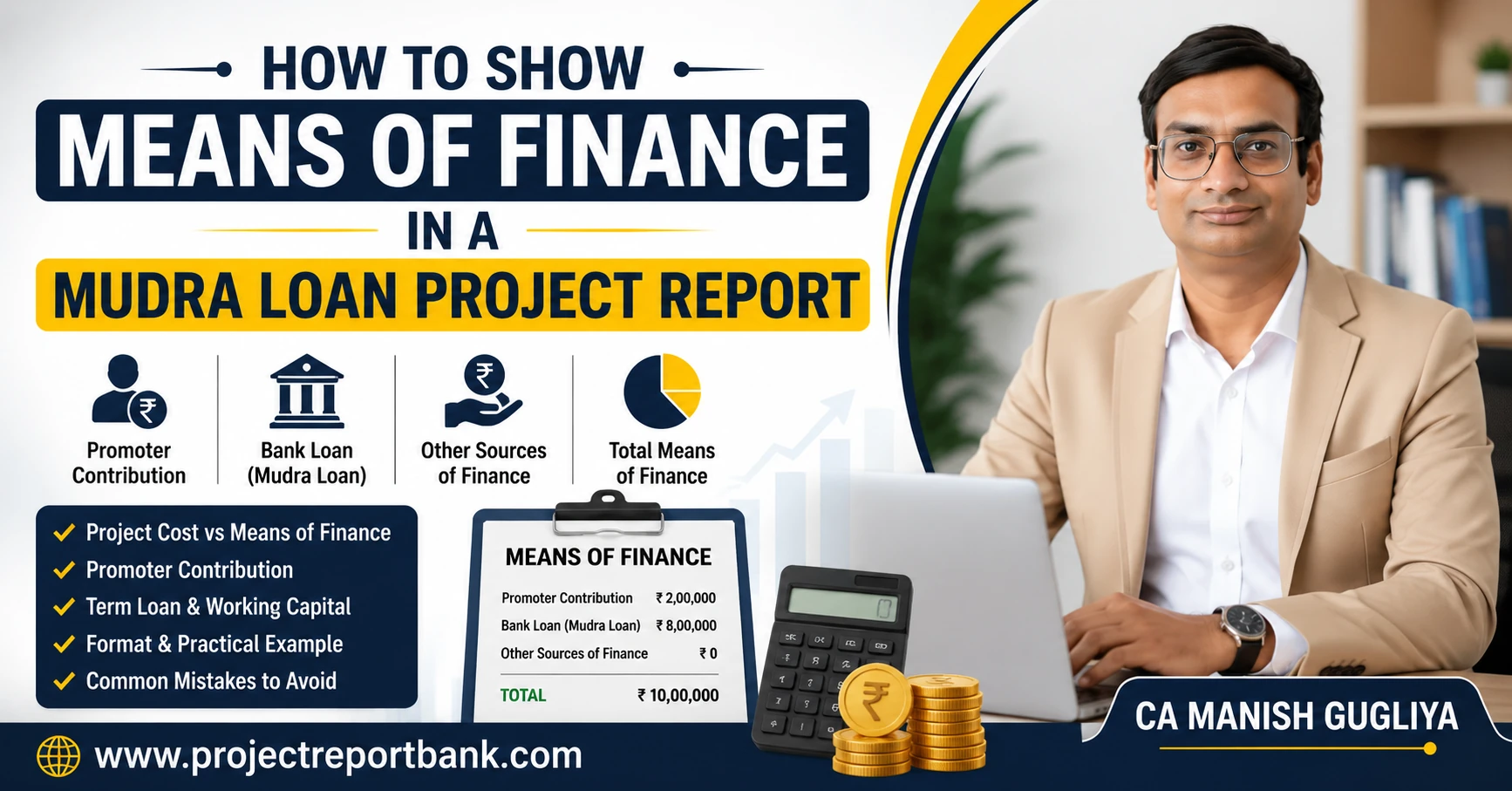
For example, if a project requires ₹10,00,000, the report must identify where that ₹10,00,000 will come from – say, ₹2,00,000 as promoter contribution and ₹8,00,000 as the proposed Mudra Loan.
Mudra loans are available up to Rs. 10 lakh under the Pradhan Mantri Mudra Yojana (PMMY), and the scheme does not cover medium or large enterprises. Eligibility includes micro and small enterprises, and loans can be used for manufacturing, trading, and services. Easy access to financial resources through schemes like these contributes to job creation in local economies.
In my experience, many otherwise solid Mudra Loan project reports fail because this simple reconciliation is missing or inconsistent. Let me walk you through exactly how to get it right.
What Is Means of Finance in a Mudra Loan Project Report?
Means of finance in a Mudra Loan project report is the structured statement of all proposed sources of funds that will meet the total project cost.
- Project Cost = where the money will be spent (machinery, equipment, working capital etc.)
- Means of Finance = where the money will come from (promoter contribution, bank finance, other sources)
A Mudra loan project report outlines funding through three tiers – Shishu, Kishor, and Tarun. Mudra loans are categorized into Shishu, Kishor, and Tarun, with a newer Tarun Plus category for entrepreneurs who have successfully repaid previous loans.
Here is a simple numeric example:
| Particulars | Amount (₹) |
|---|---|
| Promoter Contribution | 2,00,000 |
| Proposed Bank Finance (Mudra) | 8,00,000 |
| Total Means of Finance | 10,00,000 |
Total Project Cost: ₹10,00,000 = Total Means of Finance: ₹10,00,000
This table matters to financial institutions because it reveals how much risk the promoter is taking, how much bank finance is needed, and whether the funding structure looks practical. Banks expect this section to be consistent with the rest of the Mudra Loan project report format.
Difference Between Project Cost and Means of Finance
Many applicants confuse project cost with means of finance, but they answer two fundamentally different questions. Here is a clear comparison:
| Particular | Project Cost | Means of Finance |
|---|---|---|
| Meaning | Total investment required in capital assets and working capital | Total funding arrangement to meet that cost |
| Purpose | Shows where money will be spent | Shows where money will come from |
| Contains | Machinery, furniture, miscellaneous fixed assets preliminary and pre operative expenses, working capital margin | Promoter’s capital, Mudra term loan, working capital limits, other funding |
| Example | Machinery ₹6,00,000; Working Capital ₹3,00,000 | Own Funds ₹2,00,000; Bank Loan ₹8,00,000 |
| Role | Justifies loan requirement | Demonstrates financial support availability |
For a detailed explanation of how to prepare the cost side, refer to the guide on project cost in a Mudra Loan project report.
Table of Contents
What Can Be Included in Means of Finance?
The financing options section of a project report details required funding sources. The main categories are: promoter’s contribution, proposed bank finance, and in some cases other genuine sources. Not every project will use all types – the actual mix depends on the business, scheme terms, and the bank or financial institution’s policies.
Every item shown under means of finance should be real, explainable, and backed by documentary support. Vague entries like “other funds – ₹3,00,000” without explanation create doubts during appraisal.
Promoter’s Contribution / Own Funds
Promoter contribution is the amount the entrepreneur invests from own funds – savings, retained profits, family capital – into the project. In a sense, equity capital represents the promoter’s personal stake and risk capital carries the entrepreneur’s commitment to the venture.
Financial institutions value this because it shows willingness to share financial risk. Present it as a clear line: “Promoter’s Contribution (own funds) – ₹2,00,000.”
The percentage varies by bank, borrower profile, and project. I generally recommend that the declared amount be supportable through bank statements or savings records if the banker asks. Equity shareholders or sole proprietors should be ready with evidence.
Proposed Mudra Loan / Bank Finance
This line shows the Mudra Loan or other bank finance requested. Mudra loans finance working capital and purchase of equipment, and the proposed bank finance can take several forms:
- Term loan for machinery, equipment, furniture, or other fixed assets
- Working capital facility (cash credit, overdraft) for operational needs
- Composite loan covering both, depending on the bank’s product
Under the PMMY framework, Shishu loans provide up to Rs. 50,000, Kishor loans range from Rs. 50,001 to Rs. 5 lakh, Tarun loans range from Rs. 5 lakh to Rs. 10 lakh, and Tarun Plus loans provide between Rs. 10 lakh and Rs. 20 lakh. Mudra loans support micro enterprises with loans up to Rs. 20 lakh overall.
The bank loan in means of finance must be the same amount that appears as “loan requirement” and should align with the repayment schedule and interest assumptions. Commercial banks and other financial intermediaries offering mudra loans under PMMY will verify this consistency.
Other Sources of Finance
Besides promoter funds and bank finance, some projects may include unsecured loans from family, partner’s capital, or government subsidies. Government subsidies may form part of the finance mix under certain schemes, but banks usually treat them carefully since subsidy is often received later.
In larger project financing contexts, sources can include preference capital (where dividend paid obligations exist), debenture capital debentures, foreign currency term loans, rupee term loans, or funding from a refinance agency. However, for micro enterprises engaged in small-scale activity, these are rarely relevant. The micro units development (MUDRA) scheme itself acts as a refinance agency covering loans extended by banks to small borrowers.
Each additional source should be named clearly – for example, “Unsecured loan from proprietor’s relative (interest-free) – ₹1,00,000.” Never add artificial amounts just to balance the table. Where capital issue expenses or similar costs arise in complex funding structures, they should be accounted for separately.
Means of Finance Format for Mudra Loan Project Report
Here is a standard table format:
| Particulars | Amount (₹) |
|---|---|
| Promoter’s Contribution | 2,00,000 |
| Proposed Bank Finance (Mudra Loan) | 8,00,000 |
| Total Means of Finance | 10,00,000 |
Total Project Cost: ₹10,00,000 = Total Means of Finance: ₹10,00,000
These figures are purely illustrative. Your actual amounts and structure must reflect the real project cost and funding plan. Those using Excel-based formats can see how means of finance connects with other tables in the Mudra Loan project report format in Excel.
Practical Example of Project Cost and Means of Finance
Consider a small fabrication workshop with a total project cost of ₹10,00,000:
Project Cost:
| Item | Amount (₹) |
|---|---|
| Machinery (includes basic cost of equipment and machinery technical know how) | 6,00,000 |
| Furniture & Office Equipment | 75,000 |
| Preliminary & Other Eligible Expenses | 25,000 |
| Working Capital Requirement | 3,00,000 |
| Total Project Cost | 10,00,000 |
The project cost may also include major cost elements like site development buildings, establishment expenses (which includes establishment expenses for staff), engineering fees expenses, and certain unforeseen expenses depending on the project. For some businesses, revenue expenses incurred till the start of commercial production – such as printing and postage expenses, publicity expenses, mortgage expenses, or costs of conducting market survey – are grouped under pre operative expenses.
In larger projects, cost estimates might also cover financing land (where land varies considerably by location), foreign currency expenditures for imported machinery, expenses borne for indian technicians abroad services, or engineering fees for preparing feasibility report. These are less common for typical Mudra-scale projects but are part of standard project cost terminology. The basic cost includes basic cost of machinery, and miscellaneous expenses may cover items like postage expenses and miscellaneous fixed assets.
Means of Finance:
| Source | Amount (₹) |
|---|---|
| Promoter’s Contribution | 2,00,000 |
| Proposed Bank Finance (Mudra) | 8,00,000 |
| Total Means of Finance | 10,00,000 |
Every rupee on the project cost side is matched by a rupee on the means of finance side. This reconciliation gives the banker confidence that the project represents a fully funded proposal.

How to Calculate Promoter Contribution
Promoter contribution can be expressed both in absolute terms and as a percentage:
- Total Project Cost = ₹10,00,000
- Promoter’s Contribution = ₹2,00,000
- Percentage = ₹2,00,000 ÷ ₹10,00,000 × 100 = 20%
Promotion contributions typically range from 10% to 25% of the total project cost in practice, but this is not a universally fixed margin money requirement for all Mudra Loans. Different financial institutions may expect different levels of margin money depending on risk, borrower profile, and asset type – for instance, Indian Bank requires 20% margin for Tarun Plus on both term loan and working capital portions.
Before finalising the figure, honestly verify how much own capital you can actually bring in. Overstating it to show a higher percentage only creates problems later. The project cost generally affects how much you need to contribute, so if costs change, recalculate immediately.
How to Show Term Loan and Working Capital in Means of Finance
Term loans are used for long-term investments like machinery and equipment. Working capital finance is used for day-to-day operational expenses. Proper segregation of capital and operational allocations is essential in project financing.
If the bank will sanction separate facilities, show them separately:
| Source | Amount (₹) |
|---|---|
| Promoter Contribution | 2,00,000 |
| Term Loan (Machinery & Fixed Assets) | 6,00,000 |
| Working Capital Finance | 2,00,000 |
| Total Means of Finance | 10,00,000 |
Some Mudra products are composite loans where a single amount covers both. In that case, show one combined line with a brief note. Whatever structure is shown should match the projected balance sheet and repayment schedule. If unsure, discuss with your banker or CA before finalising.
Why Project Cost and Means of Finance Must Match
Total means of finance should equal total project cost in a project report. Any difference must be explained.
Under-financing example:
- Project Cost = ₹10,00,000
- Means of Finance = ₹9,00,000
- Funding Gap = ₹1,00,000
Who will bring the remaining ₹1,00,000? The bank cannot see a clear answer, and this signals incomplete planning.
Over-financing example:
- Project Cost = ₹10,00,000
- Means of Finance = ₹11,00,000
The extra ₹1,00,000 raises questions about misclassification or double counting. Matching both sides accurately is a basic but crucial test of internal consistency.
Connection Between Means of Finance and Loan Requirement
The loan amount should flow logically from the means-of-finance table – not be an arbitrary figure. Raising debt capital should follow this logic:
- Start from total project cost
- Decide realistic promoter contribution based on own funds
- The remaining gap becomes the bank finance (term loan and/or working capital)
If project cost changes, the financing cost structure must be recalibrated. Higher Mudra Loan amounts often require more detailed analysis – refer to guidance on how Mudra Loan amount affects project report requirements.
The loan requirement reflected in means of finance must match the figure used for EMI calculations and cash flow projections. Timely loan repayments help build a strong credit score for future loans, so realistic debt capital planning matters from day one.
Means of Finance for New Business vs Existing Business
The principle – Total Project Cost = Total Means of Finance – applies equally to both new and existing firms, but fund composition can differ.
New Business
For a startup, project cost covers initial machinery, equipment, furniture, setup expenses, unforeseen expenses, and the first cycle of working capital. Initial cash losses during the gestation period are common, and the project report should account for such cash losses in financial projections.
Illustrative structure: Project Cost ₹10,00,000, funded by ₹2,00,000 promoter funds and ₹8,00,000 Mudra Loan.
Banks may pay particular attention to business viability for new ventures. The project report should also explain the nature of the new business – detailed guidance is available in the article on business activity and project description in a Mudra Loan project report.
Existing Business
For existing firms, project cost often relates to expansion – new machinery, renovation, or additional working capital – not the entire original investment.
Illustrative structure: Additional machinery ₹4,00,000 + additional working capital ₹2,00,000 = ₹6,00,000, funded by ₹1,50,000 additional promoter contribution and ₹4,50,000 additional bank finance.
Banks will want to see how the new finance sits alongside existing limits and whether profit and cash flow support increased obligations. Updated financial statements help integrate the new means of finance with the overall projected balance sheet. The business must demonstrate it can handle the direct manufacturing process expansion without overextending.
How Banks May Examine Means of Finance
A bank officer typically checks:
- Whether total means of finance matches total project cost
- Whether promoter contribution appears reasonable against income, savings, and a satisfactory credit track record
- Whether the proposed Mudra Loan amount is logical given asset requirements
- Whether each source is explained and not double counted
- Whether the structure is consistent with projected balance sheet and repayment schedule
Banks evaluate the Debt-Service Coverage Ratio when considering loan applications. Applicants must have a viable business plan, and financial assistance requests are tested against projected repayment capacity.
As a Chartered Accountant, I prefer to ensure the financing structure tells one clear story before a report goes to the bank. A neat, consistent table creates a better impression – though it does not itself guarantee sanction.
Means of Finance Must Match Other Financial Statements
The means-of-finance table is not isolated. Its figures must flow into other statements:
- Promoter contribution and bank loan amounts appear in the projected balance sheet under capital and liabilities
- Term loan amount and interest appear in the repayment schedule and projected P&L
- Working capital finance aligns with working capital calculations and cash flow
If means of finance shows a term loan of ₹7,00,000, the balance sheet cannot show only ₹5,00,000 under term loans. Before finalising, cross-check all linked sheets – the Mudra Loan project report format in Excel article explains how these tables interconnect.
Information Needed Before Preparing Means of Finance
Collect this data before drafting:
- Detailed project cost with item-wise breakup (machinery quotations, revenue expenses, working capital requirement)
- Realistic assessment of promoter’s available own funds
- Proposed loan requirement based on the funding gap
- Information about any other genuine funding sources
- For existing businesses: recent financial statements and current loan details
- A valid Aadhar card is required for application along with standard KYC documents
- Cost estimates from vendors where you engage technical consultants for installation or setup
For a more complete list, refer to the guide on information required before preparing a Mudra Loan project report. Collecting proper information first reduces later corrections.
Common Mistakes in Means of Finance (and How to Avoid Them)
One mistake I frequently notice in project reports:
- Mismatch: Total means of finance not matching total project cost due to arithmetic slips
- Inflated contribution: Promoter contribution shown at a high figure without checking actual funds
- Inconsistent loan figure: Loan requirement changed in one section but not updated elsewhere
- Confusion: Showing “machinery loan” under project cost instead of under sources of funds
- Double counting: Working capital shown twice, or the same ₹1,00,000 counted as both capital and unsecured loan
- Vague sources: “Other sources” without details or the expenses incurred to obtain them
- Balance sheet mismatch: Different loan amounts in means of finance and projected balance sheet
How to avoid these: Use a structured format, cross-check every linked sheet, and where possible, have a CA review the report before submission.
Example of an Incorrect Means of Finance (and the Corrected Version)
Incorrect:
| Amount (₹) | |
|---|---|
| Total Project Cost | 12,00,000 |
| Promoter Contribution | 2,00,000 |
| Bank Loan (Mudra) | 8,00,000 |
| Total Means of Finance | 10,00,000 |
| Funding Gap | 2,00,000 |
The bank cannot see where the remaining ₹2,00,000 will come from. The loan extended does not cover the full requirement.
Corrected (Option A):
| Source | Amount (₹) |
|---|---|
| Promoter Contribution | 4,00,000 |
| Bank Finance (Mudra) | 8,00,000 |
| Total Means of Finance | 12,00,000 |
Corrected (Option B):
| Source | Amount (₹) |
|---|---|
| Promoter Contribution | 2,00,000 |
| Bank Finance (Mudra) | 10,00,000 |
| Total Means of Finance | 12,00,000 |
These are illustrative choices. Such simple adjustments, made before submission, prevent basic queries and delays. Note that preference capital represents a form of hybrid funding in corporate contexts, but for micro enterprises engaged in small business, simpler structures work best.
Where Means of Finance Appears in a Mudra Loan Project Report
In most formats, the means-of-finance table appears after the project cost section and before financial projections:
- Executive summary (brief snapshot including loan requirement)
- Project cost statement
- Means of finance table
- Loan requirement and utilisation details
- Financial projections, ratios, and repayment schedule
Sometimes the executive summary itself includes condensed means-of-finance figures. All numbers must match exactly. For guidance on positioning, see how to write the executive summary of a Mudra Loan project report.
Means of Finance and Business/Project Description Consistency
The means of finance should make sense in light of the business activity:
- A machinery-intensive manufacturing unit typically has higher fixed-asset cost and term loan
- A consulting or service business may have lower machinery cost but higher working capital needs
- A trader claiming large machinery loans but no stock finance may trigger questions
In practice, I look at business activity, project cost, and means of finance together to check whether all three tell a consistent, believable story.
Does a Correct Means of Finance Guarantee Mudra Loan Approval?
No. Even a perfectly prepared means-of-finance table does not guarantee approval. Other factors include:
- Eligibility under PMMY and the bank’s internal policies
- Borrower’s credit history and satisfactory credit track record
- Overall business viability and repayment capacity
- Quality and completeness of documentation
- Sector and financial risk perception at branch level
No collateral is needed for loans up to Rs. 10 lakh, and the scheme promotes entrepreneurship among underprivileged sections – Mudra loans aim to empower underprivileged entrepreneurs. However, high risk of default is a limitation of Mudra loans, and limited awareness of the scheme affects its outreach. The credit guarantee fund mechanism helps banks manage risk, but sanction remains at the lender’s discretion.
A clean project report helps the banker understand your proposal and reduces avoidable queries. For a deeper discussion, refer to does a project report guarantee Mudra Loan approval.
A well-structured financial plan can facilitate easy loan approval, but it is a tool for transparent communication – not a magic guarantee. Previous loans repaid cleanly always strengthen an applicant’s case.
Practical Checklist Before Finalising Means of Finance
✓ Total Project Cost equals Total Means of Finance – no unexplained gap or surplus ✓ Promoter contribution is correctly calculated and realistically available ✓ Proposed Mudra Loan matches the loan requirement used elsewhere ✓ No source of funds is counted twice ✓ Working capital is not shown as both a use of funds and a source ✓ Figures match projected balance sheet, cash flow, and repayment schedule ✓ All funding sources are genuine and explainable ✓ Arithmetic has been checked after every edit
Where possible, have a CA or knowledgeable advisor review the report before submission.

Expert View by CA Manish Gugliya
Means of finance may look like a small table, but it is one of the most critical connecting points in a Mudra Loan project report. Every rupee of project cost should have a clearly identifiable and explainable rupee of means of finance behind it.
When I review project reports, I check whether project cost, promoter’s contribution, bank finance, working capital, and financial projections form one consistent financial story. Even minor inconsistencies – like different loan amounts in different sections or unrealistic own contribution – can reduce the banker’s confidence in the document.
With some care and the right format, even first-time entrepreneurs can present a clear, bank-ready means-of-finance table. The project represents your vision – make sure the numbers support it convincingly.
Frequently Asked Questions (FAQs)
Can the Mudra Loan amount itself be shown as a source of finance in the project report?
Yes. The proposed Mudra Loan is one of the main sources and should appear clearly as “Proposed Bank Finance (Mudra Loan)” with the exact amount requested. This amount must stay within the applicable limit – Mudra loans provide up to Rs. 10 lakh for small businesses under the standard PMMY categories. If the loan structure includes both term loan and working capital, these can be shown separately or as a composite Mudra Loan depending on the bank’s product.
When should promoter contribution be brought into the business for Mudra projects?
Lenders often expect the promoter to bring in own contribution before or along with the first disbursement. Be prepared to show bank statements or proof of funds when the loan is processed. The project report can briefly mention timing – for example, “Promoter’s contribution of ₹2,00,000 will be deposited into business account before first disbursement.”
Can government subsidy be included as a source in means of finance for a Mudra project?
In some schemes, eligible capital subsidies can be shown as part of the funding structure, but banks treat them carefully since subsidy is often received later. Show it under a separate, clearly labelled line and do not mix it with immediate bank finance. Always refer to specific scheme guidelines and discuss treatment with your bank.
How should partner’s capital or family loans be shown in means of finance?
Partner’s capital in a partnership firm is normally shown under promoter’s contribution/own funds. Loans from relatives are shown as unsecured loans under “Other Sources of Finance.” Each source should be clearly identified with the nature of the relationship and whether it is interest-bearing. Amounts should be realistic and backed by confirmation.
What if project cost changes after the first draft of the project report?
If quotations change or the business plan is revised, the means-of-finance table must be updated. Re-calculate promoter contribution and bank finance so that Total Project Cost equals Total Means of Finance again, and revise all related projections and tables. Submitting a report where both sides are based on different versions of the plan creates confusion during bank appraisal.
- How to Present Sales & Revenue Projections in a Mudra Loan Project Report
- How to Present Working Capital Requirement in a Mudra Loan Project Report
- How to Present Machinery Details in Mudra Loan Project Report
- How to Show Means of Finance in a Mudra Loan Project Report
- How to Present Project Cost in a Mudra Loan Project Report
- How to Write Business Activity & Project Description in a Mudra Loan Project Report
- How to Write Promoter Profile in a Mudra Loan Project Report
- How to Write Business Profile in a Mudra Loan Project Report
- Mudra Loan Project Report Executive Summary – How to Write It Right