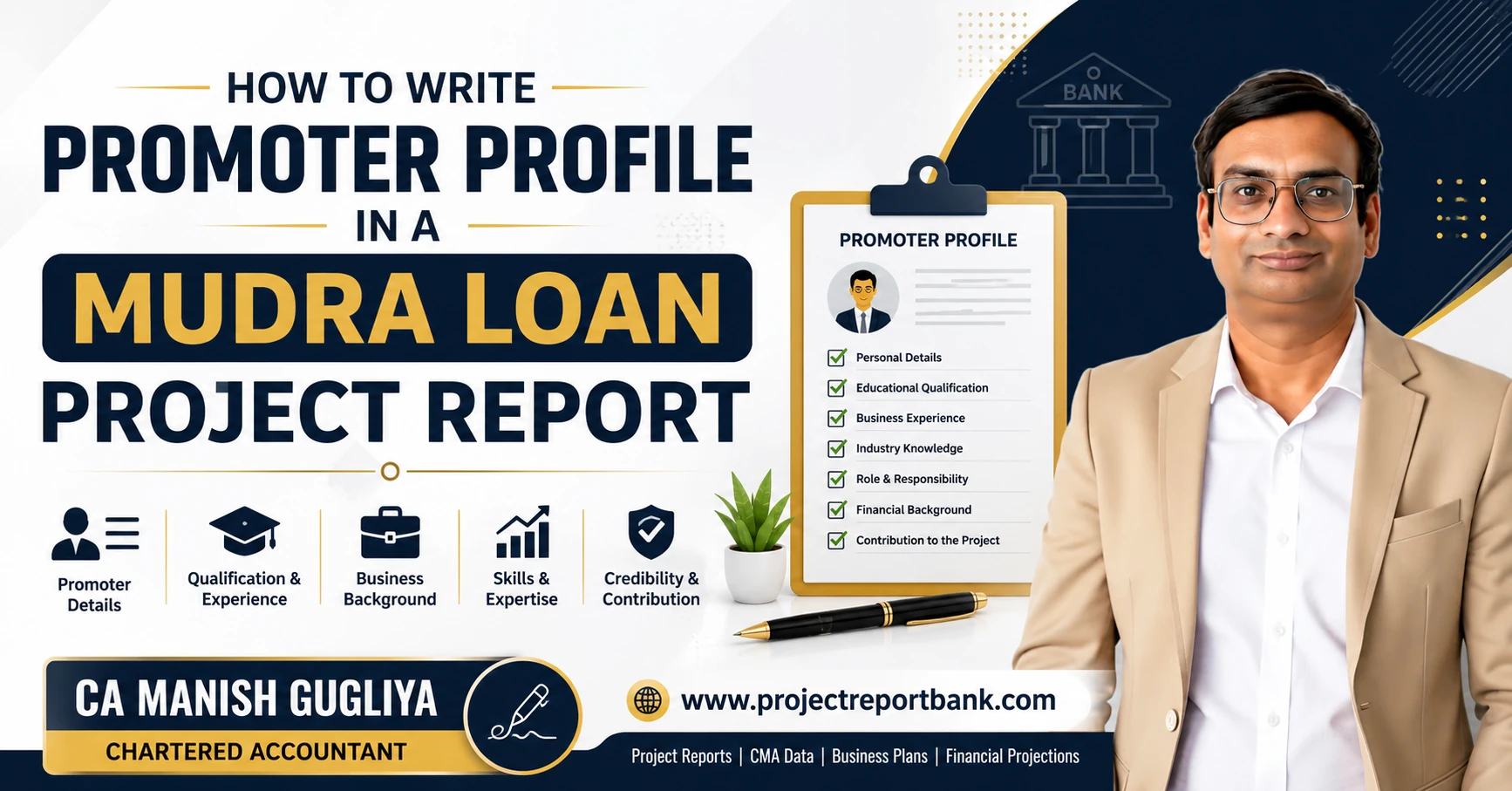
If you are preparing a mudra loan project report and wondering what exactly to write under the promoter profile section, you are not alone. Many applicants either skip this section, write a two-line biodata, or copy a generic template from the internet. All three approaches hurt your approval chances.

In my experience of preparing and reviewing project reports for MSME borrowers, the promoter profile is one of the sections that bank officers read early and form a quick impression from. This article will walk you through exactly what a promoter profile means, what details to include, how to structure it, and how to write it even if you have no prior business ownership.

Key Takeaways

  • The promoter profile in a mudra loan project report explains who you are, what education and experience you have, and why you are capable of running the proposed business successfully.
  • The promoter profile must not be a long biography but should connect your qualifications, skills, and experience to the specific mudra loan project you are proposing.
  • Banks use this section along with financial projections, DSCR, cash flow analysis, and overall project viability. A detailed promoter profile improves project report credibility, but the profile alone does not guarantee loan sanction.
  • This article provides a clear promoter profile format for project report, a step-by-step writing process, and realistic promoter profile examples for Mudra Loan.
  • The guidance here is based on practical experience of CA Manish Gugliya in preparing and reviewing Mudra and MSME loan project reports.

What Is a Promoter Profile in a Mudra Loan Project Report?

A “promoter” in the context of a mudra loan is the person who starts and runs the business. In a proprietorship, the proprietor is the promoter. In a partnership firm, all active partners may be treated as promoters. In a small private limited company, key shareholders or directors who will manage day-to-day operations are the promoters.

The promoter profile in a mudra loan project report refers to the dedicated section describing the person behind the business idea. It is placed early in the report, typically after the executive summary and business overview. The executive summary is the most important page of the report, and the promoter profile follows closely, supporting the bank’s understanding of who will execute the project.

A promoter profile includes personal details and background of the individual. A business profile, on the other hand, covers the enterprise itself – its products, services, location, and market. Both are part of a standard Mudra Loan project report, but they serve different purposes.

Under Pradhan Mantri Mudra Yojana (PMMY), mudra loans have three categories: Shishu, Kishor, and Tarun. Shishu loans provide up to ₹50,000 for seed-stage businesses. Kishor loans range from ₹50,001 to ₹5 lakh for established businesses. Tarun loans offer ₹5 lakh to ₹10 lakh for small enterprises. A project report is mandatory for Kishore and Tarun loans, and the promoter profile is a key section in that detailed project report.

Since mudra loans are collateral free, the person’s capability matters as much as the numbers. The promoter profile acts as the human and operational anchor of the application.

Why Is the Promoter Profile Important for a Mudra Loan?

From a banker’s appraisal perspective, when there is no collateral backing the loan, the lender relies heavily on project viability plus the promoter’s competence and commitment. The promoter profile must establish personal and professional credibility for lenders.

Here is why bank officers look closely at promoter details in Mudra Loan project report:

  • To know who is actually going to run day-to-day business operations.
  • To assess prior business or job experience relevant to the proposed activity. Banks prefer promoters with relevant industry experience, and promoter experience influences loan approval speed.
  • To check basic financial discipline indicators such as stable employment history and responsible roles handled previously.
  • To evaluate technical skills, especially for manufacturing, repair shops, or specialised services.
  • To understand seriousness through the promoter’s financial contribution to the project.
  • To see whether the promoter can practically implement the assumptions used in financial projections.

The promoter’s skills and experience significantly affect loan approval odds. Lenders evaluate the promoter profile closely when preparing a project report for a PMMY loan.

However, a critical clarification: the promoter profile alone does not decide loan approval. The bank still evaluates the full project report, DSCR (which must be above 1.25 for loan approval), credit history, cash flow projections, and scheme eligibility. For Tarun loan approval specifically, DSCR must be at least 1.25. To understand why a project report is required for a Mudra Loan, the appraisal framework covers much more than just the promoter section.

Different banks – public sector banks, private banks like Axis Bank, or NBFCs – may give different weightage, but all expect honest, relevant, and consistent promoter details. Around 45% of Mudra loans get rejected due to weak project reports, and a poorly written promoter profile contributes to that weakness.

A small business owner is seated at a desk, meticulously reviewing financial documents and papers, including a detailed project report that outlines their business overview and financial projections for a mudra loan project. The cluttered desk suggests a busy environment, with various papers related to cash flow and market analysis spread out for careful consideration.

What Details Should Be Included in a Promoter Profile?

A comprehensive promoter profile entails core components like personal information and work experience. Key elements of a promoter profile include personal details and business experience, but several more areas need coverage.

A typical promoter profile in a mudra loan project report covers 8–10 areas. The promoter profile should feature complete KYC credentials and technical qualifications. Let me walk through each.

Personal Details of the Promoter

Personal information in the promoter profile includes name, age, and address. Specifically, you should mention:

  • Full name as per Aadhaar/PAN
  • Age or date of birth
  • Current residential address with city and state
  • Contact details (mobile number, email)
  • Proposed designation in the business (Proprietor, Managing Partner, Director)

A promoter’s name must match their Aadhaar card exactly. Aadhaar and PAN must align with the details provided in the promoter profile. Even minor name mismatches across documents can cause application rejection.

The promoter’s family background may influence the lender’s assessment of stability – for example, if your family has been in the same trade or if you have been settled at your current address for several years.

Do not include highly sensitive data like full Aadhaar number or bank account numbers in the narrative. Those belong in KYC documents.

Educational Qualification

List your education qualification from Class 10 onwards:

  • Board/university name, year of passing
  • Highest degree or diploma obtained
  • Relevance to proposed business (e.g., B.Com for trading, B.Pharm for pharmacy)

Even if your highest qualification is Class 10 or Class 12, it can still be presented positively when linked to practical skills and experience. Do not exaggerate or invent degrees – all qualifications must match supporting certificates.

Technical Qualification and Skills

This section matters greatly for manufacturing, repair work, beauty parlors, welding, automobile services, agro processing, printing, and similar technical mudra projects. Include:

  • Certificates like ITI, polytechnic diploma, vocational training (with institute name and year)
  • Short-term practical courses (e.g., 3-month beauty parlour course, 6-month computer hardware course)
  • Software skills like Tally or MS Excel where relevant for business operations

For example: “Completed 1-year Diploma in Beauty and Hair Designing from VLCC Institute, Jaipur in 2023, directly relevant to proposed beauty parlour.”

Even informal skills – learning from a senior mechanic, working in a family tailor shop – can be mentioned honestly as “hands-on training.”

Previous Business or Work Experience

This is often the most important part for the bank. The promoter profile should explain why the promoter is capable of undertaking the project.

  • Mention employer name, designation, period (with years), key responsibilities
  • Self-employment or family business exposure counts – clearly label it as such
  • Connect each experience item to the proposed activity

Avoid vague statements like “has good experience.” Instead write: “3 years as Sales Executive in ABC Mobile Shop, handling 50–60 walk-in customers per day, managing inventory, and processing supplier payments.”

Industry Knowledge

The promoter should show understanding of the market without writing a full market analysis. Include a detailed market analysis in your project report separately, but here show awareness of:

  • Target customers (locality, income group)
  • Main products or services and demand patterns
  • Key competitors in the area
  • Supplier sources
  • Basic pricing and margins

Monthly sales estimates should be based on market research, and your industry knowledge section should reflect that you have done such research.

Existing Business Background

For existing businesses applying for expansion or additional working capital under the mudra scheme:

  • Name of existing business, location, type of activity, year started
  • Brief note on scale (e.g., “average monthly sales around ₹2,20,000 during FY 2024–25”)
  • Link between existing and proposed activity

Figures must match GST returns, ITR, or bank statements attached with the project report.

Role and Responsibilities in the Proposed Business

The promoter profile should describe the role and responsibilities in the enterprise. Banks want clarity on who handles what:

  • Operations and production
  • Purchasing and supplier management
  • Sales and marketing
  • Staff supervision
  • Basic accounts and cash management

For example: “Promoter will personally handle purchase of raw materials, quality control, and supervision of two helpers in the unit.”

Promoter Contribution to the Project

Promoter contribution is closely related to the profile and usually mentioned toward its end:

  • Total project cost and loan amount requested
  • Amount contributed by promoter from own sources
  • Form of contribution (cash savings, existing machinery, shop deposit)

Even a small but genuine own contribution – say ₹40,000 in a ₹2.5 lakh project – signals commitment. Numbers stated here must match “Means of Finance” and financial tables in the complete Mudra Loan project report format. Financial projections must include a 5-year profit and loss statement and a balance sheet, and the promoter contribution must be consistent across all of these.

Promoter Profile Format for Project Report

Here is a ready-to-use promoter profile format for project report that you can adapt:

ParticularsDetails to Mention
Name of PromoterFull name as per Aadhaar, age, city
Role/DesignationProprietor/Partner/Director with brief description
Educational QualificationHighest degree, year, institution
Technical QualificationITI/diploma/short courses relevant to business
Business ExperienceYears and nature of previous business handled
Industry ExperienceJob roles or family business exposure in similar line
Key Skills3–5 skills directly relevant to project
Existing Business, if anyName, activity, years of operation
Role in Proposed ProjectMain operational, sales or administration responsibilities
Promoter ContributionAmount and percentage of total project cost

This format is flexible. Adapt it to your actual situation and available information.

The image shows a person focused on their work in a small workshop filled with various tools and machinery, highlighting a hands-on environment typical for small businesses. This setting reflects the essence of micro enterprises that might benefit from a mudra loan project report for financial planning and business development.

How to Write Promoter Profile for Mudra Loan Step by Step

A project report typically takes 2–3 days to prepare manually. Here is how to handle the promoter profile section efficiently:

Step 1: Collect accurate basic data – ID proofs, education certificates, experience letters – before you start drafting. Review the information required for preparing a Mudra Loan project report so nothing is missed.

Step 2: List all education, technical training, and on-the-job learning relevant to the proposed activity.

Step 3: Prepare a short work history timeline highlighting roles that match the new business.

Step 4: Identify 4–5 key responsibilities you will handle personally in the project.

Step 5: Write a concise narrative (one or two paragraphs) connecting your education and experience to the success of this specific project.

Step 6: Insert exact figures for promoter contribution and ensure they match means of finance and bank statements.

Step 7: Review for clarity, remove jargon, and cut personal details not required by the bank.

Step 8: Cross-check that the promoter profile is consistent with other sections – business profile, financial projections, and KYC data.

You can draft this yourself or take professional help. Applicants can also prepare their own Mudra Loan project report if they follow the structure carefully.

Promoter Profile Example for Mudra Loan

This is an illustrative, fictional example for learning purposes and is not based on any actual client.

Scenario: Mr. Rajesh Sharma, proposing a small LED bulb assembling unit in Jaipur under Kishore category for ₹3.00 lakh Mudra loan in 2026.

Mr. Rajesh Sharma, aged 32, resident of Jaipur, Rajasthan, proposes to set up a small LED bulb assembling unit under proprietorship. He completed his B.Sc. from Rajasthan University in 2014 and subsequently obtained an ITI Electrician certificate in 2016.

After completing his technical training, Rajesh worked for 4 years at an electrical components retail shop in Jaipur where he handled counter sales, inventory management, and basic repair services. From 2020 to 2024, he engaged in small-scale LED bulb trading, sourcing products from Delhi suppliers and selling locally.

Through this experience, he has developed practical knowledge of suppliers in Jaipur and Delhi, typical customer demand patterns in Rajasthan, and working margins in the LED segment. He understands market demand for affordable LED products in residential and small commercial segments.

In the proposed unit, Rajesh will personally handle procurement of components, quality checking, local marketing, and supervision of one helper. His total cost for the project is ₹3.70 lakh, of which ₹70,000 is his own savings already invested in tools and initial stock, and ₹3.00 lakh is the Mudra loan requirement.

This example can be adapted by readers to their own business line, but personal details and figures must always reflect the truth.

Sample Promoter Profile for a First-Time Entrepreneur

Many Mudra applicants – particularly under Shishu loans and lower Kishore loans – are first-time entrepreneurs without prior business ownership. This is perfectly acceptable if real strengths are presented properly.

Scenario: Ms. Neha Verma, 26, planning to start a home-based bakery in Lucknow under Shishu category in 2026.

Neha completed her B.A. from Lucknow University in 2022 and subsequently completed a 6-month professional bakery course from a local institute. She worked part-time at a bakery for 8 months, learning production planning, ingredient management, and customer handling.

She has participated in two local food fairs and received positive customer feedback on her products. She has identified nearby schools, offices, and residential colonies as her target customers, with strong demand for birthday cakes and snack boxes. She understands basic pricing and sourcing of ingredients from local wholesale markets.

Despite not having owned a business before, Neha has clear operational understanding: she will handle baking, order management, social media promotion, and delivery coordination for her business.

Experience and qualifications must not be fabricated. A first-time entrepreneur who presents genuine skills, informal work exposure, and a realistic plan for running the business gives the loan officer a much stronger impression than someone with an exaggerated profile.

A young entrepreneur is seen in a small bakery kitchen, skillfully preparing various baked goods. The scene captures the essence of a new business, showcasing the entrepreneur's dedication to their craft as part of their journey towards establishing a successful venture, possibly supported by a mudra loan project.

Promoter Profile for an Existing Business Owner

Existing business owners applying for Mudra (especially Kishore or Tarun categories) should write their promoter profile differently from first-timers. Their business stage allows them to show a track record.

  • Mention brief history of existing business: start year, activity, location.
  • Describe main responsibilities currently handled by the promoter.
  • Highlight steady business performance – consistent customer base, stable monthly sales, good supplier relations – without unrealistic claims.
  • Explain how the proposed Mudra project is expansion, modernisation, or diversification of the existing set-up.
  • List existing resources (shop, machinery, staff) already available to support the new project.

All information must align with financial data, GST filings, and bank statements used elsewhere in the project report. Overall business financial performance is captured separately in P&L, balance sheet, and cash flow statements.

Weak vs Strong Promoter Profile: Practical Comparison

Weak PresentationBetter PresentationWhy It Is Better
“Has business experience.”“Has 4 years of experience managing father’s kirana store, including purchase, billing, and daily cash deposit.”Specific, measurable, relevant to proposed activity
“Knows about market.”“Has surveyed three nearby colonies, identified 5 competing salons, and plans to offer home service for working women.”Shows actual research and differentiation
“Good with customers.”“Handled counter sales and customer complaints for 2 years at XYZ Mobile Shop, managing 30–40 walk-in customers daily.”Quantified and verifiable
“Will arrange finance.”“Has already invested ₹60,000 from savings in advance shop deposit and furniture, showing promoter contribution.”Demonstrates financial commitment with real numbers
“Will manage business.”“Will personally oversee production, supplier payments, and monthly stock planning, while spouse supports customer orders.”Clear role definition and operational clarity

Specific, measurable, and relevant statements create a stronger impression on bankers compared to generic claims.

Common Mistakes While Writing Promoter Details

  • Copying generic profiles from internet or friends, leading to mismatch with actual background and a weak project report.
  • Exaggerating experience or claiming business ownership that does not match ITR/GST data. Overstated revenue projections are a common rejection reason, and the same logic applies to overstated experience.
  • Writing only one or two vague lines without describing role, experience, or skills.
  • Including irrelevant personal details (hobbies, unrelated awards) that do not support credit appraisal.
  • Information inconsistencies with application form or KYC. Name mismatches across documents can cause application rejection.
  • Confusing promoter profile with business description and repeating the same text in both sections.
  • Forgetting promoter contribution and financial involvement in the project.
  • Missing Udyam Registration – this leads to loan application rejection even when the promoter profile itself is strong.
  • Using complicated language that the applicant cannot explain during discussion with the banker. Realistic revenue projections are crucial for loan approval, and so is a realistic, explainable promoter profile.

Review your draft against this checklist before finalising.

Does the Promoter Need Previous Business Experience?

Previous business experience is helpful but not always compulsory under the mudra scheme. Banks look at the overall picture: education, job experience, skills, project viability, and repayment capacity.

For technically complex activities like manufacturing or specialised repair, some relevant technical or practical experience is usually expected. For simpler trading, services, or activities like street vendors or small businesses, basic customer handling and financial discipline may be sufficient.

First-time entrepreneurs can rely on job experience, vocational courses, family business exposure, and clear operational plans. Never create fake experience or employment letters – inconsistencies damage credibility and affect future banking relationships.

Overall appraisal also depends on viability of the project as per Mudra Loan Project Report Basics, not just promoter history.

How Banks May Evaluate the Promoter Along With the Project Report

Each lender – whether State Bank, Canara Bank, or any other institution – has its internal credit policy, but common factors exist in how promoters are assessed:

  • Relevance and length of work/business experience to proposed activity
  • Stability in employment or business track record
  • Educational and technical background matching business requirements
  • Clarity of role and responsibilities shown in promoter profile
  • Financial commitment through promoter contribution and existing investments
  • Personal credit history and banking behaviour – a clean repayment track record enhances the credibility of the promoter profile
  • Reasonableness of financial projections compared with promoter’s capacity to execute – banks verify whether expected revenue claims are backed by the promoter’s real capability
  • Overall impression of honesty and consistency across documents and statements

Even a good promoter profile cannot assure sanction. To understand whether a project report guarantees Mudra Loan approval, the answer depends on the complete loan appraisal.

Promoter Profile vs Business Profile

Many applicants mix these two sections. Here is how they differ:

AspectPromoter ProfileBusiness Profile
SubjectThe person behind the projectThe enterprise and proposed activity
PurposeShows capability and credibility of the promoterShows the business model and business plan
Main ContentsEducation, experience, skills, roleProducts/services, location, target customers, competition, business description
Focus“Who will run the business”“What will be done and how money will be earned”
Place in ReportUsually follows or is combined with business profile in the project report formatUsually precedes or is placed alongside promoter profile
ImportanceExplains the personExplains the project

Both sections should be consistent but not identical. Do not copy one into the other.

Professional Tips from CA Manish Gugliya

From my experience of reviewing many loan project reports and interacting with MSME borrowers and bankers across different banks, here is what I recommend:

  • Keep the promoter profile factual and modest. Avoid big promises that the financials do not support. Your repayment plan and break even analysis must align with what you claim you can do.
  • Always connect your past experience with the specific activity for which you seek a mudra loan. An unconnected profile wastes the loan officer’s time.
  • Use simple, clear English that you can comfortably explain during bank meetings. If you cannot explain what is written, it raises doubts.
  • Mention measurable details where possible – years of experience, number of customers handled, size of team managed, approximate monthly sales in previous work.
  • Avoid giving unnecessary personal information. A bank ready project report focuses on what is relevant for credit assessment.
  • Ensure that promoter contribution details match your bank statements and project cost table. Even ₹50,000 from genuine savings matters more than ₹5 lakh that cannot be verified.
  • Review spelling of your business name, personal name, address, and dates so they match KYC documents exactly. Where you feel unsure, consider professional help – the article on who can prepare a Mudra Loan project report may guide your decision.

Frequently Asked Questions

How long should the promoter profile section be in a Mudra Loan project report?

For most small mudra projects under micro enterprises, the promoter profile is usually half a page to one page per promoter. Around 6–10 focused paragraphs or bullet points covering education, experience, role, and contribution is generally sufficient. The aim is relevant detail, not a long biography.

Can I use the same promoter profile for different bank loan applications?

The core information – education, experience, skills – can remain the same. However, the loan amount, role in the proposed project, promoter contribution figures, and repayment schedule details should be updated for each specific loan project report. Review each time to ensure consistency with that bank’s application form and the particular loan categories (Shishu, Kishore, or Tarun) being applied for, as different banks and tarun categories may have different lender norms.

Should I write the promoter profile in English or local language?

Most banks accept promoter details in simple English. Some branches are comfortable with local language or bilingual project reports. The language should be one the promoter can understand and confidently explain. If the report is prepared in English, the promoter should be familiar with what is written – especially important when the loan officer asks questions during discussion. This also applies if you need a CA signature on the report.

Do I need to attach a separate CV or biodata along with the promoter profile?

Usually a separate CV is not mandatory if the promoter profile section of the project report already covers education, experience, and role clearly. If the bank specifically asks for biodata, it should repeat the same facts and not introduce conflicting information. Many applicants make the mistake of having different details in different documents.

Can family members be shown as co-promoters in the profile?

Family members actively participating in the business – as partners, co-proprietors, or key employees – can be mentioned as co-promoters with their role and contribution clearly defined. The legal ownership structure and share in profit or responsibility must match registration documents and partnership deeds attached with the loan project report. This is relevant for existing businesses and new business formations alike, whether you are dealing with services, term loan requirements, working capital needs, or a mudra card facility under the pmmy scheme.

Conclusion

  • A well-written promoter profile in a mudra loan project report clearly answers four questions: who the promoter is, what relevant education and experience they have, how they understand the industry, and what role and financial contribution they will bring to the project.
  • The promoter profile is a critical supporting section but works together with the business profile, financial projections, DSCR, balance sheet, cash flow, repayment capacity analysis, and market demand assessment in the overall loan appraisal.
  • Honesty, clarity, and relevance are more valuable to bankers than long or exaggerated descriptions. The promoter profile indicates the person’s skills to run the project successfully – present those skills truthfully.
  • If you use the formats, examples, and steps explained in this article, you can present a professional-quality promoter profile even when preparing the project report on your own.
Facebook
Twitter
LinkedIn