Key Takeaways
- Project cost in a Mudra Loan project report is the total investment required to start or expand the business. It includes fixed assets, setup costs and working capital, not just the loan amount you are requesting. Total project cost is the sum of fixed and working capital.
- Banks expect a clear project cost breakup covering machinery, furniture, renovation, working capital and other relevant heads. This breakup must always tally with the “means of finance” table (promoter contribution + bank loan = total project cost).
- Estimating the project cost accurately is crucial for a Mudra Loan project report. Realistic quotations, reasonable assumptions and internal consistency across project cost, financial projections and repayment plan are what build credibility during bank appraisal.
- Working capital can form part of project cost, but it must be calculated logically from the business model (stock levels, receivables, operating expenses) rather than inserted as a random lump-sum figure.
- This guidance is based on the professional experience of CA Manish Gugliya. Careful preparation improves clarity and strengthens the proposal, but it does not guarantee Mudra Loan sanction. Final decisions rest with the lending bank.
Introduction: Why Project Cost Matters in a Mudra Loan Project Report
Imagine submitting a Mudra Loan application with a project report that simply states: “Total Project Cost: ₹10,00,000.” No breakup. No explanation. No details about machinery, renovation, inventory or any other head. A bank officer looking at this has no way to understand how the money will actually be spent. That single number tells nothing about the nature of the project, the assets being created, or the working capital cycle of the business. In most cases, such reports face immediate queries or outright rejection.
Project cost in a Mudra Loan project report refers to the total investment required to set up, expand, diversify or modernise the proposed business. It is not the same as the loan amount being requested. It is not annual turnover or monthly expenses. It is the upfront capital expenditure plus working capital that the enterprise needs before and at the time of starting operations. Mudra loans are categorized into Shishu, Kishore, and Tarun schemes under the Pradhan Mantri Mudra Yojana, supporting micro and small enterprises across India. A project report is essential for Mudra Loan applications, especially for Kishore and Tarun categories, and Mudra loans offer up to ₹10 lakh without collateral.
A professionally prepared Mudra Loan project report always contains a structured project cost statement alongside the business plan, financial projections and repayment schedule. As a practising Chartered Accountant, I have prepared project reports and CMA data for MSMEs across manufacturing, trading and service sectors. The project cost section is one of the first things a bank officer turns to, and getting it right sets the tone for the entire proposal.
This article covers the definition of project cost, the components to include, a sample project cost format for Mudra Loan, step-by-step calculation, the distinction between project cost and means of finance, common mistakes to avoid, and a practical worked-out example.

What Is Project Cost in a Mudra Loan Project Report?
Project cost in a Mudra Loan project report is the total estimated financial requirement for establishing or expanding a specific business activity. It includes fixed capital (land, building, machinery, equipment, furniture), eligible pre-operative expenses and working capital requirement. The project cost estimate has two components: fixed capital and working capital.
A Mudra Loan project report outlines business plans and financial needs. Within that report, the project cost section answers one specific question: how much money does this project need, and for what?
Here is what project cost is not:
- It is not the loan amount you are requesting. Your loan may cover only a portion of total project cost.
- It is not your expected annual turnover or revenue.
- It is not the yearly expenses of running the business.
- It is not the sanctioned working capital limit from the bank.
- It is not the promoter’s own investment alone.
Consider a simple example. Suppose a small enterprise requires ₹8,00,000 to start operations. The promoter contributes ₹2,00,000 from personal savings, and the remaining ₹6,00,000 is the proposed Mudra Loan (which may include a term loan and possibly a working capital loan component). Here, project cost is ₹8,00,000, while the Mudra Loan amount is ₹6,00,000. Project cost and loan amount are two different numbers, and mixing them up is a common source of confusion.
Fixed capital includes land, building, machinery, and equipment. Fixed investment is for assets used for several years, while working capital keeps the business operating on a day-to-day basis. Total project cost is the sum of both.
In a complete Mudra Loan project report format, the project cost statement is one of the first financial tables, typically appearing after the executive summary and business profile sections.
Table of Contents
Why Is Project Cost Important for a Mudra Loan?
From a bank appraisal perspective, project cost helps the lender understand how the proposed funds will be deployed and whether the investment makes commercial sense for the business activity described. Banks require a project report to assess loan viability, and the project cost is central to that assessment.
Here are the key areas where project cost matters:
- Total investment requirement: The bank needs to see the full picture, not just the loan portion. This includes both the applicant’s own money and the bank finance.
- Purpose-wise utilisation: A breakup showing machinery, renovation, working capital and other heads tells the bank exactly what assets will be created and what operational needs will be met.
- Reasonableness of estimates: If a snack-making unit shows ₹8,00,000 for machinery but projects monthly sales of only ₹30,000, the bank will question whether the investment is justified.
- Promoter contribution: Banks check whether the promoter has genuine funds to contribute. This shows commitment and reduces the lender’s risk.
- Bank finance requirement: The loan amount is derived from the gap between total project cost and promoter contribution. Mudra loans cover 80% to 95% of the project cost depending on scheme, lender and case specifics.
- Asset creation: Fixed assets appearing in project cost should show up in the projected balance sheet, generate depreciation, and support the production or service capacity claimed in financial projections.
The report should include market analysis and funding needs, and project cost must align with the Mudra scheme tier limits. For Shishu (up to ₹50,000), a simplified project cost may suffice. For Kishore (₹50,001 to ₹5,00,000) and Tarun (₹5,00,001 to ₹10,00,000), banks expect detailed breakups with supporting documents and complete financial information.
Project cost figures must remain consistent with the Mudra Loan project report executive summary, the projected balance sheet, and the loan requirement table. Any mismatch between these sections raises questions during appraisal.
What Should Be Included in Project Cost?
Project cost typically includes three broad categories: fixed assets (machinery, equipment, furniture, building, vehicles), eligible setup and pre-operative expenses (registration, initial marketing, consultancy), and working capital requirement or margin. The exact components depend on the nature of the business and its scale.
A project cost analysis must include capital expenditure, working capital, and means of finance. Not every project will have every head. Many Mudra Loan applicants operate from rented premises, so land and building may not apply. A mobile repair shop will have minimal machinery compared to a fabrication unit. The project cost should always match the business activity described in the report.
The subsections below cover each typical component with practical guidance. Before preparing these estimates, gather the information required for a Mudra Loan project report, including quotations, rental agreements, contractor estimates and supplier rate lists. Contingency costs can be estimated at 5% of total expenses where banks accept such a provision, though this must be justified and not inflated.
This section is written in plain language so that a first-time entrepreneur can match each heading to the actual costs of their own project.
Land in Project Cost
Many micro enterprises and small businesses under Mudra Loan operate on rented premises. In such cases, the space or land requirement is met through rental, and land cost under project cost is “Not Applicable.” Over-stating land values when the business does not genuinely need owned land confuses the bank and can delay appraisal.
If land is proposed to be purchased for the project, include the purchase price, stamp duty, registration charges and legal documentation expenses. These together form the total land cost.
For already-owned land, the general practice is to show it separately at a reasonable value with a note that no bank finance is sought for this item. This avoids inflating the finance requirement while still reflecting the asset base.
Some lenders may not finance land under the Mudra scheme at all. Applicants should verify this with their specific bank branch rather than assuming that land cost will automatically be covered. Speculative land investment or unrelated plots should never be added to project cost merely to increase the loan amount.
Building and Civil Construction
Building or civil construction can include factory sheds, godowns, shops, office cabins, workshops or interior partitions required for the proposed business activity. Not every Mudra project involves construction; many involve rented premises where renovation replaces new construction.
Cost estimates for building work are usually based on square-foot rates from local contractors or civil engineers. These cover foundation, flooring, roofing, plastering, doors, windows and basic sanitary works relevant to the project logistics details of the proposed business.
For projects that do require construction, show separate figures for major blocks if needed. For example: “Factory Shed: ₹4,00,000; Office Block: ₹1,00,000.” For a typical Mudra Loan size (up to ₹10 lakh), keep this schedule simple and realistic.
In many small Mudra projects, full building construction is replaced by “Renovation/Interior Work” on a rented premises (covered separately below). Do not duplicate the same cost under both heads.
Banks assess whether the extent of building cost is reasonable for the turnover and activity shown in the business activity and project description section of the report.
Machinery and Equipment
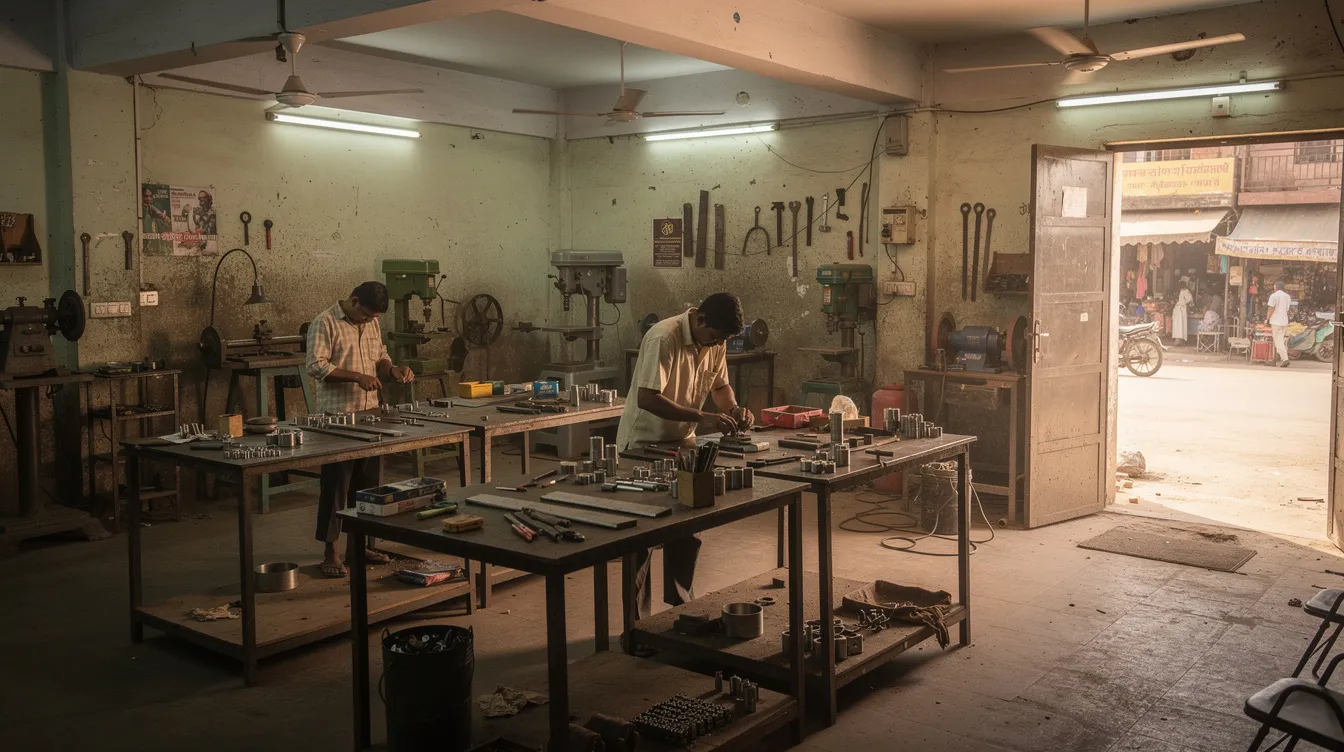
For manufacturing and certain service projects, machinery and equipment are typically the largest part of Mudra Loan project cost and require careful detailing.
Include the following: main production machinery, auxiliary machines, tools, testing equipment, packaging machines, and directly related accessories needed to start normal operations. For example, a snack manufacturing unit might list a mixture grinder, a sealing machine, a weighing scale and packaging equipment.
Add associated costs like freight, insurance during transit, installation charges and basic electrical connections (cables, panels) either as part of the machinery cost or as a separate head. The important point is to avoid double counting; if electrical installation is included under machinery, do not repeat it as a separate line item elsewhere.
Obtain at least one written quotation per major machine. Banks may ask for copies during appraisal. In my experience, item-wise machinery details supported by supplier quotations with GST numbers reduce back-and-forth queries and speed up processing.
The item-wise list should show quantity, basic specification or capacity (e.g., “2 HP Grinder, 1 No.” or “500 kg/day Sealing Machine, 1 No.”) so that the projected output in financial projections appears realistic. An unexplained lump-sum entry like “Machinery: ₹5,00,000” without any required third party details such as supplier name, model or capacity weakens the report.
Furniture and Fixtures
This head covers counters, display racks, shelves, office tables and chairs, storage cupboards, work benches and other fixtures permanently used in the business. For a small retail shop or salon, furniture can be a meaningful part of total project cost.
Include only reasonable, business-related items. A luxury sofa set or high-end designer furniture intended for personal use should not appear here. Such inclusions weaken the proposal’s credibility. In a kirana store project report, for example, display racks, a weighing scale platform and a billing counter are appropriate; an imported dining table is not.
For larger interior projects, attach one quotation or estimate from a local furniture supplier. For smaller amounts, simple local-market rates are sufficient. Ensure that the amount shown in project cost matches any interior estimate attached to the report.
Group minor items together under a single line (e.g., “Shop Furniture & Fixtures: ₹60,000”) instead of an excessively detailed micro-list that confuses rather than clarifies.
Computers, POS and Office Equipment
This head includes computers, laptops, printers, POS machines, billing systems, basic software licences and small office equipment like scanners, if genuinely required for the proposed business.
Show realistic quantities. For many small businesses, one computer and one printer are sufficient. For slightly larger units with multiple employees working at billing or back-office functions, two or three systems may be reasonable.
For services like digital marketing agencies, online trading or consultancy firms, computer and software cost will be more prominent in the project cost breakup. Mention all the products or tools being procured for the business under this head.
Software subscriptions or annual online tools normally appear as revenue expenses in projections. However, any one-time licence purchase or major software investment can be included in project cost as a fixed asset.
Keep this section aligned with the functional needs described in the business profile in a Mudra Loan project report. If the business does not need a computer at all, do not include one just to fill a line item.
Electrical Installation and Power Connection
Some projects need separate budgeting for electrical installation: internal wiring, distribution boards, electrical panels, cabling, industrial plug points and sometimes transformer contribution charges payable to the electricity board.
Small shop-type Mudra projects may not require a separate head if electrical costs are negligible and already included under renovation. For manufacturing units with three-phase power requirements, a separate “Electrical Installation” line is often justified and can run into ₹30,000 to ₹60,000 or more depending on load.
Base the estimate on an electrician’s or contractor’s quotation or past experience with similar installations. Avoid arbitrary round figures without any basis.
Power-connection deposits or charges payable to the electricity board can be shown here or under “Deposits and Other Setup Costs,” but not in both places. Appropriate electrical capacity (e.g., three-phase connection, specific kVA load) should be consistent with the machinery horsepower and load mentioned in the report.
Renovation, Interior and Fit-Out Work
Most retail, salon, clinic and restaurant-type Mudra Loan projects emphasise renovation and interior works rather than heavy machinery. In many cases, this is the primary fixed-asset investment.
Typical items include flooring changes, false ceiling, painting, wall panelling, signage, glass partitions, display counters, lighting upgrades and basic branding within the premises. Renovation costs should be supported by a contractor or interior estimate when amounts are large, especially for project costs nearing the upper Mudra limit of ₹10 lakh.
Renovation on rented premises is legitimate project cost, but the report should clearly mention that the premises are on rent and that interior works are required to start operations. Banks accept this, but want transparency.
Avoid copying high interior budgets from unrelated businesses. A restaurant may justify ₹2,00,000 in interior work; a mobile repair shop typically cannot. Renovation should be proportionate to expected turnover and the nature of the service offered.
Vehicles in Project Cost
Vehicles should be included in project cost only when they are clearly required for the business model. A goods pickup van for a distribution business, a delivery vehicle for an e-commerce fulfilment unit, or a small commercial auto for a service enterprise are valid examples.
For personal-use cars or two-wheelers, including them under project cost for a Mudra Loan creates credibility issues during appraisal. Banks can tell the difference between a delivery tempo and a personal sedan.
Show the basic on-road price of the commercial vehicle, including body-building cost where relevant. Consider whether GST input credit is assumed while deciding whether to use GST-inclusive or exclusive values.
Some banks have separate products for commercial vehicle finance. Check whether the specific Mudra scheme of your bank allows vehicle funding as part of project cost before including it.
Insurance and registration fees for a new vehicle may be treated as part of project cost or as working capital/start-up expenses, depending on the chosen presentation. The rule is simple: do not count them twice.
Preliminary and Pre-operative Expenses
Preliminary expenses include setup costs incurred before operations start. These cover initial legal and registration fees, basic consultancy or professional fees, initial marketing and advertising strategies for launch, trial-run expenses and staff training costs. In some reports, estimated preliminary expenses can reach ₹2,20,000, though this figure will be far lower for most small Mudra projects.
Banks view abnormally high pre-operative expenses with caution. This head should be moderate and clearly explained, especially in smaller Mudra Loan proposals.
Typical allowed items include: firm or enterprise registration fees, professional fees for project report and document preparation, basic branding and launch expenses, initial travel for supplier selection, and initial trial production costs.
For most small Mudra projects, group preliminary items into a single figure (e.g., “Preliminary & Pre-Operative Expenses: ₹25,000”) unless the project size justifies a more detailed breakup.
Ongoing marketing expenses, rent and salaries after operations commence should appear in the Profit & Loss projections, not loaded entirely into project cost.
Deposits and Other Setup Costs
This head covers security deposits for rented premises, electricity and gas connection deposits, telephone and broadband deposits, and any one-time refundable deposits essential to start the business.
Rent advance (e.g., two to three months’ rent) can be shown here if it is a genuine condition of the rental agreement and the amount is actually blocked for the business as mentioned in the agreement.
Do not include general contingency funds or personal emergency reserves as “deposits.” This section should contain only business-related obligations, each traceable to a document or agreement.
Some lenders prefer to keep deposits minimal in project cost. Where deposits are large (e.g., for prime-mall locations or high-street shops), clearly mention the commercial reason.
Deposits included here should be reflected appropriately in the projected balance sheet as loans and advances or deposits, so that the project cost and financial statements remain consistent.
Working Capital Requirement and Margin in Project Cost
Many banks do include initial working capital or working capital margin as part of total project cost. The calculation must be logical, derived from the business model, and consistent with the specific mudra scheme and bank practice. Working capital covers day-to-day running expenses for initial months.
In simple terms, working capital is the money tied up in stock or inventory, debtors or receivables and day-to-day operating expenses, minus trade creditors and other short-term payables. For a kirana store, this means the cost of maintaining adequate stock on shelves and covering rent, wages and utilities until sales generate enough cash flow.
There is an important distinction between “working capital requirement” and “working capital margin.” The total requirement may be funded partly by a bank working capital limit (cash credit or overdraft) and partly by the promoter’s own funds. The promoter’s share, often called the margin component, is frequently shown in project cost.
Derive working capital logically: estimate days of raw material holding, days of finished goods stock, the credit period allowed to customers, the credit received from suppliers, and operating expenses for the initial months. For one kirana store project report I reviewed, working capital for two months (covering inventory, wages, rent, electricity and miscellaneous expenses) was calculated at approximately ₹2,39,000, which was a detailed and defensible figure.
Treatment of working capital in project cost can differ with bank practice. Align your presentation with the Mudra Loan project report format in Excel you are using, and confirm the approach with your bank branch.
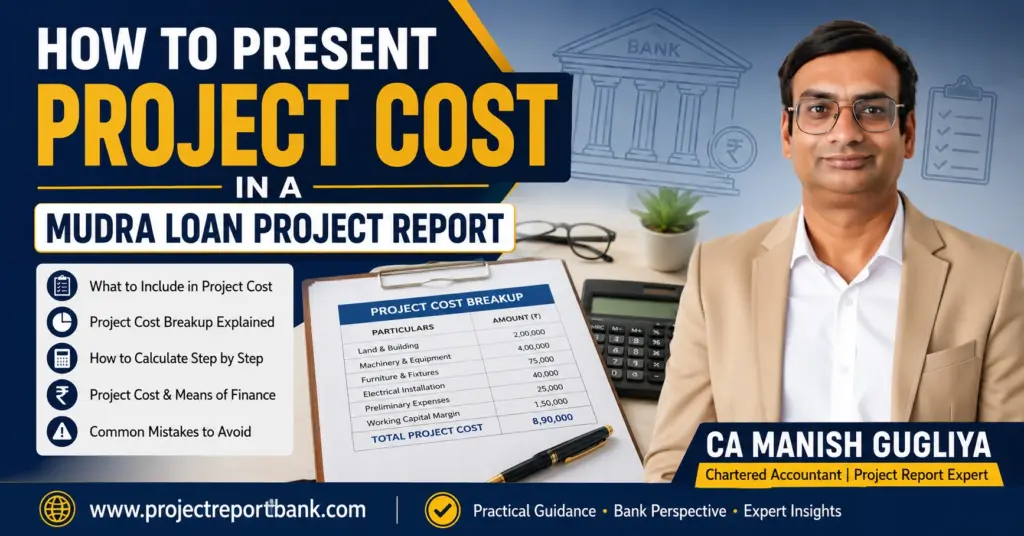
Project Cost Format for Mudra Loan (Illustrative Table)
Below is a sample project cost breakup for a typical small enterprise seeking a Mudra Loan of about ₹6 to ₹7 lakh. The total project cost in this example is ₹8,00,000. A standard project report format with this kind of table is accepted by most banks.
| Particulars | Amount (₹) |
|---|---|
| Machinery & Equipment | 4,00,000 |
| Furniture & Fixtures | 75,000 |
| Computers / Office Equipment | 50,000 |
| Electrical Installation | 40,000 |
| Renovation / Interior Work | 60,000 |
| Preliminary / Pre-operative Expenses | 25,000 |
| Working Capital / Margin | 1,50,000 |
| Total Project Cost | 8,00,000 |
This table is illustrative only. The actual project cost components and amounts must reflect each applicant’s sector (manufacturing, trading or services) and local market prices. A mobile repair shop in Madhya Pradesh may have a total project cost of ₹3 to ₹4 lakh, while a small restaurant could range between ₹12 to ₹15 lakh.
This format is widely understood by banks for small bank loan and Mudra proposals. The same heads should appear consistently in the rest of the project report where relevant, including the balance sheet, depreciation schedule and means of finance table.
Keep the layout clean. Use only one total line as “Total Project Cost” in bold. Avoid unnecessary sub-tables inside this example.
How to Calculate Project Cost Step by Step
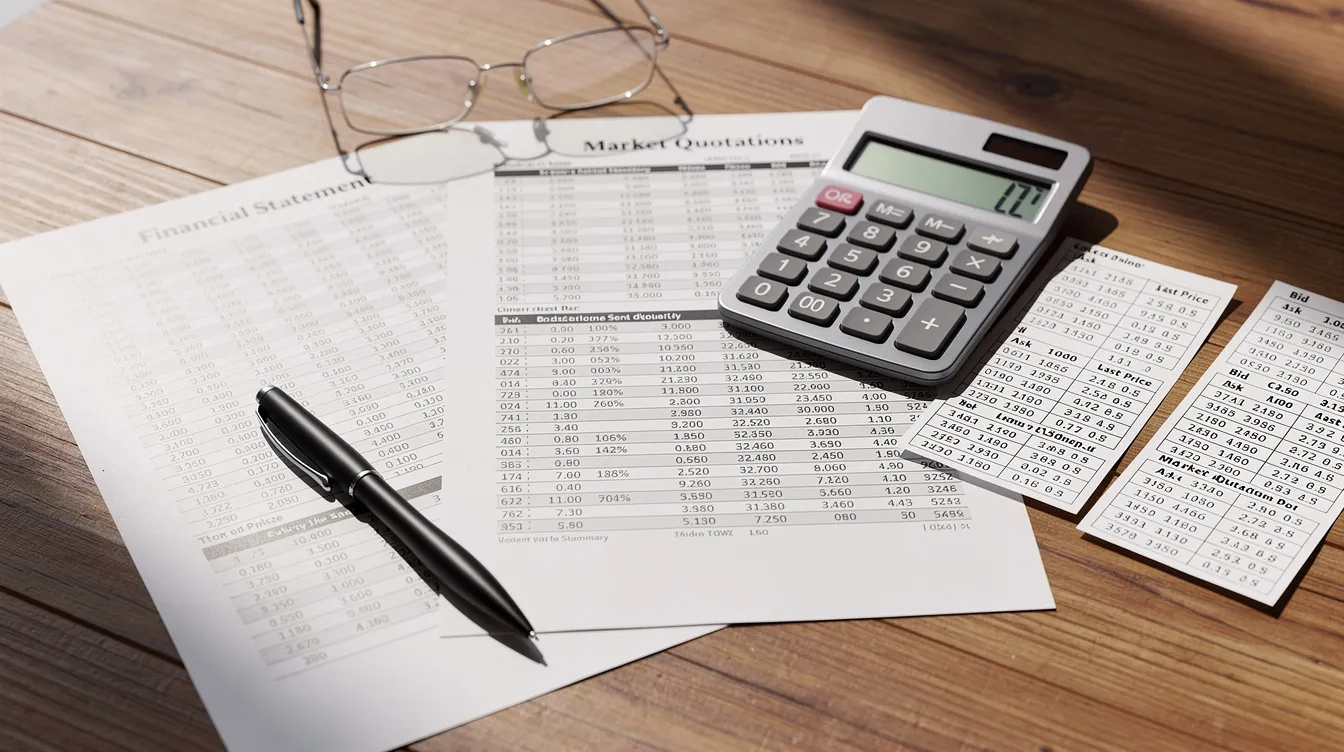
Project cost can be calculated by listing all required assets and setup costs, obtaining realistic estimates or quotations, adding eligible preliminary expenses and computing working capital requirement, then summing them up. The formula, conceptually, is: Total Project Cost = Fixed Assets + Eligible Setup/Pre-operative Costs + Working Capital Requirement.
Here is a step-by-step process:
- Identify the proposed business activity. Is it manufacturing, trading or services? This determines which assets are needed. Start from the business activity and project description already defined in the report.
- List all required fixed assets. Machinery, equipment, furniture, computers, vehicles, electrical installation and any construction or renovation needed.
- Obtain realistic quotations or estimates. For major items (especially machinery), get at least one written quotation. For renovation, get a contractor estimate. Use local market rates for furniture and fixtures.
- Add installation and directly related setup costs. Freight, insurance during transit, installation charges, basic electrical connections for machinery.
- Estimate genuine preliminary and pre-operative expenses. Registration, licensing, initial consultancy, launch-related costs. Keep this moderate.
- Compute working capital requirement. Based on stock levels, credit terms, operating expenses for the initial period. Use the business model, not arbitrary figures.
- Remove personal or unrelated costs. Personal furniture, personal vehicle, household expenses, speculative investments; none of these belong here.
- Verify all calculations. Check arithmetic. Check that no item is counted twice.
- Arrive at total project cost. Sum of all the above.
- Match with means of finance. Determine how much the promoter will contribute and how much bank finance is needed. Both sides must be equal.
All assumptions used for cost estimation (prices, quantities, working capital cycle) should be noted. They will feed into the financial projections and will be part of the bank discussion. While in some cases creating a project report can take as little as 10 minutes using structured templates, the project cost section deserves careful thought regardless of how the report is generated.
Project Cost and Means of Finance: Understanding the Difference
Project cost shows where the money will be used. Means of finance shows where the money will come from. The two must always total to the same amount. Project reports should show where the project funding will come from and how it will be spent.
Here is a side-by-side comparison:
| Project Cost (Application of Funds) | Means of Finance (Sources of Funds) |
|---|---|
| Machinery & Equipment: ₹4,00,000 | Promoter Contribution: ₹1,50,000 |
| Furniture & Fixtures: ₹75,000 | Proposed Term Loan: ₹5,50,000 |
| Computers: ₹50,000 | Working Capital Loan (if any): ₹1,00,000 |
| Electrical Installation: ₹40,000 | |
| Renovation: ₹60,000 | |
| Preliminary Expenses: ₹25,000 | |
| Working Capital / Margin: ₹1,50,000 | |
| Total: ₹8,00,000 | Total: ₹8,00,000 |
In this example, total project cost of ₹8,00,000 is funded by promoter contribution of ₹1,50,000 and proposed bank finance of ₹6,50,000 (split between a term loan and a working capital loan component). The project cost and means of finance are fully reconciled.
Promoter’s contribution is typically 5% to 10% of project cost in many Mudra Loan cases, though some banks may expect 15% to 25% depending on scheme category and risk assessment. MUDRA loans cover 80% to 95% of the project cost, but the exact ratio varies by lender, business type and applicant profile.
A common confusion: promoter contribution is a source of funds, not an item of cost. It appears in the means-of-finance table, not in the project cost breakup.
Each bank under PMMY, whether it is a public sector bank, ICICI Bank, Axis Bank or any other commercial bank or financial intermediary, may have its own comfort level on promoter contribution percentage. MUDRA, which stands for Micro Units Development and Refinance Agency, functions as a refinance agency covering loans extended by banks and financial institutions to the beneficiary micro unit. Confirm the expected margin with your specific branch rather than relying on hearsay.
How to Present Machinery Cost Correctly
In my professional experience, unsupported entries like “Machinery: ₹5,00,000” without any detail trigger the most queries during bank appraisal. Item-wise supported machinery details, on the other hand, build trust.
Present machinery cost with:
- Item description: Name and type of machine (e.g., “Flour Mixer, Semi-Automatic”)
- Basic capacity or specification: e.g., “50 kg/batch” or “2 HP motor”
- Quantity: Number of units
- Unit cost: From supplier quotation
- Total cost: Quantity multiplied by unit cost
For GST treatment: if the project assumes input-tax-credit availability, the asset may be shown at GST-exclusive cost. If not (for example, if the enterprise is not GST-registered or does not expect to claim credit), use the full invoice value including GST. State this assumption clearly to avoid confusion during appraisal.
Add freight, packing, insurance during transit and installation charges either as separate columns or aggregated under machinery. Ensure these costs are not duplicated under another head like “Electrical Installation” or “Renovation.”
Include a short note in the project report about supplier details for major machines, including city, brand and model number. For example: “Sealing Machine, XYZ Brand, Model ABC-200, Supplier: M/s PQR Traders, Indore.” This shows the bank that the applicant has done basic groundwork and has third party details available for verification.
How to Present Working Capital in Project Cost
Working capital in project cost should be presented as a calculated figure based on stock, receivables and operating cycle, not as an arbitrary round number. Show what portion will be funded as part of project cost and what portion, if any, will come through separate working capital facilities.
The main components of working capital estimation:
- Average stock of raw materials: Based on number of days of raw material holding and daily consumption rate.
- Finished goods stock: Based on production cycle and average time before sale.
- Average receivables: Based on the credit period allowed to customers (e.g., 15 days, 30 days).
- Operating expenses: Salaries, rent, utilities and other recurring costs for the initial period before stable cash flows develop.
- Minimal cash balance: A small buffer for daily transactions.
- Less: trade creditors: Credit received from suppliers reduces the working capital requirement.
The working capital cycle measures the time from paying suppliers until collecting money from customers. Longer cycles require higher working capital. Manufacturing businesses and B2B trading projects typically have longer cycles than retail cash-and-carry businesses.
In many Mudra Loan structures, only the “margin” portion of working capital is treated as part of project cost, while the remainder is funded through a cash-credit or overdraft facility. The approach depends on the financing structure and lender practice.
Ensure that the working capital assumptions in this section are exactly the same as those used for financial projections and interest calculations. If your project cost shows ₹1,50,000 as working capital but your projected balance sheet shows ₹3,00,000 as current assets, the bank officer will ask why the numbers do not match.
Project Cost for Manufacturing, Trading and Service Businesses
The composition of Mudra Loan project cost differs between manufacturing, trading and service units, even if the total amount is similar. The project cost should reflect the actual business model rather than a generic template.
Manufacturing business (e.g., a small snack-making or fabrication unit): The emphasis falls on plant and machinery, tools, factory shed or renovation, electrical installation for commercial manufacturing processes, and raw material stock as working capital. A fabrication unit in Madhya Pradesh, for instance, may have a total project cost of ₹15 to ₹18 lakh, with machinery and electricals consuming 60% to 70% of the total. Even at smaller scales, machinery will dominate. If the business has achievements like export orders, these strengthen the financial projections but do not change the project cost calculation itself.
Trading business (e.g., a mobile accessories shop or grocery store): The focus shifts to shop setup, display furniture and racks, computers or POS systems, and a sizable initial inventory stock. Machinery is minimal or absent. A grocery or retail shop may have project cost of ₹4 to ₹5 lakh, with inventory and working capital forming 50% or more of the total. Unlike a large retail chain like Big Bazaar, a small kirana store does not need elaborate infrastructure; its project cost should reflect that reality. The report should list all the products or product categories the business will stock.
Service business (e.g., a beauty salon or small clinic): Typical assets include specialised equipment (salon chairs, hair-care machines, medical devices), computers or software, interior renovation work and moderate working capital. A salon project cost of ₹6 to ₹8 lakh may allocate 30% to equipment, 30% to renovation, 15% to furniture and 25% to working capital and preliminary expenses. The project commercial aspects of a service business differ from manufacturing, and the project cost should capture those differences.
New Business vs Existing Business Project Cost
For a new business, project cost usually represents the full initial investment required to commence operations. For an existing business seeking expansion, it should represent only the incremental cost: additional machinery, expanded premises, extra working capital and any other new investment needed for the proposed expansion.
Separate existing assets (already owned machinery, building, vehicles) from proposed new assets to be acquired with the Mudra Loan. Only the new, incremental costs should appear as fresh project cost.
Consider a simple example. An existing tailoring shop with three machines wants to add five new machines and renovate its workspace. The project cost for this expansion loan should include only the five new machines, renovation cost and any additional working capital. The three old machines are part of the company’s background and existing asset base; they are not new project cost items.
Presenting the entire historical cost of existing fixed assets as new project cost can mislead the bank and distort debt-equity calculations. The bank will question why already depreciated assets are being treated as fresh investment.
For existing businesses, financial statements, track record and the promoter profile in a Mudra Loan project report (including the promoter’s education qualification and relevant expertise) should support the scale of expansion proposed.
Common Mistakes While Presenting Project Cost
A common mistake I see applicants make is not about having a weak business idea; it is about presenting project cost poorly. Many Mudra Loan applications face delays or rejection because the project cost section is unrealistic, unsupported or internally inconsistent.
Here are the most frequent errors and how to correct them:
| Mistake | How to Correct It |
|---|---|
| Showing only one lump-sum figure without breakup | Provide item-wise project cost table with each head and amount |
| Inflating machinery cost without quotations | Attach at least one quotation per major machine with supplier name and GST number |
| Including personal or luxury items (personal bike, home furniture) | Remove all non-business items; include only assets required for the proposed enterprise |
| Double-counting costs (renovation includes electricals AND electricals shown separately) | Review all heads; ensure no cost appears in two places |
| Confusing project cost with loan amount | Clearly state total project cost, then show loan amount separately under means of finance |
| Ignoring working capital entirely | Calculate working capital logically and include the applicable portion in project cost |
| Adding excessive contingency (10% to 15% without justification) | Keep contingency at around 5% of total expenses, if included at all, with a brief explanation |
| Arithmetic errors in totals | Cross-check all additions before submission |
| Mismatch between project cost and means of finance totals | Ensure both sides are equal; reconcile before finalising |
| Showing high machinery cost but very low projected production | Align machinery capacity with production volumes in financial projections |
| Including unnecessary assets for the stated business | Remove assets that have no connection to the described project activity |
Mismatches between project cost, means of finance and financial projections are warning signs for bank officers. If the project cost shows heavy investment in machinery but projected sales are very low, the bank will doubt whether the money will generate adequate returns. An exhaustive list of errors is not possible here, but the table above covers the most frequent ones.
Re-check all totals and cross-links before submission, possibly with professional assistance where needed.

How Project Cost Should Connect With Financial Projections
A good project report connects project cost, financial projections and repayment schedule into one consistent story. Supporting financial analysis in a project report is necessary for lender requirements, and this consistency is what separates a credible report from a superficial one.
Fixed assets and depreciation: Machinery, furniture, computers, vehicles and other fixed assets shown under project cost must appear in the projected balance sheet. Each asset category generates depreciation in the Profit & Loss projections at an appropriate rate. If the project cost shows machinery worth ₹4,00,000, the balance sheet should reflect this, and the P&L should include depreciation on machinery calculated at a reasonable rate (often 15% to 30% for machinery, depending on the asset type).
Loan liability and interest: The term loan derived from means of finance should match the loan liability in the projected balance sheet. Interest expense in the P&L should be consistent with the loan amount, interest rates and tenure. The project report must detail expected revenue and repayment plans, and EMI schedules should be feasible given projected cash flows.
Working capital and balance sheet: Working capital built into project cost influences stock and receivable levels in projections, cash-flow timing and the calculation of repayment capacity. If the working capital in project cost is ₹1,50,000, the current assets in the projected balance sheet should reflect a similar level of inventory and receivables.
Capacity and sales alignment: If the project cost shows an investment of ₹4,00,000 in machinery capable of producing 500 units per day, but the projected sales show only 50 units per day, the bank will question the economics. Investment and revenue should be proportionate.
Ratios: Banks often look at the Debt Service Coverage Ratio (DSCR), the ratio of cash available for debt repayment to actual debt obligations. For manufacturing, many banks expect a DSCR of around 1.5; for trading and services, 1.25 to 1.5 is common. The debt-equity ratio for financing can be 1.50:1 in many small-project appraisals. These ratios are derived from the project cost and the financial analysis built on it.
Documents That Can Support Project Cost Estimates
While PMMY itself does not prescribe a single fixed list of documents, banks often ask for supporting papers when project cost is sizeable or machinery-heavy. Having these ready demonstrates preparation.
Common supporting documents include:
- Machinery and equipment quotations from suppliers (preferably with GST number, supplier address and details information about the items)
- Civil construction or renovation estimates from contractors
- Furniture and interior quotations
- Vehicle quotations (on-road price breakup)
- Rent agreement drafts showing monthly rent and deposit requirements
- Electricity board deposit demand letter or connection charge details
- Supplier rate lists for key raw materials (to support working capital estimation)
Working capital estimation may be supported by statements from suppliers about credit terms, industry norms for stock levels and any existing purchase orders or customer enquiries. If the business has existing operations, past purchase invoices and bank statements provide strong evidence.
Keep these documents ready for discussion with the bank, even if they are not all attached with the initial application. Specific requirements can vary by lender and loan amount. How Mudra Loan amount can affect project report requirements depends on whether the application falls under Shishu, Kishore or Tarun categories; follow your bank’s checklist.
Practical Example of Project Cost and Means of Finance
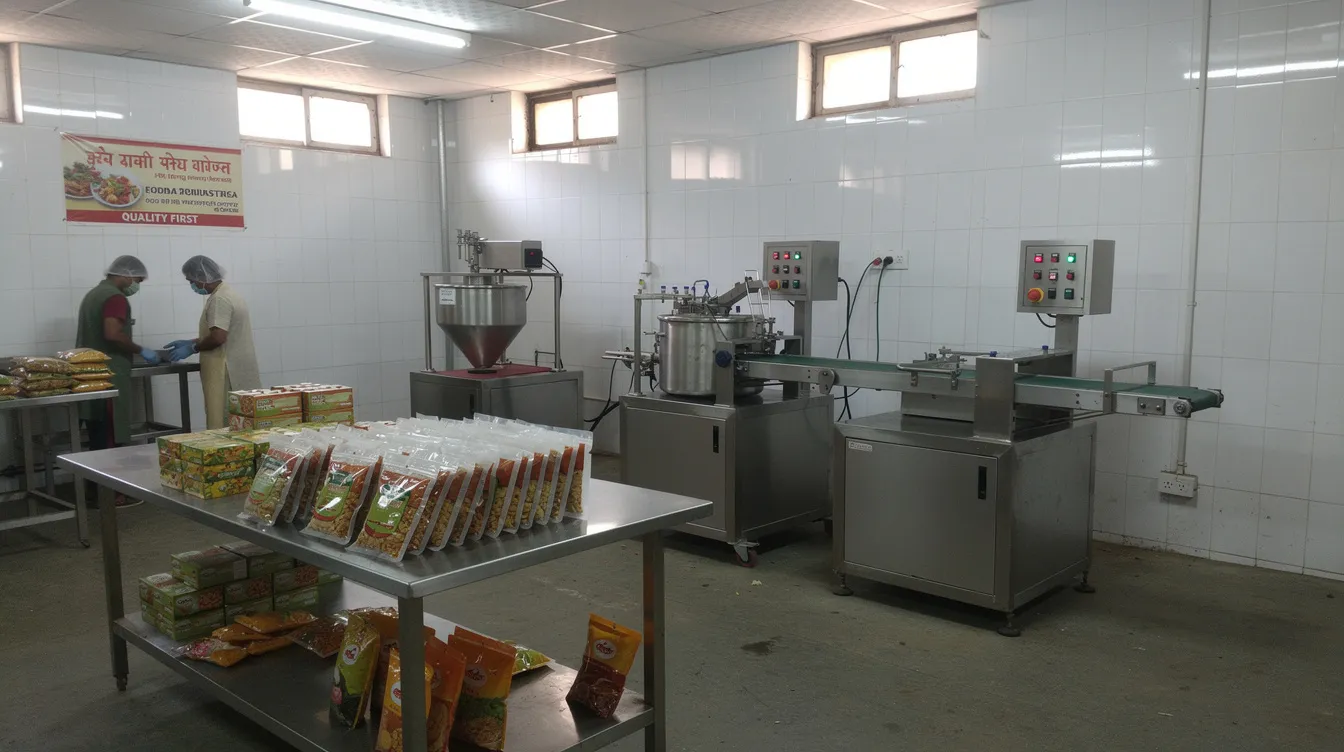
Here is a realistic example of a small snack manufacturing unit (a beneficiary micro unit under PMMA) planning to set up operations with a Mudra Loan. The enterprise will operate from a rented premises, use semi-automatic machinery and sell through local distributors.
Project Cost Breakup:
| Particulars | Amount (₹) |
|---|---|
| Machinery & Equipment (mixer, sealing machine, fryer, packaging unit) | 3,50,000 |
| Furniture & Fixtures (work tables, storage racks, office chair & table) | 50,000 |
| Computers & Billing System (1 desktop + printer + billing software) | 35,000 |
| Electrical Installation (3-phase wiring, panel, earthing) | 45,000 |
| Renovation of Rented Premises (flooring, painting, partition, signage) | 55,000 |
| Preliminary & Pre-operative Expenses (registration, licence, initial marketing, trial run) | 25,000 |
| Working Capital / Margin (raw materials for 2 months, wages, rent, utilities) | 1,40,000 |
| Total Project Cost | 9,00,000 |
Means of Finance:
| Source | Amount (₹) |
|---|---|
| Promoter Contribution (own savings, shown in bank statement) | 1,50,000 |
| Proposed Mudra Term Loan | 6,50,000 |
| Working Capital Loan / Cash Credit Margin | 1,00,000 |
| Total Means of Finance | 9,00,000 |
Why each major cost is included:
- Machinery: Basic production line for expected output of 100 kg/day of snacks; quotations obtained from two Indore-based suppliers.
- Renovation: Converting a rented shop into a food-compliant workspace; contractor estimate attached.
- Electrical Installation: Three-phase connection required for machinery load of approximately 8 HP.
- Working Capital: Three months’ raw material, wages and operating expenses estimated from projected production volumes.
- Promoter Contribution: ₹1,50,000 available in the promoter’s savings account, as reflected in the six-month bank statement attached to the report.
This is for illustration only. The actual structure should follow the complete Mudra Loan project report format used for the specific business. While a typical project cost in larger industrial enterprises can total ₹86,250,190 or more, Mudra Loan projects operate at a much smaller scale, and the focus should be on precision and consistency rather than sheer size.
Checklist Before Finalising Project Cost
Before submitting a Mudra Loan project report, run through this checklist to catch avoidable errors:
- [ ] All costs are business-related. No personal items included.
- [ ] Major asset figures are supported by quotations or market-based estimates.
- [ ] Machinery capacity is reasonable for the projected sales volume.
- [ ] Working capital calculation is logical and based on stock, receivables and operating expenses.
- [ ] No duplicate costs exist (e.g., same item under renovation and furniture).
- [ ] Totals are arithmetically correct.
- [ ] Total project cost equals total means of finance.
- [ ] Term loan and working capital figures match the repayment plan and schedule.
- [ ] Fixed assets and deposits appear correctly in the projected balance sheet.
- [ ] GST treatment (inclusive or exclusive) is applied consistently based on whether input tax credit has been assumed.
- [ ] Promoter contribution is shown under means of finance, not as a project cost item.
- [ ] The project company profile, business scale and employees working are consistent with the investment shown.
Where in doubt, consult a practising Chartered Accountant for a one-time review of the project cost and projections before approaching the bank. A small investment in professional review can prevent weeks of delays and repeated queries.
Expert View: CA Manish Gugliya on Project Cost Presentation
In my practice at ProjectReportBank.com, I have seen loan project reports succeed and fail for reasons that often have nothing to do with the business idea itself. The most common reason for queries and delays in a Mudra Loan project report is not poor profitability; it is an inconsistent or unsupported project cost section.
The objective of preparing project cost is not to maximise the loan amount. It is to present a reasonable, explainable and internally consistent investment requirement aligned to the business model. When I prepare a project report, I focus on whether every line item in the project cost can be explained in a two-minute conversation with a bank officer. If it cannot, it either needs better documentation or it should not be there.
Both overstatement and understatement cause problems. Inflating machinery cost to get a higher loan can result in repayment strain; the business may not generate enough revenue to service the inflated debt. Understating genuine requirements to look cheaper can leave the enterprise underfunded, with inadequate capacity or working capital to operate.
A well-structured project cost statement improves clarity and speeds up bank discussions, but it does not by itself guarantee Mudra Loan approval. The final decision rests with the lending bank based on multiple factors including credit assessment, promoter’s capacity, nature of the business, market conditions and internal policies. For a candid discussion on this, read about whether a project report guarantees Mudra Loan approval.
ProjectReportBank.com focuses on practical, bank-compatible project report structures for Indian small businesses, based on real-life financing assignments. My knowledge of this process comes from preparing reports across sectors, and the guidance in this article reflects that experience. The approval chances of any loan application depend on multiple factors, and my goal is to help applicants develop a strong, credible document that does its job well.
Frequently Asked Questions on Project Cost in Mudra Loan Project Report
Is project cost the same as Mudra Loan amount?
No. Project cost is the total investment required for the project, covering both the promoter’s own funds and the bank loan. The Mudra Loan amount is only the bank-financed portion. For example, if total project cost is ₹8,00,000 and the promoter contributes ₹1,50,000, the loan amount sought is ₹6,50,000. These are two different figures and should be presented separately in the report.
Can I include working capital in project cost?
Yes. Many banks accept initial working capital or the margin portion of working capital as part of project cost. The calculation should be derived from the business model: estimated stock levels, credit period to customers, operating expenses for initial months. Avoid inserting an arbitrary round figure. The treatment may differ by bank, so confirm with your branch.
Should GST be included in machinery cost?
This depends on whether the enterprise is eligible for and plans to claim input tax credit on GST paid on machinery. If credit is available and assumed in the financial analysis, show the GST-exclusive cost as the asset value. If no credit is expected, include the full invoice value with GST. State the assumption clearly in the project report to avoid confusion.
Can an existing business show old machinery as new project cost?
No. Old machinery already owned and in use should not be presented as new project cost for a fresh loan. Only the incremental investment (new machines, additional renovation, extra working capital for expansion) should appear. Existing assets may be mentioned separately as part of the current asset base, with a note on their regard and current value, to give the bank context about the enterprise.
How detailed should the project cost breakup be for small Mudra Loans?
For Shishu loans (up to ₹50,000), a simplified breakup with four to five heads is usually sufficient. For Kishore and Tarun loans, banks expect more detailed breakups with item-wise costs, quotations for major assets and a calculated working capital requirement. The level of detail should be proportionate to the loan amount and the complexity of the business. When banks may ask for a Mudra Loan project report depends on the amount and the lender’s internal process, but even a small loan benefits from a clear, honest breakup over a vague single number.
- How to Present Sales & Revenue Projections in a Mudra Loan Project Report


- How to Present Working Capital Requirement in a Mudra Loan Project Report

- How to Present Machinery Details in Mudra Loan Project Report
- How to Show Means of Finance in a Mudra Loan Project Report

- How to Present Project Cost in a Mudra Loan Project Report
- How to Write Business Activity & Project Description in a Mudra Loan Project Report

- How to Write Promoter Profile in a Mudra Loan Project Report

- How to Write Business Profile in a Mudra Loan Project Report

- Mudra Loan Project Report Executive Summary – How to Write It Right