
Chocolate milk is one of the fastest-growing segments in India’s value-added dairy sector, driven by urbanisation, changing consumer preferences and the rapid expansion of modern retail. Yet most promoters who approach me for project advice have only a rough idea of machinery cost and no real clarity on how a lender will evaluate their proposal. A well-prepared Chocolate Milk Manufacturing Plant Project Report bridges that gap, combining technical design with bankable financial projections.
Key Takeaways
A Chocolate Milk Manufacturing Plant Project Report is far more than a machinery price list. It is a comprehensive document that serves as a key pitch document for banks and investors, demonstrating process design, market opportunity, capacity planning, regulatory compliance and robust financial projections covering capital investment, working capital and profitability analysis. From my experience preparing DPRs across dairy and food-processing projects in India, lenders evaluate risks, margins and ramp-up curves, not just whether the promoter can afford equipment.
Indicative investment for a small to mid-scale commercial chocolate milk production plant (5,000–20,000 litres per day) in India typically falls between ₹5 crore and ₹10 crore excluding land, depending on whether the line is pasteurised or UHT, the automation level and the packaging system chosen. For reference, a minimum investment for a 500 LPH dairy plant starts at roughly ₹25–40 lakhs, while a total project cost for a micro dairy ranges between ₹40–80 lakhs. These numbers scale significantly once you add value-added processing for chocolate flavored milk.
The commercial opportunity is strong. India’s flavoured milk market was valued at approximately ₹76.4 billion in 2025, with chocolate holding roughly 36% share among flavours. However, competition from national dairy brands, malt beverages and protein drinks is intense. Success requires careful pricing, shelf-life planning, distribution strategy and realistic financial modelling. A bankable Chocolate Milk Manufacturing Plant DPR must integrate technical design with financial projections tailored to the promoter’s proposed project. ProjectReportBank.com, led by CA Manish Gugliya, assists entrepreneurs in preparing customised, lender-friendly project reports, CMA Data and financial projections for such projects.
What Is a Chocolate Milk Manufacturing Plant?
A chocolate milk manufacturing plant is an industrial facility that processes raw or chilled milk into commercially packaged chocolate flavoured milk using controlled formulations, hygienic dairy technology and standardised process parameters. Milk chocolate in its confectionery form contains cocoa, milk and sugar, and the beverage variant follows a parallel logic: blending standardised milk with cocoa powder or chocolate premix, sugar, stabilisers and permitted ingredients under process-controlled conditions.
The difference between homemade preparation and industrial chocolate milk production is significant. An automatic chocolate milk processing plant involves continuous milk reception, standardisation of fat and milk solids, filtration, controlled cocoa and sugar addition, homogenisation, heat treatment such as pasteurization or UHT, and filling on a production line. A project report for a chocolate milk manufacturing plant outlines both the technical and operational feasibility of such operations. The manufacturing process involves steps such as milk reception, pasteurization and packaging, each governed by food-safety protocols.
An industrial chocolate milk processing plant may produce pasteurised refrigerated chocolate milk in pouches or bottles, UHT chocolate flavoured milk in aseptic cartons, PET or glass-bottle products, and institutional packs for HoReCa and QSRs. The core unit operations run sequentially: milk reception → clarification → standardisation → chocolate or cocoa syrup preparation → mixing and blending → homogenisation → pasteurisation or UHT → cooling (for pasteurised) → filling → packaging → cold storage or ambient storage → dispatch. A proper Chocolate Milk Manufacturing Plant Project Report describes each of these operations, their capacity and role, supported by process-flow diagrams and equipment specifications suited to Indian conditions.
Chocolate Milk Market Opportunity in India
Chocolate flavoured milk sits within the larger space of value-added dairy products and ready-to-drink beverages, competing with milkshakes, malted beverages, lassi, cold coffee, ice cream-based drinks and protein drinks. For perspective, the global milk chocolate market was valued at USD 67.0 billion in 2025 and is expected to reach USD 87.0 billion by 2034, projected to grow at a CAGR of 2.90% from 2026 to 2034. Combination bars dominated the confectionery market with sales surpassing $140 billion in 2018, underscoring how deeply chocolate resonates with consumers worldwide.
Market analysis should evaluate local and national demand and target customer segments. In India, demand drivers include growing middle-class income, urbanisation, rising consumption of on-the-go beverages, school and college canteens, QSRs, online grocery platforms and the shift from unpacked to branded dairy products. Consumer segments range from children preferring smaller, sweeter packs to teenagers, young working professionals, gym-goers seeking high-protein variants and impulse buyers at retail counters, each preferring different pack sizes, sweetness levels and price points.
Distribution channels vary by technology: local dairy brands selling pasteurised chocolate milk within a 50–100 km radius via refrigerated vehicles, regional brands selling UHT chocolate milk across multiple states, and private-label production for large retailers. The competitive landscape includes national dairy cooperatives, regional dairies, flavoured milk brands, malt and cocoa beverage manufacturers, and café-style milkshake outlets. A good Chocolate Milk Plant Project Report must include realistic market sizing for the chosen geography and positioning.
Chocolate Milk Product Variants and Product Mix
Finalising the product mix is one of the earliest strategic decisions in a chocolate milk manufacturing project. The choice of variants, sweetness, fat content and pack size directly shapes machinery requirements, ingredient cost and revenue potential.
Typical variants include classic chocolate milk (3.0–3.5% fat), dark chocolate milk with higher cocoa content, low-sugar or no-added-sugar chocolate milk, high-protein or whey-enriched chocolate milk, fortified variants with added vitamins and minerals, premium cream-rich chocolate milk, and kids’ packs in 150–200 ml sizes. Milk chocolate typically contains 45–50% sugar by weight in confectionery form; beverage formulations adjust this considerably based on consumer preferences and health positioning. Milk chocolate must contain at least 3.5% milkfat in most of Europe and at least 10% cacao in the US, providing useful benchmarks for export-oriented producers.
The chosen product mix influences the chocolate milk manufacturing process parameters, ingredient cost per litre including milk solids, cocoa, sugar and stabilisers, as well as selling price, gross margin and marketing positioning. Packaging formats such as pouches, PET bottles, glass bottles and UHT cartons are part of the product mix and must align with target consumers and planned distribution radius. The DPR should model at least 2–3 realistic product-mix scenarios, and promoters can refer to the guidance on value-added dairy plant capacity planning and product mix for deeper reading.
Chocolate Milk Manufacturing Process
The chocolate milk manufacturing process is fundamentally about process control, food safety and consistency rather than just theoretical steps. From a practical standpoint, every batch must deliver the same taste, texture, viscosity and microbiological safety, which is why the process demands disciplined engineering and monitoring.
The sequence begins with milk reception and chilling, followed by quality testing for fat, SNF, adulteration and microbial load. The milk undergoes filtration and clarification, then standardisation of fat and SNF using cream separators or blending with milk powder. Milk is often added in powdered form to adjust solid levels. After preheating, the cocoa or chocolate syrup premix is prepared using high-shear mixers to achieve proper dispersion. This premix is blended into standardised milk along with sugar and stabilisers in jacketed, agitated tanks. Two-stage homogenisation follows, which is required for chocolate milk in India to reduce fat-globule size and keep cocoa particles suspended. The homogenised blend then undergoes pasteurisation at approximately 72–75°C for 15–20 seconds, or UHT treatment at 135–140°C for a few seconds for extended shelf-life products. After cooling for pasteurised milk, intermediate storage in ageing tanks may occur, followed by automatic filling, sealing, coding, labelling and secondary packaging before cold storage or ambient storage and dispatch.
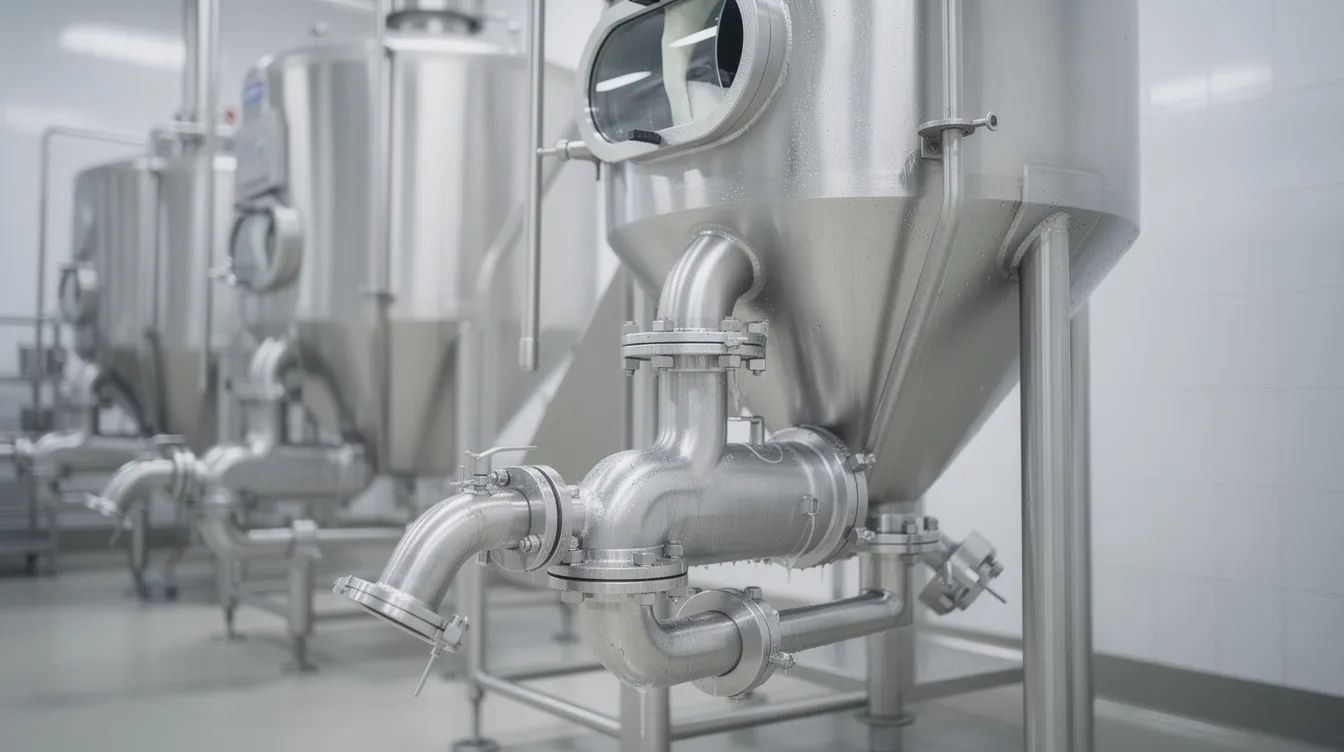
Cocoa dispersion and sedimentation control are among the most critical challenges in chocolate milk. Cocoa solids are heavier than milk, and without proper stabiliser systems, homogenisation pressures and mixing protocols, the product will separate within days. CIP systems, sanitary design features using SS-304 or SS-316 contact parts, food-grade gaskets and sanitary pumps are essential, and lenders evaluating long-term viability pay close attention to these aspects. For a broader understanding of value-added dairy products manufacturing process and production line, promoters can explore detailed process flows beyond chocolate milk.
Raw Materials Required for Chocolate Milk Production
Raw-material planning is central to both manufacturing consistency and the cost of production in a chocolate milk manufacturing project, especially in India where milk and cocoa prices can be volatile. Cocoa availability will influence chocolate manufacturing costs significantly across all scales of operation.
Key dairy raw materials include raw milk (cow, buffalo or mixed), standardised milk, skim milk or milk powder for solids adjustment, cream where higher fat is needed, and potable process water meeting IS and FSSAI norms. Cocoa beans are fermented and dried after harvesting before being processed into cocoa powder, which forms the primary flavour ingredient.
Non-dairy ingredients include cocoa powder at approximately ₹404–422 per kg in Q2 2026, chocolate premix, sugar or permitted sweeteners, stabilisers and emulsifiers as per FSSAI approval, flavours such as vanilla for certain blends, salt in small quantities in some recipes, and vitamins and minerals for fortified variants. Cocoa butter may feature in premium formulations.
Packaging and ancillary inputs include food-grade PET or HDPE bottles, caps, pouches and laminate film, UHT cartons, labels, shrink sleeves, corrugated boxes and shrink film for secondary packaging. The DPR should specify indicative consumption norms per 1,000 litres of chocolate milk with sensitivity analysis for changes in milk and cocoa prices, and all formulations must conform to applicable FSSAI standards for flavoured milk.
Chocolate Milk Plant Machinery and Equipment
Machinery selection for a chocolate milk manufacturing plant is not only about price but about capacity, energy efficiency, cleanability, automation and after-sales support, all of which influence bankability. A small dairy plant requires a batch pasteurizer at minimum, while larger operations demand continuous HTST or UHT systems.
Core process equipment includes a raw milk reception tank, weigh bowl or flow meter, plate or can-type milk chiller (the chilling system), clarifier, cream separator for in-plant standardisation, balance tank, milk storage tanks, jacketed mixing and blending tanks, cocoa premix preparation tank with high-shear mixer, sugar-dissolving tank, double-stage homogeniser, pasteuriser or HTST unit, UHT plant where applicable, holding tubes, intermediate storage tanks and CIP system.
Filling and packaging equipment encompasses automatic bottle or pouch filling machines, capper or heat-sealing unit, rinsing machine, labelling machine, inkjet or laser printer for batch coding, shrink-wrapping or carton-erecting machine, conveyors and weigh-checkers for larger lines.
Utilities and support systems include a boiler and steam distribution, hot-water generator, refrigeration plant and chilled-water system, air compressor, water-treatment plant, effluent treatment plant, electrical panels and control systems, and basic quality control laboratory instruments such as lactometer, milk analyser, pH meter and BOD incubator.
The difference between semi-automatic and fully automatic chocolate milk production lines is significant. Manual ingredient dosing versus automated dosing, and semi-manual versus automatic filling directly influence chocolate milk plant machinery cost, manpower requirement, consistency and productivity. Indicatively, a two-stage homogeniser for approximately 2,000 LPH capacity ranges from ₹1.8–2.5 lakh. For detailed machinery-cost insights, promoters can review the value-added dairy plant machinery and equipment cost resource.
Chocolate Milk Plant Capacity Planning
Capacity planning for a chocolate milk production plant in Indian conditions should consider raw-milk availability, local demand, shelf life, distribution distance and intended product mix rather than simply copying a competitor’s size. Proper plant location considers proximity to raw milk sources and utility availability.
Common commercial capacities include 3,000–5,000 LPD for a small regional dairy, 10,000–20,000 LPD for a mid-size plant, and 30,000 LPD and above for an industrial chocolate milk production plant. For context, annual production capacity for a milk chocolate plant ranges from 5,000–20,000 MT, depending on configuration. In financial projections, a 10,000 LPD line might operate at 50–60% utilisation in year one, ramping to 75–80% over 3–5 years. Lenders specifically look for such phased utilisation in DPRs.
Factors influencing capacity include distribution radius, whether the product is short-shelf-life pasteurised or long-shelf-life UHT chocolate milk, cold chain availability, existing dairy processing plant infrastructure and potential for future expansion.
Land, Building and Hygienic Plant Layout
A hygienically designed plant layout is as important as the chocolate milk manufacturing machine list. It directly affects food safety, operating efficiency and inspection approvals.
For a 10,000–20,000 LPD plant, indicative built-up area requirements range from 10,000–20,000 square feet, though final requirements depend on site conditions, integration with existing dairy operations and future expansion plans.
Key functional areas include milk reception and chilling, raw-milk and ingredient storage, processing hall, ingredient preparation room for cocoa and sugar solutions, homogenisation and pasteurisation area, filling and packaging hall, finished-goods cold room or ambient warehouse, utilities block covering the boiler, refrigeration and compressor, quality control lab, CIP room, ETP, administrative office and staff amenities.
Hygienic zoning principles require clear separation of raw and pasteurised zones, controlled personnel and material movement, dedicated hand-washing and change rooms, and unidirectional product flow from dirty to clean areas to minimise cross-contamination. For detailed layout planning, refer to the guidance on value-added dairy plant land, building, utilities and hygienic layout.
Utilities Required for a Chocolate Milk Processing Plant
Robust utility planning for power, steam, water, refrigeration and compressed air forms a key part of any Chocolate Milk Plant Project Report and directly influences both capital cost and operating cost.
Electricity considerations include connected load estimations for processing equipment, refrigeration, lighting and packaging, with a separate DG set for backup in regions with unstable power. Thermal utilities require boiler capacity sizing for pasteuriser or UHT plant, CIP and hot-water generation, with fuel options including furnace oil, briquettes, LPG or PNG. Refrigeration and chilled-water systems handle milk chilling, cold storage of finished products, jacket cooling for mixing tanks, with recommended cold-room temperatures of 2–4°C for pasteurised chocolate milk.
Additional utilities include potable and process water, compressed air for pneumatic valves and packaging, CIP chemicals, ETP for effluent treatment and basic fire-safety systems. Exact utility sizing is typically finalised at DPR stage with machinery vendor inputs.
Packaging Options for Chocolate Milk
Packaging choice is one of the biggest commercial decisions in a chocolate milk plant because it drives both setup cost and the distribution model. Packaging choices impact shelf life, consumer convenience and regulatory compliance in measurable ways.
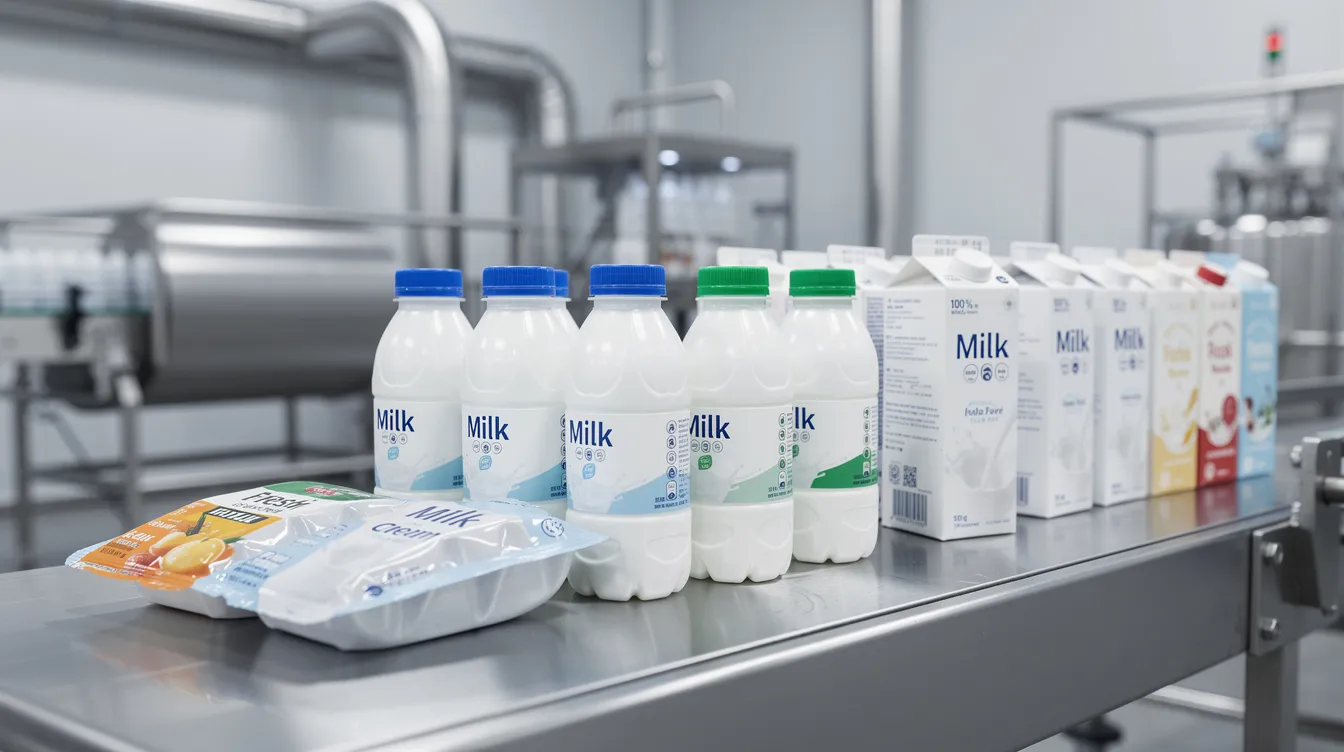
Common formats include LDPE pouches for refrigerated pasteurised chocolate milk, PET or HDPE bottles (200–500 ml) for chilled distribution, glass bottles for institutional or premium markets, and UHT or aseptic cartons (150–200 ml school packs and 1 litre family packs) for ambient storage.
Each format involves trade-offs in initial machinery and material cost, per-litre packaging cost, achievable shelf life, branding possibilities, breakage risk, recyclability and consumer perception. Aseptic chocolate milk packaging (UHT plus aseptic filling) generally requires higher machinery investment but offers longer shelf life and wider geographic reach without continuous refrigeration. The DPR should compare at least two realistic packaging strategies and comment on their impact on working capital, logistics and selling price.
Cold Storage and Distribution Requirements
Pasteurised chocolate milk typically requires continuous refrigeration from factory to retailer at 2–4°C, while UHT chocolate milk can be stored and distributed at ambient temperature, drastically changing logistics and working-capital needs.
Cold-chain elements for refrigerated chocolate milk include product cooling, finished-goods cold room sizing, pre-chilled vehicles with mechanical refrigeration, retailer-level refrigeration and temperature-monitoring practices. Distribution radius is usually smaller for pasteurised chocolate milk, often within 150–200 km, while UHT chocolate milk can be sold across states through distributors and e-commerce.
Typical shelf-life ranges are 5–10 days for pasteurised refrigerated chocolate milk versus 4–6 months for UHT chocolate milk, depending on formulation and packaging. Actual shelf life depends on process validation and regulatory norms. Promoters planning wider cold-chain infrastructure can explore the resource on cold storage and cold chain requirements for value-added dairy products.
Chocolate Milk Manufacturing Plant Setup Cost
Chocolate milk manufacturing plant cost in India varies widely with capacity, technology, automation level and packaging system. A 500 LPH dairy plant costs ₹25–45 lakhs to set up, while a commercial chocolate milk facility at 10,000 LPD or above requires substantially more investment. DPRs should present itemised cost rather than a single headline figure.
| Cost Component | Indicative Range (₹ Crore) |
|---|---|
| Land and site development | 0.50–1.00 |
| Civil construction and building | 2.00–2.80 |
| Processing machinery | 2.00–3.00 |
| Filling and packaging machinery | 0.80–1.50 |
| Cold storage | 0.50–1.00 |
| Utilities (boiler, refrigeration, water treatment, ETP) | 1.00–1.60 |
| Electrical, piping, lab, furniture | 0.40–0.80 |
| Pre-operative expenses and contingency | 0.30–0.80 |
| Margin money for working capital | As per bank norms |
Note: Figures are indicative for a 10,000 LPD semi-automatic pasteurised chocolate milk plant. UHT and aseptic lines cost significantly more. All costs exclude land purchase in certain estimates.
Pre-operative expenses cover design, consultancy, interest during construction, trial-production losses, statutory fees and contingency. Lenders expect these transparently captured. Margin money for working capital is usually treated as part of total project cost for term-loan appraisal.
Project Cost and Means of Finance
As a project finance consultant, I typically structure chocolate milk manufacturing plant investment into project cost (fixed assets plus margin money) and means of finance (equity, term loan, unsecured loans and subsidies where applicable).
Common means-of-finance structures for Indian promoters use debt–equity ratios of 1.5:1 to 2:1, meaning 40–50% promoter margin in cash, with term loans from banks or financial institutions covering the balance. Where eligible, government subsidy schemes for dairy and food processing can form part of overall funding but are usually treated as post-disbursement benefits rather than core equity substitution.
| Means of Finance | Indicative Share |
|---|---|
| Promoter’s contribution (equity) | 40–45% |
| Term loan from bank or FI | 50–55% |
| Other sources (unsecured loans, subsidies) | As applicable |
For detailed structuring guidance, promoters can refer to the discussion on value-added dairy plant project cost and means of finance.
Working Capital Requirement
Working capital is critical in chocolate milk manufacturing because businesses must regularly pay for fresh milk, cocoa, sugar, packaging and wages while sales may be partly on credit through distributors and retailers.
Key components include inventory of raw milk and powder, cocoa and sugar stocks, stabilisers and flavours, packaging material, finished-goods inventory adjusted for shelf life, trade receivables from distributors, and minimal cash balances. Pasteurised chocolate milk with short shelf life typically has faster cash cycles, while UHT chocolate milk often carries higher finished-goods inventory and longer distributor credit, increasing working-capital requirement.
Banks typically provide cash credit or overdraft against stock and receivables. ProjectReportBank.com provides detailed discussion on working capital requirement for value-added dairy products plant for deeper planning.
Revenue Model for a Chocolate Milk Plant
The revenue model of a chocolate milk manufacturing business depends on daily production volume, capacity utilisation, product mix, pack sizes and net realisation per litre after distributor and retailer margins.
Main revenue streams include own-brand retail chocolate milk sales, institutional sales to schools, offices, hotels and QSRs, private-label manufacturing for large retailers, and B2B supplies of bulk milk base to other food manufacturers. Pricing structure involves ex-factory price versus MRP, typical trade margins for distributors and retailers of 10–20%, and discounts for institutional buyers.
For example, if the MRP per 200 ml bottle is ₹30, packaging and filling cost may be ₹4–5 and net realisation after margins approximately ₹20. These are illustrative figures; every DPR must derive them from project-specific data. Promoters designing broader portfolios can review the value-added dairy products revenue model and market strategy.
Operating Cost and Cost of Production
The cost of production combines variable costs and fixed costs, and lenders closely review these in any Chocolate Milk Plant DPR. Operating costs for chocolate milk plants are dominated by raw materials, which typically account for 55–65% of total operating expenses.
Variable cost heads include raw milk or milk powder, cocoa powder or premix, sugar and other ingredients, stabilisers and flavours, packaging material, power and fuel, water, and direct labour. Fixed and semi-fixed costs cover salaries of technical and managerial staff, maintenance, quality control expenses, insurance, marketing and selling expenses including distributor incentives, administrative overheads and statutory compliance costs.
Accurate cost estimation requires customised data for each project, hence ProjectReportBank.com prepares plant-specific operating-cost schedules in its Chocolate Milk Manufacturing Plant Project Reports.
Chocolate Milk Plant Profitability and Break-Even Analysis
Profitability analysis in a chocolate milk manufacturing project focuses on gross margin per litre, overall EBITDA, profit after tax, and the capacity utilisation at which the project reaches operational break-even. Gross profit margins for chocolate milk plants typically range from 24–34%, depending on product mix, pricing and raw-material costs.
The break-even point indicates the sales volume required to cover all operating costs. Contribution margin (selling price minus variable cost) must cover fixed costs such as salaries, interest, depreciation and overheads. Higher contribution per litre and higher capacity utilisation both improve chocolate milk manufacturing profit margin.
A change in milk purchase price or cocoa cost by even a few rupees per litre can materially affect contribution, making the case for sensitivity analysis. For deeper profitability modelling, promoters can explore the resource on value-added dairy plant profitability and break-even analysis.
Financial Projections Required in a Chocolate Milk DPR
A bankable Chocolate Milk Plant DPR must translate technical assumptions into structured financial projections, typically for 7–10 years, to support bank loan or investor decisions. Financial projections should cover capital investment, working capital and profitability analysis in an integrated manner. Essential components of the project report include an executive summary, market analysis and financial projections.
Key financial statements include projected profit and loss account, balance sheet, cash-flow statement, and working-capital assessment. Supporting schedules cover capacity utilisation by year, sales and revenue, raw-material consumption, power and fuel, manpower, interest and term-loan repayment, depreciation and tax calculations. Key indicators include DSCR, ROI, IRR, payback period and break-even point. Promoters can refer to the detailed guide on value-added dairy plant financial projections for DPR.
DSCR and Loan Repayment Capacity
DSCR (Debt Service Coverage Ratio) compares available cash, calculated as net profit plus depreciation and other non-cash adjustments, with annual term-loan instalments and interest. Indian banks place significant emphasis on DSCR while appraising chocolate milk plant bank loan proposals, typically looking for minimum and average DSCR above their internal thresholds over the projection period.
Repayment schedules, moratorium periods and interest rates interact with projected cash accrual to determine adequacy. Overly aggressive loan tenors or underestimated expenses can make DSCR appear weak, undermining the entire proposal. For understanding lender expectations in detail, see the resource on DSCR and loan repayment capacity for value-added dairy project.
Bank Loan and Project Finance for Chocolate Milk Manufacturing Plant
Banks and financial institutions in India evaluate term-loan proposals for commercial chocolate milk production plants by assessing promoter profile, project concept, market potential and projected financial performance. A professionally prepared chocolate milk project report for bank loan can significantly improve clarity during appraisal.
Typical documents include the Detailed Project Report covering technical and financial aspects, CMA Data, KYC and financials of promoters, land and building documents, machinery quotations, civil estimates, approvals-in-principle and projected DSCR and profitability statements. Lender considerations include debt-equity ratio, collateral security where required, track record of promoters and existing banking relationships.
Some promoters may also raise funds from NBFCs or private investors, where investor-ready DPRs highlight scalability, brand-building plan and exit options. For comprehensive guidance, explore the resource on bank loan and project finance for value-added dairy products plant.
Term Loan Assessment
Term loans generally finance fixed assets and margin money for working capital in a chocolate milk manufacturing project. Lenders verify machinery quotations, civil estimates and utility costs, and may exclude certain items like promoters’ personal vehicles from eligible project cost.
Typical parameters include proposed repayment period of 5–8 years, moratorium on principal during construction and initial ramp-up, interest rate, security structure and promoter’s contribution percentage. In a professionally prepared Chocolate Milk Plant DPR, the term-loan assessment is aligned with realistic cash-flow projections so that instalment schedules match the project’s ramp-up curve. The detailed explanation on term loan assessment for value-added dairy manufacturing plant provides additional context.
Chocolate Milk Plant Feasibility and Project Viability
Feasibility is multi-dimensional: technical, market, financial and regulatory. A chocolate milk manufacturing plant feasibility study must address all four for a realistic go or no-go decision.
Technical feasibility covers reliable milk procurement, availability of quality cocoa and ingredients, suitability of proposed machinery, availability of utilities and skilled manpower, and compliance with food-safety norms. Commercial feasibility examines actual market demand in the chosen geography, distributor network access, competitive pricing and achievable shelf life. Financial viability considers realistic capacity utilisation, contribution per litre, operating margins, DSCR, ROI and sensitivity to raw-material cost changes.
Feasibility is never guaranteed and must be project-specific. Promoters can explore the resource on value-added dairy plant feasibility and project viability for extended evaluation frameworks.
ROI, IRR, Payback and Sensitivity Analysis
Beyond profitability, investors and banks look at return metrics like ROI, IRR, equity IRR and payback period to understand the attractiveness of a chocolate milk manufacturing project. Overall project ROI measures return on total capital deployed, while project IRR discounts all project cash flows to determine the effective yield. Equity IRR separates promoter equity flows from debt to assess returns on the promoter’s own investment.
Payback period is the approximate time required for cumulative cash inflows to recover the original investment. Shorter payback is preferred but must be realistic given capacity ramp-up.
Sensitivity analysis should assess risks like price fluctuations and lower-than-expected sales. Scenarios modelled typically include milk-price increase of 10–20%, cocoa-cost surge, packaging inflation, selling-price pressure, lower capacity utilisation and higher interest rates. The resource on ROI, IRR, payback and sensitivity analysis of value-added dairy plant provides a more detailed discussion.
Regulatory Approvals and Compliance
Specific approvals depend on state, location, plant size and technical choices. Promoters should always consult local professionals and authorities for final regulatory compliance requirements.
Typical registrations for a chocolate milk manufacturing plant in India include incorporation or registration of the business entity, FSSAI licence for dairy processing (an FSSAI manufacturing license is mandatory for dairy plants in India), GST registration, factory licence, local municipality or panchayat approvals, fire-safety clearance and pollution-control board consent. Regulatory compliance includes securing food safety licenses and environmental clearances.
Utility-related approvals may include high-tension electricity connection, boiler registration and inspection, diesel-storage permissions for DG sets, and clearances for effluent treatment. Packaging and labelling compliances cover Legal Metrology requirements for pack declarations, FSSAI labelling norms for flavoured milk including ingredient list, nutrition information, allergen declaration and batch coding. The DPR can outline typical approvals and timelines based on experience but does not substitute for legal advice for a particular site.
Quality Control in Chocolate Milk Manufacturing
Consistent quality is essential for consumer trust and brand building in chocolate milk manufacturing. Quality control and food safety are critical in dairy projects, including hygiene standards and testing protocols. Lenders view sound quality systems as indicators of long-term sustainability.
Key quality checks at milk-reception stage include organoleptic testing, temperature verification, fat and SNF analysis, acidity measurement, adulteration checks and microbial load assessment. Incoming cocoa, sugar and other ingredients are verified for specification, particle size and microbiological quality, ensuring all inputs are food grade and permitted under FSSAI.
In-process controls cover standardisation records, homogenisation pressure logs, pasteurisation or UHT time-temperature records, viscosity checks, stability and sedimentation observations, and sensory evaluation of trial batches. Finished-product testing includes fat and SNF content, cocoa level, sugar content, microbial tests as per standards, pack integrity for leaks and seal strength, coding and shelf-life testing under real storage conditions, along with documentation and traceability practices.
Major Risks in a Chocolate Milk Manufacturing Project
Every chocolate milk manufacturing business carries risks, and a realistic DPR should acknowledge and address them rather than promising guaranteed results.
Raw-material and price risks include volatility in milk procurement prices, fluctuations in cocoa and sugar prices, potential supply disruptions and the need for long-term supplier relationships and buffer stocks. Operational risks include lower-than-expected capacity utilisation, formulation problems causing sedimentation or phase separation, equipment breakdowns, inconsistent quality, microbial spoilage due to cold-chain lapses and dependence on key technical staff.
Market and financial risks include intense competition, pressure on selling price, delayed payments from distributors, higher marketing spend, higher interest rates and difficulty meeting projected DSCR and repayment schedules. Mitigation strategies include preventive-maintenance systems, strong distributor agreements, conservative borrowing and cautious initial capacity planning.
Chocolate Milk vs General Flavoured Milk Manufacturing
Chocolate milk is a specific sub-category of flavoured milk, distinguished by significant cocoa solids content, darker colour and more pronounced flavor and stability challenges compared to many other flavours like cardamom, rose or saffron.
Formulation differences include higher cocoa solids affecting viscosity, mouthfeel and texture, the need for tailored stabiliser systems to prevent sedimentation, and potential use of different sugar levels or sweetener blends. Some formulations may use lecithin as an emulsifier. Process differences involve more critical high-shear mixing or dispersion systems for cocoa, stricter attention to homogenisation, mixing time and sensory targets for sweetness and bitterness balance. Milk chocolate production requires a two-stage grinding or dispersion process to achieve proper particle-size distribution.
From a plant-layout perspective, the same milk processing plant can usually produce both chocolate milk and other flavoured milks with shared core equipment but different ingredient-handling arrangements and cleaning protocols. Promoters evaluating the broader opportunity should review the comprehensive flavoured milk manufacturing plant project report for a central view of commercial flavoured milk manufacturing projects and DPR preparation.
What Should a Chocolate Milk Manufacturing Plant DPR Include?
A well-structured Chocolate Milk Manufacturing Plant DPR prepared for bank finance or investors should read like a complete business plan, integrating technical, market and financial analysis coherently.
Core sections include executive summary, promoter background and experience, project rationale, market and competitive analysis, proposed plant capacity and product mix, manufacturing process description, machinery and equipment list, land, building and layout, utilities and manpower, and implementation schedule.
Financial and commercial sections cover detailed project cost, means of finance, working-capital assessment, revenue assumptions, cost-of-production estimates, projected profit and loss, balance sheet, cash flow, DSCR and loan-repayment schedule, break-even analysis, ROI, IRR and payback period.
Risk and compliance components include a regulatory-approval roadmap, quality control and food-safety plan, key project risks with mitigation strategies, and notes on environmental considerations. In practice, ProjectReportBank.com prepares customised Chocolate Milk Manufacturing Plant DPRs tailored to each project’s specific capacity, technology, location, promoter contribution and funding structure.
How CA Manish Gugliya Can Assist
I have been advising entrepreneurs and businesses on manufacturing-sector DPRs, CMA Data and bank-finance documentation for over a decade, with particular focus on dairy, food processing and MSME projects across India. My approach to each project report is grounded in practical project-finance thinking, not template filling.
Services include preparation of customised Chocolate Milk Manufacturing Plant Project Reports, assistance with CMA Data and financial projections, project-cost estimation and means-of-finance structuring, working-capital assessment, DSCR and break-even analysis, ROI and IRR evaluation, and preparation of bank-loan or investor presentations where separately engaged.
The engagement typically begins with a preliminary discussion of proposed capacity, technology and location, followed by collection of machinery quotations and cost inputs, development of technical assumptions, preparation of integrated financial models and iterative refinement in coordination with the promoter. All DPRs and projections are prepared based on information shared by the client, market inputs and professional judgement, intended to assist decision-making and bank appraisal rather than act as guarantees of profitability.
Entrepreneurs, dairy companies and MSME promoters planning a commercial chocolate milk production plant in India are welcome to contact ProjectReportBank.com for professionally prepared DPRs and project-finance support.
Conclusion
Chocolate milk manufacturing is a promising value-added dairy opportunity in India, combining strong consumer appeal with the complexity of dairy technology, formulation, packaging, cold chain and working-capital management. The growth potential is undeniable, but commercial success requires far more than enthusiasm about the drink category.
Success depends on disciplined milk procurement, sound manufacturing process design, appropriate packaging choice, realistic pricing, effective distribution and careful financial planning. A professionally prepared Chocolate Milk Manufacturing Plant Project Report helps promoters and lenders view the project holistically, understand risks and returns, and create a feasible funding structure.
CA Manish Gugliya and ProjectReportBank.com support entrepreneurs in turning technically sound chocolate milk manufacturing concepts into bankable, implementation-ready projects backed by robust financial projections. Rather than relying solely on generic sample reports, promoters benefit most from tailored guidance that accounts for their specific capacity, location, product mix and funding structure.
Frequently Asked Questions (FAQ)
The following questions address practical aspects that may not be fully covered elsewhere in this article. Answers are indicative, and promoters should seek customised advice for their specific project.
What is a reasonable timeline to commission a chocolate milk manufacturing plant in India?
Typical timelines include 4–8 weeks for DPR preparation and bank finance processing, 8–16 weeks for machinery manufacturing and delivery, 3–6 months for civil construction and utilities (often running in parallel), and 1–2 months for installation, trial runs and FSSAI licensing. Setting up a dairy plant takes approximately 4–8 months from order to commissioning. Overall, an indicative timeframe from serious planning to commercial production is around 6–12 months.
Can an existing milk processing plant be upgraded to add chocolate milk production?
Many existing dairy plants already have key equipment such as chillers, pasteurisers, homogenisers and storage tanks and can often add chocolate milk by installing additional mixing tanks, cocoa-dispersion equipment, suitable filling and packaging lines, formulation development and updated FSSAI licences. This can reduce total chocolate milk plant setup cost compared to a greenfield project.
Is UHT chocolate milk always more profitable than pasteurised refrigerated chocolate milk?
Not necessarily. UHT chocolate milk offers longer shelf life and wider distribution but requires higher machinery and packaging investment. Pasteurised chocolate milk has lower capital cost but depends heavily on local cold-chain infrastructure. Profitability depends on market strategy, selling price, packaging cost, utilisation and working-capital cycle rather than technology alone.
How important is product development and pilot trials before full-scale investment?
Before finalising a chocolate milk manufacturing plant investment, it is advisable to conduct pilot trials or small-batch production to optimise formulation, sweetness, cocoa level, stabilisers and sensory profile. Even small changes in recipe can significantly affect consumer acceptance, cost per litre and shelf-life performance.
Can one DPR be used for multiple bank branches or investors?
A professionally prepared, comprehensive Chocolate Milk Manufacturing Plant DPR can generally be shared with multiple banks or investors. However, minor adjustments in loan amount, interest rate assumptions or security structure may be needed for each lender. ProjectReportBank.com typically assists clients in customising the same base DPR for different institutions when required.