Key Takeaways
- A bank loan for a dairy beverage manufacturing plant in India is structured as a combination of promoter contribution, term loan for fixed assets, and working capital limits for daily operations.
- Banks evaluate the entire dairy beverage project; technology, plant capacity, market viability, project cost, DSCR and security are all assessed, not just machinery cost or milk processing throughput.
- A bankable dairy beverage plant project report (DPR) that links technical assumptions, manufacturing process flow and market plan with integrated financial projections and loan repayment capacity is a pre-condition for credit appraisal.
- Realistic production capacity utilization, cold storage and cold-chain planning, working capital assessment and a satisfactory DSCR are central to how banks judge dairy beverage manufacturing project proposals.
- CA Manish Gugliya and ProjectReportBank.com assist promoters in preparing DPRs, financial projections, CMA data and bankable project finance proposals for dairy beverage plants across India.
Introduction: Why Project Finance Matters for Dairy Beverage Manufacturing Plants
A typical Indian dairy beverage manufacturing plant processing 50,000 to 200,000 litres per day requires capital expenditure across land, hygienic buildings, milk processing lines, pasteurisation and UHT systems, homogenization, refrigeration, bottling and aseptic packaging, utilities and quality-control laboratories. Even mid-scale projects for flavoured milk, lassi, buttermilk or other value-added dairy beverages can involve multi-crore investment, plus substantial working capital for raw milk procurement, ingredients, packaging and trade receivables. A feasibility study is essential before starting a manufacturing plant of this scale.
Promoters usually combine three sources: promoter contribution (equity), a term loan for fixed assets, and a working capital facility from banks or NBFCs. Banks do not sanction loans merely on the basis of machinery quotations. They appraise the overall technical, commercial and financial viability of the dairy beverage project. A professionally prepared detailed project report connects dairy technology, market assumptions and financial projections with loan repayment capacity, forming the backbone of project finance appraisal for any dairy processing or food processing venture.
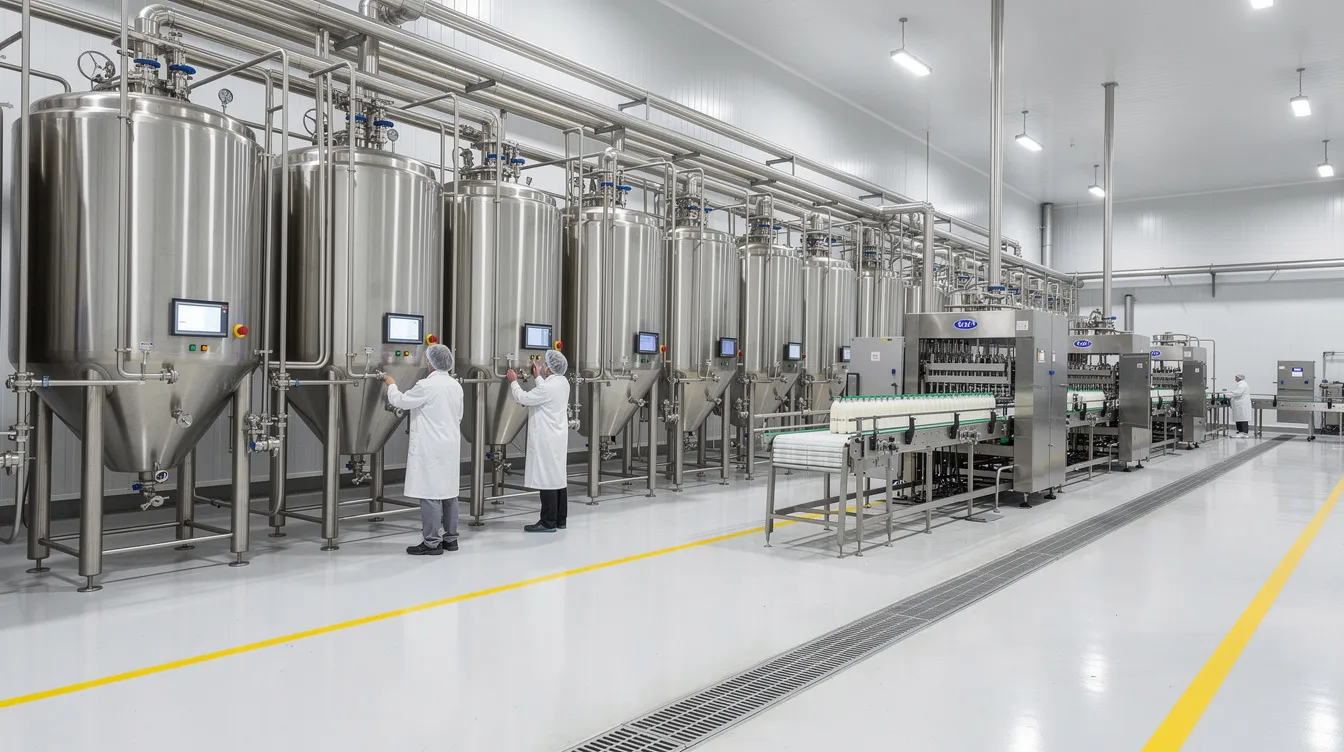
Bank Finance Structure for a Dairy Beverage Manufacturing Plant
The financing structure for a dairy beverage manufacturing plant in India follows a straightforward pattern: promoter margin covers a defined share of total project cost, a term loan finances the bulk of fixed assets, and working capital limits fund day-to-day operations.
Total project cost splits into fixed capital expenditure (land, building, plant and machinery, utilities, pre-operative expenses, contingency) and margin money for working capital. The resulting “means of finance” statement matches each cost head with its funding source. For a medium-capacity dairy processing plant, a common split observed is approximately 30% promoter contribution, 65% term loan and 5% from subordinate or unsecured sources, though actual ratios depend on project size, promoter profile, banking relationship and applicable schemes.
Lenders focus on whether the projected cash flows from the dairy beverage business can service the combined term loan instalments and working capital interest obligations over the loan tenure. The dairy beverage manufacturing plant loan structure, in essence, tests whether the business generates enough cash accrual to repay debt comfortably, year after year.
Term Loan for Fixed Assets: What Banks Typically Finance
A dairy beverage plant term loan finances eligible fixed assets: processing lines, filling and packaging systems, refrigeration, utilities and approved civil construction. Key equipment includes pasteurizers, homogenizers and filling machines, along with milk reception and chilling units, mixing tanks, CIP systems, PET and glass bottling lines, aseptic packaging systems, cold rooms, boilers, DG sets, electrical panels, laboratory equipment and related civil works.
Lenders may restrict financing on components like land purchase, old machinery or second-hand equipment depending on internal credit policy and valuation norms. Project-specific term-loan tenure, moratorium period and repayment schedule are determined by expected cash generation, DSCR and the lender’s risk perception.
Consider a hypothetical example: a 20,000 LPD flavoured milk and milkshake plant with PET bottle filling, where fixed capital excluding land is approximately ₹10 to 12 crore. The term loan might cover ₹6.5 to 8 crore (roughly 65% of fixed capital), with the balance funded by promoter contribution and other permissible sources. Loan disbursements are often phased according to project milestones such as civil work completion, machinery delivery and erection stages.
Working Capital Finance for Dairy Beverage Manufacturing
Beyond the term loan, every dairy beverage manufacturing plant requires working capital to finance raw milk, sugar, flavours, stabilisers, packaging materials, wages, power, cold-chain expenses and trade credit extended to distributors and retailers. Raw materials account for 70 to 80% of operating expenses in a dairy beverage business, making procurement cost management a constant priority.
Common working capital facilities include cash credit, overdraft and bill discounting. Banks assess working capital based on operating cycle or turnover methods, and the promoter must bring in a minimum margin in current assets. Chilled dairy products move fast but UHT packs, packaging material inventories and receivables from modern trade (often 30 to 60 days) still create funding gaps.
The working capital requirement for a dairy beverage plant should be calculated separately from fixed-asset investment and presented clearly in the DPR and CMA data.
What Banks Examine Before Financing a Dairy Beverage Project
Banks evaluate the promoter, project and security together. Banks evaluate manufacturing loans based on technical feasibility and market demand, not just the machinery quotation or dairy farming background. Banks conduct technical appraisals to assess project feasibility and machinery cost as part of this process.
Promoter aspects: Business track record, experience in dairy processing, food processing industries or FMCG distribution, education, net worth, banking history, existing borrowings and management capability. The promoter’s animal husbandry or dairy farming project background, if any, adds credibility but is not the only factor.
Project aspects: Installed plant capacity (litres per day), product mix (flavoured milk, lassi, buttermilk, liquid milk beverages), technology, plant location, raw milk availability, supply tie-ups, cold-chain arrangements. The rising consumer demand for dairy beverages and rising popularity of value-added milk products are positive signals, but banks want project-specific evidence.
Financial appraisal: Total project cost, means of finance, promoter contribution, projected profitability, gross profit margins on milk processing, working capital cycle, DSCR, break even point and sensitivity to changes in milk price, selling price or utilisation. Debt-equity ratio is an important consideration for banks during loan approval.
Security appraisal: Primary security (plant, machinery, building), possible collateral security (land, other property) and guarantees. Tangible collateral is often required for medium-to-large manufacturing loans. FSSAI registration is mandatory for food manufacturing businesses in India, and banks check that statutory approvals are in place or planned.
Dairy Beverage Plant Detailed Project Report (DPR) for Bank Loan
A comprehensive detailed project report is essential for loan applications, especially for greenfield dairy beverage manufacturing plants. The DPR should translate the promoter’s concept into a structured document covering technical feasibility, market viability and financial projections for 5 to 7 years. The DPR should outline processing capacity and product line in detail.
A strong dairy beverage manufacturing plant DPR avoids generic content and uses project-specific assumptions for capacity, pricing, raw material requirements, cold chain, manpower and utility requirements. Lenders check internal consistency: production volumes must reconcile with installed capacity, revenue numbers must align with selling prices and product mix, and expenditure projections must follow from volume assumptions.
Key Components of a Bankable DPR for Dairy Beverage Plant
The following subsections cover what banks typically expect in a plant project report for dairy beverage manufacturing. Each links dairy technology, market positioning and financial analysis into a coherent finance proposal.
Promoter Profile and Business Background
- Age, qualification, experience in dairy farming, dairy processing, food processing or FMCG distribution, and any earlier MSME or industrial ventures
- Legal constitution (proprietorship, partnership, LLP, private/public limited), shareholding pattern and governance structure
- Existing dairy farm, milk processing or beverage operations, including installed capacity, current turnover, major customers and banking relationships
- Promoter net worth, asset-liability position and credit history at a summary level
- Clarity on roles within the promoter team: operations, procurement, finance, marketing
Project Background, Capacity and Implementation Plan
This subsection outlines the project concept (e.g., flavoured milk, probiotic lassi, buttermilk, dairy-based beverages) with clear installed capacity in litres per day and annual operating days. A fruit-flavoured milk drink plant, for instance, may require 10 to 50 million litres annual capacity depending on target geography and distribution reach. The fruit-flavored milk drink market is projected to grow at 7.66% CAGR, indicating stable demand and investment opportunities.
Setting up a plant typically takes 12 to 24 months, encompassing land acquisition, site development, civil construction, machinery ordering, erection, trial runs and commercial production. The dairy beverage plant capacity planning and product mix section of the DPR should specify SKU mix, pack sizes and utilisation ramp-up schedule.
Technical Details: Process, Machinery and Utilities
The dairy beverage manufacturing process and production line covers milk reception, filtration, standardisation, ingredient mixing, homogenization and heat treatment, cooling, filling, packaging, cold storage and dispatch.
The DPR should carry a machinery and equipment list aligned with dairy beverage plant machinery and equipment cost estimates, including capacities, material grades (stainless steel AISI 304/316) and key utilities. Equipment costs form 35 to 50% of fixed capital in most dairy projects. Utility requirements covering power load, steam, water, refrigeration (TR), compressed air and effluent treatment give lenders comfort on technical feasibility.
Market Assessment and Revenue Model
This subsection should segment potential customers: general trade, modern retail, HoReCa, institutional buyers, private label clients and regional distributors. Target geography, product positioning (mass, premium, functional) and competitive landscape with reference to key players in the dairy industry should be defined.
Pricing strategy, distributor margins, promotions and logistics cost assumptions support topline projections. The dairy beverage revenue model and market strategy should reflect realistic market share build-up. Unrealistic milk sales assumptions in early years are a common red flag.
Financial Projections and Viability Analysis
Projected profit and loss account, balance sheet and cash flow statement for 5 to 7 years from commissioning form the core of the financial analysis. Financial projections assess capital investment and operating costs over the project lifecycle. Key ratios include DSCR, interest coverage, break-even utilisation, gross margin and contribution per litre. An integrated model where capacity utilisation drives production volumes, which in turn drive raw material consumption, total operating expenses, EBITDA and debt-servicing ability, is essential.
Sensitivity analysis showing the impact on DSCR and profitability of adverse movements in raw milk price, selling price or capacity utilisation strengthens the proposal. Dairy beverage plant financial projections for DPR should be internally consistent and linked to capacity planning.
Dairy Beverage Plant Project Cost and Means of Finance
Lenders expect a properly itemised dairy beverage plant project cost and means of finance statement covering land, site development, building and civil works, plant and machinery, utilities, lab equipment, furniture, vehicles, pre-operative expenses and margin for working capital. Fruit-flavored milk drink plant setup costs include these capital investments along with packaging requirements and cold-chain infrastructure.
Rule-of-thumb or lump-sum cost estimates without quotations weaken the bank’s confidence. The means of finance section should show promoter contribution (equity and permissible unsecured loans), term loan amount, possible subsidies or soft loans, and internal accruals from existing business where applicable. Banks examine the debt-equity ratio, adequacy of margin money and timelines for bringing in promoter contribution before or alongside bank disbursement.
Promoter Contribution, Margin Money and Debt-Equity Considerations
Promoter contribution is the share of total project cost that promoters bring in through equity capital, acceptable unsecured loans or internal resources. Promoter contribution typically ranges from 10% to 25% of the total project cost for dairy beverage projects, though actual requirements vary by lender, project risk, collateral and applicable schemes. Banks view higher genuine promoter contribution as a sign of commitment, lowering perceived credit risk.
Lenders also examine the overall dairy beverage project debt-equity ratio and the sufficiency of margin money for working capital built into the project funding structure. Promoter contribution timing (before machinery disbursement, proportionate with each stage) is usually specified in sanction terms.
Machinery Quotations and Bank Loan Assessment
Banks insist on detailed machinery quotations corresponding to the equipment schedule in the DPR. Quotations should mention equipment description, capacity, key technical specifications, quantity, basic price, GST, freight, installation and commissioning charges, warranty terms, delivery schedule and payment terms. They should come from reputed dairy machinery manufacturers, be dated, valid for a reasonable period and consistent with the project cost statement.
For packaging machinery, the dairy beverage bottling plant: PET, glass and packaging systems page covers relevant packaging requirements and cost considerations. Up-to-date quotations help lenders verify whether the proposed loan amount is adequate and whether the machinery configuration matches the projected capacity and product mix.
Capacity Planning, Manufacturing Process and Technology Appraisal
Unrealistic capacity utilisation is a red flag. Projecting 80 to 90% utilisation from the first year of a new dairy beverage line weakens proposal credibility. Lenders expect gradual ramp-up: 45 to 50% utilisation in Year 1, 60 to 70% in Year 2, reaching 80 to 85% by Year 4 or 5, under normal operating conditions. Installed capacity should be expressed in litres per hour or per day, with number of shifts, annual operating days and phased production capacity utilization clearly specified.
The unit operations involved in dairy beverage manufacturing, from milk reception and testing through clarification, standardisation, ingredient mixing, homogenization, heat treatment (pasteurisation vs UHT), cooling, filling, packing and cold storage, should be described with enough detail to demonstrate technical feasibility. Homogenization and heat treatment choices influence shelf life, cold-chain needs and capital cost. Where aseptic products are planned, the DPR should reference aseptic dairy beverage processing and packaging plant technology and its impact on equipment costs.
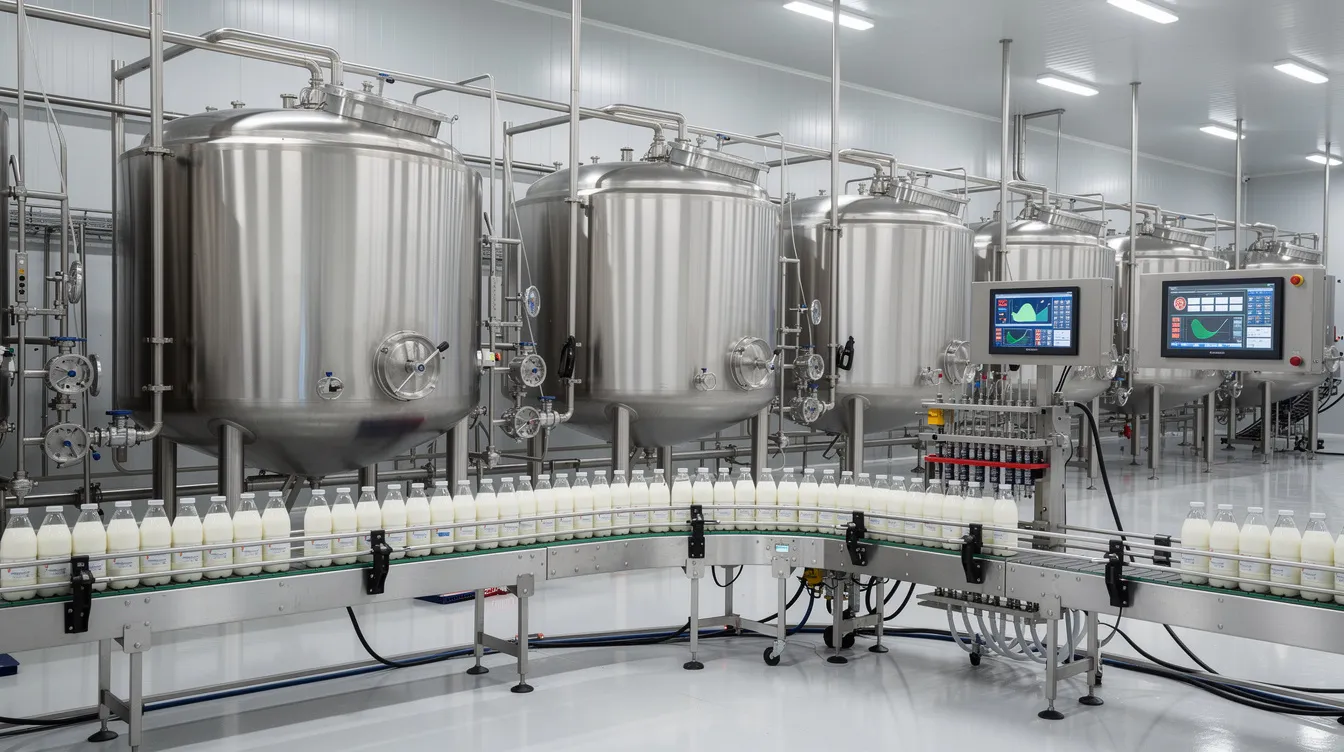
Land, Building, Utilities, Hygienic Layout and Cold Chain
Lenders review land and building plans to confirm that proposed area, hygienic layout and utilities are adequate for safe dairy beverage manufacturing at planned capacity. Processing areas, raw material storage, packaging zones, finished goods cold rooms, utility areas, QC laboratory, staff facilities and material flow must demonstrate compliance with hygienic zoning norms. Civil works should meet food-grade standards: acid-resistant flooring, glazed tiles, proper drainage and separate material flows as specified in MoFPI cost norms.
Infrastructure requirements include reliable power supply, backup DG sets, water treatment, steam/boiler capacity, refrigeration systems and effluent treatment. For chilled products, cold storage and cold chain requirements for dairy beverages covering cold rooms, reefer vehicles, distributor storage, transportation requirements and wastage assumptions are essential parts of the DPR.
Financial Projections, DSCR and Break-Even Analysis
Bank credit appraisal for a dairy beverage project hinges on the quality of financial projections. The projected profit and loss account should show revenue by product category, raw milk and ingredient costs, packaging material, utilities, salaries, selling expenses, interest, depreciation and tax. Operating costs for dairy beverage plants run at 70 to 80% raw materials, making raw material cost management central to healthy profitability potential.
The projected balance sheet captures fixed assets (at WDV), current assets, term loan outstanding, working capital borrowings and promoter’s net worth, enabling assessment of leverage and liquidity. The projected cash flow is critical because repayment capacity depends on actual cash accrual (PAT plus depreciation) versus yearly principal and interest obligations, not just accounting profit. Income projection and expenditure projections should cover the full repayment period.
A debt-service coverage ratio (DSCR) of at least 1.5 to 2 is usually expected by Indian banks for dairy processing project loans. DSCR equals cash accrual available for debt service divided by total debt service (interest plus principal) in a given year. The DSCR and loan repayment capacity for dairy beverage project page explains how banks judge sustainability of repayments. Even if average DSCR over the loan tenure is above 1.50, a Year-1 DSCR dipping below lender norms is a red flag.
Break-even for fruit-flavored milk plants ranges from 3 to 6 years depending on scale, product mix and market penetration. Dairy beverage plant profitability and break-even analysis shows the level of sales or capacity utilisation at which contribution covers fixed costs, and helps lenders understand operating risk. Net present value and internal rate of return calculations further support project economics.
Working Capital Assessment and Cash Credit Limit Estimation
Working capital assessment for dairy beverage plants requires detailed analysis of inventory holding for raw milk (low days due to perishability), ingredients, packaging materials, finished goods (chilled vs UHT), and receivables from distributors and modern trade. Creditors for milk and packaging partially fund working capital; the balance becomes the bank-financeable portion after promoter margin.
Banks use operating cycle or turnover methods to estimate working capital requirement and derive cash credit limits. For small dairy units, banks may assess working capital as 25% of projected annual turnover, with the bank financing 20% and promoter margin at 5% of turnover.
Indicative Bank Loan Assessment Flow for Dairy Beverage Projects
The appraisal flow for industrial dairy plant project finance typically follows these steps:
- Concept and promoter discussion with the bank branch
- Submission of DPR, KYC documents, machinery quotations, land documents
- Site and land verification by the bank’s field officer
- Technical and market appraisal of the dairy beverage project
- Project cost and means of finance assessment
- Financial projections, DSCR and working capital assessment
- Security and collateral evaluation
- Credit committee review and sanction
- Documentation, charge creation and staged disbursement
Sanction terms may include conditions precedent such as bringing in promoter contribution, registering charges, obtaining insurance and complying with statutory licences (FSSAI, pollution control) before full disbursement. Different banks have variations in internal processes, but the core appraisal logic remains similar.
Documents Commonly Required for Dairy Beverage Plant Bank Finance
Document checklists differ by lender and scheme; the following is indicative.
Promoter / Entity Documents
- PAN, Aadhaar, photographs and KYC documents of all promoters and directors
- Constitution documents: partnership deed, LLP agreement, MoA/AoA, registration certificates
- Udyam/MSME registration where applicable; GST registration
- Promoter profile note summarising experience, track record and role in the proposed dairy beverage plant
- Net worth statements or asset-liability statements from key promoters
Financial Documents
- Audited financial statements (balance sheet, P&L, schedules) for existing businesses for last 2 to 3 years
- Income tax returns for recent assessment years; 6 to 12 months of bank account statements
- Statements of existing term loans, cash credit limits and other banking facilities
- Projected financial statements, DSCR workings and CMA data in the lender’s preferred format
Essential documentation includes KYC, business registration and financial projections as the minimum baseline. The CGTMSE scheme provides collateral-free loans for Micro and Small Enterprises (MSEs), which may apply to smaller dairy units.
Project Documents
- Dairy beverage plant detailed project report, item-wise project cost, means of finance statement and implementation schedule
- Machinery quotations, civil cost estimates, utility equipment quotations, cold-chain and vehicle quotations where applicable
- Land ownership or lease documents, site layout, building plan approvals
- Financial projection summaries: projected profit and loss, balance sheet, cash flow, break-even and DSCR statements
Technical / Regulatory Documents
- FSSAI licence or registration (or application status), local body trade licence, pollution control consents, factory licence
- Plant layout drawings showing process flow, utilities and hygienic zoning
- Vendor catalogues or technical brochures for major dairy beverage processing equipment
- Not all approvals need to be in place at sanction stage, but lenders typically set timelines for obtaining them before commercial production
Common Weaknesses in Dairy Beverage Project Loan Proposals
Based on practical project finance experience, these issues frequently weaken proposals:
- Inflated milk sales projections without supporting market evidence or distribution tie-ups
- Over-optimistic capacity utilisation from Year 1 (e.g., 80% for a greenfield plant)
- Underestimation of working capital, especially cold-chain energy costs and transportation requirements
- Machinery capacities inconsistent with projected production volumes
- Projections not reconciling with DPR narratives or CMA data
- DSCR below lender comfort due to aggressive repayment period assumptions
- Ignoring packaging requirements cost escalation or seasonal raw milk price volatility
- Missing implementation details, statutory approvals or realistic maintenance and downtime costs
- Weak milk procurement planning without supply tie-ups or pricing benchmarks
Each weakness reduces lender confidence and can lead to delays, higher collateral requirements or outright rejection.
How to Strengthen a Dairy Beverage Plant Project Finance Proposal
- Use realistic capacity and market assumptions supported by pilot sales, distribution tie-ups or industry trends data
- Obtain updated machinery quotations from reputed suppliers, matching the DPR equipment schedule
- Prepare a detailed, itemised project cost with clear means of finance and documentary evidence of promoter contribution
- Build integrated financial projections with DSCR analysis, break-even study and sensitivity scenarios
- Validate raw milk procurement, cold-chain infrastructure and distribution strategies with supporting documents
- Maintain complete, consistent document sets ready for lender queries
- Present variable costs, fixed costs and operating expenses transparently
Dairy Beverage Plant Setup Cost in India and its Financing Relationship
The overall dairy-based beverage manufacturing plant setup cost in India depends on plant capacity, level of automation, product portfolio (chilled vs UHT vs aseptic), packaging formats and depth of cold-chain infrastructure. A small chilled flavoured milk plant (5,000 to 10,000 LPD) may cost ₹1 to 8 crore excluding land, while a large integrated dairy plant (100,000 LPD) can reach ₹50 to 60 crore.
Government initiatives support dairy processing and value-added milk products through various schemes. The Animal Husbandry Infrastructure Development Fund (AHIDF) provides debt financing for dairy processing and dairy development infrastructure. The PMFME scheme offers credit-linked subsidies for micro food processing enterprises. The Dairy Entrepreneurship Development Scheme provides capital subsidies for dairy projects. Eligibility for government schemes depends on business structure and compliance with scheme guidelines.
Cost variation across states, land locations and technology choices is large, so promoters should avoid relying on generic per-litre thumb rules without a tailored DPR. Realistic cost estimation, followed by appropriate term loan and working capital planning, supports a sound project finance structure.
Role of CA Manish Gugliya and ProjectReportBank.com in Dairy Beverage Project Finance
As a practising Chartered Accountant with experience in project reports, CMA data and project funding for manufacturing units, I assist promoters in preparing dairy beverage plant detailed project reports, project cost and means of finance statements, financial projections, DSCR analysis and break-even assessments.
This work includes assisting with working capital assessment, CMA data preparation, reviewing machinery quotations for financial structuring, and aligning DPR narratives with banker expectations. The focus is on preparation, analysis and structuring of information. Final credit decisions, collateral requirements and sanction terms remain with the respective lending institution.
Entrepreneurs and companies planning a dairy beverage manufacturing plant in India are welcome to connect through www.projectreportbank.com for professional support in drafting bankable proposals.
Frequently Asked Questions
These FAQs address practical queries entrepreneurs raise when planning to seek a bank loan for a dairy beverage manufacturing plant in India.
Can a first-time entrepreneur get a bank loan for a dairy beverage manufacturing plant?
First-time entrepreneurs can obtain project finance if they present a well-researched DPR, demonstrate adequate promoter contribution, show relevant management capability (through team members if not personally experienced) and offer acceptable security. Lenders scrutinise assumptions more closely when there is no prior business track record, so realistic projections and complete documentation become particularly important. Prior experience in dairy farming or milk processing strengthens the case but is not mandatory if the promoter builds a capable technical and commercial team.
How long does it usually take for banks to sanction a dairy beverage plant loan?
Timelines vary by lender and project complexity. After submission of a complete DPR and documents, appraisal and sanction for a medium-scale dairy project can take several weeks to a few months. Delays typically occur due to incomplete documentation, pending quotations, land or legal clarifications, or extensive internal approvals.
Can the dairy beverage plant be implemented in phases and still get project finance?
Many banks are open to phased implementation, for example starting with pasteurised flavoured milk and later adding UHT or aseptic lines, provided the DPR clearly defines each phase, associated cost, capacity and financing requirement. Financial projections and DSCR should reflect the actual phasing so lenders can see how cash flows from initial operations support later expansion.
How are government subsidies or incentives treated in dairy beverage project finance?
Where eligible, capital subsidies or state incentives are treated as additional support that may reduce effective project cost once received, but banks generally appraise the project independently of subsidy. Promoters should check current dairy and food processing schemes at central and state levels and reflect any expected assistance transparently in the DPR.
Are dairy farm loans and dairy beverage plant loans different?
Dairy farm loans can fund purchasing cows or buffaloes and are typically smaller in scale. Loan amounts for dairy farms vary by lender and purpose; MUDRA loans for dairy farms range from ₹50,001 to ₹5 Lakh, and NABARD-linked dairy loans typically have repayment tenures of 3 to 7 years. Kisan Credit Card offers interest rates as low as 4% for dairy farmers. A dairy beverage manufacturing plant loan, by contrast, is an industrial project finance facility assessed on the basis of capital investment, market viability, DSCR and the promoter’s ability to run a manufacturing business. The National Dairy Development Board and the national bank for agriculture and rural development (NABARD) support both segments through different programmes.
Conclusion: Presenting a Bankable Dairy Beverage Manufacturing Project
Securing a bank loan for a dairy beverage manufacturing plant requires a structured approach that goes well beyond collecting machinery quotations. It demands a coherent, data-backed presentation of promoter strength, realistic project cost, means of finance, technical feasibility, market viability and sustainable DSCR. Milk powder, double toned milk, fruit juice or other value-added milk products on the product slate each carry different margin structures, and the DPR must reflect this.
A well-prepared dairy beverage plant project report for bank loan, supported by integrated financial projections and consistent CMA data, is central to lender appraisal of term loan and working capital facilities. Careful attention to capacity planning, milk procurement, cold-chain design, working capital estimation, profitability and break-even analysis improves lender confidence in the project. Interest subvention benefits, where available, can further improve project economics.
Entrepreneurs, MSMEs and dairy companies planning industrial dairy beverage projects are welcome to approach CA Manish Gugliya via www.projectreportbank.com for professional assistance in preparing DPRs, financial projections, project finance analysis and loan documentation. Final sanction decisions rest with the respective lending institutions.
Author: CA Manish Gugliya