Key Takeaways
- Understanding cold storage requirements for dairy beverages is as critical as selecting your pasteuriser or filler-without a validated cold chain, even a well-processed product will fail commercially.
- Temperature rise over 4°C accelerates bacterial growth in milk and dairy beverages, shortening shelf life, increasing product returns, and directly eroding project profitability.
- Cold chain design-cold rooms, refrigeration systems, refrigerated transport, and real time monitoring-must be integrated into the DPR, capacity planning, and working-capital assessment from day one.
- Different dairy beverages (pasteurised flavoured milk, chilled milkshakes, protein drinks, cultured beverages) have different storage temperature ranges depending on formulation and processing method.
- This guide is written from the perspective of CA Manish Gugliya of ProjectReportBank.com, advising entrepreneurs and lenders on commercially viable dairy beverage projects in India.
Introduction: Cold Storage as a Core Design Choice, Not a Post-Production Accessory
In a modern Indian dairy beverage plant, cold storage and cold chain infrastructure are foundational utilities-as important as your processing line. Dairy beverages require strict temperature control to prevent bacterial growth, and any lapse between processing and the consumer’s hand can destroy both product and brand. Proper handling of dairy prevents spoilage and maintains nutritional quality, making refrigeration a non-negotiable design input.
Inadequate cold storage in the dairy supply chain leads to loss of sensory quality-off-flavours, texture breakdown, colour changes-and forces shorter declared shelf life. Every extra day of safe, usable shelf life directly improves supply chain efficiency, working capital rotation, and profitability. For chilled dairy products, cold chain planning is a financial decision as much as a technical one.
Decisions on processing (heat treatment level, chilling technology), packaging, and distribution radius must be harmonised with cold storage capacity. Related topics like the Dairy Beverage Manufacturing Process & Production Line and Dairy Beverage Plant Land, Building, Utilities & Hygienic Layout are covered in dedicated guides within this cluster.
Understanding the Cold Chain for Dairy Beverages
The dairy beverage cold chain is a continuous temperature-controlled path, not just a cold room at the factory. The typical sequence in India runs: Processing → Rapid Cooling → Filling & Packaging → Finished-Goods Cold Room → Loading Bay → Reefer Truck → Distributor Cold Room → Retail Refrigerator → Consumer. The cold chain must be maintained throughout storage and transportation to ensure safety.
Maintaining a steady, validated product temperature through all these nodes is the real objective of dairy cold chain management. Each handover-plant to transporter, transporter to distributor, distributor to retailer-is a risk point for temperature excursion that must be designed into the project’s SOPs and cost structure. Cold chain integrity, temperature monitoring, and regulatory compliance at every stage protect food safety, consumer trust, and brand reputation.
Which Dairy Beverages Require Cold Storage and a Chilled Cold Chain?
Not all dairy beverages follow the same cold chain model. Chilled categories that typically require continuous refrigerated storage in India include: pasteurised flavoured milk (180 ml glass and PET), chilled chocolate milk, short-shelf-life milkshakes, lassi and buttermilk variants, fresh protein-enriched dairy beverages, and functional dairy drinks with probiotics. These fresh dairy products usually need a continuous cold chain from plant to retail at roughly 2°C–8°C. Dairy beverages should not be left at room temperature for more than two hours.
By contrast, unopened UHT dairy beverages can be stored at ambient temperature until opened, thanks to higher heat treatment and aseptic dairy beverage processing and packaging. A DPR must clearly specify the percentage of chilled versus ambient SKUs, as this mix decides how much cold storage for flavoured milk, milkshakes, and other chilled SKUs is required.
Dairy Beverage Storage Temperature Management Across the Chain
There is no single universal dairy beverage storage temperature. The correct range depends on formulation, processing, packaging, microbiological limits, and claimed shelf life. Shelf life varies based on processing methods and should be followed as per manufacturer guidelines. Maintain chilled dairy beverages between 2°C and 4°C as a general target, while liquid dairy beverages should be kept at ≤4°C for optimal safety and quality.
Key temperature control points include: product exit temperature from the pasteuriser, rapid cooling to below approximately 4°C–5°C, storage in the finished-goods cold room (refrigerators for dairy should operate at 0°C to 4°C), dispatch temperature, in-transit temperature, and retail display temperature. Tighter temperature control enables longer practical shelf life, which improves supply chain efficiency, reduces food wastage, and allows servicing a wider distribution radius.
Importance of Rapid Chilling After Processing
Dairy products need quick cooling after pasteurization to inhibit bacteria. Dairy beverages should be refrigerated immediately after processing. Promptly cooling hot product from 70–90°C down to near 4°C using plate heat exchangers, regenerative cooling, and chilled water or glycol systems minimises holding time in the danger zone (10–40°C). Decisions described in Homogenization & Heat Treatment for Dairy Beverages directly affect exit temperature and required cooling load.
At the farm level, milk must be chilled within a few hours after milking. Bulk milk coolers (BMCs) rapidly lower milk temperature to slow bacterial growth, and milk is stored at 3°C to 4°C in chilling centres before processing. Inadequate rapid chilling shows up as higher refrigeration load downstream, increased power consumption, and more conservative shelf-life declarations in the DPR.
Cold Room Requirements in a Dairy Beverage Plant
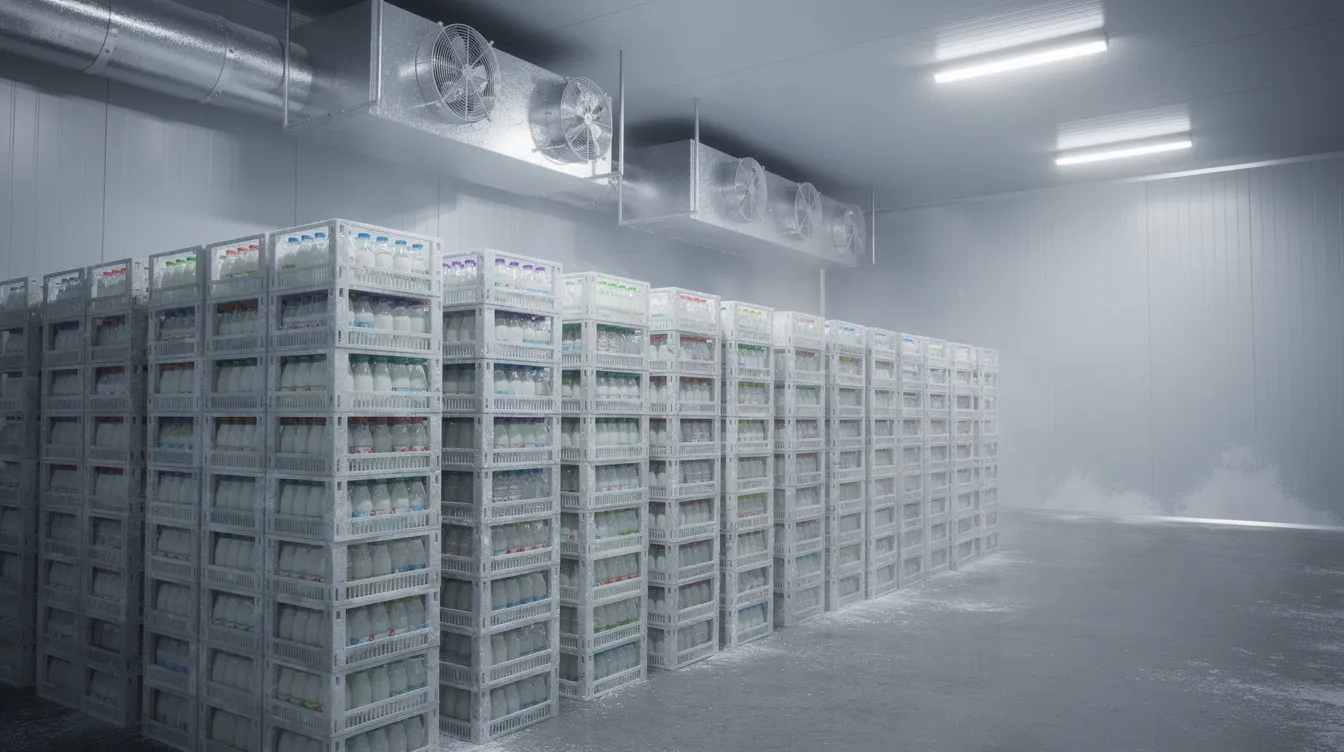
The finished-goods cold room is a core part of the dairy plant cold storage facility. Key design elements include insulated PUF panels for walls and ceilings with vapour barriers, insulated flooring for pallet stacking and wash-downs, and food-grade internal finishes. Air circulation must be uniform to prevent warm spots in cold storage. Keep the relative humidity around 85% to 90% in cold storage for dairy beverages.
Avoid overloading the cold storage to maintain proper airflow. Evaporator placement must ensure bottles or pouches do not freeze locally. Door design (insulated, fast-acting, with proper gaskets), air curtains, low-temperature lighting, and drainage slopes all matter. Operational aspects-FIFO/FEFO racking, batch segregation, restricted access, and clear pallet-truck circulation paths-directly affect operational efficiency. Store beverages in sealed food-grade packaging to prevent spoilage, and keep dairy containers tightly sealed to prevent contamination. Dairy beverages should be stored away from strong-smelling items to avoid odour absorption.
Cold Storage Capacity Planning for Dairy Beverage Plants
Cold storage capacity must be calculated from planned daily production, SKU mix, distribution pattern, and intended shelf life-not guessed from available space. A useful starting formula:
Required Finished-Goods Cold Storage ≈ Daily Chilled Output × Average Holding Days + Operational Buffer
| Factor | Impact on Storage Requirement | Planning Consideration |
|---|---|---|
| Daily production volume | Directly proportional | Align with capacity planning |
| Number of SKUs | More segregation, more pick-face locations | Increases effective footprint |
| Dispatch frequency | More frequent = fewer holding days | Reduces required volume |
| Seasonal demand peaks | May require 20–30% buffer | Plan for summer surge |
| Pallet height and aisle width | Affects usable volume per m² | Engineering input needed |
| Distribution radius | Longer routes = more holding days | Increases storage and logistics cost |
SKU Mix, Packaging Formats and Their Impact on Cold Storage
Choices like 180 ml bottles versus 1 litre bottles, PET versus glass versus pouches, and loose crates versus corrugated cartons significantly affect warehouse layout and cold storage capacity utilisation. Common Indian dairy beverage SKUs include 180/200 ml flavoured milk bottles, 500 ml chilled milkshakes, 1 litre family packs, and pouch packs for buttermilk. Each packaging type has different stacking strength and racking approaches, as detailed in Dairy Beverage Bottling Plant: PET, Glass & Packaging Systems. A broader SKU mix increases complexity in inventory management and can inflate working capital unless carefully modelled in the DPR.
Refrigeration Load Calculation: What Needs to Be Considered
Refrigeration capacity cannot be based purely on cold room volume. The main load components include: incoming product load (often 50–70% of total), transmission load through walls and roof (heavily influenced by Indian summer ambient conditions of 40–45°C), infiltration load from door openings, and internal loads from people, lighting, and equipment. Consultants generally keep a 15–25% safety margin. For context, a dairy processing plant in South Central India with a 20,000 LPH line required approximately 56 TR of refrigeration for its cold storage alone. Oversizing increases capital cost and part-load inefficiency; undersizing risks temperature excursions.
Refrigeration System Options for Dairy Beverage Plants
Refrigeration systems represent a major subset of dairy beverage plant machinery and equipment cost. Small and medium plants typically use packaged condensing units with commercial refrigerants and air-cooled condensers. Larger industrial plants may use centralised ammonia-based systems with water-cooled condensers and pumped glycol loops. Key components include compressors, condensers, evaporators, expansion devices, receivers, and automation controls for dairy beverage temperature control.
Decision factors include plant capacity, desired temperature range, regulatory constraints, availability of skilled technicians, safety considerations (especially with ammonia), refrigerant environmental profile, and lifecycle cost over 10–15 years. Power supply instability is a common issue in dairy chilling centres across rural areas. These choices directly affect plant connected load, DG-set sizing, and monthly electricity bills.
Backup, Redundancy and Risk Management in Dairy Cold Storage
Cold chain failures can lead to significant economic losses for dairy producers. A few hours of refrigeration failure during peak Indian summer can force massive write-offs. Redundancy features should include standby compressor capacity, ability to switch loads between parallel systems, adequate backup power through DG sets, and alarm systems for temperature rise and power failure. Preventive maintenance schedules, critical spares, and written SOPs for product disposition during breakdowns are essential. Lenders will scrutinise whether contingency measures are built into project design.
Temperature Monitoring, Data Logging and Cold Chain Integrity
Real-time temperature monitoring is essential for dairy logistics compliance. FSSAI mandates documenting cold chain transportation for milk compliance, making proper records a regulatory requirement, not just good practice. Check temperature regularly with calibrated thermometers or data loggers. Monitor temperature continuously with automated systems to ensure compliance. Real-time monitoring helps identify temperature deviations quickly before they compromise product safety.
ERP systems improve real-time temperature monitoring in dairy logistics, enable batch traceability linked to temperature history, and help maintain compliance with food safety regulations. Smart route planning through ERP enhances chilled dairy deliveries, while ERP reduces spoilage and expiry losses in dairy operations. Real time alerts and real time tracking through cloud-based systems provide real time visibility across the dairy cold chain.
Handling Temperature Excursions: Procedures and Business Implications
A temperature excursion occurs when product or storage temperature leaves the validated range for longer than the allowed time. Temperature rise over 4°C accelerates bacterial growth in milk and dairy beverages. Key procedures include: detecting excursions via monitoring, identifying affected SKUs, segregating stock, documenting time–temperature exposure, and involving quality teams. Returning temperatures to normal does not automatically restore safety-the decision to release, downgrade, or destroy product must follow risk assessment and company SOPs. Excursions must be factored into wastage assumptions in the dairy beverage cold chain DPR.
Loading Bay & Dispatch Infrastructure
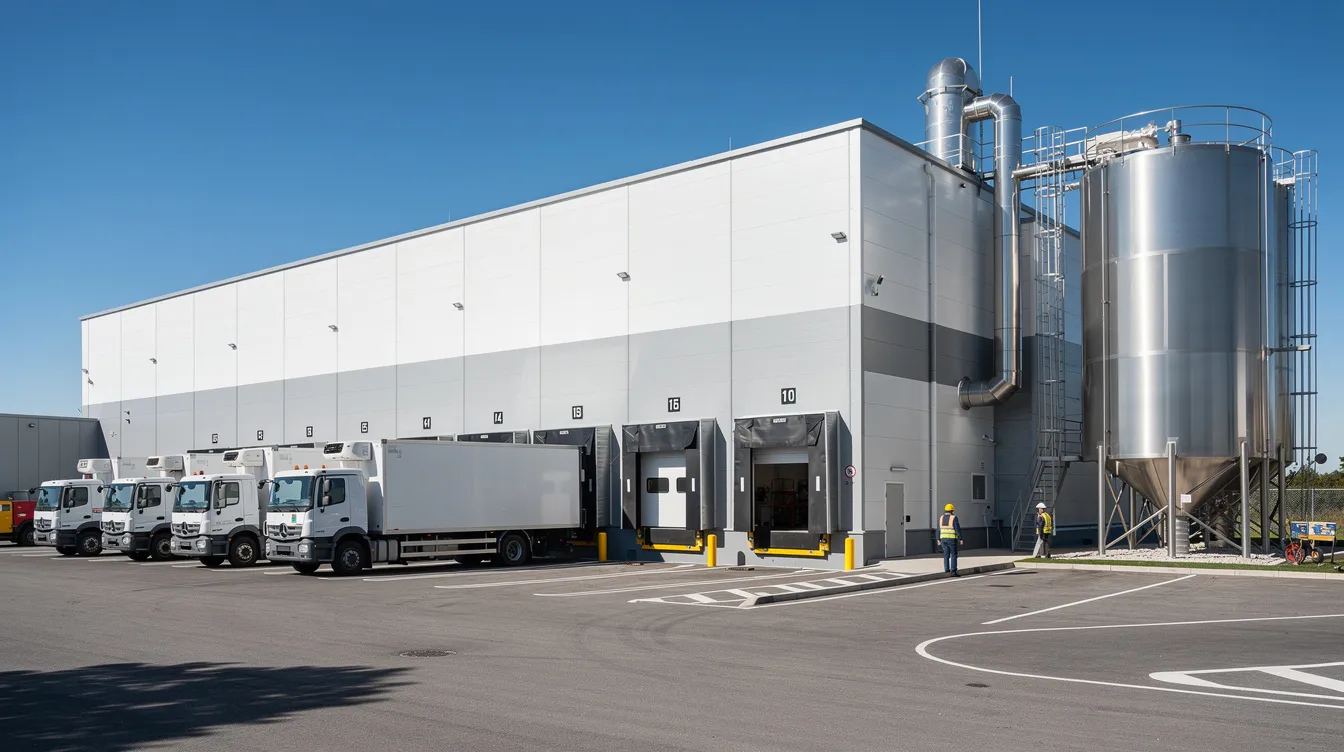
Even well-designed cold rooms and reefer trucks fail if the loading bay is poorly planned. Skipping pre-cooling of refrigerated trucks can raise temperatures by 2°C to 3°C. Infrastructure should include dock levellers, insulated loading areas, staging zones, and process flows that minimise door-open time. Pre-cool vehicles, verify vehicle temperature before loading, move pallets rapidly, and close doors immediately. Larger plants benefit from dock shelters or telescopic tunnels, especially in hot and humid regions.
Refrigerated Transportation and Dairy Beverage Distribution Logistics
Refrigerated vehicles maintain stable temperatures during dairy transport, forming the backbone of the dairy beverage distribution network. Vehicle sizing should match daily dispatch volume, route length, number of drops, and Indian summer conditions. The critical principle: dairy beverage refrigerated transport is for maintaining already-chilled product temperature, not for cooling warm beverages-using reefers as moving chillers is a common but risky mistake. Integrated cold chain logistics minimize spoilage and improve efficiency across the food supply chain.
Own Reefer Fleet vs Outsourced Refrigerated Logistics
| Parameter | Own Fleet | Outsourced Fleet |
|---|---|---|
| Upfront CAPEX | High (vehicle purchase) | Low (converted to variable OPEX) |
| Control over temperature | Direct, high accountability | Dependent on SLA enforcement |
| Utilisation risk | Borne by promoter | Shared with logistics companies |
| Scalability | Slower, requires more capital | Faster, route-by-route flexibility |
| Maintenance burden | In-house responsibility | Vendor-managed |
| Suitability | Established plants, dense routes | Early-stage, fluctuating volumes |
Regardless of ownership model, agreements should define temperature responsibilities, data-sharing for real time monitoring, and penalties for cold chain failures. Banks will examine whether the proposed model is realistic for the planned distribution radius and sales volumes.
Distributor and Retail Cold-Chain Infrastructure
Maintaining temperature only at the factory is insufficient. Regional distributors need cold rooms or walk-in chillers, retail outlets need glass-door display chillers, and modern trade partners require back-room refrigerated storage. The dairy beverage storage temperature range must align across all levels. Urban demand growth is pushing cold chain capabilities to scale, and for hero SKUs like chilled flavoured milk or chocolate milk, supporting distributors with chiller schemes may be necessary. Implement strict First-In, First-Out (FIFO) stock rotation to minimize waste at every level.
Last-Mile Cold Chain in the Indian Context
Last mile delivery is often the most challenging stage in India-high ambient temperatures, dense traffic, multiple delivery points, and inadequate infrastructure at small shops. Smaller refrigerated or insulated vehicles, carefully planned delivery routes, and coordination with retailer receiving times help mitigate risk. Power supply instability in rural areas can limit retailer refrigeration. Last-mile wastage must be factored into margin structures in the DPR, especially where ambient temperatures regularly exceed 40°C. Route density and market geography heavily influence cold chain cost per litre.
Shelf Life, Food Safety and Cold-Chain Integrity
Cold storage extends milk’s shelf life and reduces spoilage when the cold chain is properly maintained. Shelf life is validated under specific temperature conditions; any deviation effectively shortens usable shelf life. Pasteurized milk should be consumed within 5 to 7 days after opening. Opened UHT beverages require refrigeration and should be consumed within 7 to 10 days. A plant designed for 30-day chilled shelf life might practically operate on a 15–20 day window because of distribution realities, raising working capital intensity.
Cold Storage Hygiene, Housekeeping and Food Safety Practices
Refrigeration slows bacterial growth but cannot compensate for poor hygiene. Key practices include regular cleaning of floors and racks, managing condensation and ice build-up, prompt spill cleaning, segregation of returned stock, pest control adapted for cold environments, proper drainage, and staff hygiene protocols. Damaged, leaking, or bloated packs should be removed immediately to avoid cross-contamination. Hygienic cold storage facilities are part of overall food safety systems that lenders, auditors, and institutional buyers increasingly scrutinise for consumer safety and regulatory compliance.
Energy Consumption and Operational Efficiency of Dairy Cold Storage
Refrigeration systems often dominate electricity consumption in a chilled dairy beverage plant, with significant impact on operating margins. Efficiency levers include adequate insulation thickness, correctly sized compressors, energy-efficient motors, variable-frequency drives, disciplined door management, and regular condenser cleaning. Even small improvements-set-point optimisation within validated limits, reducing unnecessary door openings-yield tangible annual savings. Fuel consumption for backup DG sets adds further. Energy-saving features may raise initial dairy plant cold storage cost but can produce attractive payback periods, reducing both carbon footprint and per-litre cost.
Project Cost, CAPEX & OPEX Planning for Dairy Beverage Cold Chain
Cold storage and refrigeration items form a significant portion of total dairy beverage manufacturing plant setup cost in India.
| Cost Head | CAPEX/OPEX | Key Cost Driver |
|---|---|---|
| Insulated panels & civil work | CAPEX | Cold room size, insulation thickness |
| Refrigeration plant | CAPEX | TR capacity, refrigerant type |
| Cold room doors & dock equipment | CAPEX | Number of loading points |
| Temperature monitoring systems | CAPEX | Number of sensors, cloud vs local |
| Reefer vehicles (if owned) | CAPEX | Fleet size, vehicle capacity |
| Backup power (DG sets) | CAPEX | Connected refrigeration load |
| Electricity for refrigeration | OPEX | Energy tariff, ambient conditions |
| Outsourced reefer logistics | OPEX | Route distance, drops per trip |
| Maintenance & refrigerant top-ups | OPEX | Equipment age, leak rates |
| Cold-chain wastage & returns | OPEX | Cold chain quality, distribution radius |
All costs must be built into the dairy beverage cold chain DPR with assumptions clearly stated.
Working Capital, Inventory and the Economics of Short Shelf Life
Chilled dairy beverages with 15–30 day shelf life require tight coordination of production, sales, and logistics. Inventory holding at plant, in transit, and at distributor/retail levels adds up to total days of stock. Each additional day in cold storage adds working capital requirement and wastage risk. Offering too many slow-moving SKUs or distributing too far from the plant inflates working capital and reduces supply chain efficiency. The DPR should include realistic assumptions on credit periods, expected returns, and cold-chain-related losses. Good cold chain planning improves cash conversion cycles and overall project viability, reducing waste across dairy operations.
Cold Chain Cost per Litre and Overall Project Profitability
Cold-Chain Cost per Litre ≈ (Storage Cost + Refrigerated Transportation + Handling + Distributor Refrigeration Support + Expected Cold-Chain Losses) ÷ Sales Volume
As distribution radius expands and route density falls, cold chain cost per litre increases sharply. A 1% increase in cold-chain-related wastage or a ₹0.50/litre rise in refrigeration energy cost can materially affect EBITDA margins in a high-volume dairy beverage project. Investors and lenders will stress-test the business model for such variations, so cold storage decisions must be justified in terms of long-term cost per litre, improving efficiency across dairy businesses.
Incorporating Cold Chain into a Dairy Beverage DPR
A professional dairy beverage cold storage project report must integrate cold chain assumptions across technical, financial, and market sections. Key elements include: proposed capacity and product mix (chilled vs ambient), required cold storage capacity and days of stock, refrigeration load estimates, CAPEX for cold rooms and reefer vehicles, electricity consumption, distribution radius and route strategy, logistics cost per litre, and assumptions on returns and wastage. Specialised DPR pages such as Milkshake Manufacturing Plant Project Report or Ready-to-Drink Dairy Beverages Manufacturing Plant Project Report provide product-specific guidance. A coherent, well-costed cold chain plan signals promoter preparedness and reduces perceived compliance risk.
Bank and Lender Perspective on Dairy Beverage Cold Chain
Banks evaluating term loans for a chilled dairy beverage project will look beyond sales projections to check whether cold chain infrastructure is adequate, realistic, and financeable. Lender concerns include alignment between plant capacity and cold storage capacity, adequacy of power and backup, robustness of distribution arrangements, and evidence that costs have been budgeted properly. Gaps such as undersized cold rooms, no temperature monitoring provision, or over-optimistic wastage rates raise red flags. A strong, data-backed cold chain plan in the DPR improves chances of sanction and better terms from farmer producer organizations to dairy producers entering the dairy sector.
Illustrative Example: Planning Cold Storage for a Medium-Sized Flavoured Milk Plant
All figures below are illustrative assumptions, not universal norms.
Consider a plant producing 30,000 litres/day of chilled flavoured milk and milkshakes in 200 ml and 1 litre PET bottles. With an average 1.5–2 days holding in the cold room, finished-goods storage needed is approximately 45,000–60,000 litres equivalent. Accounting for crate space, pallet stacking, and airflow aisles inflates room volume by 20–30%. Refrigeration product load alone (cooling 10,000 kg from 25°C to 4°C) would be approximately 222 kWh per batch, with transmission, infiltration, and safety margins adding 15–25% more.
Dispatch might require 3–5 reefer trucks daily serving a 150 km radius. CAPEX lines would include cold room panels, a refrigeration plant in the range of 40–60 TR, 2–3 reefer vehicles, and backup power. OPEX lines cover electricity, reefer operating cost, and maintenance. These feed directly into per-litre cold chain cost assumptions in the DPR-typically a meaningful component of total cost for any dairy industry project.
Conclusion: Integrating Cold Storage and Cold Chain into Project Design from Day One
Cold storage requirements for dairy beverages-and the wider dairy beverage cold chain-must be designed alongside product formulation, processing technology, packaging, and distribution strategy from the earliest project-concept stage. Underestimating refrigeration, cold room capacity, and refrigerated logistics can make an otherwise technically robust dairy beverage project commercially fragile, with chronic wastage, returns, and margin pressure. Ice cream requires continuous sub-zero monitoring during storage, while chilled beverages need unbroken 2°C–4°C chains-each product demands its own validated approach.
Successful projects treat the cold chain as a strategic asset that supports food safety, regulatory compliance, brand reputation, and quality assurance, rather than as a cost to be minimised blindly. At ProjectReportBank.com, we help entrepreneurs and investors prepare realistic DPRs, feasibility studies, and financial models that properly integrate cold storage, refrigeration, and dairy beverage supply chain management. Explore the linked resources across our Dairy Beverages cluster for deeper guidance on processing, plant layout, machinery, and individual product reports as you refine your project concept.
Frequently Asked Questions on Cold Storage Requirements for Dairy Beverages
What temperature should dairy beverages be stored at?
Most pasteurised chilled dairy beverages in India are validated for storage in the 2°C–4°C range, though some products may permit up to 8°C depending on formulation, heat treatment, and packaging. Processed milk should be stored at 3°C to 4°C in chilling centres. There is no single legally mandated temperature for all dairy beverages-manufacturers must follow their validated SOPs and applicable FSSAI food-safety standards. Promoters should consult food technologists when finalising set-points for their DPR.
How much cold storage capacity is needed for a new dairy beverage plant?
Capacity depends on daily chilled production volume, average days of finished-goods holding (typically 1–2 days), SKU mix, pallet configuration, and dispatch frequency. Use the formula: Daily Production × Average Storage Days + Buffer as a starting point, then refine with engineering inputs for aisle space, airflow, and seasonal peaks. Oversizing increases CAPEX and energy cost; undersizing creates bottlenecks and temperature excursions.
Can dairy beverages be transported without refrigeration?
For pasteurised chilled dairy beverages with short shelf lives, temperature-controlled transport using refrigerated trucks or insulated vehicles with active cooling is strongly recommended, especially given Indian climatic conditions where ambient temperatures in many regions exceed 40°C. Very short local movements may use insulated vehicles if scientifically validated. Relying on ambient trucks for long-distance chilled distribution leads to spoilage, product returns, and reputational damage-this approach should be avoided in any serious dairy cold chain feasibility study.
How does cold storage affect dairy beverage profitability?
Cold chain costs-cold room depreciation, refrigeration energy, reefer hire, monitoring systems, and cold-chain-related wastage-translate into a per-litre cost that directly reduces contribution margins. However, an effective cold chain enables longer realisable shelf life, wider market coverage with high quality dairy products, and fewer returns, which can increase net profitability despite higher operating cost. DPRs should calculate cold chain cost per litre under realistic utilisation assumptions and stress-test profitability under different scenarios.
What should be included in a dairy cold-chain project report?
A comprehensive DPR should cover: proposed production capacity and chilled vs ambient product mix, required cold storage capacity and holding days, refrigeration load estimates, CAPEX for cold rooms and reefer fleet, projected electricity consumption, distribution radius and logistics strategy, per-litre logistics cost, wastage and returns assumptions, working capital impact, and expansion provisions. The cold chain section should be integrated with the financial model-not isolated as a standalone machinery line item.