Key Takeaways
- This hub explains how to plan, evaluate and finance a Dairy Beverages & Flavoured Milk Manufacturing Plant Project Report / DPR in India, covering product strategy, processing, infrastructure and bank finance.
- A bankable Dairy Beverage Manufacturing Plant DPR must integrate land and site development, dairy processing technology, cold storage, machinery selection, project cost, working capital and realistic financial projections.
- From a project finance perspective, plant capacity, product mix (flavoured milk, fruit flavored milk drink, milkshake, functional beverages), packaging format and cold-chain model drive both capital expenditure and profitability.
- Lenders focus on DSCR, break-even, cash flows, means of finance, promoter contribution and risk analysis; a customised DPR is essential for serious bank loan proposals.
- This article is the central cluster hub on www.projectreportbank.com, connecting you to 26 specialised guides on manufacturing process, machinery, project cost, profitability, DSCR, ROI and detailed product-wise project reports.
Dairy Beverages & Flavoured Milk Manufacturing Plant – Project Overview
India is the world’s largest milk producer, contributing roughly 23% of global milk production, yet a relatively small share of this output is converted into branded dairy products and value added dairy products. In my experience advising food processing and dairy development projects, this gap represents one of the strongest opportunities for entrepreneurs and existing dairy processors willing to invest in a commercial dairy beverage manufacturing plant. Establishing a dairy beverage manufacturing plant requires adherence to DPR guidelines that bring together technical design, market assessment and financial feasibility into a single decision-making framework.
A dairy beverage processing plant is an integrated dairy processing unit that converts raw milk into commercially packaged beverages such as flavoured milk, chocolate milk, fruit flavored milk drink, milkshakes, RTD dairy beverages, protein shakes and functional beverages for retail and institutional markets. Such dairy processing units can produce flavored milk and yogurt alongside plain pasteurized milk, depending on the installed capacity and processing configuration.
The distinction between chilled pasteurised beverages, UHT-treated products and aseptically packed ready-to-drink beverages is fundamental. Chilled pasteurised products (typically heated to around 72°C for 15–40 seconds) offer fresh flavour but demand heavy cold chain infrastructure and have a shelf life of about five to seven days. UHT treatment (heating to 135–150°C for a few seconds) can increase shelf life to three to nine months at ambient temperature but involves higher machinery costs. Aseptic packaging, where both product and pack are sterilised separately and filled in sterile conditions, reduces cold-chain dependency further but requires specialised filling lines and cleanroom environments.
A Dairy Beverages & Flavoured Milk Manufacturing Plant Project Report should evaluate the project across technical, operational, market and financial parameters rather than only listing machinery and costs. The DPR should document project rationale, technical design, and regulatory compliance in a coherent structure. This hub connects to detailed supporting articles on specific products, processes, machinery, project cost, profitability, DSCR and investment returns, helping promoters navigate every component of the project ecosystem.
Major Product Opportunities in a Dairy Beverage Project
Product mix must be finalised before capacity, machinery and building layout are frozen. Each beverage category carries different processing requirements, packaging formats, cold storage needs and margin profiles. The global flavored milk market was valued at USD 63.75 billion in 2025, with APAC holding 46.4% of that market. In India specifically, flavored milk sales increased by 25% from 2020 to 2024, driven by rising demand among health-conscious consumers and significant growth in milk consumption among children.
The major product groups that a dairy beverage processing plant may handle include flavoured milk, chocolate milk, milkshake, fruit flavored milk, RTD beverages like cold coffee and lassi, protein and functional dairy beverages, evaporated milk and sweetened condensed milk. The chosen portfolio affects plant capacity planning, homogenisation requirements, viscosity handling, sugar and stabiliser dosing systems and packaging formats. Detailed formulations, process parameters and product-wise economics are covered in dedicated spoke articles linked from the navigation table below.
Flavoured Milk
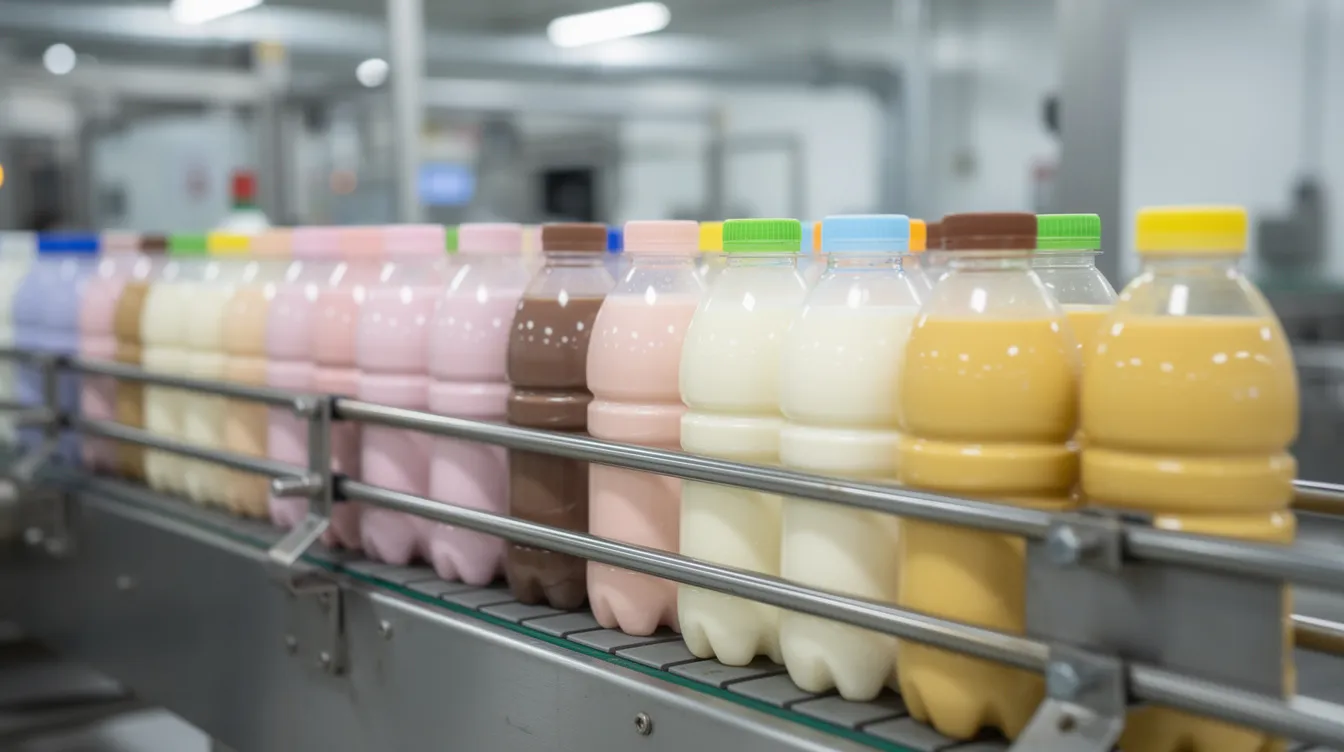
Flavoured milk is a core value added dairy product positioned as a nutritious alternative to carbonated drinks. Flavored milk drinks are marketed as healthier alternatives to sodas, providing approximately 300 mg of calcium per serving alongside essential nutrients. Production typically involves standardisation, sugar syrup preparation, flavour dosing, homogenisation and either pasteurisation with cold storage or UHT with aseptic packaging. A fruit flavored milk drink typically contains 4% to 6% sugar. Consumer preferences increasingly favour fruit flavors, strawberry flavored milk and innovative taste profiles across Indian retail.
Entrepreneurs can refer to the dedicated Flavoured Milk Manufacturing Plant Project Report for detailed capacity options, plant setup and financials.
Chocolate Milk
Chocolate milk requires efficient cocoa dispersion and higher-viscosity handling, often needing more robust mixing and homogenisation compared with standard flavoured milk. Typical Indian consumption occasions include school packs and on-the-go beverages, where consistent flavour and mouthfeel are essential to compete with established national brands in the flavored milk sector.
The specialised Chocolate Milk Manufacturing Plant Project Report covers deeper process and project-economics details for this category.
Milkshake
Milkshakes generally have higher total solids and thicker texture, requiring stronger agitators, stabiliser systems and carefully designed filling lines to handle higher viscosity without processing bottlenecks. Chilled milkshakes need reliable cold chain infrastructure, whereas UHT versions require more advanced processing but can extend shelf life and travel longer distances.
Promoters can explore the Milkshake Manufacturing Plant Project Report for formulation and plant design nuances.
Ready-to-Drink Dairy Beverages
RTD dairy beverages such as cold coffee, flavoured lassi and buttermilk-based drinks are witnessing growing off-take in Indian modern trade and QSR channels. The fruit-flavored milk drink market is projected to grow significantly across target markets in metros and tier-2 cities. A flexible RTD dairy beverage plant must support multiple SKUs and pack sizes with quick changeovers and robust CIP systems to prevent cross-contamination.
The comprehensive guide on Ready-to-Drink Dairy Beverages Manufacturing Plant Project Report provides detailed coverage.
Protein & Functional Dairy Beverages
High-protein and functional beverages fortified with whey protein, vitamins, minerals or probiotics target health-conscious urban consumers and gym-goers. From a technical and DPR perspective, these products demand precise dosing, stronger quality control, more sophisticated laboratories and potentially different regulatory scrutiny under food safety authorities.
The Protein & Functional Dairy Beverages Manufacturing Plant Project Report provides in-depth product and financial analysis.
Evaporated Milk
Evaporated milk is concentrated, unsweetened milk commonly used in bakery, desserts and institutional applications. Incorporating it into the portfolio changes the thermal-processing section and may require additional utilities like multi-effect evaporators.
The Evaporated Milk Manufacturing Plant Project Report covers detailed technical and economic parameters.
Sweetened Condensed Milk
Sweetened condensed milk, with its high sugar content, is widely used in Indian sweets and confectionery. Sugar handling, evaporation capacity, controlled crystallisation, viscosity management and hygienic storage become critical project-design elements when this product is included in the plant mix.
Refer to the Sweetened Condensed Milk Manufacturing Plant Project Report for a deeper dive.
Dairy Beverage Plant Capacity Planning and Product Mix
Capacity planning must precede detailed costing. In India, seasonal milk availability, festival-driven demand spikes and distribution radius all influence how much production capacity a promoter should install. A plant designed at 50,000 LPD with market support for only 15,000 LPD will suffer poor capacity utilisation, strained working capital and weak DSCR in the early years.
Decisions such as 10,000 LPD versus 50,000 LPD, single shift versus multi-shift, and the mix of flavoured milk, chocolate milk and fruit flavored milk drink directly affect machinery sizing, utilities, manpower and cold storage capacity. From a project finance perspective, realistic capacity utilisation build-up is critical. Lenders expect graduated assumptions-perhaps 50–60% in year one, rising to 75–85% by year three-rather than 100% utilisation from day one.
Promoters should not simply copy competitors’ capacities. The detailed guide on Dairy Beverage Plant Capacity Planning & Product Mix provides a structured methodology for matching production capacity to actual market demand and milk procurement realities.
Dairy Beverage Manufacturing Process – Hub-Level View
The dairy process flow typically includes reception, storage, processing, and packaging stages. At a hub level, the production process follows this sequence: milk reception → quality testing → filtration and clarification → chilling → milk standardisation → ingredient preparation (sugar syrup, flavours, stabilisers) → blending → homogenisation → heat treatment (pasteurisation or UHT) → cooling or aseptic transfer → filling and packaging → storage (cold storage or ambient) → dispatch.
Raw milk is collected from dairy farmers for processing. At the plant gate, milk undergoes quality testing for fat content and microbial contamination before being accepted. The milk is then pasteurized to eliminate harmful microorganisms. The mixture is homogenized to ensure uniform texture and prevent separation across all beverage formats. Flavored milk is filled into containers and packaged for distribution through retail and institutional channels.
Process variations exist for different beverages. Thicker milkshakes and protein beverages need adjusted mixing and homogenisation parameters, while UHT beverages need sterile product paths. Clean-in-place systems are essential for maintaining sanitation in machinery, and dairy plants must ensure traceability from raw milk to finished products for safety and compliance. Raw milk must be securely sourced with appropriate procurement and testing procedures at every collection point.
Readers requiring detailed flow diagrams and time-temperature combinations can refer to the Dairy Beverage Manufacturing Process & Production Line guide.
Homogenisation and Heat Treatment Considerations
Homogenisation is essential for flavoured milk and fruit flavored milk to achieve stable emulsion, uniform mouthfeel and prevention of cream separation. Standard pasteurisation regimes suit chilled products with shorter shelf life, while UHT treatment suits shelf-stable beverages but increases energy consumption and capital investments. From a DPR perspective, the selected heat-treatment technology must align with target markets and projected sales volumes to avoid underutilised high-end equipment.
The specialised article on Dairy Beverage Homogenization Process & Heat Treatment covers process parameters in detail.
Machinery and Equipment for a Dairy Beverage Processing Plant
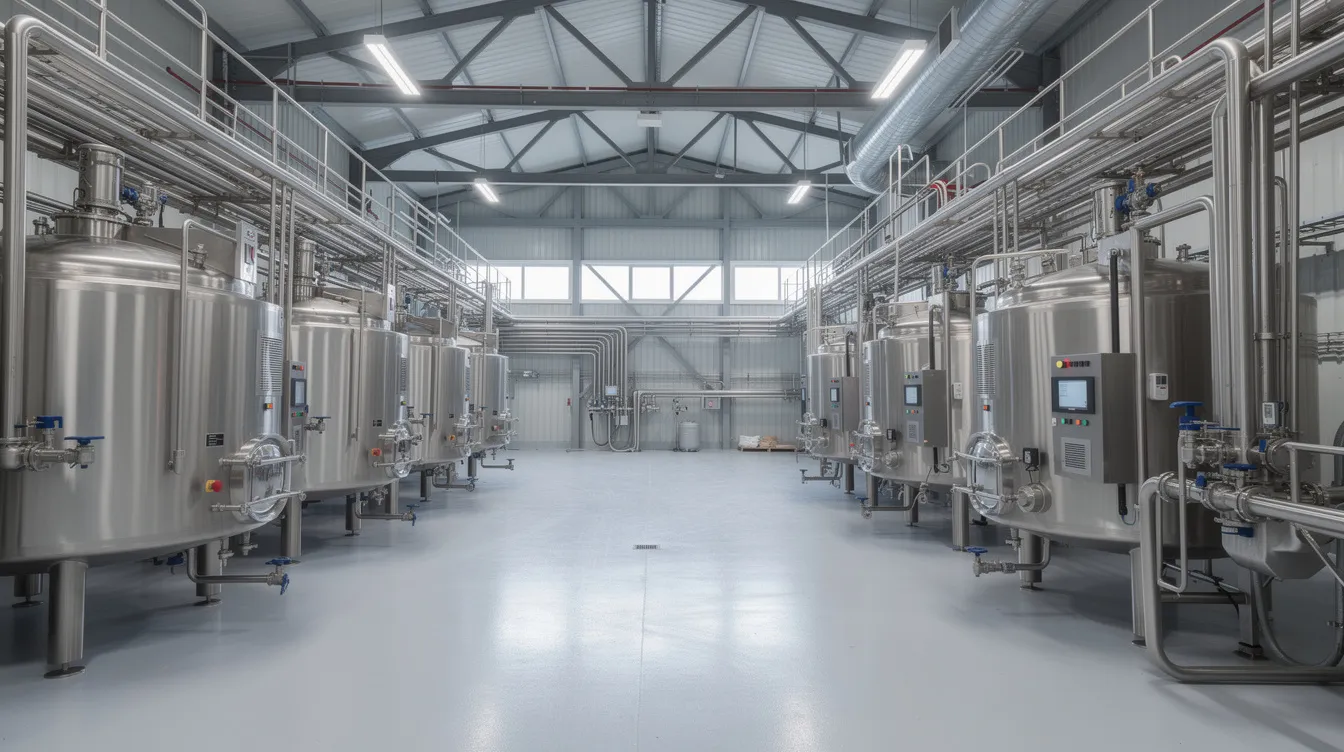
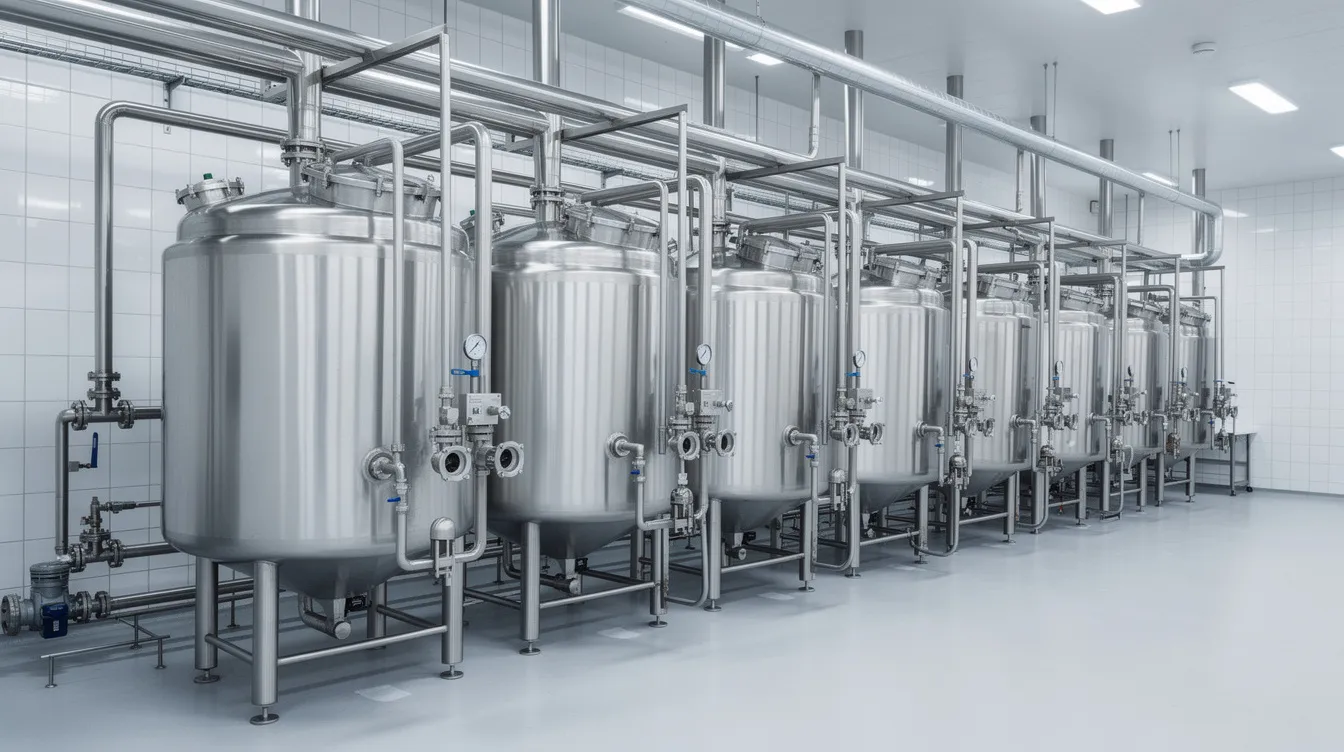
Dairy beverage plant machinery is more than just a pasteuriser and filling line. It consists of integrated systems covering milk handling, processing, packaging, utilities and quality control. Dairy beverage plants require pasteurizers and homogenizers as core processing equipment. Milk processing machinery includes mixing tanks and flavor dosing systems for product formulation. Equipment in dairy processing must meet sanitary design standards and be easy to clean and maintain.
Key machinery categories include:
- Milk reception tanks, weigh bowls, filtration units and milk chillers
- Storage and balance tanks, cream separators, standardisation systems
- Pasteurisers, homogenisers, blending and mixing tanks
- Sugar-syrup preparation units and flavour dosing systems
- UHT systems (if applicable) and CIP plant
- Refrigeration plant, air compressors, boiler, water-treatment plant and effluent-treatment plant
- Bottle rinsers, fillers, cappers, pouch-filling machines, carton packers, labellers, inkjet coders, conveyors and shrink-wrapping machines
A fruit-flavored milk drink plant needs filling and sealing machines sized to match its packaging lines and production capacity. Machinery costs are the largest portion of capital expenditure in most dairy beverage projects. Configuration, capacity (litres per hour), automation level and imported versus indigenous choices materially affect both capital expenditure and operating costs.
The detailed Dairy Beverage Plant Machinery & Equipment Cost guide covers vendor considerations and cost ranges.
Packaging Options for Dairy Beverages
Packaging format influences shelf life, logistics, consumer perception and capital expenditure significantly. PET bottles are lightweight and popular for flavoured milk and fruit flavored milk drink in Indian markets. Glass bottles offer a premium look but involve heavier handling and higher breakage risk. Flexible pouches are cost-effective but perceived as lower-end in some urban markets.
Aseptic cartons require specialised filling lines and cleanroom conditions but allow ambient storage and longer distribution distances, which may suit national or export-focused brands. From a DPR and project finance perspective, packaging lines and packaging materials can account for a significant share of both capital and operating cost. The dedicated Dairy Beverage Bottling Plant – PET, Glass & Packaging Systems guide covers packaging costs and line configurations.
Aseptic Packaging and Shelf-Stable Dairy Beverages
Aseptic dairy beverage processing involves UHT treatment, sterile product transfer, aseptic intermediate tanks and aseptic filling machines within controlled environments. The trade-off is clear: higher initial investment versus lower reliance on cold storage and refrigerated distribution, which can be attractive for long-distance or export market strategies.
Aseptic design has implications for utility sizing, CIP validation, microbiological testing and operator skill levels-all of which should be captured in a Detailed Project Report for Dairy Beverage Manufacturing Plant. The specialised Aseptic Dairy Beverage Processing & Packaging Plant article covers these considerations.
Plant Location, Land, Building and Hygienic Layout
Key criteria for selecting a plant location include availability of raw milk within a practical collection radius (consistent supply from dairy farmers is critical), access to target markets, connectivity to highways, stable power supply, water availability and local regulatory environment. The core regulatory framework for dairy in India is primarily governed by FSSAI standards, and dairy facilities must follow GMP/GHP requirements under Schedule 4 of FSSAI.
Land and site development typically includes land acquisition or lease, site levelling, boundary wall, approach road, drainage, borewell or water connection and space planning for future expansion. Hygienic zoning is essential to prevent cross-contamination in dairy processing plants-raw and finished product zones must be segregated with unidirectional product and personnel flow, separate CIP and chemical storage areas, adequate ventilation and easy-cleaning surfaces to meet FSSAI and ISO 22000/HACCP expectations. Effluent treatment plants are required to manage high BOD wastewater generated in dairy processing.
The detailed Dairy Beverage Plant Layout & Hygienic Utilities guide provides layout examples and utility-planning guidelines.
Cold Storage and Cold Chain Requirements
Most flavoured milk and fruit flavored milk drink in India is still sold via chilled distribution, requiring dairy beverage processing facilities to maintain cold chain management for raw milk at ≤4°C and finished products at 2–4°C. Key cold-storage elements include raw milk chilling tanks, refrigerated processing halls, finished-product cold rooms, walk-in chillers and monitoring systems.
The DPR must reflect not only in-plant cold storage but also downstream cold-chain requirements such as insulated vehicles, reefer trucks, distributor-level coolers and retailer refrigerators. These affect overall project feasibility and working capital. Dairy beverage processing requires cold storage facilities for products throughout the supply chain.
The dedicated Cold Storage & Cold Chain Requirements for Dairy Beverages guide addresses design and cost implications in detail.
Dairy Beverages & Flavoured Milk Project – Detailed Guides
For promoters, investors, dairy processors and consultants who wish to explore any specific aspect of this project-whether it is product selection, machinery, project cost, financial feasibility, DSCR or investment returns-the following navigation table provides direct access to focused guides. Each article is designed to offer deeper, specialised information on its respective topic, complementing the hub-level overview presented on this page.
These 26 supporting guides together form a comprehensive resource for anyone planning, financing or evaluating a commercial dairy beverage or flavoured milk manufacturing plant in India.
Dairy Beverage Manufacturing Plant Setup Cost
Total setup cost goes far beyond processing machinery. It must include land and site development, factory building with hygienic finishes, plant and machinery, packaging lines, utilities (boiler, chiller, compressor, water treatment), cold storage, laboratory equipment, electrical installation, pre-operative expenses, contingency and margin for working capital.
There is no single universal cost for a dairy beverage manufacturing plant setup in India. A small dairy processing plant costs ₹20 to ₹30 lakhs for basic configurations. A medium dairy beverage plant costs ₹40 lakhs to ₹2 crores depending on scope. The initial project cost for a 10,000 LPD plant can reach ₹5.0 to 7.5 crores when factoring in building, equipment, utilities and cold chain. Construction costs for dairy processing facilities range from $420 to $720 per square foot depending on hygienic specifications and structural requirements.
From a project finance perspective, each cost head should be supported by recent quotations or engineer estimates in the DPR before approaching banks or investors. Readers seeking indicative cost-head breakdowns should refer to the detailed Dairy Beverage Manufacturing Plant Setup Cost in India article.
Project Cost and Means of Finance
The standard project-cost structure in a dairy beverage plant DPR includes: land and site development, civil construction, dairy processing plant machinery, packaging equipment, utilities, electrical installation, cold storage, quality-control lab, furniture, vehicles (if considered), preliminary and pre-operative expenses, contingencies and margin for working capital.
The means of finance section should set out promoter contribution (equity, typically 25–35%), term loan requirement, working capital facilities and any subsidies or financial assistance from schemes like those supported by the National Dairy Development Board or state-level dairy development programmes. From a lender’s angle, clarity on debt-equity ratio, security coverage and repayment capacity through DSCR is essential; vague or inflated cost estimates often delay sanction.
The detailed Dairy Beverage Plant Project Cost & Means of Finance guide covers structuring approaches.
Revenue Model and Market Strategy
Main revenue channels for a dairy beverage plant include retail packs through distributors and retailers, supplies to supermarkets and modern trade, sales to HoReCa and institutional buyers, and potential private-label or contract-manufacturing arrangements. Product pricing, distributor and retailer margins, promotional expenditure and geographical expansion pace all directly impact turnover build-up and the financial projections assumed in the DPR.
Industry trends such as rising demand for functional beverages, stable demand for branded dairy products in urban India, price trends favouring premium positioning and consumer preferences for convenient ready-to-drink dairy products should inform product positioning and market analysis. The Dairy Beverage Revenue Model & Market Strategy article provides structured market-planning frameworks.
Profitability and Break-Even Analysis
Primary drivers of profitability include procurement price of raw milk, sugar and sweetener costs (operating costs for flavored milk plants are driven by raw materials, especially sugar), flavour and stabiliser usage, packaging material cost, power and fuel, labour, logistics, marketing and finance charges. Raw materials account for 70–80% of operating expenses in dairy plants, with milk procurement alone representing 55% to 70% of total operating expenses.
Flavored milk production can achieve gross profit margins of 30–40% when capacity utilisation is adequate and product mix includes higher-margin categories like protein beverages. The contribution margin per litre, actual capacity utilisation and sales mix determine the break-even point. In a bankable DPR, break-even analysis is presented alongside DSCR calculations and sensitivity analysis.
The detailed Dairy Beverage Plant Profitability & Break-Even Analysis guide covers numerical approaches.
Financial Projections for a Dairy Beverage Plant DPR
A bankable Dairy Beverage Manufacturing Plant Project Report should contain projected profit and loss accounts, balance sheets, cash-flow statements, term-loan repayment schedules and working-capital assessments for at least five to seven years. Financial planning in a DPR should outline CAPEX, OPEX, and profitability metrics in a consistent framework. The DPR should specify product specifications conforming to FSSAI regulations and relevant standards.
Key assumptions that must be justified include plant capacity and utilisation year-wise, selling prices by product, raw material consumption norms per litre, power and fuel usage, manpower costs, maintenance, admin and selling expenses and tax assumptions. From a project finance perspective, financial projections must align with technical design-sales projections cannot exceed what the rated production capacity and working days permit.
The Dairy Beverage Plant Financial Projections for DPR article provides detailed modelling approaches.
Working Capital Requirement
Working capital in practical terms represents funds blocked in raw milk and ingredients inventory, packaging materials, finished goods (especially in cold storage), trade receivables from distributors and retailers, and minimal cash balances. Dairy beverages, especially chilled flavoured milk and fruit flavored milk drink, often require significant stock at different points in the cold chain, which increases working-capital needs compared to simple commodity dairy products.
Banks generally evaluate separate working-capital limits (cash credit or overdraft) based on operating cycle. Margin for working capital (promoter’s portion) should be disclosed as part of the total project cost in the DPR. The detailed Dairy Beverage Plant Working Capital Requirement article covers methodology and typical cycles.
DSCR and Loan Repayment Capacity
DSCR (Debt Service Coverage Ratio) measures whether projected cash accruals are adequate to service interest and principal on the term loan. It is a central indicator in bank appraisal of any dairy beverage plant term loan application. In a realistic DPR, DSCR is calculated year-wise, reflecting ramp-up in capacity utilisation and gradual stabilisation of margins rather than assuming immediate full utilisation.
Promoters should avoid over-optimistic projections showing very high DSCRs based on unrealistic selling prices or underestimated variable costs, as seasoned lenders typically normalise assumptions. The Dairy Beverage Project DSCR & Loan Repayment Capacity guide provides formulas and illustrative calculations.
Bank Loan and Project Finance for Dairy Beverage Plants
The broad steps in seeking bank finance include preparing a bankable Dairy Beverage Manufacturing Plant DPR, compiling CMA data, arranging quotations, identifying collateral and approaching suitable banks or financial institutions. Lenders typically evaluate promoter background and experience in dairy processing, technical feasibility, market analysis, project cost and means of finance, profitability, DSCR, security coverage and compliance with regulatory requirements.
A strong DPR improves clarity and speeds appraisal but does not guarantee sanction. Banks will carry out independent risk assessment and may seek clarifications or modifications. The Bank Loan & Project Finance for Dairy Beverage Manufacturing Plant guide provides more detailed guidance on term-loan proposals.
Term Loan Assessment and Technical–Financial Feasibility
Term-loan assessment focuses on funding eligible fixed assets and sometimes a portion of working capital, with repayment schedules matched to projected cash flows and a reasonable moratorium during implementation and early operations (typically six to twelve months). Technical feasibility-availability of milk, technology, infrastructure, skilled manpower, cold storage-and financial feasibility including profitability, DSCR and IRR must be evaluated together before finalising project cost and loan structure.
Expansions or modernisation projects may have different financing patterns compared with greenfield plants, often leveraging existing infrastructure and balance sheets. The guides on Dairy Beverage Plant Term Loan Assessment and Dairy Beverage Plant Feasibility & Project Viability provide deeper insights.
ROI, IRR, Payback and Sensitivity Analysis
Investors and lenders look beyond simple profit figures to metrics such as Return on Investment (ROI), Internal Rate of Return (IRR), payback period and equity returns when assessing a dairy beverage project. A good dairy beverage plant DPR should include sensitivity analysis on key variables like raw milk price, selling price, capacity utilisation, sugar and packaging costs and interest rates to understand the project’s risk profile.
In my experience reviewing manufacturing projects, sensitivity analysis often highlights that apparently small changes in milk price or utilisation-say ±5–10%-can materially affect DSCR and payback. The ROI, IRR, Payback & Sensitivity Analysis of Dairy Beverage Plant article covers these financial metrics comprehensively.
What Should a Dairy Beverage Manufacturing Plant DPR Include?
A bankable DPR for a Dairy Beverages & Flavoured Milk Manufacturing Plant Project Report should cover all essential project dimensions. Dairy DPRs should include compliance with local environmental norms and waste management standards alongside technical and financial documentation. The DPR should also include a staff training plan that covers hygiene, GMP, and HACCP principles in dairy facilities.
The DPR should include:
- Executive summary and promoter profile
- Project concept, objectives and detailed description of proposed products (flavoured milk, fruit flavored milk drink, milkshake, plain milk, milk powder applications)
- Market analysis, demand assessment and competitive landscape
- Proposed plant capacity and phased capacity utilisation schedule
- Manufacturing process description and quality assurance framework
- Plant and machinery list with quotation-backed costs
- Raw materials and packaging requirements with consumption norms
- Land and site development details, building and plant layout plans
- Utilities, effluent treatment, water treatment and power backup
- Manpower planning and organisation structure
- Statutory and regulatory requirements (FSSAI licensing, pollution control, food safety compliance)
- Implementation schedule with milestones
- Detailed project cost estimates and means of finance
- Working-capital assessment and proposed banking facilities
- Projected profit and loss accounts, balance sheets and cash flows for 5–7 years
- Term-loan repayment schedule and DSCR calculations
- Break-even analysis, ROI, IRR, payback period
- Sensitivity analysis on key assumptions
- Key project risks and mitigants
All assumptions-selling prices, milk procurement cost, capacity utilisation, credit terms-should be consistent with industry trends and supported by realistic justifications.
Key Factors That Determine Dairy Beverage Project Viability
Several key factors determine whether a dairy beverage project will deliver sustainable returns:
- Milk procurement price and reliability directly influence raw material costs, which typically form the largest portion of operational costs. Seasonal fluctuations in milk production and procurement competition from other processors can affect consistent supply.
- Achievable realisation per litre depends on product mix (premium functional beverages versus base flavoured milk), packaging type, brand positioning and distribution margins. Market demand and consumer preferences in target markets must be validated through proper market analysis.
- Operational factors such as plant capacity utilisation, downtime, wastage levels, energy efficiency of utilities, effectiveness of cold chain and product shelf life each impact cost per litre and profit margins.
- From a financing viewpoint, leverage level (debt-equity ratio), adequacy of working capital and discipline in financial management materially affect the project’s ability to withstand market or cost shocks over the first three to five years.
Common Mistakes While Planning a Dairy Beverage Plant
Frequent strategic errors include:
- Purchasing machinery based on attractive quotations before finalising the detailed product portfolio, capacity plan and distribution strategy, leading to mismatched equipment and underutilisation
- Assuming 100% capacity utilisation from year one, ignoring realistic working-capital requirements, underestimating cold chain and packaging costs and presuming subsidies or grants without confirmation
- Inadequate space planning for cold storage, ignoring effluent-treatment plant requirements, under-sizing utilities and neglecting proper hygienic layout and CIP arrangements
- Preparing financial projections disconnected from actual plant capacity, using unrealistic selling prices and ignoring distributor margins
Engaging experienced DPR and project-finance advisors early in the planning stage can help avoid these pitfalls and create a more bankable dairy beverage plant DPR.
Who Can Consider Setting Up a Dairy Beverage & Flavoured Milk Plant?
Typical promoter profiles for whom such projects may be appropriate include existing dairy processors wanting to move into value added dairy products, cooperative unions looking to launch branded flavoured milk, regional dairy brands expanding beyond liquid milk, food and beverage companies diversifying into dairy beverages, and MSME entrepreneurs with access to stable milk supplies and market networks.
These projects may also suit existing milk chilling or dairy processing units that already have part of the infrastructure (like pasteurisation and cold rooms) and now wish to add a dedicated dairy beverage line to improve capacity utilisation. Prospective promoters should realistically assess their understanding of dairy processing, distribution capabilities, risk appetite and ability to bring in required equity before committing to a high-capex industrial dairy beverage manufacturing plant.
Why a Customised Dairy Beverage Manufacturing Plant DPR Is Important
Two dairy beverage plants with identical rated capacity-say 20,000 LPD-can have very different project costs, margins and risks depending on product mix, level of automation, land cost, packaging formats and distribution strategy. Copying generic numbers or DPRs from other projects or online sources without adapting assumptions to the actual location, milk procurement scenario, market prices and product portfolio can mislead both promoters and lenders.
From my advisory perspective, a bankable Detailed Project Report for Dairy Beverage Manufacturing Plant should always be prepared on project-specific data, vendor quotations and market references, and should be periodically updated if there are major changes in milk prices or interest rates before sanction. Promoters requiring customised DPRs, financial projections, CMA data and feasibility analysis tailored to their proposed dairy beverage project configuration in India can explore the resources and advisory support available at www.projectreportbank.com.
FAQs – Dairy Beverage Manufacturing Plant DPR
What is a dairy beverage manufacturing plant in practical terms?
It is an integrated milk processing unit designed to produce value-added beverages like flavoured milk, fruit flavored milk drink, chocolate milk, milkshake and functional beverages at commercial scale. Such a dairy processing plant includes dedicated processing lines, packaging systems, cold storage and quality-control facilities, distinguishing it from a basic milk chilling or pasteurisation unit.
Can one plant produce flavoured milk, chocolate milk and milkshakes together?
Yes, a single dairy beverage processing plant can handle multiple products if properly designed with appropriate mixing, homogenisation, CIP and packaging systems. However, the DPR must plan capacities and changeover times realistically to avoid bottlenecks. Different viscosity levels and formulation requirements for milkshakes versus standard flavoured milk need to be factored into equipment sizing.
How do I choose the initial capacity for my dairy beverage plant?
Estimate realistic near-term demand based on distribution reach, number of outlets, expected off-take per outlet and competitive landscape. Build in a moderate growth cushion, but avoid over-sizing capacity without confirmed market support, as this can strain DSCR and working capital in early years.
Is cold storage compulsory for every dairy beverage project?
Chilled pasteurised products definitely require in-plant cold rooms and refrigerated distribution. UHT and aseptically packed beverages can be stored and transported at ambient temperatures, although controlled conditions may still be advisable in hot climates. The choice between chilled and ambient distribution materially affects both capital expenditure and operational costs.
What financial documents should I prepare along with the DPR for a bank loan?
Key documents include the detailed dairy beverage plant DPR, CMA data, projected financial statements (profit and loss, balance sheet, cash flow), term-loan request letter, KYC and financial statements of promoters, collateral details, machinery and civil quotations and detailed financial analysis supporting DSCR and break-even calculations. Banks may also require a sensitivity analysis demonstrating project resilience under adverse assumptions.
Conclusion
Establishing a dairy beverages and flavoured milk manufacturing plant is a substantial but potentially rewarding investment. It requires integrated decisions on product mix, milk procurement, processing technology (pasteurised versus UHT), packaging formats, cold storage, project cost, working capital and financing structure. Each decision has downstream implications for profitability, DSCR and long-term viability, which is why the dairy industry demands disciplined planning from the outset.
A robust Dairy Beverages & Flavoured Milk Manufacturing Plant Project Report serves as both a decision-making tool for promoters and an appraisal document for lenders, bringing together technical design, market assessment and financial feasibility in one coherent framework. It is not merely a compliance document-it is the foundation on which investment decisions and financing commitments are built.
Promoters, dairy companies and investors seeking customised DPRs, bank-finance documentation, CMA data or feasibility analysis for dairy beverage projects in India may consider engaging specialised advisory support for their specific project configuration.
CA Manish Gugliya, FCA, DISA (ICAI) www.projectreportbank.com