Key Takeaways
- This hub article explains how to prepare a bankable integrated dairy processing plant project report (DPR) in India, from capacity selection and milk procurement to financial projections, DSCR and loan appraisal.
- An integrated dairy plant covers the full chain – milk collection, chilling, pasteurisation, value-added dairy products, utilities, cold chain and distribution – and the DPR must connect all these into one consistent business model.
- Banks do not finance machinery alone; they appraise promoter profile, milk availability, product mix, market, project cost, means of finance, working capital, cash flow, break-even, ROI/IRR and risk under realistic assumptions.
- ProjectReportBank.com, led by CA Manish Gugliya (FCA, DISA ICAI), prepares customised, bank-oriented DPRs, CMA data and financial models for integrated milk and dairy processing projects across India.
- Use this article as the central guide and refer to the linked detailed guides on capacity planning, setup cost, machinery, utilities, revenue model, projections, working capital, DSCR, feasibility and sensitivity analysis for deeper planning.
📊 Operations & Finance: Utilities | Revenue Model | Financial Projections | Working Capital | CMA Data | DSCR
🏦 Bankability & Viability: Bank Finance | Term Loan | Feasibility | Break-Even | ROI / IRR | Sensitivity & Risk
Introduction: Integrated Dairy Processing Plant DPR from a Bank-Finance Perspective
If you are planning to set up an integrated dairy processing plant in India, one of the first serious steps is preparing a detailed project report that a bank can appraise, question and – if the numbers hold – finance. An integrated dairy processing plant project report serves as a comprehensive blueprint for setting up a modern dairy business, and its preparation is far more involved than writing a report for a single-product manufacturing unit.
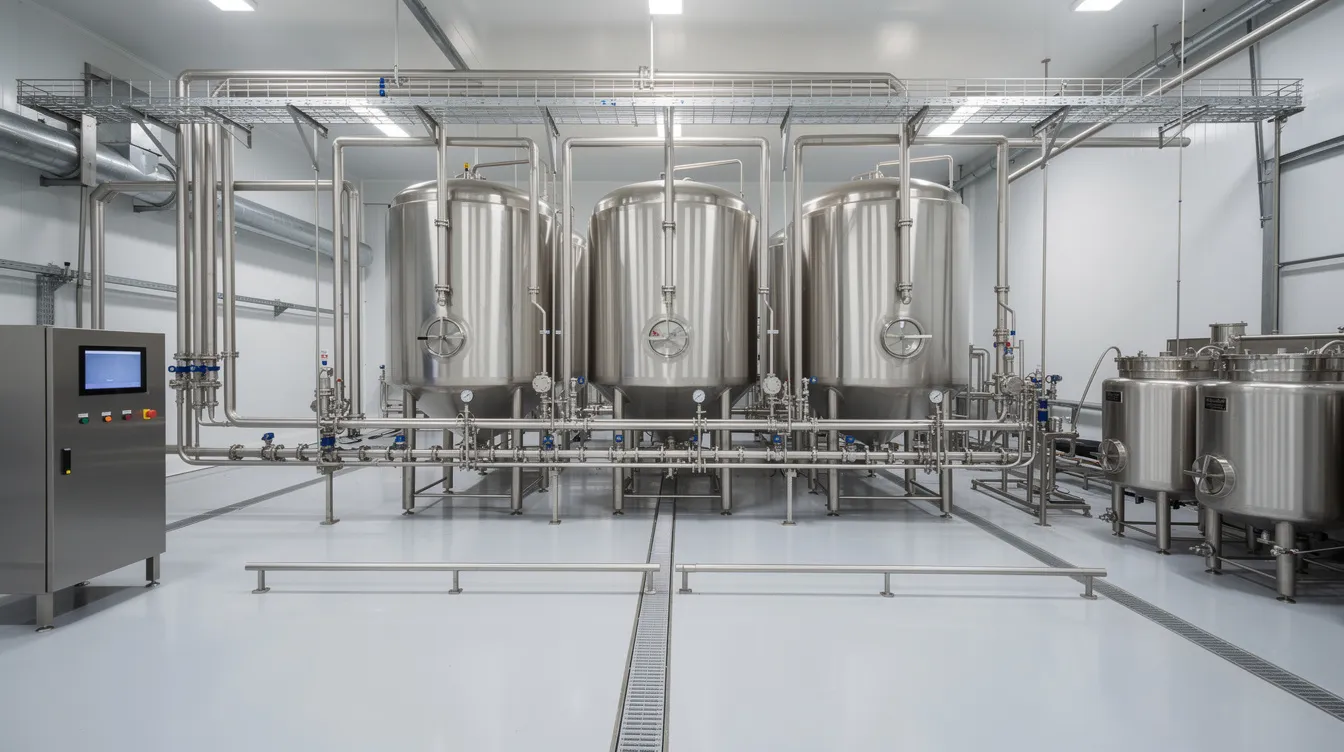
An integrated dairy processing plant typically handles everything from milk collection to distribution. The facility may include raw milk reception docks, bulk milk coolers, storage tanks, pasteurisers, homogenisers, cream separators, product-specific equipment for curd, paneer, ghee, butter, flavoured milk, cheese, cream and milk powder, along with cold rooms, a boiler, refrigeration systems, compressors, an effluent treatment plant and distribution infrastructure.
The dairy market in India is growing over 6% annually, and milk accounts for 35.7% of the global dairy market. India ranks third in global milk production, and the organised dairy sector is expanding rapidly. This growth makes dairy processing an attractive investment – but also means that banks receive numerous proposals and scrutinise each one carefully.
A bankable integrated dairy processing plant DPR must convincingly demonstrate that raw milk can be procured, processed into milk and dairy products, and sold profitably enough to service both the term loan and working-capital limits. The DPR is not just a document to “get a loan.” It is the foundation on which lenders evaluate whether your business model can survive real-world challenges – seasonal milk fluctuations, pricing pressure, utility costs and distribution complexities.
In my practice as a Chartered Accountant handling project finance and DPR assignments, I have seen that the quality of the project report often determines whether a dairy proposal moves forward or gets stuck in endless bank queries. This guide explains how to approach the entire process.
What Is an Integrated Dairy Processing Plant?
There are three broad levels of dairy operations, and understanding the distinction matters for your project report.
Basic milk collection and chilling centres operate at the village or route level. They collect fresh milk from milk producers, test it for fat and SNF content, chill it in bulk milk coolers and transport it to a larger dairy plant. Value addition is minimal, and margins are thin.
Standalone dairy product units manufacture a single product – say, only paneer or only ghee – using purchased milk or curd. These units depend on external suppliers for raw materials and have narrower product portfolios with limited pricing flexibility.
An integrated dairy processing plant combines backward integration (milk procurement network, collection routes, chilling centres) with central processing (pasteurisation, homogenisation, standardisation of market milk) and forward integration (value-added dairy products, branding, packaging, cold storage and distribution). Milk processing extends the shelf life of fresh milk from hours to weeks, enabling wider distribution and better price realisation.
Value-added dairy products such as flavoured milk, dahi, paneer, ghee, butter, cheese, lassi and milk powder significantly alter the revenue model. For context, Dodla Dairy’s value-added products comprised approximately 29.2% of its revenues in FY 2025-26, demonstrating how product mix directly influences gross margins and payback period compared to selling only liquid milk.
What Is an Integrated Dairy Processing Plant DPR?
A detailed project report in the context of Indian bank and financial-institution appraisal is a structured document that explains the technical, commercial and financial aspects of the proposed dairy processing plant. The essential components of an integrated dairy processing project report connect commercialisation, milk supply, technical processes, compliance, operations and financial planning into a single coherent narrative.
The project report typically includes an executive summary, technical specifications, financial projections, market analysis and operational plans. Beyond these, a comprehensive DPR covers promoter background, industry trends, plant capacity, location, milk procurement plan, proposed milk and dairy products, manufacturing process, plant layout, machinery, land and building, utilities, manpower, project cost, means of finance, working capital, sales and cost assumptions, DSCR, break-even, ROI/IRR and risk analysis.
A robust project report explains the rationale for establishing the dairy plant based on supply and demand dynamics. A strong project report includes a comprehensive market analysis of current dairy consumption and projected demand, identifying target customer segments and the competitive landscape.
The difference between a generic dairy processing plant project report with template numbers and a bankable dairy plant DPR for bank loan is internal consistency. In a bankable report, technical capacities (LPD/TPD) align with expected sales volume, milk procurement availability and distribution reach. Banks use the DPR as a starting point for appraisal – they independently test assumptions, verify quotations, ask queries and seek clarifications on DSCR, repayment schedule and sensitivity to changes in milk prices or selling prices.
Choosing the Right Dairy Plant Capacity
In my project-finance work, I generally start with capacity planning before finalising machinery, project cost or financial projections. The important question is not only how much the plant can process, but how much milk can be procured and sold profitably.
Dairy plant capacity – whether 20,000 LPD, 50,000 LPD, 1 LLPD, 2 LLPD, 5 LLPD or larger – should be determined by realistic milk procurement potential in the catchment area, seasonality, existing competition and distribution strength, not by arbitrary size or vendor suggestions.
Key factors affecting capacity selection include:
- Daily milk availability in the milk producing areas
- Distance from milk-shed villages and transport logistics
- Seasonal milk surplus (flush) and lean periods
- Planned product mix – liquid milk versus high-solids products like milk powder or ghee
- Target markets (local, regional, institutional) and distribution capability
- Promoter’s ability to manage procurement and sales teams
- Investment capacity and working-capital strength
The DPR should show stepwise capacity utilisation build-up – for example, 50–60% in Year 1, then gradually increasing – clearly linked to milk procurement and sales assumptions. A dairy processing plant can process 5,000 litres of milk daily at the smaller end, while large integrated facilities operate at several lakh litres per day.
For typical capacity options and how they affect investment and financial metrics, refer to the detailed guide on dairy plant capacity planning.
Integrated Dairy Processing Plant Setup Cost
Media or consultant claims such as “₹X crore integrated dairy plant” are oversimplified. Actual setup cost depends on capacity, scope of milk and dairy products, level of automation, land cost and infrastructure. The total capital investment for a 5,000 LTR/day plant is approximately Rs. 4.81 Cr, but scaling to 10,000 LPD with value-added product lines can push capital costs to ₹6.64–9.54 crore.
Major capital cost heads include:
- Land and site development
- Civil works for processing block and utility areas
- Milk reception dock, storage tanks and core processing equipment
- Value-added product lines (curd, paneer, butter, ghee, flavoured milk, cheese, milk powder)
- Refrigeration and cold storage
- Boiler and steam system, electrical installations
- ETP, laboratory, vehicles
- Pre-operative expenses and contingency
Capital costs in a project report usually encompass land, building, plant and machinery expenses. A project handling only pasteurised milk with basic chilling will cost significantly less than an integrated facility that also includes milk powder, cheese or UHT milk lines. The integrated dairy processing plant project report should present item-wise cost estimates with supporting quotations.
For a structured view of typical cost components, read the guide on integrated dairy processing plant setup cost in India.
Project Cost and Means of Finance
In bank appraisal, project cost (total capital investment) and means of finance (funding structure) are examined separately but must reconcile within the dairy plant project report for bank loan.
Project cost is typically grouped as: land and site development, buildings, plant machinery, utilities, furniture and office equipment, preliminary and pre-operative expenses, interest during construction (if applicable), contingency and margin for working capital.
Means of finance includes:
- Promoter contribution / equity
- Term loan from banks or financial institutions
- Unsecured loans treated as quasi-equity where acceptable
- Subsidy components where applicable (government schemes provide financial assistance for dairy processing setups)
- Separate assessment of working-capital limits
A realistic debt–equity ratio and adequate promoter margin are critical from a lender’s perspective. Over-leveraging or inflated own contribution without proof can lead to appraisal issues. For step-by-step structuring, refer to the guide on dairy plant project cost and means of finance.
Machinery and Equipment Planning
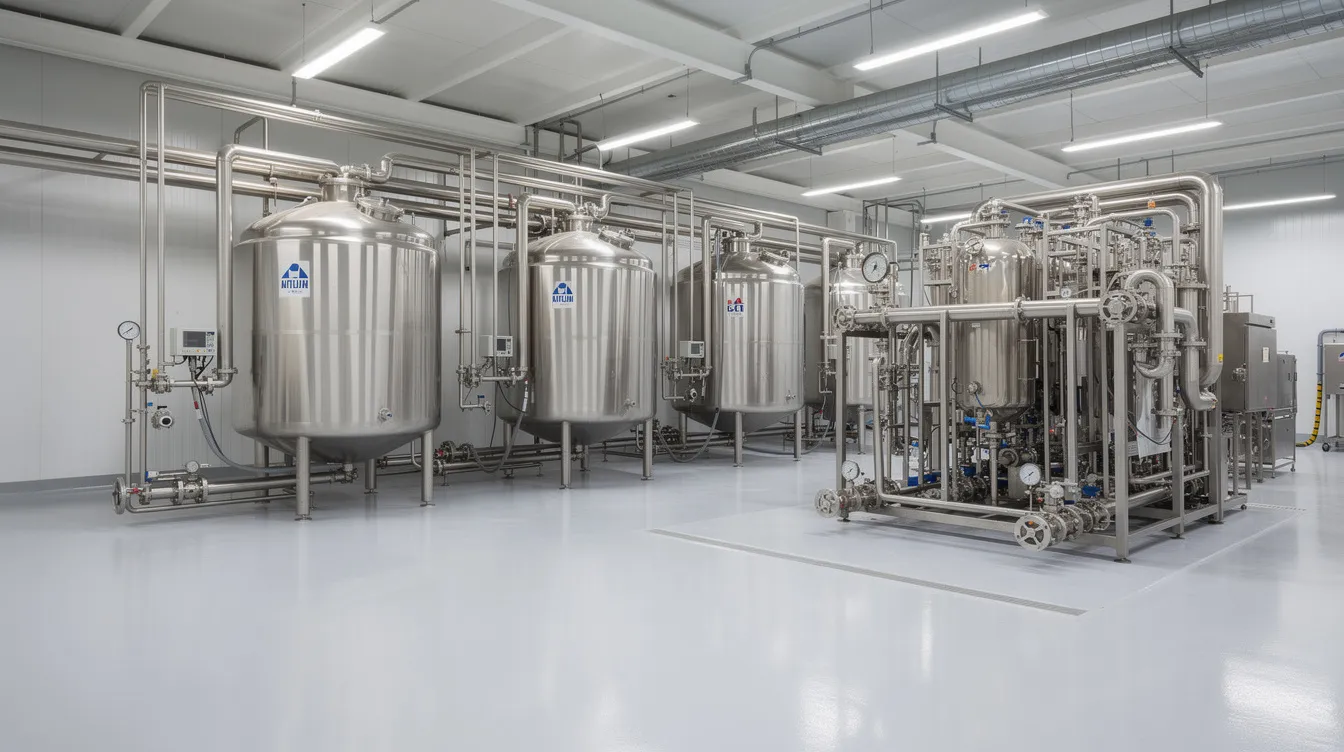
Machinery planning should follow from the selected plant capacity and product mix so that each line is technically balanced and capable of handling seasonal peaks. Equipment in a dairy processing plant includes homogenisers, pasteurisers and filling machines, among many other categories.
Principal equipment categories include:
- Milk reception (weighing, dumping units, can conveyors)
- Milk testing equipment (fat/SNF analysers, lactometers, adulteration testing kits)
- Storage tanks (silo tanks, balance tanks)
- Pasteurisers, homogenisers, cream separators
- Standardisation tanks and product-specific equipment for curd, paneer, ghee, butter and flavoured milk
- CIP system, refrigeration plant, cold rooms and blast chillers
- Laboratory equipment
Automation level (manual, semi-automatic, automatic) impacts both investment and operating cost, as well as product quality consistency and labour requirement. Butter production requires skimming and pasteurising raw milk with specialised churning equipment. Cheese production involves heating milk and adding rennet through dedicated vat systems. Milk powder is made from non-pasteurised milk through evaporation and spray-drying units.
The DPR should attach or reference key quotations from machinery suppliers for major equipment. For category-wise machinery planning, see the guide on dairy processing plant machinery and equipment cost.
Land, Building and Infrastructure
Selecting a location that balances milk catchment access, proximity to consumption centres and availability of basic utilities like power and water is fundamental. A basic dairy processing setup requires around 2,000 sq. ft. of space, though integrated plants with multiple product lines, cold rooms and utility blocks need considerably more.
Typical functional zones include:
- Milk reception and unloading area
- Processing hall and value-added products section
- Cold storage and finished-goods warehouse
- Utility block (boiler, refrigeration, compressors, DG set)
- ETP and waste-handling area
- Quality-control laboratory
- Administrative block and staff facilities
Hygienic plant layout and product flow – forward flow from raw milk to finished products, minimal cross-movement, adequate spacing – are critical from both FSSAI compliance and bank risk-assessment standpoints. Compliance with FSSAI hygiene standards is mandatory for dairy products, and dairy processing plants require licences from statutory agencies. The project report must align with the Food Safety and Standards Authority of India requirements for dairy processing.
Infrastructure elements such as internal roads, drainage, rainwater management, boundary wall and security should appear in the DPR’s civil cost estimates. For detailed layout considerations, refer to dairy plant land, building and infrastructure requirements.
Milk Collection and Procurement Infrastructure
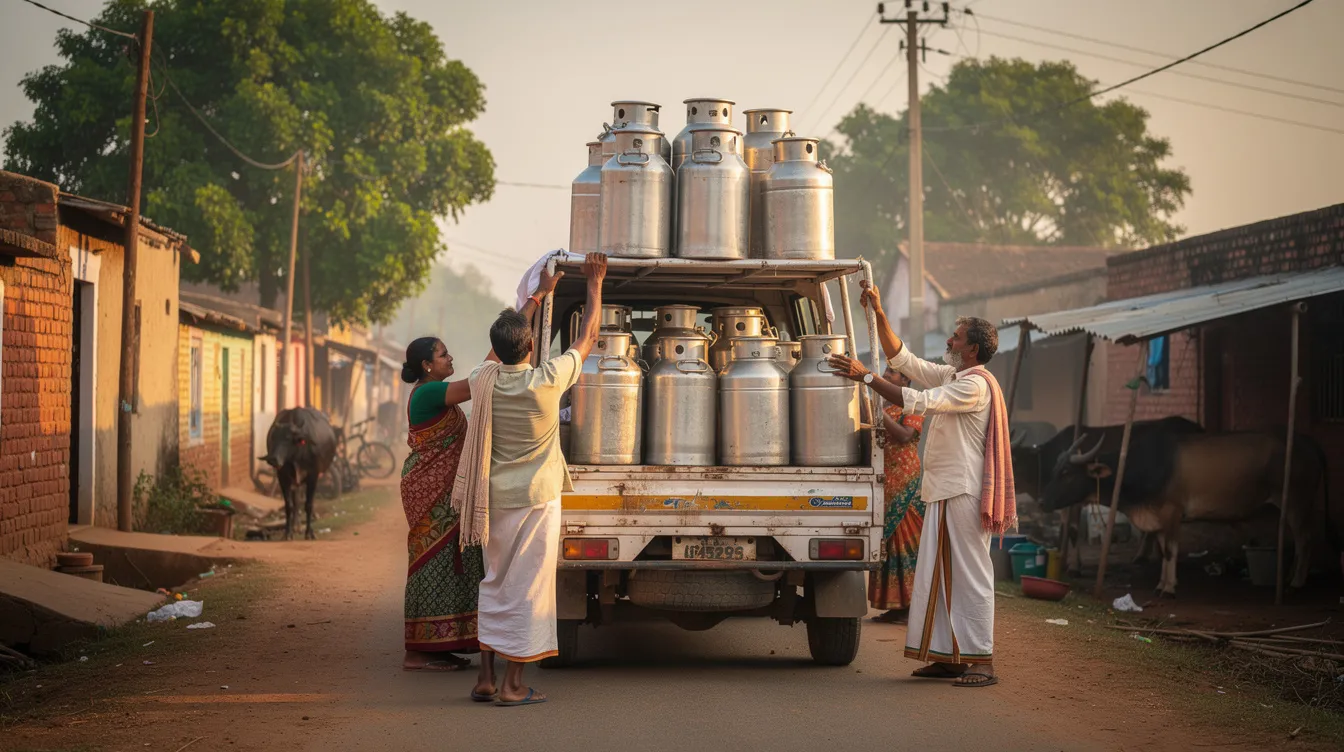
The most sophisticated dairy processing plant cannot operate viably without a robust and economical milk procurement system. About 15% of total milk production is distributed through both cooperatives and organised channels, but a large share still comes from marginal farmers and fragmented supply chains.
The project report should outline the milk procurement plan including collection centres and quality parameters. Planning the milk-shed area involves identifying villages, expected milk surplus, distance from plant, farmer base, cooperative or private-collection models and pricing strategy for raw milk.
Typical milk procurement infrastructure includes:
- Village-level collection centres (VLCCs)
- Bulk milk coolers (BMCs)
- Milk cans, crates and insulated tankers
- Milk-testing facilities at village or route level
- IT systems for milk collection data and traceability
Seasonal variation in milk availability – flush and lean seasons – must be factored into capacity planning and product mix decisions. The report should establish quality control measures including raw milk testing and product testing at multiple stages. Dodla Dairy, for example, procures from approximately 1.3 lakh farmers across 8,800 villages through about 7,800 VLCCs.
For building a sustainable milk network, read dairy plant milk collection and procurement infrastructure.
Explore the Integrated Dairy Plant Project Planning Guides
The following table summarises key planning areas covered in specialist guides on ProjectReportBank.com. Each guide offers deeper analysis on a specific aspect of setting up an integrated dairy processing plant.
| Project Planning Area | Detailed Guide |
|---|---|
| Plant Setup & Investment | Integrated Dairy Processing Plant Setup Cost in India |
| Capacity Selection | Dairy Plant Capacity Planning |
| Project Cost & Funding | Dairy Plant Project Cost & Means of Finance |
| Machinery | Dairy Processing Plant Machinery & Equipment Cost |
| Land & Infrastructure | Dairy Plant Land, Building & Infrastructure Requirements |
| Milk Procurement | Dairy Plant Milk Collection & Procurement Infrastructure |
| Utilities | Dairy Plant Utilities – Power, Water, Steam, Refrigeration & ETP |
Utilities: Power, Water, Steam, Refrigeration and ETP
Utilities are a major contributor to both capital cost and operating cost. For large integrated plants, ETP costs alone can range from ₹8–25 crore depending on capacity and complexity. The dairy processing plant project report must size these properly.
Key utility areas include:
- Connected electrical load and transformer requirements
- Diesel generator backup sizing
- Water source, treatment and recycling
- Boiler capacity for process steam
- Refrigeration and chilling systems for milk and dairy products
- Compressed-air system and CIP utilities
Environmental compliance includes addressing wastewater treatment and solid waste management. Entrepreneurs must secure environmental clearances for dairy plants, and regulatory approvals needed include FSSAI licence and pollution control board consents. A litre of milk processed can generate 1–5 litres of wastewater depending on the product category, making ETP sizing critical.
Utility consumption assumptions – kWh per litre, steam per litre, water per litre – should be integrated into the financial projections as operating expenses. For practical sizing considerations, refer to dairy plant utility requirements – power, water, steam, refrigeration and ETP.
Product Mix and Revenue Model for Milk and Dairy Products
The economic strength of an integrated dairy plant lies not only in litres processed but in the product mix and contribution margin per litre of milk handled. Gross profit margins for milk processing typically range from 15–25%, but value-added products like paneer, ghee and flavoured milk can push overall margins higher. Milk processing plants can achieve profit margins of 25–35% after one year with the right product mix.
Typical portfolio choices in an integrated milk processing unit include:
- Packaged liquid milk (whole milk, toned milk, double toned, standardised milk, skimmed milk)
- Curd/dahi, paneer, lassi, buttermilk
- Flavoured milk (strong urban demand and per capita consumption is rising)
- Butter, ghee, cream, cheese
- Skimmed milk powder, whole milk powder or dairy whitener where viable
The DPR should allocate daily milk volume between these products, linking milk fat and milk solids utilisation with respective product yields and expected selling prices to arrive at a realistic revenue model. Product-wise sales volume must reconcile with processing capacity, cold-storage space and distribution capacity. Over-ambitious value-added volumes without distribution support can be flagged by banks.
For deeper examples of how different mixes impact realisation and gross contribution, see the guide on integrated dairy plant revenue model and product mix.
Financial Projections for a Dairy Processing Plant DPR
In my project assignments, I insist that every financial projection in the dairy processing project report flows logically from technical and market assumptions rather than being reverse-engineered to fit a target profit. Financial projections in a project report typically cover 5–10 years of revenue, expenses and projected financial statements.
Components of the projection model include:
- Year-wise production and sales volumes by product
- Selling price assumptions for each major product
- Milk procurement rate and other raw materials cost (packing materials, consumables)
- Power and fuel costs, salaries and wages
- Transport, repairs, administrative expenses
- Interest on term loan and working-capital facilities
- Depreciation on fixed assets
- Projected Profit & Loss Account, Balance Sheet and Cash Flow Statement
The report should include a detailed organisational structure highlighting manpower requirements, as salary cost forms a significant recurring expense. Assumptions must be internally consistent – capacity utilisation used in revenue calculation must match the depreciation and interest calculations for the same period.
For stepwise modelling guidance, use the detailed guide on dairy processing plant financial projections.
Working Capital Requirement in Milk and Dairy Processing
Integrated dairy plants are often profitable on paper but face cash-flow stress because of inadequate working-capital planning. Operating costs for a milk processing plant are 80–85% raw milk expenses, which means daily procurement payments consume enormous cash.
Major working-capital components include:
- Raw milk payments to farmers or aggregators (often weekly or fortnightly)
- Credit extended to distributors and institutional buyers (receivables)
- Inventory of packing materials (pouches, cups, cartons)
- Short shelf life of milk products requiring adequate finished stock
- Day-to-day operating expenses including power, fuel and salaries
The DPR should estimate working-capital margin for inventories, receivables and operating expenses, and translate this into requirements for cash credit limits, overdrafts or other working-capital lines. Banks review the working-capital cycle using ratios like current ratio and drawing power, often through CMA data.
For a detailed methodology of computing working-capital needs, see dairy plant working capital requirement.
DSCR and Loan Repayment Capacity
DSCR – Debt Service Coverage Ratio – measures the ratio of cash available for servicing debt (interest plus principal) to the total debt service obligation of the year. In a dairy plant bankable project report, DSCR is usually presented year-wise for the full repayment tenure.
Banks assess whether projected DSCR is comfortable based on their internal benchmarks. Many government and cooperative lending schemes require a minimum DSCR of 1.25, though individual banks may have different thresholds.
DSCR depends on EBITDA, interest cost, principal repayment schedule, moratorium period and tax assumptions – all of which must be consistent across the DPR. A project with healthy profitability may still show low DSCR in initial years if repayments are too aggressive; therefore the repayment structure must be aligned with projected cash flow and the gradual ramp-up of capacity utilisation.
For deeper understanding of DSCR interpretation, refer to dairy project DSCR and loan repayment capacity.
CMA Data for Dairy Processing Plant Bank Loan
Many banks, especially for larger MSME and corporate proposals, require CMA (Credit Monitoring Arrangement) data in addition to the DPR.
CMA data typically contains:
- Historical financials (for existing businesses)
- Projected balance sheets and P&L
- Analysis of current assets and current liabilities
- Working-capital gap and proposed bank finance
- Fund-flow statements and key financial ratios
For new integrated dairy plants, the projected figures in CMA data are derived from the financial model and should match the dairy processing plant DPR submitted to the bank. CMA data helps the bank assess working-capital requirements, drawing power and overall creditworthiness of the borrower over the projected period.
For detailed CMA formats and how they relate to the DPR, see dairy processing plant CMA data for bank loan.
Bank Loan and Project Finance for Dairy Processing Plants
An integrated dairy processing plant DPR is essentially a term-loan and working-capital proposal presented in a structured technical-financial form. Government schemes provide financial assistance for dairy processing setups through various channels.
Typical financing channels include commercial banks, cooperative banks, regional rural banks and specialised financial institutions with focus on food processing or MSME sectors.
- Term loans finance fixed assets – land, building, plant machinery, utilities
- Working-capital facilities (cash credit, overdraft, WCTL or WCDL) finance day-to-day operations
- Security structure may include primary security (assets financed) and collateral security (other immovable property or financial instruments), with conditions varying across lenders
The dairy industry in India has attracted significant lending interest, but banks still evaluate each proposal on its merits. For a deeper understanding of loan types, appraisal stages and documentation, see bank loan and project finance for dairy processing plant.
How Banks Assess a Dairy Project Term Loan
From a banker’s perspective, milk and dairy processing projects involve both agribusiness and manufacturing risks, so appraisal is comprehensive.
Key appraisal aspects include:
- Promoter’s background and financial strength
- Clarity of business plan and business requirements
- Milk availability and procurement plan in target milk producing areas
- Plant capacity and scalability for future expansion
- Product mix, major competitors and market positioning
- Projected sales and pricing assumptions
- Cost structure, profitability analysis and DSCR
- Security coverage and repayment schedule
Banks look for consistency between the detailed project report for dairy processing plant, submitted financial projections and any existing financial statements. Timely project implementation, realistic construction period and provision for contingencies are carefully checked. Market analysis should identify target customer segments and the competitive landscape.
For an expanded view of the lender’s appraisal methodology, see dairy project term loan assessment.
Dairy Project Finance & Viability Guides
The following table summarises specialised guides focused on financial analysis, viability, DSCR, break-even, ROI/IRR and risk analysis for integrated dairy processing projects.
| Financial / Bank Appraisal Area | Detailed Guide |
|---|---|
| Financial Projections | Dairy Processing Plant Financial Projections |
| Working Capital | Dairy Plant Working Capital Requirement |
| DSCR | Dairy Project DSCR & Loan Repayment Capacity |
| CMA Data | Dairy Processing Plant CMA Data for Bank Loan |
| Bank Finance | Bank Loan & Project Finance for Dairy Processing Plant |
| Term Loan Appraisal | Dairy Project Term Loan Assessment |
| Feasibility | Dairy Processing Plant Feasibility & Project Viability |
| Break-Even | Dairy Plant Break-Even Analysis |
| Investment Returns | Dairy Project ROI, IRR & Payback Analysis |
| Risk Testing | Dairy Project Sensitivity & Risk Analysis |
Feasibility and Project Viability
A detailed project report for an integrated dairy processing plant should demonstrate technical feasibility, commercial viability and regulatory compliance. These are distinct dimensions, and establishing one does not automatically prove the others.
- Technical feasibility – availability of appropriate technology, machinery and utilities to process milk into the planned range of dairy products at the desired quality assurance and safety levels.
- Commercial feasibility – strength of demand for selected milk products, competition analysis, distribution-channel access, market trends, domestic consumption patterns and price sensitivity in target markets. Dairy products like flavoured milk have strong urban demand, while staples like toned milk serve broader segments.
- Operational feasibility – adequacy of milk procurement logistics, trained manpower, management systems, quality control, cold chain and IT support for day-to-day operations.
- Financial feasibility – profitability, DSCR, ROI, IRR and payback period under realistic assumptions.
Having enough money to construct the plant does not itself establish project viability. For a structured approach, see dairy processing plant feasibility and project viability.
Break-Even Analysis for a Dairy Processing Plant
Break-even analysis helps both promoters and bankers understand how much sales volume is required before the integrated dairy project starts covering all fixed costs. The financial analysis section of the project report should include break-even analysis and sensitivity analysis.
- Fixed costs: salaries of core staff, interest, depreciation, insurance, minimum utility charges
- Variable costs: raw milk, packing material, processing fuel and power, variable labour, selling expenses
Contribution per litre or per kg for major dairy products is used to compute break-even sales volume in litres or rupees. The break-even point for a dairy processing plant is typically around 55% capacity utilisation. For integrated dairy plants, the DPR should compute the approximate capacity utilisation at break-even and compare it with projected ramp-up.
For calculation methodology, see dairy plant break-even analysis.
ROI, IRR and Payback Period in Dairy Projects
Beyond accounting profits, lenders and investors look at return-on-investment metrics to assess an integrated dairy project’s attractiveness.
- ROI (Return on Investment) is the ratio of average annual profit to total capital investment. It is a simple but limited indicator that does not account for the time value of money.
- IRR (Internal Rate of Return) is the discount rate at which the NPV of project cash flows becomes zero. IRR reflects cash-flow timing and is more meaningful for comparing projects of different scales.
- Payback period is the time required to recover the initial investment from net cash inflows. Shorter payback is generally preferred but must be viewed alongside IRR and DSCR.
For practical illustrations of how these metrics are computed for integrated processing plants, see dairy project ROI, IRR and payback analysis.
Sensitivity and Risk Analysis in an Integrated Dairy DPR
In my experience, one of the most important but often-missing sections in dairy processing unit project reports is a proper sensitivity and risk analysis. The project report should assess risks including seasonal milk fluctuations and market price competition.
Key variables whose movement can materially impact the project:
- Raw milk procurement price
- Selling prices of milk and dairy products
- Capacity utilisation levels
- Product mix changes
- Power and fuel costs
- Interest rate movements
- Implementation delays
- Changes in credit terms and receivable collection
Scenario analysis should be presented in the DPR – base case, optimistic case and stressed case – with recalculated EBITDA, DSCR, break-even and IRR for each scenario. Banks appreciate realistic sensitivity analysis because it shows the promoter has considered potential volatility and has contingency plans.
For common risk scenarios and how to model them, see dairy project sensitivity and risk analysis.
What Should a Bankable Integrated Dairy Plant DPR Contain?
This section outlines the practical structure of a dairy processing plant project report in India, focusing on what banks expect and why each component matters.
Strategic and market sections:
- Executive summary with snapshot of capacity, major products, project cost and means of finance
- Promoter profile covering experience, net worth and existing businesses
- Business concept and objectives for milk and dairy products
- Industry and market overview with demand–supply context, industry trends, key competitors and the competitive landscape in the Indian dairy industry
- Product mix and target markets
- Plant capacity and technology
- Milk procurement plan covering catchment area, collection model and quality assurance protocols
Technical and infrastructure sections:
- Location, land and building details with cross bred cattle and livestock product export potential where relevant
- Manufacturing process flow descriptions for major dairy products
- Plant layout and material flow
- Plant and machinery list with broad specifications and cost
- Utilities (power, water, steam, refrigeration, ETP)
- Manpower plan and organisational chart
- Implementation schedule with probable commissioning date
Financial sections:
- Detailed project cost statement
- Means of finance
- Working capital assessment
- Sales and pricing assumptions
- Raw material and operating cost assumptions
- Projected financial statements (P&L, balance sheet, cash flow)
- Ratio analysis, DSCR and break-even
- ROI/IRR/payback
- Risk and sensitivity analysis
- Annexures with key quotations, land documents, collateral details and approvals in principle
Each section should be written with tables where appropriate, ensuring figures reconcile across the bankable project report and any CMA data submitted.
How the Financial Model Should Connect in an Integrated Dairy DPR
A well-structured integrated dairy processing plant DPR is underpinned by a financial model where all assumptions are logically connected rather than isolated numbers.
The logical chain works as follows:
Milk procurement capacity (litres per day) → Practical processing capacity with seasonal adjustments → Capacity utilisation ramp-up year by year → Allocation of milk to different dairy products → Product-wise production and sales volumes → Product-wise selling prices and net realisation → Aggregate sales revenue
Then: Raw milk cost, consumables and packing material cost → Power, fuel and utilities → Salaries and overheads → EBITDA → Interest and depreciation → Profit before tax and profit after tax → Cash accrual available for debt servicing
From cash accrual, the model deducts year-wise term-loan principal and interest to derive DSCR. Changes in any upstream assumption – milk price, selling price, capacity utilisation or interest rate – should automatically update DSCR and profitability downstream.
The Dairy Processing Plant DPR tables should be designed so that bankers can trace any number (for example, sales of flavoured milk or ghee) back to underlying assumptions, demonstrating transparency and professionalism.
Common Mistakes in Dairy Plant DPRs (From a Practitioner’s View)
As a practising Chartered Accountant handling multiple milk and dairy processing term-loan proposals, I frequently see recurring issues in project reports submitted to banks.
Strategic mistakes:
- Choosing large capacity without verifying milk availability in the catchment area
- Ignoring seasonal variations in milk supply from the dairy sector
- Planning too many value-added dairy products from day one without adequate marketing or distribution network
Technical–financial inconsistencies:
- Production volumes not matching installed machinery capacity
- Absence of realistic wastage and process-loss assumptions
- Underestimation of utilities and ETP cost
- Incomplete provision for pre-operative expenses and further processing infrastructure
Projection-related mistakes:
- Assuming constant high capacity utilisation from the first year
- Using very optimistic selling prices for milk and dairy products that lack market justification
- Underestimating milk procurement price
- Ignoring distribution and marketing costs, especially for reaching a competitive edge in new markets
Banking-related errors:
- Not providing a proper term-loan repayment schedule
- Using unrealistic moratorium assumptions
- Calculating DSCR on profit rather than cash accrual
- Omitting sensitivity analysis
- Submitting generic downloaded dairy project reports that do not reflect the actual location, capacity or machinery of the proposed plant and ignore labor laws and local compliance
Illustrative Integrated Dairy Plant Financial Framework
This section presents an illustrative financial framework showing how key parameters relate to each other. This is a conceptual tool, not a set of universal benchmarks.
| Parameter | Project-Specific Assessment |
|---|---|
| Processing Capacity | Based on identified milk-shed, total milk production in the area and market potential |
| Capacity Utilisation | Gradual ramp-up assumptions – not 80% from Year 1 |
| Product Mix | Milk + selected value-added products based on market study |
| Milk Procurement Cost | Location-specific, accounting for seasonal fluctuation |
| Selling Price | Product and market-specific; validated against current realisations |
| Project Cost | Based on actual scope, quotations from machinery suppliers and civil estimates |
| Promoter Contribution | As per financing structure and bank margin norms |
| Term Loan | Subject to lender appraisal and business requirements |
| Working Capital | Based on operating cycle, raw material payments and receivables |
| Repayment | Based on projected cash flow and moratorium period |
| DSCR | Calculated from project-specific projections, not generic benchmarks |
| Break-Even | Based on fixed/variable cost structure for the specific product mix |
| ROI/IRR | Derived from project cash flows and total capital investment |
Actual numbers depend on plant capacity, product mix, location, technology, milk procurement arrangements and financing terms. Treat these elements as a checklist when discussing assumptions with your CA or DPR consultant, rather than copying figures from sample reports.
Documents and Information Required to Prepare a Dairy Processing DPR
A high-quality detailed project report for dairy processing plant requires accurate project-specific information from the promoter, not just industry averages.
Promoter-related items: KYC and background, net-worth details, existing business interests, income-tax returns and banking relationships.
Project-related items: Proposed plant location and land documents (ownership or lease), site layout sketches, proposed capacity (LPD), initial thoughts on product mix (world milk production trends and domestic consumption patterns can inform this), intended technology route and target markets.
Cost-related items: Preliminary civil cost estimates, quotations or budgetary offers for major machinery and utilities, estimates for cold rooms and ETP, any existing agreements for milk procurement or supply of dairy products.
Finance-related items: Proposed means of finance, details of any existing loans, security or collateral available, requirement of working capital, and any specific bank or government-scheme preferences the promoter is targeting for the bank loan.
Why a Generic Dairy Project Report May Not Be Enough for Bank Finance
Many entrepreneurs initially download or buy generic “dairy products project report” PDFs and present them directly to banks, only to face queries and rejection.
Such generic reports often assume a fixed capacity, fixed product mix, standardised milk procurement costs, generic selling prices and standard interest rates – none of which may match the actual proposal. They ignore location-specific factors like land cost, sanctioned power load, local market conditions, multinational companies competing in the area and actual machinery quotations.
Discrepancies between generic DPR figures and real supporting documents – different land cost, different machinery quotes, different milk procurement rates – reduce the lender’s confidence in the seriousness of the proposal.
While generic dairy processing unit project reports can be useful for initial orientation, a bankable DPR must be customised to the promoter’s actual integrated dairy project, location and financing plan.
Professional DPR Preparation for Integrated Dairy Processing Projects
I am CA Manish Gugliya (FCA, DISA ICAI), a practising Chartered Accountant, and through ProjectReportBank.com I work with entrepreneurs and existing dairy operators on project finance, DPR preparation, CMA data and financial advisory for integrated milk and dairy processing projects across India.
The typical scope of professional assistance includes:
- Refining project concept and product mix
- Validating capacity in relation to milk procurement and market
- Compiling project cost from quotations and civil estimates
- Structuring means of finance
- Preparing detailed financial projections, working-capital assessment, DSCR and break-even analysis
- Drafting a comprehensive DPR aligned with bank formats
Where required, services extend to preparing CMA data, fine-tuning projections after bank queries and helping promoters understand appraisal feedback. The final lending decision remains entirely with the bank or financial institution.
Projected figures are prepared based on information and assumptions shared by the promoter. They are estimates and not guaranteed outcomes. If you are seriously evaluating an integrated dairy processing plant and need a project-specific, bank-oriented DPR, I welcome a discussion about your proposal.

An integrated dairy processing project is not simply a machinery investment. Its viability depends on the alignment of milk procurement, capacity, product mix, market, machinery, infrastructure, utilities, working capital, financial projections and debt repayment. A good integrated dairy processing plant project report for bank loan connects all these elements into one commercially realistic and financially consistent proposal.
Use the detailed supporting guides linked throughout this article on ProjectReportBank.com for deeper analysis of each component – from capacity planning and setup cost to DSCR, feasibility, sensitivity analysis and bank appraisal.
FAQ – Integrated Dairy Processing Plant Project Report / DPR
These FAQs address common queries that entrepreneurs and borrowers raise when planning an integrated dairy processing plant DPR for bank loan, complementing the main sections above.
What is an integrated dairy processing plant and how is it different from a simple milk chilling centre?
A simple chilling centre mainly collects and cools raw milk for onward transport to a larger facility. An integrated dairy processing plant carries out full processing – pasteurisation, homogenisation, standardisation and conversion into multiple dairy products like curd, paneer, ghee, butter and flavoured milk – supported by utilities, cold chain and distribution infrastructure. The investment, complexity and revenue potential are all materially higher.
What should I finalise first for my DPR – plant capacity, product mix or machinery?
Plant capacity and broad product mix should be finalised first, based on milk procurement potential and a realistic market study. Only then should you move to freezing machinery specifications and obtaining quotations. This sequence ensures the integrated dairy processing plant DPR remains logically consistent and avoids the common mistake of building a financial model around vendor quotations rather than market reality.
Can one DPR be used for bank loan, subsidy applications and internal planning?
A well-prepared integrated dairy processing plant project report can support multiple purposes – bank term loan, working-capital assessment, internal budgeting and sometimes subsidy applications. However, formats and annexures may need minor adjustment depending on the specific scheme or authority. The core financial model and assumptions should remain the same.
How long should financial projections cover in a dairy plant DPR?
Projections should cover at least the full term-loan tenure, typically 7–10 years for integrated dairy projects in India. This allows banks to assess the ramp-up of capacity utilisation, repayment schedule, DSCR trends and investment-return metrics like IRR across the entire financing horizon.
Is milk procurement planning really scrutinised by banks during appraisal?
Milk procurement planning is a critical part of bank appraisal because without reliable and economical supply of raw milk, even the best-designed dairy plant cannot run viably. Lenders frequently question catchment area details, collection logistics, procurement pricing strategy and seasonal supply risks in considerable detail during the appraisal process.
📊 Operations & Financial Planning: Utilities | Revenue Model & Product Mix | Financial Projections | Working Capital | CMA Data | DSCR & Repayment Capacity
🏦 Bank Finance, Viability & Returns: Bank Loan & Project Finance | Term Loan Assessment | Feasibility & Viability | Break-Even Analysis | ROI, IRR & Payback | Sensitivity & Risk Analysis