Key Takeaways
A dairy processing plant feasibility study goes far beyond estimating machinery cost or installed capacity. It must rigorously test milk procurement assumptions, product mix viability, capacity utilisation ramp-up, working capital adequacy, and debt servicing ability over at least 7–10 projected years. Without this integrated analysis, even a technically sound plant can become a financial burden.
A technically functional milk processing plant can still fail financially if raw milk availability is overestimated, selling prices are assumed too optimistically, or capacity utilisation in the first 3–5 years falls significantly short of projections. Fixed costs like depreciation, interest, and utility charges do not reduce proportionally when the plant runs at low utilisation.
Banks in India typically evaluate DSCR, break-even volume, IRR, ROI, working capital cycle, and promoter contribution before considering term loan and cash credit limits for dairy projects. A feasibility study that does not address these parameters from the lender’s perspective is unlikely to survive bank appraisal scrutiny.
Product mix-liquid milk versus value-added dairy products like paneer, ghee, curd, and cheese-and plant capacity relative to assured milk supply are two of the most powerful levers affecting profitability. Getting either of these wrong can turn a seemingly attractive dairy project into an unviable one.
This article is written from the perspective of CA Manish Gugliya, a practising Chartered Accountant associated with ProjectReportBank.com, focusing on practical project finance and feasibility study aspects for dairy processing plants in India in 2026 and beyond.
Introduction – Why Dairy Processing Plant Viability Cannot Be Judged by Machinery Cost Alone
Many Indian promoters evaluate a milk processing plant primarily on equipment price-what does a pasteuriser cost, how much for a pouch packing machine, what is the total machinery bill for a 50,000 LPD processing plant? This is a critical mistake. The machinery cost is only one component of a much larger financial equation that determines whether the dairy project will survive, break even, and eventually generate returns.
Consider a simple illustration. A promoter installs a 50,000 LPD dairy processing plant with a total project cost of approximately ₹15 crore, financed with 25% equity and 75% term loan. If in Year 1, actual milk procurement supports only 30% capacity utilisation (15,000 LPD), fixed costs like depreciation, interest, and base utility charges remain largely unchanged. The per-litre processing cost shoots up, EBITDA turns thin or negative, and the DSCR falls below acceptable levels. The plant is technically sound-but financially stressed.
A true dairy processing plant feasibility study must combine technical feasibility, milk procurement feasibility, market and commercial feasibility, and financial feasibility into one integrated analysis. Conducting a feasibility study minimises financial risk by uncovering hidden flaws in assumptions before capital is committed.
In the Indian dairy industry during 2024–2026, several plants have come under financial pressure not because of technology failure, but due to weak milk procurement networks, unrealistic marketing strategy assumptions, and inadequate working capital planning. The dairy sector continues to grow, but growth alone does not guarantee profitability for every new entrant.
In my experience with project finance and DPR preparation for MSMEs and mid-size dairy companies across states like Rajasthan, Gujarat, Uttar Pradesh, and Maharashtra, I have observed that the projects which succeed are those where the promoter invests time in understanding viability before investing money in machinery.
What Is a Dairy Processing Plant Feasibility Study?
A dairy processing plant feasibility study is a structured analysis designed to determine whether a proposed milk processing plant can operate sustainably, generate adequate returns, and service its debt over its economic life. A feasibility study evaluates whether a proposed dairy plant is technically viable, commercially sensible, and financially sound before any major capital investment is made.
It is important to distinguish between related but different documents:
- Project Idea: An initial concept-“I want to start a dairy plant in District X.”
- Feasibility Study: A multi-dimensional evaluation answering-“Can this plant work commercially and financially? What configuration is best?”
- DPR (Detailed Project Report): A structured document fixing the chosen configuration with technical specs, cost schedule, implementation plan, and financial projections.
- Financial Appraisal: Evaluation of projected returns, cash flows, and ratios.
- Bank Appraisal: The lender’s independent assessment of the DPR and financial projections before loan sanction.
Key components of a dairy feasibility study include market analysis and financial analysis, along with technical assessment and raw material procurement planning. The study typically covers demand assessment, technical configuration, dairy plant project cost and means of finance, milk procurement feasibility, financial projections for at least 7–10 years, and risk or sensitivity analysis.
Four critical questions guide the feasibility study process: Is there enough milk available? Is there enough market demand? Can the project generate adequate returns? Can it service its debt comfortably?
From a bank’s viewpoint, feasibility analysis is used to judge project viability before sanctioning term loan and working capital limits for the dairy processing plant.
Major Areas of Dairy Plant Feasibility Analysis
Dairy plant viability cannot be decided on any single financial ratio. A DSCR above 1.3 means little if milk procurement assumptions are unrealistic. An attractive IRR is meaningless if the market cannot absorb the projected product volumes. Feasibility requires a balanced view across technical, raw material, market, and financial dimensions.
For an integrated dairy processing project-whether 1 LLPD or 2 LLPD-each of the following components must be separately assessed and then combined into one holistic feasibility study. Weakness in any one area can undermine the entire project.
Technical Feasibility
Technical feasibility determines plant capacity and the required processing equipment. For a proposed capacity of 50,000 LPD or 1 LLPD, the evaluation must check whether equipment selection, process flow, and utility infrastructure can support the intended product range efficiently.
Key technical components include:
- Pasteurisers, homogenisers, cream separators, and milk silos
- Pouch packing machines, paneer vats, ghee kettles, and curd incubation rooms
- Automated CIP (Clean-in-Place) systems for hygiene compliance
- Refrigeration plant, boilers for steam generation, water treatment, compressed air, and cold storage
- Effluent treatment plant (ETP) for environmental compliance
The manufacturing process flow-milk reception → chilling → processing → packaging → cold storage → dispatch-must be designed with proper hygiene zoning. Food safety compliance must adhere to local dairy industry standards and regulations, including HACCP-based process controls that are critical for food safety in dairy processing.
A practical example: planning space and utility connections for an additional pasteuriser or extra milk silo during initial construction can reduce future expansion cost by 20–30% compared to retrofitting later. For small plants, a 500-litre dairy processing plant requires approximately 1,500 to 2,000 square feet of processing area.
Raw Milk Procurement Feasibility
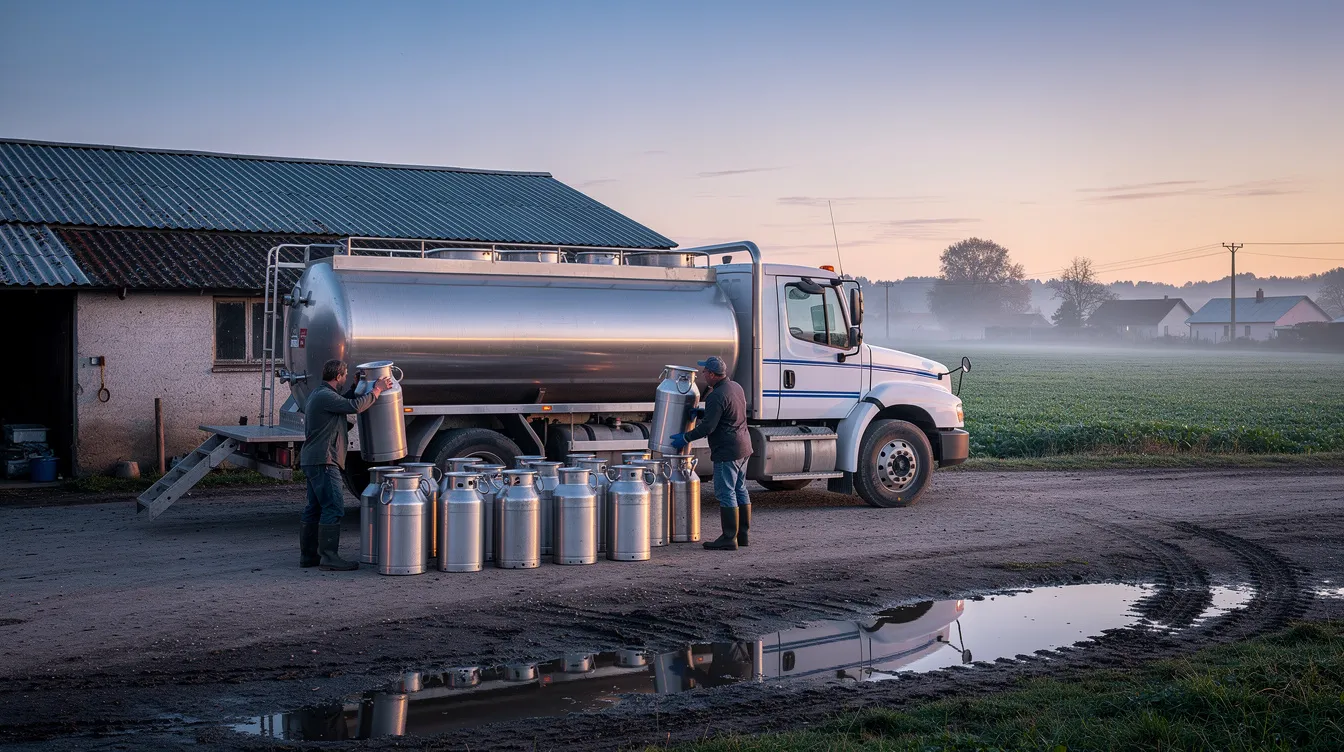
Raw milk availability within a realistic procurement radius is the most critical factor for any milk processing plant feasibility study. A feasibility study checks raw milk supply within 20–30 km as a primary zone, though in many Indian regions, procurement extends to 50–80 km with intermediate chilling infrastructure.
Assessment must include the number of villages, approximate cattle and animals in milk, average daily yield per animal, and competing dairy players or cooperatives in the catchment area. Local availability of raw milk ensures a consistent year-round supply from dairy farmers, but this must be verified through field work, not assumed.
Procurement infrastructure includes village-level collection centres, Bulk Milk Coolers (BMCs), milk cans, optimised collection routes, and milk testing equipment for fat, SNF, and adulteration checks. According to published BMC cost models, a 2,000-litre BMC unit costs approximately ₹11.80 lakh, while a 5,000-litre unit costs around ₹17.25 lakh.
Seasonal fluctuations in milk production between flush and lean seasons affect both procurement price and available volume. Fat and SNF levels also vary seasonally. Chilling raw milk to approximately 4°C within 2–3 hours of milking is the industry benchmark for maintaining quality. Feasibility studies must model milk procurement cost separately for different seasons and show how reduced arrivals affect capacity utilisation and revenue in lean months.
Market & Commercial Feasibility
A thorough market analysis includes target customer segments and competitor analysis. Analyzing demand for dairy products helps identify gaps in the market for pasteurised liquid milk, dahi, lassi, paneer, ghee, butter, cream, flavoured milk, cheese, and milk powder.
Realisation per litre of milk varies significantly depending on the dairy products produced. For context, the global UHT milk market was 130.97 billion litres in 2025 and is expected to reach 205.42 billion litres by 2034, indicating rising demand for processed dairy globally. UHT milk is heated to 135°C to 150°C during processing, requiring specialised equipment.
Feasibility studies must compare alternative product mixes. Distribution channels-own distribution within 50–100 km, wholesalers, institutional sales to hotels, restaurants, caterers and sweet shops, modern retail, and B2B bulk customers-each carry different margin profiles and working capital implications.
The competitive landscape and brand positioning, packaging formats (200 ml, 500 ml, 1 litre), shelf life, and trade margins to distributors must all be factored into the market feasibility assessment. Analysis of supply chain logistics is crucial for maintaining the quality of dairy products, particularly for perishable items.
Financial Feasibility
Financial feasibility brings together project cost, means of finance, projected revenues, operating expenses, EBITDA, profit after tax, and cash flows over 7–10 years. Financial viability includes calculations for capital expenditure and operational expenditure across the projection period.
Operational expenditures include costs for raw milk, utilities, labour, and packaging. In many dairy plants, raw milk accounts for 70–80% of operating costs, making procurement price the single largest variable cost driver. A dairy plant’s financial model must include projections for revenue and cash flows that reflect realistic capacity ramp-up assumptions.
Key indicators include break-even volume, gross margin per litre, EBITDA margin, cash profit, DSCR, ROI, and IRR. For instance, if a plant generates annual cash accrual of ₹2 crore against annual debt service (principal + interest) of ₹1.4 crore, the DSCR works out to approximately 1.43-generally considered acceptable by most lenders.
Working capital requirement-covering milk stock, packaging material inventory, finished goods, and trade receivables-must be estimated carefully. Underestimation creates liquidity stress even in an otherwise profitable dairy project. From a lender’s viewpoint, sustainable DSCR, realistic repayment schedule, and adequate promoter contribution are crucial tests of dairy plant financial viability.
Capacity Planning and Its Impact on Project Viability
Installing a 5 LLPD milk processing plant when only 1–1.5 LLPD milk is realistically procurable in the next three years leads to chronic underutilisation and heavy financial stress. Fixed costs-depreciation, interest, base utility charges, permanent staff-remain largely constant regardless of throughput.
Realistic capacity utilisation assumptions are essential: perhaps 40% in Year 1, 55% in Year 2, and 70% by Year 3, aligned with actual procurement development and market penetration plans. Per-litre processing cost reduces significantly as utilisation increases-for example, fixed cost absorption at 70% utilisation might be ₹3.5 per litre versus ₹6 per litre at 40% utilisation.
Feasibility studies should compare at least two capacity scenarios (say, 1 LLPD vs 2 LLPD) to test which scale gives a better balance between total capital investment, risk, and profitability. Promoters planning capacity decisions can refer to detailed guidance on dairy plant capacity planning for scenario-based evaluation approaches.
Milk Procurement Infrastructure and Raw Material Feasibility
Beyond assessing raw milk availability, feasibility studies must plan tangible procurement infrastructure: BMCs of 5,000–10,000 litre capacity at strategic locations, village collection centres with basic testing equipment, and reception docks at the dairy plant with weigh bridges and sampling systems.
Route planning-milk collection timings, transport vehicles (insulated tankers versus cans), and typical distances per route in Indian rural conditions-directly affects transportation costs and milk quality at reception. Cold chain logistics planning is essential to prevent spoilage in dairy processing.
Quality control at reception-testing for fat, SNF, temperature, and MBRT where applicable-determines the usable volume and commercial value of milk received. Procurement infrastructure cost must be included in overall project cost, not treated as an afterthought. For detailed infrastructure design guidance, refer to the specialised article on milk collection and procurement infrastructure.
Project Cost – Is the Proposed Investment Financially Justified?
Project cost for an integrated dairy plant includes land, site development, civil construction, plant and machinery, refrigeration, utilities, electrical installations, ETP, laboratory, cold storage, vehicles, preliminary expenses, contingencies, and working capital margin.
A small dairy processing plant costs approximately ₹20 to ₹30 lakhs for basic configurations, while a 5,000-litre-per-day plant requires approximately ₹4.81 crores total investment including civil work and utilities. For large-scale operations, a 3 LLPD plant benchmarks at approximately ₹80–85 crore total project cost.
Financial assistance is available through various schemes. NABARD offers 25% to 33.33% capital subsidy for dairy projects, available after project verification completion. The PMFME Scheme provides grants up to ₹10 lakhs for micro food processors. State-specific dairy schemes exist alongside central government programs under DIDF and AHIDF.
Contingencies of 5–10% and proper provision for pre-operative expenses and interest during construction must be included. Underestimating project cost leads to cost overruns, additional borrowing, and weaker DSCR, making even a commercially sound project appear unviable during bank appraisal.
Machinery Investment and Technical Feasibility
Selection of dairy processing machinery-automatic versus semi-automatic pasteurisation lines, pouch packing machines, paneer presses, ghee boilers, curd incubation systems-directly affects capital cost, energy consumption, manpower requirement, and product range capability. For a 5,000 LPD plant, basic equipment cost ranges from ₹50–90 lakhs, while smaller 1,000 LPD plants require approximately ₹15–35 lakhs.
Feasibility reports should compare alternative machinery configurations-indigenous versus imported equipment, manual versus hydraulic paneer pressing-to balance CAPEX with operational efficiency. Energy-efficient equipment, though slightly costlier upfront, can reduce operating cost significantly over a 10-year horizon, improving overall financial feasibility. Modern technology in automation (PLC/SCADA systems) increases CAPEX but lowers OPEX and improves consistency.
Machinery specifications must match projected product mix and future expansion plans. For deeper technical costing insights, refer to the detailed analysis of dairy processing plant machinery and equipment cost.
Land, Building and Infrastructure Feasibility
Land requirement depends on processing area, utility blocks, administrative building, laboratory, cold storage, vehicle movement, parking, future expansion space, and effluent treatment area. Location and infrastructure are important factors in assessing a dairy processing plant’s feasibility-proximity to the milk procurement area, access to target markets, labour availability, power supply reliability, water source, and road connectivity all matter.
Building design must support hygienic product flow with separation of raw and finished product areas, proper drainage, ventilation, and compliance with FSSAI and local food safety norms. Regulatory compliance includes necessary licenses and environmental clearances required for operations. For comprehensive site planning guidance, see the article on dairy plant land and building requirements.
Utility Requirements and Their Effect on Operating Cost
Utilities-electricity, water, steam, refrigeration, compressed air, and effluent treatment-constitute a significant portion of milk processing operating cost. Dairy processing requires approximately three litres of water per litre of milk processed. Power consumption varies by technology but typically ranges from 0.08–0.15 kWh per litre of milk processed in medium-scale plants.
Fluctuations in power tariff, diesel price for backup generators, and water charges across states like Maharashtra, Karnataka, and Rajasthan can meaningfully change operating margins. Environmental assessments include wastewater treatment requirements and emissions monitoring, and ETP operation is a notable recurring cost often neglected in early budgeting. For detailed utility planning, see the guide on dairy plant utility requirements.
Product Mix – One of the Biggest Drivers of Dairy Plant Viability
Processing 1,000 litres of milk entirely into pouched liquid milk might yield a gross margin of ₹3–5 per litre. The same milk, partially converted into paneer, curd, and ghee, can yield significantly higher aggregate margins. Paneer and ghee offer profit margins of 20 to 40 percent in most Indian markets. UHT milk processing plants have gross profit margins of 25–35%.
Feasibility studies should test at least 2–3 alternative product-mix scenarios-a “liquid milk heavy” model versus a “value-added heavy” model-and show impact on revenue, operating margin, working capital, and profitability. However, practical constraints like consumer demand development, cold chain requirement, distribution complexity, and product-specific seasonality may limit how aggressively value-added products can be pushed in the first 2–3 years.
For a comprehensive understanding of how product mix drives viability, refer to the dedicated article on dairy plant revenue model and product mix.
Financial Projections for Dairy Plant Feasibility
Realistic 7–10 year financial projections-Profit & Loss Account, Balance Sheet, and Cash Flow Statement-form the backbone of dairy processing plant financial analysis. Assumptions for plant capacity utilisation, milk procurement price, product-wise selling prices, processing losses, utility cost, packaging material, and manpower must flow logically into yearly revenue and operating cost estimates.
Fixed costs and variable costs must be separated clearly to properly analyse break-even volume and the impact of capacity utilisation changes on profitability. Projections should incorporate depreciation, interest on term loan, working capital interest, income tax, and potential subsidy inflows where applicable, with all figures declared as estimates based on current conditions.
Promoters seeking projection templates can refer to the detailed guide on dairy processing plant financial projections.
Working Capital Requirement and Operating Cycle
Even a profitable dairy plant on paper can face severe cash-flow problems if working capital is underestimated. The operating cycle involves daily cash outflows for milk procurement, weekly payments for packaging and utilities, build-up of inventory, and credit given to distributors and institutional buyers.
You need enough working capital for 3–4 months of operations to sustain business operations during stabilisation. For a 1,000 LPD plant with raw milk procurement at approximately ₹35 per litre, monthly raw milk cost alone runs to roughly ₹10.5 lakh, with total monthly OPEX approaching ₹12.5 lakh or more. Average holding levels for raw milk, finished goods, and trade receivables (typically 7–15 days) must be estimated and compared against supplier credit and bank working capital limits.
For detailed working capital assessment methods, see the article on dairy plant working capital requirement.
DSCR and Loan Repayment Capacity
DSCR is one of the most important indicators for lenders evaluating dairy project viability. It measures whether cash profits-after interest, tax, and adding back non-cash charges like depreciation-are sufficient to cover term loan instalments and interest.
A simple illustration: if annual cash accrual is ₹2 crore and annual debt service (principal repayment + interest) is ₹1.4 crore, DSCR equals approximately 1.43. Most banks expect minimum DSCR of 1.25–1.30 in early years. Accounting profit alone is not sufficient; feasibility studies must focus on actual cash generation.
Repayment schedules with reasonable moratorium periods aligned to project cash flows can improve DSCR, while over-aggressive repayment can make an otherwise sound dairy processing project appear unviable. For deeper DSCR analysis, see the guide on dairy project DSCR and loan repayment capacity.
Break-Even, ROI and IRR Analysis
Break-even point-expressed as litres of milk processed or percentage of plant capacity at which total cost equals total revenue-guides minimum sales targets. A 50,000 LPD plant might break even at 55–65% utilisation depending on product mix and cost structure.
ROI and IRR help promoters and investors judge project attractiveness relative to risk and alternative investment options. Net present value and payback period (for example, recovering initial investment by Year 5–7 under reasonable assumptions) provide additional decision-support. However, what constitutes “acceptable” returns depends on capital structure, cost of borrowing, promoter expectations, and milk supply stability in the target geography.
Banks use these indicators as part of broader appraisal, not as standalone approval criteria.
Sensitivity Analysis – Test the Project Before Investing
Dairy processing plant profitability is highly sensitive to changes in a few key variables. Risk assessment identifies potential risks such as supply chain disruptions and price volatility, and sensitivity analysis quantifies their financial impact.
Consider a 1 LLPD plant with projected EBITDA margin of 8%:
- A 5–10% increase in milk procurement price (the largest variable cost) can reduce EBITDA margin by 3–5 percentage points
- A 5% fall in average selling price due to competitive pressure can push DSCR below the bank-acceptable threshold of 1.2
- A 10% increase in project cost raises annual depreciation and interest burden, reducing ROI and IRR materially
- Implementation delays of 6–9 months increase interest during construction and shift revenue commencement, permanently affecting project IRR
Feasibility studies should prepare base-case, optimistic, and stress-case scenarios. Promoters must review sensitivity results carefully before finalising plant capacity, debt-equity ratio, and product mix strategy.
CMA Data and Bank Financial Assessment
In India, banks generally require CMA Data (Credit Monitoring Arrangement statements) along with DPR for term loan and working capital assessment of dairy processing plants. Standard CMA Data components include projected operating statement, balance sheet, current assets and current liabilities, fund flow statement, and key financial ratios like current ratio and TOL/TNW.
While DPR focuses on overall project feasibility, CMA Data presents structured financial information in the format specifically required by banks for working capital assessment. CMA Data should be consistent with feasibility study assumptions on capacity utilisation, sales, costs, and working capital cycles to avoid queries during bank appraisal.
For CMA formats and preparation guidance, refer to the dedicated resource on dairy processing plant CMA Data for bank loan.
How Banks Evaluate Dairy Processing Plant Viability
From a bank appraisal perspective, lenders evaluate dairy projects on multiple dimensions simultaneously:
- Promoter background: Experience in dairy production, food processing, or FMCG project execution
- Equity contribution: Typically 20–35% depending on project size and bank norms
- Project cost reasonableness: Cross-checked against industry benchmarks
- Milk procurement feasibility: Verified milk availability, not just assumptions
- Market potential: Demand validation for proposed product mix
- Profitability and DSCR: Conservative projections that survive stress scenarios
- Collateral and security: Where applicable
- Regulatory approvals: FSSAI license, Pollution Control Board NOC, building permits
Feasibility studies aligned to bank appraisal logic-realistic margins, conservative utilisation ramp-up, reasonable repayment-are more likely to clear credit committee scrutiny. For detailed bank-finance guidance, see bank loan and project finance for dairy processing plant.
Term Loan Appraisal of the Dairy Project
Term loan appraisal focuses on long-term funding for fixed assets-land, building, plant and machinery, utilities, and other capital expenditure. Lenders evaluate whether projected cash accruals after meeting operating expenses and working capital interest are sufficient to service term loan instalments with acceptable DSCR across all projected years.
Feasibility studies should propose a repayment schedule that aligns with anticipated cash flows and provides adequate moratorium for installation, commissioning, and stabilisation. For detailed guidance on term loan structuring, refer to dairy project term loan assessment.
Practical Dairy Plant Viability Checklist
Before finalising investment or approaching banks, promoters should verify:
- Milk procurement: Adequate and verified milk supply within feasible radius, with field data on villages, animals, and major competitors for raw milk
- Plant capacity: Realistic relative to assured milk availability and market demand-not aspirational
- Product mix: Clearly defined with tested market demand and realistic selling prices
- Project cost: Accurate estimation including procurement infrastructure, utilities, ETP, working capital margin, and 5–10% contingency
- Capital structure: Adequate promoter equity; conservative debt levels keeping DSCR comfortable
- Infrastructure: Land, building, cold storage, utilities, and cold chain ready or planned
- Regulatory compliance: FSSAI Manufacturing License (State FSSAI license needed for turnover below ₹20 crore), GST registration (mandatory after ₹20 lakhs turnover), State Pollution Control Board NOC, Local Body Trade License from municipal authorities, and Udyam Registration (takes about 10 minutes online and allows access to government subsidies for MSMEs). Licenses and permits are necessary for food processing operations and environmental compliance.
- Implementation timeline: Realistic schedule with buffer for construction and commissioning delays
- Sensitivity analysis: Base-case and stress-case scenarios tested
- Quality assurance: HACCP systems, testing protocols, and quality control processes planned
Common Reasons Dairy Processing Projects Become Financially Unviable
In my experience preparing dairy project reports and feasibility studies, most failing plants do not suffer from technology issues. The problems are almost always rooted in planning and financial-structuring mistakes.
Common pitfalls include:
- Installing over-sized capacity far exceeding realistic milk procurement in the first 3–5 years
- Overestimating milk availability without field verification of dairy farmers, cattle population, and existing competition
- Paying unsustainably high procurement prices to attract milk, eroding margins from day one
- Relying excessively on low-margin liquid milk without developing sufficient value-added dairy products
- Underestimating project cost, leading to cost overruns and additional unplanned borrowing
- Inadequate working capital planning-profitable on paper, cash-starved in practice
- Over-aggressive repayment schedules that leave no room for operational fluctuations
- Ignoring seasonality in both milk production and consumer demand
- Assuming 90–100% capacity utilisation from Year 1 without operational justification
- Neglecting maintenance, ETP operating expenses, and animal feed cost fluctuations affecting farmer economics
Promoters should treat feasibility studies as a tool to avoid these mistakes-not as a mere paperwork requirement for bank loan applications.
Feasibility Study vs DPR – What Does a Dairy Project Need?
A feasibility study answers: “Should we invest in this dairy project configuration at all?” A Detailed Project Report answers: “How exactly will we implement this selected project?”
A feasibility study may test multiple options-different capacities, locations, product mixes-to identify the most viable configuration. The DPR documents the finalised choice with detailed technical specifications, machinery lists, layout drawings, implementation schedule, and financial projections. In practical project-finance assignments for MSME dairy plants in India, feasibility analysis and DPR often overlap, but promoters must first be convinced of viability before spending on detailed engineering.
Banks usually rely on the DPR for sanction decisions, but a prior feasibility study helps ensure that the chosen DPR configuration is financially and commercially sensible. Collecting secondary data on market trends, industry trends, and consumer demand patterns strengthens both documents.
Role of a Chartered Accountant in Dairy Project Financial Feasibility
From the perspective of a practising Chartered Accountant, the CA’s role in dairy project feasibility is to provide independent, realistic financial appraisal-highlighting both strengths and risks-rather than guaranteeing bank sanctions or project success.
Key professional contributions include:
- Structuring project cost and means of finance with appropriate debt-equity balance
- Validating assumptions for milk procurement price, selling prices, and capacity ramp-up
- Preparing detailed financial projections including P&L, Balance Sheet, and Cash Flow
- Computing and analysing DSCR, break-even (BEP analysis), ROI, IRR, and net present value
- Assessing working capital requirement and operating cycle
- Preparing CMA Data aligned with DPR and bank appraisal expectations
- Designing repayment schedules compatible with projected cash flows
- Conducting sensitivity analysis across multiple scenarios
- Assisting with bank finance proposal preparation and documentation
ProjectReportBank.com, under CA Manish Gugliya, has experience in preparing dairy processing plant feasibility reports, DPRs, CMA Data, and bank finance documentation for projects across varying scales and Indian states.
Conclusion – Integrating Technical, Commercial and Financial Viability
The true viability of a dairy processing plant depends on the combined strength of milk procurement, capacity utilisation, product mix, market realisation, accurate project cost estimation, operating margins, working capital planning, and debt servicing capacity. No single ratio or assumption can substitute for this integrated evaluation.
A comprehensive dairy processing plant feasibility study is not just a bank document. It is a decision-making tool that allows promoters to refine project design, test assumptions under stress, and identify risks before committing substantial capital. In the Indian dairy industry context of 2025–2026, increasing competition, rising input costs, and growing demand for quality dairy products make rigorous feasibility studies and realistic financial projections more important than ever.
Promoters planning new or expansion dairy processing projects may seek professional assistance from CA Manish Gugliya and ProjectReportBank.com for preparation of feasibility studies, DPRs, financial projections, CMA Data, and bank loan documentation. Sound planning today determines whether the plant will produce milk profitably-or merely produce milk.
Frequently Asked Questions (FAQs)
These questions address practical doubts frequently raised by promoters during dairy processing plant feasibility assignments in India.
How long does it typically take to complete a dairy processing plant feasibility study in India?
A focused feasibility study for a small to mid-size dairy plant-say 50,000 to 200,000 LPD-usually takes about 4 to 8 weeks. The timeline depends largely on how quickly field data on milk availability, market demand, cost estimates, and infrastructure requirements can be collected and validated. Projects where promoters have already done preliminary groundwork on location, milk supply, and product range tend to move faster. Complex multi-product or multi-location studies may take longer.
What is the minimum economically viable capacity for a new dairy processing plant?
While very small plants of 500 to 2,000 LPD can work in niche local markets, many integrated plants become more competitive at 10,000 to 50,000 LPD or above due to better fixed-cost absorption and ability to support a diversified product mix. However, the “right” capacity ultimately depends on assured milk procurement from the catchment area, local demand for milk products, available capital investment, and the promoter’s ability to develop the market. This is precisely what the feasibility study should evaluate rather than relying on general benchmarks.
Can an existing dairy plant use feasibility studies for expansion decisions?
Yes. Existing dairies planning to add new product lines-such as cheese, UHT milk, or flavoured dairy-or increase processing capacity should conduct a focused feasibility study to test whether additional investment, product mix change, and higher working capital will generate sufficient incremental returns and maintain acceptable DSCR. Expansion feasibility differs from greenfield studies because it must account for existing operations, current utilisation levels, and incremental rather than total revenue impact.
What basic information should a promoter prepare before approaching a professional for a feasibility study?
Promoters should ideally have preliminary clarity on proposed location, tentative plant capacity, target product range, approximate access to raw milk (nearby villages, cooperatives, and animal husbandry data), existing or potential market outlets, and available own funds. Having even rough estimates of land availability, water source, and power supply helps the consultant build realistic scenarios quickly. The more detailed information the promoter can collect data on upfront, the faster and more accurate the feasibility study will be.
Is it mandatory to prepare a feasibility study before applying for a bank loan for a dairy plant?
There is no specific legal requirement mandating a formal feasibility study. However, most banks effectively expect DPRs and financial projections that reflect thorough feasibility analysis-covering market analysis, technical aspects, financial analysis, and sensitivity testing. Conducting a structured feasibility study significantly improves the quality and credibility of the bank loan proposal, and reduces the risk of queries or rejections during the bank appraisal process. In practice, the investment in a proper feasibility study pays for itself many times over by helping promoters avoid committing capital to projects that may not be financially viable.
📊 Operations & Financial Planning: Utilities | Revenue Model & Product Mix | Financial Projections | Working Capital | CMA Data | DSCR & Repayment Capacity
🏦 Bank Finance, Viability & Returns: Bank Loan & Project Finance | Term Loan Assessment | Feasibility & Viability | Break-Even Analysis | ROI, IRR & Payback | Sensitivity & Risk Analysis