Key Takeaways
Dairy cold chain requirements directly drive plant feasibility, profitability and bank finance eligibility for any value-added dairy project in India. A cold room is not merely a storage chamber-it is part of the production line, quality-control system and working-capital cycle.
- Cold storage sizing must be linked to product mix, daily throughput, shelf life, dispatch cycles and distribution radius. A plant producing paneer, curd, yogurt, lassi, cheese, butter, probiotic drinks and dairy desserts cannot use a single cold room at one temperature for everything.
- Cold storage for dairy products is essential to prevent financial losses-incorrect capacity planning (under-sized or over-sized) leads either to product losses and market returns or to unnecessary capex and electricity cost that erode EBITDA.
- A bankable DPR must quantify cold-room capacity, refrigeration load, electricity demand, reefer logistics and their impact on project cost, working capital and profitability.
- Maintaining a strict cold chain inhibits bacterial growth and preserves both safety and nutritional value across the dairy supply chain.
- All temperature ranges and costs discussed in this article are indicative for Indian industrial conditions. Final design must follow product formulation, packaging specification, FSSAI norms and detailed engineering.
Introduction: Why Cold Storage Is Central to Value-Added Dairy Projects
In the context of Indian value-added dairy plants manufacturing paneer, curd, yogurt, lassi, cheese, butter, probiotic beverages and dairy desserts, cold storage and cold chain infrastructure are not supporting utilities that can be decided after machinery selection. They are core to plant design, production capacity and commercial viability. Dairy items like raw milk and ice cream require specific temperature thresholds during transport, and milk can spoil within a few hours without refrigeration. Cold chain logistics extends the shelf life of dairy products from hours to days or weeks, making it the single most important post-processing investment in a value-added dairy project.
Small temperature deviations destroy value rapidly. If curd is held at 12°C instead of 4°C for six to eight hours, psychrotrophic bacteria multiply, lactic acid production accelerates, whey separation begins, and the product sours beyond consumer acceptance. Paneer loses freshness and develops off-odours. Yogurt turns grainy. These are not hypothetical scenarios-they are daily realities in plants where cold chain management in dairy industry operations is treated casually. Every such failure converts into distributor returns, brand damage and financial loss.
Cold storage connects directly with commercial variables: shelf life determines market radius (a local city vs 300–500 km interstate), dispatch frequency (daily vs alternate-day) dictates how many days of stock sit in cold rooms, and distributor stocking policy determines how many working-capital days are locked in finished goods. India’s cold storage capacity is insufficient for its milk production, making it even more critical for individual plants to get their own infrastructure right.
The dairy cold chain is an unbroken temperature-controlled sequence from packaging line to finished-goods cold room, through the dispatch bay, into the reefer vehicle, through the distributor cold room, to the retailer and finally the consumer. A breakage at any node converts into spoilage, contamination risk and revenue loss. Throughout this article, the perspective is that of a practising Chartered Accountant and DPR consultant, focusing on bankability, project feasibility and realistic cold storage requirements for value-added dairy products in India.
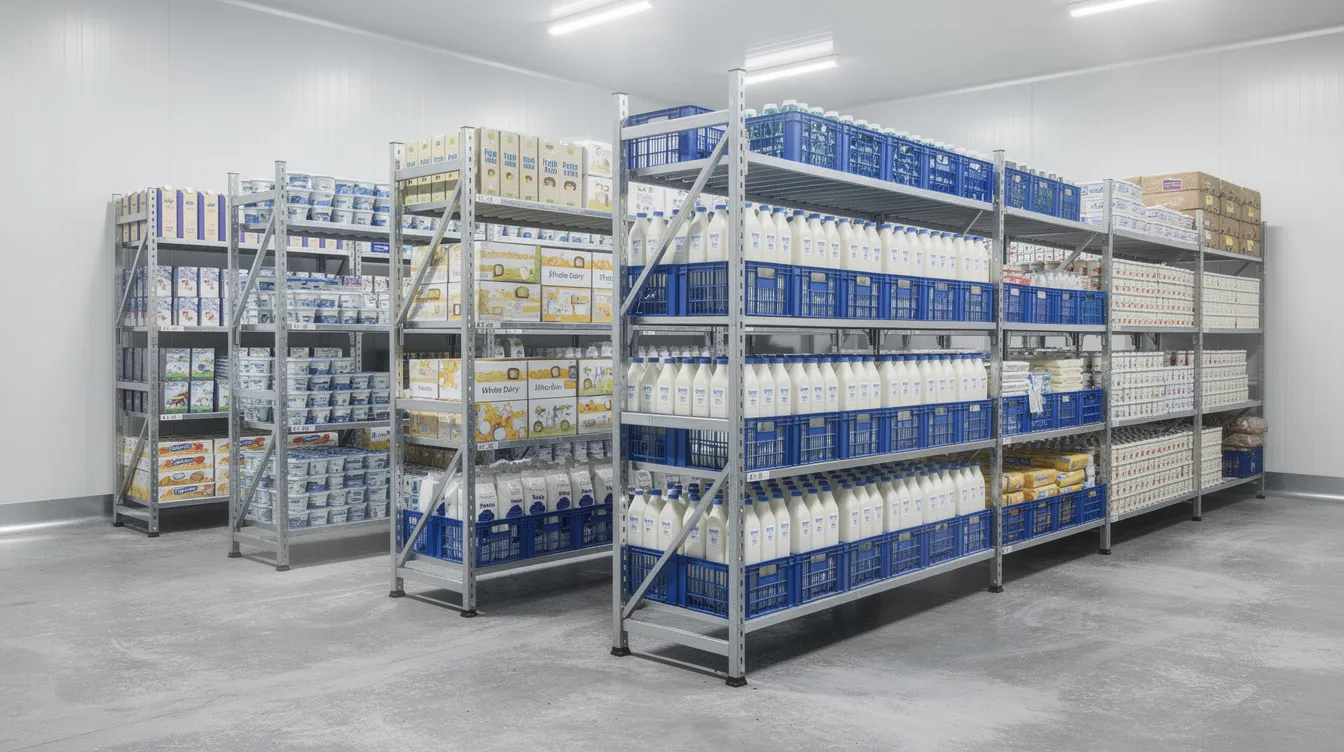
Why Cold Chain Is Commercially Critical for Value-Added Dairy Products
Value-added dairy products carry higher realisation per litre of milk than commodity liquid milk, but they are far more sensitive to temperature abuse. Refrigeration slows bacterial growth in dairy products significantly, and without it, the premium margins that justify investment in processing infrastructure simply evaporate. Temperatures above 4–6°C allow rapid growth of spoilage organisms, and inadequate refrigerated storage leads directly to bacterial contamination risks.
The mechanisms of failure are specific and measurable:
- Uncontrolled bacterial growth-especially psychrotrophic bacteria-causes souring, gas formation and bloating of cups and pouches.
- Physical changes such as whey separation in dahi, grainy texture in yogurt, crumbling paneer, rancidity in butter and textural breakdown in cheese and dairy desserts.
- Packaging deformation and leakage due to gas production and thermal expansion.
Poor cold chain for dairy products translates into direct P&L impact:
- Frequent distributor disputes and stock returns that consume management time and erode trust.
- Higher unsaleable stock written off near expiry dates.
- Increased free-replacement schemes that erode gross margins by 2–5% of revenue.
- Difficulty in achieving projected sales volumes assumed in DPR and CMA data submitted to banks.
- Higher quality complaints, potential FSSAI non-compliance, and insurers questioning product-liability claims after documented temperature excursions.
Product-Wise Cold Storage Requirements & Indicative Temperatures
Dairy products require specific temperature ranges for optimal storage, and cold storage requirements for value-added dairy products differ by product, process, packaging and desired shelf life. Cold storage extends the shelf life of yogurt and cheese, while products like paneer and dahi have far narrower windows. The following table is indicative-final design must follow product specifications, lab validation and applicable regulations.
| Product | Storage Category | Indicative Temp Range | Shelf-Life Sensitivity | Key Cold-Chain Consideration |
|---|---|---|---|---|
| Paneer (fresh) | Chilled | +2°C to +4°C | Short (5–15 days) | Rapid cooling post-pressing |
| Curd / Dahi | Chilled | +4°C to +8°C | Short (7–15 days) | Quick transfer from incubation |
| Set & Stirred Yogurt | Chilled | +2°C to +6°C | Medium (10–30 days) | Avoid post-acidification |
| Greek Yogurt | Chilled | +2°C to +4°C | Medium (10–21 days) | Strict temp for texture |
| Probiotic Yogurt/Drinks | Chilled | +2°C to +4°C | High (culture viability) | Maintain live culture counts |
| Lassi | Chilled | +4°C to +8°C | Medium (10–30 days) | Prevent flavour deterioration |
| Flavoured Milk/Beverages | Chilled | +2°C to +6°C | Medium (7–21 days) | Packaging-dependent |
| Pasteurised Milk | Chilled | +2°C to +4°C | Short (3–7 days) | Continuous chain essential |
| Butter (short-term) | Chilled | +2°C to +4°C | Medium | Oxidation protection |
| Butter (long-term storage) | Frozen | −18°C to −20°C | Low when frozen | Avoid freeze–thaw cycles |
| Processed Cheese Blocks | Chilled | +2°C to +4°C | Low (up to 9 months) | Proper barrier packaging |
| Mozzarella / Pizza Cheese | Chilled/Frozen | +2°C to +4°C or −18°C | Medium | QSR contracts need consistency |
| Dairy Desserts (shrikhand, mousse) | Chilled | +2°C to +6°C | Medium–High | Validate per formulation |
| Ice Cream / Frozen Desserts | Deep-frozen | −20°C or below | High (texture) | Avoid heat-shock cycles |
| Fresh Milk | Chilled | 0°C to +4°C | Short | Store immediately |
- Probiotic dairy products need tighter temperature control because viable cell counts decline faster above +6°C, and label claims of specific CFU counts through expiry become commercially unenforceable if the cold chain breaks.
- Paneer cold storage requirements often demand faster cooling and shorter holding than hard cheese-NDDB technical guidelines indicate paneer stored at +4°C with improved packaging can last approximately 45 days, while frozen paneer at −18°C extends to six months.
- Cheese cold storage requirements differ between processed blocks (which may hold 9 months in barrier packaging at +4°C) and high-moisture mozzarella used by QSR customers, which is far more sensitive to temperature fluctuation.
- Even within “yogurt,” yogurt cold storage temperature may vary between standard yogurt, Greek yogurt and flavoured yogurt based on solids content, culture mix and packaging format. Pasteurised liquid milk must be maintained consistently between 2°C and 4°C.
Chilled Storage vs Frozen Storage for Dairy Products
Dairy cold storage temperature requirements broadly fall into two groups-chilled (above 0°C) and frozen (typically −18°C or below). Wrong categorisation inflates either capex or wastage. Maintaining correct temperatures throughout the cold chain is critical to safety and quality, and frozen dairy must remain at or below −18°C to avoid texture damage.
Chilled storage for dairy products:
- Typical range 0°C to +8°C depending on product.
- Used for paneer, curd, yogurt, lassi, flavoured milk, processed cheese, table butter for short holding and dairy desserts.
- Operational aspects include frequent door openings, fast turnaround and compatibility with manual crate handling common in Indian dairy plants.
Frozen storage for dairy products:
- Temperatures around −18°C to −25°C for butter bulk blocks, mozzarella, certain cheese types, frozen paneer and frozen desserts. Butter requires freezing at −18°C to −20°C for long-term storage, and ice cream requires deep-freeze conditions at −18°C or lower during transport.
- Higher refrigeration load, thicker PUF/PIR insulation (100–150 mm vs 60–80 mm for chilled rooms), insulated floor with vapour barrier and heavier doors.
- Extended shelf life (3–12 months) but higher energy and capex compared to chilled storage.
Where applicable, blast-freezing or rapid chilling from approximately +30°C to +4°C (for paneer, yogurt cups, dairy desserts) is commercially justified because short pull-down time reduces bacterial growth and effectively doubles usable shelf life in distribution. The DPR should justify each frozen-storage investment-whether for seasonal milk-flush balancing, export-oriented products or specific B2B contracts requiring long shelf life.
Cold Storage Capacity Planning Linked to Plant Capacity & Dispatch Cycles
Dairy cold storage capacity planning must be done alongside overall plant capacity planning and product-mix decisions, not after purchasing processing machinery. Cold-room capacity, when determined as an afterthought, almost always results in either a bottleneck or an over-investment. Promoters should study Value-Added Dairy Plant Capacity Planning & Product Mix before freezing cold-room specifications.
Key drivers of cold room for dairy products capacity include:
- Daily and peak-season production (kg or litres per product).
- Average storage days in plant before dispatch-different for paneer (1–2 days), curd (2–3 days), yogurt (3–4 days), lassi (1–2 days), cheese (7–30 days) and butter (15–60 days frozen).
- Dispatch frequency: daily dispatch needs less storage than once-in-three-days dispatch.
- Distribution radius: local city vs 200–300 km vs interstate 800–1,000 km.
- Palletisation or crate-based stacking pattern with required aisles for forklifts or hand pallets.
- Separation needs for different temperature zones or odour-sensitive products.
Indicative calculation example: Assume a 20,000 litres/day plant producing 6,000 kg curd, 3,000 kg yogurt, 1,500 kg paneer and 3,000 litres lassi. Product-wise daily volume × average holding days: curd 6,000 × 2 = 12,000 kg; yogurt 3,000 × 3 = 9,000 kg; paneer 1,500 × 1 = 1,500 kg; lassi 3,000 × 1.5 = 4,500 litres. Apply a storage factor of 1.4–1.6 to convert kg into cold-room volume considering crate size, stacking height and aisle space.
Litre-to-cubic-metre direct conversion is misleading because:
- Air circulation gaps around racks consume 15–25% of room volume.
- Crate stacking height is limited by product damage risk and manual handling.
- Space near doors, under evaporators and in corners is not usable for storage.
- Quarantine or hold stock area for quality-control sampling and buffer for rejected or near-expiry stock must not block regular dispatch operations.
Impact of Product Mix on Cold Storage Zones & Design
A diversified value-added dairy plant producing paneer, curd, yogurt, lassi and butter usually requires multiple temperature zones or separate rooms. Different dairy products require distinct thermal zones during transit and storage, and this choice affects refrigeration load, insulation and internal logistics.
- A plant making paneer, dahi and lassi can mostly operate with a common chilled room at +2°C to +6°C, but may need segregation between unflavoured and strongly flavoured products to prevent odour transfer.
- Adding Greek yogurt and probiotic products may require tighter control at +2°C to +4°C with minimal temperature fluctuation.
- Butter and frozen mozzarella need a separate frozen room at −18°C with thicker floor insulation. Butter and cheese are transported at chilled conditions or frozen depending on storage needs.
- High-value dairy desserts in glass jars might need a separate area to avoid damage from crate movement.
- Cold storage zoning must be finalised in parallel with capacity and product-mix strategy, as detailed in the guidance on dairy plant capacity planning and product-mix decisions.
- Product-mix changes influence the number of evaporator units, defrost strategy (electric vs hot-gas) and its effect on temperature stability, and SKU-wise inventory holding days that drive working-capital needs.
- Shifting product mix after commissioning-for example, adding frozen pizza cheese later-typically requires additional cold chain infrastructure, which should be planned at DPR stage to avoid disruptive retrofits.
Cold Storage Layout & Integration in the Dairy Processing Plant
Cold storage layout is part of overall dairy plant layout and hygienic zoning. Poor layout increases handling time, labour cost and product exposure to higher temperatures. Dairy products need 85% to 90% relative humidity for optimal storage, and layout design must facilitate this.
- Processing and pasteurisation area leading to filling and packing machines.
- Immediate transfer through a short, covered and preferably temperature-controlled corridor into the finished goods cold room.
- Dedicated dispatch bay or ante-room at controlled temperature where loading into refrigerated or insulated vehicles occurs.
- Separate small cold room for raw materials like cream, butter blocks, cultures and certain ingredients.
- QC hold area for samples and suspect batches.
- Returns or rejected-stock room so that market returns do not mix with fresh finished goods. Regular cleaning of cold rooms is essential to prevent contamination.
- Readers should refer to Value-Added Dairy Plant Land, Building, Utilities & Hygienic Layout for broader guidance on integrating cold rooms within overall plant building and utility planning.
- Layout decisions-location of machine room, distance of refrigeration piping, height of cold rooms-also affect project cost, future expansion possibilities and energy efficiency.

Refrigeration System & Load Calculation for Dairy Cold Storage
The industrial dairy refrigeration system must be designed based on refrigeration load (TR or kW), not only on cold-room dimensions. Cold chain systems for dairy products rely on maintaining a precise temperature range, and correct sizing of compressors, condensers and evaporators for Indian summer conditions (ambient 40–45°C in many states) is critical.
Main components in a typical dairy plant cold storage system:
- Compressors (reciprocating or screw) sized for both chilled and frozen loads.
- Condensers (air-cooled or evaporative) placed to handle peak ambient temperatures.
- Evaporator units inside each cold room with proper air throw and defrost arrangement.
- Expansion valves, refrigeration piping, receiver vessels and oil management.
- Insulated panels, cold-room doors with proper gaskets, and door heaters for sub-zero rooms.
- Control panels, PLC or basic controllers, temperature and pressure sensors, safety cut-outs.
Major components of refrigeration load calculation:
- Product load: cooling product from filling temperature to storage temperature (often the largest single component).
- Transmission load through walls, ceiling and floor due to ambient conditions.
- Infiltration load from door openings, people movement and forklifts.
- Internal loads from lighting, fans and equipment inside the room.
- Pull-down load when fresh production enters within a few hours.
Indicative example: If 10,000 kg/day of mixed dairy products enters the cold room at +20°C and must be brought to +4°C within six hours, the product load alone (considering specific heat of dairy products around 3.5 kJ/kg·°C) generates a substantial TR requirement. Engineering consultants will refine exact tonnage after factoring in all load components and safety margins.
- Under-sized units cause temperature swings, partial freezing near evaporator outlets and rejected batches.
- Over-sized units increase capex, electricity bills and may run inefficiently at part load, reducing project IRR.
Cold Room Insulation, Temperature Monitoring & Power Backup
Insulation quality, control systems and uninterrupted power supply are as important as compressor capacity in meeting dairy cold storage requirements and controlling operating costs.
Insulation and cold-room construction:
- PUF/PIR insulated panels with appropriate thickness: 60–80 mm for chilled rooms, 100–150 mm for frozen rooms considering local climate.
- Vapour barriers, proper sealing of joints and avoidance of thermal bridges at steel columns and ceiling supports.
- Floor insulation and vapour barriers under frozen rooms to prevent condensation and structural damage.
Temperature monitoring and control:
- Calibrated digital sensors in representative locations, not just near evaporators.
- Continuous data logging with alarms for high and low temperature excursions. Real-time data loggers and IoT-based sensors are used to track internal temperatures continuously, and smart cold chain systems use real-time data transmission to central monitoring dashboards.
- Temperature monitoring and data logging ensure traceability and compliance. Written or electronic records form part of FSSAI, HACCP or ISO 22000 documentation.
- Corrective-action procedures when limits are breached-hold, segregate and evaluate affected lots.
Power backup for dairy cold storage:
- Frequent power outages disrupt stable cooling conditions in rural areas and semi-urban industrial parks across India. DG sets sized for essential refrigeration compressors, pumps and control systems are non-negotiable.
- Automatic changeover panels and sequencing to prevent compressor damage on power restoration.
- Planning modest thermal buffer-tighter door discipline, higher insulation, pre-cooling before scheduled outages-instead of oversizing generators excessively.
- Lenders take comfort when DPRs mention robust insulation, monitoring and backup plans because they directly reduce risk of spoilage and revenue underperformance.
Cold Chain Beyond the Plant: Dispatch, Reefer Vehicles & Distribution Radius
Meeting dairy cold storage requirements inside the plant is only half the job. Cold chain during dispatch, transport and distributor storage is equally critical for products with 7–30 day shelf life. Refrigerated transport is essential for dairy supply chain efficiency, and effective cold chain management reduces dairy product wastage significantly.
Dispatch and loading practices:
- Using pre-cooled vehicles for dairy transport is essential to prevent temperature spikes. Never load warm paneer or freshly packed dahi into a reefer expecting the vehicle to cool it down.
- Minimise loading duration and keep dock temperature as low as practical.
- Use strip curtains or dock shelters at dispatch bays. Refrigerated vehicles must maintain target temperatures even during extreme conditions.
- Vehicles used in dairy transport require proper internal insulation and airflow design. Cold chain transport of dairy products is about keeping products within their validated temperature range.
Reefer vehicle requirement:
- Criteria for deciding between owned reefers vs contracted refrigerated logistics based on daily dispatch volume, route stability, distance and control needs.
- Options include small insulated vans with eutectic plates for local city distribution vs 20–30 ft reefers for regional or interstate supplies.
- Hub-and-spoke models where one main reefer feeds multiple smaller insulated vehicles. Refrigerated logistics also enable direct-to-consumer dairy sales in premium segments.
Distribution radius and shelf life relationship:
- For products like paneer and dahi with 7–10 day shelf life, long routes beyond 300–400 km leave very little selling time at retailer level.
- One extra day lost in non-refrigerated or poorly refrigerated transit can convert into 5–10% wastage at retail.
- Distribution strategy (local, regional, national) must be aligned with formulation, packaging and cold chain strength.
- Promoters should reflect actual transport choices and cold chain logistics for value-added dairy products explicitly in DPR assumptions, rather than simply assuming “reefer trucks” without costing them.
Energy Consumption, Utilities & Operating Cost of Dairy Cold Storage
The refrigeration system for a dairy plant is usually one of the largest electricity consumers, often 30–50% of total connected load in a value-added dairy project in hot Indian climates. High energy costs hinder cold storage and transport efficiency, making energy planning a profitability driver.
Key factors influencing energy consumption:
- Ambient temperature and humidity-hotter states like Rajasthan, Gujarat and Telangana have higher kWh per tonne of product cooled.
- Quality and thickness of insulation, especially for roof and west-facing walls.
- Compressor technology: older reciprocating vs efficient screw compressors with variable-speed drives where justified. AI optimizes cold chain efficiency for dairy logistics in modern installations.
- Door-opening discipline and extent of air infiltration during loading and unloading.
- Product incoming temperature and rate of production; sudden large hot loads demand more power in short bursts.
Potential energy-efficiency measures:
- Select energy-efficient compressors, fans and pumps with attention to life-cycle cost, not only purchase price.
- Use floating condensing pressure and proper condenser maintenance to reduce power consumption.
- Install automatic door closers, air curtains or strip curtains. Cold chain technology reduces dairy spoilage significantly when combined with operational discipline.
- Plan heat recovery from compressors for process hot water where technically and economically viable.
Utilities and infrastructure must include adequate sanctioned load, transformer capacity, panel sizing and earthing. Machine rooms need ventilation, safe access, drainage, condensate removal and fire-safety provisions. Energy costs must be explicitly modelled in DPR financial projections-for broader machinery and power-cost context, refer to Value-Added Dairy Plant Machinery & Equipment Cost.
Cold Storage & The Dairy Manufacturing Process Flow
Cold storage fits into the typical process sequence: pasteurisation and standardisation → fermentation or processing → filling and packing → secondary packing → cooling or setting → finished-goods cold room → dispatch. Raw milk must be chilled to 4°C or below within two hours of milking at collection centres, and many dairy-producing regions still lack adequate chilling centres for this purpose.
- Curd/Dahi: Incubation at 40–45°C until desired acidity, then rapid transfer to chilling room. Fresh milk should be stored at 0°C to 4°C before processing.
- Yogurt and Greek yogurt: Fermentation in cups or tubs followed by controlled cooling and storage at 2–6°C.
- Paneer: Hot block pressing followed by rapid cooling in chilled water or cold room before cutting, packing and final chilled storage.
- Lassi and flavoured milk: Pasteurisation (or UHT as per process), filling, then chilled storage till dispatch.
- Cooling time and set time (6–8 hours for dahi setting) affect the number of crates in intermediate rooms vs finished goods cold room. These timings must be considered when calculating total refrigeration load and storage area.
- Readers should study the Value-Added Dairy Products Manufacturing Process & Production Line to align cold chain planning with each processing step.
- Poor synchronisation between production scheduling and cold-room availability leads to bottlenecks, increased labour overtime and forced compromises on cooling profiles that damage product quality and freshness.

Product-Specific Cold Chain Considerations
While overall principles are similar, certain value-added dairy items have distinct cold-chain sensitivities that affect both technical design and project economics. Below are targeted considerations for the most common products in Indian value-added dairy plants.
Paneer Cold Chain Requirements
Paneer is a high-moisture, low-shelf-life product. Ideal storage is typically at +2°C to +4°C, with maximum holding of a few days for fresh, non-frozen paneer in Indian markets. The product is consumed widely and commands strong margins, but those margins vanish quickly if temperature control fails.
- Rapid cooling from approximately 70–80°C after pressing to below 10°C within 2–3 hours is critical to control bacterial growth and maintain taste and texture.
- Hygienic handling, clean crates and avoidance of direct floor contact are essential. Paneer is one of the most complained-about products in distributor return data.
- Frozen paneer (around −18°C) is viable for institutional or export markets, requiring separate frozen storage and higher energy cost. For detailed feasibility considerations, refer to the Industrial Paneer Manufacturing Plant Project Report.
Curd / Dahi Cold Chain Requirements
Curd is typically incubated at elevated temperature (around 40–45°C) until desired acidity is achieved, then must be chilled and maintained at approximately +4°C to +8°C to stabilise texture and flavour.
- The DPR must plan both incubation-room capacity and finished-goods chilled storage capacity, as these are interdependent.
- Inadequate cooling or intermittent warm periods cause excessive souring and whey separation-both are leading causes of market returns.
- FEFO inventory management is critical due to 7–15 day typical shelf life in Indian retail. The Curd / Dahi Manufacturing Plant Project Report covers detailed project economics.
Yogurt and Greek Yogurt Cold Chain
Set yogurt, stirred yogurt and Greek yogurt have different processing sequences but share a need for consistent chilled storage at +2°C to +6°C. Greek yogurt’s premium positioning makes margin sensitivity to cold-chain failures especially high. Yogurt must be kept at 4°C or lower to prevent culture breakdown and post-acidification.
- Tighter temperature control is required to maintain smooth texture and prevent syneresis.
- Higher solids and protein in Greek yogurt make it particularly prone to textural changes if temperature fluctuates even by 3–4°C for a few hours.
- Well-designed cup-incubation and cooling areas are often needed separately from the main finished-goods cold room. Promoters evaluating yogurt-focused projects should review the Industrial Yogurt Manufacturing Plant Project Report and the Greek Yogurt Manufacturing Plant Project Report.
Probiotic Dairy Products Cold Chain
Probiotic yogurts and drinks are sensitive to temperature because viable cell counts reduce faster at elevated temperatures. The typical recommendation is to maintain 2–6°C across the entire cold chain, from production through retail.
- Continuous cold chain management is crucial if label claims mention specific CFU counts through expiry. A break in the chain does not just affect quality-it potentially creates a regulatory and legal issue.
- Careful selection of distribution partners and reefer logistics is especially important for long-distance urban markets where consumers pay premium prices based on label promises.
- The Probiotic Dairy Products Manufacturing Plant Project Report addresses feasibility, DPR preparation and cold-chain planning for this category.
Lassi and Flavoured Dairy Beverages
Lassi and flavoured milk beverages are usually filled at elevated temperature and cooled to about +4°C to +8°C. They have moderate shelf lives (often 10–30 days depending on process and packaging) and are frequently sold in PET bottles, pouches or cups.
- Lassi cold chain requirements demand that products be transported and merchandised chilled in most Indian climates, where ambient temperatures routinely exceed 35°C.
- Repeated temperature abuse affects flavour stability, carbonation (where applicable) and consumer repeat-purchase behaviour.
- Special attention is needed for glass bottles or carton packs requiring careful stacking and crate design. For investors considering lassi-focused units, the Industrial Lassi Manufacturing Plant Project Report provides relevant project economics.
Inventory Management, Losses & Working Capital in Dairy Cold Storage
Cold storage for dairy products is also a financial store of inventory. Days of stock on hand directly translate into working-capital requirement and potential wastage if sales lag behind projections. Cold storage is essential to prevent financial losses in dairy production, and good practices in dairy cold chain include FIFO stock rotation and limiting time outside refrigeration.
- FIFO (First In, First Out) and FEFO (First Expiry, First Out) are essential in high-SKU dairy product portfolios. FIFO rotation minimizes waste by using older stock first, and FEFO ensures shortest-dated products move out before longer-dated ones.
- Batch-wise tracking, expiry-date monitoring and traceability are necessary for quick recalls and minimising wastage of perishable foods.
- Rejected, damaged or returned stock must be managed separately with realistic salvage or destruction policies.
Cold-chain losses and wastage arise from temperature excursions, power failures, long distribution routes, poor retailer refrigeration, packaging failures, delayed dispatch, improper loading and excess inventory. Even 2–3% product loss at MRP level can wipe out a significant portion of operating margin for a value-added dairy plant.
Simple numerical illustration: Assume finished goods inventory valuation of ₹1.5 crore at any point for a mid-sized plant. If the plant holds 3 days of stock, the inventory is approximately ₹65 lakh. If holding increases to 7 days, inventory rises to approximately ₹1.5 crore-the additional ₹85 lakh attracts interest cost (say 10–12% p.a.) of ₹8.5–10 lakh annually and increases bank working-capital limit requirement. Promoters must incorporate realistic inventory days and loss percentages in DPR and CMA data rather than ideal zero-loss assumptions.
Cold Storage Machinery Cost, DPR Integration & Bank Finance Perspective
Dairy cold storage machinery cost and cold chain infrastructure cost are a significant portion of overall dairy refrigeration plant project cost. Bankers expect explicit treatment of these items in Detailed Project Reports, and vague one-line entries for “cold storage” do not inspire confidence.
Major capex components include:
- Insulated cold rooms (panels, doors, floor insulation).
- Industrial dairy refrigeration system (compressors, condensers, evaporators, valves, piping, controls).
- Electrical panels, cabling, starters and VFDs where applicable.
- Material-handling equipment (racks, pallets, hand pallets, forklifts).
- Backup generators and associated electrical works.
- Reefer vehicles or contracted cold-chain deposits.
No single “per tonne” cost applies because of substantial variation with plant capacity (10,000 vs 1,00,000 litres per day), chilled vs frozen rooms, number of zones, automation level, local ambient conditions, electricity tariffs and equipment brand. Readers wanting broader cost guidance should refer to Value-Added Dairy Plant Machinery & Equipment Cost.
From a bank-lending perspective:
- Lenders examine whether proposed cold storage capacity matches projected production and sales ramp-up.
- They check that electrical load and DG backup for refrigeration are considered in project cost.
- They expect realistic working capital reflecting finished-goods holding and credit terms, not optimistic assumptions ignoring cold-storage inventory.
- They review whether spoilage and wastage allowances are built into projections at conservative levels.
Common Cold Storage Planning Mistakes in Dairy Projects
Many dairy projects in India face post-commissioning issues because cold storage was treated as a small ancillary room rather than a critical capacity centre and a significant portion of the plant’s production system.
- Finalising cold room size only after main processing machinery is ordered, leading to space and capacity mismatch.
- Ignoring peak-season milk availability and festival-demand spikes while sizing storage.
- Calculating room size purely on litres produced without allowing for crates, racks, aisles and air circulation.
- Assuming a single controlled temperature will suit paneer, curd, probiotics and butter alike.
- Providing insufficient door width and number of doors, causing queues and temperature rise during loading.
- No backup refrigeration or DG set for compressors, leading to major losses during outages.
- No temperature logging or alarm system, making it impossible to prove product was stored correctly during quality disputes.
- Oversizing storage, which results in under-utilised space, higher capital cost and higher electricity per kg stored.
- Promoters should review cold-chain design with both process engineers and financial advisors at DPR stage so that mistakes are corrected on paper rather than after construction.
Illustrative Example: Planning Cold Storage for a Mid-Sized Value-Added Dairy Plant
This is an illustrative example for understanding only, not a design recommendation.
Consider a hypothetical 30,000 litres/day plant in North India producing 10,000 kg curd, 5,000 kg yogurt (mix of set and stirred), 2,000 kg paneer, 6,000 litres lassi and flavoured milk, and 1,000 kg butter from cream (stored frozen). India is the world’s largest producer of milk, and such a mid-sized plant represents a common investment profile.
Product-wise storage estimation:
- Curd: 10,000 kg/day × 2 days holding = 20,000 kg
- Yogurt: 5,000 kg/day × 3 days holding = 15,000 kg
- Paneer: 2,000 kg/day × 1 day holding = 2,000 kg
- Lassi/beverages: 6,000 litres/day × 1.5 days = 9,000 litres
- Butter (frozen): 1,000 kg/day × 20 days = 20,000 kg
Applying a storage factor of 1.5 (accounting for crate dimensions, stacking height, aisles and air gaps), the chilled storage requirement for the non-frozen products is approximately 46,000 kg equivalent converted to roughly 70–80 m³ of cold room space. The frozen butter room at −18°C would need approximately 25–30 m³ separately.
Two chilled rooms-one for paneer, curd and yogurt, and another for lassi and beverages-plus one frozen room for butter are more practical than one very large multi-use room. For 200–300 km distribution radius, dedicated reefer vehicles may be justified for daily dispatch, while contracted reefers may suffice during ramp-up. This structured planning flows directly into DPR chapters covering technical description, project cost, utilities, production plan, sales projections, working capital and profitability analysis. India’s dairy industry depends on such careful planning from farm to consumer.

Cold Chain Planning Checklist for Value-Added Dairy Projects
- Product list (paneer, dahi, yogurt, Greek yogurt, probiotics, lassi, cheese, butter, dairy desserts) is finalised.
- Storage temperature band and shelf life for each product are identified and validated.
- Daily and peak-season production volumes are estimated for each product.
- Average and maximum finished-goods holding days are defined based on dispatch cycles and distribution radius.
- Cold-room capacity (chilled and frozen) is calculated using realistic crate/pallet dimensions and aisle requirements.
- Refrigeration load assessment is completed considering ambient conditions, pull-down time and door openings.
- Insulation specification (panel thickness, floor insulation, vapour barriers) is finalised for each room type.
- Temperature monitoring, logging and alarm systems are included in capex.
- Power backup strategy for cold storage is defined and costed (DG sets, automatic changeover).
- Reefer logistics (owned vs outsourced) are aligned with market geography and product shelf life.
- Cold storage opex (power, maintenance, labour) and product losses are included in financial projections.
- Inventory levels in cold storage are reflected in working-capital estimates for bank finance.
- Price fluctuations for energy and transport are stress-tested in projections.
FAQs on Dairy Cold Chain Requirements for Value-Added Products
The following questions address practical concerns that entrepreneurs and lenders frequently raise beyond the core topics covered above.
How early in a value-added dairy project should cold storage planning begin?
Cold storage and cold chain planning must start at the same stage as product-mix and plant-capacity planning-not after finalising machinery or building layout. Early planning allows optimal placement of cold rooms adjacent to packing areas, appropriate machine-room sizing, correct electrical and DG sizing, and realistic costing in the DPR. When cold storage is retrofitted later, costs are typically 20–40% higher due to rework, and layout inefficiencies persist for the life of the plant. Many consumers in India are increasingly conscious about freshness and preservation of nutrients, making reliable cold chain a market differentiator from day one.
Can the same cold room be used for all dairy products to save cost?
While some chilled products like curd, yogurt and lassi can share a common temperature zone at +4°C to +6°C, it is often commercially unwise to store all products together. Odour transfer risks exist-strongly flavoured products can affect paneer. Probiotic products need tighter temperature control than standard dahi. Frozen butter at −18°C obviously cannot share space with chilled milk products. At minimum, basic zoning within the cold storage design is recommended, and for plants with diverse product mix, two to three separate rooms are the practical norm. Non living foods like UHT products and living foods like probiotic yogurts have fundamentally different storage sensitivities.
What happens if reefer vehicles are not used for short-distance deliveries?
For very short distances within a city and quick deliveries under 30–45 minutes, insulated vans with ice or eutectic plates may sometimes be acceptable. However, for products like probiotics and Greek yogurt, even short exposures to high afternoon temperatures of 40°C or above can be damaging. The country experiences wide climatic variation, and what works in winter may fail in summer. Promoters should evaluate local climate, product sensitivity, transit time and demand patterns before deciding to skip reefer vehicles, and should document this rationale in the DPR and risk assessment. Meat and dairy share similar cold-chain vulnerability, and the food industry increasingly treats refrigerated transport as a baseline rather than a premium.
How frequently should temperatures be recorded in dairy cold rooms?
Continuous automated recording is recommended wherever feasible, with at least hourly logs stored digitally and manual cross-checks at defined intervals per shift. From a food-safety and dispute-resolution standpoint, robust temperature records help demonstrate due diligence to regulators, buyers, insurers and lenders. Many leading dairy plants now deploy IoT-based sensors connected to cloud platforms for real-time visibility. Humidity levels should also be tracked since dairy products need 85% to 90% relative humidity for optimal storage, and deviations cause surface drying or condensation.
Can investing more in cold chain actually reduce overall project cost?
While better insulation, efficient compressors and reefer vehicles increase initial capex, they often reduce electricity cost, product wastage and market returns, thereby improving EBITDA and payback period. For example, upgrading from 60 mm to 80 mm PUF panels in a chilled room in a hot climate can reduce compressor running hours by 10–15%, saving several lakh rupees in annual energy cost. Promoters should compare scenarios in their DPR-basic vs energy-efficient cold chain-to quantify savings and present a stronger case to banks, investors and farmers cooperatives evaluating the project. Cold storage facilities with superior equipment also retain higher asset value and attract better insurance terms.
Conclusion: Integrating Cold Chain into Dairy Project Feasibility
Cold storage and cold chain infrastructure for value-added dairy products are integral to processing capacity, quality assurance, logistics strategy, working capital and profitability. They are not line items to be minimised on a cost sheet-they are the backbone that determines whether paneer reaches the retailer fresh, whether yogurt cultures remain viable, whether butter holds its quality through months of frozen storage, and whether the plant’s financial projections hold up in practice.
There is no one-size-fits-all answer to dairy cold chain requirements. The optimal design depends on product mix, plant capacity, storage period, market geography, refrigeration technology and local energy economics. A plant in coastal Gujarat faces different ambient loads and humidity than one in Punjab. A plant dispatching daily to local markets has different cold-room needs than one supplying modern retail chains across three states. Each variable must be evaluated on its merits and reflected in the project’s technical and financial architecture.
A robust, professionally prepared Detailed Project Report for a value-added dairy plant must integrate processing lines, cold rooms, refrigeration load, building layout, utilities, logistics, project cost, working capital and realistic financial projections into one coherent bankable document. Treating each element independently-or worse, treating cold storage as an afterthought-almost always leads to post-commissioning surprises that erode margins and delay break-even.
CA Manish Gugliya, FCA, DISA (ICAI), regularly assists entrepreneurs and project promoters with DPR preparation, bank-finance DPRs, financial projections, CMA data, feasibility studies, term-loan proposals and industrial project financial planning for dairy and other agro-processing sectors. Promoters planning value-added dairy projects should seek customised professional advice tailored to their specific product mix, capacity, location, market strategy and financing requirements, ensuring that cold chain planning is woven into the fabric of the project from the very first page of the report.