Key Takeaways
- An integrated grain industrial complex combines bulk grain storage, primary milling, value-added food processing, animal feed manufacturing, logistics and shared utilities within one coordinated campus, creating significant advantages over standalone grain mills.
- Typical integrated projects in India fall in broad investment bands such as ₹25–50 crore, ₹50–100 crore and above ₹100 crore, depending on scope, capacity, land and technology level. The estimated cost for a small food processing unit, by contrast, is only ₹25–45 lakh.
- Bankability depends on a professionally prepared Detailed Project Report, realistic financial projections, DSCR analysis and a phased capital expenditure strategy rather than on any single product line.
- Food processing plants in India generally have profit margins of 15–25%, but integrated complexes can improve overall margins through better utilization of by-products and shared infrastructure.
- Project Report Bank, led by CA Manish Gugliya, FCA, DISA (ICAI), provides customised DPRs, feasibility studies, financial modelling and project finance advisory for large integrated food processing and agro-industrial projects.
What Is an Integrated Grain Industrial Complex?
An integrated grain industrial complex is a master-planned industrial facility where grain procurement, storage, primary milling, value-added food processing, animal feed production and logistics operate under one coordinated infrastructure. Such a complex typically combines cleaning, grading, milling and storage with downstream manufacturing, shared utilities and common warehousing within a single campus.
This is fundamentally different from a standalone rice mill or flour mill that performs only one processing function. An integrated complex houses multiple processing units, each drawing from common raw material handling systems and sharing power, steam, water treatment, roads and dispatch infrastructure. The concept is closer to an industrial park designed specifically for the grain value chain.
Backward integration involves direct linkages with farmers, FPOs and mandis to ensure raw material quality and consistent supply at competitive cost. Forward integration extends into finished packaged food products, B2B ingredients and export markets. Ethanol production from grains is sometimes included where policies and environmental management approvals permit. Ethanol serves as a biofuel and is blended with petrol under India’s national blending targets, making it a commercially relevant downstream product.
These projects require structured DPRs of the depth typically prepared for agro processing clusters and food parks. Global parallels exist: Kazakhstan’s grain processing project, known as the Kazak Protein project, involves a total investment of USD 320 million with a planned annual processing capacity of 250,000 tons of wheat. That integrated complex will produce gluten, starch and animal feed from a single facility, demonstrating how the concept operates at scale internationally.
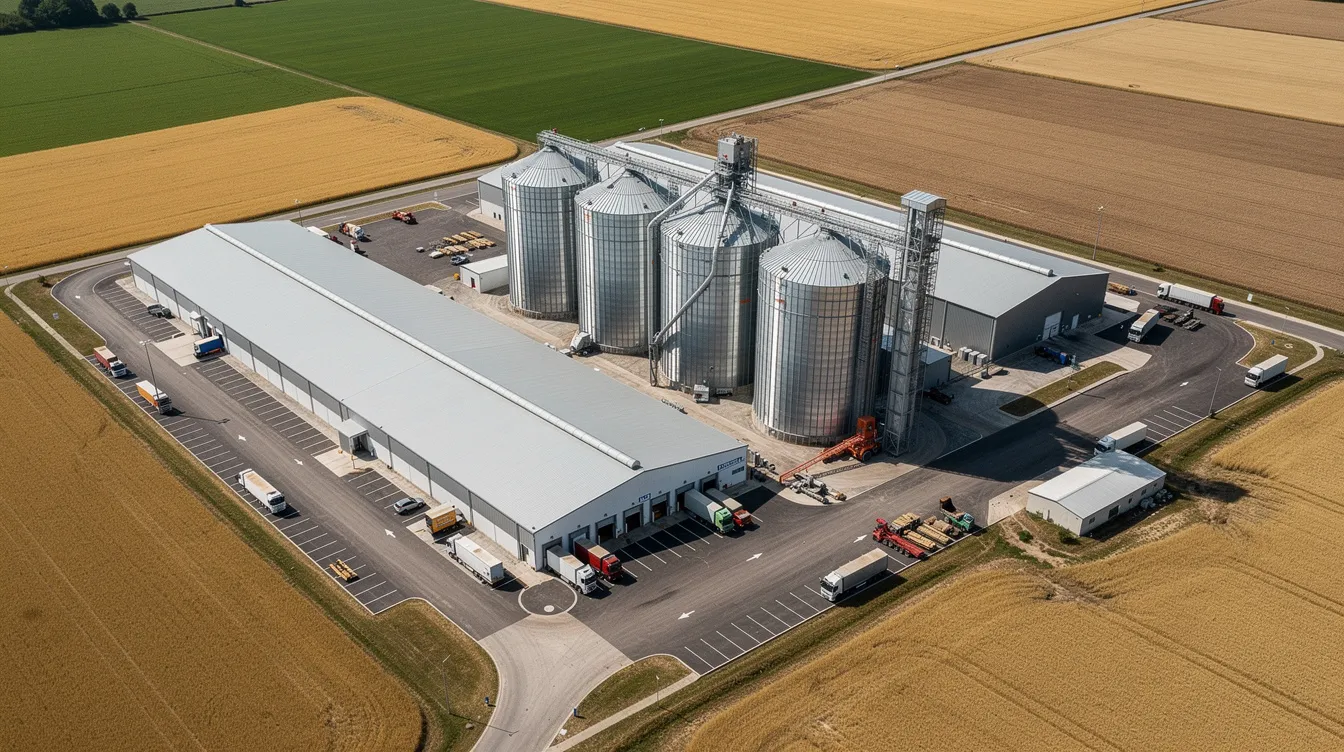
Major Manufacturing Units in an Integrated Grain Complex
Not every complex will host every type of unit. Configuration should be based on local grain availability, market access, supporting utilities and overall feasibility. The following are typical manufacturing units that can be housed within an integrated grain campus:
| Unit | Input Grain | Principal Products | Typical Capacity Band | Value-Add Role |
|---|---|---|---|---|
| Wheat flour mill | Wheat | Atta, maida, semolina, bran | 50–300 TPD | Primary milling |
| Rice mill | Paddy | Polished rice, parboiled rice, bran | 50–400 TPD | Primary milling |
| Maize dry mill | Maize | Grits, flour, germ, feed | 30–150 TPD | Primary milling |
| Millet processing | Millets, sorghum | De-hulled grains, flour, flakes | 10–80 TPD | Specialty processing |
| Breakfast cereals | Wheat, maize, rice, oats | Corn flakes, puffed rice, muesli | 10–60 TPD | High value-add |
| Extruded snacks | Maize, rice, millets | Puffed snacks, kurkure-type | 5–30 TPD | High value-add |
| Animal feed | Bran, screenings, DDGS | Pellet/mash feed | 30–200 TPD | By-product utilization |
| Grain silos | All grains | Safe bulk storage | 5,000–50,000 MT | Procurement buffer |
| Starch derivatives | Maize, broken rice | Starch, glucose, dextrins | Up to 888 TPD | Industrial ingredients |
By-products such as bran, polish, germ and screenings from primary mills flow naturally into grain-based animal feed manufacturing units, improving overall complex-level margins. Grain-based ethanol production generates DDGS (Dried Distillers Grains with Solubles) as a by-product, which itself serves as a high-protein animal feed ingredient.
For millet and specialty grain processing, the increasing demand for nutritious food products makes dedicated lines commercially attractive within a multi-grain campus. Similarly, breakfast cereals and extruded foods lines such as corn flakes manufacturing add premium value to commodity grains.
Integrated Grain Industrial Complex Business Models
Configuring the business model is as critical as selecting the manufacturing lines. Financing, revenue streams and risk-sharing depend on it.
| Business Model | CAPEX Responsibility | Revenue Structure | Bank Appraisal Complexity |
|---|---|---|---|
| Single-promoter captive complex | Promoter bears entire cost | Product sales, by-product revenue | Moderate–High |
| Multi-product JV facility | Shared across JV partners | Revenue split by unit | High |
| SPV-based industrial cluster | SPV owns infrastructure; tenants own units | Lease income + utility charges | High |
| Anchor investor + ancillary units | Anchor bears major cost | Anchor product sales + tenant fees | High |
| Contract manufacturing | Promoter owns assets; clients supply brand | Processing fees | Moderate |
A single-promoter model is straightforward but capital-intensive. A multi-product facility where the promoter owns core milling and storage but brings in contract manufacturers for extruded snacks or specialty products can reduce upfront investment. Common facilities in integrated projects may include warehousing, processing units and utilities, shared across occupants. A 5,000 TCD sugar mill, for reference, is a significant mid-to-large scale unit that similarly requires anchor-level logistics and raw material coordination, illustrating how scale drives the business model choice.
Location Selection and Land Requirements
Location determines logistics cost, grain procurement competitiveness and long-term operating margins. Site selection should consider land requirements and proximity to highways, railheads and ICDs for export-oriented operations.
Key parameters include proximity to major grain belts: Punjab and Haryana for wheat and rice, Madhya Pradesh for wheat and soy, Maharashtra and Karnataka for maize and sorghum, and Rajasthan for millets. Locally available grain sourced from nearby areas reduces inbound transport cost significantly.
Industrial land-use zoning matters. Locating within notified industrial estates or food processing zones can expedite access to power, water and common amenities. Land conversion from agricultural to industrial use adds both cost and time.
For a medium complex of 15–25 acres, an indicative land-use plan might allocate 35–40% for processing buildings, 15–20% for silos and storage, 10–15% for roads and truck movement, 10% for utilities and effluent, 10% for green belt and 5–10% for future expansion. Larger complexes may require 30–50 acres depending on throughput and the number of processing lines.
Plant Capacity Planning and Manufacturing Integration
Capacity planning must link projected grain availability, realistic domestic market off-take and working capital capacity. It should not be driven solely by machinery vendor quotations.
A DPR should model daily grain throughput in TPD, operating days per year (commonly 300), and phased ramp-up in capacity utilisation at perhaps 60% in Year 1, 75% in Year 2 and 85% from Year 3 onwards. Alignment between primary mills and downstream value-added units must be checked through material balance. For instance, a 200 TPD wheat mill generates approximately 40–50 TPD of bran and by-products. If a 30 TPD integrated animal feed mill is planned onsite, these flows must match.
Phased development, with Phase I covering core mills and industrial grain storage silos and Phase II adding value-added lines, often improves DSCR and reduces early interest burden. The Kazakhstan facility referenced earlier plans to process 250,000 tons of wheat annually, demonstrating that even large-scale projects plan throughput carefully against procurement logistics.
Manufacturing Process and Integrated Material Flow
The integrated material flow follows a logical sequence:
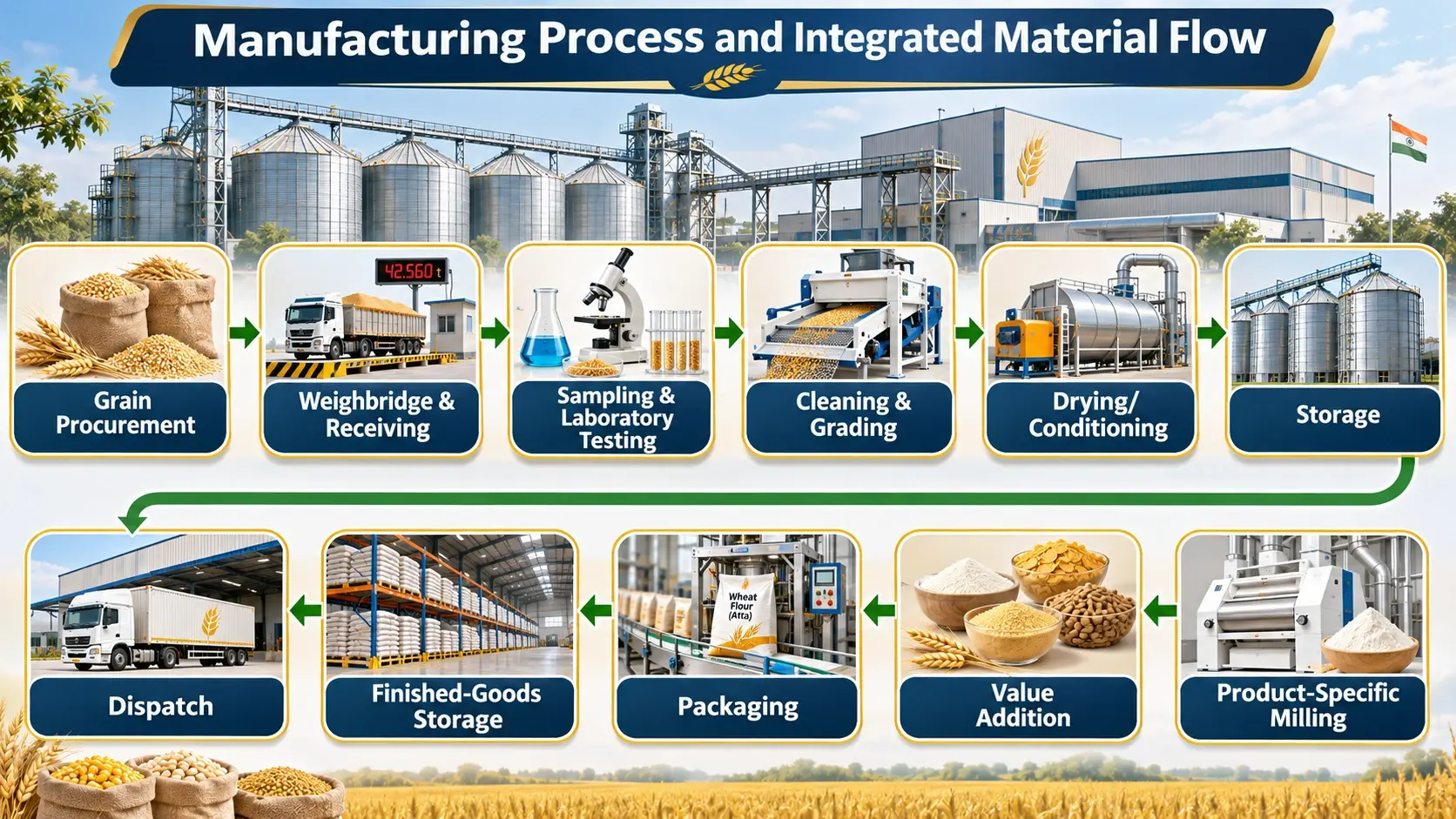
Grain Procurement → Weighbridge & Receiving → Sampling & Laboratory Testing → Cleaning & Grading → Drying/Conditioning → Storage → Product-Specific Milling → Value Addition → Packaging → Finished-Goods Storage → Dispatch
Different grains follow similar front-end cleaning but diverge in specific processing steps. Wheat moves through roller mills for atta and flour manufacturing. Paddy goes through de-husking, polishing and grading in integrated rice milling lines. Maize enters dry milling for grits, flour and germ separation. Millets require de-hulling and specialised grading in integrated millet processing lines.
Ethanol production involves grain handling, milling, fermentation and distillation. Broken rice can be used for ethanol production due to its starch content. The process can also produce rice protein with over 80% purity as a co-product. By-product streams including bran, husk, germ and fines are collected separately for animal feed, biomass fuel or other value-add.
Good layout design reduces cross-contamination risks, supports traceability and FSSAI compliance, and optimises material movement for consistent output across all processing lines.
Plant Machinery, Equipment and EPC Requirements
Integrated grain complexes combine conventional milling machinery with modern automation, food extrusion lines, packaging systems, utilities and safety infrastructure. A DPR outlines equipment requirements for grain processing plants across all these categories.
Key equipment groups include grain receiving pits, conveyors, pre-cleaners, de-stoners, magnetic separators, hammer mills, roller mills, dryers, storage silos, colour sorters, polishers, extrusion lines, flakers, blenders and automatic packaging machines. Grain-based ethanol plants require specific equipment for milling and fermentation stages.
Supporting utilities include boilers, steam distribution, compressed air, power distribution, DG sets, water treatment, wastewater treatment and dust collection systems. These support both food processing operations and environmental compliance requirements.
EPC (Engineering, Procurement and Construction) contracts offer single-point responsibility and better integration quality but typically cost more upfront than individual equipment procurement. For machinery and EPC cost estimation related to extrusion and breakfast cereal lines, project-specific vendor quotations remain essential. Automation through PLC and SCADA systems improves efficiency, traceability and production monitoring.
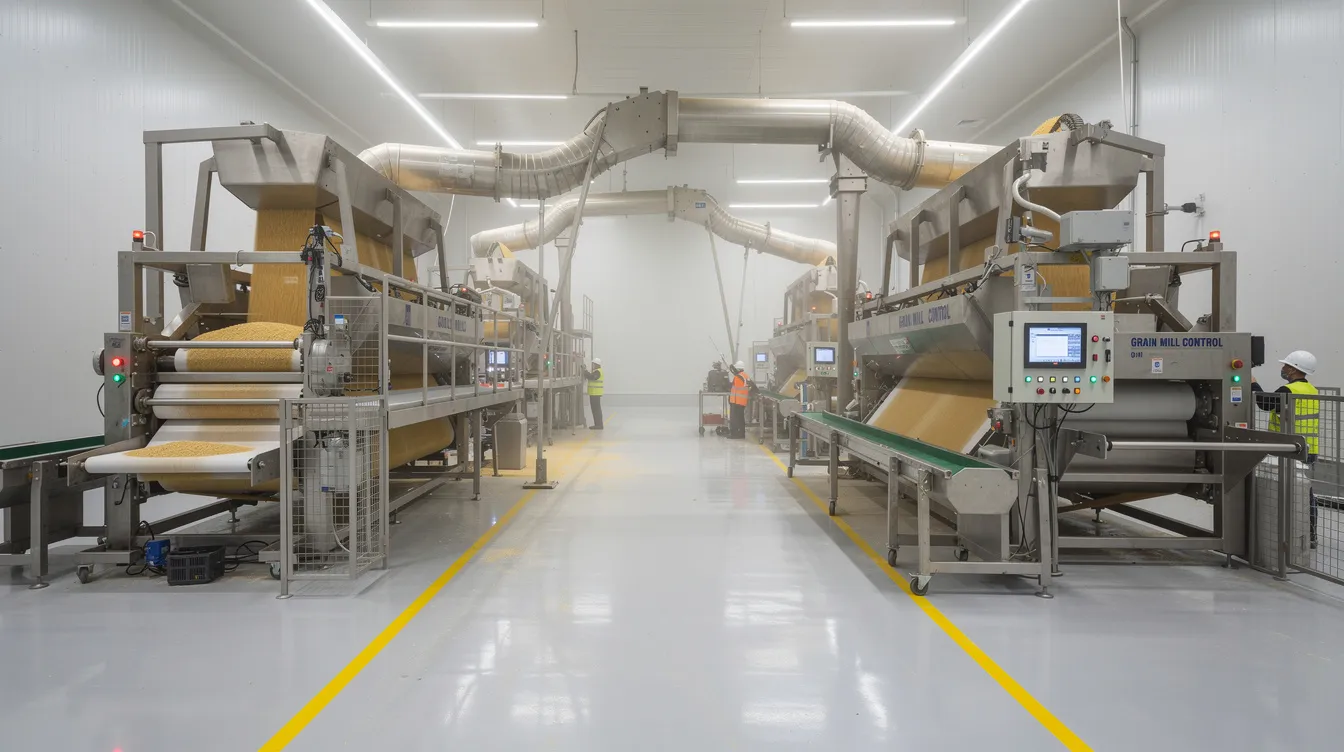
Integrated Grain Processing Complex Setup Cost in India
Project cost estimation should detail capital expenditure by component. The following table provides an indicative percentage-wise cost breakup:
| Cost Component | Indicative Share (%) |
|---|---|
| Land and site development | 10–20% |
| Buildings and civil construction | 20–30% |
| Processing machinery and equipment | 35–45% |
| Utilities, electricals and infrastructure | 10–15% |
| Pre-operative, contingency, IDC | 5–10% |
Broad investment bands for integrated grain processing complexes in India:
- ₹10–25 crore: Limited integration, typically one major mill plus silos and basic packaging
- ₹25–50 crore: Multi-unit but regionally focused, perhaps two milling lines with common infrastructure
- ₹50–100 crore: Diversified product mix including value-added lines, larger storage and automation
- Above ₹100 crore: Full-scale integrated park with multiple processing units, ethanol, feed and export infrastructure
For context, the Kalahandi project involves an investment of ₹350 crore for integrated expansion. A Pulses and Cattle Feed project was estimated at ₹70.22 crore. The sugar manufacturing unit expansion in Karnataka costs ₹1,229 crore. A documented 640 TPD rice processing plant had total CAPEX of approximately ₹210 crore including ₹101 crore for plant and machinery alone. DPRs detail project costs including land and machinery expenses at this level of granularity.
Integrated Grain Processing Complex Investment and Financing Structure
Typical capital structure options include promoter equity, long-term bank term loans, working capital limits, quasi-equity and equity from strategic or financial investors. Loan structuring is a key component of bank finance project reports, determining how debt service aligns with cash generation.
Prudent debt-equity ratios for large projects generally fall in the 1.5:1 to 2:1 range, subject to bank norms and risk profile. Drawdown schedules must align with construction milestones and implementation phasing. CMA data is essential for bank loan applications in India and must demonstrate adequate debt-servicing capacity.
For SPV-based cluster models, funding common infrastructure can be separated from funding individual processing units promoted by anchor tenants or group companies. Where large-ticket private equity or strategic investment is required, promoters should understand equity funding eligibility and investor readiness and approach capital planning systematically.
Working Capital Requirements
Large integrated grain complexes are highly working capital intensive due to seasonal procurement of raw material, finished goods inventory, receivables from institutional buyers and limited supplier credit from farmers.
| Working Capital Component | Typical Holding Period |
|---|---|
| Raw grain inventory | 30–90 days |
| In-process and finished goods | 10–30 days |
| Packaging material | 15–30 days |
| Receivables | 30–60 days |
| Less: Creditors/payables | 15–30 days |
In the documented 640 TPD rice processing plant case, working capital for just two months was ₹75.48 crore, representing approximately 36% of total project cost. For a mid-sized integrated complex with annual turnover of, say, ₹150 crore, working capital requirements could range between ₹25–45 crore depending on inventory cycles and credit terms.
Banks typically provide cash credit, working capital term loans and LC/BG facilities, but these must be justified through professional CMA data covering at least three to five future years. Underestimating working capital in the DPR can strain operations even when fixed-asset funding is adequate.
Operating Cost and Production Economics
Raw material cost usually accounts for 60–70% of total operating expenses in grain processing projects. Cost of production should be analysed alongside projected profitability statements to identify realistic margin expectations.
Key cost components per tonne of finished product include cost of raw grain, processing cost (power, fuel, labour, maintenance), packaging, inward and outward logistics, quality-control costs and administrative overheads. Yields and recoveries directly influence profitability: modern rice mills target less than 10–12% broken rice, while flour extraction rates for wheat typically range around 72–76%.
Integrated utilisation of by-products, including bran into animal feed, husk as biomass fuel for boilers, and screenings as ingredients, can improve overall complex-level margins even when individual product lines show modest spreads. The food processing industry in India generally operates on net margins of 15–25%, but integrated complexes that produce processed food products across multiple categories can achieve better scale efficiency.
Financial Projections, DSCR, IRR and Project Profitability
Financial projections are crucial for securing bank financing and for investment decisions. A 10-year integrated financial model should cover product-wise sales projections, capacity utilisation ramp-up, pricing assumptions, cost structure and funding profile. Financial analyses should use realistic assumptions for projections and sensitivity analyses rather than optimistic targets.
| Financial Metric | Typical Benchmark/Range |
|---|---|
| Average DSCR (over loan tenure) | 1.3–1.5x minimum |
| Project IRR | High teens to mid-20s% |
| Payback period | 4–7 years |
| Break-even capacity utilisation | 45–55% |
| Ramp-up to full capacity | Year 3–4 |
Banks look for average DSCR above their minimum threshold over the loan tenure. Investors focus on project IRR and equity IRR under conservative scenarios. Sensitivity analysis on raw grain prices, product selling prices, capacity utilisation and interest rates supports go/no-go decisions and phasing strategies.
The documented 640 TPD rice plant case showed approximately 28% return with break-even at about 50% capacity utilisation, but these numbers are specific to that project configuration.
Integrated Grain Industrial Complex Feasibility Study
Before detailed DPR preparation, a structured feasibility study should test whether the integrated concept is technically and commercially justified for the chosen location and promoter. Market analysis should assess demand-supply dynamics and identify target markets for each product line.
Key feasibility dimensions include:
- Technical: Technology options, process integration, utilities, automation requirements
- Commercial: Market demand, competition, price trends, export potential
- Raw material: Grain availability from nearby agricultural regions, procurement logistics, seasonal patterns
- Infrastructure: Land, connectivity, power, water access
- Financial: Returns, DSCR, funding capacity, equity adequacy
- Environmental: Pollution norms, effluent management, solid-waste handling
- Organisational: Management bandwidth, technical partners, operational resources
DPRs provide insights into market outlook and procurement strategies across all these dimensions. A practical two-stage approach works well: preliminary pre-feasibility to narrow down configuration and scale, followed by full DPR-level feasibility with detailed financial modelling.
Regulatory Approvals and Compliance in India
Actual requirements vary by state, capacity and product mix. Statutory approvals may include FSSAI licence and pollution control board consent as baseline requirements. Regulatory assessments should factor environmental impacts and necessary clearances for each processing unit.
Core registrations include company or LLP or SPV incorporation, PAN, GST, Importer-Exporter Code for exports and applicable trade licences. Industrial approvals include land conversion where required, building plan sanction, factory licence, fire-safety NOC, electrical safety approvals and boiler registration.
Food processing-specific compliance includes FSSAI central licence, proper labelling standards, GMP norms and optional certifications such as ISO 22000, HACCP and BRC. DPRs assess environmental management and pollution control needs including effluent treatment, boiler emissions, dust collection and solid waste handling, particularly where the complex includes grain-based ethanol production or biomass boilers.
Government Schemes, Incentives and Institutional Support
Integrated grain complexes may be eligible for certain central and state-level incentives under food processing, agro-processing and infrastructure policy schemes. The PMFME scheme offers a 35% subsidy for project costs for eligible micro food processing enterprises. Larger complexes may benefit from schemes like PMKSY (with allocations of ₹4,600 crore in recent budgets) for agro-processing cluster infrastructure.
State policies vary: Uttar Pradesh offers up to 35% subsidy capped at ₹10 crore for food processing and cold-chain projects. Haryana provides capital subsidy of 25–45% on eligible expenditure under its agri-business policy.
Promoters should cross-check current guidelines and timelines from official government sources before making investment decisions based on expected subsidies. Incentives should improve project returns, not serve as the core driver of feasibility.
Risk Assessment and Sensitivity Analysis
Integrated grain complexes face commodity risks and project risks simultaneously. Comprehensive risk analysis should address raw material price volatility and technological obsolescence alongside implementation and market risks.
| Risk Category | Potential Impact | Mitigation Strategy |
|---|---|---|
| Raw grain price volatility | Margin compression | Diversified sourcing, forward contracts |
| Seasonal shortages | Production disruption | Adequate silo capacity, buffer stock |
| Quality variability | Yield losses, rejections | Robust QC lab, grading at procurement |
| Capacity underutilisation | Weak DSCR, cash stress | Phased commissioning, demand validation |
| Power/water disruption | Production stoppage | Captive DG, water harvesting |
| Regulatory changes | Compliance cost, delays | Proactive monitoring, legal advisory |
| Working capital shortage | Operational stress | Conservative CMA, adequate limits |
| Construction delays | Cost overruns, IDC increase | Contingency budget, milestone tracking |
Financial sensitivity analysis should test DSCR and IRR under scenarios of reduced selling prices, increased grain cost, lower utilisation and higher interest rates.
Detailed Project Report (DPR) for an Integrated Grain Industrial Complex
Bank loans typically require detailed project reports for approval. A Detailed Project Report must cover technical, financial and regulatory dimensions for a project of this complexity. An integrated grain industrial complex project report goes far beyond a basic project profile.
Major DPR chapters include:
- Executive summary with total project cost and projected break-even points
- Promoter profile and project background
- Industry and market analysis
- Technical configuration, capacity and plant layout
- Project cost estimates with component-wise capital expenditure
- Means of finance and capital structure
- Implementation schedule
- Working capital assessment
- Ten-year financial projections
- DSCR, IRR, NPV and break-even analysis
- Risk and sensitivity analysis
- Bankability assessment
DPRs include grain handling, milling and fermentation processes where ethanol units are part of the complex. Supporting technical annexures may cover separate notes for grain silos, animal feed, breakfast cereals or millet processing units, all integrated into one coherent financial model. The starch derivatives project referenced earlier, with a target capacity of 888 TPD, illustrates the scale at which technical annexures become essential.
Why Integrated Grain Complexes Require Professional Financial Planning
The complexity of multiple product lines, high working capital needs, shared utilities and large-ticket term loans makes professional financial planning critical. Common pitfalls in large food processing and agro projects include overbuilt capacity relative to demand, underestimation of working capital, optimistic selling-price assumptions, ignoring ramp-up time and fragmented implementation leading to weak DSCR.
Professional Perspective – CA Manish Gugliya
In my experience preparing DPRs for integrated industrial projects, the most common mistake is treating financial projections as a formality rather than a decision-making tool. A ₹50 crore integrated grain complex with three product lines and seasonal grain procurement needs a financial model that can test multiple demand scenarios, phased commissioning options and different debt-equity structures before the promoter approaches a bank.
The plan must show clearly how cash flows support term-loan repayment under conservative assumptions. Banks and investors both examine downside resilience. A well-structured integrated grain industrial complex project report positions the promoter for informed negotiations rather than reactive adjustments after sanction.
For professional DPR, CMA data and financial advisory services, the emphasis should always be on customised analysis aligned with the specific project configuration.

Frequently Asked Questions
What is the minimum practical scale for an integrated grain industrial complex in India?
A meaningful integrated complex typically requires at least two complementary processing lines, for example a wheat flour mill and an animal feed unit, along with shared silos and utilities. At this scale, the investment usually starts at ₹25–30 crore. Projects below this budget are generally better structured as standalone food processing units rather than integrated complexes.
Should ethanol production be included from Day One or planned as a later phase?
Ethanol production utilises starch from broken rice and other grains and requires dedicated environmental clearances, pollution-control infrastructure and significant capital. For most promoters, it is prudent to plan ethanol as a Phase II addition after core milling and food processing operations are stabilised. The regulatory and capital requirements for ethanol are distinct from food processing.
How long does implementation typically take from land acquisition to commissioning?
For a medium integrated complex with two to three processing lines, implementation typically takes 12–18 months after all approvals and land are in place. Larger complexes with multiple product lines, utilities and possibly ethanol may require 24–30 months. Construction delays, equipment delivery timelines and approval processes are common sources of schedule overruns.
What level of promoter equity do banks normally expect?
Banks generally expect promoter contribution of 25–40% of total project cost, depending on the sector, scale, promoter track record and collateral offered. For integrated grain complexes involving multiple processing units and high working capital, a stronger equity base, perhaps 30% or more, improves bankability and DSCR comfort.
How should a promoter decide between a single-entity complex and an SPV-based cluster model?
A single-entity model suits promoters with strong equity, technical capability and direct control over all processing lines. An SPV-based cluster is appropriate when multiple occupants or investors share infrastructure costs. The choice depends on the promoter’s capital resources, management bandwidth and willingness to coordinate with multiple tenants. Each model has different bank appraisal requirements, and the DPR structure must reflect the chosen approach.
Conclusion and Professional DPR & Feasibility Services
Integrated grain industrial complexes represent a strategic development approach for India’s food processing industry, optimising logistics, enhancing value addition through multiple product lines and generating stable agricultural demand from farmers across grain-producing regions of the country. Their strategic importance grows as India seeks to reduce post-harvest losses and expand its processed food products sector.
The viability of such projects depends on realistic capacity planning, disciplined capital allocation, robust working capital assessment, conservative financial projections and thorough risk analysis. Whether the investment is ₹25 crore or ₹350 crore, the underlying discipline remains the same: defensible assumptions, adequate equity, conservative gearing and phased implementation.
Professional Integrated Grain Industrial Complex DPR & Feasibility Services
CA Manish Gugliya, FCA, DISA (ICAI) ProjectReportBank.com
Project Report Bank provides customised professional support for integrated grain industrial complex projects, including:
- Integrated industrial complex project reports and DPRs
- Technical and financial feasibility assessments
- Capital investment and project cost modelling
- Bank finance DPR and CMA data preparation
- Ten-year financial projections with product-wise analysis
- DSCR, IRR, NPV and sensitivity analysis
- Investor-ready DPR and fundraising documentation
- Equity funding and capital planning advisory
Serious project promoters, industrial investors and corporate developers planning integrated grain processing investments should initiate a professional consultation through ProjectReportBank.com for project-specific feasibility and financial structuring, rather than relying on generic templates or vendor-led projections.
Integrated food processing investments are commercially attractive only when backed by sound planning, credible numbers and disciplined execution across the full project lifecycle.