Key Takeaways
- Common packaging, food testing and dispatch facilities form the commercial backbone of any modern agro processing cluster, reducing capex for individual food processing units and improving regulatory compliance across the park.
- Modern agro-processing parks should have shared infrastructure for packaging to lower costs. Centralised packaging and food testing can reduce per-unit packaging cost by 20–35% while enhancing quality consistency for tenants handling grains, pulses, oilseeds, dairy, spices and ready-to-eat foods.
- Properly sized common facilities – packaging lines, laboratories, warehouses and dispatch docks – directly determine the bankability, DSCR and IRR of agro processing parks for lenders and institutional investors.
- The Agro Processing Cluster scheme offers grants-in-aid of 35% to 50% for eligible project cost, while the Mega Food Park Scheme provides 50% capital grants in general areas and up to 75% in difficult regions including himalayan states and north east states, making shared infrastructure financially attractive.
- Developers must integrate these common facilities from day one in the Detailed Project Report for any multi-tenant agro processing park, with realistic utilisation assumptions, tariff modelling and phased capacity planning.
Introduction: Common Packaging, Testing & Dispatch in Agro Processing Clusters
Post-harvest losses can account for up to 80% of production in certain agricultural products categories in India. Food loss occurs from harvest until consumption, encompassing weight loss from rotting as well as quality loss that reduces the economic worth of crops. Agro-processing parks require integrated common packaging facilities to reduce these post-harvest losses and to enhance food production efficiency across the supply chain.
This is where agro processing park common packaging facilities, centralised food testing laboratories and shared warehousing become essential. Instead of leaving each food processing unit to independently invest in packaging machinery, laboratory instruments and warehouse infrastructure, a professionally designed park consolidates these into common processing facilities operated by the park SPV or a specialised operator. The Mega Food Park Scheme provides modern food processing infrastructure across India, with 22 operational food parks currently running, each supporting approximately 25–30 food processing operations. Each agro processing cluster requires a minimum investment of Rs. 25 crores, and these clusters aim to reduce post-harvest losses by linking farmers directly to processors and markets through a well equipped supply chain.
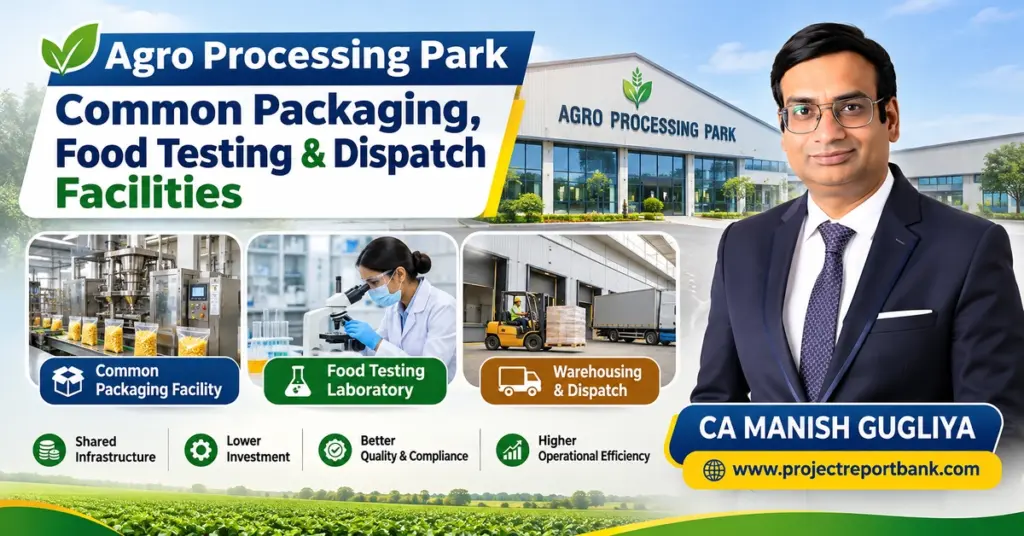
At Project Report Bank, our advisory practice led by CA Manish Gugliya focuses on preparing bankable DPRs, financial projections and feasibility studies for agro processing parks. This article examines the technical, financial and regulatory dimensions of establishing shared packaging, food testing and dispatch infrastructure within integrated agro-processing clusters in India.
What Are Common Packaging, Food Testing and Dispatch Facilities?
Common facilities in an agro processing park are centrally owned packaging, testing and logistics infrastructure used by multiple food processing units on a pay-per-use or contract basis. The park developer or SPV builds, operates and maintains these assets, while individual tenants access them without duplicating capital investment. This includes food testing laboratory services, common packaging lines and pooled warehousing.
This model differs fundamentally from independent setups. When each tenant installs its own small packaging line and basic lab, the result is typically underutilised equipment, inconsistent quality, higher per-unit costs and weaker compliance. A Multi-Tenant Agro Food Processing Park Project Report captures how shared services drive both cost efficiency and commercial viability.
Typical users include grain mills, pulses processors, oilseed and edible oil units, spice grinding operations, fruit and vegetable processors, dairy and milk processing plants, poultry processors, meat products manufacturers and ready-to-eat food brands. These shared facilities support agricultural products testing, quality assurance, branding consistency and export readiness for MSME manufacturers who otherwise cannot justify high-end equipment. Agro-processing clusters include basic enabling infrastructure like roads and water supply alongside these other common processing facilities, creating a complete ecosystem for food processing industries in India.
Common Packaging Infrastructure in an Agro Processing Park
A common packaging centre typically includes receiving bays where semi-finished products arrive from tenant units, bulk product hoppers, a primary packaging hall, secondary and tertiary packaging sections, and a finished-goods marshalling and palletisation area. Common packaging infrastructure is categorised by supply chain stage and product type, ensuring each category of agricultural products receives appropriate handling.
The main functional zones cover:
- Bulk packaging for B2B markets: 25–50 kg bags, drums and bulk containers for grains, pulses and oilseeds
- Retail packaging for B2C channels: pouches, cartons and bottles for atta, rice, dal, cold-pressed oil, snacks and spices
- Export packing with specialised packaging meeting international buyer specifications
- Temperature-controlled packaging halls that prevent thermal shock during packing of sensitive goods like dairy, frozen foods and ready-to-eat products
Agro-processing parks require robust packaging machinery that can accommodate multiple product types. The same packaging block can handle wheat flour, basmati rice, chana dal and cold-pressed oil using separate lines, colour-coded utensils and hygiene zoning to avoid cross-contamination. Packaging infrastructure in agro-processing parks should meet strict food-safety standards across all zones.
| Parameter | Independent Packaging (Per Unit) | Central Common Packaging |
|---|---|---|
| Capital investment | ₹1–5 crore per unit | ₹10–30 crore shared across 15–25 units |
| Per-unit capex burden | Full cost borne individually | 25–40% lower per tenant |
| Equipment utilisation | Often 30–40% | Targeted 60–75% through pooling |
| Labour requirement | Dedicated staff per unit | Shared trained workforce |
| Quality compliance | Variable across units | Standardised, auditable |
| Export readiness | Difficult for MSMEs | Achievable through shared high-end lines |
Packaging Machinery and Equipment
Machinery selection depends on the Agro Processing Park Industry Mix and Value Chain Integration and planned daily output. Oversizing or undersizing lines can materially change IRR and payback period.
Vertical and Horizontal Form-Fill-Seal machines automatically package bulk agricultural commodities and retail SKUs. Flexible packaging lines handle various food products including spices, flour and snacks. Multihead weighers enable precise measurement of varied food products for packaging. Modified Atmosphere Packaging extends the shelf life of fresh produce and processed foods, particularly relevant for ready-to-eat and snack categories.
Key equipment categories and indicative Indian costs:
| Equipment | Description | Indicative Cost (₹ Lakh) |
|---|---|---|
| VFFS with multi-head weigher | Grain/pulse retail pouches (0.5–5 kg) | 8–80 |
| HFFS / pre-made pouch filler | Flexible packs, stand-up pouches | 12–120 |
| Sachet packaging machine | Spice sachets, single-serve packs | 3.5–15 |
| Oil filling and capping line | 200 ml to 5-litre bottles/cans | 10–40 |
| Vacuum / MAP packaging | High-value snacks, ready-to-eat foods | 25–60 |
| Metal detector line | Contamination detection | 2–5 |
| Checkweighers | Weight verification | 3–8 |
| X-ray inspection | Premium export lines | 30–80 |
| Carton erecting and sealing | Secondary packaging automation | 5–15 |
| Robotic palletiser | Automated stacking of finished goods | 10–500 |
| Inkjet coders and labelling | Batch coding, MRP, nutritional labels | 2–10 |
Quality control equipment ensures packages are free from contamination and correctly weighted. Robotic palletizers stack finished products onto pallets in pre-programmed patterns for efficient dispatch. Shared conveyors, elevators and material-handling systems integrate multiple machinery lines into a single packaging hall.
All costs are indicative and must be validated through vendor quotations and project-specific assessment.
Central Food Testing and Quality Control Laboratory
A central food testing and agricultural products testing laboratory inside an agro processing park addresses multiple critical needs: regulatory compliance under FSSAI food safety standards, export certification requirements, retailer audit readiness and prevention of costly product recalls. Food testing labs ensure compliance with food safety standards across all tenant operations.
The scope of testing covers:
- Incoming raw material checks: moisture, impurities, aflatoxin for grains, pesticide residues for fruits and vegetables
- In-process controls: weight checks, seal integrity, packaging material verification
- Finished-product testing: microbiology (total plate count, E. coli, Salmonella), chemical parameters (fat, protein, carbohydrate), nutritional analysis and shelf-life studies
Testing and Quality Assurance Labs verify seal integrity and microbial safety of packaging materials. While routine tests can be performed in-house, highly specialised analyses such as pesticide residue panels, heavy metals and complex allergen profiling may still need to be outsourced to external NABL-accredited laboratories. However, the central laboratory serves all park tenants, enabling viable installation of instruments like HPLC or GC that individual MSMEs could never justify independently.
Food Testing Laboratory Equipment and Infrastructure
Laboratory infrastructure follows its own layout logic: sample receiving, sample preparation, wet chemistry lab, microbiology room, instrument room, washing area and documentation room. Packaging material testing laboratories check seal strength and barrier properties of materials used across the park.
Primary analytical instruments for a park-level food testing lab include:
- Moisture analysers (₹1.5–3 lakh), pH/Brix/conductivity meters (₹0.2–0.6 lakh)
- UV-Vis spectrophotometer, Kjeldahl protein analyser, fat extraction systems
- HPLC for food additives and residue analysis, GC or GC-MS for pesticide panels
- Atomic absorption spectrophotometer or ICP-OES for metals testing
- Texture analysers for product consistency evaluation
Microbiology facilities require laminar airflow cabinets, incubators, autoclaves, biosafety cabinets, colony counters, microscopes, media preparation areas and separate air-handling with hygienic zoning. Support infrastructure includes cold storage for sample preservation, UPS and power backup for sensitive instruments, gas lines for carrier gases, water purification systems and a Laboratory Information Management System for traceability.
Under the Food Safety and Standards (Recognition and Notification of Laboratories) Regulations, 2018, laboratories seeking FSSAI notification must hold NABL accreditation under ISO/IEC 17025. This accreditation from the national accreditation board is mandatory for regulatory recognition. NABL application fees are approximately ₹11,000 per discipline with annual accreditation fees around ₹24,000. Total laboratory setup costs for a medium-scale chemistry plus microbiology lab with some advanced capabilities may range from ₹1 crore to ₹5 crore, forming a part of the eligible project cost for grants under applicable schemes.
Common Warehousing and Dispatch Facilities
A finished-goods warehouse in an agro processing park typically includes racked storage for palletised goods, floor storage for bulk bags, segregation between ambient zones and temperature-controlled areas for cold storage of dairy, frozen foods and IQF products. Cold chains help reduce post-harvest wastage significantly when integrated with processing and packaging.
Key components include:
- Pallet racking systems (₹1,500–4,000 per pallet position for selective racking) with forklifts and pallet trucks
- Cold and chilled storage rooms with appropriate refrigeration systems
- Pre-cooling chambers that prevent microbial growth by rapidly reducing temperature in fresh produce
- Ripening chambers for fruits like bananas and mangoes
- Cold Chain Integrated Loading Docks that ensure perishable items maintain temperature discipline during transfer
- Dock levellers, weighbridge, parking bay and marshalling yards
- End-of-line facilities that prepare products for long-distance transport and distribution
- Common dispatch and palletisation facilities that enable efficient handling and loading of packaged goods
Modern parks integrate warehousing with ERP and WMS systems using barcode or QR-code tracking, ensuring FIFO and FEFO inventory management, batch traceability and real-time stock visibility. Additional revenue-generating services include cross-docking, value-added secondary packing, consolidation for exporters and third-party logistics operations from within the park.
Integrated Material and Product Flow in the Park
The complete material flow in a professionally managed agro processing park follows a defined sequence:
| Stage | Responsible Entity | Key Controls |
|---|---|---|
| Raw material receipt at tenant unit | Tenant | Incoming QC, moisture/impurity checks |
| Processing and manufacturing | Tenant | In-process quality parameters |
| Semi-finished product transfer | Tenant / Park logistics | Documentation, batch tracking |
| Common packaging centre | Park operator | Packaging, coding, weighing, sealing |
| Finished-goods quality testing | Park laboratory | Microbiology, chemistry, compliance checks |
| Central warehouse intake | Park operator | ERP entry, pallet allocation, FIFO/FEFO |
| Dispatch planning | Park operator | Order consolidation, truck scheduling |
| Outbound logistics | Park / 3PL | Weighbridge, documentation, delivery |
Coordination mechanisms include slot booking for packaging lines, daily testing schedules, warehouse space allocation and truck loading windows. Regulatory compliance and nutritional labeling checkers ensure packaging adherence to food safety standards at the appropriate stage. This integrated flow enables traceability required for export-oriented agricultural products and organised retail and e-commerce channels.
Land, Building and Industrial Layout Requirements
Sizing and layout of common packaging, laboratory, warehousing and dispatch facilities must align with the overall Agro Processing Park Land Requirement and Master Planning. The site development includes site development for internal roads, boundary wall, drainage, landscaping and green buffer zones.
Key building spaces include:
- Dedicated packaging hall with clear height of 8–10 metres for pallet handling and overhead conveyors
- Attached dry warehouse block with separate cold storage zones
- Food testing laboratory building with controlled access and separate air handling
- Loading docks with dock levellers, truck parking and marshalling yard
- Common office space for park administration, dispatch planning and tenant coordination
For a medium park, approximately 3–5 acres may be earmarked for common packaging, warehousing and laboratory, with 60,000–100,000 sq. ft of built-up area. Hygiene zoning requires clear separation of raw and finished goods traffic, controlled personnel movement, pest-proof design, adequate ventilation and scope for future expansion. The electricity supply and water supply infrastructure must be sized for peak demand across all shared facilities.
Plant Capacity and Infrastructure Sizing
Packaging, laboratory and warehouse capacities must be designed for peak throughput based on the total installed capacity of all tenant units, realistic capacity utilisation ramp-up and planned shift operations.
Consider a park with aggregate processing capacity of 300 MT/day of grains and pulses, 50 MT/day of oilseeds and 20 MT/day of ready-to-eat foods. This translates into:
| Design Parameter | Indicative Sizing |
|---|---|
| Bulk packaging line capacity | 10–15 MT/hour |
| Retail pouch lines | 2–3 lanes, 3,000–8,000 packs/hour each |
| Oil filling line | 500–2,000 bottles/hour |
| Laboratory samples per month | 200–500 tests (at 3–6% sampling rate) |
| Warehouse pallet positions | 1,500–2,500 (based on 15–30 days holding) |
| Daily truck movements | 8–20 trucks (inbound + outbound at dispatch) |
| Loading docks | 4–8 bays with dock levellers |
Over-sizing increases capital cost while under-sizing creates bottlenecks. Both directly impact DSCR, IRR and payback period. These parameters must be carefully analysed within the DPR with conservative assumptions.
Capital Investment and Project Setup Cost in India
All cost figures presented below are indicative for 2025–2026 Indian conditions and must be validated through vendor quotations and location-specific detailed project reports. Similar Integrated Grain Complex Infrastructure Layout and EPC Cost principles apply to common packaging and dispatch facilities.
| Cost Head | Indicative Range (₹ Crore) |
|---|---|
| Land development and civil works (packaging hall, lab, warehouse, docks) | 10–25 |
| Packaging machinery and automation | 10–30 |
| Food testing laboratory instruments and setup | 1–5 |
| Warehouse racking and material handling equipment | 0.5–2 |
| Utilities (power supply, steam generation boilers, compressed air, HVAC, power backup) | 3–8 |
| IT systems (ERP/WMS/LIMS), safety and certifications | 0.5–2 |
| Contingencies, EPC management, pre-operative expenses | 2–5 |
| Total indicative CAPEX | 30–70 |
When individual MSME tenants use these shared facilities instead of setting up their own packaging lines and basic labs, the per-unit capex saving typically ranges between 25–40%. For example, the Chittoor fruit processing cluster established a common aseptic packaging facility at approximately ₹6 crore for 80 tonnes/day capacity, enabling multiple smaller units to access export markets that require specialised packaging – an investment none could justify individually.
The minimum investment requirement of Rs. 25 crores under the Agro Processing Cluster scheme makes shared infrastructure a natural fit for meeting scheme thresholds while distributing cost across tenants.
Operating Cost and Revenue Models
Common facilities operate as a service business inside the agro processing park, with their own operating costs and revenue streams independent of individual tenant profitability.
Typical cost heads include operator and technical staff salaries, shift-wise packaging labour, laboratory chemists and microbiologists, utilities (electricity being major for packaging and cold storage), maintenance and spares, AMC for laboratory instruments, cleaning and sanitation, quality certifications and calibration laboratories upkeep, ERP/WMS/LIMS licences and administrative overheads.
Revenue models typically include:
- Per-kg or per-tonne packaging charges differentiated by product type and packing format
- Per-test laboratory fees for food testing services
- Monthly subscription or minimum guarantee charges from anchor tenants
- Storage charges based on pallet positions or square feet per month
- Handling charges per truck or per tonne at dispatch
- Value-added service fees for labelling changes, kitting, tetra pack operations and export documentation
At 60% utilisation for a medium facility with ₹50 crore capex, gross annual service revenue may range between ₹8–15 crore depending on tariffs and product mix, with operating costs around ₹5–9 crore, yielding a net operating surplus of ₹3–6 crore. These numbers must be validated through project-specific modelling. GST classification of packaging and laboratory services, along with input tax credit on capital goods, requires careful structuring from a compliance perspective.
Financial Feasibility, Profitability and Bankability
Commercial success of agro processing park common packaging facilities depends on realistic utilisation ramp-up, balanced tariff setting and assured volumes from Agro Processing Park Anchor Tenant Selection and Plot Allotment. Anchor tenants play a crucial role in ensuring base utilisation that protects break-even occupancy.
Key financial indicators for evaluation:
- DSCR should be maintained above 1.25–1.40 across the projection period for bank finance comfort
- IRR targets of 15–20% are reasonable for well-utilised common facilities
- Break-even occupancy typically falls in the 40–55% range for properly designed parks
- Payback period of 5–7 years is achievable at 60–70% capacity utilisation
- EBITDA margins of 30–45% are realistic at steady-state operations
Sensitivity analysis should test the impact of utilisation dropping by 15–20%, tariff reduction by 10%, power cost increases and delayed tenant onboarding. A facility that maintains DSCR above 1.20 even under moderate stress scenarios demonstrates bankability.
Working capital for the shared-services entity covers receivables from tenant units, inventory of packaging materials if centrally procured, maintenance spares and operational expenses. CMA Data must capture these cycles accurately for bank finance proposals. Financial assistance through grants in aid under the Agro Processing Cluster scheme (35% in general areas) and the Mega Food Park Scheme can materially improve project economics and enhance profitability.
Regulatory Compliance and Certifications
Common packaging and food testing facilities in India must navigate FSSAI licensing, state food safety authorities, Legal Metrology requirements, environmental regulations and factory laws.
Specific compliance requirements:
- FSSAI licensing for each category of food processing, packing and storage activity within the common facility
- Mandatory labelling and packaging declarations under Food Safety and Standards (Packaging and Labelling) Regulations
- Weight and measurement compliance under the Legal Metrology Act for all retail packs
- NABL accreditation under ISO/IEC 17025 for the food testing laboratory when reports are needed for regulatory or export purposes
- The Agro Processing Cluster scheme provides 35% grants in general areas, and grants can reach Rs. 10 crores for projects in state notified ITDP areas and challenging regions. The Mega Food Park Scheme offers 50% capital grants, with grants increasing to 75% in difficult regions like himalayan states such as Himachal Pradesh, north east states and other qualifying areas.
Additional certifications that organised buyers may require include ISO 22000 or FSSC 22000 for food safety management, ISO 9001 for quality systems and BRCGS for export-oriented packing facilities. Ancillary approvals cover building and fire NOC, pollution control board consent (particularly if an effluent treatment plant is needed for cleaning operations), factory inspectorate clearances and occupational safety requirements.
Implementation Schedule and EPC Planning
A typical implementation timeline for greenfield common packaging and testing facilities runs 15–24 months from concept to commercial operations.
Key stages:
- Project conceptualisation and DPR preparation (2–3 months)
- Detailed engineering, layout finalisation and tendering (3–4 months)
- Civil construction including industrial plots development (6–10 months)
- Machinery procurement and installation (4–6 months, overlapping with civil works)
- Commissioning, trial runs, calibration and laboratory validation (2–3 months)
- Phased tenant onboarding and ramp-up (3–6 months)
Early freezing of packaging line layouts, laboratory room configuration and warehouse racking plans prevents rework and cost overruns. Coordination between Agro Processing Park Common Utilities – Power, Steam, Water and Effluent Treatment and shared facilities is critical, as delays in utility readiness routinely push commissioning dates.
Challenges, Risks and Mitigation Strategies
Common packaging, food testing and dispatch facilities introduce both opportunities and risks.
Key risks:
- Underutilisation of packaging lines and warehouse space due to slow tenant ramp-up
- Incompatible product categories leading to allergen or cross-contamination risks across sorting, processing and packing of different agricultural products
- Differing quality standards among tenants (export-grade versus local market)
- Scheduling conflicts for shared machinery and dispatch dock bottlenecks
- Calibration failures in laboratory instruments and testing delays
- Technology obsolescence in packaging machinery
Mitigation strategies include anchor tenant agreements with minimum committed volumes, clear product zoning and line segregation policies, robust HACCP-based food safety plans, preventive maintenance contracts, backup equipment for critical laboratory functions and digital slot-booking systems. Well-structured service agreements with transparent tariff escalation clauses, penalties for non-compliance and insurance coverage for equipment and business interruption protect commercial interests.
These risk factors must be modelled in the sensitivity analysis within the DPR, showing investors how properly managed risk stabilises cash flows and protects DSCR.
Role of a Detailed Project Report (DPR) and Professional Advisory
A rigorous DPR is mandatory for bank finance and investor evaluation of agro processing park common packaging and testing facilities, particularly when project sizes range from ₹50 crore to ₹250 crore. An Integrated Grain Industrial Complex Project Report demonstrates the depth required for multi-product agro processing parks with centralised packaging and testing.
The DPR should cover demand assessment for packaging and food testing services, benchmarking of comparable agro processing clusters, detailed technical configuration including machinery lists and laboratory equipment specifications, capex estimates supported by vendor quotations, and phased implementation planning.
Financial analysis components include multi-year projections, funding pattern and means of finance, promoter contribution planning, term loan structuring, working capital assessment, DSCR analysis, IRR and payback period calculations, break-even analysis and sensitivity modelling. CMA Data preparation must reflect the separate cash-flow profile of the common facilities entity, capturing the unique revenue and cost dynamics of shared infrastructure services within the broader park development.
Frequently Asked Questions (FAQ)
The following questions address common investor and developer concerns not fully covered in the main body of this article.
What is the minimum practical scale for common packaging and lab facilities in an agro processing park?
Below an aggregate processing capacity of approximately 100–150 MT/day across all tenant units, fully fledged common facilities with automated packaging lines and a comprehensive food testing laboratory may not generate adequate revenue to cover fixed costs. In such cases, a leaner setup with semi-automatic packing facilities, basic QC instruments and modular warehouse racking is preferable, with provisions for later expansion as occupancy grows and the industry mix stabilises.
Can an agro processing park outsource specialised tests while running only a basic in-house laboratory?
Many parks operate a basic QC and microbiology lab in-house for rapid turnaround on routine parameters, while outsourcing advanced pesticide residue, allergen and heavy-metal testing to external NABL-accredited calibration laboratories and testing labs. This hybrid model is acceptable to regulators and commercially sensible, provided documentation, sample traceability and turnaround commitments are robust. As sample volumes grow and the park matures, investment in HPLC or GC instruments can be justified.
How are charges for common packaging and warehouse services usually structured for tenants?
Typical models include per-kg or per-tonne charges for packaging differentiated by product type and format, per-pallet or per-square-foot monthly warehousing fees, minimum monthly commitments for anchor tenants and volume-based slab discounts for smaller processors. Tariffs must cover operating costs and debt servicing while remaining competitive enough to attract MSME food processing units that would otherwise set up independent facilities.
Is it possible to phase the investment in common facilities as the park occupancy grows?
Many developers adopt a modular design, starting with essential packaging lines, limited warehouse space and a core laboratory covering basic chemistry and microbiology. Additional lines, racking, cold storage and advanced instruments are added in later phases as tenant occupancy and product mix stabilise. This approach manages initial capex exposure, improves early-year DSCR and reduces the risk of idle capacity in the initial growth period. Agriculture and food processing sectors often exhibit seasonal demand patterns that further support phased development.
What type of professional support is needed to make these common facilities bankable?
Developers should engage specialised techno-financial consultants for DPR preparation, financial modelling, CMA Data and bank-finance documentation, along with qualified food technologists, laboratory experts and EPC partners for technical design and execution. The development of facilities serving vegetables, fruits, spices, milk, poultry, meat products and other food categories requires integration of production, quality and supply chain expertise into a coherent project plan.
Conclusion and Professional Advisory Call to Action
Well-designed agro processing park common packaging facilities, supported by a central food testing laboratory and integrated warehousing and dispatch systems, can significantly enhance the commercial viability and competitiveness of agro processing clusters in India. These shared facilities reduce duplication, improve compliance, support growth into export markets and create measurable value for farmers, processors and investors across the food production chain.
The right combination of infrastructure sizing, machinery selection, regulatory compliance and robust financial modelling determines investor returns, DSCR and long-term sustainability. Each project requires customised feasibility assessment based on location, agricultural catchment, tenant mix, product categories and funding structure. Generic templates cannot replace a project-specific DPR.
Planning Common Packaging, Food Testing and Dispatch Facilities for an Agro-Processing Park?
CA Manish Gugliya at ProjectReportBank.com provides professional assistance with detailed project reports, techno-economic feasibility studies, infrastructure investment planning, financial projections, CMA Data, bank-finance documentation and investor-ready DPRs for agro-processing and food manufacturing projects in India. Share your proposed location, total land area, planned tenant mix, facility capacities, estimated investment and financing requirements through the ProjectReportBank.com website or WhatsApp for a customised consultation.