Key Takeaways
- Agro processing park phased development spreads capital expenditure and infrastructure roll-out across well-defined stages linked to tenant occupancy, reducing idle investment and improving project bankability.
- Parks in India typically involve planned investments of ₹50–₹100 crore or more; developing them in phases aligned with real market demand helps control financial exposure and attract investment from both lenders and institutional investors.
- Robust master planning, anchor tenant strategy, and modular shared infrastructure are crucial to avoid stranded assets-agro industrial parks can attract significant investments through scalable phased development models.
- Phased growth scenarios reduce financial exposure for investors by tying each round of construction to measurable occupancy triggers and demonstrated cash generation.
- Project Report Bank, led by CA Manish Gugliya, FCA, DISA (ICAI), specialises in customised DPRs, feasibility studies, financial projections, and bank finance documentation for phased agro-processing park projects across India.
Introduction – Why Phased Development Matters for Agro Processing Parks
Agro processing park phased development is the practice of spreading capital expenditure and infrastructure construction over multiple stages, matching each investment tranche to real or near-certain tenant demand rather than building the entire park upfront.
The rationale is straightforward. A 40-acre agro processing park with a total planned investment of ₹75 crore involves substantial commitment to roads, power distribution, water systems, effluent treatment, cold storage, warehousing, and common processing facilities. If this entire infrastructure is constructed before a single tenant begins operations, the developer faces idle plots, underutilised utilities, significant interest during construction, and difficulty servicing debt. These problems are not theoretical-reports indicate that only 2 out of 70 approved Agro Processing Cluster projects had completed operations, with at least 30 running behind schedule, often due to land acquisition delays, funding gaps, and viability concerns.
Phased development improves bankability by linking each construction stage to occupancy milestones. When lenders can see that Phase 1 has achieved 60–70% occupancy before Phase 2 CAPEX is committed, DSCR projections become more credible and IRR estimates rest on demonstrated rather than projected cash flows. The phased development model focuses on matching infrastructure to market demand, and this discipline is what distinguishes viable agro-processing parks from projects that stall mid-execution.
In India, agro-processing parks should align with governmental scheme requirements for support-central schemes like PMKSY’s Agro Processing Cluster programme require a minimum of 5 food processing units with aggregate investment of at least ₹25 crore, while state policies in regions like Uttar Pradesh, Maharashtra, and Telangana offer additional incentives for compliant developments. Globally, initiatives such as the Alliance for Special Agro-Industrial Processing Zones aim to invest $3 billion in agro-industrial park development, reflecting the scale of capital that well-structured parks can mobilise.
The sections that follow cover master planning, phase-wise strategy, infrastructure expansion, CAPEX scheduling, financing, risk management, and DPR preparation-examined from a professional project finance and CA-led advisory perspective.
What Is Agro Processing Park Phased Development?
Phased development means sequential planning and execution of land development, roads, utilities, and shared infrastructure instead of a one-time full build-out. Agroparks integrate agricultural production and processing facilities under a common infrastructure umbrella, and the core objectives of an agro-processing park include defining its scope and phasing strategy early in the planning process.
The critical difference between single-stage and phase-wise development lies in how capital risk is distributed over time. In single-stage development, the entire CAPEX-site grading, all roads, full-capacity power substations, complete ETP, all warehousing-is committed before any lease revenue materialises. In agro processing park phase wise development, backbone infrastructure is sized for long-term capacity, but modular equipment and tenant-specific facilities are added only when occupancy or committed lease agreements justify the expenditure.
The typical development sequence follows a clear logic:
- Land acquisition, title verification, and development SPV formation
- Master planning, zoning, and park regulations
- Backbone infrastructure and minimum viable common facilities
- Onboarding initial anchor tenants and generating first lease revenue
- Occupancy-driven second-phase expansion
- Third-phase value addition and ecosystem deepening
Effective management of agro-processing parks often involves a specially formed entity-a development SPV-that owns the land, handles approvals, creates infrastructure, and manages plot allotment. This structure isolates project risk from the promoter’s other businesses and provides a clean vehicle for PPP, SPV, or joint venture financing models.
| Parameter | Single-Phase Development | Phased Development |
|---|---|---|
| CAPEX profile | Entire investment upfront | Spread across 3–4 stages |
| Time to first revenue | Long; all infrastructure must complete | Shorter; Phase 1 generates early revenue |
| Risk of stranded assets | High if occupancy is slow | Lower; expansion matches demand |
| Financing flexibility | One large debt drawdown | Phased disbursement, re-appraisal possible |
| Ability to scale or reconfigure | Limited once built | High; later phases adapt to market |
| Lender comfort | Depends on projected occupancy | Improves as each phase demonstrates cash flow |
Phased development strategies mitigate risks by linking project execution to actual demand, and phased development allows modular expansion of agroparks in a manner that respects both financial discipline and long-term growth potential.
Agro Processing Park Phase Wise Development Strategy
A practical four-phase framework-Phase 0 through Phase 3-provides a structured approach for Indian agro-processing parks with total planned investment in the ₹50–₹100 crore range. Each phase has distinct objectives: Phase 0 covers pre-development and investment readiness; Phase 1 delivers minimum viable industrial infrastructure; Phase 2 is tenant-led expansion; and Phase 3 deepens the industrial ecosystem with value addition.
Phase 0 – Pre-Development & Investment Readiness
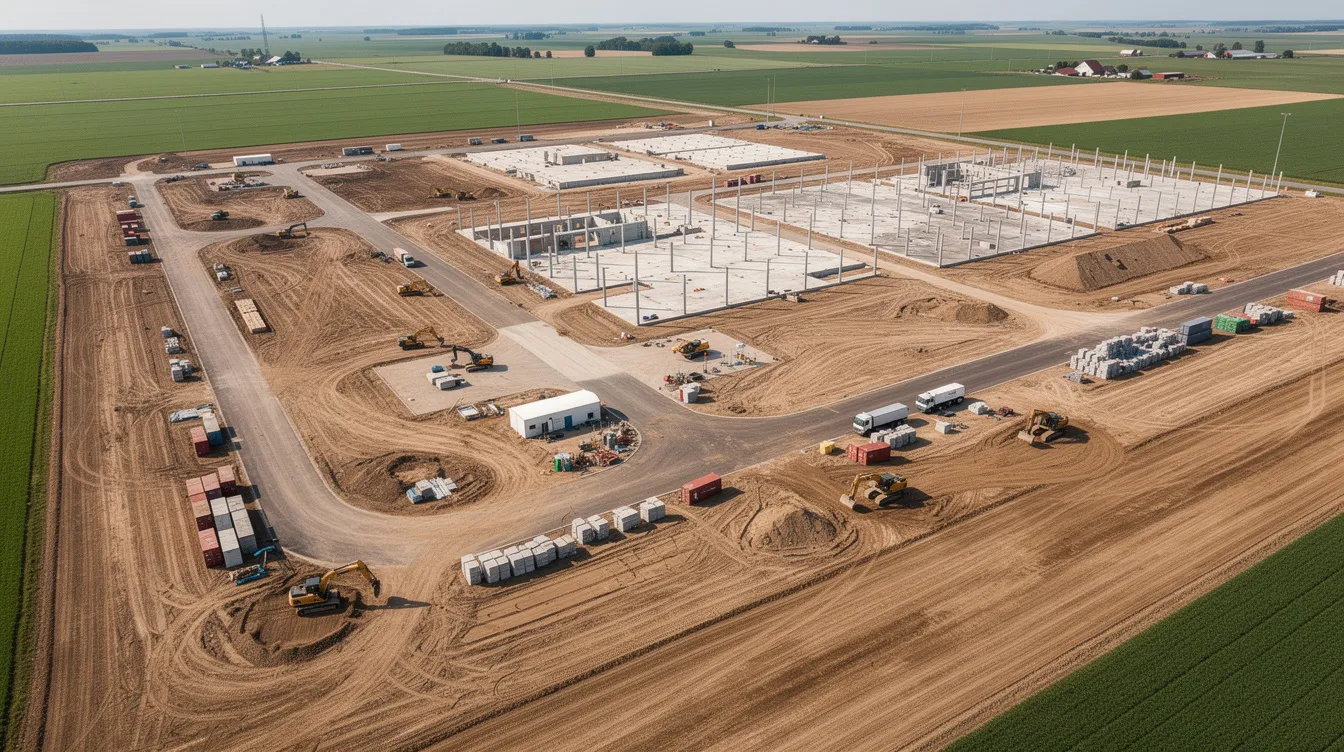
Phase 0 produces no physical infrastructure but determines whether the project should proceed at all. The work includes:
- Project concept and value chain selection: Identifying target agriculture sectors-grains, oilseeds, dairy, fruits and vegetables-based on regional crop patterns and processing demand. Strategic positioning defines the agropark’s target market and production strategy.
- Land identification and due diligence: Evaluating sites of 25–60 acres for clear title, industrial or agro-processing use conversion potential, and connectivity to highways, mandis, and ports. Site selection criteria for agro-processing projects include proximity to raw material sources. Site analysis includes climate, water availability, and logistics considerations.
- Market demand analysis: Understanding regional and export demand for processed products, mapping surrounding agricultural production for raw material assessments, and validating tenant interest. Raw material assessments involve mapping surrounding agricultural production in the catchment area.
- Tenant pipeline development: Engaging potential anchor tenants through expressions of interest, letters of intent, and preliminary plot discussions. Without credible demand signals, committing capital is premature.
- Feasibility study and financial modelling: Preparing pre-feasibility and detailed feasibility studies including demand analysis, technical options, tentative CAPEX, IRR, NPV, and DSCR analysis, structured around a development SPV.
- Regulatory mapping: Identifying required statutory approvals-land-use conversion, pollution control, building plan, fire safety-and aligning the project with government incentive schemes.
Phase 0 should produce a bankable DPR, financial model, and investment memo suitable for approaching lenders and investors. A detailed project report for an agro-processing park outlines comprehensive structuring of costs, revenues, and implementation milestones.
Phase 1 – Minimum Viable Industrial Infrastructure
Phase 1 focuses on developing core backbone infrastructure on a limited portion of the land-typically 30–40% of total plots-to quickly operationalise the park and begin generating lease revenue. The initial core includes essential services and infrastructure required for the first tenant units to function.
Typical Phase 1 works include:
- Site grading, main access road, internal loop road, boundary wall, and gate complex
- Storm water drainage and primary water storage
- Initial power distribution system (with backbone sized for future full capacity)
- Modular ETP capable of handling initial tenant loads
- Basic warehousing, a small cold room, administrative building, security systems, and utility control room
The concept of minimum viable shared infrastructure means installing enough to commission the first 3–5 processing units and start generating lease and utility revenue, while keeping CAPEX controlled. Agroparks can reduce costs by pooling resources among businesses, and this principle applies from the very first phase.
Phase 1 CAPEX is typically funded through a mix of promoter equity, initial term loan, and grant or subsidy components under relevant government schemes. Under the APC scheme, grants of 35% of eligible project cost in general areas (50% in difficult or NE regions) are available, with a maximum of ₹10 crore per project. Agro-processing parks must prove operational sustainability for initial phases before expansion is justified.
Phase 2 – Tenant-Led Infrastructure Expansion
Phase 2 is triggered when pre-agreed occupancy thresholds are met-for example, 60–70% occupancy of Phase 1 plots or executed lease agreements for additional units. Expansion proceeds according to demand in phased development, not according to a fixed calendar.
Phase 2 typically includes:
- Development of remaining plots with internal roads and utility connections
- Power substation capacity augmentation
- Water supply line extension and ETP capacity expansion
- Additional warehousing, cold storage bunkers, and grain silos
- Sector-specific common packaging facilities, cleaning, grading, and sorting infrastructure
CAPEX decisions in this phase must be directly tied to confirmed or highly probable demand. Signed lease deeds, security deposits, and individual tenant DPRs serve as evidence for financiers. Lenders may require updated CMA Data and revised financial projections-prepared through professional bank loan DPR and CMA Data services-before sanctioning additional disbursements.
Phase 3 – Industrial Ecosystem Expansion & Value Addition
Phase 3 deepens the industrial ecosystem through value-added processing, by-product utilisation, and industrial symbiosis between park units. This phase supports local value addition and facilitates integration into larger markets.
Examples include:
- Biomass-based power or steam plants using husk and agro-waste
- Bio-fertiliser units processing ETP sludge and organic waste
- Multi-commodity cold logistics hub serving regional distribution
- Specialised food testing and R&D facilities
- Rooftop solar, solar dryers, and advanced automation
- Digital infrastructure (SCADA/IoT) for utility monitoring
This phase is often supported by retained earnings, strategic partnerships, and targeted green financing. Planning for Phase 3 infrastructure corridors and land pockets should begin at the master-planning stage itself, even if construction is years away.
| Phase | Key Infrastructure | Commercial Objective | Indicative Duration | Expansion Trigger | Financial Considerations |
|---|---|---|---|---|---|
| Phase 0 | None (studies, approvals, LOIs) | Investment readiness | 6–12 months | Feasibility confirmed, LOIs received | Pre-operative expenses only |
| Phase 1 | Roads, power, water, ETP, basic common facilities | First tenants operational | 12–18 months | Land secured, anchor tenants committed | Equity + initial term loan + grants |
| Phase 2 | Expanded plots, cold storage, warehouses, common processing | Full occupancy, diversified tenant base | 12–24 months | 60–70% Phase 1 occupancy | Additional debt, tenant deposits |
| Phase 3 | Value addition, renewable energy, R&D, logistics hub | Ecosystem depth, sustainability | 18–36 months | Stable recurring revenue, strategic interest | Retained earnings, green finance |
Note: Durations and triggers are illustrative and will vary by location, land status, approvals, technology choice, and tenant mix.
Agro Processing Park Master Planning for Future Expansion
A robust master plan ensures that early-phase construction does not block later expansion of roads, utilities, processing clusters, or shared infrastructure. Technical feasibility studies assess site selection, topography, and master planning to determine optimal layout before any earthwork begins. A master plan organizes productive zones and shared services in agroparks to maximise operational efficiency across decades.
Key master-planning considerations include:
- Land-use zoning: Processing zones, warehousing and logistics belt, utility block (ETP, boiler, power substation), administrative and training area, green buffers, and reserved future expansion land
- Road design: Ring roads with adequate truck-turning radii, cul-de-sacs for dead-end plots, and separation between heavy-vehicle movement areas and food-safety zones
- Utility corridors: Right-of-way reservations for water mains, power cables, steam lines, and communication infrastructure-so that additional pipes and cables can be laid in later phases without costly demolition
- Drainage: Storm water and process effluent channels designed for full-build capacity from the start
Illustrative Land Allocation – 40-Acre Park (Hypothetical)
| Land Use | Approximate % | Approximate Area (Acres) |
|---|---|---|
| Processing plots (leasable) | 50–55% | 20–22 |
| Internal roads and circulation | 12–15% | 5–6 |
| Common facilities and utilities | 10–12% | 4–5 |
| Warehousing and logistics | 8–10% | 3–4 |
| Green belt and buffer | 5–6% | 2–2.5 |
| Reserved for future expansion | 5–8% | 2–3 |
These allocations are purely illustrative. Actual land requirements depend on project configuration, tenant mix, and local regulations.
Decisions on shared infrastructure sizing directly influence phased CAPEX and operating costs. An undersized power substation, for instance, may require expensive replacement rather than simple augmentation during Phase 2.
Anchor Tenant Selection and Occupancy-Linked Development
Anchor tenants are large, financially credible processing units whose presence attracts other processors, logistics operators, and suppliers to the park. Their commitment is often the single most important factor in a lender’s decision to finance Phase 1 infrastructure.
Criteria for selecting anchor tenants include sector fit (an integrated grain mill, dairy processing plant, or IQF unit that aligns with the park’s target value chain), creditworthiness, long-term operational plans, and willingness to use the park’s shared infrastructure rather than building fully self-contained facilities.
Pre-leasing strategy matters enormously. MOUs, letters of intent, or conditional allotment agreements help developers demonstrate future occupancy to financiers. Without such evidence, committing to large infrastructure CAPEX is speculative and can lock up capital, eroding DSCR.
Occupancy-linked development triggers ensure disciplined expansion-for instance, committing additional roads and common utilities only after a specified percentage of Phase 1 area is leased. Agroparks support smallholders by providing access to advanced tools and markets, and a diversified tenant mix that includes smaller processors alongside anchor tenants creates both resilience and broader economic impact. Agro industrial parks enhance smallholders’ negotiating power by providing collective access to infrastructure, market linkages, and quality testing.
Project Report Bank can support both park developers and individual anchor tenants with DPRs, financial projections, and CMA Data to secure bank finance for their respective investments.
Agro Processing Park Infrastructure Expansion Planning
Not all infrastructure should be built at full scale in Phase 1. The discipline lies in distinguishing backbone systems-which must be sized for full build-out to avoid costly rework-from modular equipment that can be added incrementally.
Agro-processing generates high-BOD liquid and organic solid waste requiring management, so ETP backbone (civil structures, collection network) should be designed for ultimate capacity even if only modular treatment equipment is installed initially. Similarly, the main ring road and primary storm drain should handle full park traffic from day one, while branch roads and lateral drains are added phase-wise.
Agro industrial parks support sustainability through collective resource sharing, and this principle applies across every infrastructure stream. Agro industrial parks reduce costs through shared services-common warehousing, testing labs, and packaging units reduce individual tenant project cost and encourage higher occupancy among smaller processors and MSMEs. Agro industrial parks also reduce import and export costs for local producers by concentrating logistics and storage infrastructure.
Infrastructure Expansion Matrix
| Infrastructure | Phase 1 Installation | Reserved Future Capacity | Expansion Trigger | Financial Implication |
|---|---|---|---|---|
| Main ring road | Full capacity | – | – | Built once; branch roads added later |
| Power substation | 50–60% of ultimate capacity | Transformer bays, bus bar space | Connected load exceeds 60% | Pre-investment in civil saves cost |
| Water supply | Bore wells + primary storage | Piping network for full park | New plot development | Marginal CAPEX per extension |
| ETP | Civil for full capacity; modular equipment for Phase 1 | Equipment addition | Effluent load increase | Avoid civil rework |
| Cold storage | 1–2 chambers | Space and foundation for expansion | Tenant demand, seasonal peaks | Modular; add chambers as needed |
| Warehousing | Basic godown | Reserved land pocket | Occupancy > 60% | Revenue-generating asset |
| Fire safety | Ring main, hydrants for Phase 1 | Extended piping layout | New zone development | Mandatory; phased is acceptable |
| Digital monitoring | Basic SCADA/metering | Sensor addition | Utility complexity | Low incremental cost |
Optimised agro processing park infrastructure expansion reduces stranded CAPEX, improves cash flow, and makes it easier to attract investment for later phases.
Phased CAPEX Planning and Capital Investment Scheduling
Phased financial analysis breaks down capital expenditures across different project phases, aligning construction spending with expected revenue and financing availability. This approach minimises interest during construction and avoids liquidity stress during the early years when lease revenue is still ramping up.
Major CAPEX components include land acquisition, site development, roads and drainage, administrative and common buildings, utilities (power, water, ETP, boilers), warehouses, cold storage, equipment for common facilities, pre-operative expenses, capitalised interest, and contingencies. Each must be modelled phase-wise in a professional financial model.
Illustrative ₹50 Crore Multi-Phase Development Scenario
| Phase | Illustrative CAPEX (₹ Crore) | Key Milestones | Indicative Timing |
|---|---|---|---|
| Phase 0 | 1.5–2.0 | DPR, feasibility, approvals, LOIs | Months 1–12 |
| Phase 1 | 20–23 | Land, backbone infrastructure, first plots, anchor units | Months 6–24 |
| Phase 2 | 15–18 | Expanded plots, cold storage, warehousing, common facilities | Months 24–42 |
| Phase 3 | 8–12 | Value addition, renewable energy, logistics hub | Months 36–60+ |
These figures are hypothetical modelling assumptions, not verified industry benchmarks or guaranteed investment requirements. Geography, land ownership, technical specifications, and tenant mix can significantly alter these allocations.
For reference, the Spices Park at Guntur, Andhra Pradesh, developed approximately 125 acres of land with common infrastructure costing around ₹19.50 crore, with State ASIDE contributing ₹11.60 crore and the Spices Board ₹7.90 crore-illustrating how even large parks can begin with modest shared infrastructure investment.
Phased CAPEX scheduling is critical for planning means of finance, promoter contribution, and negotiation of term loan disbursement conditions with banks and financial institutions.
Project Financing, Debt Structuring & Phase-Wise Fundraising
The typical capital structure for an agro processing park SPV combines promoter equity, strategic or institutional investors, term loans from banks or NBFCs, and potentially viability gap funding or capital subsidies where eligible. Public-private partnerships often finance agro industrial parks, and the financing architecture must reflect the phased nature of development.
Term loans are usually disbursed in tranches against EPC progress, land payments, or certified bills-a structure that naturally aligns with phased construction. Under the APC scheme, grant releases are tied to infrastructure progress: the second installment is released only after 60% of basic enabling infrastructure cost and 40% of core infrastructure cost have been incurred.
Lease deposits, upfront land lease premiums, and utility connection charges from tenants can serve as supplementary funding sources for infrastructure expansion. Investors seek predictable returns from well-structured agroparks, and a transparent, milestone-linked disbursement structure provides exactly that predictability.
The distinction between park-level financing (common infrastructure, land, utilities) and unit-level financing (individual processing plants within the park) is important. Lenders evaluating park-level debt focus on lease revenue, occupancy trajectory, and utility cost recovery. Unit-level financing-such as a dairy plant or rice milling unit within the park-is appraised separately based on that unit’s production economics.
Lenders may insist on updated DPRs and revised cash-flow projections before agreeing to finance subsequent phases, especially if earlier cost or occupancy assumptions have changed materially. Repayment schedules must match cash generation, with DSCR covenants tested under realistic occupancy ramp-up scenarios.
Occupancy, Lease Revenue and Development Cash Flow
Occupancy rate, lease rentals, and service charges drive the park SPV’s revenue and its ability to service debt and fund later phases. Revenue models for agro-processing parks include land sales (or long-term lease premiums) and utility service fees, supplemented by cold storage charges, common facility usage fees, and maintenance recoveries.
Typical revenue streams include:
- Upfront plot or land lease premium
- Monthly or annual lease rentals
- Common area maintenance charges
- Utility service charges (power, water, steam, ETP)
- Cold storage and warehousing fees
- Income from shared processing or packaging facilities
The distinction between lease commencement dates and signing dates matters for cash flow modelling. Rental-free fit-out periods-often 3–6 months-delay revenue even after a lease is executed.
An illustrative occupancy ramp-up might assume 30% of leasable area occupied by end of Year 2, 55% by Year 4, and 75–80% by Year 6. Expansion decisions-starting Phase 2, for instance-should be linked to sustainable levels of recurring lease revenue rather than optimistic forecasts. The revenue model must be supported by sensitivity analysis on rent levels, vacancy periods, and collection risk. Agro industrial parks enhance local agricultural productivity and can enhance financial sustainability for smallholder farmers in the surrounding regions by providing reliable procurement channels and value-addition access.
Financial Projections, DSCR, IRR & Phase-Wise Investment Appraisal
A robust financial model must reflect phase-wise CAPEX, debt drawdown, interest during construction, occupancy assumptions, lease escalation, operating expenses, and tax impacts. Financial projections for agro-processing parks include metrics like project IRR and NPV, and an agro-processing park’s financial metrics must be tracked across phases to reflect the evolving risk profile.
Core outputs required by investors and lenders:
- Projected P&L, cash flow statement, and balance sheet
- Year-wise DSCR profile
- Project IRR and equity IRR
- NPV at appropriate discount rates
- Payback period
- Break-even occupancy level
Three-scenario analysis should be built into every financial projection:
| Scenario | Occupancy by Year 5 | Rent Level | CAPEX Overrun | Indicative Project IRR | DSCR Range (Years 3–7) |
|---|---|---|---|---|---|
| Conservative | 50–55% | Base minus 10% | +15% | 10–12% | 1.05–1.25 |
| Base case | 65–70% | At assumed rates | As estimated | 14–17% | 1.25–1.50 |
| Optimistic | 80–85% | Base plus 10% | -5% | 18–22% | 1.50–1.80 |
These are illustrative modelling ranges, not industry averages or guaranteed returns.
DSCR must be analysed year-wise, not merely as an average. A project showing comfortable aggregate DSCR may still face stress in specific years when debt obligations peak while occupancy is still building. Sensitivity analysis should test resilience to delays in tenant commissioning, increases in utility costs, and changes in interest rates or subsidy timelines.
Agroparks require rigorous financial feasibility studies for success. The quality of a financial model depends more on the quality of its assumptions than on the appearance of its ratios.
Infrastructure Expansion Triggers and Investment Decision Gates
Decision gates are structured checkpoints where promoters, lenders, and the SPV board decide whether to proceed to the next development phase based on pre-defined criteria.
Quantitative triggers include:
- Minimum percentage of leasable land committed (e.g., 65% of Phase 1)
- Number of anchor tenants achieving financial closure
- Connected power load reaching a specified threshold
- Minimum recurring lease revenue sustained for 2–3 consecutive quarters
Qualitative triggers include:
- Key statutory approvals obtained for next phase
- EPC contracts finalised within budget
- Technical viability of utilities validated through Phase 1 operations
- Satisfactory operating performance of Phase 1 common facilities
Stage-Gate Checklist
- Updated DPR with revised CAPEX and revenue projections
- Audited operating results of current phase
- Executed lease deeds or binding LOIs for new phase plots
- Risk review memorandum
- Board resolution authorising next-phase investment
- Bank consent or fresh sanction for additional disbursement
- Environmental clearance amendment (if capacity thresholds change)
These thresholds are illustrative and must be calibrated for each project’s risk appetite, financing structure, and regional demand outlook.
Statutory Approvals and Regulatory Planning Across Development Phases
Regulatory requirements vary by state, project scale, pollution category, and product mix. Mapping approvals early-during Phase 0-is essential to avoid idle CAPEX and cost overruns in later phases.
Typical approvals relevant to agro processing park development include land-use conversion, layout and building plan approvals, environmental and pollution control clearances, fire safety NOC, factory licences, and food-industry-specific registrations such as FSSAI for individual operators. Environmental impact assessments are mandatory for agro-processing projects for regulatory compliance, particularly where ETP capacity, boiler installations, or proximity to eco-sensitive zones triggers assessment requirements.
Not every park requires every listed approval. Applicability depends on local laws, installed capacity of ETP and boilers, specific processes, and location. Some approvals can be staged: initial clearances for backbone infrastructure in Phase 1, followed by capacity expansion or amendment approvals in later phases.
Integrating regulatory timelines into the overall project schedule and financing plan prevents situations where infrastructure is built but cannot be commissioned due to pending permissions.
Major Risks in Phased Agro Processing Park Development
While phased development reduces upfront capital risk, it introduces its own set of strategic, financial, construction, and operational challenges. Risk assessments may include crop failure and market fluctuations as potential threats alongside the more commonly discussed construction and occupancy risks.
| Risk | Description | Mitigation |
|---|---|---|
| Low tenant occupancy | Insufficient demand for plots delays revenue | Pre-leasing, diversified tenant mix, competitive lease terms |
| Anchor tenant withdrawal | Key committed tenant exits before commissioning | Multiple anchor tenants, binding agreements with forfeiture |
| Cost escalation | Civil, EPC, or utility costs exceed estimates | Contingency margins (10–15%), fixed-price EPC contracts |
| Utility under-sizing | Phase 1 backbone too small for expansion | Design backbone for ultimate capacity from start |
| Funding gaps | Subsidy delays or loan sanction shortfalls | Conservative financing assumptions, multiple lender approach |
| Regulatory delays | Approvals take longer than scheduled | Early statutory mapping, dedicated liaison, staged clearances |
| Technology obsolescence | Equipment outdated before Phase 3 | Modular procurement, technology-neutral civil design |
| Revenue concentration | Dependence on 1–2 large tenants | Diversified tenant strategy, capped single-tenant share |
| Regional crop pattern changes | Shifts in agriculture reduce raw material availability | Multi-commodity park design, flexible processing infrastructure |
Continuous monitoring of market demand, crop availability, and policy environment is necessary so that later phases can be re-scoped or reprioritised when conditions change. Professional feasibility studies and periodic model updates serve as essential tools for managing risk across such long-gestation infrastructure investments.
Illustrative Case Study – Phased Development of an Integrated Agro Processing Park in India
This is a hypothetical case study created for explanation. It does not represent a real project, client engagement, or guaranteed investment outcome.
Project profile: A notional 40-acre integrated agro processing park in a major grain- and pulse-producing state, with total planned investment of approximately ₹50 crore over 7–8 years.
Phase 0 (Months 1–10): Land identified and acquired at ₹1.5 crore. Pre-feasibility completed, SPV incorporated, anchor tenant LOIs obtained from a grain mill and a pulse dal processing unit. Feasibility study and DPR prepared, bank loan application submitted.
Phase 1 (Months 8–24): ₹22 crore invested in backbone infrastructure covering 16 acres of leasable plots. Core facilities include ring road, power distribution, water system, modular ETP, basic warehousing, and administrative block. Three anchor tenants-grain mill, dal plant, and an oilseed extraction unit-commence construction. Lease revenue begins by Month 20.
Phase 2 (Months 24–42): Triggered when 65% of Phase 1 plots are leased. ₹17 crore invested in remaining plot development, cold storage (2 chambers), expanded warehousing, common grading and sorting facility, and laboratory. Additional tenants include a spice processing unit and two small fruit and vegetable processors.
Phase 3 (Months 36–60+): ₹10 crore invested in biomass boiler using processing waste, rooftop solar, expanded cold logistics, and food testing lab upgrade. Revenue from shared facilities supplements lease income.
Decision gates applied: Phase 2 commenced only after Phase 1 occupancy exceeded 60% and recurring lease revenue covered Phase 1 operating expenses. Phase 3 authorised after aggregate DSCR exceeded 1.30 for two consecutive quarters.
Under base-case assumptions, project IRR may stabilise at 15–17% once Phase 2 occupancy reaches 70%, while conservative-scenario IRR-reflecting slower tenant uptake-could range around 11–13%. Actual results depend entirely on real-world performance, costs, and regulatory environment. In both Africa and India, agro industrial parks have demonstrated that 80% of food produced by smallholders can be better channelled through organised park infrastructure-though each market context is different.
How to Prepare a DPR for Phased Agro Processing Park Development
A bankable DPR for agro processing park phased development must integrate technical planning with financial modelling and regulatory strategy over the full project life. Feasibility studies for agro-processing parks require balancing technical design, market demand, regulatory compliance, and financial viability within a single coherent document. Reference guidelines exist from organisations like FAO for agro-industrial park studies, providing useful frameworks for structuring such assessments.
Core components include:
- Market and tenant demand assessment: Regional and export demand for target products, raw material availability mapping, and tenant pipeline analysis
- Technical configuration: Infrastructure master plan, machinery and utilities sizing, phase-wise land-use and layout
- Phase-wise cost estimates: Detailed CAPEX for each development stage, EPC and equipment specifications, pre-operative expenses
- Financial projections: Phase-wise revenue, operating costs, profitability, cash flows, DSCR, and IRR
- Means of finance: Promoter contribution, term loan structure, grant eligibility, and tenant contributions
- Risk analysis and sensitivity testing: Testing assumptions on rental levels, occupancy rates, utility tariffs, raw material availability, and subsidy timelines
- Implementation roadmap: Construction schedule, approval milestones, and development triggers
Lenders and institutional investors expect DPRs prepared by experienced professionals using realistic assumptions and documented benchmarks-not generic templates. Project Report Bank, under CA Manish Gugliya, prepares customised DPRs, CMA Data, and investor-ready financial models specifically tailored to agro processing cluster and integrated grain-complex projects.
When Should Developers Commission a Professional Feasibility Study?
A comprehensive feasibility study should ideally be commissioned before major land purchase commitments, EPC contracting, or long-term debt tie-ups. The cost of a professional feasibility study is a fraction of the capital at risk in a ₹25–₹100 crore park development, and the analysis it provides can prevent far more expensive mistakes.
Feasibility becomes particularly critical when:
- Projected CAPEX exceeds ₹20–₹25 crore
- Multiple development phases are planned
- Bank or investor financing is expected
- Product focus changes or a new anchor tenant profile emerges
- Government incentive frameworks are altered
- Substantial cost or interest-rate shifts occur after initial planning
Credible feasibility reports support discussions with government agencies, funding institutions, and strategic investors. Phased growth scenarios reduce financial exposure for investors by ensuring that each tranche of capital is committed only after the previous investment has been validated.
Project Report Bank offers stand-alone feasibility studies as well as integrated DPR and financial modelling assignments for agro-processing infrastructure projects.
Professional DPR, Feasibility Study & Financial Advisory for Agro Processing Park Development
Project Report Bank is a Chartered Accountant-led professional advisory platform providing customised DPRs, financial modelling, CMA Data, and project finance advisory for agro processing parks, multi-tenant food processing parks, and integrated grain-industrial complexes across India.
CA Manish Gugliya, FCA, DISA (ICAI), brings more than 20 years of experience in project finance, bankable documentation, and investment appraisal for manufacturing, agro-processing, and infrastructure clients.
Key services relevant to agro processing park expansion planning include:
- Phase-wise CAPEX planning and infrastructure layout costing
- Detailed financial projections with DSCR, IRR, NPV, and sensitivity analysis
- Bank loan DPRs and CMA Data preparation
- Investor-ready feasibility documentation and pitch decks
- SPV structuring and revenue model analysis (lease, utilities, shared facilities)
- Project economics for discussions with banks, NBFCs, and private investors
Serious developers, SPVs, and industrial investors are invited to share project concepts and land details via the contact and WhatsApp options available on www.projectreportbank.com for a customised proposal.
Conclusion – Building Scalable and Financially Sustainable Agro Processing Parks
Agro processing park phased development is not merely a construction sequencing exercise. It is a capital allocation discipline that balances early-stage viability with long-term growth, ensuring that each investment tranche is justified by real tenant demand and demonstrated operating performance.
The foundations of a successful park lie in rigorous master planning, credible anchor tenant commitments, occupancy-linked investment triggers, and disciplined CAPEX scheduling. These elements together help developers attract investment, maintain lender confidence, and build infrastructure that generates returns across decades rather than becoming a stranded asset.
Professionally prepared DPRs, feasibility studies, and financial projections are central tools for evaluating each development phase and safeguarding promoter equity. The scale of investment involved-typically ₹50 crore and above-demands the kind of structured financial analysis that goes well beyond template-based documentation. Agro industrial parks facilitate integration of producers into larger markets, enhance local agricultural productivity, and create lasting economic value when they are developed with financial discipline and professional rigour.
Project Report Bank provides end-to-end advisory for phased agro-processing park development in India-from initial concept and feasibility through detailed financial closure documentation. Promoters planning such investments can reach out through www.projectreportbank.com for a structured, professional engagement.
FAQs – Agro Processing Park Phased Development
What is a realistic timeline for completing all phases of an agro processing park?
Smaller parks with limited shared infrastructure may complete two phases within 4–6 years, while larger multi-product agro parks often spread development over 7–10 years depending on approvals, financing, and tenant uptake. Timelines are highly project-specific and should be determined through detailed feasibility and implementation planning rather than generic benchmarks.
How can a developer attract investment and early tenants before full infrastructure is ready?
Developers can use indicative master plans, draft park regulations, conditional allotment letters, and competitive lease terms once a bankable feasibility study is in place. Clear commitment to shared infrastructure-testing labs, packaging, cold chain-and transparent utility pricing significantly improves early tenant interest and investor comfort.
What role do shared infrastructure facilities play in keeping tenant CAPEX low?
Shared ETP, boilers, warehouses, cold rooms, and packaging units reduce the need for each tenant to invest individually in such assets. This allows smaller processors and MSMEs to enter the park with lower project cost, improving overall occupancy, supporting a diversified tenant mix, and creating additional service revenue for the park SPV.
Do banks in India prefer single-phase or phased agro park development?
Many banks are comfortable with phased projects if each phase has a clear business case, defined CAPEX and means of finance, and realistic occupancy projections supported by a detailed DPR. Lenders may insist on re-appraisal or supplemental documentation before funding later phases, particularly when assumptions or market conditions have changed materially.
How does phased development help manage regulatory and environmental compliance?
Starting with lower capacities can simplify initial approvals and gives developers time to fine-tune ETP and waste-management systems before scaling up. Future phases can be planned using environmental performance data from earlier operations, supporting better design and smoother clearance processes.