Key Takeaways
Setting up an agro-processing park for grain aggregation requires strategic planning and infrastructure development that goes well beyond selecting a site and constructing buildings. The commercial viability of every food processing unit inside an integrated park depends directly on how reliably, affordably, and consistently raw materials reach the processing floor.
- Agro processing park grain aggregation refers to the organised collection, grading, storage, and distribution of food grains-wheat, rice, maize, millets, and pulses-from farm-level sources to multiple food processing units within a shared industrial cluster, through a planned supply chain.
- Agro processing clusters should integrate various processing units to enhance value addition, and well-designed aggregation hubs with common facilities such as silos, warehouses, quality laboratories, and weigh bridges reduce per-tenant costs and improve capacity utilisation across the park.
- Establishing partnerships with farmer producer organizations ensures consistent grain supply, improves traceability, and supports better market access for farmers while reducing procurement risk for processors.
- Professionally prepared DPRs, financial modelling, and feasibility studies-covering total project cost, working capital assessment, DSCR, IRR, and sensitivity analysis-are essential for securing bank finance and attracting serious investment into these projects.
- Project Report Bank, a New Delhi–linked, CA-led advisory practice, helps entrepreneurs, SPVs, and MSMEs prepare bankable project documentation for agro processing parks and grain aggregation infrastructure across India.
Introduction to Agro Processing Park Grain Aggregation
In the Indian context, an agro processing park is an industrial cluster dedicated to food processing industries-rice mills, flour mills, dal mills, maize processing plants, millet processing units, and animal feed facilities-supported by shared core infrastructure that individual tenants cannot economically duplicate. Grain aggregation is the operational backbone that connects agricultural produce from the farm gate to these processing facilities through a structured procurement and logistics system.
India’s total foodgrain production in 2024-25 was approximately 357.73 million tonnes, yet the country reportedly faces a storage gap of roughly 166 million tonnes and loses an estimated 15 million tonnes annually due to post-harvest inefficiencies. These numbers illustrate why professionally planned aggregation and storage infrastructure is not optional but commercially critical.
The typical stakeholders in an agro processing park grain aggregation system include the park developer or special purpose vehicle (SPV), MSME and large anchor processing tenants, farmer producer organizations (FPOs) and farmer producer companies (FPCs), commodity traders, logistics providers, financial institutions, equipment manufacturers, and quality testing laboratories.
The persistent pain points that grain aggregation systems must address include fragmented procurement from small landholdings, high per-unit transport cost for small lot sizes, quality inconsistency in moisture content and impurity levels, excessive dependence on mandis that may be geographically distant and operationally inefficient, lack of integrated silos and modern warehouses near processing clusters, and working capital constraints that delay farmer payments and increase financing cost.
This article guides project developers, investors, and entrepreneurs through the practical elements of planning grain aggregation systems-from assessing catchment availability and structuring farmer and FPO linkages to integrating these components into a bankable detailed project report. Agro-processing projects require detailed raw material assessments before any meaningful financial projection can be prepared.
Agro Processing Parks, Clusters and Grain-Based Value Addition
Agro processing clusters across India are designed to promote value addition in cereals and pulses through milling, cleaning, grading, packaging, and branded food processing. Under various central sector scheme initiatives and state-level programmes, these clusters receive financial assistance for basic enabling infrastructure, common processing facilities, and modern infrastructure that individual MSMEs cannot afford independently.
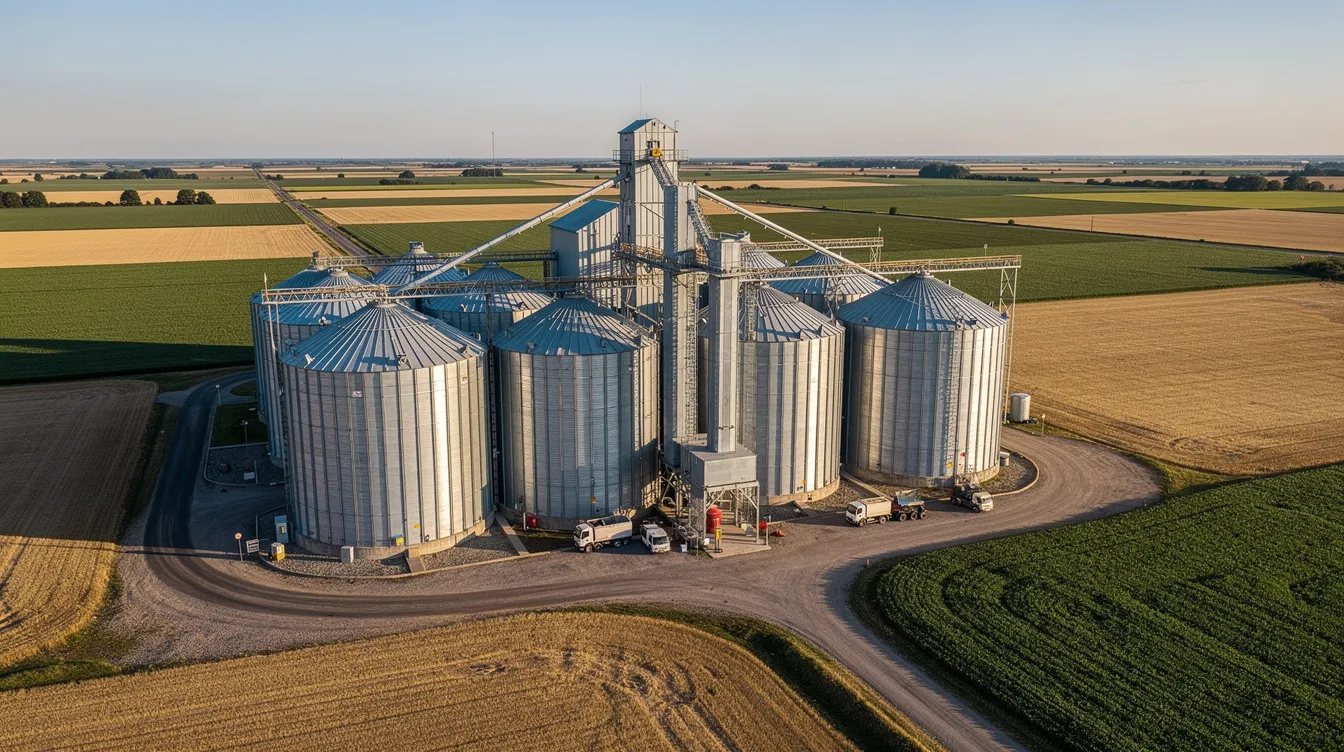
Agro-processing parks need a structured hub-and-spoke network for effective grain aggregation. The central processing centre (CPC) houses anchor tenants and shared infrastructure, while primary processing centres (PPCs) function as farm-proximate collection and basic storage hubs within a defined procurement radius. The Punjab Agro Mega Food Park, for example, operates a CPC at Ludhiana with PPCs at Hoshiarpur, Amritsar, Abohar, and Talwandi Sabo-each providing dry storage and cold storage capacities serving the central hub.
A typical Mega Food Park includes a 12 TPH rice mill and a 10,000 MT warehouse, along with 2,500 MT cold stores to serve both grain and perishable produce requirements. Some food processing parks are developed on 10 acres of land each for individual processing zones. Primary processing centres should focus on cleaning, grading, and moisture control before dispatching grain to the main park for further processing.
The types of grain-based food processing units typically hosted include:
- Rice mills and parboiling units (for reference, see integrated rice milling plant project reports)
- Wheat flour mills and atta chakki plants
- Dal mills for pulses
- Maize grit, starch, and animal feed plants
- Millet processing units for health food products
- Ready-to-cook mixes, breakfast cereals, and specialized packaging lines
Constructing internal roads and proper drainage systems are vital for operational efficiency, particularly in parks handling large volumes of seasonal grain arrivals. Common facilities such as weigh bridges, quality labs, steam generation boilers, packing facilities, and water supply systems reduce duplication and allow processing tenants to focus on their core production. Ripening chambers and pre cooling chambers serve the fruits and vegetables processing segments within mixed-use parks.
Food processing parks support raw material sourcing and storage, and national agriculture market reforms, digital trading platforms including e NAM, and improved logistics corridors are reshaping how agro processing parks connect to domestic and global markets.
Farmer, FPO and FPC Linkages for Grain Aggregation
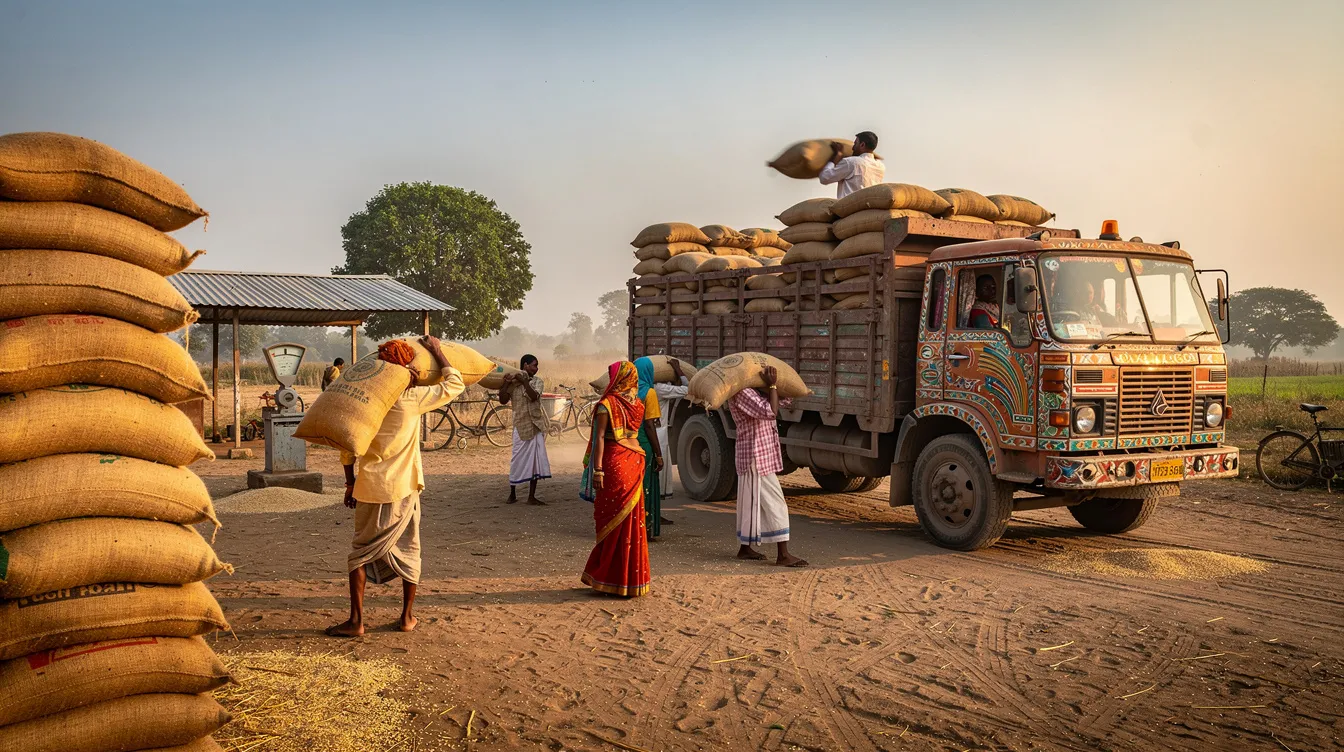
Direct linkages with farmers, FPOs, and FPCs reduce dependency on intermediaries, improve traceability of agricultural produce, and stabilise raw material supply for food processing units inside the park. Farmer aggregation is vital for ensuring a reliable grain supply to processing facilities, and without structured sourcing arrangements, most multi-tenant parks face chronic supply uncertainty.
Under the Government of India’s “Formation & Promotion of 10,000 FPOs” scheme, over 10,000 FPOs were formed by 2025, with cumulative funds of ₹827.81 crore released as management cost and ₹631.98 crore as matching equity. Over 5,765 FPOs now have their own processing units. However, many FPOs remain small-6,964 FPOs reported turnover up to ₹50 lakh, and only 1,135 crossed ₹1 crore-which means the park developer must carefully assess the institutional strength of potential supply partners.
Market research and crop selection are essential for identifying suitable grain types for processing, and the practical linkage models include:
- Direct farmgate procurement by a park-level aggregation centre, where the SPV or its agent purchases grain at announced rates at village collection points
- FPO or FPC supply agreements with minimum quantity commitments, quality bands (moisture, impurity, pest damage levels), and pre-agreed delivery windows aligned with harvest seasons
- Aggregator-led sourcing through third-party procurement companies contracted to handle pooling, transport, and quality assurance for multiple tenants
- Contract farming or buy-back arrangements with registered farmer groups, particularly for specialty crops like millets or organic cereals
FPOs and FPCs can be supported with training in quality control, moisture management, drying techniques, and post-harvest handling to meet park-level standards. This capacity building directly improves farmers welfare and helps farmers produce meet the requirements of institutional buyers and export markets.
Designing simple, bank-compliant contracts that define volumes, quality bands, delivery windows, payment timelines, and dispute resolution is essential. These contracts must respect state-specific mandi and marketing rules, which vary significantly across India. A properly prepared detailed project report should map existing FPOs within a defined radius, their membership base, typical production volumes, and ability to participate in grain aggregation arrangements. The paddy procurement and raw material planning approach used for rice mills illustrates how such mapping supports bankable documentation.
Grain Aggregation Models and Supply Chain Architecture
Three main operational models define how grain reaches processing tenants in a multi-tenant agro processing park:
| Model | Description | Working Capital Exposure | Advantages | Limitations |
|---|---|---|---|---|
| Independent tenant procurement | Each tenant procures grain independently; uses shared park storage and handling | Borne by each tenant | Flexibility; lower SPV risk | Duplication of effort; weaker bargaining; quality inconsistency |
| Centralised SPV procurement | Park SPV or dedicated company buys grain in bulk and supplies tenants | High; borne by SPV | Scale economies; quality control; cost efficiency | High inventory and financing burden; governance requirements |
| Third-party procurement agency | Independent aggregator contracted to source, handle, and deliver for multiple tenants | Split between agency and tenants | Professional procurement; reduced SPV capital exposure | Dependency on third party; agency margins |
A hybrid model is also possible, where the SPV provides infrastructure and facilitation while grain ownership rests with the tenant or supplier until final processing.
Digital systems facilitate inventory management and procurement in agro-processing parks, and digital platforms enhance transparency and accountability in grain procurement and storage. A park-level master plan should layout village-level collection centres, primary processing sheds for cleaning and drying, main silos and warehouses, truck parking, and internal roads to minimise turnaround time.
Aggregation plans must coordinate with seasonal cropping cycles. Grain arrives in concentrated bursts during harvest periods-typically 2-3 months for each major crop. Stock must be built during this window and released progressively to processors throughout the year. This creates substantial working capital requirements during post-harvest months, with inventory holding days often reaching 90-120 days.
The supply chain design must align with financial modelling assumptions: throughput volumes, storage turnover (number of stock cycles per year), average stock days, and working capital financing structure all feed directly into DSCR and IRR calculations. A shift in average inventory holding days from 30 to 60 days can nearly double the working capital requirement, materially affecting interest cost and debt-servicing capacity.
Common Infrastructure for Grain Collection, Storage and Handling
Grain aggregation in agro processing parks relies on shared infrastructure that no single MSME tenant could justify independently. Silos and warehouses are critical for bulk grain storage in agro-processing parks, and the choice between conventional godowns, scientific warehouses, and steel silos has direct implications for storage losses, capital cost, and operating expense.
A quality control laboratory is necessary for testing grain moisture and protein levels, and key infrastructure components include:
- Receiving infrastructure: truck unloading docks, receiving pits, digital weigh bridges, sampling stations
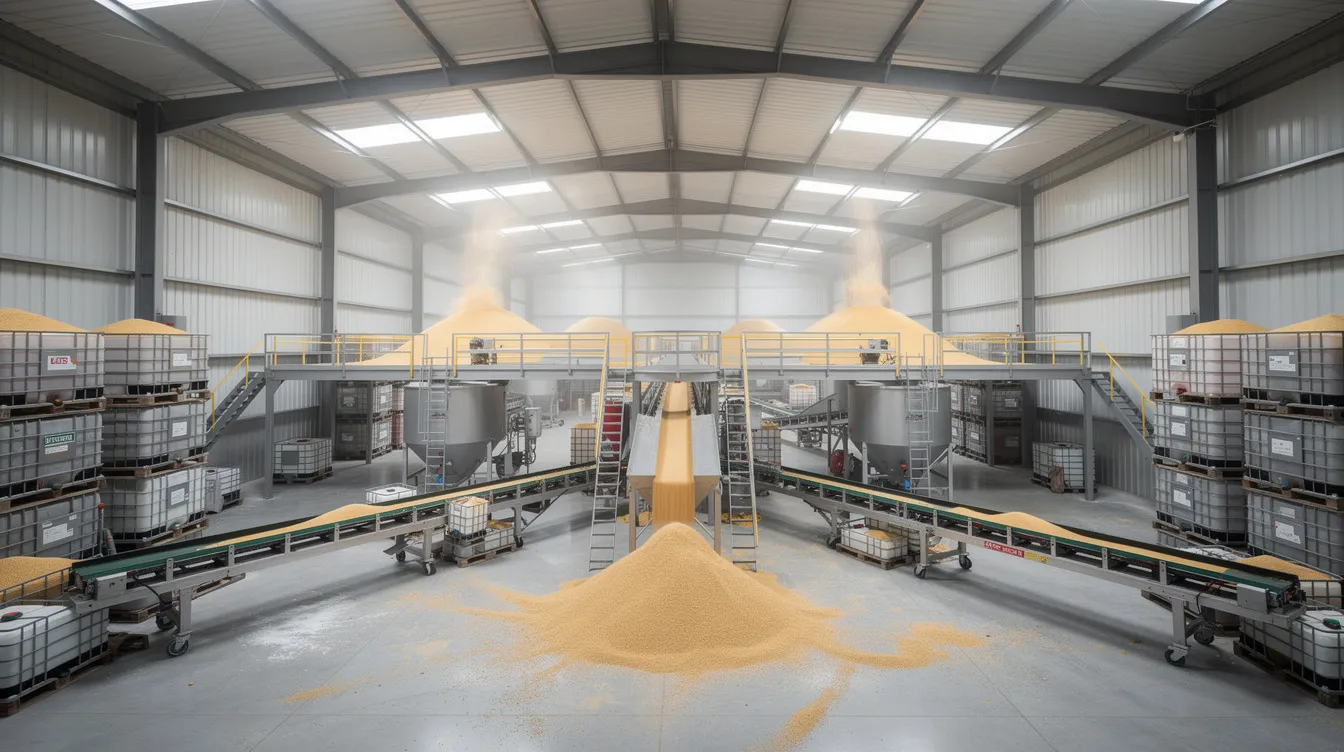
- Pre-processing equipment: pre-cleaners, destoners, dryers (where moisture content exceeds safe storage limits), grading units
- Storage systems: steel silos with aeration, conventional warehouses with humidity control, cold stores for specific commodities, cold storage facilities for raw material preservation
- Handling systems: belt or chain conveyors, bucket elevators, bagging and palletising lines
- Quality and food testing laboratories: moisture meters, impurity screens, mycotoxin testing, with NABL accreditation where required for export-grade produce
- Support infrastructure: power backup (DG sets, solar), water supply, fire safety systems, truck parking, administrative offices, food testing laboratories, and power backup systems
Proximity to grain-producing regions lowers transportation costs for agro-processing parks and should be a primary location selection criterion. Pest management and quality assurance are critical for maintaining stored grain quality-comparative data shows that godown storage losses (moisture, rodents, pests) can reach approximately 8% per annum, while modern silo systems reduce total losses to 0.2–1%.
Infrastructure sizing depends on expected annual throughput, peak harvest intake rate, commodity mix (wheat versus paddy versus maize versus millets and pulses), and typical storage duration. For a park planning 25,000 MT annual throughput, if 40% of the annual intake arrives during a 3-month harvest window, the daily intake design capacity should be roughly 150-200 MT per day-which determines the specification for handling equipment and receiving infrastructure.
Effective project planning incorporates land and infrastructure requirements for processing units, including industrial plots, common road networks, drainage, and utility corridors. The infrastructure and layout planning approach for integrated grain complexes provides a detailed framework for these design decisions.
Agro processing clusters require post-harvest storage facilities, and cold storage facilities are essential for agro processing projects, particularly where perishable produce like fruits and vegetables is handled alongside dry grain commodities.
Project Cost, Finance and Working Capital Planning
The total project cost for grain aggregation infrastructure within an agro processing park depends on scale, technology selection, commodity mix, and location. Agro processing projects can cost up to Rs 140 crores for comprehensive facilities. Infrastructure costs for agro processing can reach up to Rs 140 crores, depending on scope-for instance, developing post-harvest facilities in Kashmir costs Rs 140 crores for apple storage infrastructure alone.
Key benchmarked cost ranges for grain storage infrastructure include:
| Component | Approximate Cost Range | Notes |
|---|---|---|
| Steel grain silos | ₹50–90 lakh per 1,000 MT | Excluding land; varies with automation |
| Modern scientific warehouse | ₹4,000–6,500 per MT | For 10,000–50,000 MT capacities |
| Steel silo systems | ₹8,000–12,000 per MT | Including aeration and handling |
| 10,000 MT modern warehouse | ₹5–7 crore | Excluding land |
| 25,000 MT steel silo complex | ₹15–25 crore | Excluding land |
A Mega Food Park project in India costs Rs 80 crores-for reference, setting up Orissa’s first Mega Food Park costs Rs 80 crores, and a DPR for a Mega Food Park covers this scale of investment. Setting up 150 TPD facilities costs Rs 24 crores for fruit and grain processing lines, while developing 6 pilot plants costs Rs 30 crores. A detailed DPR can cost around Rs 30 crores for comprehensive agro projects involving multiple processing lines and common infrastructure.
Government schemes can provide financial support for agro-processing infrastructure development. Under the PMKSY Integrated Cold Chain and Value Addition Infrastructure scheme, grant assistance is typically 35% of eligible project cost in general areas and 50% in difficult areas or for FPO and SC/ST projects, subject to a ceiling of ₹10 crore per project. The scheme supports creation of cold storage, processing facilities, and common infrastructure. The scheme aims to attract investment into food processing sector development, and scheme supports both new projects and expansion of existing facilities. Grants in aid reduce the effective equity requirement for promoters, improving project returns.
Financial modelling is essential for agro processing project feasibility. Financial modelling supports investment decisions in agro processing projects, and financial modelling aids in assessing project costs and profitability across different scenarios. The typical means of finance structure involves:
- Promoter equity: 25–35% of total project cost
- Term loan: from banks or financial institutions
- Capital subsidy or grants: where eligible under central or state government initiatives
Loan structuring is an important component of financial planning for project financing, and loan structuring is a key component of bank finance reports. CMA Data is essential for securing bank loans, and financial projections are crucial for bank loan applications. Agro processing projects often require financial projections for viability assessment covering at least 7-10 years of projected operations.
Working capital for grain aggregation is driven primarily by inventory holding-grain purchased during harvest but processed or sold over subsequent months. For centralised procurement models, working capital exposure during peak post-harvest months can be substantial. The working capital planning approaches used in grain processing illustrate how inventory cycles, receivables, and operating expenses must be modelled together.
The analytical tools used in a bankable DPR include CMA Data preparation, projected balance sheet, profit and loss, cash flow statements, DSCR calculations, IRR and payback period estimates, and sensitivity analysis on grain price, throughput, and capacity utilisation. Banks typically expect DSCR above 1.25-1.30 in initial years, and sensitivity analysis must demonstrate that the project remains financially sustainable even after moderate adverse variations in key assumptions.
Understanding local market demands aids in designing processing capacities for grain, and the financial projections for agro processing parks must reflect realistic capacity utilisation ramp-up-often 50-60% in initial years, progressing to 70-80% over subsequent years.
Market Access, National Agriculture Market and Route to Global Markets
Modern agro processing parks can integrate with digital trading and national agriculture market platforms to expand market access well beyond local mandis. The e NAM platform has registered over 1.77 crore farmers and approximately 2.56 lakh traders, creating a digital marketplace that supports price discovery and reduces information asymmetry.
Quality-assured, aggregated grain enables tenants to produce standardised products suitable for institutional buyers, organised retail, e-commerce distribution, and export channels. The production of value addition products-branded flours, ready-to-cook mixes, breakfast cereals, health foods from millets-commands higher margins than commodity trading and creates stronger market linkages for the park ecosystem.
For developers considering global markets, the requirements include end-to-end traceability, compliance with food safety standards (FSSAI for domestic, Codex Alimentarius and destination-country regulations for exports), consistent supply volumes over long-term contracts, and appropriate packaging meeting export specifications.
Internationally, large-scale food park development demonstrates the commercial potential: establishing a food park in Tanzania costs US$ 27 million, and a food processing project in Uganda costs US$ 27 million as well. At the larger end, the Barikab Agricultural Economic Zone costs US$ 760 million and covers 100 sq. km, illustrating that agricultural economic zones can attract significant investment. A feasibility study for food parks in Kenya was conducted to evaluate similar potential. Feasibility studies support the establishment of agricultural economic zones by providing the commercial and technical validation that investors and development finance institutions require.
Location and logistics connectivity-proximity to highways, rail sidings, ports, or inland container depots-directly affects both inward raw material cost and outward finished goods logistics. The agro processing park revenue model must include a clear marketing strategy and buyer segmentation supported by realistic pricing and volume assumptions. Market demand assessment should cover domestic procurement by food brands, government procurement channels, and export potential based on quality standards achievable at the park.
Risk Assessment, Regulation and Compliance
Risk assessment for grain aggregation infrastructure covers several interconnected categories:
| Risk Category | Key Risks | Mitigation Approaches |
|---|---|---|
| Raw material | Crop failure, yield instability, procurement competition from FCI/government agencies | Multi-crop sourcing; multi-district catchment; buffer stock planning |
| Price | MSP changes, market price volatility, input cost escalation | Forward contracts; diversified supplier base; sensitivity modelling |
| Operational | Storage losses, pest infestation, machinery downtime, labour shortages | Silo investment; pest management protocols; maintenance schedules |
| Financial | Interest rate changes, cash flow mismatches, low utilisation | Conservative debt structure; phased capacity; working capital lines |
| Regulatory | Changes to mandi laws, GST interpretation, export restrictions, stock limits | Legal review; compliance monitoring; contractual flexibility |
Environmental compliance is mandatory in the establishment of agro-processing facilities-this includes building approvals, fire safety certification, pollution control clearances, and waste management systems. Specific requirements vary by state and commodity, so a one-size-fits-all compliance checklist is not appropriate.
Feasibility studies assess viability of agro processing projects by evaluating project costs and infrastructure needs comprehensively. Feasibility studies can include cold storage and processing facilities as integral components, and a feasibility study for a food park costs US$ 27 million at the upper end of international benchmarks. The integrated agro processing park feasibility study approach demonstrates how Indian park developers can structure these evaluations within local cost and regulatory parameters.
Insurance cover for stock, fixed assets, and business interruption should be included in operating expenditure estimates within the financial model. Contractual safeguards with farmers, FPOs, tenants, and logistics providers must address quality disputes, delivery delays, and payment default risk with clear escalation and resolution mechanisms.
DPRs include design and planning for processing facilities along with structured risk matrices and mitigation strategies that satisfy lenders’ due diligence expectations. The bank loan DPR and CMA Data documentation must demonstrate that the promoter has identified, quantified, and planned for the principal risks before requesting finance.
Role of Project Report Bank in Grain Aggregation DPRs
Project Report Bank is a Chartered Accountant-led advisory practice that prepares customised DPRs, financial models, and feasibility studies for agro processing parks and grain aggregation projects. DPRs assess feasibility for agro-processing projects, DPRs support the establishment of food processing clusters, and DPRs are essential for securing bank finance for projects of this nature and scale.
Services relevant to grain aggregation park projects include:
- Industrial project planning and agro processing cluster project report preparation
- Project cost estimation covering land, buildings, silos, machinery, utilities, and pre-operative expenses
- Plant and machinery configuration and production capacity planning for multi-tenant agro food processing parks
- Financial projections including DSCR, IRR, NPV, and break-even analysis
- CMA Data preparation and bank loan proposal support
- Investor-ready documentation for equity fundraising
- Setup cost analysis and means of finance planning
- Industry mix and value chain integration advisory
The firm works with serious promoters, MSMEs, and SPVs to create documentation that aligns with bank appraisal formats and investor expectations. Professional DPRs reduce project risk by validating assumptions on raw material availability, market demand, project economics, and regulatory compliance before large capital is committed. This is particularly important for grain aggregation infrastructure, where catchment assessment, seasonal procurement planning, and working capital modelling directly determine commercial viability.
Planning an Integrated Agro Processing Park or Grain Aggregation Project?
Project Report Bank provides professional assistance with detailed project reports, feasibility studies, financial projections, CMA Data and bank finance documentation, integrated agro-processing park investment planning, and investor-ready project documentation for grain aggregation infrastructure and food processing clusters anywhere in India.
CA Manish Gugliya, FCA, DISA (ICAI) ProjectReportBank.com Website: https://projectreportbank.com/
Serious industrial investors, developers, SPVs, and entrepreneurs are invited to initiate discussions through the website or WhatsApp for project-specific advisory. Every engagement is based on customised analysis and project-specific assumptions-not generic templates.
Frequently Asked Questions (FAQ)
How is grain aggregation different from a normal warehouse?
A normal warehouse provides passive storage-grain is received, stored, and dispatched. Grain aggregation in an agro processing park context encompasses active procurement from multiple sources, quality testing and grading at intake, cleaning and drying where required, inventory management coordinated with tenant production schedules, and dispatch planning aligned with seasonal and commercial requirements. The aggregation function adds procurement logistics, quality assurance, and supply coordination to the basic storage function, directly affecting the financial feasibility and capacity utilisation of the entire park.
Can small MSME units in remote districts benefit from agro processing clusters?
Yes, provided the cluster is planned around locally available agricultural produce and realistic market demand. The economic rationale of agro processing clusters is that shared infrastructure-weigh bridges, laboratories, storage, power backup, water supply-reduces the per-unit investment each MSME must make. In remote or difficult areas, government scheme support may be higher (50% of eligible project cost versus 35% in general areas), improving project economics. However, each project requires state-specific and crop-specific analysis to determine whether sufficient raw material surplus and market access exist to support viable operations. The land requirement analysis for agro processing parks addresses these location-specific considerations.
What minimum scale justifies a dedicated aggregation hub?
There is no universal threshold, but as a practical guideline, a dedicated aggregation hub with silos, quality lab, and handling equipment typically becomes economically viable when the combined raw material requirement of processing tenants exceeds 15,000-20,000 MT per annum. Below this level, shared warehouse rental or third-party aggregation may be more cost-effective. The breakeven depends on storage infrastructure cost, utilisation, handling charges, and the cost differential between organised procurement and open-market purchase. Financial modelling should test the sensitivity of project returns to utilisation rates between 50% and 80%.
How long does a DPR for an agro processing park typically take?
A comprehensive DPR for an integrated agro processing park, including catchment assessment, tenant demand mapping, infrastructure planning, detailed cost estimation, financial projections, DSCR and IRR analysis, and risk assessment, typically requires 6-12 weeks of professional work. The timeline depends on the complexity of the project, availability of site and production data, number of processing tenants to be evaluated, and whether subsidy or scheme applications need to be coordinated. Preliminary feasibility assessments can often be completed faster to support initial investment decisions before committing to a full DPR.
Can one park handle both domestic and export-focused food processing?
Yes, many integrated parks are designed to serve both domestic and export markets. However, export-focused processing requires higher standards of traceability, food safety documentation, quality control, and packaging. The park infrastructure must accommodate food testing laboratories capable of testing for mycotoxins, pesticide residues, and other export-grade parameters. Storage and handling systems must support lot-wise traceability. The marketing strategy within the DPR should clearly segment domestic and export revenue streams, with distinct pricing, volume, and compliance assumptions for each channel.