Key Takeaways
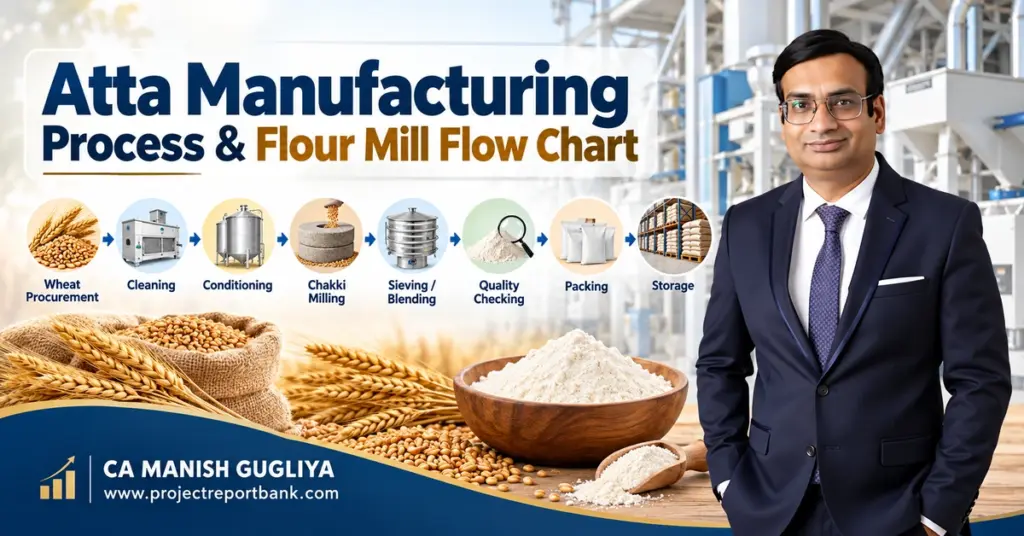
- The atta manufacturing process follows a defined sequence: Wheat Procurement → Cleaning → Conditioning → Chakki Milling → Sieving/Blending → Quality Checking → Packing → Storage. Each stage directly influences the quality, yield and cost of the finished product.
- Understanding the complete atta manufacturing process flow chart is essential before deciding plant capacity, machinery configuration and investment for any commercial flour mill.
- Cleaning and wheat conditioning are as critical as chakki milling itself. Skipping or underinvesting in these stages compromises flour quality, increases machinery wear and reduces extraction yield.
- Process design directly impacts wheat consumption, electricity cost, labour deployment, working capital and profitability of an atta chakki plant.
- This article is written from the perspective of CA Manish Gugliya of Project Report Bank, combining both technical process knowledge and financial advisory experience for entrepreneurs planning atta manufacturing units.
Introduction: What Is Atta and Why the Manufacturing Process Matters
Atta is whole wheat flour produced by grinding clean wheat so that bran, wheat germ and endosperm are retained together. It is the primary flour used across Indian households for chapatis, rotis, parathas and other traditional flatbreads. The entire process of atta production is aimed at improving the suitability for making these flatbreads, and atta retains the nutrient-rich bran and germ from wheat, making it fundamentally different from refined white flour such as maida.
There is a significant gap between grinding wheat at a neighbourhood chakki and running a commercial atta manufacturing process in an organised flour mill. A local shop may simply feed wheat kernels into a small stone grinder and hand over the flour. An organised plant must manage cleaning, conditioning, controlled milling, sieving, blending, quality control, packing and storage-each stage governed by defined process parameters and food safety requirements.
As plant size and automation increase, process control over moisture content, temperature, particle size and consistency becomes critical. Entrepreneurs, MSME promoters and investors must understand the complete wheat to atta manufacturing process before finalising machinery, plant capacity and project finance. Without this understanding, machinery selection happens in isolation, financial projections lack an operational base, and the resulting business plan may not reflect ground reality.
Atta Manufacturing Process at a Glance
Before examining each stage in detail, here is the core sequence of a commercial atta production process:
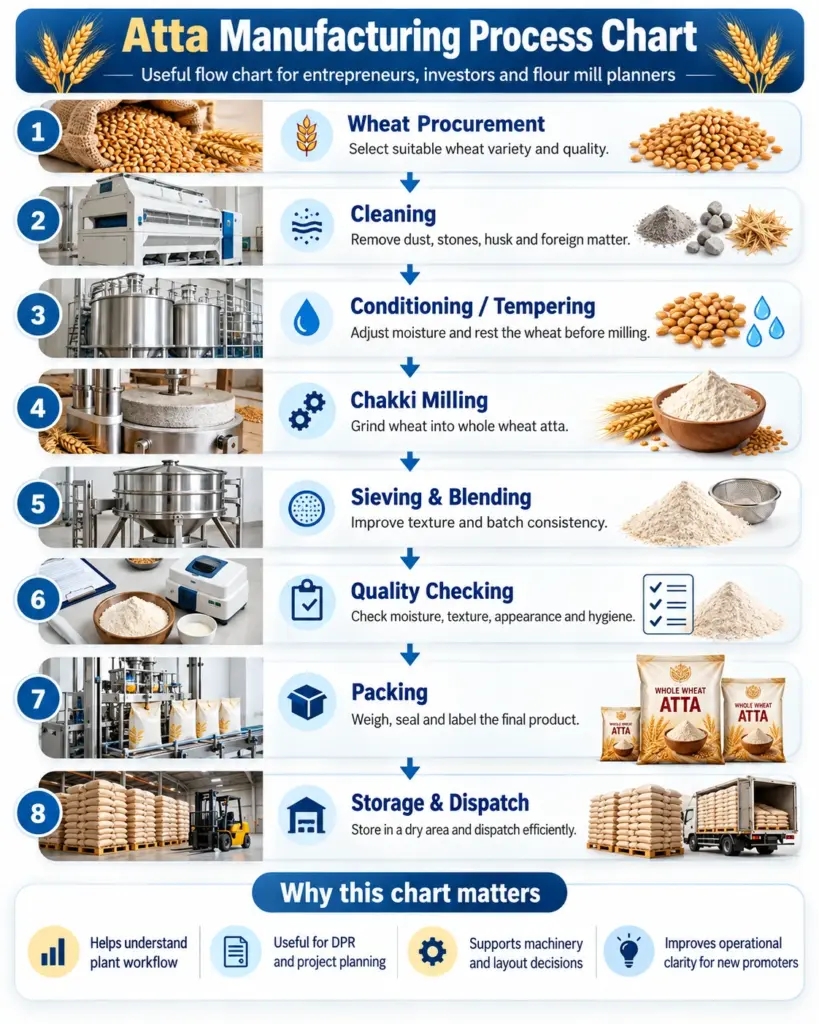
Wheat Procurement → Cleaning → Conditioning → Chakki Milling → Sieving/Blending → Quality Checking → Packing → Storage
Each stage contributes a specific function:
- Cleaning removes stones, dirt, metallic pieces and other impurities from raw wheat.
- Conditioning prepares wheat grains for efficient flour milling by adjusting moisture.
- Chakki milling grinds the whole grain into flour, retaining bran and germ.
- Sieving and blending ensure consistent particle size and uniform product characteristics.
- Quality checking maintains food safety and product specifications.
- Packing and storage protect the finished product from moisture, pests and degradation.
Atta manufacturing transforms raw wheat into whole-wheat flour through cleaning, conditioning, grinding, and sifting. However, actual plant configurations may vary based on:
- Plant capacity (a 1 TPH unit versus a 5 TPH line requires different equipment counts and layout)
- Wheat varieties (hard versus soft, protein level, regional origin)
- Target product (chakki atta, multigrain atta, specialised whole wheat flour)
- Level of automation (semi-automatic versus fully automatic atta plant process)
- Customer type (bulk supply to bakeries versus branded packaged wheat flour for retail shelves)
The following sections expand this overview into a detailed atta manufacturing plant workflow suitable for DPR preparation and feasibility planning.
Step-by-Step Atta Manufacturing Process
This section breaks down each critical step in the wheat flour manufacturing process for atta. While terminology may appear technical, these are everyday operational controls that any commercial flour mill must manage. The quality and efficiency at each stage determine whether the plant produces consistent, marketable atta or faces complaints, wastage and financial losses.
1. Wheat Procurement and Raw Material Selection
Wheat is the principal raw material for atta, typically sourced from major wheat-growing states such as Madhya Pradesh, Rajasthan, Uttar Pradesh, Punjab and Haryana. India processes several wheat varieties-Sharbati, Lok 1, PBW series and others-each differing in gluten strength, protein content, colour and chapati softness. Many commercial plants blend varieties to balance cost and performance, since no single variety may deliver all desired attributes at the lowest price.
Key quality parameters checked at procurement include moisture content (generally targeted at or below 12%), protein level, gluten strength, test weight (often 78–80 kg per hectolitre for premium grains), and the presence of shrivelled, damaged or insect-infested grains and foreign materials. Procurement lots failing these checks require rejection or price adjustment.
From a financial and DPR perspective, wheat procurement strategy significantly influences working capital requirement, purchase timing (harvest season versus lean season), raw material cost per tonne and overall gross margin. Seasonal wheat price fluctuations can materially affect cash flow, making procurement planning an important operational and financial decision.
2. Wheat Cleaning
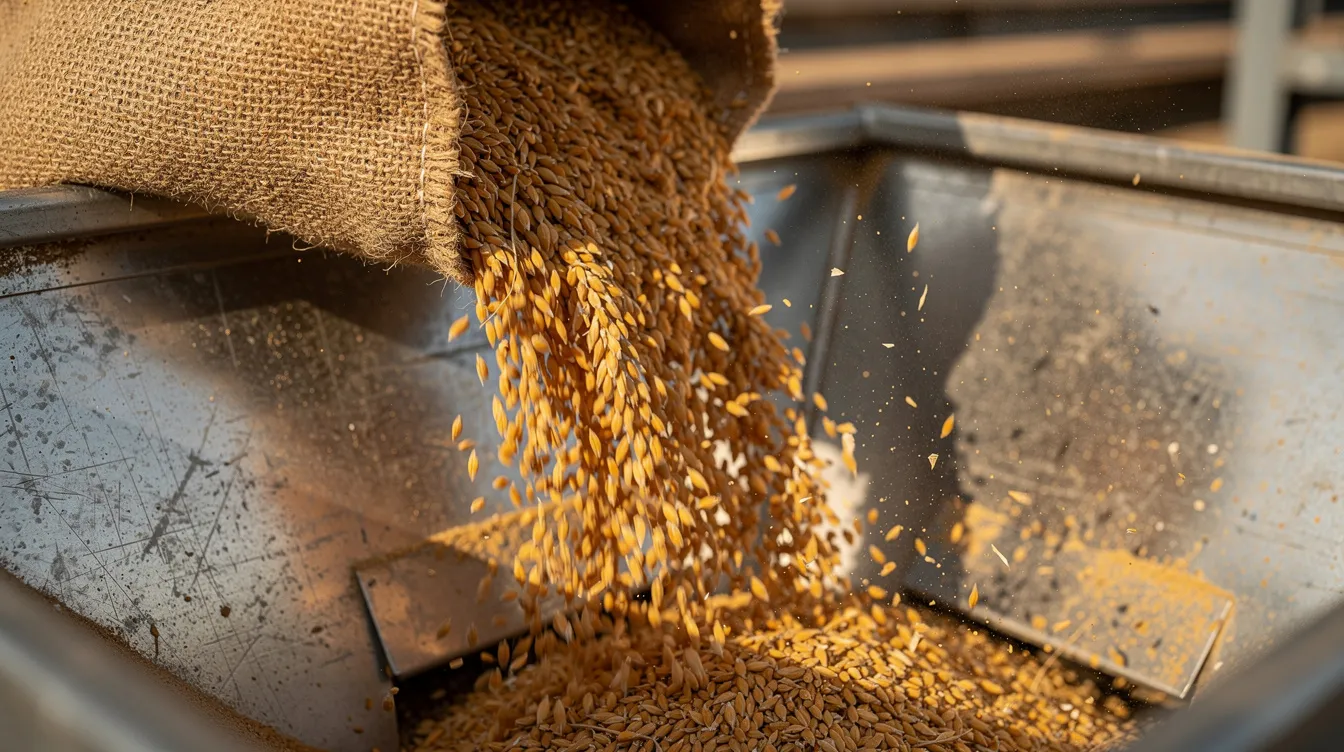
Newly received wheat usually contains dust, straw, chaff, stones, metal pieces and other foreign materials. Wheat cleaning removes impurities like stones and dirt before any wheat milling process can begin. Wheat is cleaned to remove impurities before milling, and this step is essential to prevent equipment damage.
Typical cleaning operations include:
- Pre-cleaning with coarse screens to remove large impurities like straw and sticks
- Fine screening using a vibrating screen to separate smaller particles
- Aspiration to remove light chaff and dust through air current
- Magnetic separator units to catch iron and steel fragments
- Destoning machines to remove stones and heavy debris
Efficient cleaning enhances the quality of the final flour product, protects chakki stones and other machinery from damage, ensures smoother material flow and reduces contamination risk. An atta chakki plant typically uses a combination of elevators, cleaners, destoners and magnets designed for the rated flour mill capacity. Promoters interested in detailed equipment specifications can refer to the guide on atta chakki machine and automatic atta plant machinery cost.
3. Wheat Conditioning or Tempering
Conditioning, also called tempering, means adding or adjusting moisture and allowing wheat grains to rest in tempering bins for a defined period before milling. Water is added during conditioning to toughen the outer bran layer and mellow the endosperm. This controlled moisture addition helps soften the bran while keeping the endosperm firm, improving how the grain breaks during grinding.
Conditioning adjusts wheat moisture to 14% to 15.5% for milling, though the optimal moisture content for wheat depends on the initial moisture level, hardness of the grain, local climate, plant design and desired product characteristics. Conditioning improves milling efficiency and flour quality. Over-conditioning produces too-wet flour that invites mould during storage, while under-conditioning causes excessive bran flaking, higher heat generation and reduced yield.
For commercial wheat flour manufacturing, conditioning is monitored with simple moisture meters and controlled water dosing systems. There is no universal fixed resting time-it varies by wheat type, ambient humidity and mill configuration.
4. Chakki Milling
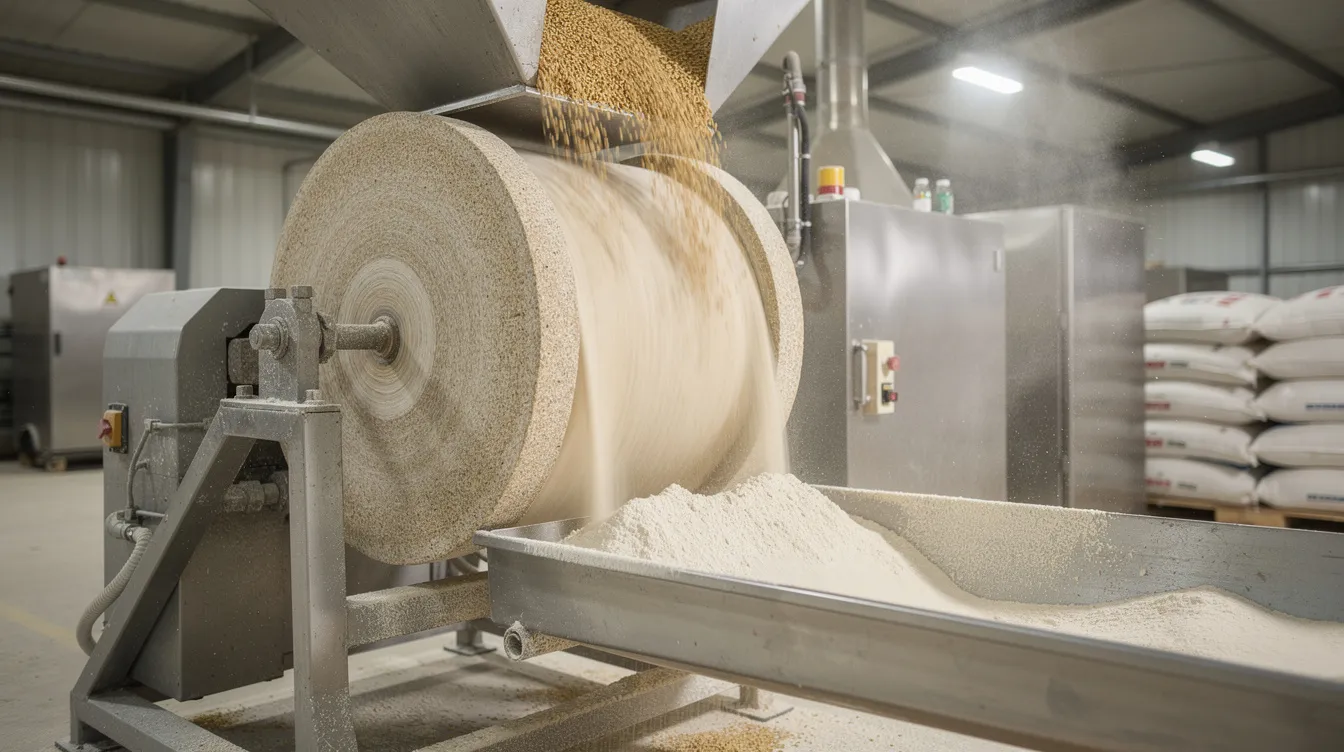
In the chakki atta manufacturing process, cleaned wheat that has been conditioned is fed between rotating stone discs or emery stones that grind the entire grain-bran, germ and endosperm-together into whole wheat flour. Wheat grinding involves breaking down kernels into smaller particles, and the grinding process determines the texture and quality of flour.
There is a meaningful difference between traditional small stone chakkis used at retail shops and commercial or automatic chakki systems designed for industrial flour production. Commercial units operate at higher capacity with continuous feeding, dust control and motor power sized for sustained production. The milling technology influences the final flour’s ability to absorb water and maintain softness, which directly affects chapati quality.
Proper setting of stone gap, feed rate and regular dressing of grinding stones are important for controlling particle size, temperature rise and stone wear. Excessive heat during grinding can alter atta colour, flavour and starch damage levels. Whole-wheat atta production emphasises retaining bran and germ for improved nutritional value, so the milling process must balance throughput with product quality.
Plant promoters should choose chakki capacity based on realistic demand, available power and alignment with upstream cleaning and downstream packing sections, rather than simply purchasing the largest marketed machine.
5. Sieving and Flour Separation
Immediately after chakki milling, the ground wheat mass passes through sieves to achieve the required texture. Flour sifting separates fine flour from bran and coarse particles. Wheat milling involves grinding, sifting, and purification as integrated operations. Sieving ensures consistent texture for commercial flour packaging.
High plansifters use multi-layer lattices for flour grading, and flour purification may need to be repeated multiple times to achieve the desired particle size distribution. Oversize coarse particles are typically recycled for regrinding. The final milling stage ensures uniform flour quality and purity.
For chakki atta-being a whole wheat product-the objective is not to remove all bran as in maida production, but to control the distribution of fine and coarse particles for good chapati quality and dough handling. Sieve mesh size and the number of sieving stages are selected according to product specification and flour mill design, impacting output capacity and flour characteristics.
6. Blending and Standardisation
Flour from different chakkis or different time batches may be mixed in batch mixers or continuous blenders to achieve consistent colour, aroma, taste and dough behaviour. Blending different wheat varieties can ensure consistent flour characteristics in the production of atta. This is particularly important for branded packaged wheat flour manufacturers where lot-to-lot uniformity builds consumer trust.
Blending may involve combining atta from different wheat varieties to balance protein, gluten strength and softness according to brand positioning. Some plants may also consider fortification, which may involve adding micronutrients like iron and vitamins to the atta, depending on regulatory requirements or market positioning.
Standardisation through natural blending and process-based controls-not through unverified additives-is the foundation of consistent quality in commercial flour production.
7. Quality Checking
Quality control runs throughout the atta manufacturing process, but formal checks on finished atta before packing are critical. Quality checks include moisture content, particle size, and protein levels during the atta production process. Additional parameters typically assessed in a basic flour mill lab include colour, appearance, aroma, taste on test baking, presence of foreign matter and basic hygiene indicators.
Larger plants or export-oriented units may conduct more developed testing, including microbiological analysis, gluten percentage and ash content, depending on market and regulatory requirements such as IS 1155:2022 standards. Consistent quality reduces wastage, customer returns and price discounts, thereby supporting stable cash flows and better financial performance.
8. Atta Packing
Packing serves two broad modes:
- Bulk packing in 25 kg or 50 kg bags for bakeries, hotels and institutional buyers
- Branded retail packaging in 1 kg, 2 kg, 5 kg and 10 kg bags for household consumers
Packaging protects finished flour from humidity and prevents rancidity, thereby maintaining freshness. Finished atta is packaged in moisture-proof bags to extend shelf life. Flour packaging typically uses automatic machines for efficiency, ensuring accurate weighing, proper sealing, clean filling and clear labelling with batch code, manufacturing date, expiry date and statutory details.
Packaging material selection-laminated pouches, HDPE or paper bags-depends on protection requirements, branding needs and handling strength during transport. For packaged wheat flour targeting modern trade and e-commerce, leak-proof sealing, tamper evidence and attractive design play an important commercial role in the market.
9. Finished Goods Storage and Dispatch
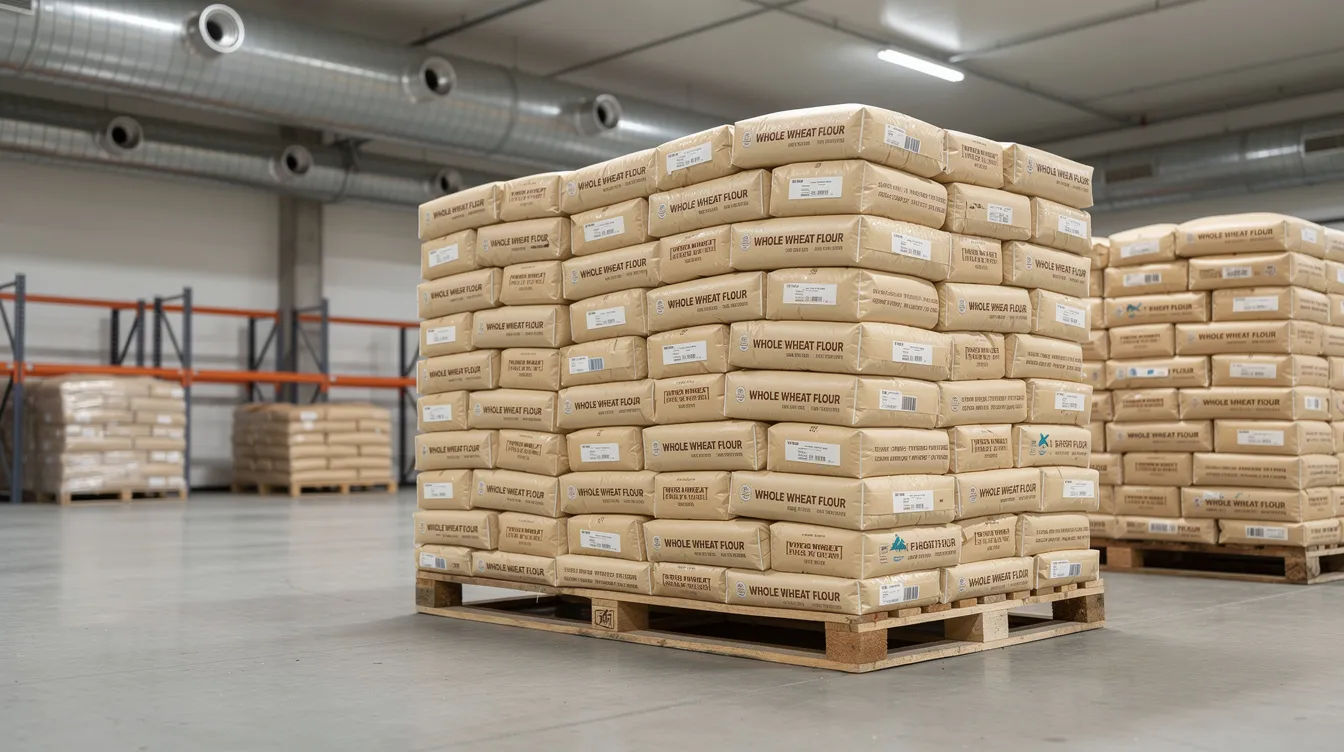
Packed atta must be stored in a dry, ventilated, pest-controlled warehouse, preferably on pallets, away from walls and direct moisture sources. Flour should be kept dry and ventilated during storage. Proper storage prevents flour quality degradation. Ideally, flour should be stored at 10–20 °C, and relative humidity for flour storage should be below 60%.
FIFO (First In, First Out) or FEFO (First Expiry, First Out) rotation is important because atta is a food product with limited shelf life-typically around two to three months under normal room conditions. Good warehouse layout, clear stacking and systematic dispatch planning help maintain product quality and minimise damage and pilferage.
From a financial perspective, excessive finished goods inventory blocks working capital. Production planning and dispatch scheduling should align with realistic sales forecasts to avoid unnecessary carrying costs.
Atta Manufacturing Process Flow Chart
The following flour mill process flow chart provides a more detailed view of the entire process from wheat intake to dispatch, suitable for inclusion in DPRs and feasibility studies:
Wheat Procurement ↓ Raw Wheat Storage ↓ Pre-Cleaning & Cleaning ↓ Destoning / Magnetic Separation ↓ Conditioning / Tempering ↓ Chakki Milling / Grinding ↓ Sieving ↓ Blending / Standardisation ↓ Quality Checking ↓ Weighing & Packing ↓ Finished Goods Storage ↓ Dispatch
Smaller plants may combine some steps-for example, cleaning and destoning in a single integrated machine-whereas larger automatic atta plant process lines may add intermediate storage bins, dust collection systems and automated sampling points between stages.
Although different manufacturers may present slightly different process diagrams, the core sequence from wheat procurement to packed atta dispatch remains consistent across most commercial atta processing plant designs in India.
Machinery Used in an Atta Manufacturing Plant
Machinery should be selected after finalising required capacity (tonnes per day), product range and intended level of automation. Typical equipment categories in a commercial wheat flour manufacturing plant include:
- Grain receiving and intake systems
- Raw wheat storage silos or bins
- Pre-cleaners and vibro separators
- Aspirators for light impurity removal
- Destoners for stones and heavy debris
- Magnetic separators for metallic contaminants
- Conditioning or tempering equipment with water dosing
- Chakkis or industrial atta mills (stone disc or emery stone type)
- Bucket elevators and conveyors for material transfer
- Sieving machines and plansifters
- Flour collection and transfer systems
- Blenders or mixers for standardisation
- Weighing and packing machines
- Dust-control systems and air filtration
- Control panels and basic instrumentation
The exact number and size of machines depend on plant capacity, process flow and desired automation level. Power requirements scale significantly-a small chakki unit may need 7.5–22 kW, while plants processing 1–2 tonnes per hour may require 30–60 kW or more. Detailed costing and model selection vary by vendor, technology and location. Readers seeking specific price and specification information can refer to the detailed guide on automatic atta plant machinery and equipment cost.
Factors That Affect Atta Plant Process Design
Process design determines how wheat moves from intake to finished atta, which machines are used, what level of automation is adopted and how different sections are balanced in capacity. Key factors include:
- Planned production capacity (30 TPD versus 120 TPD requires fundamentally different layouts)
- Number of working shifts per day and operating days per month
- Locally available wheat varieties and their quality profile
- Target product mix (only chakki atta or various types of wheat flour)
- Desired extraction rate and acceptable process losses
- Labour availability and skill level
- Degree of automation (manual bag handling versus conveyors and PLC-controlled lines)
- Space constraints and plant layout options
- Storage requirements for raw wheat and finished atta
- Preferred packaging formats and branding strategy
- Power availability and cost per kWh
- Dust management and environmental considerations
- Provision for future expansion
In project-report practice, process design, machinery selection and building layout should be finalised together. Changing one without adjusting the others often creates bottlenecks and financial inefficiencies.
Atta Plant Capacity and Production Planning
The rated capacity of a flour mill machine (tonnes per hour) is not the same as saleable atta output over a month or year. Production planning must account for the relationship between:
- Milling capacity in kg per hour
- Effective operating hours per day (after excluding cleaning, maintenance and stoppages)
- Tonnes per day (TPD)
- Number of shifts
- Practical capacity utilisation as a percentage of rated capacity
- Process losses including dust, cleaning waste and yield from the extraction rate
Illustrative Example (for understanding only, not a standard industry assumption): If a chakki section is rated at 2 tonnes per hour and the plant operates for 10 effective production hours, theoretical milling throughput is 20 tonnes per day. Actual saleable atta will be lower after accounting for cleaning loss, process yield, downtime and realistic capacity utilisation. Exact figures depend on plant design, wheat quality and operating conditions.
In financial modelling, I generally recommend that promoters reconcile machine-wise capacity, working shifts and market demand to avoid overestimating revenue and DSCR. Continuous year-round utilisation at high rates may not be realistic for new atta brands entering the market, so cautious assumptions are advisable in DPRs.
Atta Manufacturing Plant Setup Considerations
Plant setup decisions extend beyond the core milling process to cover land, building, utilities, licensing and working capital. Key aspects include:
- Land area requirements based on capacity and storage needs
- Building design with separate zones for raw material, process area, packing section, finished goods and quality control lab
- Appropriate floor height and load-bearing capacity for equipment and storage
- Power connection planning, DG backup and panel room
- Water supply for conditioning and utilities
- Ventilation and dust-control strategy
- Laboratory and quality-control area
- Staff facilities and office space
- Licensing and food business registration requirements applicable in India
This section is intentionally kept at a high level. Readers planning an investment can refer to the detailed guide on atta chakki plant setup cost in India for specific cost components and investment estimates.
Difference Between Traditional Chakki and Automatic Atta Plant
Both traditional chakki and automatic atta plant use the principle of grinding wheat into flour. Milling can be performed using traditional stone mills or modern roller mills or commercial disc-based chakki systems. However, they differ substantially in scale, consistency, process integration and suitability.
Illustrative Comparison: Traditional Chakki vs Automatic Atta Plant
| Parameter | Traditional Stone Chakki | Automatic Atta Plant / Commercial Flour Mill |
|---|---|---|
| Typical capacity | 50–200 kg/hour | 500 kg to several tonnes per hour |
| Automation level | Manual feeding and collection | Automated feeding, milling, sieving and packing |
| Cleaning system | Basic or none; customer may bring cleaned wheat | Integrated cleaning line with destoner, aspirator, magnetic separator |
| Product consistency | Varies batch to batch | Standardised and controlled for brand quality |
| Labour per tonne | Higher | Lower due to automation and scale |
| Packaging integration | Loose flour; customer brings own container | Packed in branded bags with batch coding and sealing |
| Quality control | Visual inspection, experience-based | Lab testing for moisture, particle size, gluten, appearance |
| Ideal use case | Neighbourhood grinding services, local supply | Regional or national branded wheat flour manufacturing |
Neither system is universally superior. Small neighbourhood chakkis serve local grinding demand effectively, while automatic plants suit regional or national packaged wheat flour brands requiring consistent quality and food safety systems. Promoters upgrading from traditional chakki to automatic plant should plan for process redesign, quality systems and branding-not just machinery replacement.
The coarse milling stage separates bran from the endosperm in roller-based systems, while fine milling uses fine rollers to produce very fine flour particles for products like maida. For a detailed comparison of roller flour milling, readers may find the guide on roller flour milling process and flow chart useful.
Common Mistakes While Planning an Atta Manufacturing Plant
Based on reviewing multiple atta and wheat flour project reports over the years, here are frequent mistakes I observe:
- Finalising machinery first and estimating market demand later
- Assuming rated TPH equals actual saleable output without considering downtime and process loss
- Underestimating the importance of wheat cleaning and conditioning, leading to quality complaints and higher maintenance costs
- Providing inadequate raw wheat storage, creating price vulnerability and inconsistent wheat quality across seasons
- Ignoring working-capital needs for wheat procurement, packaging materials and receivables
- Designing a cramped layout that hampers material flow and prevents future scale-up
- Selecting packing machines with lower capacity than the milling section, causing bottlenecks
- Poor dust control, leading to product loss, workplace hazards and hygiene issues
- Preparing project cost solely from machinery quotations without including building, utilities, pre-operative expenses and contingencies
Involving both technical and financial professionals early in planning significantly reduces the probability of these costly errors.
Financial and DPR Perspective on the Atta Manufacturing Process
In my experience preparing detailed project reports at Project Report Bank, the atta manufacturing process is not just a technical narrative-it is the operational foundation of every financial projection. Here is how process parameters translate into numbers:
- Installed milling capacity defines maximum potential turnover
- Capacity utilisation assumptions directly influence revenue projections year by year
- Wheat consumption norms and extraction rate (typically 90–95% for chakki atta) drive raw material cost, the single largest expense
- Process losses from screening, bran separation and dust impact the quantity of saleable atta and therefore gross margin
- Electricity and labour needs depend on plant configuration, automation level and operating shifts
- Packaging cost per kg is tied to the pack size mix-a plant selling mostly 1 kg retail packs has higher packaging cost per tonne than one selling 50 kg bulk bags
- Inventory norms for raw wheat and finished atta determine the working-capital requirement
A sound DPR ensures reconciliation between machinery capacity, production schedule and projected sales. It should use realistic assumptions on operating days, downtime and credit periods for both wheat suppliers and customers. DSCR and break-even calculations must be consistent with actual processing realities.
I would advise entrepreneurs to avoid copy-paste project reports. Instead, insist on project-specific analysis that reflects your location, wheat availability, market positioning and chosen atta manufacturing plant workflow. For those exploring comprehensive DPR structures for wheat flour projects, the wheat flour mill project report guide covers the essential cost and planning framework.
Frequently Asked Questions
What is the basic process of manufacturing atta in a commercial plant?
The core sequence is: Wheat Procurement → Cleaning → Conditioning → Chakki Milling → Sieving/Blending → Quality Checking → Packing → Storage/Dispatch. All stages matter-skipping or weakening cleaning or conditioning can compromise flour quality and yield. This is the standard flow used in most commercial atta processing plant layouts in India, with minor variations based on capacity and automation.
How is wheat converted into atta in the chakki atta manufacturing process?
Cleaned and conditioned wheat grains are ground between rotating stone discs or emery stones, which crush the full grain-bran, germ and endosperm-together. The ground material is then sieved to achieve the required texture, with oversize particles sometimes reground depending on the flour mill process design. The final product is whole wheat flour retaining all grain components, unlike refined maida where bran and germ are separated.
What machinery is typically required for a small to medium atta manufacturing plant?
Main equipment groups include grain intake and storage systems, cleaners and destoners, magnetic separator, conditioning system, chakkis, elevators and conveyors, sieves, flour blender, weighing scales and packing machines, along with dust-control equipment. Exact machine models, counts and capacities depend on planned TPD and product mix.
What is wheat conditioning before milling and why is it important?
Conditioning or tempering means adjusting wheat moisture and letting grains rest so that bran and endosperm respond optimally during grinding. Proper conditioning improves milling efficiency, reduces breakage problems and supports consistent atta texture, while helping manage heat build-up during flour milling. Conditioning targets differ by wheat type and plant setup-there is no single fixed percentage suitable for all mills.
How does chakki atta differ from roller-milled wheat flour?
Chakki atta is produced by stone grinding the entire wheat kernel into whole wheat flour, commonly used for chapatis and rotis. Roller-milled flour typically separates bran, germ and endosperm through multiple break and reduction passages, producing refined flour like maida as well as other grains of wheat flour. Fine milling in roller mills produces flour with very fine particles. Texture, water absorption and dough behaviour differ between chakki atta and roller-milled flour, making them suited to different end uses in the food industry. Roller mills may also produce “resultant atta” by recombining separated fractions.
What should be considered before setting up an automatic atta plant?
Promoters should evaluate realistic market demand, wheat sourcing strategy, required production capacity, level of automation, plant layout, power availability, working-capital requirement, packaging format and applicable food safety licensing before committing capital. Financial feasibility should be assessed through a properly prepared DPR rather than relying on machinery vendor estimates alone.
Conclusion
The complete atta manufacturing process-procurement → cleaning → conditioning → milling → sieving/blending → quality control → packing → storage/dispatch-forms the operational backbone of any commercial wheat flour business. Success depends on much more than installing chakkis. Promoters must focus on raw wheat quality, robust cleaning systems, accurate conditioning, controlled milling, consistent blending, strong quality control and appropriate packaging to produce atta that meets market expectations.
Process choices directly affect wheat consumption, extraction rate, power use, labour deployment, working capital, yield and ultimately the profitability and debt-servicing capacity of the project.
In every project report and financial model I prepare at Project Report Bank, the atta manufacturing process flow is always the starting point for realistic capacity, cost and revenue assumptions. I encourage readers to use this process understanding as a foundation before engaging with detailed DPR preparation, machinery selection and bank finance discussions for their own wheat flour manufacturing projects.
CA Manish Gugliya FCA, DISA (ICAI) More than 20 years of professional experience in project reports, financial projections, CMA Data, project finance and business advisory.