Key Takeaways
When entrepreneurs search for atta chakki machine price, they usually expect a single number. In practice, a commercial atta chakki or automatic flour mill plant is not one machine – it is an integrated line comprising wheat cleaning equipment, grinding machinery (chakki stone mill or pulveriser), sifting systems, material handling (bucket elevators, screw conveyors), storage bins, control panels and atta packing machines. The price of each section varies depending on capacity, automation, material of construction and scope of supply.
A basic 7.5 HP commercial atta chakki machine with approximately 75–80 kg/hr output can start from under a lakh for the grinder unit alone (ex-motor, ex-GST). However, a complete 500–1,000 kg/hr automatic atta chakki plant with full cleaning, sifting, dust collection and packing can require machinery investment ranging from tens of lakhs to well over ₹1 crore, depending on configuration and automation level. Pricing for large-scale industrial atta chakki setups can exceed ₹10,00,000 depending on the specifications and scope.
- Machine selection directly affects production capacity, power consumption, labour costs, product quality, working capital, operating cost, bank finance eligibility and DSCR (Debt Service Coverage Ratio). Prices should therefore be evaluated alongside capacity utilisation projections and expected cash flows – not in isolation.
- All prices given in this article are indicative ranges reflecting typical Indian market conditions for 2024–2026. Final investment decisions should always be based on actual vendor quotations and a properly prepared Detailed Project Report (DPR).
- Entrepreneurs planning a commercial atta chakki or automatic flour mill plant may benefit from professional advisory for customised DPR, financial projections and bank loan planning before committing capital.
This article is written from the advisory perspective of CA Manish Gugliya, FCA, DISA (ICAI), at Project Report Bank.
Introduction – Atta Chakki Machine Price Beyond a Single Grinder
Entrepreneurs researching atta chakki machine price online often expect to find a single cost figure. The reality is more involved. Atta chakki machines are classified into domestic and commercial categories, depending on their intended use. Domestic atta chakki machines typically range from ₹13,000 to ₹25,000 and come with features like safety locks, automatic cleaning and LED displays. However, a commercial atta chakki or an automatic wheat flour mill plant is a chain of interconnected machines – from wheat intake to packed atta. The capacity of atta chakki machines can range from under 5 kg/hr for small domestic units to over 500 kg/hr for industrial models.
A typical commercial atta plant includes wheat cleaning (pre-cleaner, destoner, magnetic separator), grinding (chakki stone mill or pulveriser), sifting (vibro sifter or plansifter), material handling (bucket elevators, screw conveyors), storage bins, machinery control panel and atta packing machines. The machinery cost will vary sharply with capacity (kg/hr or TPH), degree of automation (manual, semi-automatic, fully automatic), product range (only atta versus atta plus multigrain flour or maize flour), quality of components (mild steel versus stainless steel contact parts) and whether the unit is a basic commercial atta chakki or a branded packaged atta plant aimed at food processing industries.
This article is a professional, vendor-neutral guide written by CA Manish Gugliya of Project Report Bank, focusing on how machinery choices affect total project cost, working capital, DSCR and long-term profitability. The objective is not to promote any particular manufacturer but to help entrepreneurs evaluate atta chakki plant machinery from a financial and project-planning perspective. Entrepreneurs considering related food processing units such as wheat flour milling or multigrain flour manufacturing will find that much of the machinery selection logic discussed here applies across grain-milling projects.
Atta Chakki Machine Price in India – What Really Determines the Cost?
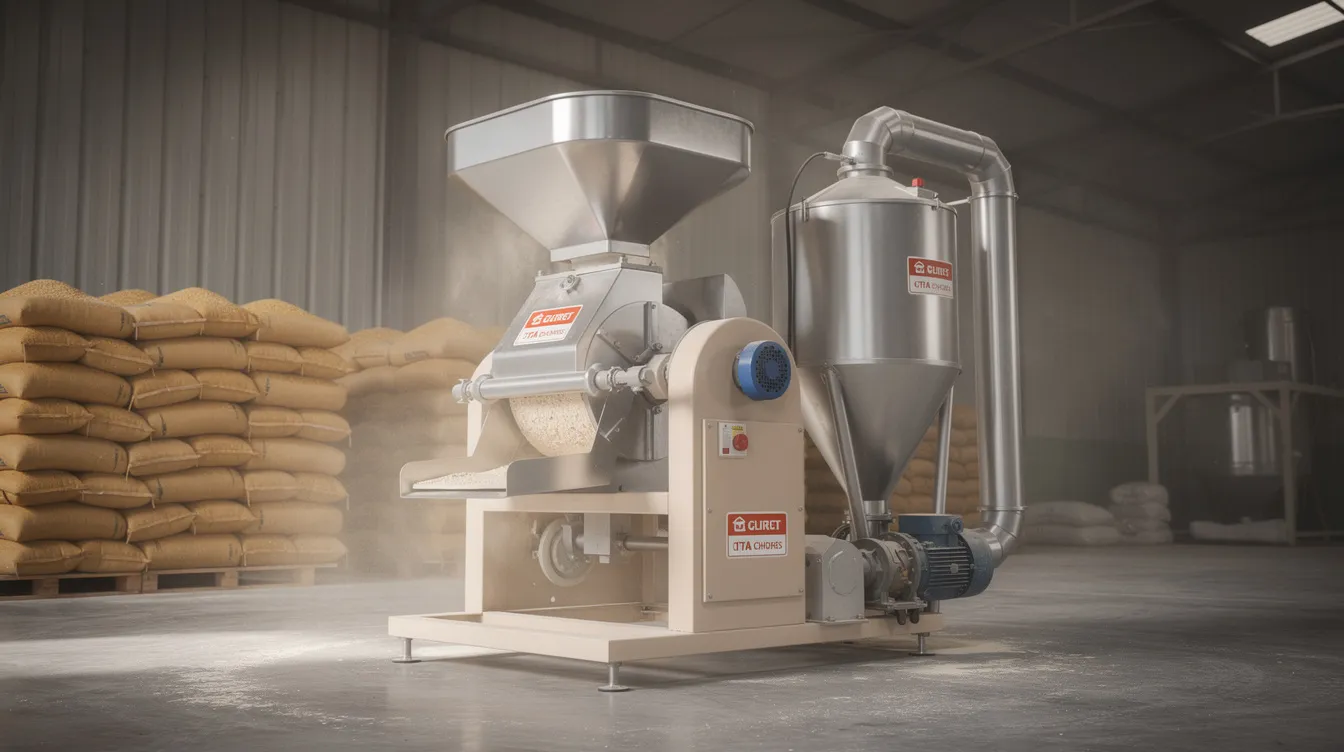
Market quotations for an atta chakki machine can range from less than ₹1 lakh for a small standalone grinding unit to more than ₹1 crore for a fully automatic atta chakki plant with integrated cleaning, sifting and packaging. The price range for atta chakki machines varies significantly based on capacity and automation level. Multiple factors drive this variation, and understanding them is essential before comparing vendor offers.
Capacity is the primary driver. Consider these typical bands:
- A 100 kg/hr single-chakki setup requires far less investment than a 500 kg/hr multi-chakki or pulveriser line.
- As capacity increases, cost per kg/hr of installed capacity often falls – but the absolute machinery investment rises sharply.
- Plants rated at 1–2 TPH or higher involve substantially more equipment and automation.
Single chakki versus multi-chakki configuration. One 20-inch or 24-inch chakki may handle 100–200 kg/hr. For 300 kg/hr and above, larger stones (27–30 inches) or multiple chakkis operating in parallel become necessary, increasing both capex and connected electrical load.
Stone chakki versus pulveriser or stoneless system. Traditional emery stone mills and double-chamber pulverisers serve different market segments. The grinding mechanism influences pricing – traditional stone models are generally cheaper than modern steel-based pulveriser systems. The choice also affects flour character, power consumption and maintenance patterns.
Semi-automatic versus fully automatic plant. Manual feeding and bagging versus automatic feeding, bucket elevators, pneumatic conveying, automatic flour packing and PLC-based controls. Higher automation reduces labour costs and improves consistent flour output but increases machinery investment.
Material of construction. Build materials include mild steel and stainless steel, impacting durability and price. A machine with SS304 contact parts and food-grade finishes costs more than one with MS contact areas, but may be necessary for premium branded atta targeting quality control standards expected by modern retailers.
Cleaning section. Whether the plant includes only basic sieving or a complete cleaning line with grain cleaner, destoner, magnetic separator and aspirator – each machine adds cost. Even a basic destoner for a 500 kg/hr flour mill may cost a few lakhs. Build quality affects the price further – heavier materials and more robust construction cost more.
Dust collection and hygiene. Cyclone separators, central dust collection systems and airlocks reduce product loss and improve working conditions. These are important for automatic flour mill plant approvals and audits for food processing machinery compliance.
Material handling. Manual bag handling versus bucket elevators, screw conveyors and pneumatic conveying systems. These are often excluded from headline atta chakki machine price quotations but are essential for efficient commercial atta chakki plants and smooth operation.
Electricals and automation. MCC panels, VFDs, PLC automation, cabling and instrumentation are frequently excluded from “machine-only” quotations. The actual installed machinery cost including wiring, control panels and transformers can be noticeably higher than the ex-works grinder price.
Motor power for atta chakki machines ranges from 0.5 HP to 7.5 HP in domestic and commercial applications, and up to 20 HP or more for large commercial units. Higher horsepower motors increase throughput and cost.
Any atta chakki machine price found online is usually equipment only – excluding GST, transport, installation and commissioning. Always ask for a detailed scope of supply before comparing quotations.
Machinery Required for a Commercial Atta Chakki Plant
A commercial flour mill processes raw wheat through several stages before producing packed atta. The typical process flow in a small-to-medium flour mill plant runs as follows:
Raw Wheat Receiving → Pre-Cleaning → Destoning → Magnetic Separation → Fine Cleaning / Grading → Conditioning (where used) → Grinding → Sifting → Flour Collection & Storage → Weighing → Packing
Each stage has a specific role:
- Raw Wheat Receiving: Intake hopper, conveyors and basic weighing to receive wheat from trucks or storage.
- Pre-Cleaning: Grain cleaner removes dust, stalks, straw and large impurities before further processing.
- Destoning: Removes stones, glass and heavy impurities that can damage chakki stones or pulveriser components.
- Magnetic Separation: Prevents ferrous metal fragments from entering the atta chakki machine, protecting motors and stones while avoiding contamination.
- Fine Cleaning / Grading: Improves uniformity of wheat entering the grinder, leading to better flour quality.
- Conditioning: Moisture adjustment to improve milling efficiency – adopted in some larger setups where processing wheat of varying moisture content.
- Grinding: The core stage – a commercial atta chakki stone mill or pulveriser grinds wheat into flour. Heavy-duty commercial atta chakki machines are designed for continuous heavy grinding.
- Sifting: Vibro sifter or plansifter separates fine atta from coarse particles and bran.
- Flour Collection & Storage: Intermediate bins or hoppers hold finished flour before packing.
- Weighing & Packing: Semi-automatic or fully automatic atta packing machines weigh and pack flour into retail or bulk bags.
A full atta chakki plant machinery quotation usually includes these sections. However, some small vendors quote only the chakki machine and motor. This can mislead entrepreneurs comparing total project costs. The difference between the price of one grinder and the cost of a complete line can be several multiples.
Wheat Cleaning Equipment Cost – Pre-Cleaner, Destoner, Magnetic Separator, Aspirator
Cleaning quality directly impacts flour grade, stone life, machine downtime and atta extraction percentage. Even a 100 kg/hr commercial atta chakki unit benefits from basic cleaning equipment. Skipping proper cleaning increases the risk of product contamination, customer complaints and premature wear on grinding components.
All price ranges below are indicative for Indian market conditions and typically exclude GST, transport and installation. Actual quotations vary by manufacturer, specification, capacity, material of construction and automation.
Pre-Cleaner / Grain Cleaner
A pre-cleaner or grain cleaner removes straw, husk, dust and large impurities before wheat enters the finer cleaning and milling stages. It is the first line of defence in any commercial flour production setup.
- For 100–300 kg/hr atta plants, small 0.5–1 TPH grain cleaners are generally sufficient.
- For 500–1,000 kg/hr commercial flour mill setups, 2–4 TPH units are more appropriate.
- Indicative cost: basic Indian-made grain cleaners for smaller capacities can start from around ₹1.5–2.5 lakh. Higher-capacity 3–4 TPH machines with advanced features may cost ₹3–4 lakh or more, depending on construction and features.
- Options range from simple vibrating screen pre-cleaners to multi-deck grain cleaners with aspiration. The incremental cost for higher-efficiency units is typically justified by lower dust, reduced impurities and better downstream machine performance.
Destoner Machine
A destoner separates heavy impurities like stones, glass and metal pieces using air and vibration, protecting chakki stones and improving product safety.
- For a 500 kg/hr flour mill, a 1–2 TPH destoner is typically sufficient.
- Small commercial destoners may start from the low-to-mid lakhs range, while higher-capacity or SS versions cost more.
- Destoners are often sold in combination with a grain cleaner as part of a cleaning line.
- The cost of a destoner is small compared to the risk of damaging a 20 HP, 30-inch chakki stone or causing product rejection due to stone complaints from customers.
Magnetic Separator
A magnetic separator removes ferrous metal pieces from the wheat stream before it enters the chakki machine. This protects motors and stones and avoids metal contamination of finished atta.
- These units are usually placed just before the grinder or immediately after the cleaning section.
- Relatively low-cost compared to other machines in the line – indicative pricing ranges from tens of thousands to around a lakh or slightly more, depending on size, magnet strength and housing material.
- This is a low-investment, high-importance item that no serious commercial atta chakki should operate without.
Aspirator / Dust Removal Equipment
Aspirators or air cyclone systems are needed in plants handling higher capacities (for example, 1–2 TPH) or operating in dusty environments where husk, light straw and dust must be continuously removed.
- Basic cyclone and small aspiration systems may add tens of thousands to a few lakhs to the cleaning section, depending on capacity and ducting requirements.
- Dust collection and aspiration are often missed in initial budgets but are important for worker comfort, product loss reduction and compliance with audits for branded atta operations in food processing industries.
Atta Chakki / Stone Mill Machine Cost – 16-Inch to 30-Inch Commercial Units
A commercial atta chakki machine typically refers to a heavy-duty emery stone mill, with stone diameters commonly available in 16-inch, 18-inch, 20-inch, 24-inch, 27-inch and 30-inch configurations. Motor power ranges from 5 HP to 20 HP, and production capacity varies accordingly. Modern atta chakki machines can grind up to 300 kg/hr in the largest commercial configurations.
Typical capacity by stone size and motor HP:
| Stone Size | Motor HP | Approximate Capacity (kg/hr) |
|---|---|---|
| 16-inch | 5 HP | 40–50 |
| 18-inch | 10 HP | 100–120 |
| 20-inch | 7.5 HP | 80–100 |
| 24-inch | 10–15 HP | 150–200 |
| 27–30-inch | 15–20 HP | 250–300 |
The 16 Inch Commercial Atta Chakki has a grinding capacity of 40–50 kg per hour. The 18 Inch Commercial Atta Chakki grinds 100–120 kg per hour and uses a 10 HP motor for efficiency. The 30 Inch Commercial Atta Chakki can produce flour at a rate of 300 kg/hr. The 5 HP Commercial Atta Chakki has a grinding capacity of 20–25 kg per hour. The 10 HP Atta Chakki Machine delivers a capacity of 100 kg per hour and operates on a three-phase power supply. The 7.5 HP Atta Chakki produces 75–80 kg/hr of flour. The 20 HP Commercial Atta Chakki is designed for high-volume operations.
Indicative ex-factory prices for stone chakki machines (without motor, ex-GST):
| Machine | Indicative Price (ex-factory) |
|---|---|
| 16-inch Commercial Atta Chakki | ~ ₹52,000 |
| 18-inch Commercial Atta Chakki | ~ ₹68,000 |
| 30-inch Commercial Atta Chakki | ~ ₹56,500 |
| 5 HP Double Chamber Atta Chakki | ~ ₹46,000 |
| 7.5 HP Atta Chakki Machine | ~ ₹94,500 |
| 10 HP Atta Chakki Machine | ~ ₹1,02,200 |
These prices are for the grinder unit and may not include motor, starter, control panel or accessories. GST, freight and installation are extra. Prices vary by brand, region, stone quality and construction.
Factors that change the price further:
- Bearing quality and design (three-bearing versus simpler layouts)
- Trolley or cabinet construction – robust construction adds weight and cost
- Type and grade of emery stone
- Inclusion of cyclones, hoppers and control boxes
- Optional stainless steel contact parts for premium atta
- Three phase material and mild steel electricity connection requirements
Maintenance considerations: Stones require periodic dressing and eventual replacement. A cheaper chakki may have a lower upfront price but higher lifetime cost per kg due to frequent stone changes, higher power draw or lower extraction. Entrepreneurs should consider cost per kg of finished flour over 5–10 years rather than only the initial atta chakki machine price.
Pulveriser vs Stone Chakki – Which Grinding System to Choose?
Many modern commercial atta chakki and industrial atta chakki machine quotations are actually pulveriser-based systems without traditional stones. The choice between these two technologies affects both capex and product positioning significantly.
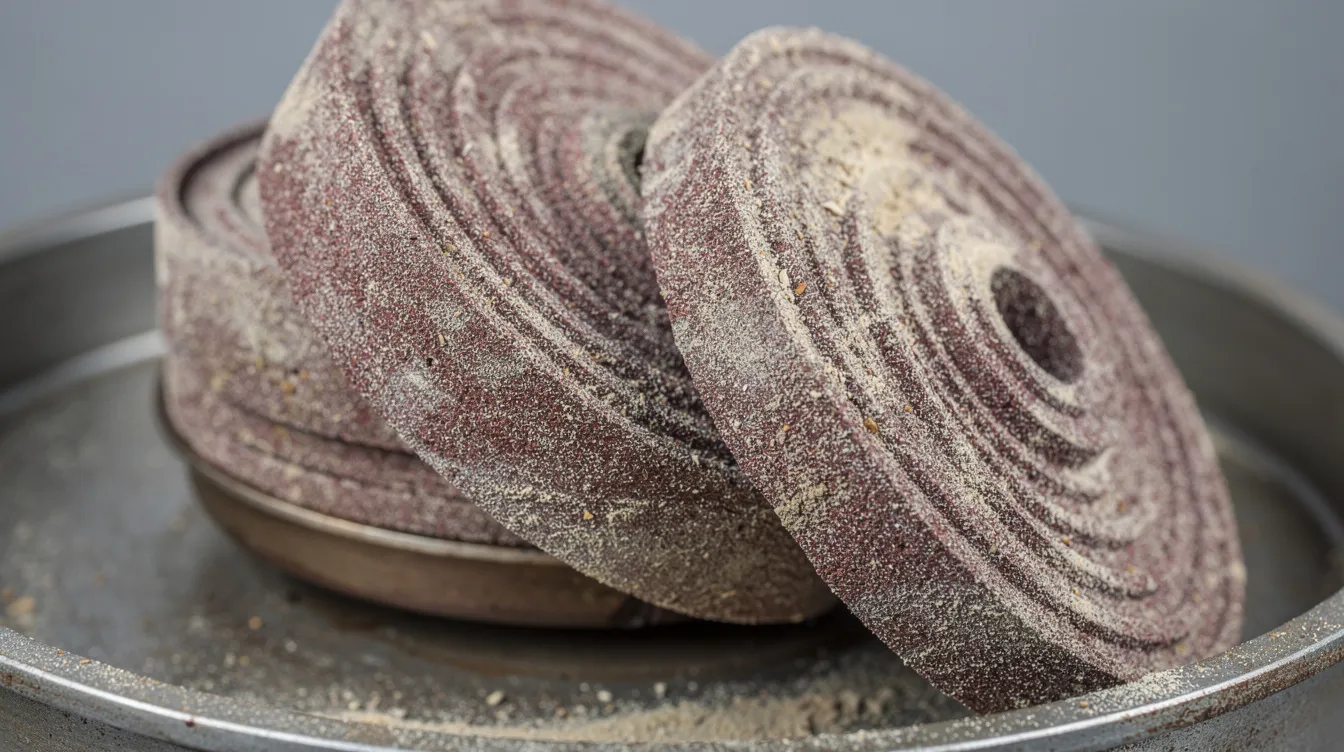
Grinding principle. A stone chakki uses slow stone-on-stone grinding, which is the traditional method. A pulveriser or hammer mill uses high-speed rotating beaters or blades against liners and screens. Double stage pulverizers minimize heat generation during grinding compared to single-stage designs.
Flour texture and heat. Stone grinding is perceived as more traditional, producing slightly coarser, aromatically rich atta with better nutritional value retention. Pulverisers can deliver very fine flour – advanced grinding technology ensures fine, uniform flour output – but may generate more heat if not properly designed. Stoneless atta chakki technology eliminates contamination risks associated with stone wear.
Power consumption. Pulverisers often run at higher RPM and may draw more kWh per 100 kg than large stone chakkis, though individual vendor designs vary. Advise buyers to compare specific energy consumption (kWh/kg) in quotations to understand true operating cost.
Maintenance. Chakkis require stone dressing and periodic replacement. Pulverisers require screen and beater replacement and careful balancing. The cost pattern is different, not necessarily lower for either system. Low maintenance is often claimed but should be verified with actual consumable costs.
Indicative pulveriser prices (based on published vendor data):
| Configuration | Capacity (kg/hr) | Indicative Price |
|---|---|---|
| 5 HP Double-Chamber Pulveriser | 40–60 | ~ ₹2,15,000 |
| 7.5 HP Double-Chamber Pulveriser | 60–80 | ~ ₹3,35,000 |
| 10 HP Double-Chamber Pulveriser | 80–100 | ~ ₹4,30,000 |
These prices are substantially higher than basic stone chakkis of similar HP but offer different advantages in terms of throughput, fineness and versatility for processing other grains such as maize flour or besan.
Guidance for different business models:
- Small retail mills targeting “chakki fresh atta” may prefer stone mills for their marketing appeal and perceived quality
- Bulk flour suppliers or plants producing multi grain flour or besan alongside atta may prefer pulverisers, which can function as 2-in-1 machines
- High-capacity, fully automatic atta plants sometimes combine both technologies or opt for stoneless high-speed systems with cyclone discharge and vibro graders
- Plants producing finely ground flour for institutional or packaged retail use may lean towards pulverisers for uniform flour texture and consistent grinding results
No single system is universally best. The right choice depends on target market, desired flour characteristics, local competition, india power consumption costs and available electrical infrastructure.
Sifter and Flour Separation Equipment – Vibro Sifter, Rotary Sifter, Plansifter
In a commercial flour mill plant, sifting is as important as grinding. It defines fineness, removes oversize particles and separates bran and coarse fractions from the final atta. Without proper sifting, consistent flour quality cannot be maintained regardless of how good the grinding system is.
Vibro sifter. A circular or rectangular vibrating screen, commonly used in 100–500 kg/hr atta plants. The vibro sifter separates fine atta from the coarse fraction. Indicative cost starts from around ₹1–2 lakh and increases with size, number of mesh decks and material of construction contact surfaces.
Rotary sifter or centrifugal sifter. Used where higher throughput or gentle separation is needed. Slightly higher investment than a basic vibro sifter but compact, efficient grinding output classification and suitable for continuous operation in medium-scale plants.
Plansifter. A multi-deck box-type sifter mainly relevant for larger, more sophisticated automatic wheat flour mill plants. Plansifters cost substantially more and are usually justified only above certain TPH levels. They are standard equipment in roller flour mills but may also be found in high-end atta chakki plants.
Sizing is critical. Sifter capacity must match or exceed grinding capacity to prevent bottlenecks. An undersized vibro sifter will cause frequent stoppages and reduced effective output, even if the chakki is a 7.5 HP or 15 HP unit running at rated speed. Consistent production depends on the entire line being balanced, not just the grinder.
Bucket Elevators, Conveyors and Material Handling System
Many first-time entrepreneurs underestimate the cost of bucket elevators, screw conveyors, belt conveyors, gravity chutes and pneumatic conveying systems when budgeting for an atta chakki plant. These are not glamorous machines, but without them, a plant cannot function efficiently.
Bucket elevators are the standard for vertical transport of wheat and flour between floors and machines in a flour mill. Indicative per-elevator cost ranges from tens of thousands to a couple of lakhs, depending on height, capacity and casing material (MS versus SS).
Screw conveyors are commonly used for horizontal or inclined transfer of wheat or flour. They are typical between grinders and sifters in semi-automatic plants. Cost depends on length, diameter and material, but individual conveyors are generally in the tens-of-thousands range.
Pneumatic conveying systems are used in sophisticated automatic flour mill plant setups where air moves flour between points. These carry a higher initial cost but offer improved hygiene and reduced manual handling – critical for high quality flour production in branded atta operations that require minimal manual intervention.
Benefits of proper material handling: Lower labour requirement per shift, reduced spillage and product loss, more consistent throughput – all of which impact operating margins and working capital. A plant that loses even 1–2% of flour to spillage and dust due to poor handling will see that loss compounding over years of operation.
Atta Packing Machine Price – Semi-Automatic and Automatic Systems
For loose atta supply to local chakki customers, simple manual bagging may be sufficient. But for branded 1 kg, 5 kg and 10 kg packs, proper atta packing machines are essential and form a significant part of total machinery cost in any flour mill plant. The choice of packing system directly affects labour costs, presentation and market positioning of the finished product.
Semi-Automatic Packing Machine
A semi-automatic system typically consists of an electronic weigh filler with foot-pedal operation, a separate sealing machine, and manual bag placement and removal. This is suitable for smaller commercial atta chakki units packing a few hundred kg per day, institutional 25–50 kg bags or regional brands in early stages.
Indicative price: Simple semi-automatic weigh-filling plus sealing setups often start from low lakhs and move upwards with multiple filling heads or higher accuracy specifications.
Automatic Weighing and Packing Machine
Automatic systems where pouches are automatically formed or pre-made bags are automatically filled, weighed and sealed with minimal operator intervention. These are relevant for supermarket-oriented branded atta businesses where uniform output and consistent quality in packaging units are expected.
Typical pack sizes include 1 kg, 5 kg and 10 kg. Automatic multi-head or servo-driven packing machines for 1–5 kg packs can range from higher single-digit lakhs to tens of lakhs, depending on speed, automation level and whether integrated with conveyor, metal detector and check weigher.
Form-Fill-Seal (FFS) Packing System
FFS machines form pouches from roll stock, fill and seal in one integrated line. They are suitable for larger capacity automatic atta chakki plants and national brands requiring high packing speed and uniform presentation. FFS machinery cost is relatively high but must be matched with the plant’s milling capacity and sales volume to justify the investment.
Auxiliary equipment often needed with any packing system:
- Conveyor for bag transport
- Batch coding printer
- Metal detector
- Check weigher
- Finished-goods weighing scales
Each of these adds to the total atta packing machine price.
Automation Equipment in an Automatic Atta Plant
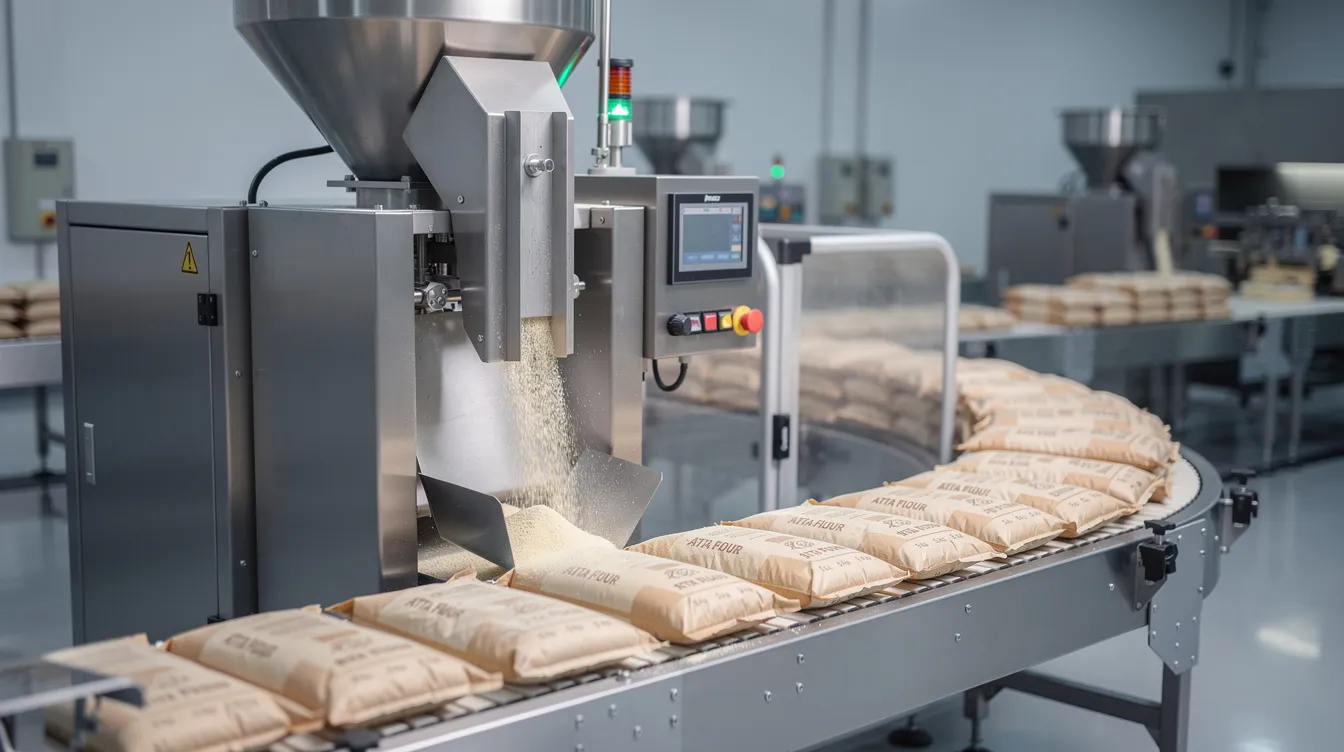
Automation is an enabler of consistency, data collection and labour optimisation – not a goal by itself. A fully automatic atta chakki plant price will necessarily be higher than semi-automatic options, but the investment should be evaluated against tangible operational benefits.
Typical automation hardware in an automatic atta plant:
- Control panels with MCC, starters and overload protection – the central machinery control panel for the plant
- PLC automation for sequence control, alarms, interlocks and operation mode management
- VFDs (Variable Frequency Drives) to adjust motor speeds for optimal operation and low power consumption
- Sensors for level, choke and motion monitoring across the line
- Weighing modules for batching and automatic packing, with fully automatic motor power management
Fully automatic models feature built-in smart sensors and are generally more expensive than semi-automatic models. Safety and additional features – such as emergency stops, interlocking between stages and overload protection – can add incremental value to machinery pricing but also provide important operational safety.
Practical benefits: Improved start-up and shutdown sequences, protection of motors and chakkis, reduced risk of operator error, basic production and power consumption monitoring, and consistent production with minimal manual intervention.
Automation investment should be justified in the DPR by quantifying potential savings in labour, rework, wastage and overtime, rather than assumed as automatically profitable. Advanced technology is valuable only when the plant runs at sufficient utilisation to recover the additional capex.
Indicative Atta Chakki Machinery Cost by Capacity
The following table presents an indicative comparison of atta chakki plant machinery cost by capacity. These figures represent machinery investment only and exclude land, building, installation, GST, freight and working capital.
| Plant Capacity | Typical Configuration | Automation Level | Indicative Machinery Investment | Suitable For |
|---|---|---|---|---|
| 100–200 kg/hr | Single 7.5–10 HP chakki, basic grain cleaner, small vibro sifter, manual or semi-automatic packing | Semi-automatic | ~ ₹5–15 lakh | Local chakki business, small-scale flour mill, loose atta supply |
| 250–500 kg/hr | 15–20 HP chakki or multi-chakki combination, pre-cleaner + destoner + magnetic separator, bucket elevators, vibro sifter, semi-automatic packing | Semi to basic automatic | ~ ₹12–25 lakh | Regional brand, small commercial flour production |
| 500–1,000 kg/hr (0.5–1 TPH) | Multi-chakki line or pulveriser, full cleaning section, multiple elevators, larger sifters, dust collection, semi-auto or basic automatic packing | Automatic | ~ ₹20–40 lakh | Medium-scale branded atta, institutional supply |
| 1–2 TPH | Industrial atta chakki plant with robust cleaning, grading, multi-chakki or stoneless systems, full dust collection, automatic packing (FFS) | Fully automatic | ~ ₹35–70 lakh+ | Regional or semi-national brands, large institutional supply |
| Above 2 TPH | Large-scale automatic atta plant with PLC control, comprehensive cleaning and grading, high-capacity milling, integrated FFS packing | Fully automatic | ~ ₹80 lakh to over ₹1 crore | National brands, high-volume commercial flour mill operations |
Published examples from vendor listings support these ranges. For instance, a heavy-duty 200–1,000 kg/hr fully automatic atta chakki plant has been listed at approximately ₹12,00,000 for machinery. A 5 TPH automatic atta plant with cleaning and grading has been quoted at ₹89,70,000.
Important disclaimer: These are planning estimates only. Entrepreneurs must obtain updated vendor quotations with clear scope-of-supply details before finalising any project or applying for bank finance. The country of origin of components, brand of the manufacturer, and whether SS or MS contact parts are used will significantly affect actual pricing.
Semi-Automatic vs Fully Automatic Atta Plant Machinery Cost
The choice between a semi-automatic commercial atta chakki plant and a fully automatic atta chakki plant is one of the most consequential decisions affecting capex, operating cost and long-term viability.
| Parameter | Semi-Automatic Plant | Fully Automatic Plant |
|---|---|---|
| Initial machinery cost | Lower – typically 60–70% of equivalent automatic plant | Higher – includes PLC, VFDs, automated feeding, packing |
| Operators per shift | More (typically 4–8 depending on capacity) | Fewer (typically 2–4 with automation handling routine tasks) |
| Material handling | Manual or semi-manual (manual bag carrying, basic conveyors) | Elevators, pneumatic systems, automated conveyors |
| Consistency and traceability | Dependent on operator skill and attention | More consistent – automated weighing, feeding and monitoring |
| Ease of expansion | Moderate – adding lines or equipment may require rework | Better if designed modularly from the outset |
| Maintenance complexity | Simpler individual machines, less electrical complexity | More complex – PLC, sensors, VFDs require skilled technicians |
| Suitable scale | Local market, loose atta, small regional brand | Regional to national brand, packaged atta, institutional supply |
A fully automatic flour mill plant is not always financially superior. Viability depends on capacity utilisation, market reach and the ability to sell premium, packaged atta at higher margins. If a plant runs at only 40% utilisation because the local market cannot absorb full output, the higher capex of automation will drag down DSCR and extend the payback period.
Hidden Machinery Costs Entrepreneurs Often Miss
The ex-factory atta chakki machine price is only part of the installed cost. Many additional items must be budgeted in the DPR and bank loan proposal. Ignoring them can lead to under-estimation of project cost by 15–30% compared to machinery list value alone.
Commonly missed or underestimated costs:
- GST on machinery and packing equipment (currently 18% on most industrial machinery)
- Freight and insurance from supplier works to project site
- Unloading, shifting and erection, including labour, cranes and rigging
- Installation and commissioning charges – sometimes quoted separately by the vendor
- Electrical cabling, cable trays, MCC/PCC panels and additional transformers or DG sets for higher connected loads
- Foundations, machine platforms and mezzanines for elevators and sifters
- Ducting, dust collection pipes and cyclones – important for hygiene and efficient grinding environment
- Air compressor where pneumatic actuators or packing machines require compressed air
- Weighing scales and simple laboratory equipment for moisture, ash or basic quality checks
- Storage bins, hoppers and silos for wheat and atta
- DG backup for uninterrupted operation in areas with unstable electricity supply
- Initial spare parts and consumables – screens, beaters, stones and belts
- Piping and civil platforms for material flow
Excluding these items adversely affects loan requirement calculation, promoter margin planning and the accuracy of projected depreciation and operating costs.
How to Compare Atta Chakki Machinery Quotations Professionally
Comparing vendor quotations only on total price can be misleading. The cheapest offer may exclude essential equipment or assume a lower specification. A professional comparison should normalise offers to a common base capacity and scope.
Comparison checklist for atta chakki plant machinery quotations:
- Rated versus practical capacity: Ask for output at specified hours per day, type of wheat and desired fineness
- Connected load and kWh per 100 kg for each configuration – this directly impacts operating cost
- Material of construction – MS versus SS contact parts; construction mild steel country of manufacture
- Scope of supply – does the quotation include cleaning equipment, elevators, sifters, dust collection, packing machines and control panel, or only the grinder?
- Warranty period and conditions – construction mild steel warranty terms differ between vendors
- Availability and cost of spare parts – stones, screens, bearings and beaters
- Installation and commissioning – included in the price or charged separately?
- After-sales service network, response time and sales service reputation of the vendor
- Delivery period and payment terms
- Taxes, freight and insurance – clearly stated or excluded?
- Performance guarantee, if offered – what capacity and power consumption are guaranteed?
Using a simple evaluation sheet – as is often used during DPR preparation – helps normalise offers so that the “lowest” price does not result in missing essential equipment.
Machinery Capacity and Production Planning
As a practising Chartered Accountant preparing DPRs for atta chakki and flour mill projects, one of the first things I evaluate is whether the proposed machinery capacity is aligned with realistic sales volumes.
A simple planning approach:
- Decide annual sales target – for example, 1,000 tonnes per year
- Assume reasonable working days (for example, 300 days) and shifts (one or two)
- Derive hourly requirement: 10,00,000 kg ÷ 300 days ÷ 8 hours = approximately 417 kg/hr
- Choose a plant capacity (for example, 500 kg/hr) that covers this with a reasonable buffer for downtime, maintenance and seasonal variation
Common mistake: Buying 1 TPH commercial flour mill machinery but operating only one shift at 40–50% utilisation. This leads to under-absorbed fixed costs, higher depreciation per kg, inflated power cost per kg and lower DSCR. The machine grinds wheat efficiently, but if the market is not there, high efficiency alone does not solve the financial problem.
For bank finance planning, Year-1 and Year-2 projections should usually assume lower capacity utilisation, ramping up gradually, rather than immediate 100% utilisation of a 100 kg hr or 1 TPH plant. This conservative approach makes projections more credible and gives the business room to prove performance before scaling.
Machinery Cost and Bank Finance
Atta chakki machinery cost is a central element of any Detailed Project Report prepared for bank finance. When an entrepreneur seeks a term loan for a flour mill project, the machinery quotations directly feed into several key components of the DPR.
How machinery cost enters the DPR and CMA Data:
- Total project cost: Machinery is typically the largest single component of fixed capital
- Means of finance: The total project cost, including machinery, determines the term loan requirement and promoter contribution
- Depreciation: Machinery value drives depreciation charges in projected profit and loss statements
- Interest and repayment schedule: Higher machinery cost means higher borrowing, higher interest and higher annual repayment
- DSCR analysis: Performance metrics like cash flow analysis and loan repayment capacity are essential for project viability assessments – DSCR must demonstrate that projected cash accruals are sufficient to service the proposed debt
Banks often ask for multiple quotations or pro-forma invoices for major machines and may scrutinise whether the proposed machinery is appropriate for the stated capacity and market plan. They may also check whether the vendor is a leading manufacturer or a known supplier.
Bank approval is never guaranteed purely on machinery purchase. Viability, promoter profile, collateral, regulatory compliance and quality of the DPR all play a role.
Machinery Cost vs Total Atta Chakki Project Cost
Even for a fully automatic atta chakki plant, machinery is typically 40–60% of the total fixed capital outlay, depending on the land and building situation.
Other major cost components include:
- Land and site development
- Building, civil work and internal roads
- Plant electrification, transformers and DG
- Utilities (water system, compressor, fire system)
- Pre-operative expenses (interest during construction, professional fees)
- Working capital margin for wheat stock, packing materials and receivables
Entrepreneurs evaluating the complete investment – including land, building, machinery, utilities and working capital – can also refer to our detailed guide on Atta Chakki Plant Setup Cost in India.
This article intentionally focuses on machinery cost. A separate, comprehensive treatment of total project cost – covering land, civil, utilities and other components – is available in the linked article.
Financial Projections Before Selecting Machinery
It is prudent to run financial projections before finalising a 7.5 HP chakki or a 1 TPH automatic wheat flour mill plant – to determine whether proposed selling prices and volumes can support EMI commitments, working capital requirements and operational viability.
Key assumptions to model:
- Production capacity and realistic utilisation ramp-up (e.g., 50% in Year 1, 65% in Year 2)
- Wheat purchase price and expected yield (atta extraction percentage, typically 85–90%)
- Power consumption per kg based on selected machinery – this varies between stone chakkis and pulverisers
- Labour cost for different automation levels
- Packaging material cost per kg
- Selling price by product and customer segment
- Interest, depreciation and term-loan structure
- Resulting EBITDA, cash accrual and DSCR
Sensitivity analysis is particularly important before locking in a high-end fully automatic atta chakki plant price. For example, what happens if wheat prices rise by ₹2/kg or utilisation drops by 10%? If DSCR falls below 1.25x under moderate stress, the proposed machinery configuration or capacity may need to be reconsidered.
For promoters who want structured, spreadsheet-based projections, we assist with customised Financial Projections & Financial Modelling Services for atta chakki and flour mill projects. Tailored financial analysis aids in investment decisions for businesses seeking project financing.
Feasibility Study Before Investing in a Large Automatic Atta Plant
For capacities like 1–2 TPH and above, or for integrated automatic wheat flour mill plants requiring investment of ₹50 lakh or more, a formal market and financial feasibility study is strongly advisable before committing capital.
Components of a feasibility study for an automatic atta plant:
- Target markets: Retail versus institutional versus B2B bulk – each has different pricing, credit terms and volume predictability
- Competitor analysis: Local chakki mills, roller flour mills, packaged atta brands – what is the existing supply situation?
- Wheat sourcing: Logistics and pricing in the proposed location, seasonal variation, procurement credit terms
- Alternative capacity and automation evaluation: Is a 500 kg/hr plant better than 1 TPH? Is full automation justified or would semi-automatic suffice?
- Operating cost build-up and breakeven analysis: At what monthly volume does the plant break even?
- Scenario analysis: How does profitability change with price fluctuations, utilisation variations and wheat cost movements?
At Project Report Bank, we support promoters with independent Project Feasibility Study & Project Viability assessments before they commit large capital to automatic atta chakki plant machinery.
DPR and Bank Loan Planning for an Atta Manufacturing Unit
A full DPR becomes necessary when an entrepreneur is seeking a larger term loan, planning a new plant above 250–500 kg/hr, or approaching institutional lenders and government subsidy schemes such as those under PMFME or MSME support programmes.
What a DPR for an atta chakki or automatic flour mill plant typically includes:
- Project background and objectives
- Detailed machinery list with capacity, specifications and indicative prices
- Project cost and means of finance
- Operating assumptions – production capacity, working days, shifts, capacity utilisation ramp-up, raw material cost, selling prices
- Projected profit and loss, balance sheet and cash flow for 5–7 years
- DSCR, break-even point and key financial ratios
- Sensitivity analysis on critical variables
As a practising Chartered Accountant, I help prepare and evaluate these projections based on reasonable assumptions and promoter inputs. I do not “certify” guaranteed results. Figures are based on reasonable assumptions, industry benchmarks and operational parameters discussed with the promoter. Entrepreneurs seeking term loans for flour mill projects can explore our Bank Finance DPR & Loan Proposal Assistance services.
How to Select the Right Atta Chakki Machinery Configuration
Machinery selection should start from the business model, not from a catalogue of 5 HP, 7.5 HP or 20 HP machines. The machine grinds wheat – but the business model decides which machine makes financial sense.
Decision checklist:
- Target market: Local loose atta versus packaged branded atta – this determines automation and packing requirements
- Daily and annual output requirement: Derive from realistic sales projections, not from maximum capacity
- Desired flour characteristics: Chakki-style atta, multigrain flour, or also maida/suji? – this affects whether you need a stone chakki, pulveriser or both
- Available electrical connection: Single-phase versus three phase stone size and motor capacity constraints; sanctioned load and transformer requirements
- Labour availability and skill level: Rural locations may find it harder to recruit PLC operators; semi-automatic may be more practical
- Budget and promoter contribution: What machinery investment can be realistically financed without stretching debt beyond serviceable levels?
- Space constraints: Vertical flour mill layouts versus horizontal layouts; number of floors available
- Future expansion plan: Can additional chakkis, packing lines or cleaning sections be added without major rework? Plan building layout and electrical capacity accordingly
For very small capacities, a single commercial atta chakki machine plus basic cleaning may be sufficient. For a serious branded atta play, a complete automatic atta chakki plant with robust cleaning, sifting and packing is normally required. Entrepreneurs considering alternative or complementary products such as bajra flour or wheat dalia should factor in machine versatility when selecting equipment.
Example Machinery Configuration for an Automatic Atta Plant
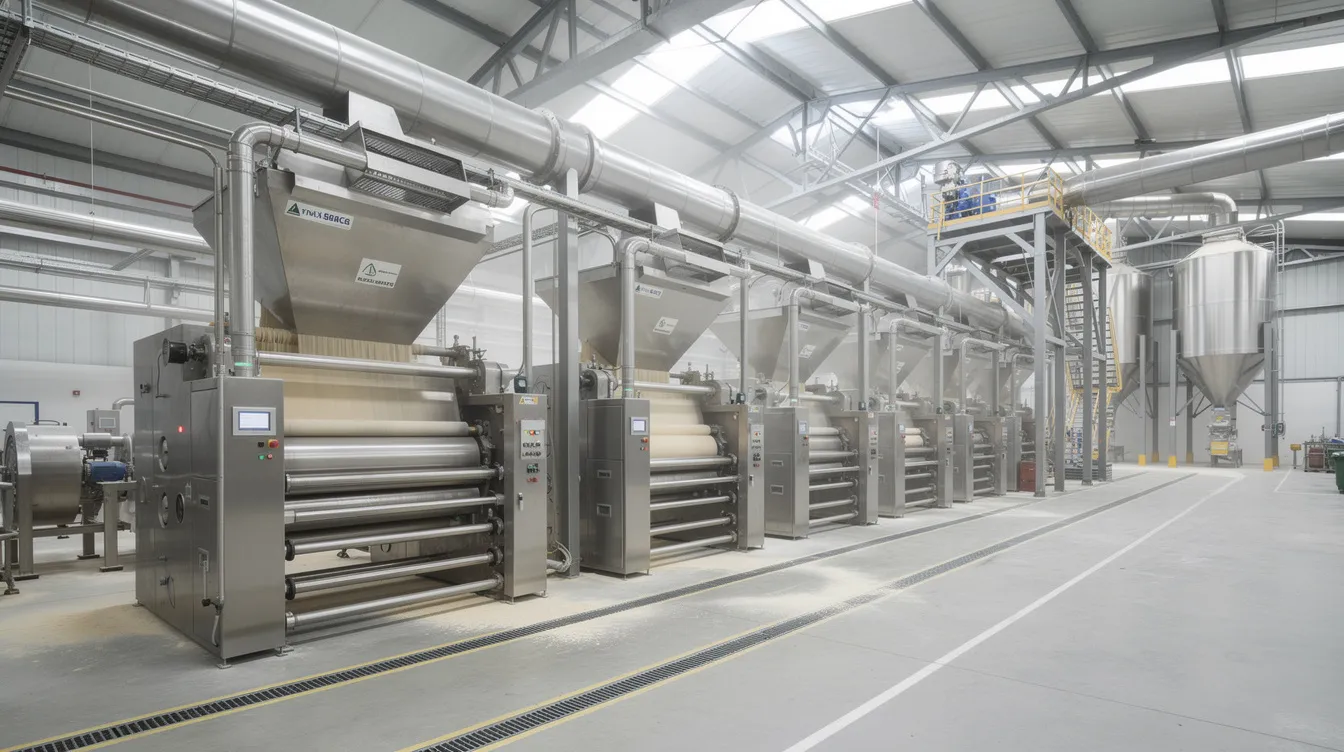
The following configuration is illustrative – designed for approximately a 500 kg/hr automatic atta chakki plant. It must be customised for each project based on actual capacity, product requirements and budget.
Typical equipment in process order:
- Intake hopper and feeding conveyor
- Pre-cleaner / grain cleaner (1–2 TPH capacity)
- Destoner with integrated aspiration
- Magnetic separator
- Wheat storage bins and controlled feeding system
- 2–3 commercial atta chakki units (for example, 20–24-inch stones or equivalent pulverisers) with 7.5–15 HP motors each
- Flour collection hoppers and cyclone dust collectors
- Vibro sifter / plansifter for atta grading and bran separation – ensuring consistent flour quality and uniform grinding across batches
- Bucket elevators and screw conveyors for internal transfer
- Intermediate atta storage bin
- Semi-automatic or automatic atta packing machine
- Central dust collection system
- Control panel with basic PLC automation and operation mode selection
Such a plant could require a connected load in the range of 35–60 HP depending on choices made at each stage. This affects mild steel electricity connection sizing, transformer capacity and DG backup requirements. The phase country of installation and local utility norms will also influence electrical infrastructure cost.
This is an illustrative configuration. The exact machinery list, specifications and pricing should be developed in consultation with equipment suppliers and verified through a proper DPR.
Frequently Asked Questions on Atta Chakki Machine Price
What is the price of a 7.5 HP commercial atta chakki machine in India?
A 7.5 HP commercial atta chakki machine producing approximately 75–80 kg/hr is priced at around ₹94,500 for the grinder unit (indicative, ex-factory). With motor, basic stand and accessories, the cost is higher. A complete unit including motor, starter, hopper and cyclone can range upward. Quality of stone, three phase country specifications, construction material, and whether SS contact parts are used cause significant variation. GST, freight and installation are typically extra. Always confirm whether the quoted price includes the motor or is “ex-motor.”
How much does a 100 kg/hr atta chakki plant (with cleaning and sifting) typically cost?
It is important to distinguish between “only grinder” and a small integrated plant. A 10 HP atta chakki machine alone may cost around ₹1,02,200. However, a truly integrated 100 kg/hr line – including grain cleaner, destoner, magnetic separator, chakki, vibro sifter and simple packing – is likely to require machinery investment in the range of ₹5–15 lakh or more, rather than just the base cost of one machine. Always get itemised vendor quotations with a clear scope of supply. India minimum order quantity norms and delivery terms should also be confirmed.
Is a fully automatic 500 kg/hr atta chakki plant always better than two smaller 250 kg/hr lines?
Not necessarily. A single automatic 500 kg/hr line may offer lower labour per kg, simpler controls and higher efficiency. But two smaller lines can provide redundancy – if one breaks down, the other continues operating, maintaining consistent flour output. Two lines also allow staggered investment and can be scaled to match demand growth. The answer depends on sales stability, maintenance philosophy, finance availability and whether the market can absorb 500 kg/hr output from the start.
Can I upgrade from a semi-automatic commercial atta chakki to an automatic flour mill plant later?
Yes, many entrepreneurs start with basic chakkis and add pre-cleaning, sifting and packing equipment in phases. However, it is important to plan building layout, electrical capacity and material flow upfront so that later additions fit without major rework. Retrofitting automation into a plant not designed for it can be expensive and disruptive. Plan at least the building structure and three phase material connections for future capacity from the beginning.
Can banks finance atta chakki machinery separately from building and working capital?
In India, term loans for plant and machinery – including atta chakki machines, wheat cleaning equipment and packing machines – are common. Banks usually treat them as part of the overall project cost along with building and other assets. Finance depends on promoter contribution, collateral, project viability and a proper DPR – not on machinery invoices alone. Eligible machinery may form part of the project cost considered for financing, subject to lender policies, borrower eligibility, project viability and documentation. Preparing a well-structured project report improves the quality of the loan proposal.
Is an automatic atta plant profitable?
There is no blanket answer. Profitability depends on capacity utilisation, wheat procurement cost, extraction rate, market selling price, packaging cost, power consumption, labour, competition and financing cost. A well-run automatic atta plant operating at 70%+ utilisation with good market access can generate reasonable margins. However, if utilisation remains low, fixed costs – depreciation, interest, rent – continue regardless of output. A proper feasibility study and financial projection should be prepared before assuming profitability. High efficiency in grinding is necessary but not sufficient for profitability.
How much electricity does an atta chakki plant require?
Connected load depends on capacity, motor specifications and auxiliary machines. A small 100 kg/hr unit may need 10–15 HP total. A 500 kg/hr automatic atta chakki plant may require 35–60 HP or more including cleaning, conveyors, sifters, packing and dust collection. Power consumption per kg of atta is typically in the range of 0.03–0.06 kWh/kg depending on machine type, but should be verified with specific vendor data for the selected configuration.
Conclusion – Choosing Atta Chakki Machinery with a Financial Lens
The right atta chakki machine price is the one aligned with your capacity requirement, market strategy, power availability and financial strength – not simply the lowest online quote or the most automated brochure. A machine that costs less upfront but delivers lower extraction, higher power draw, or frequent breakdowns will cost more per kg over the plant’s operating life.
Machinery choices influence operating cost per kg, product quality, labour needs, bank finance structure, DSCR and future expansion options. They deserve the same careful evaluation that goes into selecting a business location or setting a product price. Entrepreneurs should obtain multiple vendor quotations with matching scope, prepare realistic financial projections and test the numbers under stress scenarios before committing substantial capital to any flour mill plant investment.
If you are planning a commercial atta chakki, automatic atta chakki plant or wheat flour mill and need assistance with DPR preparation, machinery-cost evaluation, financial modelling or bank-loan documentation, you may contact CA Manish Gugliya through ProjectReportBank.com. WhatsApp enquiry is preferred; calling is also available.
By CA Manish Gugliya FCA, DISA (ICAI) More than 20 years of professional experience in project reports, financial projections, CMA Data, project finance and business advisory.