Key Takeaways
An atta chakki plant feasibility study evaluates demand, wheat procurement, capacity, costs, margins, break-even and DSCR before a promoter commits capital. The study answers whether the proposed flour mill project can generate enough revenue to cover operating costs, repay loans and deliver a reasonable return.
- Two flour mills with identical machinery can produce very different financial results depending on location, wheat prices, capacity utilisation, product mix and working capital planning. Feasibility is project-specific, not generic.
- A professional feasibility study and detailed project report for a flour mill must include realistic capacity utilisation, contribution margin, working capital cycle, DSCR (minimum 1.5 for bank loans) and sensitivity analysis rather than optimistic assumptions.
- Fixed assets such as land, building, chakki plant machinery and utilities are only one part of viability. Commercial success depends equally on distribution strategy, achievable selling prices and adequate working capital.
- Financial projections should cover a 5-year period and include projected P&L and cash flow statements, with CMA data prepared for bank submission.
- Project Report Bank, led by CA Manish Gugliya, assists in customised feasibility studies, bankable detailed project reports, CMA data and project finance advisory for atta chakki and wheat flour mill projects across India.
Introduction: Why an Atta Chakki Plant Needs a Serious Feasibility Study
Setting up an atta chakki plant in India involves more than purchasing a 1-2 TPH grinding unit and estimating production capacity. A feasibility study examines whether the proposed wheat flour mill can sell enough atta at the right price to cover costs, repay debt and generate adequate return on the promoter’s investment.
This article, written from my perspective as CA Manish Gugliya (over 20 years of experience in DPR preparation, CMA data, financial projections and project finance advisory), focuses on atta chakki plant feasibility study methodology and atta chakki project viability, not just machinery specifications or subsidy schemes.
Consider the contrast: a small local flour mill processing 250-500 kg/hr serving neighbourhood customers operates under very different economics compared to an automatic atta manufacturing plant running at 2-3 TPH supplying packaged wheat flour through distributors across a state. The raw material cost per kg may be similar, but project cost, working capital, distribution expense, break-even levels and DSCR will differ materially.
In states like Madhya Pradesh, Uttar Pradesh, Rajasthan and Punjab, wheat availability is strong. But demand patterns vary: urban consumers increasingly buy packaged atta from national brands such as Aashirvaad, Pillsbury and Patanjali, while rural and semi-urban buyers still rely on loose atta from local chakkis. A feasibility study evaluates market demand, technical needs and financial viability to determine whether a specific flour mill project should proceed, be resized, redesigned or reconsidered.
What Is an Atta Chakki Plant Feasibility Study?
A feasibility study is a structured assessment of whether a proposed atta chakki or flour mill project is technically, operationally and financially workable in a specific location and business model. Conducting a feasibility study involves analyzing technical, economic and operational viability before committing investment.
The study covers several layers:
- Technical feasibility: Can the selected machinery, process and utilities deliver the required output at acceptable quality? Technical infrastructure requires reliable power supply and access to clean water for processing.
- Market feasibility: Is there sufficient addressable demand? Who are the buyers? What are competitors charging?
- Operational feasibility: Can the promoter procure wheat reliably, manage manpower, handle logistics and maintain quality control?
- Financial feasibility: Financial feasibility requires estimating capital and operational expenditures, projecting profitability, cash flow and debt-servicing capacity.
- Commercial viability: Is the project bankable? Will lenders and investors find the financial structure credible?
The study must answer questions such as:
- Can wheat be procured consistently at competitive prices?
- Is the proposed capacity appropriate for the market and promoter’s resources?
- What contribution margin per kg is achievable after realistic costs?
- How much working capital will be locked in wheat, packaging and receivables?
- At what sales volume does the chakki plant break even?
- Will cash flows service the term loan, with DSCR of at least 1.5 for loan approval?
- What happens if wheat prices rise or selling prices fall?
An atta chakki plant feasibility study usually precedes the formal detailed project report. It helps the promoter decide whether to move to full DPR preparation or reconsider the project altogether.
Market Assessment for an Atta Chakki Plant
Market feasibility is the first filter. Capacity decisions must be driven by demand, not by what machinery a supplier quotes.
Consider the demand segments a wheat flour factory may serve:
- Loose atta demand from local households and kirana shops
- Branded or packaged wheat flour (2, 5, 10 kg packs) for urban and semi-urban retail
- Institutional buyers: hotels, restaurants, canteens, caterers, hostel kitchens
- B2B bulk flour supply for bakeries, namkeen manufacturers and biscuit units
The Indian market shows gradual demand increase in consumption of whole wheat flour. Industry observers have noted that demand for atta increases by approximately 10% each year when accounting for population growth, urbanisation and the shift from loose to packaged formats. However, a new atta chakki plant will not capture the entire local demand.
To estimate realistically addressable demand, a promoter should:
- Analyse population and per-household atta consumption within a serviceable radius
- Deduct market share already captured by national and regional brands
- Factor in a realistic share a new entrant can capture over 2-3 years
- Consider radius of operation (25-50 km for fresh atta vs 200-300 km for packaged distribution)
Commercial viability can be influenced by market trends and consumer preferences in flour products. Local consumers may pay a small premium for fresh chakki atta. Wholesalers and institutional buyers negotiate tight margins. Market research should include local wholesale market visits, dealer feedback, retailer interviews and competitor packet MRPs rather than relying solely on secondary industry reports.
Raw Material Availability and Wheat Procurement
Wheat is the principal input in any atta flour mill project, constituting 75-80% of total production cost. Raw material sourcing involves assessing availability and pricing of wheat at realistic landed-cost levels, because even a ₹1-₹2 per kg change in effective wheat cost can alter atta chakki plant profitability across thousands of tonnes processed annually.
Regional wheat sourcing options include procurement from major mandis in MP, UP, Rajasthan, Punjab and Haryana, buying through local traders or commission agents, and direct purchase from farmers or FPOs where feasible. The Minimum Support Price for wheat was ₹2,275 per quintal for the 2024-25 rabi marketing season, but actual mandi prices typically range between ₹2,300-₹2,600 per quintal depending on variety and location. Premium varieties like Sharbati or Lokwan command ₹200-₹600 per quintal more.
Practical factors to evaluate include distance from plant to key mandis and freight cost per tonne, seasonal price patterns (rabi harvest in February-April when prices are lower, lean months when prices rise), moisture content and cleaning loss assumptions. Storage strategy matters: maintaining buffer stock for 30-60 days during peak season requires godown space, handling cost and capital. Poor storage conditions create risk of quality deterioration, pest infestation and weight loss.
Wheat variety, cleaning, tempering and grinding sequence directly impact extraction percentage and finished atta quality; promoters should understand the complete atta manufacturing process before freezing assumptions for a feasibility study.
Procurement reliability, quality consistency and negotiated long-term relationships with suppliers often matter more for viability than a one-time low purchase price.
Choosing the Right Plant Capacity
Many promoters select capacity based on supplier quotes or scheme limits instead of market absorption and financial comfort. This can make a flour mill project risky from day one.
Key capacity concepts to understand:
- Installed capacity in TPD (tonnes per day) or TPH (tonnes per hour)
- Operating hours per shift and number of shifts (1, 2 or 3)
- Planned operating days per year (270-300 days after holidays and maintenance)
- Practical vs theoretical utilisation, considering downtime, cleaning and breakdowns
An illustrative utilisation ramp-up pattern for a new plant (example only, not a universal benchmark):
| Year | Capacity Utilisation (Illustrative) |
|---|---|
| Year 1 | 40-50% |
| Year 2 | 55-65% |
| Year 3+ | 65-75%, stabilising based on sales strength |
Very high capacity reduces per-tonne fixed cost but sharply increases total project cost, bank debt and break-even level. If local market is limited, this may not be justified.
A structured approach to Atta Chakki plant capacity planning helps match TPD capacity with demand, investment ability and working capital strength. The feasibility study should prepare at least two capacity scenarios (for example, 30 TPD vs 60 TPD) and compare project viability, DSCR and payback under each.
Machinery and Technology Feasibility
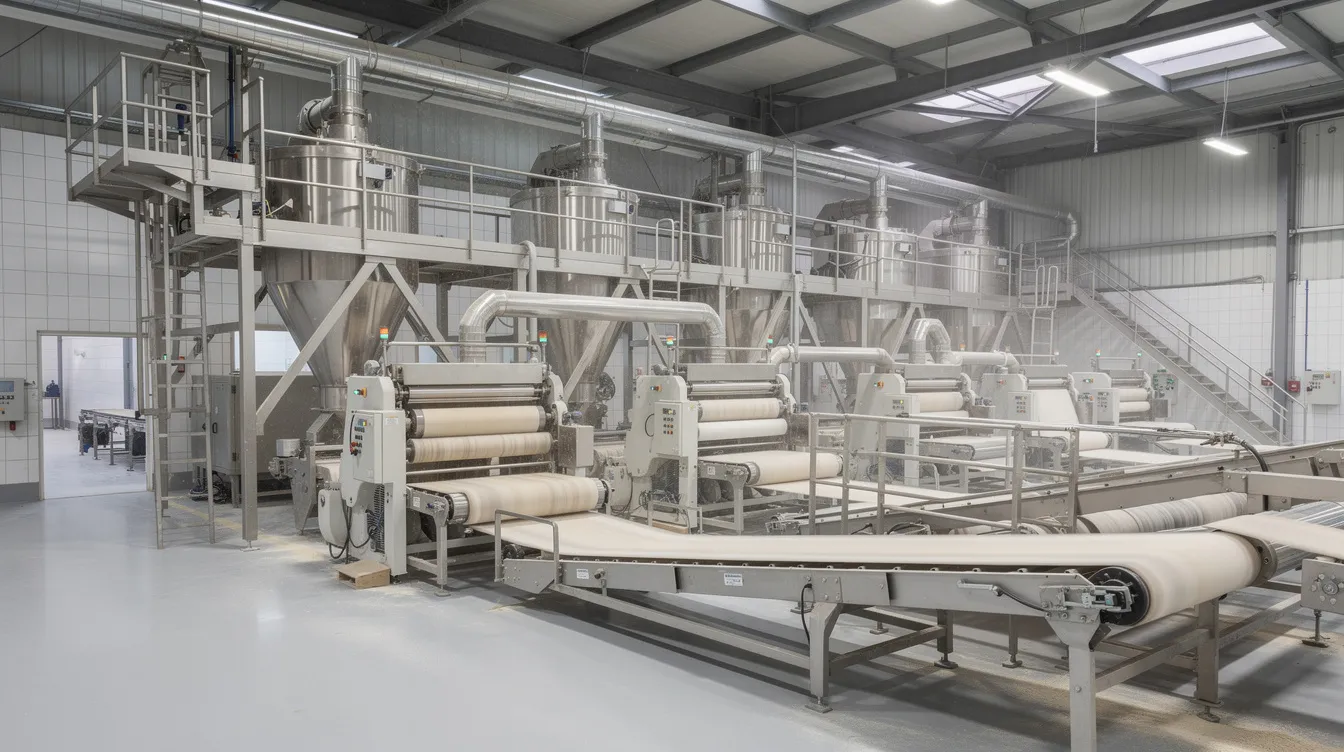
Machinery choice impacts extraction rate, energy cost per tonne, labour requirement, product consistency and maintenance downtime, all of which flow into atta chakki plant profitability and break-even analysis.
Main categories of technology for atta flour mills:
- Small commercial atta chakki units: Machinery specifications include a capacity of 50-200 kg/hr with power requirements of 10-25 HP, serving local retail customers. A mini flour mill’s machinery cost is around ₹3 lakh.
- Semi-automatic chakki plants: Capacity of 0.5-1 TPH with elevators, cyclone, sifter and basic packaging. MOFPI cost norms indicate a 500 kg/hr semi-automatic setup at approximately ₹13.95 lakh for machinery.
- Fully automatic atta plants: 2-5 TPH and above with cleaning, destoning, tempering, automatic feeding and advanced packing lines. Machinery costs for 1-2 TPH plants range from ₹35-70 lakh depending on specifications.
The feasibility study should check expected extraction percentage, kWh consumption per tonne, automation level vs available skilled manpower, spares availability, cleaning requirements and suitability for intended product mix (whole wheat atta, multigrain flour etc.). Quality control is essential for maintaining product consistency and safety in flour milling.
Before freezing capex assumptions, promoters should review realistic Atta Chakki machinery and equipment cost ranges for different capacities and automation levels. Machinery quotations should include basic price, GST, installation, commissioning, foundation costs and freight.
Feasibility analysis must not be biased by optimistic vendor claims; conservative assumptions for power, extraction and maintenance should be used instead.
Location Feasibility of an Atta Chakki Plant
A flour mill’s location can change its logistics cost structure, wheat procurement options and ability to access customers. A well-chosen site can add 1-2% to operating margin compared to a poorly located plant.
Key locational considerations:
- Proximity to wheat-producing areas and major mandis
- Distance to primary sales markets (city and town clusters)
- Quality and reliability of three-phase power supply
- Availability and cost of labour and technical staff
- Municipal restrictions, industrial zoning, NOCs and regulatory compliance (obtaining registrations and necessary licenses for operation)
Proper planning for utilities and waste management is crucial for operational efficiency. Infrastructure requirements depend on plant size and must ensure efficient material flow.
The trade-off between locating near the raw material source versus the demand centre depends on the specific project. Near the source: lower wheat freight and possible advantage for bulk institutional sales. Near the demand centre: lower finished goods freight and faster retailer response. For packaged atta brands, a midway highway location sometimes works best for distribution.
While doing location feasibility, also review typical Atta Chakki plant land, building and layout requirements to ensure the selected plot can accommodate future capacity expansion. Land cost should be evaluated in relation to freight savings, scheme eligibility and long-term expansion plans, as land is a permanent part of fixed assets.
Competition Analysis for Atta & Flour Mill Projects
Flour mill feasibility should never be calculated only on paper consumption. Competition from local mills, regional brands and national brands determines realisable selling price and volume.
Main competitive forces include:
- Local neighbourhood chakkis grinding wheat brought by customers
- Small commercial atta mills selling loose atta to kirana stores
- Regional packaged atta brands in 5-10 kg packs
- National brands selling through modern trade and general trade
- Bulk institutional suppliers serving hotels, canteens and food manufacturers
To map competitors, a promoter should compile a list of mills within a 25-50 km radius, note their visible retail brands, pricing, packet sizes and discounts, and understand typical dealer and distributor margins in the region. Industry trends in the flour milling sector show that the organized milling sector in India has installed capacity of 28-30 million metric tonnes per year but operates at only 55-60% utilisation, which indicates both opportunity and competitive pressure.
A strong business plan identifies a realistic competitive positioning: fresher local atta with quick supply, slightly lower price for bulk buyers, specialised wheat varieties (e.g., MP Sharbati premium atta), or value-added products like multigrain flour where demand justifies. The feasibility study should qualitatively assess whether the proposed project can win and retain profitable market share.
Revenue Model and Product Mix
Atta flour mill project viability depends greatly on product mix and revenue streams, not only on total tonnage milled. Wheat flour is the most consumed flour in India, and the product options include:
- Loose whole wheat flour sold in bulk to local shops and institutions
- Packaged atta in 1, 2, 5 and 10 kg packs under own brand
- Speciality atta (multigrain, MP Sharbati, high-fibre variants)
- By-products like bran for cattle feed
Product mix affects average realisation per kg, packing material cost per kg, distribution economics from factory to end consumer, credit terms and receivables. For instance, a retail chain may offer higher per-kg realisation for packaged products but demand 45-60 day payment cycles, while a local shop pays cash.
By-products contribute to revenue but feasibility should assign conservative values; do not overstate profits from bran sales. A sales-mix table in the feasibility might show, for example, 60% bulk loose atta, 30% packaged atta and 10% institutional supply in Year 1, evolving over 3-5 years.
Changes in product mix can be a key lever to improve contribution margin when raw material cost moves unfavourably.
Understanding Atta Chakki Plant Profitability
A wheat flour mill with high sales can still struggle financially if contribution per kg is low or overheads are high. The distinction between turnover and profitability is critical.
Major cost and margin drivers:
| Cost Head | Impact on Profitability |
|---|---|
| Wheat purchase price per kg | Largest variable cost; ₹1-2/kg shift changes gross margin materially |
| Extraction rate | Lower extraction = higher effective raw material cost per kg of atta |
| Average selling price | Driven by product mix, competition and brand positioning |
| Packaging material cost | Relevant for branded products; adds ₹1-3/kg |
| Power and fuel expenses | kWh per tonne varies by technology; DG backup adds cost |
| Labour and supervision | Per-shift cost; higher automation reduces this |
| Freight and logistics | Often underestimated; affects net realisation |
| Dealer/distributor margin | Reduces net selling price for packaged products |
Margin layers in simple terms:
- Gross margin = Sales minus wheat cost and direct variable cost
- EBITDA/Operating margin = Gross margin minus salaries, power, repairs, administration expenses and overheads
- Profit before tax = Operating margin minus interest and depreciation
- Cash surplus = Net profit plus depreciation minus loan repayments
From a project appraisal perspective, strong gross margin alone does not guarantee viability. Debt structure, working capital requirement and DSCR also determine whether the project is bankable. Promoters should test different pricing and cost scenarios to understand the realistic profitability range.
Project Cost, Fixed Assets and Means of Finance
Cost of project for an atta chakki plant includes both fixed assets (capital expenditure) and the initial working capital margin required to start operations. A typical flour mill project cost ranges from ₹2-25 lakh depending on capacity, automation and location.
Main fixed asset heads:
- Land purchase or lease-related deposits
- Site development, boundary wall, internal roads
- Factory building and civil construction (mill shed, godowns, office)
- Atta chakki plant and machinery including pre-cleaning, storage and packing line
- Electrical installation, cabling, control panels and transformer
- Utilities: compressor, DG set, weighing machines, laboratory equipment, packaging machine
- Furniture, computers, office equipment
Preliminary and pre-operative expenses (company formation, approvals, interest during construction, trial run) and contingency margin are also part of total cost. For reference, a ₹10 lakh flour mill project typically includes about ₹5.5 lakh for machinery cost.
Means of finance typically include:
- Promoter’s equity or own contribution (share capital)
- Term loan from bank or financial institution; banks typically fund 75-90% of the project cost
- Possible subsidies: PMFME offers a 35% capital subsidy for flour mills, up to ₹10 lakh for eligible units. MUDRA Tarun provides loans up to ₹10 lakh for micro enterprises.
For a structured view of typical investment heads and funding structures, promoters may refer to Atta Chakki plant project cost and means of finance while finalising their DPR.
High-level capex ranges by capacity and technology for new units across India are discussed in our article on Atta Chakki plant setup cost in India, which can supplement this feasibility analysis.
Working Capital Requirement in a Flour Mill Project
Working capital is the lifeblood of day-to-day operations in any atta flour mill. Funds get blocked in wheat stock, packaging materials, finished goods and credit extended to customers. Inadequate working capital can force a plant to operate at suboptimal utilisation even when demand exists, damaging atta chakki project viability and DSCR despite good paper profitability.
The working capital cycle runs from paying for wheat to receiving cash from atta buyers:
- Wheat inventory: 15-60 days based on procurement strategy and risk appetite
- Packaging materials: Minimum batch requirements for printed bags and rolls
- Finished goods: Particularly for packaged atta brands waiting for dispatch
- Trade receivables: 7-10 days for local cash buyers vs 30-60 days for institutions and large distributors
- Trade payables: Partial credit from wheat traders and packaging suppliers
Conceptually, the net working capital cycle equals inventory days plus receivable days minus payable days. The longer the credit given to customers or the higher the buffer stock, the more capital gets locked. Current assets including inventory and receivables form a large portion of total assets in a flour mill business.
Feasibility analysis should include month-wise working capital assessment for at least the first year, not just a single average number, because wheat buying and sales patterns are seasonal.
Financial Projections for Atta Chakki Project Viability
Financial projections for a flour mill should link technical capacity, market demand, cost structure and financing terms into a coherent model. Financial projections should cover a 5-year period at minimum.
Key components of a robust projection set:
- Year-wise capacity utilisation and production volume
- Sales mix and weighted-average selling price
- Raw material cost and packing material cost assumptions with expected annual escalation
- Power, labour and overheads with realistic inflation
- Working capital movement and interest cost
- Financial reports should include projected P&L and cash flow statements, along with projected balance sheet
- Other project financials: profitability ratios, projected pay back period, break-even capacity
Each change in capacity utilisation or selling price must be reflected in raw material consumption, electricity usage, packaging cost and working capital requirement. Projections cannot simply scale revenue without adjusting costs. A project report must include CMA data and DSCR computations for bank submission.
We discuss linkage between projections, working capital requirement and DSCR in more depth in our guide on Atta manufacturing financial projections, working capital and DSCR, which complements the feasibility study.
From a CA’s perspective, projection accuracy is less about predicting the exact future and more about testing whether the project remains viable across a range of realistic scenarios.
Atta Chakki Break-Even Analysis
Break-even analysis in an atta chakki feasibility study identifies the sales volume or capacity utilisation at which the flour mill covers all operating costs but does not yet earn profit. A feasibility study must include a break-even analysis for determining profitability timelines.
Key terms explained:
- Fixed costs: Salaries, supervision, rent, insurance, minimum power demand charges, administration expenses, interest on term loan
- Variable cost: Wheat, packaging, power consumption linked to production, direct labour, outward freight
- Contribution per kg: Selling price minus variable cost per kg; this contribution goes toward covering fixed costs and then generating net profit
Break-even is interpreted as:
- Break-even sales volume in tonnes per month or year
- Corresponding percentage capacity utilisation of the atta chakki plant
- An analytical tool, not a guaranteed sales level
To illustrate (all figures illustrative only): if a 60 TPD atta plant has annual fixed costs of a certain amount and earns an average contribution of a certain amount per tonne, the feasibility model may show that the plant must operate at roughly 45-50% utilisation to cover all costs. Bankable DPR examples show break-even capacity utilisation around 48-50%. If realistic Year-1 sales can support only 25-30% utilisation, risk is higher and the project structure may need revision.
Expected utilisation during the first 2-3 years should stay meaningfully above break-even levels, leaving cushion for adverse conditions. Lenders review break-even capacity and contribution assumptions carefully before sanctioning term loans.
DSCR and Loan Repayment Capacity
DSCR (Debt Service Coverage Ratio) measures how comfortably a project can service its term loan principal and interest obligations from operating cash flows. A minimum DSCR of 1.5 is required for funding from most Indian banks.
In plain terms:
- DSCR above 1 means cash accrual exceeds loan instalments and interest
- DSCR below 1 means cash generation is insufficient, potentially causing repayment stress
In practical bank appraisal of atta flour mill projects, lenders review year-wise DSCR, not just the average. Early years with low utilisation are often the critical period for repayment. The moratorium period and loan tenure must be aligned with ramp-up assumptions.
Factors that can reduce DSCR even when the flour mill appears profitable on paper:
- Very high term loan relative to promoter’s equity
- Aggressive repayment schedule with short tenure
- Underestimation of working capital leading to ad-hoc high-cost borrowings
- Slower-than-projected sales ramp-up or margin pressure
The feasibility study should simulate DSCR under conservative and stress scenarios. While banks seek DSCR benchmarks of 1.5 or more on average, an experienced CA will focus on whether the projected DSCR pattern genuinely reflects operational realities and seasonality.
Promoters can review how DSCR analysis works in practice through our article on DSCR and loan repayment capacity for food processing projects.
Sensitivity Analysis: Testing Atta Chakki Project Viability
Sensitivity analysis is a crucial part of any atta chakki plant feasibility study. It shows how project outcomes change if key assumptions move unfavourably. Sensitivity analysis helps assess potential impacts of price fluctuations on project viability.
Typical scenarios to test:
- Wheat cost increases by 3-5% above base assumption
- Average selling price is 2-3% lower than expected due to competition
- Capacity utilisation is 10-15 percentage points lower in initial years
- Power tariffs rise faster than inflation
- Receivable days extend by 15-30 days, increasing interest on working capital
- Project completion is delayed by 3-6 months, adding interest during construction
For each scenario, monitor the impact on gross and operating margins, change in break-even capacity, effect on DSCR in stressed years and shift in payback period. Risk assessment identifies supply chain risks and plans for equipment downtime as part of this analysis.
A robust atta flour mill project should remain broadly viable under moderate adverse changes. If minor variations in wheat price or selling price cause DSCR to crash below 1 or result in persistent losses, risk is high.
Promoters should use sensitivity analysis to potentially re-design the project: adjust capacity, modify product mix, reconsider loan tenure or strengthen working capital lines before finalising investment. This type of testing is routine in professional CA-led feasibility and helps avoid overconfidence based on a single optimistic base case.
Key Viability Factors: Practical Checklist for Promoters
This checklist helps prospective flour mill entrepreneurs self-assess project viability before approaching banks or investors.
Market and demand:
- Is there clearly identified local and regional demand that can support 3-5 years of sales ramp-up?
- Is the target customer group identified (retail, institutional, wholesale)?
- Has market and demand analysis involved identifying target customers and existing competitors?
Procurement and operations:
- Are reliable wheat procurement sources mapped with approximate landed cost and quality parameters?
- Is plant capacity aligned with addressable demand and promoter’s financial strength?
- Is there a preliminary selling price strategy for each product segment?
- Are realistic gross margin and contribution per kg calculated after all variable costs including packaging and freight?
Infrastructure and capacity:
- Are land, building and layout adequate for process flow, storage and future expansion?
- Is there a plan for manpower including mill operators, electricians and quality-control staff?
- Has working capital requirement for wheat stock and receivables been estimated with seasonal peak assumptions?
Financial viability:
- Does break-even utilisation stay comfortably below projected utilisation for the first 3 years?
- Does DSCR remain acceptable under slightly conservative assumptions?
- Are key parameters of the project stress-tested through sensitivity analysis?
Soft factors:
- Does the promoter or management team have prior experience in food processing, trading or distribution?
- Is there a written business plan, not just an informal idea?
- Are key project risks identified with mitigation strategies (insurance, diversified customers, buffer capital)?
If most items are answered positively with documented assumptions, the project is more likely to be both bankable and commercially viable.
Warning Signs That an Atta Chakki Project May Not Be Viable
Many flour mill projects struggle because early red flags are ignored. Promoters should pause and re-evaluate when these warning signs appear.
Planning red flags:
- Plant capacity and technology selected purely on machinery supplier advice or scheme maximum, with no market study
- No clear route to market (no distributor relationships, retail tie-ups or institutional leads)
- Unrealistic capacity utilisation assumptions (70-80% from Year 1 without evidence of orders)
Financial red flags:
- Wheat procurement cost assumed at lowest historical mandi rates, without freight, wastage or quality loss margins
- Outward freight either ignored or severely underestimated in projections
- Working capital margin kept minimal to reduce cost of project on paper, leading to negative cash flows in practice
- High debt-equity ratio and tight repayment schedules just to maximise bank loan eligibility
Commercial red flags:
- Contribution per kg too low to absorb marketing, distribution and credit costs
- Break-even utilisation very close to projected normal utilisation, leaving almost no safety margin
- Dependence on a single large buyer for most sales
- Aggressive credit terms to dealers with low margins
When several such signs appear together, promoters should consider resizing capacity, revising the business model or postponing the project rather than pushing bank finance at any cost.
Atta Chakki Feasibility for Different Business Models
Feasibility and economics change depending on whether the project is a local chakki, automatic atta plant, packaged brand or institutional supplier. One size does not fit all.
Local Commercial Atta Chakki (Neighbourhood Flour Mill)
Small capacity mills (100-300 kg/hr) operating at shop level serve walk-in customers and nearby retailers. Capex is relatively low; a typical flour mill machinery cost is ₹5.5 lakh for basic food processing equipment at this scale. Dependence on local footfall is high.
Feasibility factors: low marketing cost but intense local competition from other neighbourhood chakkis, importance of location within residential areas, typically cash-based sales with limited receivables, and working capital mainly in wheat stock and small packaging inventory. Wheat flour is among the basic food ingredients consumed daily, ensuring steady if modest demand. These mills often handle consumed flour in the most traditional sense; grinding wheat as a basic foods requirement.
Automatic Atta Manufacturing Plant (Bulk and Semi-Branded Supply)
Automatic plants (1-5 TPH) focus on higher throughput, mechanised handling and supply to wholesalers, institutions and sometimes other brands for private labelling. The industrial world of flour milling is where these units compete.
Feasibility aspects: higher fixed assets and term loan, more stringent break-even and DSCR requirements, working capital locked in large wheat procurement and credit to buyers, need for stable power supply, skilled labour and strong maintenance practices. Technical feasibility includes determining plant capacity and selecting appropriate machinery at this scale.
Packaged Atta Brand
Here the flour mill establishes its own retail brand with printed pouches in multiple SKUs sold via distributors and modern trade. This model targets investment opportunities in branded food.
Viability elements: branding, design, regulatory labelling and FSSAI compliance, trade schemes and dealer margins that reduce net realisation, marketing and promotional spend for visibility against national brands, and longer receivable cycles from supermarkets. The executive summary of a feasibility study for this model needs to address brand-building costs honestly.
Institutional / Bulk Supply Model
This model focuses on supplying bulk atta to hotels, restaurants, catering units, large canteens and food manufacturers on contract or rate agreements. Market opportunities exist in growing food service sectors.
Feasibility issues: large volume but often thin margins, high quality consistency requirements, risk from customer concentration, and stringent food-safety audits. Gluten flour specifications and wheat field sourcing standards may be specified by institutional buyers.
The same manufacturing plant may be attractive under a balanced mix of bulk and packaged sales and weak under only low-margin institutional contracts. Feasibility must be model-specific.
Feasibility Study vs Detailed Project Report (DPR)
A feasibility study and a DPR are related but distinct outputs. They should not be confused as the same document.
A pre feasibility study or full feasibility study answers: “Should we proceed, and if yes, under what structure and capacity?” It analyses options, tests scenarios and compares alternative configurations. It can be relatively concise yet decision-focused.
A detailed project report prepares a bankable document once key parameters are frozen. It includes technical descriptions, land and layout details, machinery specifications, statutory compliances, 5-7 year financial projections, CMA data for bank submission, existing proposed total particulars of the project and a funding plan. The flour mill project report is used for submission to banks, investors and government agencies.
A well-executed feasibility study reduces rework at DPR stage because demand, capacity, margins and working capital questions are already addressed.
When Should a Promoter Conduct the Feasibility Study?
Feasibility should ideally be taken up at conceptual stage: after the initial idea and preliminary quotes, but before committing major capital to land, machinery orders or long-term leases.
Complete the study before:
- Finalising plant capacity and technology configuration
- Paying heavy advances to machinery suppliers
- Registering large term loans or offering property as collateral (loan applications require KYC and land proof documents)
- Entering binding contracts with institutional buyers based on untested cost assumptions
Feasibility can still help existing mill owners planning expansion or diversification into packaged atta. Preliminary cost estimates, draft site options and vendor quotations from current market conditions are adequate inputs. Waiting for “perfect data” is less important than testing realistic ranges.
Banks require hard copies of the project report with stamp paper for final appraisal, and approval timelines typically range from 2 to 4 weeks after submission. But the feasibility work should happen well before this stage.
View feasibility as an investment in risk management rather than an additional cost.
Professional Feasibility and Project Viability Assessment
Many flour mill promoters benefit from independent CA-led evaluation that challenges optimistic assumptions and structures the project for bankability. Sound business decisions in a capital-intensive sector like flour milling require structured financial analysis.
A professional atta chakki feasibility engagement typically covers:
- Structured demand and competition assessment
- Evaluation of wheat procurement strategies and landed cost patterns
- Capacity and technology selection aligned with promoter risk appetite
- Project cost build-up and fixed asset planning
- Working capital estimation including seasonal peaks
- Integrated financial projections with P&L, cash flows and balance sheet
- Break-even, DSCR, sensitivity and risk analysis covering all financial charges
Project Report Bank, led by CA Manish Gugliya, is a specialised advisory platform providing customised modelling and bank-oriented presentation for each atta flour mill project. We prepare project reports, not templates. The approach focuses on helping promoters make the project a profitable project based on realistic assumptions rather than aspirational numbers.
Promoters planning atta chakki or wheat flour mill projects who require customised feasibility and DPR support may connect with our team on WhatsApp for a preliminary discussion.
Details of our project feasibility study and project viability assessment services are available for entrepreneurs and MSMEs across India planning new or expansion flour mill units.
Conclusion: Is an Atta Chakki Plant a Viable Business?
An atta chakki or wheat flour mill can be commercially attractive when wheat procurement is secure and competitively priced, there is clear addressable demand, plant capacity and technology match market and capital strength, contribution margin per kg is adequate after all real costs, and sufficient working capital and sensible debt structure are in place. The project should sustain industry performance standards across operating costs, margins and cash flows.
There is no universal answer. Atta chakki project viability is project-specific, driven by location, business model, management capability and execution quality. A wheat field’s proximity, a roller flour mill’s competition in the same region, the dark brown colour preference of local consumers for stone-ground atta, or ethanol production from damaged wheat as an alternative outlet can all affect assumptions. Even tissue culture base seeds for improved wheat varieties can influence long-term procurement planning in certain regions.
The true purpose of an atta chakki plant feasibility study is not to justify a pre-decided investment but to critically examine whether that investment is justified under realistic market and financial conditions. From my experience of evaluating manufacturing projects over more than two decades, promoters who invest time and resources in robust feasibility and DPR preparation navigate bank appraisal more smoothly and reduce the risk of financial stress in the first 3-5 years of plant operation.
If you are evaluating a flour mill project and would like to discuss your proposed location, capacity, approximate budget and business model, you are welcome to share basic details via WhatsApp so that a tailored feasibility and DPR approach can be suggested.
CA Manish Gugliya FCA, DISA (ICAI)
Frequently Asked Questions (FAQ)
These questions address practical doubts entrepreneurs commonly raise during an atta chakki plant feasibility study.
What minimum capacity is generally practical for a new commercial atta chakki plant?
Very small capacities below 200-250 kg/hr are suited mostly for neighbourhood mills. Commercial projects targeting wholesalers or institutions usually start around 500 kg/hr to 1 TPH. A typical flour mill capacity is 50-200 kg/hr for mini or micro units. The answer is not a fixed thumb rule; feasibility should determine whether a 20-30 TPD or 50-60 TPD flour mill capacity is appropriate based on addressable market, investment ability and working capital strength. The gradual demand increase day by day in a specific catchment area should inform this decision.
How long does it typically take to complete a feasibility study and DPR for a flour mill project?
For a standard atta chakki project with basic inputs available (location, tentative capacity, initial quotations), a focused feasibility study can usually be completed within 2-3 weeks. Once feasibility is positive and data is frozen, a detailed project report and CMA data set for bank submission often require another 1-2 weeks depending on complexity and responsiveness of the promoter.
Can an existing grain trader or wheat broker improve project viability through their experience?
Prior experience in wheat trading or grain logistics is a strong positive. Such promoters typically understand mandi dynamics, pricing trends and quality issues better than first-time investors. However, successful plant operation also needs process control, quality assurance, branding and financial planning. Trading experience should be combined with professional feasibility and plant operations planning.
How do government schemes and subsidies affect atta chakki project feasibility?
Capital subsidies or interest subvention under schemes like PMFME (which offers a 35% capital subsidy up to ₹10 lakh) or state food processing policies can improve project returns. However, subsidies should be treated as an upside, not the core basis of viability. Feasibility should first show reasonable viability even without subsidy. Any approved subsidy then acts as additional margin of safety or helps accelerate the payback period. The r i (return on investment) and e r i (effective return on investment) should be evaluated both with and without subsidy support.
Is it necessary to register a separate company for a flour mill, or can it be run as a proprietorship?
Flour mills can be set up as proprietorships, partnerships, LLPs or private limited companies. The choice affects taxation, compliance and banking documentation but not technical feasibility. Promoters should discuss ownership and funding structure with their CA at feasibility stage. Some banks and investors prefer partnership, LLP or company format for larger atta manufacturing units, as it provides clearer documentation of fixtures pre operative costs, total assets and share capital structure.