Key Takeaways
- Atta chakki plant project cost is not just machinery; it includes land, building, electrical installation, utilities, pre-operative expenses, contingency and margin for working capital. Treating a machinery quotation as total investment is the most common budgeting error.
- The cost structure splits into fixed capital investment (land, building, plant and machinery, electrical, utilities, furniture) and working capital requirement (wheat stock, packaging material, receivables, operating expenses). Both must be estimated separately, as they drive different types of financing.
- Means of finance typically combines promoter contribution, bank term loan for fixed assets and separate working-capital limits. A balanced debt-equity structure directly affects DSCR, repayment comfort and the bank’s willingness to sanction the loan.
- Actual figures vary by production capacity (200 kg/hr to 1000 kg/hr or higher), automation level (basic chakki plant vs. fully automatic atta chakki), location, building type and product range. This article provides illustrative tables for a commercial plant but stresses that project-specific estimates must be prepared.
- A properly prepared DPR with financial projections, CMA Data and a reconciled means-of-finance statement is what converts a business idea into a bankable proposal.
Introduction: Why Atta Chakki Plant Project Cost Needs Proper Structuring
Most entrepreneurs start planning their atta chakki plant by requesting a machinery quotation from a supplier. The supplier responds with a price for a fully automatic atta chakki or a semi-automatic flour mill plant, and the promoter treats that number as the total atta chakki plant project cost. This approach creates problems when the actual investment requirement turns out to be 1.5 to 2.5 times the machinery quote alone.
A bankable commercial atta chakki project cost must account for land and building, plant and machinery, electrical installation, utilities, furniture, preliminary and pre-operative expenses, contingency and margin for working capital. Cost factors for atta chakki setups include machinery, utilities, and working capital needs, and ignoring any of these heads leads to funding gaps during implementation. Consumer demand for fresh wheat flour remains high in India, making this a viable food processing opportunity, but viability depends on getting the cost and financing right.
In my experience as a practising Chartered Accountant, the atta chakki plant project cost also has to be matched with a realistic means of finance before approaching banks. The project setup cost varies with production capacity and automation level; a small scale flour mill may need a fraction of what a 1000 kg hr industrial atta chakki plant requires. Broader component-wise ranges and capacity breakups are covered in the detailed atta chakki plant setup cost in India, while this article focuses on structuring the cost correctly and planning how to finance it.
What Is Included in Atta Chakki Plant Project Cost?
The total project cost has two building blocks that every promoter must understand before preparing a DPR or approaching a lender.
Fixed capital investment covers everything needed before the plant starts producing: land and site development, civil construction, plant and machinery, electrical installation, utilities (water, compressed air, dust extraction), furniture and fixtures, and laboratory or quality control equipment. These are one-time capital expenditures, and most are eligible for term-loan financing.
Working capital requirement represents the funds blocked in running the business: wheat stock (raw material inventory), packaging material, consumables, finished-goods inventory, trade receivables and day-to-day operating expenses. Total project cost assessment should include installation and working capital; failing to do so means the flour mill plant may be physically ready but unable to buy wheat or extend credit to customers.
A useful conceptual formula:
Total Project Cost = Fixed Assets + Preliminary & Pre-operative Expenses + Contingency + Margin for Working Capital + Other Eligible Project Expenses
Different banks may classify and present these components in slightly different appraisal formats, but the underlying concept remains the same. This article focuses on how to think about atta chakki plant investment and funding structure rather than providing one universal figure for all capacities.
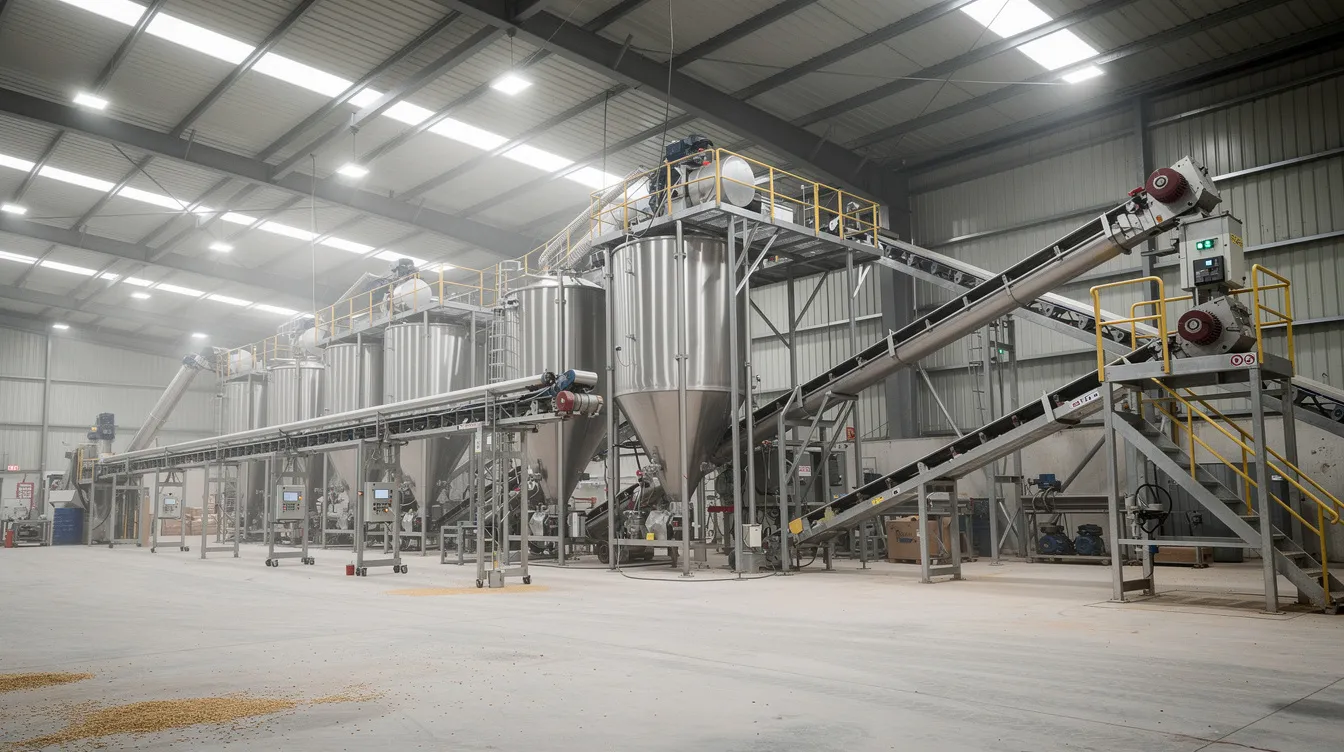
Land and Site Development Cost
Land cost treatment depends on three scenarios: the promoter already owns land, needs to purchase industrial land, or will operate in leased premises. Each case affects atta chakki total investment and bank finance structure differently.
Typical site-development elements include levelling, compound wall, gate, internal roads, rainwater drainage, borewell or water connection, and basic landscaping. These should be part of atta chakki capital expenditure even though they are easy to overlook. Land and building costs can add ₹20 to ₹50 lakh to the budget depending on location and state-level industrial land rates.
Most lenders do not finance bare land purchase as part of term loans but may consider site development and compound works as eligible project expenditure. When land is already owned by the promoter, a notional value may be shown in the project cost depending on the bank’s format, with treatment agreed during appraisal. For detailed plot-size norms and layout considerations, refer to the guide on atta chakki plant land and building requirements.
Building and Civil Construction Cost
A commercial flour mill typically requires these built-up areas:
- Raw-wheat godown (storage for incoming grain)
- Wheat cleaning section and conditioning or tempering area
- Milling section (chakki or grinding units)
- Sifting and grading area
- Packaging section and finished-goods godown
- Utility room (electrical panels, compressor, DG set)
- Laboratory or quality control room
- Office, worker amenities and washrooms
The choice between RCC construction and pre-engineered building (PEB) structures affects the atta chakki building cost materially. PEB can be faster to erect but may cost differently per square foot depending on the region.
Required built-up area scales with plant capacity and production flow. A factory building for a 1000 kg hr plant needs more height (for elevators and gravity flow) and floor space than a small shop-based milling unit. Building cost estimates should use local civil-construction rates (₹/sq ft) prevailing in 2026 in the relevant state, not outdated generic figures. Demand for packaging and marketing infrastructure increases as production capacity scales, so packaging-area sizing deserves attention from the start. For typical sizing and atta plant layout requirements, refer to the dedicated article.
Plant and Machinery Cost for a Commercial Atta Chakki
Plant and machinery is usually the single largest component of an atta chakki plant project cost, especially for fully automatic flour mill plants and industrial flour mill configurations at 1000 kg hr or higher.
Major equipment categories include:
- Grain cleaning plant: pre-cleaner, vibro cleaner, gravity separator, destoner
- Magnetic separators for metallic impurities
- Wheat conditioning or tempering system
- Chakki or milling units (stone mills, pulverisers, or roller mills for fine grinding)
- Sifters and grading equipment (sifting equipment separates flour into different textures like atta and maida)
- Elevators and conveyors (machinery elevator systems for vertical grain movement)
- Dust-collection or aspiration system (dust control systems maintain air quality during milling)
- Storage silos for holding raw grains and finished flour
- Weighing and packaging machines (these automate weighing and sealing of flour)
Cleaning machines remove dust and impurities from grains before milling. The milling section includes roller mills and hammer mills for grinding. A fully automatic atta chakki plant can process 500 kg per hour, while fully automatic flour mills at the upper end can process up to 5000 kg/hr. An automatic atta chakki plant with PLC-based machinery control panel, pneumatic handling and automatic bagging costs more than a basic semi-automatic chakki plant configuration.
Machinery costs for a small-scale plant range from ₹15 to ₹25 lakh. The MOFPI cost norms list a 500 kg/hr semi-automatic plant’s machinery at approximately ₹13.95 lakh (45.5 HP), providing a reliable baseline against which supplier quotes can be compared. At 1 TPH, supplier quotations for premium fully automatic lines reach ₹40-45 lakh for machinery alone, showing how cost depends on capacity kg hr, material of construction (construction mild steel vs SS contact parts), brand, country of origin and packaging configuration.
This article does not provide a machine-by-machine price list. For equipment-wise analysis and vendor comparison, refer to the detailed page on atta chakki machinery cost and automatic atta plant machinery.
Electrical Installation and Utility Costs
Many first-time promoters underestimate atta chakki electrical installation cost, assuming the machinery quote covers everything. It rarely does.
Key electrical components:
- Main LT panel and distribution boards
- Internal factory wiring, cabling and cable trays
- Earthing and lightning protection
- Factory lighting
- Motor starters, VFDs and soft starters
- Dedicated transformer or HT connection where the connected load exceeds the local utility’s LT threshold
Heavy machinery in a commercial milling unit needs a stable three-phase commercial electricity connection. A mild steel electricity connection panel may suffice for smaller units, but a 1000 kg hr plant with 80-120 HP connected load typically requires proper three phase material and may need a dedicated transformer. Electricity requirements can impact operational costs for atta chakki setups; electricity bills for large plants can range from ₹1 to ₹5 lakh monthly. High-capacity plants can achieve energy efficiency of 40-45 kWh per ton, which makes power consumption a critical variable in project economics.
Typical utilities for a commercial chakki plant include compressed-air systems, dust-collection or aspiration systems, water supply for wheat conditioning, fire-fighting equipment, and optional DG set or backup power. These are generally eligible components of atta plant CAPEX for term-loan funding.
Furniture, Office Equipment and Laboratory Setup
Though smaller in value compared to plant and machinery, furniture and fixtures, computers and quality control equipment should still appear in the atta chakki total investment estimate.
Typical items include office tables and chairs, filing cabinets, CCTV system, basic IT equipment, weighing scales, moisture meters, sieves and simple lab instruments for routine flour-quality checks. Banks usually include these under fixed assets; amounts should be reasonable and supported by catalogues or quotations. A modest investment in proper laboratory and QC equipment can improve output quality and reduce customer complaints, making it worth the allocation even in a tight budget. Maintaining hygiene standards through proper QC equipment is particularly relevant for food processing businesses serving modern retail.
Preliminary and Pre-operative Expenses
This block of atta plant CAPEX covers costs incurred before commercial production begins and is frequently underestimated.
Preliminary expenses typically include:
- Company, LLP or proprietorship formation and registration
- Project-report preparation and technical consultancy
- Initial branding, trademark search or registration
Pre-operative expenses commonly cover:
- Statutory approvals and licences (legal operation requires obtaining municipal and food safety licenses; FSSAI and GST registration are required for food processing businesses)
- Travel and site visits during implementation
- Staff recruitment and initial training
- Trial production expenses and initial raw-material purchases
- Advertising and product-launch costs
- Interest during construction (IDC) if implementation spans several months
Licenses and compliance expenses vary based on business scale and location. Banks may capitalise certain pre-operative expenses into the project cost and fund them through the term loan, while others must be borne by the promoter directly. Professional fees for a detailed project report, CMA Data and financial projections are minor compared to overall project cost but are important for structuring atta chakki bank finance properly.
Contingency Provision in Atta Chakki Project Cost
A contingency line item accounts for unforeseen price escalations, minor design changes and small extra works that arise during implementation. It is usually calculated as a percentage (commonly 5-8%) of selected cost heads like civil works, plant and machinery, electrical and utilities.
The percentage should be justified based on project size and risk profile, not copied from a generic template. Very high or very low contingency provisions raise questions during bank appraisal. In 2024-2026, material prices, steel, concrete and freight have been volatile, making a transparent and well-reasoned contingency provision more important than in stable-price periods.
Working Capital Requirement for an Atta Chakki Plant
Working capital and fixed capital serve different purposes, and entrepreneurs must estimate both separately. Operational expenses for flour mills include labor, utilities, and maintenance on an ongoing basis, all funded through working capital.
Typical working-capital components for a flour mill plant:
- Wheat stock (raw material inventory); maintaining raw material inventory is crucial for continuous production in milling operations
- Packaging material (bags, pouches, boxes) and packaging units
- Packing consumables, spare parts
- Finished-goods inventory
- Trade receivables (credit given to distributors and retailers)
- Minimum cash or bank balance for daily operations
The working-capital cycle runs from purchase of wheat, through processing wheat into atta, storage, sale to buyers, and collection from debtors. Longer credit terms or larger wheat inventory directly increase the flour mill working capital requirement. Monthly raw material costs for a mid-scale unit can reach ₹10 to ₹50 lakh depending on throughput and wheat prices, which shows why working capital cannot be treated as an afterthought.
A plant with 1000 kg hr capacity running multiple shifts needs substantially more raw material inventory and receivables than a 200-300 kg hr unit. A structured working-capital assessment, projected balance sheet and properly prepared CMA Data for bank finance help promoters justify adequate cash-credit or overdraft limits instead of ad-hoc sanction amounts that later prove insufficient.
Working Capital Margin (Promoter’s Share in Working Capital)
Working-capital margin is the portion of total working-capital requirement that must be funded by the promoter’s own sources rather than by bank cash-credit limits.
Conceptually: Working Capital Margin = Total Working Capital Requirement – Bank Working Capital Finance (CC limit)
Banks typically require the borrower to bring a certain percentage from own sources; Indian Bank’s IB Star Agro Mills scheme, for example, applies 20-25% margin on stock and 25% on book debts. However, the exact margin varies by bank policy, scheme and borrower profile. In project-cost statements, margin for working capital appears as a separate line item, often financed through promoter contribution or, in some structures, partly through the term loan.
Underestimating working-capital margin is a common reason why technically sound atta chakki projects face liquidity stress after commissioning.
Means of Finance for an Atta Chakki Plant
Means of finance is the funding side of the project: how the total atta chakki plant project cost will be met by promoters, banks and other sources.
Typical funding sources:
- Promoter contribution (own funds or equity capital)
- Unsecured loans from promoters or relatives (where acceptable to the lender)
- Bank term loan for fixed assets
- Subsidy-linked components under eligible government schemes (PMEGP, PMFME, MOFPI schemes)
- Separate bank working-capital limits (cash credit, overdraft)
In a properly structured DPR, total means of finance must equal total project cost. Any gap must be resolved before submission to the bank.
| Source of Finance | Illustrative Amount |
|---|---|
| Promoter Contribution | ₹XX lakh |
| Bank Term Loan | ₹XX lakh |
| Other Eligible Sources (subsidy, etc.) | ₹XX lakh |
| Total Means of Finance | ₹XX lakh |
These figures are purely illustrative and do not represent a bank sanction recommendation. The exact structure depends on project size, capacity, location, promoter strength, collateral and bank policy.
For reference, a PMEGP flour mill project in Thane with ₹22 lakh total project cost was funded with approximately 10% promoter contribution, 15% subsidy and 75% bank term loan. General bank-financed projects without scheme support typically require 20-30% promoter contribution.
If you are planning a commercial atta chakki project and need assistance with a customised DPR, project-cost statement, means-of-finance structure, CMA Data or financial projections, you can reach out via WhatsApp for an initial discussion. Professional fee for Bank Finance DPR and Loan Proposal Assistance starts from ₹25,000.
Promoter Contribution and Equity Funding
Atta chakki promoter contribution is the portion of project cost funded from the promoter’s own capital, share capital or other acceptable long-term sources, excluding bank finance.
Banks require adequate promoter contribution because it demonstrates commitment, reduces leverage and provides a cushion against unforeseen challenges in the initial years. Potential sources include accumulated savings, sale of non-core assets, capital brought in by partners or shareholders, and properly documented unsecured loans where banks classify them as quasi-equity.
Different banks and government schemes have different expectations on minimum promoter equity. Under MOFPI guidelines, promoter equity of at least 20% is expected in general areas and 10% in difficult or special-category areas. Entrepreneurs should verify specific norms with their lender rather than relying on a single percentage from informal sources.
From a project-finance perspective, over-stretching bank debt to reduce promoter investment can weaken DSCR and repayment capacity, making the project less attractive to the lender.
Term Loan Structure for Fixed Capital
An atta chakki term loan finances eligible fixed-project assets: building, plant and machinery, electrical installation, utilities, furniture and select pre-operative expenses. It does not cover routine working expenses.
Key structural aspects:
- Loan amount linked to net project cost after deducting promoter margin
- Moratorium period during construction and stabilisation (6-12 months is common)
- Repayment tenor of 5-7 years depending on project size and bank norms
- Interest rate (fixed or floating) as per bank’s lending policy
- Monthly or quarterly instalment pattern
Banks assess term-loan eligibility based on DSCR, projected cash flows, project viability, collateral coverage and borrower profile. A 1000 kg hr fully automatic atta plant with higher automation may justify a longer repayment period than a small semi-automatic chakki because of larger capital investment, subject to lender norms.
For entrepreneurs who need customised loan-structuring assistance, professional support is available through project finance and loan structuring advisory.
Debt-Equity Ratio and Funding Balance
Debt-equity ratio is the ratio of long-term debt (term loans) to the promoter’s equity invested in the project. A ratio of 2:1, for example, means ₹2 of debt for every ₹1 of equity.
An extremely high ratio gives short-term comfort by reducing promoter outlay but creates higher interest burden, tougher DSCR conditions and greater risk during low-demand periods. Conversely, an excessively low ratio (too much equity, very little debt) may underutilise available concessional credit or subsidies.
In practice, an appropriate structure satisfies bank norms, maintains comfortable DSCR and allows the promoter to run the plant without constant cash-flow stress. Running multiple financial projections with different debt-equity combinations helps identify the structure that balances return on equity with repayment safety, ideally with professional financial projections and financial modelling support.
Impact of Plant Capacity and Automation on Project Cost
Different capacity brackets create step changes across every cost head:
| Capacity Range | Typical Profile | Approximate Total Project Cost (excl. land) |
|---|---|---|
| 200-300 kg hr | Small commercial flour mill, semi-automatic | ₹5-15 lakh |
| 500 kg hr | Automatic flour mill plant, partial automation | ₹20-35 lakh |
| 1000 kg hr | Fully automatic atta chakki, packaged-atta focus | ₹40-80 lakh |
| 2-5 TPH | Industrial atta chakki plant with silos, QC lab | ₹60 lakh to ₹2.5 crore+ |
Source: ProjectReportBank.com cost ranges and MOFPI norms. Figures vary by location, vendor and scope.
Production capacity ranges from 200 kg/hr to 1000 kg/hr for most commercial projects. A commercial atta chakki can provide various products beyond traditional wheat flour, including multigrain flour, maize flour and other grains, which affects machinery requirements and process complexity.
Higher automation (fully automatic atta chakki with PLC, automatic bagging, minimal manual intervention) generally results in higher initial CAPEX. Automation reduces labor costs by up to 30% in flour mills and fully automatic plants ensure consistent flour quality with minimal manual effort. Automated mills can also process various grains, enhancing operational flexibility and production scale. While machinery cost grows roughly with capacity, associated costs like land, building, utilities and working-capital inventory often grow in non-linear ways.
For deeper guidance on selecting the right capacity, refer to the article on atta chakki plant capacity planning.
Effect of Manufacturing Process Choices on Cost Structure
The chosen atta manufacturing process, including the number of cleaning stages, type of conditioning system, grinding units (chakki, roller mills, or combination), components in the cleaning section, dust-collection arrangement, blending and packaging automation, directly affects plant and machinery cost and, to some extent, building and utility requirements.
A plant with advanced multi-stage cleaning (grain cleaning machine, destoner, gravity separator, magnetic separation), automated blending for manufacturing excellent quality range of flours, and advanced technology for uniform grinding will cost more upfront than a basic cleaning-cum-milling line. However, it may meet the consistent quality and hygiene standards demanded by modern retail chains and institutional buyers, supporting higher sales service realisation per kg.
This article does not reproduce the complete process flow. For technical details, refer to the atta manufacturing process and flow chart. When preparing a DPR, specific machinery selections based on the process flow should be tied to realistic quotations so that the atta chakki capital expenditure is aligned with the chosen technology.
Illustrative Atta Chakki Project Cost Format (Sample 1000 kg/hr Plant)
This is an illustrative example for a medium commercial plant. It is not a ready-made quotation or universal figure. Actual atta chakki plant cost in India will differ by state, vendor quotations and project-specific choices.
| Particulars | Estimated Cost (₹ lakh) |
|---|---|
| Land / Site Development | ₹XX |
| Building & Civil Work | ₹XX |
| Plant & Machinery (incl. cleaning, milling, sifting, packing) | ₹XX |
| Electrical Installation | ₹XX |
| Utilities (compressed air, water, dust extraction, fire safety) | ₹XX |
| Furniture & Office Equipment | ₹XX |
| Laboratory & QC Equipment | ₹XX |
| Preliminary Expenses | ₹XX |
| Pre-operative Expenses | ₹XX |
| Contingency (5-8% of selected heads) | ₹XX |
| Margin for Working Capital | ₹XX |
| Total Project Cost | ₹XX |
Key points:
- Actual project cost must be determined from plant capacity, location, building requirement, verified machinery quotations, utility load, product mix and operating assumptions.
- The machinery component for a 1000 kg hr plant with fully automatic motor power and packaging typically represents 40-55% of total project cost (excluding land).
- For broader capacity-wise cost ranges, refer to the cost of setting up an atta chakki plant.
Illustrative Means of Finance Structure for the Same Project
| Source | Amount (₹ lakh) |
|---|---|
| Promoter Contribution (equity, own funds) | ₹XX |
| Bank Term Loan | ₹XX |
| Other Eligible Sources (subsidy, grant, if applicable) | ₹XX |
| Total Means of Finance | ₹XX |
Other eligible sources may include state or central government subsidy-linked components under schemes like PMEGP or PMFME, but availability depends on scheme guidelines, location and the promoter’s eligibility category. Working-capital finance (cash-credit limits) is typically sanctioned separately from the term loan and is based on a formal working-capital assessment and CMA Data submitted to the bank.
These sample structures do not constitute loan offers or guarantees. They are demonstration formats to help promoters organise their own atta chakki project financing plan.
Cost Components Often Missed by First-Time Promoters
From preparing and reviewing project reports for food processing and grain milling projects, here are items that are frequently omitted, leading to last-minute funding gaps:
- Freight and insurance on machinery from the supplier to the project site
- Unloading, shifting and placing machinery on foundations
- Civil foundations, structural supports and exhaust ducting specific to the equipment layout
- Transformer and electrical-connection charges (can run into several lakh for higher loads)
- Laboratory instruments for moisture, ash, gluten and particle-size testing
- Fire and safety equipment, extinguishers, fire-line where required
- Pre-operative salaries and wages during installation and trial run
- Trial-production losses (initial batches during calibration)
- Packaging design, printing plates, barcode or GS1 registration
- Initial marketing material and product-launch expenses
- GST on machinery and construction services (and whether input tax credit can be availed, which affects cash requirement at the time of purchase)
- Three phase warranty and after-sales service costs not included in base machinery quotes
Reviewing this list with a consultant or CA before finalising the DPR can prevent avoidable gaps in term-loan requirement and promoter contribution.
Why Machinery Quotation Alone Is Not the Project Cost
Many enquiries start with a single figure obtained from a machinery supplier or leading manufacturer. The promoter sees a price for a 1000 kg hr automatic atta chakki plant and assumes this is the total investment.
Consider a simple example: a machinery quote of ₹35-45 lakh for the processing line may exclude building, foundations, electrical panels and cabling, transformer, freight, installation, GST, pre-operative expenses and margin for working capital. Together, these additional heads can exceed the machinery cost itself, pushing the real atta chakki total investment to ₹70-90 lakh or more for the same plant.
Supplier quotations are essential inputs for the plant and machinery component but must be integrated into a comprehensive project-cost statement prepared from a financial and banking perspective. For readers comparing machinery models and vendors, the detailed page on flour mill machinery and equipment cost covers equipment-wise analysis.
How Banks Examine Atta Chakki Plant Project Cost
From a project-finance perspective, lenders scrutinise project-cost estimates during appraisal of atta chakki bank finance proposals on several fronts:
- Cost reasonableness: Are building rates per sq ft current? Do machinery quotations include motors, panels, freight and installation? Are electrical and utility costs aligned with the declared power load?
- Means-of-finance reconciliation: Does total financing equal total project cost? Is promoter contribution verified and documentary evidence available? Is margin money accounted for?
- Projections and repayment capacity: Projected profitability, cash flows, DSCR, break-even and sensitivity to wheat price or selling price changes are studied to evaluate repayment capacity of the term loan and working-capital facilities.
Eventual project economics depend on factors like machinery cost and operational scale. Banks cross-check everything. Clear documentation, including a detailed DPR, financial projections, CMA Data and supporting quotations, improves the quality and speed of appraisal.
Role of DPR, CMA Data and Financial Projections in Bank Finance
A well-prepared Detailed Project Report for an atta chakki plant brings together technical details (capacity, process, machinery requirements), project cost, means of finance, projected financial statements, DSCR and risk analysis in a structured document. Project feasibility analysis is essential before making investment decisions in milling, and the DPR is the vehicle for that analysis.
Financial projections and financial modelling help test different scenarios: what happens if wheat prices rise 15%? What if capacity utilisation is only 60% in the first year instead of 80%? These scenarios test profitability, cash flow and loan repayment under stress.
CMA Data for bank finance summarises historical, current and projected financial information in a format commonly used by Indian banks for sanctioning cash-credit and term-loan facilities. In the context of flour mill working capital requirement, properly prepared CMA Data helps justify adequate limits instead of ad-hoc sanction amounts.
Professional guidance is often sought for customised project and financial analysis, and Bank Finance DPR and Loan Proposal Assistance is available for promoters who need structured support.
Common Mistakes in Atta Chakki Project Financing
From real manufacturing-project assignments, these are the mistakes I see most frequently:
Cost estimation errors:
- Treating machinery cost as total project cost
- Ignoring building, electrical installation and utility setup
- Skipping contingency and pre-operative expenses
- Using outdated quotations from 2-3 years ago
Financing-structure errors:
- Planning for very high bank loan with minimal promoter contribution
- Accepting aggressive repayment schedules that strain early cash flows
- Relying on unrealistic capacity-utilisation assumptions (90%+ in year one)
- Projecting unrealistic margins without accounting for labor costs, wastage and seasonal wheat-price variation
Working-capital errors:
- No formal calculation of flour mill working capital requirement
- Overstocking wheat without corresponding finance arrangements
- Ignoring receivable cycles from large retail buyers who may take 30-60 days to pay
Before freezing the atta chakki plant investment, review all assumptions with a CA or project-finance advisor and run at least one sensitivity analysis on sales volume and margins.
Practical Checklist Before Finalising Your Atta Chakki Project Cost
Capacity and Technology:
- [ ] Plant capacity selected (e.g., 500 kg hr, 1000 kg hr, 2 TPH) and automation level decided
- [ ] Process flow finalised: number of cleaning stages, milling type, packaging configuration
- [ ] At least two comparable machinery quotations obtained with clear scope (FOB vs delivered and installed)
Site and Infrastructure:
- [ ] Land identified or acquired; ownership or lease documentation available
- [ ] Preliminary building plan and civil-cost estimate based on current local rates
- [ ] Electrical load assessed and electrification budgeted (panels, transformer, connection charges)
- [ ] Utility requirements (water, compressed air, dust extraction, fire safety) estimated
Cost Completeness:
- [ ] Freight, installation, foundation costs and GST accounted for
- [ ] Approvals and licences identified with estimated costs
- [ ] Pre-operative expenses and contingency included
- [ ] Proper budgeting done for all cost heads, not just machinery
Working Capital and Finance:
- [ ] Wheat inventory policy defined; credit period to customers and from suppliers estimated
- [ ] Flour mill working-capital requirement and margin for working capital calculated
- [ ] Promoter contribution amount and source confirmed
- [ ] Term-loan requirement and tentative repayment tenor computed
- [ ] Projected profitability and DSCR reviewed
- [ ] Means of finance reconciled with total atta flour mill project cost
Atta Chakki Plant Project Cost & Means of Finance: FAQs
How much investment is required for a commercial atta chakki plant in India?
Investment varies based on capacity, automation, land and building status, and product range. Starting an atta chakki business can cost from ₹2 lakh to ₹50 lakh at the small end; setting up a flour mill plant costs ₹10 lakh to ₹1 crore when civil work, electricals, utilities and working capital are included. For a 1000 kg hr fully automatic atta chakki, total project cost (excluding land) typically falls in the ₹40-80 lakh range, but location and configuration cause wide variation. Entrepreneurs should first decide capacity and process, obtain machinery quotations, estimate civil and electrical costs, add pre-operative expenses and margin for working capital, and then prepare a structured project-cost statement. The separate article on atta chakki plant setup cost covers capacity-wise investment ranges.
Is machinery cost the same as total atta chakki project cost?
No. Machinery cost is only one component, often 40-60% of total CAPEX for a mid-sized plant depending on civil and site conditions and the ss contact plant condition and material specification. Additional cost heads, including building, electrical installation, utilities, freight, installation, preliminary and pre-operative expenses, contingency and working-capital margin, must be included to know the real atta chakki total investment. Machinery quotations from suppliers or a leading manufacturer should be treated as inputs to a full DPR rather than the final investment figure.
Can banks finance the full cost of an atta chakki plant?
Indian banks generally do not finance 100% of the project cost. They expect a reasonable promoter contribution and a balanced debt-equity ratio, along with margin for working capital. Subject to viability, collateral and lending policy, banks may consider term-loan funding for eligible fixed assets and sanction separate working-capital limits. Under the MOFPI guidelines, minimum promoter equity of 20% is expected in general areas. A well-prepared DPR with CMA Data and financial projections improves the bank proposal but cannot guarantee approval.
Is working capital included in the atta chakki plant project cost?
Many project-cost formats include only the margin for working capital (the promoter’s share) as part of “cost of project.” The remaining working capital is expected to be met through bank cash-credit limits sanctioned separately. From a planning perspective, both total working-capital requirement and the margin component must be calculated alongside fixed capital. Ignoring working capital can leave a flour mill plant without funds to buy wheat, maintain finished-goods inventory or offer credit to customers even after all fixed assets are installed.
How can Project Report Bank help with atta chakki plant project cost and finance planning?
Project Report Bank, led by CA Manish Gugliya, assists entrepreneurs with customised DPR preparation, atta chakki project cost assessment, means-of-finance structuring, CMA Data preparation, and 5-7 year financial projections for bank and investor discussions. Assistance may include term-loan repayment planning, DSCR analysis, working-capital assessment and guidance for banker presentation and bank queries.
Professional fee for Bank Finance DPR & Loan Proposal Assistance starts from ₹25,000. Payment terms: 30% advance at commencement and 70% after submission of the first complete draft, before final release. First draft is normally ready within 5-6 working days after receipt of complete inputs, with finalisation in 10-15 days depending on timely availability of information and review.
CA Manish Gugliya FCA, DISA (ICAI) Practising Chartered Accountant More than 20 years of professional experience in DPR, CMA Data, financial projections, project finance and MSME advisory.