Key Takeaways
- This article explains how to plan a Toor (Arhar) dal mill in India across typical capacities of 5, 10, 20 and 50 TPD, covering project cost ranges, machinery, milling recovery, working capital and financial viability considerations.
- A professionally prepared, bankable Toor Dal Mill Project Report (DPR) and CMA Data are critical for term loan, working capital and investor discussions – generic templates rarely satisfy bank appraisal requirements.
- Profitability in a dal mill depends mainly on raw pulse procurement price, milling recovery percentage, capacity utilisation and working capital management, not just machinery cost alone.
- This article is written from the perspective of CA Manish Gugliya (Project Report Bank), with over 20 years of experience in Detailed Project Reports, financial projections and project finance advisory for manufacturing and agro-processing projects.
- Promoters planning a Toor Dal mill can contact us on WhatsApp for a customised DPR, financial modelling and bank finance proposal discussion.
Introduction – Toor Dal Mill Project Report in India
Toor dal is a staple protein source across households in India and among the most heavily consumed split pulses in Indian cuisine. Whether it appears as sambar, dal tadka or a simple everyday preparation, pigeon peas play a crucial role in the diet of millions. Pulses are an integral part of the Indian diet, and the demand for quality processed dals continues to grow steadily.
The terms Tur, Toor, Arhar and pigeon pea all refer to the same pulse – Cajanus cajan. Regional trade names differ, but the processing principles and machinery are essentially the same. Occasionally, even the spelling “dall mill” appears in trade searches; the underlying business remains identical.
A Toor Dal Mill Project Report (DPR) covers the complete technical and financial scope of a proposed dal milling unit: capacity planning, manufacturing process, machinery selection, raw material procurement, project cost, means of finance, working capital assessment, profitability projections, DSCR, break-even analysis and risk evaluation. Banks and financial institutions now expect a detailed, realistic dal mill project report rather than a generic template – particularly for commercial capacities like 5, 10, 20 and 50 TPD.
At Project Report Bank, CA Manish Gugliya leads the preparation of customised DPRs, financial models and CMA Data for manufacturing and food processing projects across India. The approach is advisory and analytical, built on over 20 years of professional experience in project finance.
Planning to establish a Toor Dal (Arhar Dal) processing plant in India? CA Manish Gugliya provides professional DPR preparation, financial projections, CMA Data and bank finance proposal assistance for manufacturing projects. Contact us on WhatsApp to discuss your proposed plant capacity, investment and financing requirements.
Toor Dal Processing Industry and Market Opportunity
India is the largest producer and consumer of pulses globally, with an annual production of approximately 13.19 million tonnes. India processes roughly 75% of this volume through its network of dal mills and processing plants. The dal mill industry is the third largest food processing sector in the country and one of the major agro processing industries, ranking alongside rice milling and oil processing among the largest food processing industries.
Key Toor-growing belts – including Kalaburagi (Gulbarga) in Karnataka, parts of Vidarbha and Marathwada in Maharashtra, Madhya Pradesh, Gujarat and Telangana – form the primary raw material supply zones. Proximity to raw pulse-producing agricultural belts reduces transportation overheads and gives mills a cost advantage in procurement.
Demand drivers for milled dal include:
- Growing demand driven by population and rising protein and consumer awareness
- Shift from loose, unbranded dal to packaged and branded products in the domestic market
- Institutional consumption – hotels, canteens, caterers and mid-day meal programmes
- Modern retail channels and online grocery platforms expanding sales reach
- Pulses are a source of protein, minerals, fibre and essential nutrients valued by health-conscious consumers
Dal mill businesses can operate in two broad market models. B2B bulk supply to traders, wholesalers and brand owners involves lower marketing cost but thinner margins. Branded dal marketing under own-label packs yields better margins but requires investment in packaging, labelling, quality assurance and distribution. Identifying local wholesalers and institutional buyers is crucial for market strategy in either model.
Pigeon pea is typically harvested between October and January. Mills often procure heavily in the post-harvest window and then process and sell through the year. This seasonality creates a significant working capital and storage requirement that should be addressed realistically in any Toor Dal mill business plan.
Toor Dal Mill Plant Capacity – 5 TPD, 10 TPD, 20 TPD and 50 TPD
In dal milling, “TPD” refers to tonnes of raw pigeon pea input processed per day, typically in one standard 8-hour shift – not the finished dal output. Finished output depends on milling recovery, which is always lower than input volume.
Capacity selection depends on raw material availability, promoter experience, market reach, investment capacity and risk appetite. Many first-time entrepreneurs begin with 5–10 TPD. Established traders or larger promoters may plan 20–50 TPD plants. The processing capacity for a small to medium unit is typically 200 kg per hour, while dal mill plants can process 1.5 to 10 tons of pulses per hour at larger scales. Some mid-size commercial plants process around 300 kg of pulses per hour.
| Parameter | 5 TPD | 10 TPD | 20 TPD | 50 TPD |
|---|---|---|---|---|
| Raw input per day | 5 tonnes | 10 tonnes | 20 tonnes | 50 tonnes |
| Indicative annual raw processing (at ~280 days, 75% utilisation) | ~1,050 MT | ~2,100 MT | ~4,200 MT | ~10,500 MT |
| Typical promoter profile | New entrepreneur, trader-turned-processor | Small-medium commercial unit | Established processor or brand | Large-scale industrial unit |
| Relative investment | Small | Medium | Medium-Large | Large |
Operating days per year are generally assumed at 270–300 days. Capacity utilisation typically ramps up from about 60% in Year 1 to 75–80% by Year 3 in most DPR projections. Higher capacity reduces processing cost per kg through economies of scale but magnifies risk if procurement, marketing or working capital arrangements are weak.
Toor Dal Mill Manufacturing Process
The processing technology for toor dal includes cleaning, grading, conditioning, de-husking, and polishing. A typical processing flow includes receiving, cleaning, grading, conditioning, dehusking, polishing, and packaging. Dal milling involves cleaning, grading, and packaging pulses, but modern commercial operations add several intermediate steps for quality production and better recovery.
Key process stages:
- Raw material receipt and primary cleaning: Incoming pigeon peas are weighed, inspected, and passed through cleaning equipment – pre-cleaners, sieves and air classifiers remove dust, foreign matter and light impurities
- Grading and de-stoning: Graders segregate by size; de-stoners and magnetic separators remove stones and metal fragments
- Conditioning and tempering: Moisture adjustment to optimal levels (usually 10–13%) through soaking or conditioning; the drying process can be mechanical or sun-based depending on scale and investment – mechanical drying provides more consistent results
- Dehusking: The de-husking process achieves 50–75% efficiency in one pass; modern dal mills achieve de-husking efficiency of approximately 95% through multiple passes, as dal mill technology advancements improve de-husking efficiency to 95%
- Splitting and separation: The splitting stage separates the cotyledons; the process requires separation process to isolate husk from split dal and unsplit grains for re-processing
- Grading, polishing and sorting: Polishing enhances the visual appeal of the dal product as the final step before packaging; colour sorters can further grade the final product for premium markets
- Packaging: Cleaned, graded and polished toor dal is weighed and packed for dispatch
Simplified process flow: Raw Tur → Cleaning → Conditioning → Dehusking → Splitting → Grading → Polishing → Packaging
Moisture content, grain size and quality of raw pulses directly influence milling efficiency. Higher moisture above 13–14% increases breakage; proper conditioning helps minimize breakage and improve head dal recovery. Different markets prefer different finishes – unpolished versus polished toor dal – which affects process configuration and value realisation.
Toor Dal Mill Machinery and Equipment Requirements
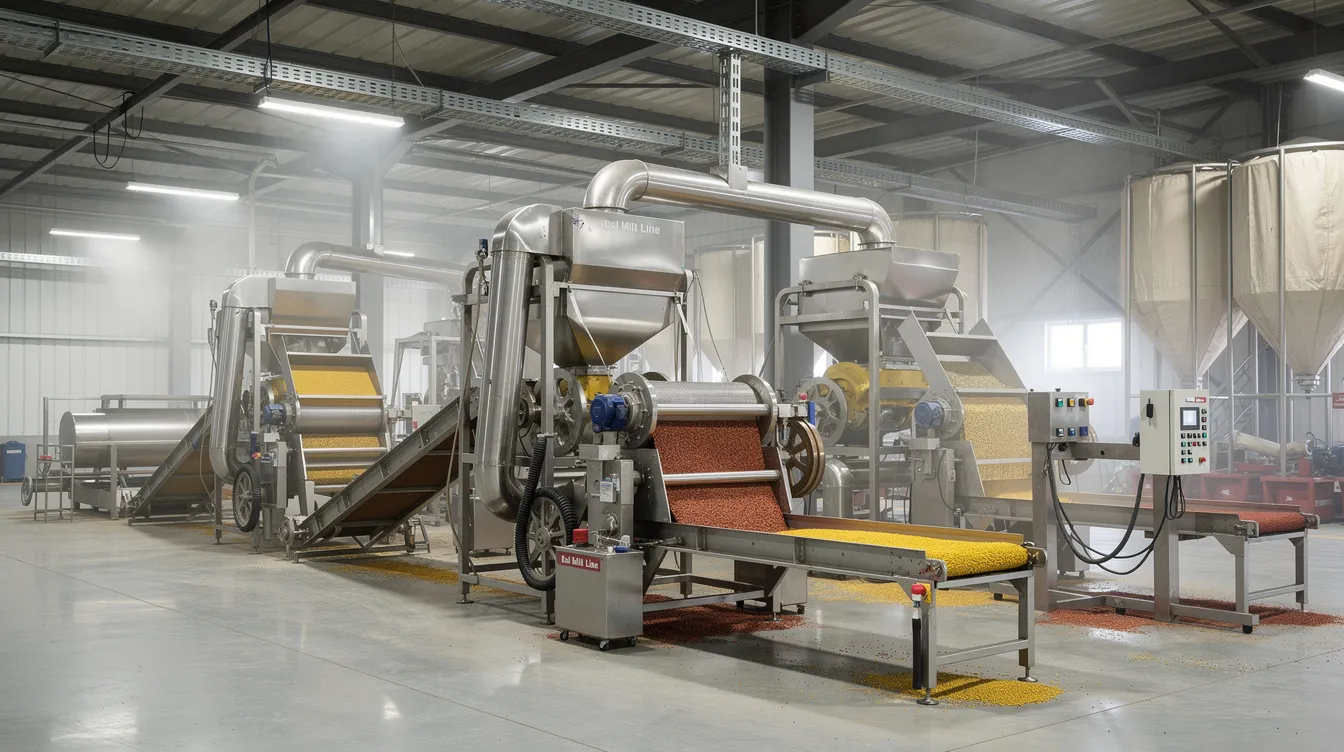
Machinery configuration differs between semi-automatic and fully automatic plants. A semi-automatic dal mill requires more manual handling and labour but involves lower initial investment. A fully automatic plant offers consistency, better recovery and lower labour per tonne, at higher fixed capital. The DPR should align equipment selection with capacity, budget and local labour availability.
Toor dal mill machinery includes precleaners and de-huskers as the core processing components. Advanced dal mill machinery includes color sorting and polishing units for premium output.
| Machinery | Function | Selection Considerations |
|---|---|---|
| Pre-cleaner and grader | Removes impurities, grades by size | Capacity matching with TPD |
| De-stoner | Removes stones and heavy particles | Throughput, maintenance ease |
| Magnetic separator | Removes metal contaminants | Food safety compliance |
| Conditioning/soaking unit | Adjusts moisture for dehusking | Batch vs continuous; uniformity |
| Emery roller / dehusking machine | Removes husk from pigeon pea | Number of passes, efficiency rating |
| Splitter | Splits dehusked grain into two cotyledons | Precision to minimize breakage |
| Aspirator and separator | Separates husk, powder from split dal | Effective separation process |
| Polisher | Gives smooth finish to dal surface | Product specification dependent |
| Colour sorter (optional) | Removes discoloured grains | Higher cost; needed for branded product |
| Packaging machine | Weighs and packs finished dal | Semi-auto or fully automatic |
| Dust collection system | Controls airborne dust | Pollution control board compliance |
Machinery cost varies significantly. For a 10 TPD semi-automatic plant, machinery investment may range between ₹60–90 lakh. For a 50 TPD fully automatic plant, the cost can exceed ₹6–8 crore. These are ex-works prices; freight, erection, civil foundations and electrical installation typically add 15–30% to the delivered cost.
Proper electrical installation, control panels and wiring design for safety and energy efficiency are often underestimated during initial planning. For a deeper discussion of equipment specifications and costs, readers may refer to our pulse dal mill machinery and cost analysis.
Toor Dal Processing Plant Setup Cost in India
All cost figures here are illustrative ranges based on typical Indian conditions. Actual project cost must be determined through a customised DPR based on site-specific quotations, local construction rates and machinery configuration.
Components of total project cost include land (or lease deposit), site development, building and civil works, plant and machinery, electrical installation, utilities, furniture and office equipment, vehicles (if any), preliminary and pre-operative expenses, contingency and margin money for working capital. Most projects should consider contingency costs to cover unexpected expenses during construction, typically budgeted at 5–10% of fixed assets.
For very small or micro units, the investment scale is different. A Toor dal mill project at micro scale may require approximately ₹8,25,000 in total fixed capital investment, with a promoter’s equity contribution as low as ₹2,00,000. At commercial scale, the investment in India ranges significantly higher:
| Capacity | Nature of Investment | Indicative Project Cost Range |
|---|---|---|
| 5 TPD | Small semi-automatic unit | ₹1.50–2.50 crore |
| 10 TPD | Medium commercial plant | ₹3.50–6.00 crore |
| 20 TPD | Larger automated plant | ₹7.00–11.00 crore |
| 50 TPD | Large integrated industrial plant | ₹18.00–30.00+ crore |
These ranges include civil works, machinery, utilities and working capital margin but exclude premium land costs. Owned land strengthens collateral for bank finance, while leased premises reduce upfront investment but may affect bank comfort depending on lease tenure and terms.
Land, Building, Utilities and Plant Layout
Site selection, layout and utilities directly influence material handling cost, production output efficiency, product quality and safety. A poorly laid out plant creates double handling, higher losses and operational inefficiency.
Toor dal processing units at a small scale may require a covered shed area of approximately 1,000 to 1,500 sq. ft. For larger commercial plants, land requirements scale considerably – a 50 TPD plant may need 2–3 acres with separate raw material and finished goods warehouses.
Functional areas in the plant layout should include:
- Raw pigeon pea receiving and unloading yard
- Raw material godown with pest control provisions
- Processing hall with adequate headroom for elevators
- Finished goods warehouse (climate-controlled if needed)
- Packing area and quality lab
- Office, staff facilities and utility block
- Circulation space for truck movement and maintenance access
The connected power load for a typical small processing unit ranges between 15 to 20 HP. Larger plants at 10–20 TPD may require 120–350 kW of sanctioned load. The power requirement should be planned carefully to avoid tripping, generator dependency and energy waste. Adequate ventilation and dust extraction are necessary both for product quality and for obtaining consent from the pollution control board.
Raw Material Requirement and Toor Dal Milling Recovery
The principal raw material is dry pigeon pea (Tur/Toor/Arhar). Key quality parameters include moisture percentage, foreign matter content, proportion of damaged or immature grains, and varietal characteristics. All of these affect milling recovery and, consequently, profitability.
Procurement channels include APMC mandis, commission agents, farmer producer organisations (FPOs) and direct purchases from farmers. Grading and sorting raw materials on receipt helps avoid hidden quality losses during processing.
Recovery rates must be calculated for finished dal versus broken pieces and husk byproducts. Under reasonably good conditions with modern machinery, research by ICAR suggests head dal recovery often falls in the 63–70% range, with advanced conditioning potentially pushing it higher.
Illustrative mass balance for 1,000 kg of raw pigeon pea:
| Output | Illustrative Quantity | Percentage |
|---|---|---|
| Head Toor Dal (Grade I) | 660 kg | 66% |
| Broken dal and splits | 130 kg | 13% |
| Husk, bran and powder | 140 kg | 14% |
| Processing losses (dust, screenings) | 70 kg | 7% |
| Total | 1,000 kg | 100% |
These are assumed figures for educational purposes, not guaranteed outcomes. A small change in head dal recovery – even 2–3 percentage points – significantly changes revenue and gross margin. This sensitivity should be modelled carefully in the DPR’s financial projections.
Toor Dal Mill Project Cost and Means of Finance
Project cost covers all fixed capital items and margin for working capital. Means of finance describes how that cost will be funded – promoter equity, term loan, unsecured loans or subsidies.
A typical financing pattern for MSME dal mill projects involves 25–35% promoter contribution and 65–75% term loan against eligible fixed assets. Central Bank of India’s dal mill cluster scheme, for instance, outlines norms including average DSCR of at least 1.25, current ratio of at least 1.10 and tenure up to 10 years including an 18-month moratorium.
Government support options include PMFME and CGTMSE collateral-free loans for micro food processing enterprises. Government subsidies for dal mills can reach up to 33% in difficult areas and rural areas under certain government schemes, though these are generally reimbursement-based and should not be treated as upfront finance unless formally sanctioned.
For very small micro units, the total fixed capital investment may be as modest as ₹8,25,000 with a promoter’s equity contribution of ₹2,00,000 and the balance through bank finance and working capital support.
At Project Report Bank, we prepare bankable DPRs and CMA Data that align with bank appraisal requirements – including term loan structuring, DSCR analysis and finance proposal documentation – so that lenders can assess repayment capacity with confidence. Final sanction decisions remain at the sole discretion of the lending institution.
Toor Dal Mill Working Capital Requirements
Working capital for a Toor Dal mill is often substantial relative to fixed assets. The seasonal procurement pattern means mills must hold raw pigeon pea stocks for months, while trade credit to wholesalers and retailers further locks up funds.
Working capital components include:
- Raw material inventory (seasonal, heavier post-harvest)
- Work-in-process and finished goods stock
- Trade receivables (credit to dealers, 15–60 days typically)
- Packaging materials, power, wages, repairs and administrative costs
The working capital cycle in dal milling runs from cash outflow for raw pulses, through processing and storage, to cash inflow from dal sales. Longer inventory holding or credit periods increase the bank fund requirement.
The total working capital requirement for a small-scale toor dal mill may be around ₹15,50,000. For commercial plants at 10–50 TPD scale, working capital requirements can run into crores. Bank finance typically covers 75% of working capital needs through cash credit or overdraft facilities, with the balance funded by the promoter as margin.
Under-funded working capital often leads to capacity under-utilisation or forced distress sales – a common reason for stress in dal mill businesses across India.
Toor Dal Mill Profitability and Financial Projections
Profitability in a toor dal mill depends on raw pigeon pea purchase price, finished dal and by-product selling prices, milling recovery percentages, capacity utilisation, power and labour costs, and financing costs. It does not depend solely on plant size.
A professional DPR normally includes 5–7 year financial projections – projected Profit and Loss, Balance Sheet and Cash Flow statements – based on transparent assumptions. Financial metrics commonly included in project reports are break-even analysis and debt service coverage ratio.
Operational revenue often includes primary sales of grade I and grade II toor dal alongside secondary sales of by-products such as husk and broken dal. Husk and powder are typically sold as cattle or poultry feed ingredients. Various types of dal including moong dal, chana dal, masoor dal and urad dal (from black gram) may also be produced if the plant handles multiple pulses.
For micro-scale units, annual revenue from 500 MT of toor dal can reach approximately ₹12,50,000, and profit margin for toor dal at this scale can exceed 40% under favourable conditions. At larger commercial scales, margins are typically thinner due to competitive pricing, higher overheads and interest costs.
Key financial indicators analysed include DSCR (above 1.25 for safety), break-even capacity utilisation, ROI, IRR and payback period. IRR for medium-scale plants is often projected in the 18–25% range under stable conditions, with payback periods of 4–7 years depending on equity contribution and utilisation ramp-up.
Market volatility in raw and finished prices can cause significant year-to-year variation – which is why conservative assumptions and sensitivity analysis are essential components of any dal mill project.
Sensitivity Analysis and Project Investment Risks
Pulse processing is inherently exposed to commodity price movements, seasonal supply variations and competitive pressure. Sensitivity analysis is a critical part of any Arhar Dal mill DPR.
Key variables to stress-test:
- Raw pigeon pea purchase price (dominant cost, highly volatile)
- Toor dal selling price in the domestic market
- Head dal recovery percentage
- Capacity utilisation rate
- Power tariffs, wage costs and interest rates
- Inventory holding period and receivable days
| Scenario | Change Assumed | Indicative Impact on EBITDA |
|---|---|---|
| Base case | As projected | – |
| Raw cost +5% | Higher procurement price | EBITDA may decline 15–25% |
| Recovery –2 pp | Lower head dal yield | Revenue drop, margin compression |
| Utilisation –10 pp | Fewer operating days / lower throughput | Higher per-kg fixed cost |
Operational risks also include machinery breakdowns, inconsistent power supply, inadequate storage leading to moisture or pest damage, and compliance lapses with food safety or labour regulations.
Promoters should treat sensitivity analysis as a decision tool: if the project is only viable under perfectly favourable assumptions, it may need re-designing before seeking finance.
Licences, Registrations and Regulatory Requirements
Exact licence requirements vary by state, local authority and project size. The following are commonly applicable:
- Business registration: Proprietorship, partnership, LLP or Pvt Ltd as appropriate; PAN; GST registration; MSME/Udyam registration; trade license from local authority
- Food safety: FSSAI licensing is mandatory for food processing units in India – registration or licence depending on production scale; compliance includes labelling, hygiene and record-keeping
- Factory and labour: Shops and Establishments Act or Factories Act registration depending on worker count and installed power; EPF, ESI and Professional Tax where thresholds are crossed
- Pollution and local approvals: Consent from pollution control board, fire safety NOC for larger godowns, building and planning permissions from municipal or panchayat authorities
A comprehensive project report is required for bank financing and MSME registration. This article does not substitute legal advice; regulatory frameworks change, and the DPR should capture current requirements specific to the project’s state and location.
Bank Loan, CMA Data and DPR Requirements for Toor Dal Mills
Banks evaluating a Toor Dal mill project for term loan focus on promoter background, project viability, collateral, financial projections and quality of documents – the DPR and CMA Data.
Documents generally needed include the Detailed Project Report, KYC and financial track record of promoters, machinery quotations, land and building details, licence status, and projected financial statements with CMA Data for 5–7 years.
CMA Data contains projected P&L, Balance Sheet, fund flow statement, working capital assessment, maximum permissible bank finance and drawing power calculations – all linked to realistic capacity, price and recovery assumptions.
Many dal mill proposals are delayed or rejected because of generic copy-paste reports that ignore local raw material costs, realistic recovery rates or working capital cycles. This underscores the need for professional, project-specific preparation.
For tailored CMA Data preparation and feasibility analysis linked to your specific dal mill project, reach out to Project Report Bank via WhatsApp with your proposed capacity and location.
Toor Dal Mill vs Integrated Multi-Pulse Processing Plant
An integrated multi-pulse processing plant handles several pulses – toor, moong (green gram), urad dal (from black gram), chana dal, masoor dal (lentils) and other beans – on shared or modular lines. A dedicated toor dal mill focuses primarily on pigeon peas.
A dedicated Toor mill may be preferable in regions with strong tur cultivation, where promoters have deep toor trading experience or where buyers need large volumes of a single product. Integrated plants offer diversification – the ability to shift between moong, urad, chana and masoor as seasonal availability and prices change, resulting in better utilisation of machinery and a wider product portfolio.
Integrated plants may need slightly higher capex and more complex process planning, but they can be more resilient to price swings in any one pulse. For promoters exploring this route, our tur dal mill project report resource and related multi-pulse guides provide further context.
The choice should be evaluated during the DPR stage based on local cropping patterns, procurement logistics, market network and promoter capabilities.
Common Mistakes When Planning a Toor Dal Mill
Many problems in dal mill projects stem from planning errors rather than technical impossibility. A robust project report is designed to identify and correct these upfront.
Frequent mistakes include:
- Assuming unrealistically high dal recovery (claiming 75%+ head dal without advanced equipment or quality raw material)
- Ignoring the price difference between head dal and broken/splits; recovery alone does not determine revenue
- Underestimating working capital, especially for seasonal bulk procurement
- Choosing plant capacity based on machinery discounts rather than market demand and finance capacity
- Cramped godowns leading to double handling and storage losses; poor ventilation causing moisture and pest damage
- Copying generic project reports with wrong state-specific taxes, tariffs or assumptions
- Inadequate clarity in land title documentation, causing bank disbursement delays
- Missing or delayed FSSAI, GST or pollution permissions
- Not budgeting for repairs, maintenance or operator training
- Lack of a clear marketing strategy for both dal and by-products in a semi urban area or rural area market
Structured planning with professional financial modelling and risk assessment significantly reduces these mistakes before capital is committed.
Professional Toor Dal Mill DPR and Project Finance Advisory
CA Manish Gugliya and Project Report Bank specialise in Detailed Project Reports, feasibility studies, financial modelling, CMA Data and bank finance advisory for manufacturing and agro-processing projects. The work is customised to each project – not a template exercise.
A professional Toor Dal Mill DPR includes:
- Technical configuration and capacity planning
- Land, building and plant layout requirements
- Machinery list with cost estimates based on actual quotations
- Detailed project cost and means of finance
- Working capital assessment
- 5–7 year projected financial statements
- DSCR, break-even, IRR and payback analysis
- Structured sensitivity and risk analysis
We collect project-specific inputs – proposed location, land status, preferred capacity (5, 10, 20 or 50 TPD), automation level, procurement and marketing plan – and tailor the DPR and financial model accordingly. Related services include project feasibility studies and investor-ready documentation for equity fundraising.
Planning to establish a Toor Dal (Arhar Dal) processing plant in India? CA Manish Gugliya provides professional DPR preparation, financial projections, CMA Data and bank finance proposal assistance for manufacturing projects. Contact us on WhatsApp to discuss your proposed plant capacity, investment and financing requirements.
Frequently Asked Questions
The following FAQs address common queries about Toor Dal Mill projects. Answers are general and not a substitute for customised professional advice.
How much does it roughly cost to start a small Toor Dal Mill in India?
For a basic micro-scale unit, total fixed capital may start from around ₹8,25,000. A commercial 5 TPD semi-automatic toor dal mill typically requires a total project investment in the range of ₹1.50–2.50 crore including building, machinery, utilities and working capital margin. Actual costs depend on location, civil construction rates, machinery configuration and state-specific charges. Promoters should prepare a customised DPR rather than rely on generic internet figures to capture realistic cost breakdowns.
Is Toor Dal milling always a profitable business?
Profitability is not guaranteed. It depends on procurement efficiency, milling recovery, cost control, capacity utilisation and market conditions for both dal and by-products. Gross margin per kg is typically narrow in commodity processing, and raw material cost accounts for the dominant share of total cost. Professional financial modelling with sensitivity analysis is essential before assuming any target profit percentage. While toor dal processing can certainly be a profitable business under good conditions, year-to-year results can vary significantly.
Can I start with Toor Dal and later add Moong or other pulses?
Many plants can be designed to handle multiple pulses – toor, moong, urad, chana and masoor – but this needs advance planning. Machinery selection, process flow, storage segregation and cleaning equipment configuration should accommodate future diversification. Promoters should discuss multi-pulse plans during the DPR stage so that the production capacity, utilities and plant layout support later expansion without major rework. This is an essential component of long-term dal mill project planning.
How long does it take to set up a Toor Dal processing plant?
An indicative timeline from concept to commissioning for a 10–20 TPD plant may be 9–18 months, covering DPR preparation and bank approval (2–4 months), land and building readiness (3–6 months), machinery ordering and manufacturing (2–4 months), and installation with trial runs (1–2 months). Early, parallel planning of licences and bank documentation can significantly reduce the overall timeline.
What information should I prepare before approaching a professional for a DPR?
Promoters should have the following ready: proposed location and land status (owned or leased), preferred capacity (5, 10, 20 or 50 TPD), target market form (bulk versus branded), tentative budget range, background in trading or agro-processing, and any specific bank or government support scheme being considered. Having these details helps produce a realistic toor dal mill project report, financial model and CMA Data aligned with the promoter’s objectives and bank expectations.