Establishing a dal mill plant in India is a commercially attractive proposition given the high demand for processed pulses across the country. Pulses are a primary source of protein for millions, and the dal mill business continues to attract entrepreneurs at every scale. However, the cost of setting up a dal mill varies significantly depending on capacity, automation and infrastructure choices. This complete guide presents a practical investment and cost breakdown to help promoters plan with clarity before committing capital.
Key Takeaways
- Indicative dal mill plant setup cost in India ranges from approximately ₹25–₹60 lakh for mini units, ₹1.50–₹2.50 crore for 5 TPD, ₹3.50–₹6.00 crore for 10 TPD, ₹7.00–₹11.00 crore for 20 TPD and ₹18.00–₹30.00 crore for 50 TPD plants. These are illustrative estimates based on October 2026 market information, not verified supplier quotations.
- Total dal mill project cost equals fixed capital (plant and machinery, land and building, electricals) plus pre-operative expenses plus margin for working capital. Working capital alone can represent 30–50% of overall funding needs for a commercial plant.
- Plant capacity (TPD), automation level (semi-automatic vs fully automatic), the number of pulses handled and land choice (own vs lease) are the biggest drivers of dal mill plant investment.
- For a typical 10 TPD commercial dal mill, overall project investment can easily fall in the range of ₹3.50–₹6.00 crore depending on specifications, excluding land purchase in metro locations.
- Project Report Bank, led by CA Manish Gugliya, prepares customised DPRs, financial projections, CMA Data and realistic dal mill project cost estimates for bank finance and investors.
Dal Mill Plant Setup Cost in India – Investment Overview
How much does it cost to set up a dal mill in India? The answer depends on scale and technology. A mini dal mill handling 1–2 TPD with basic equipment may require ₹25–₹60 lakh. A 5 TPD semi-automatic pulses mill plant serving regional markets typically costs ₹1.50–₹2.50 crore. A 10 TPD commercial dal mill plant can require ₹3.50–₹6.00 crore. Larger plants of 20 TPD may need ₹7.00–₹11.00 crore, while a 50 TPD fully automatic integrated pulse processing plant can require ₹18.00–₹30.00 crore or more. These ranges are indicative planning figures excluding land in premium urban locations.
A dal mill plant processes raw pulses-tur, chana, urad, masoor, moong (green gram), pigeon peas and various kinds of lentils-through stages of cleaning, dehusking, splitting, polishing and grading. The outer layer of pulses is removed during dehusking, and the final dal is packed and prepared for sale after processing. TPD refers to tonnes of raw pulses processed per day, based on rated machine output.
Key plant types include:
- Mini dal mill (1–2 TPD): basic machinery, semi-automatic, manual bagging. Mini or small-scale units process 1 to 2 tons per day.
- Small commercial dal mill (~5 TPD): improved cleaning, polishing, suitable for regional wholesale.
- Medium commercial plant (10–20 TPD): semi-automatic or automatic, handling multiple pulses type, better material handling.
- Fully automatic / integrated plant (20–50+ TPD): colour sorting, advanced packaging, possibly besan or flour integration. Commercial or large-scale plants have a capacity of more than 5 tons per day.
| Plant Type | Capacity (TPD) | Automation | Indicative Project Cost (₹) |
|---|---|---|---|
| Mini Dal Mill | 1–2 | Semi-automatic | ₹25–60 lakh |
| Small Commercial | ~5 | Semi-automatic | ₹1.50–2.50 crore |
| Medium Commercial | 10–20 | Semi to fully automatic | ₹3.50–11.00 crore |
| Large / Integrated | 20–50+ | Fully automatic | ₹18.00–30.00+ crore |
Illustrative, for DPR planning only. GST and financing costs not included unless mentioned.
Actual dal mill plant setup cost in India depends on final machinery quotations, site conditions, building design, utilities and automation choices. A project-specific Detailed Project Report is necessary before freezing investment decisions or approaching banks.
Major Components of Dal Mill Plant Setup Cost
The total dal mill project cost presented to banks and investors comprises fixed capital investment, pre-operative and preliminary expenses, and margin for working capital. Each component must be estimated separately and supported by quotations or clearly stated assumptions.
Major cost heads in a complete dal mill cost breakdown include:
- Land acquisition or lease – many MSME projects take land on lease to reduce upfront capital.
- Site development – boundary wall, internal roads, drainage, levelling.
- Factory building and godowns – for raw materials storage and finished dal. Dal mills need sufficient space for storage and processing of raw materials and finished goods, with separate areas for each.
- Dal mill machine and process equipment – pre-cleaners, destoners, dehuskers, splitters, polishers, graders, colour sorters, conveyors, elevators, dust collectors.
- Electrical installation – wiring, LT panels, cabling, distribution boards. Industrial dal mill machinery typically requires a three phase electricity connection, as India is a three phase country for industrial power supply.
- Power infrastructure – transformer, HT/LT line deposit, DG set if required.
- Material handling – belt conveyors, bucket elevators, stackers.
- Dust collection and pollution control – cyclones, bag filters, blowers.
- Laboratory and quality assurance equipment – moisture meters, sieves, basic food quality testing kit.
- Packaging and finished goods handling – weighing scales, semi/automatic packing machines, sealing and stitching machines.
- Installation, testing and commissioning – typically estimated at 5–10% of machinery cost.
- Pre-operative expenses – company formation, project report consultancy, interest during construction, trial runs, statutory approvals. Licensing costs typically range between ₹20,000 to ₹50,000 for compliance, including FSSAI license, GST registration and local approvals.
- Contingency provision – 5–10% on civil and machinery heads.
- Initial margin for working capital – stocks, receivables and cash balance during ramp-up.
Illustrative Cost Breakdown – 10 TPD Semi-Automatic Dal Mill
| Cost Head | Amount (₹ Lakh) |
|---|---|
| Land and site development | 40–60 |
| Building and civil work | 90–160 |
| Plant & machinery (incl. erection) | 180–300 |
| Electrical and utilities | 30–50 |
| Miscellaneous fixed assets | 10–15 |
| Preliminary & pre-operative expenses | 20–35 |
| Contingencies | 15–25 |
| Margin for working capital | 70–120 |
| Total Project Cost | ~455–765 |
Planning assumptions for illustration; October 2026 conditions. Must be validated with current quotations. Land purchase may or may not be included depending on project structure.
Fixed capital is eligible for term loan financing. Working capital is generally supported through cash credit or OCC limits. The total project cost combining both is used for bank appraisal. Professional DPRs by Project Report Bank structure the dal mill cost breakdown in this format, with item-wise machinery lists and current market assumptions.
Dal Mill Plant Setup Cost by Production Capacity
The following subsections provide indicative cost ranges, infrastructure, manpower and power assumptions for 5, 10, 20 and 50 TPD dal mill plants. All figures are illustrative planning examples. A “5 TPD capacity” generally denotes maximum raw pulse input per 8 hours of rated machine output. Commercial plants typically operate 2 shifts (16 hours per day), and actual annual production depends on operating days and capacity utilisation.
5 TPD Dal Mill Plant Setup Cost
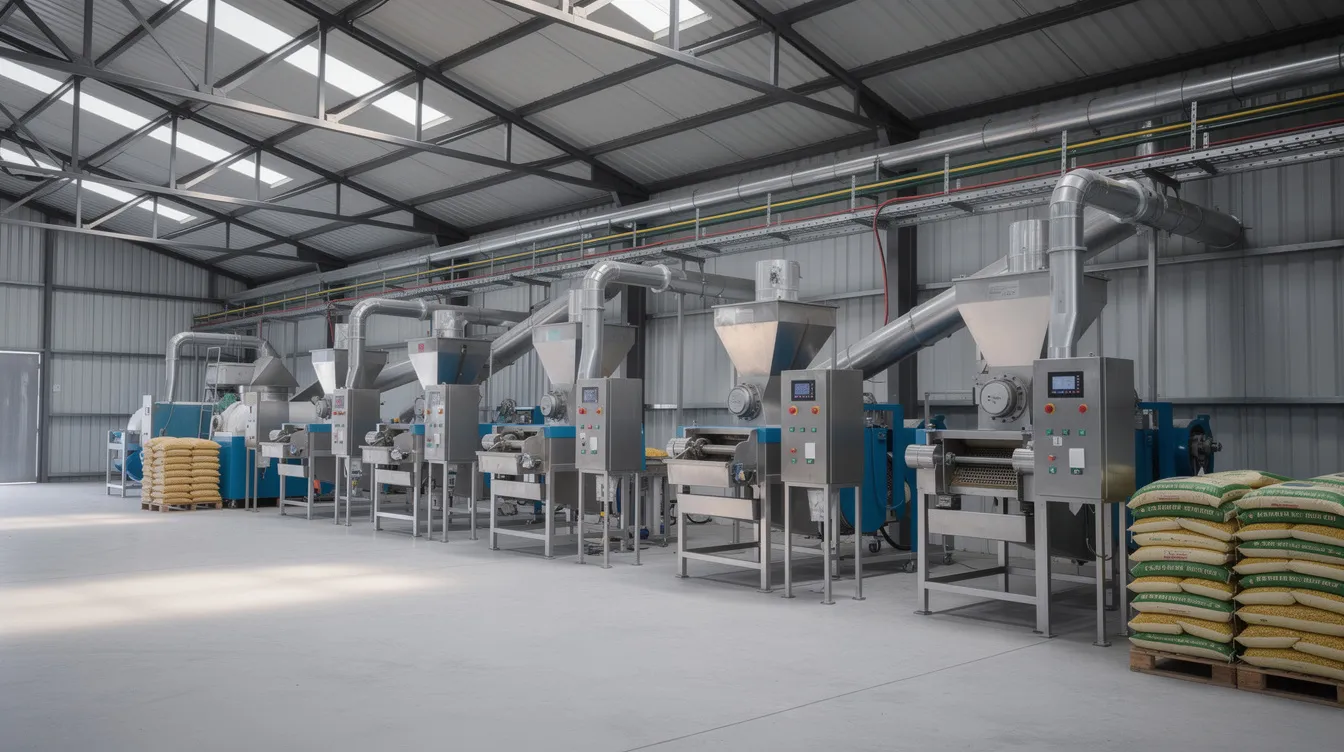
A 5 TPD plant suits regional entrepreneurs focusing on one or two products such as tur dal and chana dal, primarily semi-automatic with manual bagging. Semi-automatic units require more manual labor compared to fully automated lines. Small-scale dal mills have an investment cost ranging from ₹10 lakh to ₹25 lakh for very basic setups, while medium units require an investment of ₹30 lakh to ₹75 lakh. However, a complete 5 TPD commercial plant with building and working capital typically requires about ₹1.50–₹2.50 crore, with machinery forming around 35–45% of this amount.
Land requirement is approximately 10,000–15,000 sq ft in a non-metro industrial area, with 4,000–6,000 sq ft built-up area. Indicative manpower is 10–15 persons and connected power load is 60–80 kW. These plants are often financed under MSME schemes, and a well-prepared DPR and CMA Data can help secure bank term loan and working capital limits.
Scope for expansion includes adding polishers, integrating colour sorters later, and expanding godown space-decisions that marginally alter initial setup cost but significantly improve scalability.
10 TPD Dal Mill Plant Setup Cost
A 10 TPD dal mill plant is a common commercial size serving district-level wholesale markets with multiple pulses such as tur, chana, masoor and moong. A 2 TPH dal mill plant is common at this scale. The cost of a 2 TPH dal mill plant is about ₹1.13 crore for machinery alone. A fully automatic dal mill can process 5 tonnes per day on a single-shift basis, meaning a 10 TPD plant effectively operates two shifts.
Indicative total dal mill project cost ranges from about ₹3.50–₹6.00 crore:
- Plant and machinery: ₹1.80–₹3.00 crore
- Civil construction and storage: ₹0.90–₹1.60 crore
- Pre-operative and contingencies: 8–12% of above
- Margin for working capital: ₹0.70–₹1.20 crore
Land requirement is roughly 18,000–25,000 sq ft with 9,000–12,000 sq ft covered area. Connected power load can be 120–180 kW, and manpower 18–25 persons. A detailed project cost and means-of-finance statement for this capacity appears later in this article.
20 TPD Dal Mill Plant Setup Cost
A 20 TPD plant serves larger state-level markets or integrated food businesses, with higher automation, mechanised conveying and often in-line colour sorting. According to the Rajasthan Agricultural Competitiveness Project DPR, a 20 TPD semi-automatic plant’s main machinery cost is approximately ₹1.00 crore, while a fully automatic model with colour sorting can reach ₹8.09 crore for machinery alone.
Indicative total project cost: ₹7.00–₹11.00 crore, with machinery at ₹3.50–₹5.50 crore, civil construction at ₹2.00–₹3.00 crore, electricals at ₹0.60–₹1.00 crore, and working capital margin at ₹1.20–₹2.00 crore.
Industrial land of 30,000–40,000 sq ft with at least 18,000–22,000 sq ft built-up area is typical, allowing separate sections for cleaning, milling, quality control and dispatch. Power load is 250–350 kW and workforce 30–40 persons.
50 TPD Dal Mill Plant Setup Cost
A 50 TPD integrated pulse processing plant caters to institutional buyers, large brands or export markets with high automation, advanced colour sorters and sophisticated packing lines. Commercial automated units can require investments from ₹1 crore to ₹10 crore for machinery alone, and total project cost for a 50 TPD plant is broadly ₹18.00–₹30.00 crore, with equipment at ₹8.00–₹14.00 crore, civil work at ₹5.00–₹8.00 crore, and working capital margin at ₹3.00–₹5.00 crore. Land need is 2–3 acres in an industrial zone with power requirements of 700–1,000 kW.
These figures serve only as a planning reference. A 50 TPD dal mill plant setup cost in India must be calculated with current quotations, site-specific civil estimates and detailed financial modelling before commitment.
| Capacity | Indicative Project Cost | Land (approx.) | Power Load |
|---|---|---|---|
| 5 TPD | ₹1.50–2.50 Cr | 10,000–15,000 sq ft | 60–80 kW |
| 10 TPD | ₹3.50–6.00 Cr | 18,000–25,000 sq ft | 120–180 kW |
| 20 TPD | ₹7.00–11.00 Cr | 30,000–40,000 sq ft | 250–350 kW |
| 50 TPD | ₹18.00–30.00 Cr | 2–3 acres | 700–1,000 kW |
Dal Mill Machinery Cost and Equipment Investment
Dal mill machinery cost is the core component of fixed capital investment. It varies significantly based on capacity, technology and whether machines have three phase body material construction suited for continuous industrial operation. Machinery costs for a dal mill can vary significantly based on capacity and origin of equipment-domestic versus imported. A small dal mill plant costs around ₹7.96 lakh for basic equipment, while a fully automatic dal mill plant can cost approximately ₹1.46 crore.
Key dal mill machine categories:
- Pre-cleaner and grader – removing impurities, dust and chaff. Grading machines separate pulses by size before milling.
- Destoner and magnetic separator – removing stones and ferrous particles for quality.
- Pulse conditioning equipment – soaking/tempering to loosen husk.
- Dehusking and splitting machines – pulses shellers are essential for dehusking pulses. These are typically the costliest single items.
- Aspirators and separators – removing husk and light particles.
- Polishing machines – polishing enhances the appearance of dal and improves marketability.
- Colour sorting equipment – standard for large commercial mills, optional initially for smaller plants.
- Elevators and conveyors – essential for efficient material flow. Machines should be arranged in a sequence for smooth operation.
- Dust collection system – cyclones, bag filters, blowers for worker safety and regulatory compliance.
- Weighing, bagging and packaging equipment – for retail and wholesale packing.
Electrical loads for dal mill machinery typically range from 15 to 20 HP for basic units, scaling substantially with MS motor power ratings in larger installations. Equipment with construction-grade MS power consumption characteristics requires proper load assessment considering diversity factors.
Machinery suppliers typically offer either individual machines for phased expansion, or complete turnkey dal mill plant packages. A leading manufacturer will include structure, conveyors, dust control and electrical panel in turnkey offerings-these may appear costlier but reduce integration risk. As a planning rule, installed machinery cost generally accounts for 40–65% of fixed capital depending on automation level.
Land, Factory Building and Infrastructure Cost
While many articles focus only on dal mill machine prices, in actual projects land, building and civil infrastructure can equal or exceed machinery cost. Choosing an ideal location in an approved industrial zone reduces both land cost and regulatory effort. Space requirements for small dal mill setups range from 1,000 to 1,500 sq ft for very basic units, while commercial plants need substantially more.
A proper dal mill layout optimises workflow and safety. Adequate space for worker movement increases productivity, and a well-planned layout reduces time and effort in operations. Key civil components include the main mill shed (RCC or PEB structure), raw material and finished goods storage godowns, office and laboratory, utility block and internal roads.
If the promoter already owns land, the project cost may count only development and building costs. Civil works typically represent 30–45% of fixed assets for small-medium dal mills. In an EIRI project report for a 30 TPD plant, land and building was ₹2.70 crore versus machinery at ₹1.50 crore, demonstrating the significance of this component.
Electrical Installation, Utilities and Other Setup Expenses
Entrepreneurs often underestimate pulses electricity connection requirements, which affects both project cost and working capital through higher energy bills. Key items include electricity connection load assessment, transformer requirement if load crosses local DISCOM thresholds, LT/HT panels, cabling, earthing and lighting. Industrial plants need a reliable power supply; India being a three phase country, all major dal mill motors require three-phase connections.
Additional utilities include compressed air systems, water systems for conditioning, DG set for backup power, fire safety equipment and weighbridge for larger plants. As a planning estimate, electrical and utility infrastructure accounts for roughly 8–15% of total fixed capital. Installation and commissioning costs should be budgeted at 5–10% of supply values and kept as distinct line items.
Working Capital Requirement for a Dal Mill Plant
Working capital is the finance required to run daily operations of the dal mill business. Raw material procurement is one of the largest cash requirements in dal mill operations. Working capital is necessary for maintaining raw pulse inventory of tur, chana, urad, masoor and moong purchased directly from farmers or through mandis. The working capital requirement for a dal mill is approximately ₹15.45 lakh for a small unit, scaling substantially for commercial plants.
Key working capital components include raw material inventory, consumables and packaging materials, finished dal stock, trade receivables, less trade payables, and operating cash balance. Seasonal price fluctuations in pulses-particularly stocking during harvest season-may temporarily raise working capital needs. Underestimating working capital is a common mistake that can strain cash flow even if the plant is technically viable.
Sample Dal Mill Project Cost and Means of Finance
Below is an illustrative 10 TPD dal mill project cost statement. These are sample planning assumptions, not a ready-made project report.
| Head | Amount (₹ Lakh) |
|---|---|
| Land and site development | 50 |
| Building and civil work | 120 |
| Plant & machinery (incl. erection) | 220 |
| Electrical and utilities | 40 |
| Miscellaneous fixed assets | 12 |
| Preliminary & pre-operative expenses | 28 |
| Contingencies | 20 |
| Margin for working capital | 90 |
| Total Project Cost | 580 |
Land purchase included at non-metro industrial rates. Excludes premium urban land.
Means of Finance:
- Promoter’s contribution (25–30%): ~₹160 lakh
- Term loan (70–75%): ~₹420 lakh
- Working capital limits: separate cash credit facility
The term loan is repaid over 5–8 years and used for fixed capital. Working capital facilities are revolving limits for day-to-day operations. DSCR, interest coverage and sensitivity analysis should be part of a bankable DPR. You can sell directly to wholesalers or supply retail brands-the business model affects both revenue projections and working capital structure.
Factors Affecting Dal Mill Plant Investment
Even within the same nominal capacity, dal mill plant setup cost in India varies widely. Establishing a dal mill plant in India requires balancing production capacity and automation level carefully. Key factors include automation level, single-pulse versus multiple pulses type operation, machinery quality and supplier reputation, land location, building design, raw material storage strategy, packaging level for retail versus bulk, and regulatory requirements including FSSAI and food safety certifications.
From a project-finance perspective, running alternative scenarios with different capacity and automation combinations helps promoters choose an investment that balances market opportunity with funding ability. Conduct market research before preparing your project report to understand local demand and competitors in your region.
Mini Dal Mill vs Commercial Dal Mill vs Integrated Pulse Processing Plant
| Feature | Mini Dal Mill | Commercial Dal Mill | Integrated Plant |
|---|---|---|---|
| Capacity | 0.5–2 TPD | 5–20 TPD | 20–50+ TPD |
| Investment | ₹25–60 lakh | ₹1.50–11.00 crore | ₹18.00–30.00+ crore |
| Automation | Basic | Semi to fully automatic | Fully automatic |
| Products | Few dals | Multi-pulse | Multi-pulse + value-added |
| Target Market | Local | Regional/wholesale | National/export/brands |
First-time entrepreneurs with limited capital may start small with a mini dal mill. Existing grain traders wanting to integrate processing suit the commercial model. Established food processors seeking backward integration should consider the integrated multi-pulse processing plant.
How to Reduce Dal Mill Setup Cost Without Compromising Quality
Cost optimisation should focus on proper planning and efficient layout, not on compromising food safety or machinery quality. Practical strategies include: start small with 5 or 10 TPD but design building for future expansion; choose semi-automatic packing initially; prioritise critical machinery quality from reputable companies and suppliers; use pre-engineered buildings where feasible; optimise plant layout to minimise material handling distance; consider leasing land in approved food-processing zones; and phase the project in stages with clear capex milestones. Professional DPRs can identify cost-optimisation opportunities without undermining plant performance.
Bank Loan and Financial Planning for Dal Mill Setup
Most dal mill projects in India are financed through bank term loans and working capital facilities. A detailed project report is essential for securing funding, and successful project financing relies on financial projections that demonstrate repayment capacity. Banks generally expect a comprehensive business plan including DPR, project cost and means of finance, CMA Data for bank loan, DSCR analysis and sensitivity analysis. Include production volume and type of dal in your report. Consult industry experts to compile your project report effectively.
Banks evaluate promoter’s contribution, collateral security, and repayment capacity. Professional services like DPR preparation and financial modelling are crucial for project financing. Register for MSME Udyog Aadhaar after obtaining business registration. Government schemes like PMFME and PMEGP offer subsidies for setting up dal mills, and credit-linked subsidies can cover a percentage of eligible project expenses-though specific amounts and eligibility must be confirmed with current official guidelines. Government support through such schemes can significantly reduce effective capital outlay.
Common Mistakes in Estimating Dal Mill Project Cost
Underestimation of project cost is a frequent reason for financial stress in new dal mill ventures. Common mistakes include ignoring civil construction and drainage costs, considering only basic machinery prices without erection, freight and taxes, overlooking auxiliary equipment costs, under-budgeting electrical installations, ignoring pre-operative expenses, providing inadequate contingency, significantly underestimating working capital, and not budgeting for food-business registrations and local approvals. The total capital required to establish a dal mill varies based on scale and technology-copying generic cost figures from the internet without adapting for local conditions and the promoter’s actual business model is another frequent error. The cost of setting up a dal mill involves land, machinery, and working capital, and each must be realistically assessed.
Frequently Asked Questions
What is the minimum cost to start a small dal mill plant in India?
A very small mini dal mill handling 0.5–2 TPD with basic cleaning and dehusking can sometimes be started with a total investment of roughly ₹20–₹50 lakh on leased premises. A small dal mill plant costs around ₹7.96 lakh for equipment alone. Adding better cleaning, polishing and packing pushes total project cost towards ₹60–₹100 lakh. Such micro projects require a basic DPR and working capital planning to be viable and bankable, and the success of the industry venture depends on the efficiency of operations and demand in the local market.
Does dal mill plant setup cost normally include GST and interest during construction?
Machinery quotations are generally shared exclusive of GST, so a proper project cost should show basic price plus GST, freight, insurance and erection. Interest during construction and pre-operative expenses are budgeted as a separate line item under preliminary and pre-operative expenses within the overall project cost, especially for medium and large plants prepared for bank submission.
How does owning land change the dal mill project cost for bank appraisal?
If the promoter already owns suitable industrial land, the DPR may treat land at historical value or show it as promoter’s contribution outside the main project cost. Banks consider the value of owned land and building as collateral security, improving security coverage without necessarily increasing the loan amount requested.
Are subsidies or government schemes available to reduce dal mill investment burden?
Dal mill and pulse processing projects may be eligible under various central and state-level schemes such as those by the Ministry of Food Processing Industries. Specific subsidy rates change over time. Promoters should consult current official notifications before finalising project cost assumptions.
How frequently should dal mill project cost estimates be updated before financial closure?
Machinery and construction costs can move substantially within 6–12 months. Promoters should refresh key quotations and civil estimates before submitting final proposals. Any DPR older than 6–9 months should be reviewed and updated to keep the dal mill plant setup cost, working capital and means-of-finance calculations current.
Planning a Commercial Dal Mill or Integrated Pulse Processing Plant?
CA Manish Gugliya & Company assists entrepreneurs and businesses with Detailed Project Reports (DPR), project cost estimation, CMA Data, financial projections, bank loan proposals and project finance advisory. For professional assistance with your proposed dal mill project, connect through WhatsApp via www.projectreportbank.com.