
Key Takeaways
- A dal mill working capital assessment focuses on funding raw pulse inventory, processing stocks and receivables – not just machinery or project cost. Even profitable dal mills processing chana, tur, moong, urad and masoor can face cash shortages if seasonal raw material purchases and customer credit are not planned properly.
- Cash credit limits, drawing power and stock-backed borrowing depend on eligible inventory and receivables after applying bank margins and ageing norms. A sanctioned limit does not automatically mean the full amount is available for withdrawal.
- Incorrect assumptions on recovery, stock days or supplier credit can either overstate or understate the dal mill working capital requirement, creating risk for both the promoter and the lender.
- Working capital for a typical small dal mill can range from ₹3–10 lakh, while the overall project cost typically falls between ₹15 lakh and ₹1 crore depending on capacity and scale.
- Project Report Bank, led by CA Manish Gugliya, provides professional assistance in preparing realistic working capital calculations and CMA data for bank loans.
Introduction: Dal Mill Working Capital Assessment in Practical Terms
A dal mill working capital assessment determines how much money an operating plant needs – every day, every month – to buy raw pulses, process them into finished dal and by-products, and finance customer credit until cash is collected. Banks in India insist on this assessment before sanctioning a cash credit facility or working capital limit because the business model of a dal mill is inherently inventory-intensive. Pulses are grown across approximately 24–26 million hectares in India, and raw material procurement for dal mills is seasonal, making advance planning essential.
This article is written for dal mill promoters, MSME owners and existing processing units preparing new projects, expansion or a revision in working capital limits in 2026. Whether you operate a small dal mill with a minimum capacity of 500 kg per day or a larger plant, the principles remain similar. A typical dal mill with 1 ton per day capacity costs around ₹25 lakh, while projects can range from ₹15 lakh to ₹1 crore depending on machinery, infrastructure and location.
A term loan finances fixed assets – land, building and dal mill machinery. Working capital finance (cash credit or stock finance) funds the raw pulses, processing and receivables that keep the plant running. Both should be covered in a properly structured project report and business plan, but they serve entirely different purposes. If you are planning a dal mill and need professional support with working capital assessment or CMA data, you can reach Project Report Bank via WhatsApp for a preliminary discussion.
By CA Manish Gugliya FCA, DISA (ICAI) | Practising Chartered Accountant based in Ratlam, Madhya Pradesh | Serving clients across India
Why Working Capital Matters in a Dal Mill
Consider a dal mill in Madhya Pradesh that invested correctly in grading, splitting and polishing machinery and secured all necessary approvals including an FSSAI license. The plant is ready. But chana must be purchased in bulk during the rabi harvest around March–April when farmers bring produce to mandis. The mill pays immediately or within a few days. The processing cycle for dal involves multiple stages including cleaning, conditioning, dehusking, splitting, polishing and milling – taking several days per lot. Finished dal then sits in the godown awaiting dispatch. Wholesale buyers often take 15–45 days of credit before payment arrives.
This timing mismatch creates a continuous funding requirement:
- Raw material stock (purchased and waiting for processing)
- Work-in-process (pulses at various stages of production)
- Finished dal inventory and by-product stock
- Trade receivables (credit given to buyers)
- Minimum cash for power bills, skilled labor wages and maintenance
Even if a dal mill’s projected profit and loss shows a net profit margin of 8–15%, cash can remain blocked in stocks and debtors for weeks. Dal mills often require substantial working capital due to inventory and receivables. The value of current assets – especially raw pulses – can easily be two to four times the annual net profit. Dal mill profitability can be impacted by high inventory levels and customer payment delays. A small mistake in working capital planning can therefore create disproportionate financial stress.
Main Components of Dal Mill Working Capital Requirement
A proper dal mill working capital assessment starts by listing all operating current assets and key operating liabilities, then deriving net working capital and the bank finance needed. A dal mill’s raw material intensity is approximately 77%, meaning most of the money goes into purchasing pulses.
Operating Current Assets:
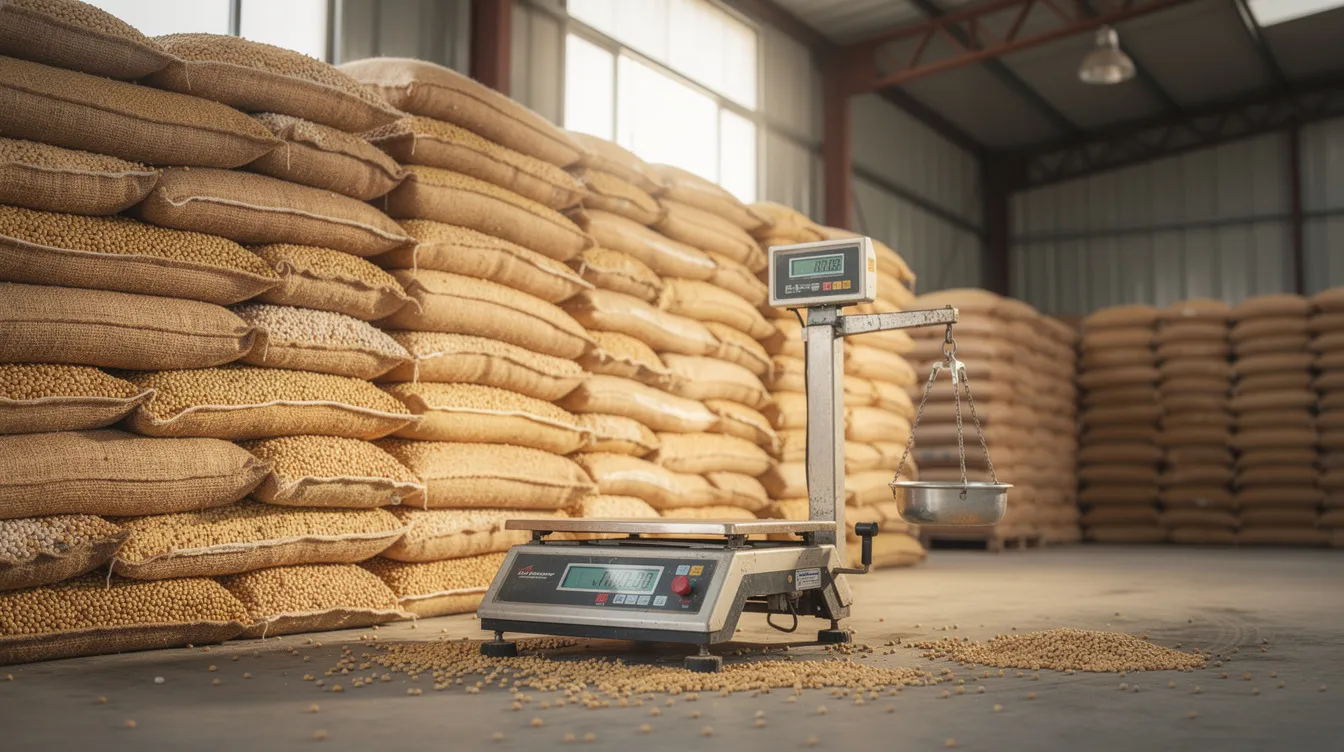
- Raw pulses – stock of chana, tur, moong, urad, masoor etc. held at raw material cost including mandi tax, transport and handling. The holding period for raw material inventory can be 1 to 3 months depending on procurement strategy and storage capacity.
- Work-in-process (WIP) – semi-processed pulses at cleaning, husking, oil application or drying stages, valued at accumulated cost (raw material plus proportionate power, labour and consumables).
- Finished dal – ready-to-sell dal valued at production cost, not at selling price. Finished goods inventory needs to meet 15 to 30 days of sales demand.
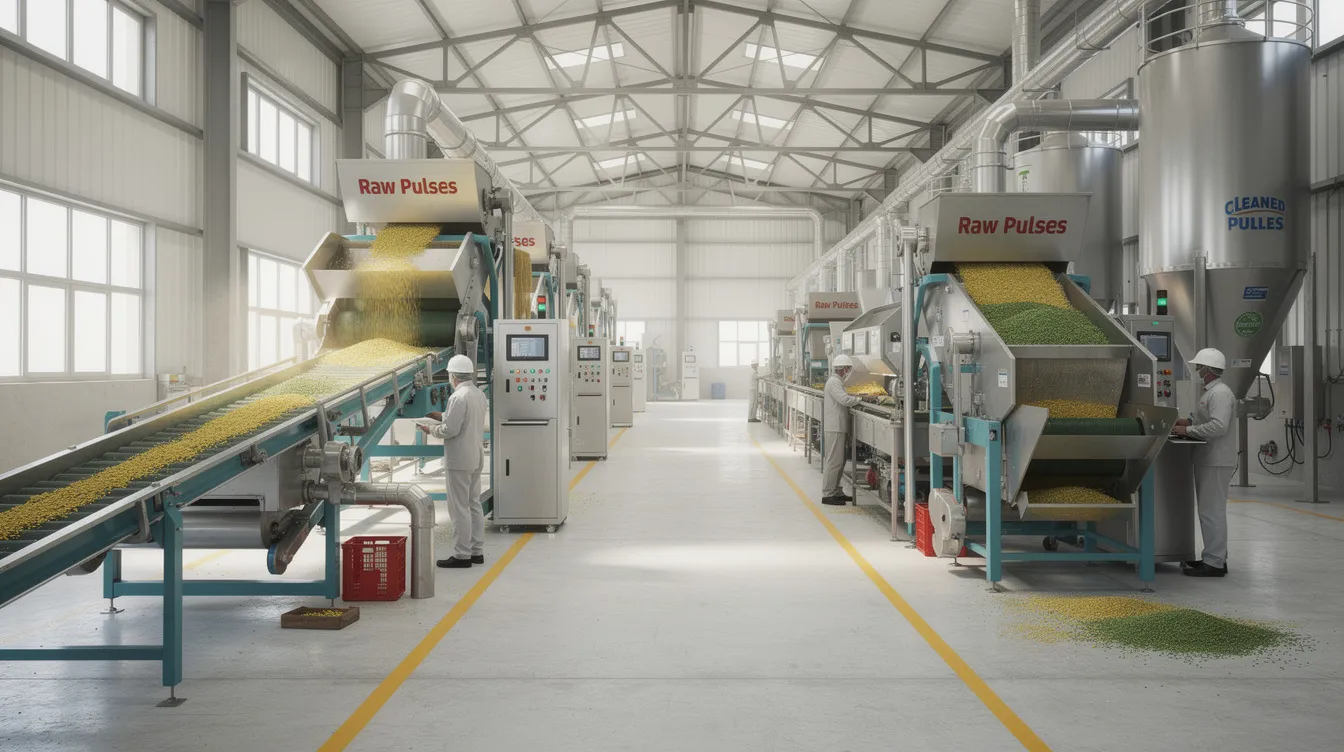
- Husk, chuni and broken dal – by-product inventory that has market value and occupies working capital. These by-products can represent 20–30% of input quantity and generate meaningful additional revenue. For detailed analysis, see dal mill by-products – husk, chuni, broken dal and additional revenue.
- Packing materials and consumables – PP bags, jute bags, BOPP printed packs, stitching thread, oil for conditioning, emery stones and cleaning screens. Working capital needs differ substantially between bulk supply and retail packaging models.
- Trade receivables – accounts receivable in dal milling typically ranges from 15 to 45 days depending on whether the buyer is a wholesaler, institutional customer or retailer.
- Minimum operating cash – a small bank or cash balance to cover daily wages, local transport and electricity deposits between realisations.
Operating Current Liabilities:
- Supplier credit and other operating liabilities – sundry creditors for pulses, packing material suppliers, power dues, labour and statutory dues. Dal mills often deal with credit extended by raw material suppliers ranging from 15 to 30 days. Supplier credit helps mitigate working capital needs for dal mills by reducing the net gap.
Deriving Net Working Capital:
- Total Operating Current Assets (sum of all above asset items)
- Less: Operating Current Liabilities
- Equals: Net Working Capital Requirement
- Less: Promoter’s Margin in Working Capital (own funds contribution)
- Equals: Bank Working Capital Finance Sought (cash credit / stock finance limit)
Dal Mill Operating Cycle and Inventory Holding Periods
The operating cycle – or cash conversion cycle – measures the period from paying for raw pulses to collecting cash from dal sales. The cash conversion cycle is a critical metric for assessing liquidity in dal mills, and operating cycle calculations help determine working capital requirements.
The simplified formula is: Inventory Days + Receivable Days – Payable Days
For a more detailed assessment, inventory days can be separated into raw material days, WIP days and finished goods days. The working capital cycle includes raw material, work-in-progress and finished goods holding periods.
Key factors influencing each component:
- Procurement strategy: Buying full-season stock at harvest versus staggered purchases throughout the year. For a comprehensive discussion, refer to raw pulse procurement, storage and seasonal inventory planning.
- Processing capacity and utilisation: A 6 TPD or 12 TPD dal mill operating at 60–70% utilisation converts raw pulses into dal at a specific rate, influencing how long inventory sits before processing.
- Recovery ratio: Traditional milling recovers only 65 to 75 percent of pulses as finished dal, while modern plants with better conditioning can achieve 78–82% for chana. Better recovery reduces raw material required for a given output and can improve inventory turnover. Detailed benchmarks are available in the dal mill recovery ratio, dal yield and milling losses article.
- Customer credit terms: Wholesale, private label and institutional buyers each have different payment patterns.
Illustrative Operating Cycle:
Assume raw material holding of 45 days, WIP 3 days, finished goods 15 days, receivables 30 days and payables 15 days:
45 + 3 + 15 + 30 – 15 = 78 days
This means the mill’s cash remains blocked for approximately 78 days from the point of purchasing raw pulses to the point of collecting payment from buyers. The milling recovery rate also impacts cash flow projections due to the timing gap between production and by-product revenue realisation.
Step-by-Step Dal Mill Working Capital Assessment (Numerical Example)
All numbers below are illustrative. Actual assessment must be customised for each dal mill project.
Assumptions for a hypothetical 6 TPD chana dal mill in Madhya Pradesh, FY 2026–27:
| Parameter | Assumption |
|---|---|
| Installed capacity (finished dal) | 6 MT per day |
| Operating days per year | 300 |
| Capacity utilisation (Year 1) | 70% |
| Annual finished dal output | 1,260 MT |
| Recovery (chana dal, cleaned basis) | 78% |
| By-products (husk, chuni, broken) | ~12% husk/chuni, ~10% broken/losses |
| Raw material required | 1,260 / 0.78 ≈ 1,615 MT |
| Raw pulse purchase cost | ₹6,000 per quintal (₹60,000/MT) |
| Average dal selling price | ₹95 per kg |
| Raw material holding | 45 days |
| WIP holding | 3 days |
| Finished dal holding | 20 days |
| By-product holding | 15 days |
| Receivable days | 30 days |
| Supplier credit (payables) | 15 days |
| Packing material holding | 15 days |
Working Capital Assessment Table (Illustrative):
| Component | Basis | Value (₹ Lakh) |
|---|---|---|
| Raw Material Inventory | ₹969 lakh × 45/365 | 119.5 |
| WIP Inventory | Annual production cost × 3/365 | 8.5 |
| Finished Dal Inventory | Annual production cost × 20/365 | 56.0 |
| By-Product Inventory | By-product cost/value × 15/365 | 4.5 |
| Packing Material & Consumables | Annual packing cost × 15/365 | 3.0 |
| Trade Receivables | Annual sales × 30/365 | 98.5 |
| Minimum Cash/Bank Balance | Estimated | 3.0 |
| Total Operating Current Assets | 293.0 | |
| Less: Trade Creditors & Operating Liabilities | Raw material credit 15 days + others | 45.0 |
| Net Working Capital Requirement | 248.0 | |
| Promoter’s Margin (≈ 25% of NWC) | 62.0 | |
| Indicative Bank Working Capital Finance | 186.0 |
The raw material inventory alone accounts for the largest share – reflecting the approximately 77% raw material intensity of this business. For smaller operations, typical working capital for a dal mill can be in the range of ₹3–10 lakh, while larger plants require proportionally higher amounts.
These figures feed directly into CMA data for bank loan proposals. For a detailed walkthrough of how working capital integrates with financial projections and DSCR, see dal mill financial projections, CMA data, working capital and DSCR. CMA data is essential for showing profitability in project reports, and a detailed project report typically includes 5-year financial projections.
Cash Credit Limit Assessment for a Dal Mill
A cash credit (CC) facility is a revolving working capital facility sanctioned up to a specified limit. Interest is charged on the daily utilised balance, not the full sanctioned amount, subject to facility terms. Security is usually provided by hypothecation of stock and receivables, often supplemented by collateral.
A sanctioned dal mill cash credit limit does not guarantee permanent availability of the full amount. The drawable amount depends on periodic drawing power calculated from stock and receivable statements submitted to the bank.
Banks assess working capital based on methods like the Turnover Method or Operating Cycle Method. Lenders evaluate working capital based on projected sales and existing financial documentation. The operating cycle method – which builds up from inventory, receivables and payables – is often more appropriate for dal mills given their seasonality and high inventory investment. The turnover-based method (a percentage of projected sales) may be used for smaller units, but percentages vary across banks and current RBI policies. Neither method should be treated as universally mandatory.
Banks typically examine:
- Projected sales and raw material consumption
- Reasonableness of stock days and receivable days compared with industry norms
- Promoter’s own margin in working capital
- DSCR and cash flow from operations – banks require a Debt Service Coverage Ratio of at least 1.5 for loans
- CMA data should show a net profit margin of 8–12% to support the case
Cash credit for working capital should not be confused with term loans for fixed assets such as dal mill machinery and plant. These are structured separately under the dal mill project cost and means of finance framework. A dal mill project typically costs ₹15 lakh to ₹1 crore depending on capacity and infrastructure.
Drawing Power Calculation for a Dal Mill (Practical Example)
Drawing power (DP) is the maximum amount a borrower can draw from the cash credit account on a particular date, based on eligible security after applying margins and sanction conditions.
Illustrative DP Calculation – Stock Statement Date: 30 June 2026
| Item | Value at Cost (₹ Lakh) | Eligible Value | Bank Margin | DP Amount (₹ Lakh) |
|---|---|---|---|---|
| Raw pulses | 95.0 | 95.0 (all paid) | 25% | 71.25 |
| WIP | 7.0 | 7.0 | 25% | 5.25 |
| Finished dal | 42.0 | 42.0 | 25% | 31.50 |
| By-products & packing | 5.0 | 5.0 | 25% | 3.75 |
| Total Stock DP | 111.75 | |||
| Receivables < 90 days | 72.0 | 72.0 | 30% | 50.40 |
| Receivables 90–180 days | 12.0 | Excluded | – | 0.00 |
| Total Receivable DP | 50.40 | |||
| Gross Drawing Power | 162.15 | |||
| Sanctioned CC Limit | 150.00 | |||
| Permissible Drawal (lower of DP or limit) | 150.00 | |||
| Current outstanding utilisation | 128.00 | |||
| Further available for drawal | 22.00 |
Margins, deductions and eligible receivable periods shown above are illustrative. Actual norms depend on the lender and sanction terms. Some banks also require deduction of unpaid stock (raw material for which suppliers have not been paid) from eligible stock.
If current utilisation exceeds the updated DP at any stock statement date, the borrower must reduce the outstanding. A sanctioned limit higher than DP does not mean the borrower can draw the entire limit. Bank-specific rules on margins, ageing and deductions for dal mill stock statements must be followed carefully.
Seasonal Raw Pulse Procurement and Peak Working Capital Funding
Raw material procurement for dal mills is seasonal. Chana is harvested during the rabi season around March–April in Madhya Pradesh and Rajasthan. Tur arrives around December–January from Maharashtra and Karnataka. Moong and urad follow their own kharif patterns. Dal mills typically procure large quantities of raw pulses during the harvest season when pulse prices are relatively lower.
Understanding seasonal procurement requirements is crucial for accurate working capital assessment. This creates two distinct funding pictures:
- Average working capital across the year (used for annual assessment)
- Peak working capital in months when raw pulse stock in godowns is at its highest
Price volatility of agricultural commodities can significantly affect working capital. While mills may expect to benefit from buying low at harvest and selling processed dal later, they must also account for price declines, government market interventions and stock limits under commodity control orders. Stock accumulation does not automatically yield profit.
When preparing CMA data and projections, promoters should model both average and peak stock scenarios, prepare monthly cash flow to track cash credit utilisation across the year, and run sensitivity analysis on raw pulse prices and holding days. For structured modelling, consider financial projections and financial modelling services that incorporate seasonal cash flow patterns.
India produced 22.95 million tons of pulses in 2016-17, reflecting the scale of the industry and the growing demand for processed dal across the country.
Cash Credit, Pledge Finance and Warehouse Receipt Finance
Dal mills can access different forms of stock finance depending on their requirements and lender policies:
| Feature | Cash Credit (Hypothecation) | Pledge Finance | Warehouse Receipt Finance |
|---|---|---|---|
| Security & Custody | Stock remains at borrower’s premises | Stock under lender/warehouse control | Stock in approved warehouse with receipt |
| Operational Flexibility | High – borrower controls stock movement | Lower – release against payment | Moderate – depends on warehouse access |
| Typical Use | Regular daily working capital | Bulk seasonal pulse storage | Specific commodity storage at harvest |
| Repayment | Revolving, no fixed tenure | Against release of pledged goods | Usually within 12 months |
| Suitability for Dal Mill | Most common for ongoing operations | When mill accepts restricted access for higher funding | Where acceptable warehouses and commodity exist |
Cash credit against hypothecation is the most widely used facility for dal mills. Pledge finance involves physical control of stock by the bank or its agent, reducing operational flexibility but potentially enabling higher funding. Warehouse receipt finance relies on acceptable warehouse receipts issued by recognised warehouses, subject to lender policy, eligible commodities and arrangements compliant with current WDRA norms. Availability of these options varies, and promoters should discuss with their bank which options apply to their specific dal mill and commodity mix.
Stock Statements, CMA Data and Supporting Documents for Dal Mill Working Capital
Stock and receivable statements are critical periodic submissions – often monthly – that determine drawing power for the dal mill cash credit limit.
A typical dal mill stock statement for bank should capture:
- Date-wise and item-wise quantity and value of raw pulses, WIP, finished dal and by-products
- Valuation at cost, excluding profit margin
- Separate disclosure of pledged stocks, if any
- Distinction between paid and unpaid stocks where required by sanction terms
Additional documents banks may require during appraisal or renewal:
- Debtors ageing summary, especially highlighting receivables beyond 90 days
- Purchase and sales registers (GST-compliant), sale invoices and purchase bills
- Latest financial statements (audited or CA-certified as applicable) and projected financials
- CMA data preparation containing past performance and 3–5 year projections
- Essential documents include land documents, FSSAI registration, project report and KYC of promoters
- Bank statements and proof of existing facilities
Banks may also conduct stock inspection and physical verification, check insurance coverage for stock and plant, and require stock audit for larger limits or stressed accounts. Ensuring that dal mill working capital calculations in CMA data align with actual stock records, GST returns and financial statements makes the case presented to the bank consistent and credible.
Common Mistakes in Dal Mill Working Capital Assessment
Many dal mill working capital proposals face questions or delays because of unrealistic or inconsistent assumptions in project reports or CMA data.
Valuation and Recovery Errors:
- Overstated recovery – assuming 90% dal recovery in tur when traditional plants often manage only 65–75%, leading to underestimated raw material requirements and lower working capital projection
- Ignoring by-product inventory – counting revenue from husk, chuni and broken dal in projections but not including their stock in working capital calculations
- Applying selling price to all inventory categories rather than cost basis
Operational Assumptions:
- Assuming very long supplier credit (60–90 days) from farmers and traders, which is rarely available in practice
- Ignoring packing material and other consumables in both cost and stock calculations
- Treating all receivables as fully current while actual books show significant overdue amounts beyond 90 or 180 days
Financial Structuring Issues:
- Diverting working capital funds towards fixed assets (construction or machinery advances), creating a shortage for day-to-day pulse procurement – a misuse that can result in reliance on increasingly expensive short-term funding
- Inadequate promoter margin in working capital, relying entirely on bank finance
- Not adjusting for lower selling prices or slower collections, which can sharply increase working capital strain even if sales volume is achieved
Working with a professional advisor can help validate assumptions, perform sensitivity analysis for price and volume, and present a balanced case that protects both the promoter and the bank.
How Project Report Bank (CA Manish Gugliya) Can Assist Dal Mill Promoters
Project Report Bank is a CA-led advisory platform specialising in Detailed Project Reports, CMA data, financial modelling and project finance advisory for MSMEs and food processing units across India, including dal mills.
CA Manish Gugliya and team can assist specifically with:
- Preparing realistic dal mill working capital calculations based on capacity, recovery, seasonality and customer profile
- Assisting in preparing CMA data for bank loans, aligning term loan and cash credit requirements with projected financials and DSCR
- Structuring means of finance between term loan, cash credit, promoter contribution and applicable government schemes
- Preparing bank finance DPR and loan proposals focused on working capital
- Monthly and seasonal cash flow planning and sensitivity analysis
Bank Finance DPR and Loan Proposal Assistance starts at ₹25,000. Exact fees depend on project size, complexity and documentation scope. Payment terms: 30% advance at commencement and 70% after submission of the first complete draft, before final release.
Promoters are welcome to share basic details of their dal mill – location, capacity, existing bank facilities – via WhatsApp or email to explore professional assistance in dal mill working capital assessment, CMA data and bank loan documentation.
FAQ
How is dal mill working capital different from project cost?
Project cost covers the initial investment in land, building, plant and machinery and an initial working capital margin money amount. Working capital, on the other hand, is the ongoing fund required every operating cycle to finance raw pulses, stocks and receivables even after the plant is fully commissioned and operational. Both appear in a dal mill project report, but they serve different purposes and are financed through different instruments – term loan for project cost and cash credit for working capital.
Can government schemes like PMEGP or PMFME cover dal mill working capital?
Such schemes mainly support term loans and margin money for project cost rather than regular working capital. For instance, subsidy under PMFME covers 35% of eligible project cost up to ₹10 lakh, and loan processing under PMFME typically takes 30–45 days after submission. However, the margin money assistance may indirectly reduce the promoter’s overall contribution requirement, freeing up resources that can be deployed towards working capital margin. Regular working capital usually comes as cash credit from banks based on separate assessment.
How often do banks recalculate drawing power for a dal mill cash credit account?
Most banks require monthly stock and receivable statements and recalculate drawing power accordingly. Some may accept quarterly submissions for smaller limits. The actual frequency depends on bank policy and sanction terms. During periods of significant price or volume change – such as the harvest season – more frequent updates may be expected. Prompt and accurate submission of stock statements protects the borrower’s access to the full eligible drawing power.
What happens if my dal mill recovery is lower than what I projected in CMA data?
Lower recovery means more raw material is consumed per unit of finished dal output, which directly increases raw material cost, reduces profitability and can fall short of the projected cash flow. At the time of bank renewal, this gap may affect the bank’s assessment of your repayment capacity and DSCR. It is advisable to prepare conservative recovery assumptions aligned with actual plant performance and review them periodically. If recovery improves through better conditioning or innovation in machinery, future projections can be updated accordingly.
Does higher dal recovery always reduce working capital needs?
While better recovery reduces raw material required for a given output – and therefore can reduce the value of raw material inventory – higher quality processing could also involve longer conditioning time, increased power consumption or additional process steps. Recovery must therefore be analysed together with stock days, pricing and sales patterns. The net effect on working capital depends on the overall operating cycle, not just the recovery percentage in isolation.
Conclusion: Using Dal Mill Working Capital Assessment to Build a Bankable, Sustainable Operation
Effective dal mill working capital assessment is as important as selecting the right machinery or location. Cash is continuously tied up in seasonal raw pulses, processing stocks and credit sales. An efficient and well-documented assessment can mean the difference between a smoothly operating plant and one that faces periodic cash crises despite earning a profit on paper.
A realistic assessment combines correct recovery and cost assumptions, well-judged stock and receivable holding periods, clear separation of promoter margin and bank finance, and disciplined use of cash credit, pledge or warehouse receipt facilities. Every dal mill is different in scale, product mix (chana, tur, moong, urad, masoor), business model (bulk versus branded packs for export or domestic trade) and geography. Bank finance planning must therefore be customised rather than copied from standard model project reports.
If you are planning a new dal mill, seeking expansion of an existing operation, or preparing to submit working capital documentation to your bank, consider consulting Project Report Bank and CA Manish Gugliya for customised dal mill working capital assessment, CMA data preparation and bank finance DPR support. Professional assistance does not guarantee a specific loan amount or interest rate, but it does help ensure your proposal is realistic, consistent and bankable.