Key Takeaways
- An integrated multi-pulse processing plant processes Tur, Moong, Urad, Chana and Masoor within a single industrial facility, improving capacity utilisation and reducing dependence on any one crop cycle.
- A professionally prepared integrated multi-pulse processing plant project report is essential for bank loan appraisal, government scheme applications and informed investment decisions.
- Machinery planning must distinguish between shared equipment, adjustable equipment and pulse-specific equipment – this classification directly affects project cost, changeover efficiency and product quality.
- Working capital for multi-pulse operations is more complex than for a single dal mill because several pulses must be procured seasonally, stored and financed simultaneously.
- Dal recovery percentages vary significantly across pulses and are often more important to profitability than minor differences in processing cost per quintal.
Introduction – Why Integrated Multi-Pulse Processing Plants Are Attractive
India consumes pulses across every region, but consumption patterns differ substantially. Chana dal dominates in Rajasthan and Gujarat, toor dal is the staple in Maharashtra and Karnataka, masoor dal leads in Eastern India and Bihar, while moong dal and urad dal find strong demand across North India and the South. The global pulses market was valued at USD 103.25 billion in 2025 and is expected to reach USD 140.23 billion by 2034, driven significantly by rising demand for plant-based proteins. Pulses account for over 90 million tonnes of global production annually, and processed pulses are increasingly used in ready-to-eat meals and snacks. Market analysis should evaluate both domestic and commercial consumption of pulses before committing capital.
A traditional single-pulse dal mill – processing only Chana or only Tur – faces concentration risk. Raw material availability is seasonal, product output is limited, and the business depends entirely on one commodity’s price cycle. When Tur prices spike or Chana arrivals are delayed, a single-pulse unit has no fallback.
An integrated multi-pulse processing plant addresses this limitation by handling multiple pulse varieties within one industrial campus. The potential benefits include better equipment utilisation across seasons, a diversified raw material base, a wider product portfolio spanning various dals, and improved risk distribution. However, flexibility does not automatically translate into higher profits. Success depends on plant configuration, pulse-wise production planning, operational efficiency and disciplined working capital control. The rest of this article examines these factors from a project-finance and DPR perspective, aimed at promoters preparing a bankable integrated pulses processing project report.
What Is an Integrated Multi-Pulse Processing Plant?
An integrated multi-pulse processing plant is a facility that processes Tur (Arhar), Moong, Urad, Chana and Masoor using shared infrastructure – land, building, utilities, cleaning systems, material handling and packaging lines. The main functional blocks include a raw material reception yard, bulk storage for each variety, cleaning and grading section, destoning, pulse-specific conditioning (pitting, soaking, tempering), drying, dehusking and splitting, polishing where required, colour sorting, weighing, packing and finished-goods warehouse.
Equipment in such a plant falls into three categories. Common machinery includes pre-cleaners, destoners and aspirators that serve all pulses without modification. Adjustable machinery includes dehuskers with changeable emery rolls and graders with adjustable sieves that can be reconfigured for different grain sizes. Pulse-specific equipment includes special pre-treatment drums for hard Tur husk and separate polishing lines for Chana dal and Masoor.
A single universal process is not technically optimal because each pulse differs in husk adhesion, grain hardness, grain size and moisture behaviour. Tur requires intensive conditioning; Moong needs gentler handling. From a DPR and bank loan perspective, defining which machines are shared and which are dedicated is critical for estimating project cost, automation level and achievable operational efficiency.
Types of Pulses Processed in an Integrated Plant
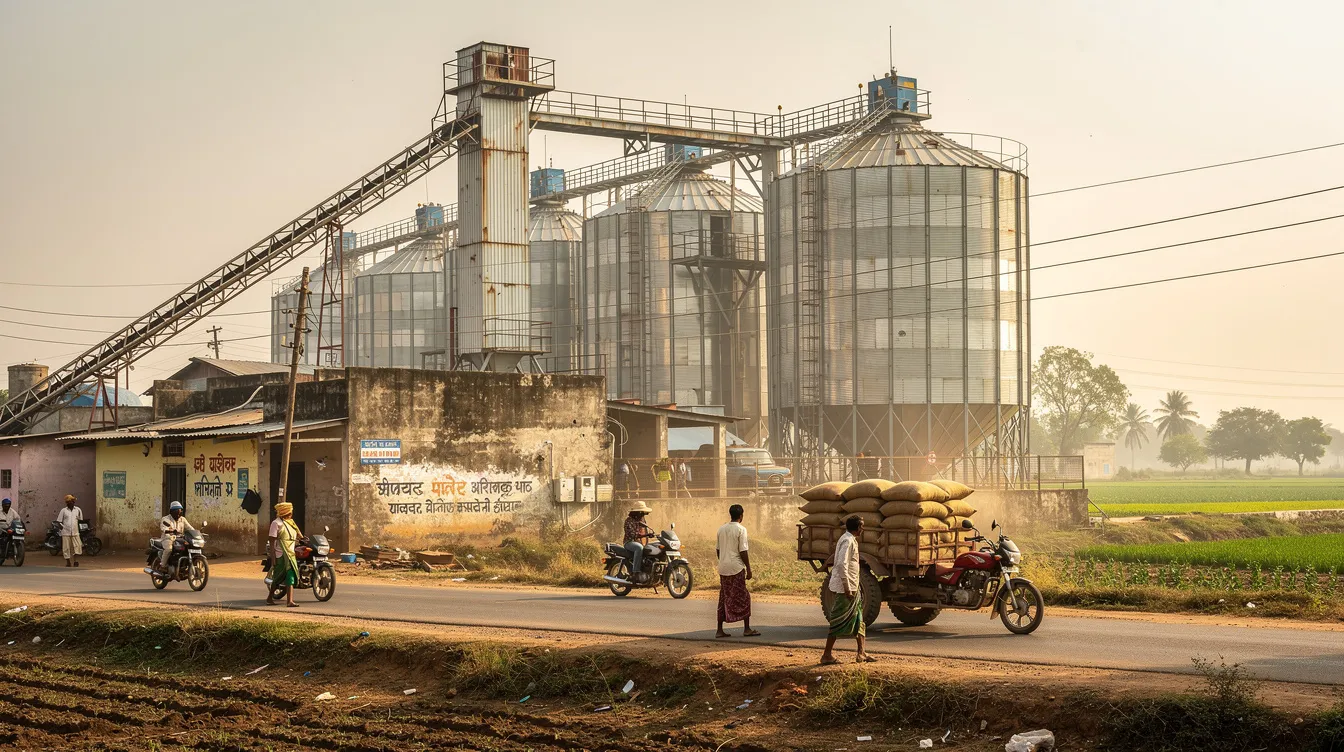
Not all pulses behave identically in milling, even when broad process steps appear similar. Pulse-wise planning is therefore essential in an integrated dal mill project report.
| Pulse | Raw Material Form | Major Processing Considerations | Typical Finished Products |
|---|---|---|---|
| Tur (Arhar) | Whole dried pigeon pea with husk | Hard husk adhesion; repeated pitting and conditioning; higher risk of brokens | Tur whole, Tur dal |
| Moong | Green gram | Delicate grain; gentle dehusking needed; breakage risk | Moong dal (dhuli), Moong splits |
| Urad | Black gram with black seed coat | Specific dehusking for seed coat removal; moisture sensitivity | Urad dal, polished Urad dal |
| Chana | Bengal gram (desi/kabuli) | Size grading critical for uniform milling; split and polish lines | Chana dal, whole Chana, besan-grade splits |
| Masoor | Lentils (red and whole) | Smaller grain; variety-wise differences; polishing for red masoor | Masoor dal, whole masoor |
Indicative recovery ranges based on ICAR technical bulletins suggest: Tur approximately 70%, Chana 78–82%, Moong and Masoor 80–82%, and Urad 75–78%. Actual dal recovery depends on raw material quality, moisture, machine set-up and operator skills. Tur and Chana can comfortably share dehusking lines with roller adjustments, but may need dedicated conditioning or polishing equipment to maintain quality and reduce contamination between batches.
Integrated Multi-Pulse Processing Plant Manufacturing Process
The process philosophy is batch-based, with separate lots for each pulse and strict segregation to avoid variety mixing. The manufacturing process includes cleaning, grading, de-husking, and sorting as core steps.
Process Flow: Raw Material Receipt → Pre-Cleaning → Cleaning & Grading → Destoning & Magnetic Separation → Pulse-Specific Conditioning (Pitting/Soaking/Tempering) → Drying → Dehusking → Splitting → Separation of Whole/Broken/Husk → Polishing (If Required) → Colour Sorting → Weighing & Packaging → Finished-Goods Storage & Dispatch.
The process diverges between pulses at the conditioning stage. Tur and Chana often require more intensive pre-treatment and multiple passes through dehuskers, while Moong and Urad need gentler handling to control brokens. Masoor processing varies depending on grain shape and whether whole or split output is targeted. Batch changeover procedures – emptying elevators and conveyors, cleaning aspirators and sorters – consume time that must be factored into effective capacity. Technical specifications in a professionally drafted project report should detail assumed process yields, moisture changes and typical cycle times for each pulse type.
Multi-Pulse Processing Plant Machinery and Equipment
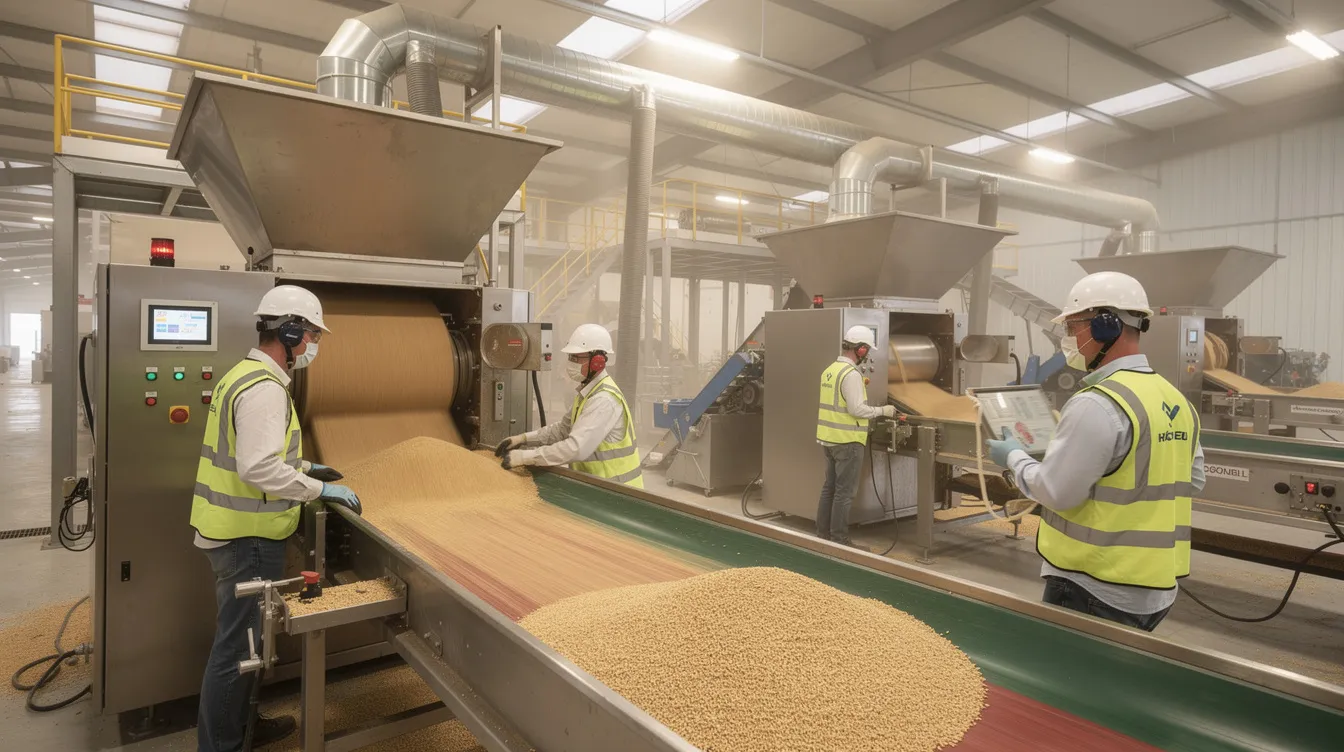
Machinery selection directly influences plant cost, automation level, operational efficiency and product quality. A typical dal mill project includes machinery costs of ₹8–30 lakh depending on scale and automation. Energy consumption for pulse processing machinery ranges from 100 to 250 kW, and operational efficiency of modern equipment can reach 99%.
Core machine groups include raw material handling (receiving hoppers, bucket elevators, chain conveyors), cleaning (pre-cleaner, vibro separator, aspirator), grading (plan sifters, rotary graders), and a gravity selector cum destoner that is responsible for removing stones and impurities from pulses. Conditioning systems, dryers, emery dehuskers, splitters, polishers, colour sorters, packing machines and dust-collection systems complete the line. Plant and machinery specifications should include detailed lists of equipment with capacity ratings, and technical specifications should detail the processing scale and product mix for pulses.
Semi-automatic plants suit lower budgets and allow operators to learn the business with moderate technology. Fully automatic configurations – using PLC panels and SCADA controls – increase consistency and reduce manpower but require higher CapEx and more skilled management. The optimum automation level should be justified in the DPR based on scale and promoter capabilities. Equipment from reliable and leading manufacturers typically delivers 15–20% lower processing time and 10–15% lower power consumption compared to local fabrications. Machinery life for most equipment runs 10–15 years; colour sorters have shorter lives of approximately 6–7 years due to complex electronics.
Integrated Dal Mill Plant Capacity Planning and Production Scheduling
Capacity planning for a multi-pulse processing plant is more complex than for a single dal mill. A typical dal mill has a minimum capacity of 500 kg per day, while larger integrated pulse processing plants can have an annual capacity of 50,000 MT. Capacity utilization metrics are crucial for profitability analysis in project reports.
Installed capacity (say 50 TPD raw pulses) differs from effective capacity after accounting for efficiency losses and changeover. At 300 working days per year, a 50 TPD plant processes up to 15,000 tonnes annually at full utilisation. Realistic capacity utilisation follows a ramp-up: approximately 50% in Year 1, 65% in Year 2, and 75–80% from Year 3 onward. Changeover downtime when switching from Tur to Moong can range from 2–4 hours for minor adjustments to a full shift for thorough cleaning – expect 1–2% capacity loss from changeovers in well-planned plants.
Pulse-wise allocation depends on local supply: for example, 40% Tur, 20% Chana, 15% Moong, 15% Urad and 10% Masoor. Shared machines like dryers and colour sorters must be sized for peak throughput phases. Individual machine capacities cannot simply be summed to represent plant output in a DPR.
Land, Building, Storage and Plant Layout
Pulses processing plants require 6,000 to 15,000+ sq. ft. area depending on capacity and storage needs. For a 30–50 TPD integrated plant, typical land requirements range from 0.5 to 1.5 acres. Functional building components include raw material godowns, covered processing shed with mezzanine floors, separate conditioning and drying areas, finished-goods warehouse segregating different dals, packaging room, QC laboratory, utility room and office block.
Plant layout should promote linear product flow from raw material receiving to dispatch, minimise backtracking, and provide dust-controlled walkways. Adequate height for elevators and gravity-flow equipment, truck movement space, fire exits and zoning for food-safety compliance are essential considerations. Dedicated bins for different raw pulses with aeration and pest-control measures prevent quality deterioration.
Multi-Pulse Processing Plant Cost in India – Project Cost Structure
A typical dal mill project cost ranges from ₹15 lakh to ₹1 crore for single-pulse operations. For a 1 ton/day capacity unit, total cost is approximately ₹25 lakh, while a typical dal mill costs around ₹39 lakh for setup with moderate automation. Integrated multi-pulse plants at 30–50 TPD require substantially higher investment. Financial projections include total capital cost and working capital assessments.
| Cost Component | Indicative Share of Total Cost |
|---|---|
| Plant & Machinery (incl. installation) | 40–55% |
| Civil Works & Building | 15–20% |
| Land & Site Development | 5–10% |
| Electrical & Utilities | 5–10% |
| Pre-operative Expenses & Contingencies | 5–10% |
| Initial Working Capital Margin | 10–15% |
Bank loans typically cover 65–75% of project costs via term loans. Higher automation and sophisticated colour sorters increase CapEx but may improve labour productivity and consistency, which should be analysed through financial modelling. All cost assumptions must be documented in the integrated multi-pulse processing plant project report, as banks review quotations, sizing justification and contingency adequacy before sanctioning a term loan.
Working Capital Requirements for a Multi-Pulse Processing Facility
Working capital is often the most underestimated part of an integrated dal mill project. Multiple pulses must be procured, stored and financed simultaneously. CMA data is essential for demonstrating loan repayment capacity and for sanctioning cash-credit limits.
Key elements include raw pulse inventory (purchased seasonally in bulk), packaging material, in-process stock, finished dal inventory across different SKUs, trade receivables and trade payables. Seasonality in crop arrivals – Chana in March–April, Tur in November–January – influences procurement timing and banking limits.
For a 50 TPD plant, an illustrative working-capital cycle might assume 30–60 days of raw pulse inventory, 15–30 days of finished goods, and 15–45 days of debtor credit, yielding a cash conversion cycle of 60–90 days. Detailed month-wise CMA data preparation showing stock levels and drawing-power calculations is typically required by Indian banks for working-capital facilities.
Dal Recovery Percentages, By-Products and Production Economics
Dal recovery – the percentage of raw pulse converted into marketable dal – is a critical driver of profitability. Output streams include finished dal (full grains), broken dal, husk, chuni/powder and process loss. Each has a different market: bran and husk serve as cattle feed or fuel; brokens sell at a discount. As per Government OTR data, total outturn for Chana dal is approximately 75.35% (Grade I ~37.43%, Grade II ~37.91%) and for Tur approximately 73.23%.
Raw uncleaned pulses account for 88–92% of total operating expenses, making raw material consumption the dominant cost driver. Operating costs account for 88–92% of total expenses in processing. A simple production-economics calculation compares per-quintal costing – raw pulses, power, labour, packaging, depreciation and finance cost – against realisable value of dal and by-products. Even a 1–2% variation in dal recovery can materially affect gross margin and DSCR, which is why a project report should test different recovery scenarios through sensitivity analysis.
Revenue Model, Profitability and Financial Projections
Revenue streams for an integrated plant include bulk dal sales, wholesale distribution, institutional supply, private-label packing, job-work processing for third parties and by-product sales. Gross profit margins for pulses processing typically range between 8–12%, while net profit margin for dal mills is typically 8–15%.
An illustrative profitability outline for a mid-sized project might assume capacity utilisation ramping from 50% in Year 1 to 75% by Year 3, with average processing margin per quintal covering raw material, power, labour, packing and interest costs. A detailed project report includes 5-year financial projections covering projected profit and loss, balance sheet, cash-flow statement and fund-flow analysis. Bankers examine gross profit margin, return on capital employed and break-even point to assess viability. A standard project report includes an executive summary and project rationale alongside these financial statements. The project report should outline the risk mitigation strategies addressing material price volatility.
DSCR, ROI, IRR and Bankability of an Integrated Multi-Pulse Processing Plant
For term loan appraisal, banks focus heavily on Debt Service Coverage Ratio. DSCR should be above 1.5 for bank loans – this measures the project’s ability to service interest and principal instalments from operating cash flow. Banks typically require a DSCR of at least 1.5 for loans of this nature.
ROI measures annual net profit relative to total investment. IRR represents the discount rate at which net present value of projected cash flows equals zero. Payback period indicates when cumulative cash flows recover the initial investment. All metrics derive from the 5–7-year financial projections in the project report.
Sensitivity analysis should test the effect of adverse changes: raw material price increases of 10–15%, selling price decreases, recovery drops of 1–2 percentage points, and capacity utilisation shortfalls. For promoters seeking customised financial modelling, DSCR calculations and bank loan structuring, Project Report Bank under CA Manish Gugliya provides analysis-driven advisory – initial enquiries can be made via WhatsApp.
Single-Pulse Dal Mill vs Integrated Multi-Pulse Processing Plant
| Aspect | Single-Pulse Dal Mill | Integrated Multi-Pulse Plant |
|---|---|---|
| Raw Material Dependency | One crop cycle | Multiple crops, seasonal spread |
| Machinery Investment | Lower, focused | Higher, shared + pulse-specific |
| Changeover Complexity | Nil | 2–8 hours per switch |
| Working Capital | Simpler, one commodity | Complex, multiple inventories |
| Product Range | Limited | Diversified portfolio |
| Operational Skill | Moderate | Higher; multi-process expertise |
| Market Flexibility | Narrow | Broader competitive advantage |
A dedicated single-pulse plant – say a Tur dal mill in a strong pigeon-pea belt – may be preferable when CapEx is limited, market demand is concentrated and the promoter’s industry expertise lies in one commodity. Conversely, integrated processing suits promoters with access to multiple crops in surrounding mandis, year-round demand for various dals and ambitions for product portfolio expansion. A detailed feasibility study should compare both options before finalising plant design.
Project Feasibility, Risk Factors and Sensitivity Analysis
A robust feasibility assessment is essential before committing capital, given pulse price volatility and competition from established dal mills across many areas. Major risks include raw material price fluctuations, finished dal price uncertainty, lower-than-expected recovery, machinery underperformance, inadequate working capital, capacity underutilisation and quality failures.
Mitigation strategies include long-term sourcing relationships with suppliers, diversification of sales channels and markets, investing in reliable machinery from leading manufacturers, preventive maintenance schedules, quality certification and conservative financial structuring with adequate promoter margin. Environmental compliance involves adherence to food safety standards and waste management protocols. The approach should focus on validating assumptions with local market data and practical banker expectations rather than relying on generic templates.
Government Approvals, Bank Loan Process and Relevant Schemes
Statutory approvals include FSSAI registration and local pollution control consents, along with business registration, Udyam MSME registration, GST registration, factory and labour-law compliances and fire safety permissions. An FSSAI license is mandatory for any food processing unit in India.
The Union Cabinet approved the Mission for Aatmanirbharta in Pulses (2025–26 to 2030–31) with ₹11,440 crore outlay, offering financial assistance up to 33% of project cost or ₹25 lakh for pulse processing units. Subsidy under PMFME covers 35% of eligible project costs, with PMFME offering a 35% subsidy on eligible project costs up to ₹10 lakh. No subsidy or credit support is automatic – it depends on scheme rules, bank discretion and project viability, and should be treated as an additional benefit rather than the foundation of a business plan.
Preparation of a Bankable Integrated Multi-Pulse Processing Plant DPR
A professionally prepared project report is the backbone of both investment decisions and successful bank-finance proposals. A high-quality DPR includes promoter profile, plant capacity and pulse mix, technical process description, machinery list with supplier quotations, implementation schedule, project cost estimates, means of finance, projected income statements, balance sheets and cash flows for 5–7 years, ratio analysis including DSCR, break-even analysis, ROI, IRR and payback period. CMA data is essential for loan approval in project reports.
Entrepreneurs planning an integrated pulses processing project can contact Project Report Bank and CA Manish Gugliya via WhatsApp or email for customised DPR preparation, financial projections and bank loan proposal assistance. The approach is analysis-driven and customised to each project’s scale, location and promoter circumstances – not template-based.
Conclusion – When Is an Integrated Multi-Pulse Plant Commercially Viable?
Integrated multi-pulse processing plants can improve capacity utilisation, distribute market risk and support product diversification. However, they demand careful planning of machinery configuration, pulse-wise production scheduling, working capital control and recovery assumptions. The total cost must be justified by achievable processing margins across the planned product mix. Commercially viable projects typically combine favourable access to multiple raw pulses, proven local demand for various dals, technically suitable equipment, realistic financial modelling and disciplined operations.
Every project is location-specific and promoter-specific. Feasibility must be tested through a customised DPR, sensitivity analysis and candid discussion with bankers before committing significant capital. The solutions that work for one region or scale may not produce the same output or profitability elsewhere.
For serious promoters evaluating an integrated multi-pulse processing plant, CA Manish Gugliya, FCA, DISA (ICAI), and the team at Project Report Bank offer professional support in DPR preparation, financial modelling, CMA data and project-finance advisory. Initial enquiries can be made conveniently via WhatsApp to deal with your specific project requirements efficiently.
Frequently Asked Questions (FAQs)
These FAQs address practical queries that entrepreneurs commonly raise about integrated multi-pulse processing plants beyond what the main sections cover in detail.
What minimum capacity is generally viable for an integrated multi-pulse processing plant?
Economic viability depends on local market size, raw material access and processing margins. Many integrated plants start becoming meaningfully efficient around 20–30 TPD and above, where the fixed costs of shared infrastructure and changeover procedures are spread across sufficient production volume. Very small units processing under 500 kg per day may find the complexity and money required for multi-pulse operations outweigh the benefits compared to a focused single-pulse line.
How long does it typically take to switch from processing one pulse to another?
Changeover time ranges from approximately 2–4 hours for minor adjustments (roller clearances, sieve changes) to nearly a full shift when thorough cleaning of conveyors, aspirators and colour sorters is needed to avoid cross-contamination. Well-designed plants with easy-access cleaning points and clearly documented changeover procedures can operate more efficiently. DPRs should factor this downtime into effective capacity planning.
Do I need separate quality certifications for an integrated multi-pulse processing plant?
An FSSAI license is mandatory regardless of whether one or multiple pulses are processed. Additionally, certifications like basic HACCP or ISO 22000 are optional but can significantly improve access to institutional clients, modern retail chains and export markets. The certification process evaluates the facility’s overall food-safety management rather than individual pulse lines.
Should a first-time entrepreneur choose semi-automatic or fully automatic machinery?
Semi-automatic plants are suitable for lower budgets and allow operators to learn the business while managing costs. Fully automatic plants deliver higher consistency and reduce manpower but require greater upfront investment and more skilled technical management. The choice should be based on project scale, available capital, promoter capability and the future growth path outlined in the business plan, validated through financial analysis in the DPR.
What is a realistic timeline to commission an integrated multi-pulse processing plant?
Subject to timely loan sanction and machinery delivery, many projects take approximately 10–18 months from project conception to commercial production, with the civil works and machinery procurement phases overlapping where possible. A well-tracked project implementation schedule – detailed in the DPR – helps avoid cost overruns and delays that can affect the company’s financial projections and service obligations.