By CA Manish Gugliya, FCA, DISA (ICAI)
Key Takeaways
- This guide covers the integrated gram processing plant project report from a Chartered Accountant’s perspective, connecting plant design with project cost, working capital, profitability, DSCR, and bankability.
- The focus is on an integrated chana dal and besan plant that processes whole gram as raw material, not a standalone besan plant purchasing ready chana dal for grinding only.
- All financial figures in this article are illustrative planning assumptions, not machinery quotations or assured results. Actual numbers require project-specific analysis.
- Readers will understand capacity planning, recovery and material balance, operating costs, financial projections, sensitivity analysis, and common mistakes to avoid in integrated besan plant setup cost estimation.
- Project Report Bank provides customised DPR, financial modelling, CMA Data, and bank finance advisory for integrated gram flour manufacturing projects across India.
Introduction
An integrated gram processing plant handles gram processing from raw procurement to packaging, combining dal milling and besan grinding under one roof. The facility receives whole gram (chana), cleans and dehusks it, splits it into chana dal, and then grinds a portion of that dal into gram flour (besan) for sale alongside the remaining dal and by-products.
This is fundamentally different from a small besan plant that simply purchases chana dal and grinds it. The integrated model requires cleaning, grading, dehusking, and splitting equipment in addition to grinding lines, resulting in higher capital investment and operational complexity.
A project-specific besan manufacturing plant project report is essential for this type of facility. DPRs help evaluate project feasibility and commercial viability before capital is committed. They are essential for securing bank finance and investor funding, especially for projects above ₹5 crore where bankers expect detailed operational and financial justification. Project feasibility studies assess potential success before investment; a comprehensive project report supports feasibility evaluations for bank financing or government subsidies.
This article is an educational guide published by Project Report Bank, a CA-led project-finance and DPR advisory platform. All numbers presented are illustrative planning assumptions, not machinery quotations or assured results. Promoters should seek customised analysis before making investment decisions.
Business Model of an Integrated Chana Dal and Besan Plant
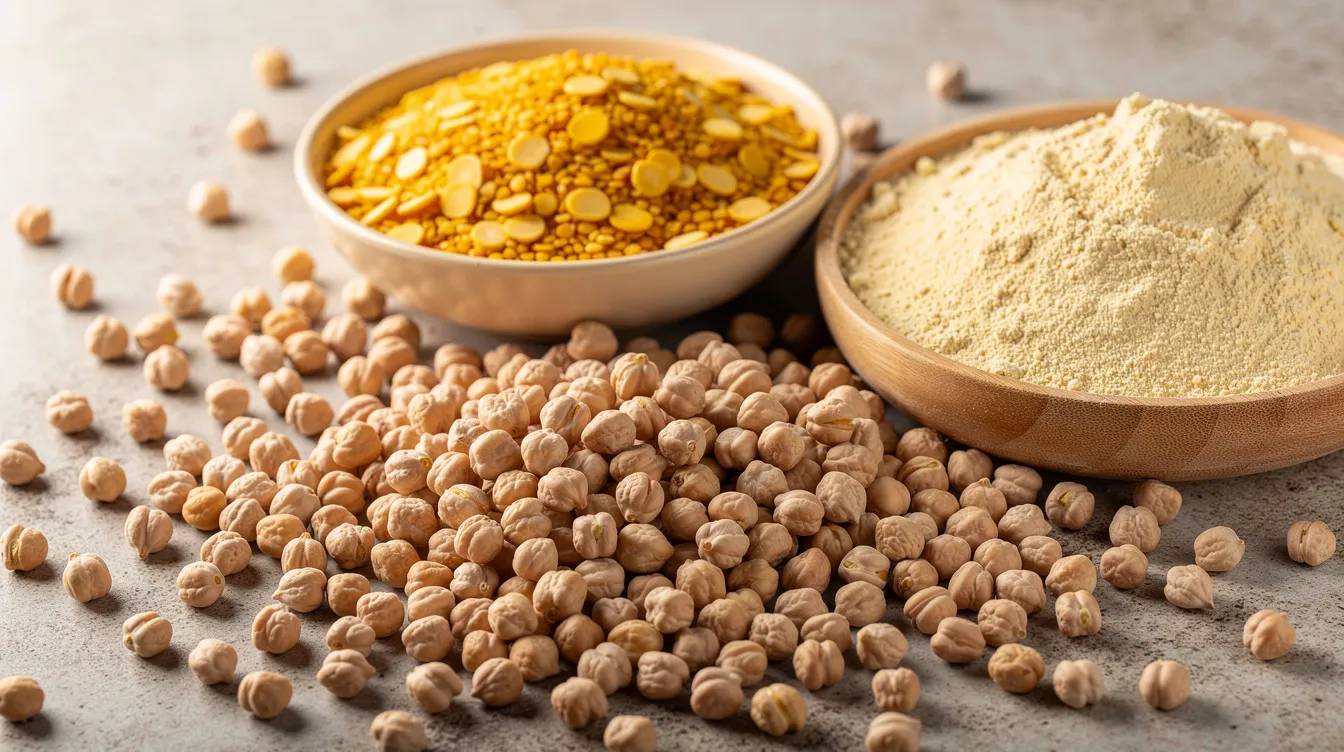
The business model begins with purchasing whole gram (chana, also called chickpeas in international markets) and converting it into multiple sellable products. The plant cleans and mills the gram into chana dal, allocates a portion of the dal for direct sale, and routes the remaining portion through grinding to produce besan. By-products like husk can be monetized as cattle feed in gram processing, while broken dal and dust/fines are sold as secondary output.
Revenue streams in an integrated chana dal and besan plant typically include:
- Wholesale chana dal (graded into head dal and smaller splits)
- Besan in different grades (standard, coarse for snack applications, and superfine for cuisines requiring finer texture)
- By-products: broken dal (churi), husk (konda/bhusi), and dust/fines
- Retail or branded packs (500 g, 1 kg, 5 kg) if the promoter invests in a brand
Product mix decisions directly affect margins and capacity utilisation. Assuming 100% of output will sell as premium besan is unrealistic; the dal component must be commercially viable on its own. Promoters evaluating the milling side of the business should review the dal mill feasibility study and project viability analysis to understand stand-alone dal economics before layering besan production on top.
Conceptually, 100% whole gram input yields roughly 78-82% dal (splits and whole), 3-5% husk, 3-8% brokens, and 1-2% dust and handling losses. The promoter then decides what fraction of dal goes to market versus the grinding section.
Integrated Plant vs Standalone Besan Unit
An integrated chana dal and besan plant requires more capital, more machinery categories, and more operational expertise than an independent besan plant that buys ready chana dal.
| Parameter | Integrated Plant | Standalone Besan Unit |
|---|---|---|
| Raw material | Whole gram (chana) | Purchased chana dal |
| Machinery scope | Cleaning, dehusking, splitting, grinding, sifting, packing | Grinding, sifting, packing |
| Integrated besan plant setup cost range | Higher (₹5-15 crore illustrative for medium scale) | Lower (₹1-5 crore illustrative) |
| Working capital | Higher due to whole gram inventory and seasonal procurement | Lower; dal purchased as needed |
| Product mix flexibility | Can shift between dal and besan sales | Limited to besan only |
| Quality control complexity | Must manage milling yield, husk separation, and grinding | Focused on grinding and fineness |
Integration does not automatically produce higher margins. If the spread between gram procurement cost and blended realisation from dal, besan, and by-products is thin, the additional investment in milling equipment may not justify itself. Readers considering a grinding-only model should review the detailed comparison in our article on besan manufacturing from chana dal.
Promoters should also note the higher working capital, maintenance, and management demands of an integrated setup. Overestimating synergies without accounting for these costs is a common error.
Products, Grades and Customers
The main outputs of an integrated plant are chana dal (in various size grades), besan (standard and superfine), and by-products. Besan is a staple ingredient across India, used in snack manufacturing, sweet preparation, and household cooking. Dal grades are sold based on split size, colour, and polish level.
Typical customers include wholesalers, traders, snack and namkeen manufacturers, institutional buyers, private-label FMCG brands, and modern retail chains. Each customer category has distinct specifications: moisture level (typically below 10-12% for packed besan), particle size distribution, colour, ash content, and microbiological parameters. Packaging requirements range from 25-50 kg PP woven bags for B2B to laminated pouches for retail. Market analysis should include demand-supply assessments and competitor analysis for pulses before finalising plant capacity.
Bulk B2B supply offers volume but thinner margins and longer credit periods. Building an own brand for retail packs in the country’s competitive market requires marketing investment and longer payback. Most new plants start by supplying bulk buyers and gradually add retail packs as production stabilises.
Manufacturing Process Flow
The production process in an integrated facility follows a defined sequence, and hygienic processing is crucial for high-quality besan production at every stage.
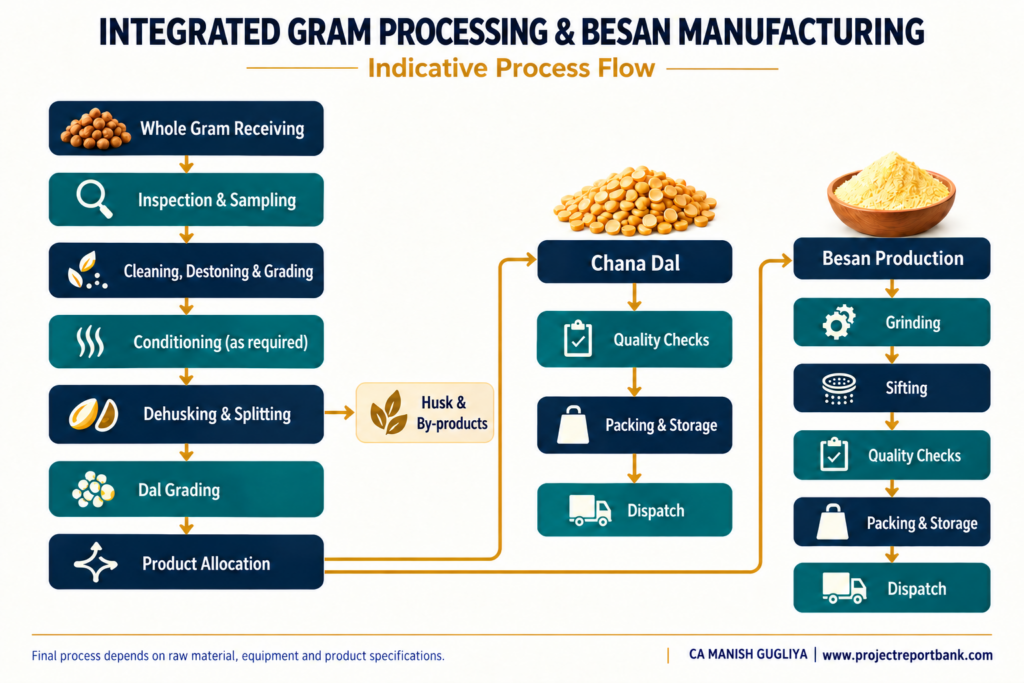
Dal Milling Section: The plant performs cleaning, grading, dehusking, and splitting of gram. Raw gram is received, weighed, and fed through pre-cleaning to remove foreign material. De-stoning equipment separates stones and heavy impurities; automatic besan plants can remove large impurities like stones and dust at this stage. Magnetic separators catch metallic contaminants. Grading sorts by kernel size for uniform quality in subsequent processing.
Where conditioning is used, moisture is added (approximately 5-6% water) and the grain is tempered for 8-12 hours to loosen the seed coat. The conditioned gram passes through dehusking machines (abrasive or emery-stone type), and splitters separate the kernels into two halves. Aspirators remove husk and fine particles. Dal is then graded; at this point, a defined portion is diverted for direct sale as chana dal, and the remainder moves to grinding.
Besan Grinding Section: Chana dal is ground into fine besan powder using hammer mills, pin mills, or systems like the UGM Mill system, which grinds chana dal into fine besan powder with controlled heat. Efficient grinding requires temperature management to prevent oil migration and screen clogging. Safety sieving removes oversized particles from the flour, and any coarse material is recycled back to the mill. Dust collection systems maintain hygiene during production. The final besan powder is stored before packaging in food-grade bags or pouches.
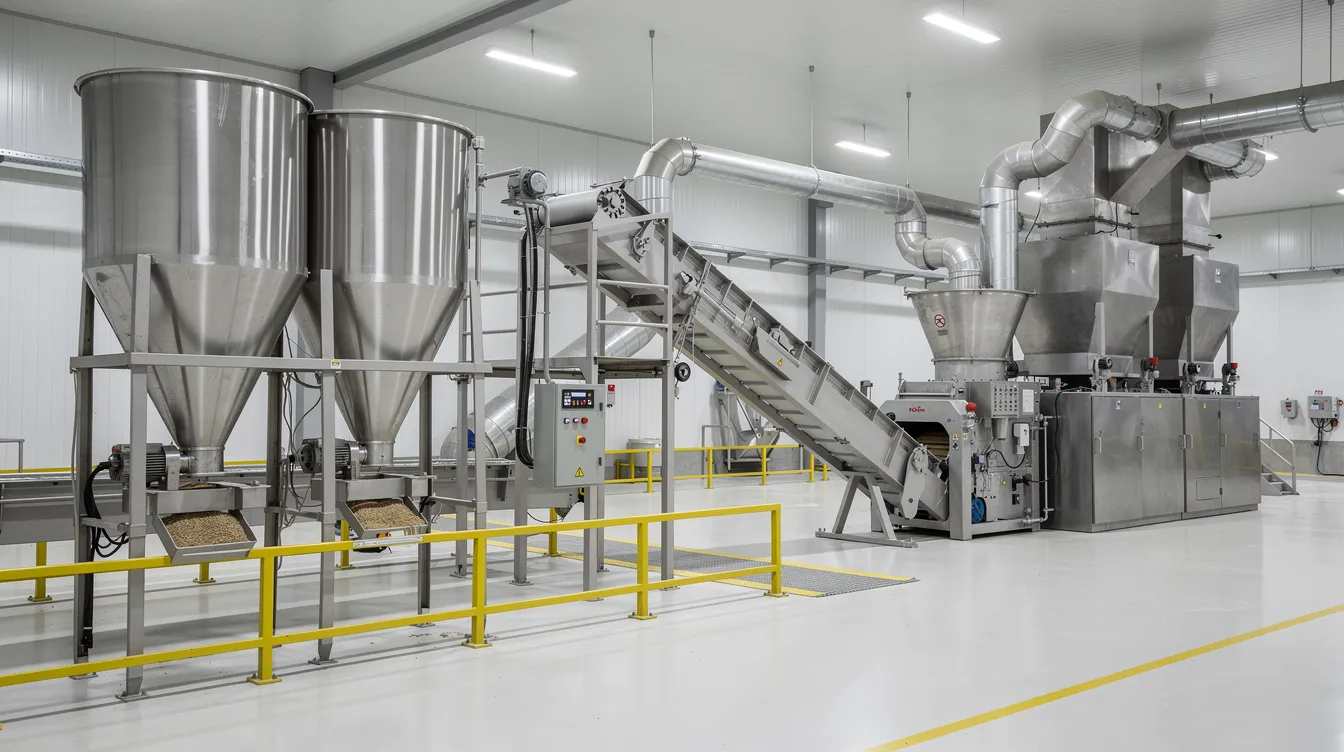
The air classification and aspiration systems play a role in separating fine particles from coarser fractions and in maintaining the precision of particle size distribution across besan grades. Dust collection systems maintain hygiene in besan processing plants and protect worker health.
Recovery, Material Balance and Illustrative Yield Example
A gram flour manufacturing project report must ensure that input equals the sum of finished products, by-products, and losses. The recovery rate for processing gram typically ranges from 68% to 75% depending on various factors such as grain moisture, variety, and machine calibration. Under good conditions with quality raw materials, industry benchmarks from MillNest’s besan processing guidelines indicate dal recovery can reach 78-82%.
Illustrative Material Balance (per 1,000 kg whole gram input):
| Output Category | Approximate Quantity | Percentage |
|---|---|---|
| Dal splits (total) | 800 kg | 80% |
| – Of which sold as chana dal | 400 kg | 40% of input |
| – Of which sent for besan grinding | 400 kg | 40% of input |
| Besan produced (after ~5% grinding loss) | 380 kg | 38% of input |
| Grinding loss (moisture, fines) | 20 kg | 2% of input |
| Brokens / churi | 40 kg | 4% |
| Husk and bran | 30 kg | 3% |
| Dust, fines, handling loss | 10 kg | 1% |
| Total accounted | 1,000 kg | 100% |
These are illustrative planning assumptions, not machinery quotations or assured results.
Dal allocated to grinding appears as besan output, not as dal sales. Double-counting this allocation is a frequent DPR error. Actual yields depend on gram quality, moisture, and machine tuning; promoters should conduct pilot trials rather than relying on brochure-best figures.
Capacity Planning
Capacity planning requires distinguishing three separate numbers: whole gram input capacity (TPD or TPH), dal output capacity, and besan grinding capacity. All three must be aligned so that no section sits idle or becomes a bottleneck.
For a 20 TPD whole gram input plant operating 300 days per year, illustrative phased utilisation might be 50% in year 1, 65% in year 2, and 80% by year 3 as the market develops. The chosen product mix (more dal versus more besan) can shift the load between splitting and grinding equipment. Allowing some excess grinding capacity helps manage periods when more dal is diverted to besan output.
Capacity planning must also align with utilities, manpower, and storage. A plant designed for 20 TPD input but equipped with storage for only 3 days of raw gram stock will face procurement bottlenecks during the harvest season.
Plant and Machinery
The machinery for an integrated line includes intake hoppers, pre-cleaners, de-stoners, magnetic separators, size graders, conditioning units, dehuskers, splitters, aspirators, polishers, bucket elevators, besan grinding mills, plansifters, dust collection equipment, metal detectors, and automatic weighing and packing machines.
Besan plants can process from 100 kg/hr to 3000 kg/hr depending on the configuration. RIECO designs milling systems from 100 kg/hr to 3000 kg/hr for various scales. Samay’s plants can process from 200 kg/hr to customized capacities. A fully automatic besan plant can produce 200 kg per hour at the smaller end of commercial scale. The grinding capacity ranges from 100 kg/hr to 3000 kg/hr, and the right selection depends on expected throughput and product fineness requirements.
Machinery compatibility between dal milling and besan grinding is critical. Mismatched capacities create either idle equipment or production constraints. Promoters should evaluate suppliers on performance data, power consumption per hour, installed base, service support, and willingness to conduct trial runs.
For existing dal mills considering the addition of besan capacity, this is an expansion project. Readers may find relevant considerations in our article on dal mill modernisation, expansion and automation.
Land, Building and Plant Layout
An integrated facility needs covered raw material storage, a milling hall, a separate besan grinding and sifting area, finished goods warehouses (separate for dal and besan), a packaging zone, a laboratory, utility and maintenance rooms, and an administrative block. The layout should ensure linear material flow from receiving to dispatch, minimising cross-movement between raw and packed goods.
Hygienic zoning separates dusty operations (dehusking, grinding) from packing areas. Dust suppression, pest prevention, adequate ventilation, and natural lighting are practical necessities. Vehicle movement for inbound raw material and outbound dispatch requires designed loading bays with sufficient turning radius. Space for future expansion should be considered at the planning stage.
Utilities and Manpower Planning
Key utilities include electrical power (connected load can be substantial for grinding mills, dehusking machines, air classifiers, and aspiration fans), DG backup where grid reliability is poor, process water for cleaning and sanitation, and ventilation systems. Power supply stability is crucial for gram processing units; interruptions during grinding can damage equipment and waste material.
Staffing for a medium-scale plant typically includes a plant manager, production supervisors, quality control staff, machine operators, helpers, maintenance fitters and electricians, storekeepers, and accounts/admin personnel. Training in food safety, machine operation, and preventive maintenance is particularly important in semi-automatic versus more automatic besan plant configurations. Manpower and utility assumptions must remain consistent with the chosen capacity and working hours in the DPR’s financial model.
Raw Material Procurement, Storage and Price Risk
Gram quality directly affects every downstream parameter: recovery, besan colour, shelf life, and customer acceptance. Key specifications at purchase include variety, grain size, moisture level (ideally 12-14%), foreign matter, and damaged kernel percentage. Raw material sourcing strategies must consider seasonal availability and quality; main harvest periods in India typically fall between March and May, after which procurement relies on stored stocks.
Seasonal procurement means building several months of inventory, increasing both investment and interest cost. Stock rotation using FIFO principles helps control quality deterioration. Promoters planning inventory financing should review the detailed discussion on dal mill working capital, cash credit and stock financing.
Assuming a flat procurement price across all months is unrealistic. Sensitivity checks for higher gram prices and compressed spreads between raw materials and finished product selling prices are essential.
Project Cost and Funding Structure
Feasibility analysis includes project cost and working capital assessment. An illustrative cost framework for an integrated plant in the ₹5-15 crore range (depending on capacity, automation, and location) typically covers:
- Land and site development (if purchased)
- Building and civil works (~15-20% of total)
- Plant and machinery for dal and besan lines (~40-55% of total)
- Electrical installations, transformer, DG set
- Laboratory and quality equipment
- Furniture, vehicles, and office infrastructure
- Preliminary and pre-operative expenses
- Interest during construction period
- Contingency (~5-10%)
- Working capital margin (promoter’s contribution to stocks and receivables)
Loan structuring is crucial for project finance planning. The funding pattern typically consists of promoter equity (25-35%), term loan from bank or financial institution (55-70%), and unsecured loans from promoters or family where needed. Project implementation schedules outline milestones for the completion of various phases, from civil construction through machinery installation to commissioning and trial production. If land is already available, the integrated besan plant setup cost reduces accordingly, but lenders expect its market value to be reflected.
Working Capital Assessment for Integrated Operations
Working capital assessment is vital for operational finance in an integrated plant. The main components include inventory of whole gram (potentially several months of stock if procured seasonally), work-in-progress in milling and grinding, finished goods of dal and besan, packaging materials, trade receivables from institutional buyers, and minimum cash balances.
Seasonal procurement can require 3-6 months of gram stock, making working capital requirements substantially higher than in a standalone besan plant that purchases dal in smaller lots. Trade credit from gram suppliers may be limited; institutional customers may demand 30-60 days of credit.
The total working capital requirement must be clearly distinguished from the working capital margin included in project cost. The margin represents the promoter’s contribution; the balance is typically financed through a cash-credit or overdraft facility sanctioned by the bank.
Operating Costs, Contribution and Profitability
Profitability depends on the spread between raw gram cost and blended realisation from chana dal, besan, and by-products. A Rajasthan-based study documented gram purchase at approximately ₹3,100/quintal and chana dal sale at ₹4,000/quintal, with a net return of about ₹362 per quintal processed (approximately 11.7% margin on gram cost). Besan grinding adds value but also adds power, labour, and grinding losses.
Major cost heads include gram purchase, packing material, power and fuel, direct labour, repairs and maintenance, freight, selling expenses, quality and lab costs, insurance, and administrative overheads. The milling component’s economics can be explored further in our article on dal mill production cost per kg and profit margin; besan grinding adds its own costs and losses, which must be separately modelled.
Promoters should understand the distinction between contribution margin (sales minus variable costs), EBITDA, net profit after tax, and cash accrual (net profit plus depreciation). A product mix weighted more towards besan may yield higher per-kg realisation but also involves higher power consumption and greater grinding losses compared to selling the same dal directly.
Financial Projections, CMA Data and Bank Appraisal
A complete integrated gram processing plant project report normally includes projected Profit and Loss accounts, Balance Sheets, Cash Flow Statements, and ratio analysis for 7-10 years. DPRs include project cost assessments and financial projections aligned with these time horizons. Financial projections support bank loan proposals by demonstrating revenue generation, cost coverage, and repayment capacity.
CMA Data is essential for bank loan applications; it includes working capital assessment, maximum permissible bank finance calculations, current ratio analysis, and stock/receivable norms. Banks typically expect a minimum current ratio of approximately 1.10 and an average DSCR of 1.25 or above for food processing term loans. DSCR analysis helps assess loan repayment capacity under the projected operating scenario.
Investor-ready documentation is crucial for risk assessment and funding applications where equity or quasi-equity investment is being sought. As a practising Chartered Accountant, I prepare or assist with these projections based on realistic assumptions; they are not “certified” guarantees of future performance.
For deeper analysis of return metrics, readers may refer to our article on dal mill ROI, IRR, payback and sensitivity analysis.
Sensitivity Analysis and Risk Assessment
Sensitivity analysis examines how various market changes affect financial outcomes. In a gram flour manufacturing project report, the key variables to stress-test include:
- 5-10% increase in gram purchase price
- 5-10% decrease in dal and besan selling prices
- Lower than expected recovery (e.g., 68% instead of 80%)
- Slower capacity utilisation ramp-up
- Extended customer credit periods
Risk analysis includes assessing the impact of pricing fluctuations in raw materials and product sales. Even a small compression in the raw-material-to-finished-product price spread can reduce contribution and DSCR below acceptable thresholds. Promoters should also consider non-financial risks: procurement concentration, customer concentration, technology mismatch, and compliance lapses.
Quality Management, Food Safety and Approvals
Project reports should highlight statutory approvals required for food processing plants. Quality control systems are necessary for maintaining food safety standards in processing plants. Key parameters to monitor include moisture, foreign matter, microbial load, particle size distribution, and aflatoxin risk in stored gram.
Packaging and labelling must include batch coding, best-before dates, nutritional information, and allergen statements. Ensuring food-grade packaging materials and tamper-evident closures is part of delivering a safe product to market.
Licenses such as FSSAI and pollution control clearances are necessary for food processing units. Other approvals may include factory registration, trade licence, fire safety clearance, and environmental consents where applicable. Environmental compliance is essential and should include waste management and emissions control measures, particularly for dust from grinding operations.
Promoters should review our article on dal mill licence requirements and approvals, noting that an integrated gram and besan facility must independently assess which licences apply in its specific state and district.
Sales Strategy and Market Development
Sales models for an integrated plant fall into several categories: bulk B2B (supplying wholesalers and processors), institutional supply to snack manufacturers, private-label manufacturing for retail brands, and building an own-brand presence.
Each model delivers different margin, volume, and working capital profiles. Supplying 25-50 kg bags to B2B buyers involves lower marketing cost but thinner margins and potentially longer receivables. Private-label manufacturing for a FMCG brand offers volume stability but requires meeting stringent specifications. Own-brand retail packs carry higher margins but demand investment in packaging, distribution, and time to build consumer trust in a competitive food processing market.
Realistic sales ramp-up should assume sample approvals, trial orders, quality validation, and gradual increase in monthly offtake. Assuming full capacity utilisation from day one is neither practical nor credible to bankers.
Common Planning Mistakes in Integrated Gram and Besan Projects
Many integrated projects face difficulty not from lack of demand but from planning errors:
- Overstated recovery: Using brochure-ideal figures (82-85%) when actual plant conditions may yield 68-75%.
- Double-counted revenue: Counting dal sent for grinding as both dal sales and besan sales.
- Inadequate working capital: Underestimating seasonal gram stock requirements and finished goods inventory.
- Mismatched capacities: Splitting equipment producing more dal than grinding lines can handle, or vice versa.
- Undersized storage and packing: Insufficient warehouse space or slow packaging equipment creating bottlenecks.
- Aggressive repayment: Scheduling term loan repayment without adequate moratorium for ramp-up.
- Ignored dust control: Poor aspiration and dust collection leading to product rejections and hygiene failures.
Promoters should have their assumptions independently reviewed by a professional before finalising investment or submitting bank proposals.
Professional DPR, Financial Modelling and Bank Finance Support
I am CA Manish Gugliya, a practising Chartered Accountant based in Ratlam, Madhya Pradesh, providing project finance advisory services online across India since 2006. DPR preparation requires customized analysis and project-specific assumptions; generic templates do not address the operational and financial details that bankers and investors expect.
For integrated gram processing and besan manufacturing projects, our services include customised DPR preparation, bankable project reports, detailed financial projections, CMA Data for bank loans, working capital assessment, DSCR analysis, means-of-finance planning, and assistance with bank queries. Each integrated gram processing plant project report is built around the promoter’s specific capacity, product mix, location, and sales model.
If you are evaluating an integrated chana dal and besan project, you are welcome to share your project details via WhatsApp message for an initial discussion on feasibility and DPR requirements.

Frequently Asked Questions
The following questions address common concerns raised by promoters planning integrated chana dal and besan projects. Answers provide general guidance; customised advice is recommended before investment decisions.
What is a realistic minimum investment range for an integrated chana dal and besan plant?
Investment depends on capacity, level of automation, land and building status, and location. Integrated plants designed for institutional-scale supply often fall above ₹5 crore including working capital margin, but smaller configurations are possible at lower capacities. A reference point: an integrated unit in Madhya Pradesh with 4 TPH capacity (cleaning, grading, dal, besan, and fried gram) reported plant and machinery cost of approximately ₹5 crore.
Final figures require project-specific machinery offers, civil estimates, and working capital planning. Copying another promoter’s costs without adjusting for capacity, location, and product mix will produce misleading projections.
Can I start with a dal mill and add a besan plant later?
Starting with a dal mill reduces initial investment and allows the promoter to learn milling operations before adding grinding. The approach has practical merit, provided the original layout reserves space for grinding equipment, additional power supply, and material flow from the dal section to the besan section.
Later expansion must account for additional working capital, separate machinery procurement, and potential production disruption during installation. Promoters considering this path should review dal mill modernisation, expansion and automation and then discuss an expansion-focused DPR for the besan line.
How should I think about recovery assumptions in my DPR?
Use conservative recovery figures based on technical data, sample trials, and local experience. The recovery rate for processing gram typically ranges from 68% to 75% depending on grain quality, moisture, and machine settings. Under ideal conditions, industry benchmarks reach 78-82%, but assuming best-case output for every operating day will overstate revenue and understate risk.
Model husk, brokens, and besan grinding losses separately. Then stress-test profitability with recovery 3-5 percentage points below your base case to understand the financial impact.
Is bank finance easier for an integrated plant or a standalone besan plant?
Banks evaluate project viability, promoter profile, collateral, and repayment capacity. Integration alone does not guarantee easier approval. Integrated projects have higher ticket sizes and operational complexity, so bankers will scrutinise the DPR, CMA Data, DSCR, and sensitivity analysis more closely.
A well-structured proposal with realistic assumptions, adequate promoter contribution, and demonstrated market understanding will receive more favourable consideration than a larger but poorly documented project.
How long does it usually take to prepare a professional project report and projections?
Once promoters share basic project details, machinery quotations, and operational assumptions, a professional DPR typically takes a few weeks to prepare. Complex integrated projects with multiple product lines, phased implementation, or investor-facing requirements may need additional time for refinement and bank-specific adjustments.
Adequate time should be allowed for data collection, assumption finalisation, draft review, and incorporation of banker feedback. Rushing this process often results in inconsistencies that create problems during bank appraisal.