
Key Takeaways
- Besan manufacturing project cost covers far more than machinery price; it must include premises, utilities, installation, pre-operative expenses, contingency and margin money for working capital.
- The project cost breakup changes based on capacity, processing route (purchased chana dal vs integrated whole-gram), automation level and whether premises are owned, purchased or leased.
- A bankable proposal requires an internally consistent project cost statement matched by an equal means of finance statement, showing promoter capital, term loan and any other accepted sources.
- Banks assess besan manufacturing project financing through DSCR (minimum 1.25), break-even analysis, promoter background, realistic capacity utilisation ramp-up and 5-year financial projections.
- Project Report Bank, led by CA Manish Gugliya, FCA, DISA (ICAI), prepares customised DPRs, CMA Data and finance-ready projections for besan gram flour projects across India.
1. Introduction: Why Project Cost & Funding Plan Matter More Than Machinery Price
Besan manufacturing project cost is the total capital required to make a besan plant operational and sustain it through early months of production. It is not the price of a gram flour mill alone. Besan manufacturing has a ₹32,000 Cr market in India, and an entrepreneur entering this food processing industry needs a funding structure that covers every rupee from civil works to the first few months of chana dal inventory.
Many promoters approach banks with a single machinery quotation and treat that number as the project cost. Banks and financial institutions do not. A bank ready project report must account for land or leasehold improvements, electrical installations, dust extraction, packing equipment, quality control, preliminary and pre-operative expenses, contingency, and the promoter’s share of working capital. Only when the full investment is mapped can a matching means of finance be structured.
The means of finance for a besan plant must exactly equal the total project cost. If there is a gap, the proposal fails basic scrutiny. If the promoter contribution is unclear, the term loan application stalls. This article walks through the project cost breakup, an illustrative numerical example, the means of finance structure, working capital treatment, bank appraisal parameters, common mistakes and documents required for a bank loan for besan manufacturing plant proposals.
2. What Determines the Besan Manufacturing Project Cost?
No single “standard cost” exists for a besan plant. The total investment depends on technology choices, business model and scale. Two plants with similar machinery prices may need very different total funding because of differences in premises, utilities and working capital structure.
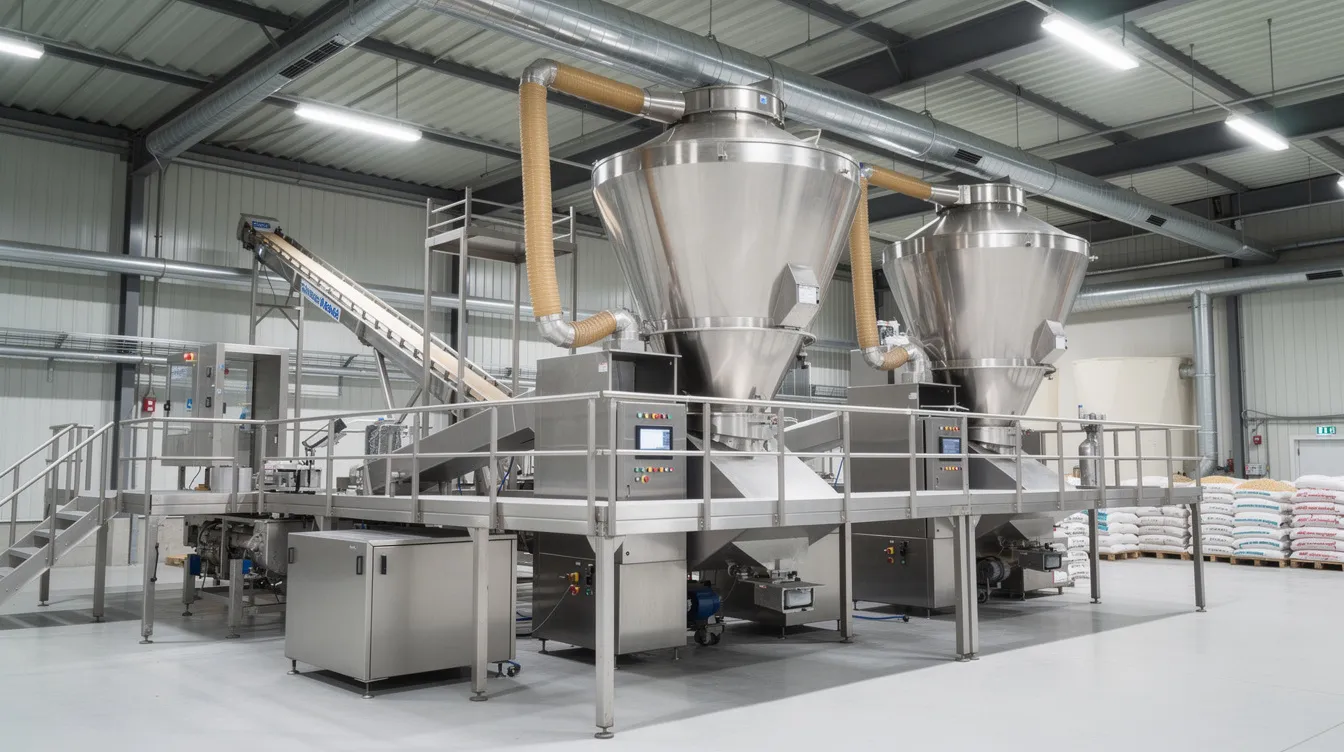
Route of processing. A plant purchasing chana dal and grinding it into chickpea flour needs only milling, sieving and packing equipment. An integrated plant buying whole bengal gram requires a dal mill for splitting, additional cleaners, dryers and storage. The integrated route raises fixed investment but can improve raw material control and by-product value. Read more about chana dal versus whole gram for besan to evaluate both options.
Installed capacity and shifts. A typical small-to-medium besan manufacturing unit processes around 100 to 200 kg per hour. A micro besan unit requires ₹8 to 18 lakh in investment. A semi-automatic besan plant requires ₹20 to 45 lakh. Large besan plants need ₹70 lakh to ₹1.5 crore. Starting a small-to-medium scale besan manufacturing plant requires ₹10 lakh to ₹20 lakh for a semi-automatic setup. The total project cost for a micro or small scale besan unit ranges from ₹7.8 lakh to ₹29.03 lakh. Scale and shift planning directly affect besan plant capacity planning.
Capacity utilisation assumptions. Year-1 utilisation for a new plant is often 40 to 60%, rising gradually to 75 to 85% over three to five years. Projections assuming 90% utilisation from the first month are not credible to lenders.
Premises model. Land and factory building costs can vary based on location and ownership approach. Owned land and constructed building get capitalised. Leased industrial sheds reduce project cost but create recurring rent. Proper planning includes considering infrastructure needs such as rental space or factory construction.
Automation and material handling. Manual, semi-automatic and fully automatic besan plants have different machinery lists and price points. PLC control panels, automatic conveyors and form-fill-seal packaging add cost but improve output capacity and consistent quality.
Product mix and packaging. Bulk besan supplied to namkeen manufacturers needs basic sack stitching. Branded retail besan gram flour in 500 g or 1 kg packs demands automatic packaging, labelling and design investment. Annual growth of branded packaged besan is 12 to 15%, making this a relevant consideration. Investing in branding and packaging is necessary for retail product lines to enhance market presence. Compare the economics of bulk supply versus branded retail besan.
Utilities and environment. Commercial power consumption for besan plants requires a heavy-duty connection of 15 to 30 HP. Dust extraction (cyclone and bag filters), aspiration systems and blowers are frequently under-budgeted. Power costs are the second-largest operational expense after raw material.
Supply chain and credit terms. Besan demand is consistent and non-seasonal throughout the year, but chana dal procurement is seasonal. Inventory holding periods, customer credit and supplier payment terms define working capital needs.
3. Besan Plant Project Cost Breakup
Banks and DPR formats use standard cost heads for the project cost breakup. This structure is the backbone of any besan plant project cost breakup and must be followed for a credible manufacturing project report.
Key machinery for besan production includes grinders, sifters and packaging equipment. Costs for essential machinery and equipment can vary from ₹4 lakh to ₹25 lakh based on scale. Operational costs for a besan plant include raw material procurement, utilities, labour and packaging. Employing contractors for civil work can impact overall project costs. A detailed besan manufacturing machinery guide covers equipment specifications.
| Cost Head | Description |
|---|---|
| Land and site development | Purchase price, registration, levelling, compound wall; excluded if leased |
| Building / leasehold improvements | Factory shed, flooring, mezzanine, RCC construction or fit-out for leased premises |
| Plant and machinery | Cleaner, de-stoner, chana dal mill (if integrated), besan mill, sieving machine, conveyors |
| Freight, installation & commissioning | Transport to site, erection, trial runs; verify if included in supplier quote |
| Electrical installations & utilities | LT panel, wiring, motors, starters, energy efficiency rated motors, DG set if needed |
| Dust collection & material handling | Bag filters, cyclones, ducting, blowers, pneumatic conveying, structural supports |
| Quality control & lab equipment | Sieve analysis, moisture testing, basic microbiological testing setup |
| Packing equipment & other fixed assets | Form-fill-seal machines, weighing scales, stitching machine, office furniture, CCTV |
| Preliminary expenses | Company formation, GST, FSSAI, Udyam registration, architect fees, project report fees |
| Pre-operative expenses | Salaries during construction, travel, trial production losses |
| Interest during construction | Applicable when term loan drawdown precedes commercial operations |
| Contingency | 5 to 10% of hard costs for price escalation and unforeseen requirements |
| Margin money for working capital | Only the promoter-funded portion of initial working capital; not the total requirement |
Regarding besan plant power requirement, dust collection and utilities, these items are frequently omitted or under-estimated. On GST: input tax credit eligibility applies to machinery and raw materials for registered purchasers, but civil works may have different treatment. Avoid double counting GST as both a cost and a credit; verify current provisions before finalising figures.
4. Illustrative Besan Manufacturing Project Cost Statement (₹ Lakh)
Illustrative planning assumptions only; these are not supplier quotations or a bank sanction estimate.
- Plant type: stand-alone besan mill using purchased chana dal (no integrated dal mill)
- Capacity: approximately 1,000 kg/day (1 tonne/day), single shift of 8 hours, 300 working days per year
- Premises: leased industrial shed with leasehold improvements; no land purchase
- Product mix: mainly B2B wholesale packs (25 to 50 kg), with provision for consumer packs later
- Location: Tier-2 city in India; figures rounded for illustration
| Cost Head | ₹ Lakh |
|---|---|
| Land and site development | Nil (leased) |
| Building / leasehold improvements | 18.00 |
| Plant and machinery (besan mill plant, cleaner, de-stoner, sieving, conveyors) | 38.00 |
| Freight, installation & commissioning | 4.00 |
| Electrical installations & utilities | 7.00 |
| Dust collection & material handling | 3.50 |
| Quality control & lab equipment | 0.80 |
| Packing machinery & other fixed assets | 3.20 |
| Preliminary & pre-operative expenses | 2.50 |
| Interest during construction | 1.00 |
| Contingency (approx. 7.5% of hard costs) | 5.00 |
| Margin money for working capital | 6.00 |
| Total Besan Manufacturing Project Cost | 89.00 |
All line items above add up to ₹89.00 lakh. Plant and machinery does not overlap with packing machinery or other fixed assets.
Prices for new machinery and setup components should be sought from suppliers for accurate budgeting. Your own besan plant project cost breakup must be based on current quotations, site-specific civil estimates and a realistic implementation schedule, preferably documented through a customised DPR. Exact figures will differ based on specifications, location and vendor terms.
5. What Is a Means of Finance Statement for a Besan Plant?
The besan plant means of finance statement shows how the identified project cost will be funded. Total means of finance must equal total project cost, with no shortfall or unexplained gap.
Promoter’s capital. Own funds introduced into the business: savings, fixed deposit encashment, sale of assets, or capital already blocked in premises. This is the primary risk cushion for lenders.
Partners’ or shareholders’ capital. In partnerships, LLPs or companies, this includes all partners’ or shareholders’ contributions. Share premium is shown separately where relevant.
Term loan from bank. The main source for financing plant, machinery, civil works and other fixed assets. Tenure, moratorium and interest are tested through DSCR in detailed projections.
Unsecured loans from promoters or relatives. Treatment as quasi-equity is lender-specific. Banks may cap the extent and insist on subordination or longer tenure. This cannot be assumed.
Other sources. Internal accruals from an existing business, capital subsidy (only after sanction, not as guaranteed cash), or investor equity. Small manufacturing plants can benefit from government schemes to ease initial investment burdens, but subsidy timing often requires bridge funding. Mudra loans up to ₹20 lakh require no collateral; however, these are typically relevant for micro-scale units.
In formal CMA Data and DPRs, the term loan is separated from working capital limits (cash credit, overdraft). Only the margin money portion of working capital appears in the project cost.
6. Illustrative Means of Finance for the Same Besan Project
Using the same total project cost of ₹89.00 lakh from the earlier example:
| Source of Funds | ₹ Lakh |
|---|---|
| Promoter’s capital | 32.00 |
| Term loan from bank | 57.00 |
| Total Means of Finance | 89.00 |
The assumed funding mix above is illustrative. Promoter contribution here is approximately 36% of project cost. This percentage is not a universal norm; the ratio acceptable to a specific bank depends on appraisal, scheme requirements and risk assessment.
Banks ask for proof of promoter contribution: bank statements, fixed deposit receipts, sale deed proceeds, or capital brought forward from an existing company. A professional besan plant business plan and DPR will justify the proposed means of finance with realistic cash flow projections, demonstrating comfortable DSCR and repayment capacity.
7. Working Capital Requirement vs Working Capital Margin
Working capital and margin money for working capital are not the same thing.
Total working capital requirement covers raw materials (chana dal), packing materials, power and fuel, wages, finished goods inventory, receivables from customers, minus credit available from suppliers and a minimum cash balance. For a besan unit, raw materials account for 65 to 75% of recurring costs. Monthly raw material costs for besan production typically range from ₹7.5 lakh to ₹9 lakh for a small-to-medium unit. Monthly utility expenses can reach ₹20,000 to ₹45,000. Packaging materials are a recurring expense, costing ₹30,000 to ₹70,000 monthly, or approximately ₹0.8 to ₹1.5 per kg. Chana dal alone costs 65 to 75% of total production cost.
Working capital margin is the promoter-funded portion. Bank-funded portion comes through cash credit, working capital demand loan or overdraft. Initial working capital allowances should account for routine expenses and credit extended to distributors. Businesses should maintain working capital for 2 to 3 months of operating expenses before launching.
Small numerical example (consistent with the ₹89 lakh project):
| Component | ₹ Lakh |
|---|---|
| Total working capital requirement | 24.00 |
| Promoter’s margin money (25%) | 6.00 |
| Bank-funded cash credit limit (75%) | 18.00 |
Only the ₹6.00 lakh margin money appears in the project cost. The ₹18.00 lakh cash credit is a separate bank exposure, reflected in current liabilities on the projected balance sheet.
In CMA Data, the term loan sits with fixed assets and long-term sources. The working capital limit appears as a short-term borrowing. CMA data must be in the RBI-prescribed format for loans above ₹10 lakh. Detailed guidance on raw material stocking for chana dal procurement and inventory planning for besan is covered separately.
8. How Banks Assess a Besan Manufacturing Finance Proposal
A bank’s appraisal goes beyond reading a besan plant project report. It examines the promoter, the technical setup, the financial viability and the risk profile of the proposed manufacturing project.
Promoter experience and financial position. Prior exposure to food processing, a dal mill or flour mill operation, personal net worth, existing liabilities and credit history all affect the appraisal. A DPR includes a business and promoter profile for this reason.
Technical feasibility. Appropriateness of plant capacity, plant layout and the machinery list for the proposed gram flour market. A manufacturing process description is essential in a DPR. Banks verify whether the proposed output capacity matches market insights and realistic demand.
Raw material sourcing. Availability of chana dal or whole gram, procurement plan, diversification of vendors and linkage to besan manufacturing recovery, yield and process losses are all examined.
Capacity utilisation and sales ramp-up. Lenders distrust projections showing 80 to 90% utilisation in the first year. A gradual step-up (say 50% in Year 1, rising to 80% by Year 4) backed by market analysis is more credible.
Implementation schedule. Delays in land acquisition, building readiness, power connection or machinery delivery increase interest during construction and erode viability.
Profitability and cash accrual. Gross margin on besan, fixed overheads, interest coverage and net cash accrual available for term loan instalments are core appraisal items. A DPR should include 5-year financial projections covering projected P&L, balance sheet and cash flow.
DSCR, break-even and sensitivity. Banks require DSCR of 1.25 or above for manufacturing loan approval. Break-even utilisation in sample DPRs often falls around 31 to 32%. Lenders expect comfortable DSCR and repayment capacity across the projection period.
Security and guarantees. Primary security (machinery, building, stock, receivables), collateral if required, and personal guarantees form the security package. No universal collateral-free eligibility can be assumed.
A well-prepared DPR and CMA Data in correct banking format reduces queries and processing time, though final sanction decisions rest with the lender.
9. Common Mistakes in Besan Manufacturing Project Cost & Financing
As a practising Chartered Accountant, I frequently observe recurring errors in besan plant DPRs and bank proposals. These mistakes cause delays, rejections, or worse, funding gaps during implementation.
- Treating only plant and machinery as the project cost, ignoring building, utilities, dust extraction and working capital margin.
- Under-budgeting installation, electricals and conveyors, then facing cost overruns during commissioning. Many supplier quotations are ex-works; freight and erection can add 10 to 20%.
- Assuming unrealistic capacity utilisation (90% from Month 1), inflating revenue and producing a misleading DSCR.
- Double-counting working capital by including both total working capital requirement and margin money in the project cost.
- Treating expected subsidy as received cash and reducing promoter contribution accordingly, ignoring the time lag between sanction and disbursal.
- Proposing term loan repayments exceeding projected cash accrual, resulting in a DSCR below 1.25 and immediate rejection.
- Misaligning figures across the DPR, CMA Data and loan application, creating inconsistency during bank appraisal.
- Using generic per-tonne investment benchmarks from the internet without validating against current supplier quotations and local construction costs.
- Overlooking compliance costs such as FSSAI registration, GST registration, testing, labelling and statutory registrations.
- Ignoring cost overruns and delayed commissioning, which increase IDC and can create a funding gap if contingency is insufficient.
Engaging professional support at the planning stage is less expensive than rectifying a weak structure after loan rejection.
10. Sensitivity Analysis & Funding Gap Identification
Besan manufacturing margins depend on raw material cost, yield, selling price and capacity utilisation. Without sensitivity analysis, a project overview may look viable under one set of assumptions but collapse under minor changes.
Typical scenarios to test:
- Chana dal price increase of 10 to 15% while besan selling price remains stable; this compresses gross margin and reduces DSCR. A general cash reserve is crucial for covering future price fluctuations in raw materials and repairs.
- Lower-than-expected recovery or yield. Besan production yield depends on raw material quality and processing methods. A 2 to 3% drop in fine besan recovery shifts economics.
- Slower sales ramp-up reducing utilisation below projections, increasing per-unit fixed cost.
- Longer customer credit periods increasing receivables and total working capital requirement, requiring either higher cash credit limits or additional margin money.
- Capital cost overrun on building or machinery due to price escalation or design changes, requiring additional fixed investment.
Distinguish between additional fixed investment (extra machinery, building modifications) and additional working capital (more stock and receivables). For instance, a 10% rise in raw material prices could reduce gross margin by 3 to 5 percentage points and push DSCR below the 1.25 threshold unless the promoter maintains a liquidity buffer. Robust financial modelling covering downside scenarios is a central part of a bankable besan plant business plan and DPR.
11. Documents Commonly Required for a Bank Loan for Besan Manufacturing Plant
Exact documentation varies by lender and scheme, but a well-prepared file covers the following categories:
- Promoter KYC and background: PAN, Aadhaar, photographs, residence proof, profile of experience in food processing or related business.
- Entity formation documents: Partnership Deed / LLP Agreement / MOA & AOA, Certificate of Incorporation, GST registration, Udyam registration. FSSAI licence is mandatory for any food manufacturing unit in India.
- Land and building papers: Sale deed, lease deed, allotment letter, building plan approvals, completion certificates as applicable.
- Machinery quotations: Itemised quotations for besan plant, gram flour mill, cleaners, de-stoners, packing machines, electricals and dust collection systems, ideally from multiple vendors.
- Cost estimates and civil drawings: Building estimates from contractor, plant layout, utility drawings.
- Financial information: Last 2 to 3 years’ financial statements and bank statements for existing businesses; personal income tax returns for promoters.
- Project-specific documentation: DPR with besan plant project cost breakup and means of finance, CMA Data in RBI-prescribed format, projected financial statements (P&L, balance sheet, cash flow), DSCR statement and working capital assessment. Loans above ₹10 lakh require CMA data in this format.
- Approvals and registrations: Pollution control consent where applicable, local municipal or industrial approvals, electricity connection application.
Banks require scheme-specific annexures in the DPR. Banks also accept project reports formatted for specific loan schemes. Additional documents may be requested during appraisal; a professionally compiled DPR and CMA Data set reduces back-and-forth.

12. How Project Report Bank & CA Manish Gugliya Can Assist
Project Report Bank is a Chartered Accountant-led advisory platform operated by CA Manish Gugliya, FCA, DISA (ICAI), practising since 2006 from Ratlam, Madhya Pradesh, serving clients across India online.
Professional support available for besan manufacturing and related food processing projects:
- Prepare customised Detailed Project Reports (DPR) for besan plant, integrated gram processing and besan plant and gram flour units, tailored to capacity, processing route and market positioning.
- Prepare CMA Data and bank-format financial projections including project cost, means of finance, profitability, cash flow, DSCR, break-even, ROI and sensitivity analysis.
- Assist with realistic estimation of besan plant project cost breakup, including land or building, machinery, utilities, pre-operative expenses, contingency and working capital margin.
- Support working capital assessment and structuring of term loan and cash credit limits aligned with operational needs and bank norms.
- Assist with preparation of bank loan proposals, annexures and supporting schedules, aligning figures across DPR, CMA Data and application forms.
- Provide advisory inputs on expansion, diversification or integrated dal mill plus besan mill configurations.
Project Report Bank prepares projections and documentation with professional care. It does not certify future results or guarantee bank loan approval; final decisions rest with lenders and investors.
If you wish to discuss your own besan manufacturing project cost and funding structure, reach out through the WhatsApp or contact options available on the ProjectReportBank.com website.
13. Frequently Asked Questions
What exactly is included in besan manufacturing project cost for a typical MSME unit?
Beyond the gram flour machinery, the cost includes civil works or leasehold improvements, electrical systems, dust extraction and material handling, quality control equipment, packing equipment, preliminary and pre-operative expenses (including company formation, FSSAI, GST registration, project report preparation fees), contingency for price escalation, and margin money for working capital. For a micro or small unit, the total project cost typically ranges from ₹7.8 lakh to ₹29.03 lakh depending on capacity and automation.
How much promoter contribution do banks generally require for a besan gram flour project?
Acceptable promoter contribution ratios vary by bank, scheme and risk profile. For MSME term loans, lenders often expect 25 to 40% of the project cost as promoter equity or capital. This is not a universal rule. The final percentage depends on the bank’s appraisal of the project, collateral, promoter net worth and the specific scheme under which the loan is applied. Unsecured loans from relatives may or may not be counted as quasi-equity; this is entirely at the lender’s discretion.
Can I count an expected government subsidy as part of my means of finance?
Subsidies should be factored carefully. PMEGP offers 15 to 35% capital subsidy for besan manufacturing, and government credit schemes like PMFME provide subsidies for micro food processing projects. However, subsidy is normally shown separately and counted firmly only after sanction. The promoter and bank must bridge the gap until actual receipt. Reducing promoter capital solely on the strength of expected subsidy creates a funding risk that lenders will flag. Verify current scheme status, as scheme validity and terms change periodically.
How does an integrated gram processing (dal + besan) plant affect investment?
An integrated plant that starts from whole bengal gram requires a dal mill, additional cleaners, dryers and storage infrastructure. This increases fixed investment substantially; for instance, a 10 TPD integrated unit may need machinery costing around ₹70 lakh compared to ₹38 to 40 lakh for a stand-alone besan mill of similar flour production capacity. The benefit is better control over raw material quality, potential by-product revenue and higher recovery of high quality besan. Project Report Bank can prepare a customised project report evaluating both configurations.
Which financial statements are most important for a bank-ready besan plant DPR?
The projected Profit & Loss account, balance sheet and cash flow statement for 5 years are essential. The term loan repayment schedule and DSCR calculation demonstrate whether the project generates enough cash accrual to service debt. Working capital assessment shows the operating cycle and required bank limits. Properly structured CMA Data combining these elements into the RBI-prescribed format greatly improves the clarity and credibility of a besan manufacturing project financing proposal. Banks review these statements as an interconnected set; inconsistency between any two documents raises questions during appraisal.