
Key Takeaways
- The besan manufacturing process follows a defined sequence – raw material receipt, cleaning, grinding, sieving and packing – where each stage directly affects product quality, recovery and operating cost.
- Consistent texture and colour of gram flour depend on raw material quality, controlled size reduction using hammer mills or pulverisers, proper sieving to the required fineness, and moisture-protective packing.
- Process choices such as the chana dal route versus the whole gram route, level of automation and besan grinding plant design materially affect project cost, yield, working capital and profitability.
- Entrepreneurs should align plant capacity, machinery selection and quality control with their target market – whether bulk supply to restaurants and hotels or branded retail besan – to maintain commercial viability.
- Project Report Bank, led by CA Manish Gugliya, helps promoters translate this manufacturing process into realistic DPRs, CMA data, financial projections and bankable project reports.
Introduction: Why the Besan Manufacturing Process Matters
Besan is made from chana dal, a split chickpea, and is commonly used in various food products in India – from pakoras and namkeens to sweets, bakery mixes and restaurant batters. Markets now expect uniform fineness, clean colour, no foreign matter and reliable hygiene. Meeting these expectations consistently is a manufacturing problem, not merely a procurement one.
A commercial besan plant follows an integrated flow: chana dal or whole gram receipt, cleaning and grading, size reduction through grinding, classification through sieving, and protective packing. Each stage affects not only the quality of the final product but also the recovery, energy consumption and cost per kilogram of finished gram flour. Process losses at any point reduce yield and directly erode profitability.
This article explains the practical besan manufacturing process from a project-feasibility and finance perspective. It is relevant to MSME units operating at common plant sizes in India – for example 500 kg/hr, 1 TPH and 2 TPH besan grinding plants – as well as larger facilities. Industrial besan plants can process up to 3,000 kg/hr, but the underlying process logic remains the same across scales.
Raw Material Selection: Chana Dal vs Whole Gram Route
Commercial besan can be manufactured either from purchased chana dal or from whole gram (Bengal gram, also referred to as chickpeas) that is first dehusked and split within the same facility. Dehusking separates the outer skin from chickpeas during the besan production process, which is necessary before the dal can be ground into flour.
The chana dal route involves a simpler line with fewer stages before grinding, lower initial investment and faster commissioning. However, it creates dependence on external dal millers for quality and pricing. For a detailed comparison, refer to chana dal vs whole gram for besan: cost and viability.
The whole gram route requires additional equipment for cleaning, conditioning, dehusking, splitting and grading. Capital expenditure is higher, but the promoter gains control over raw material cost and can sell dal and by-products (husk, brokens, chuni) as separate revenue streams. An integrated gram processing and besan plant project report covers this route in detail.
Yields must be calculated differently for each route. Dal recovery from whole gram is typically 78–82%, while besan recovery from clean chana dal is approximately 98% under good operating conditions. These figures should never be mixed into a single recovery assumption.
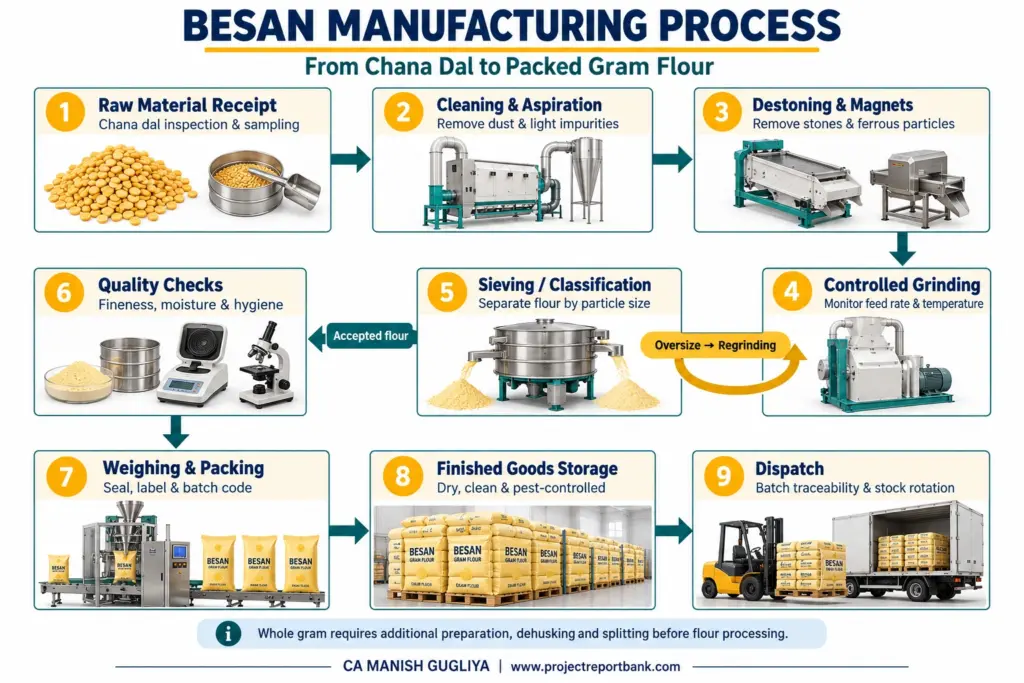
Besan Manufacturing Process Flow Chart (Text Overview)
Chana Dal Route:
Raw Material Receipt → Inspection & Sampling → Cleaning & Aspiration → Grading → Destoning → Magnetic Separation → Intermediate Storage / Feeding → Grinding (Pulveriser / Hammer Mill) → Sieving & Classification → Oversize Regrinding → Quality Checks → Weighing & Packing → Finished Goods Storage & Dispatch
Whole Gram Route (additional upstream stages):
Whole Gram Receipt → Pre-Cleaning → Conditioning / Tempering → Dehusking → Splitting → Husk & Brokens Removal → Grading → then into the common grinding–sieving–packing sequence above
Actual plant layout and sequence may vary based on capacity, automation level and specific plant supplier design, but the basic logic remains consistent. In modern besan grinding plants, pneumatic conveying, dust collection and aspiration are integrated even if not always shown on simplified charts. A proper flow chart is essential input for DPR preparation, utility estimation, manpower planning and machine selection.
Raw Material Receipt, Inspection and Storage
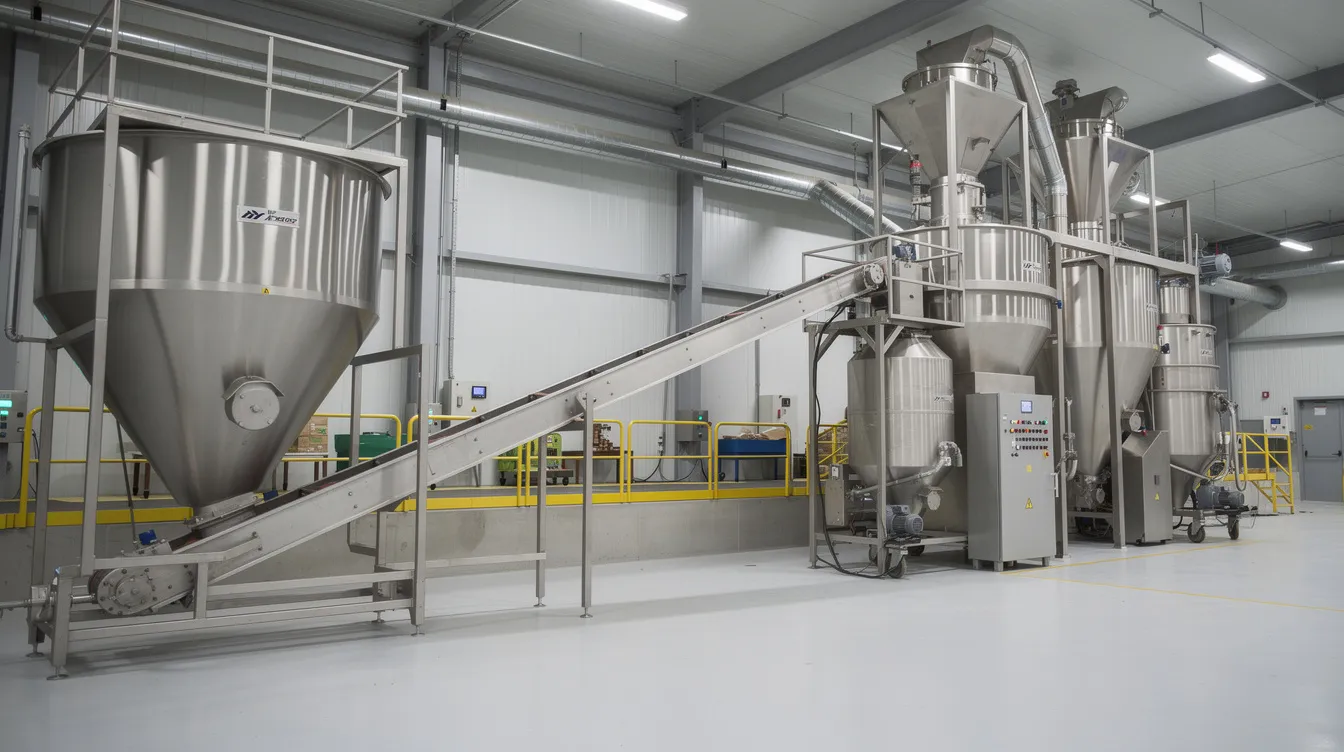
Gram flour quality starts at the receiving dock. Incoming chana dal or whole gram must be checked for moisture level, insect infestation, mould, colour, odour and foreign matter such as stones, dust or metal pieces. Moisture content of chana dal should be between 12 and 14 percent – this range facilitates efficient milling without screen clogging or microbial risk.
Practical steps include sampling each lot, maintaining batch numbers, recording supplier details and using simple moisture meters for on-site checks. Chana dal must be cleaned and conditioned before milling to ensure uniform behaviour in the grinder.
Storage conditions matter equally. Pucca godowns with raised pallets, adequate ventilation, protection from rain and systematic pest control prevent quality deterioration before processing. From a financial perspective, raw material forms 60–75% of total manufacturing cost in many besan projects, so even a 1–2% change in wastage or rejection substantially affects profitability. Traceability and batch identification also support FSSAI compliance and help handle any customer complaints.
Cleaning, Grading and Destoning Before Grinding
Pre-cleaning removes impurities from raw chickpeas or chana dal before milling. This stage uses aspirators and pre-cleaners to extract light impurities – dust, husk fragments and chaff – improving hygiene and reducing the dust load on downstream machines.
- Grading uses rotary or vibrating screens to separate by size. Undersized and broken grains are segregated, which helps achieve more uniform grinding and a more consistent besan texture.
- Destoning removes heavier impurities like stones and dense particles using specific gravity differences. This protects hammer mills and pulverisers from damage and prevents contamination in the finished flour.
- Magnetic separators remove ferrous metal pieces such as bolts or nails from the material stream. However, magnets cannot remove all blade fragments or non-ferrous metals and do not replace good housekeeping or broader contamination controls.
Modern besan grinding plants commonly combine cleaning, aspiration and destoning in compact units to save floor space. This part of the line is critical for both product safety and machine life. For equipment specifications, refer to besan manufacturing machinery.
Grinding and Pulverisation: Size Reduction of Chana Dal
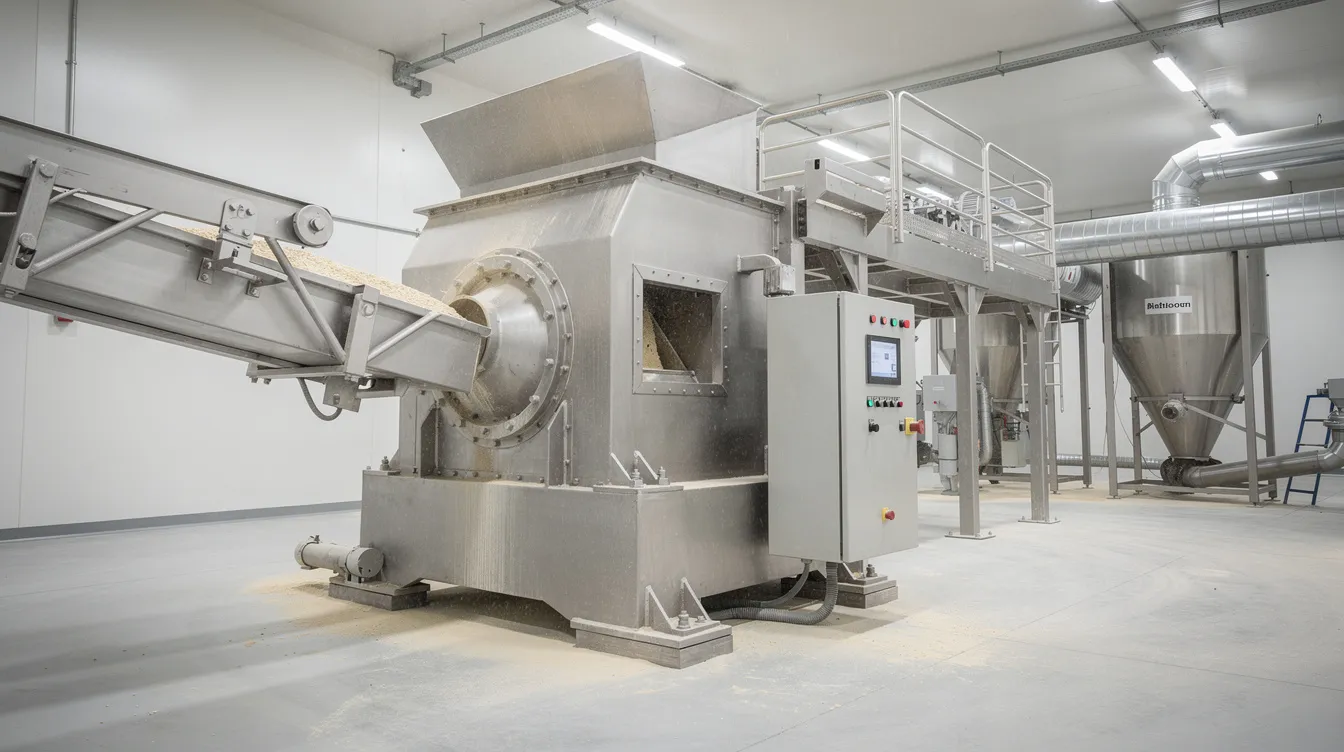
Size reduction is the core step in besan manufacturing, transforming cleaned chana dal into fine flour. Grinding is performed using heavy-duty impact pulverisers or mills designed for pulse processing.
- Hammer mills are commonly used for industrial besan production and dominate the sector due to their throughput and adjustable fineness. Burr mills are used for small-scale besan production in village or household settings but are not suitable for commercial volumes.
- Key operating parameters include controlled feed rate into the hopper, rotor speed, screen opening size and residence time in the grinding chamber. These factors together determine fineness, throughput and power consumption.
- Excessive heat during grinding can affect besan colour, taste and natural fat stability. Managing temperature rise requires proper cooling intervals, air classifying mills for premium lines or staged grinding in larger plants.
- Dust collectors minimise losses during besan milling and improve both hygiene and workplace safety. Closed conveying between the grinder and downstream equipment reduces waste and contamination risk.
A mid-scale plant of 500 kg/hr capacity typically requires approximately 22 kW (30 HP) for the main mill plus auxiliaries. Larger facilities at 2 TPH may need 150 KVA or more of connected power supply. The choice of equipment should match the energy budget and target fineness without unsupported claims about any single grinder type being universally superior.
Sieving, Classification and Ensuring Consistent Texture
The production process includes sifting to ensure a consistent texture in the flour. Sieving separates fine besan from coarser particles after grinding, and this classification step directly determines whether the product meets customer or brand specifications.
- Reel sieves are used for sieving ground besan in many plants. Vibrating screens and air classifiers serve more advanced lines. Mesh sizes are chosen based on end use requirements – slightly coarser flour suits pakora mixes, while finer grades serve sweet and bakery applications.
- Fineness of besan depends on screen mesh size used. Typical ranges span 80 mesh (coarse) to 200 mesh or above for fine besan or superfine grades.
- Oversize material from the sieve outlet is sent back to the pulveriser for regrinding. This re-circulated material is not a final product loss but forms part of the same batch.
- Modern systems ensure 99 percent material passing during milling when sieving efficiency is well maintained, maximising recovery and consistency.
- For premium branded besan, manufacturers may maintain separate bins for different grades and blend to achieve a specified particle size distribution.
Quality Checks, Process Controls and Food Safety
Quality control measures are implemented to check moisture, particle size and foreign matter at both input and output stages. Key parameters include:
- Moisture content must be between 12 and 14 percent for both incoming dal and finished flour. Moisture control is essential to prevent microbial growth, clumping and shelf-life problems.
- Particle size distribution verified through sieve tests under good light, alongside visual inspection for burnt specks or discolouration.
- Odour assessment for rancidity, and periodic third-party lab tests for microbiological and chemical parameters.
FSSAI hygiene standards are mandatory for commercial besan production. Under FSSAI regulations, besan must meet limits including total ash not more than 5.0% and acid-insoluble ash not more than 0.5%.
Grinding is a physical size-reduction step, not a validated microbial kill step. Good hygiene, pest control and low-moisture storage help manage microbial risk. Large buyers such as national snack brands or organised retailers may specify requirements stricter than statutory minimums, so project assumptions in a DPR should account for additional testing and compliance cost.
Weighing, Packing and Labelling of Gram Flour
Packaging of besan ensures protection from moisture and contaminants to extend shelf life. Two main packing modes exist:
- Bulk packing: 25–50 kg HDPE or PP bags for B2B supply to namkeen manufacturers, restaurants and institutional buyers.
- Retail packing: 500 g, 1 kg and 5 kg laminated pouches for consumer markets, requiring multi-layer moisture-barrier films.
Weighing systems range from semi-automatic weigh filler machines for MSME setups to fully automatic auger filler or form-fill-seal machines for higher volumes. Accurate weights are essential to avoid legal metrology issues and hidden product giveaway.
The besan packing process follows a sequence: feeding hopper, auger or gravity filling, weight checking, sealing, batch coding (date, batch number, MRP where applicable) and secondary packing in cartons or outer bags. The strategic choice between bulk supply and branded retail packaging significantly affects investment and margins – see bulk supply vs branded retail besan for a detailed comparison.
Finished Goods Storage and Dispatch
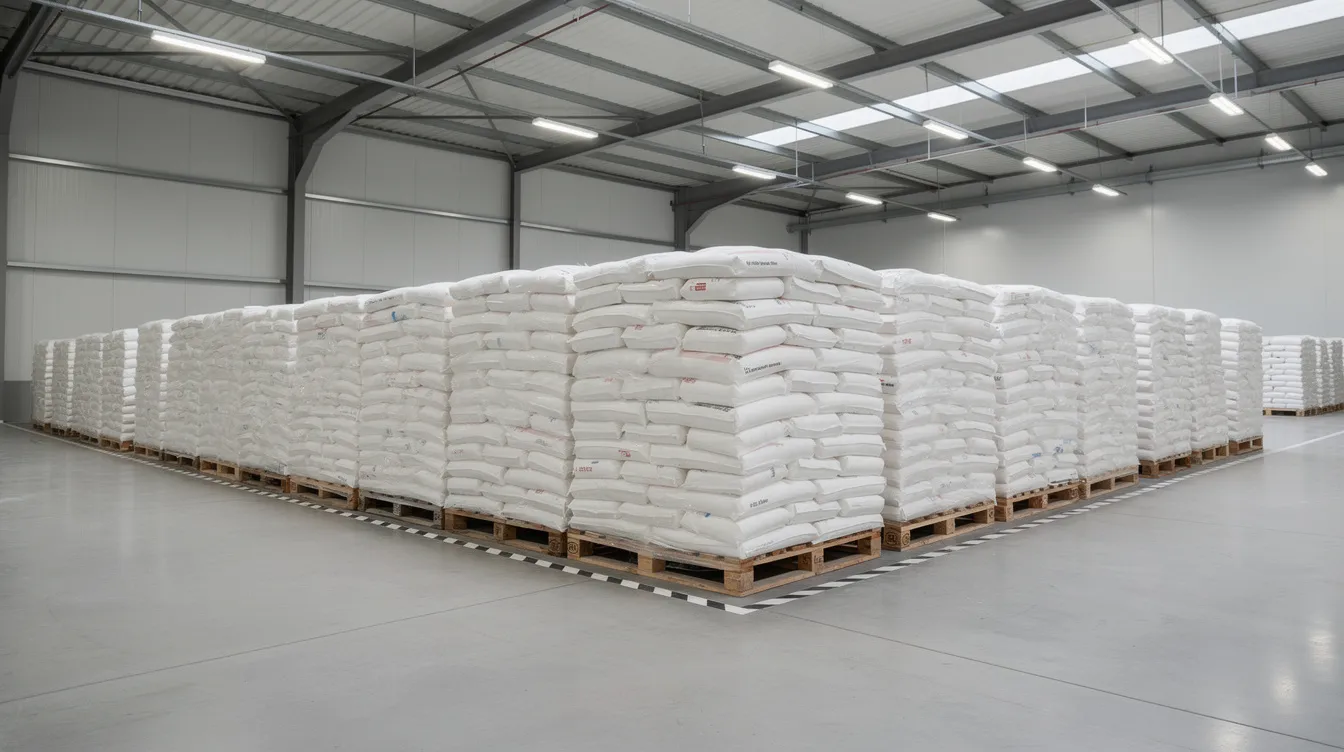
Packed besan should be stored in a cool, dry, well-ventilated warehouse on pallets away from walls, with aisles for inspection and rodent control. FIFO or FEFO stock rotation is important, especially where multiple SKUs and packing dates exist.
Shelf life depends on oil content of the dal batch, grinding temperature, moisture level at packing, packaging material and store-room climate. No fixed universal shelf life should be assumed without validation. Batch-wise dispatch registers, outward gate passes and transport documents help reconcile production, stock and sales figures – data that feeds directly into financial analysis and CMA preparation.
Machinery Required at Each Stage of a Besan Plant
| Processing Stage | Typical Equipment | Main Purpose | Key Selection Consideration |
|---|---|---|---|
| Pre-cleaning | Aspirator, pre-cleaner | Remove dust, light husk, chaff | Capacity matching with grinding line |
| Grading | Vibrating / rotary screen | Separate by size for uniform feed | Screen aperture sizes; easy cleaning access |
| Destoning | Destoner (gravity separator) | Remove stones, dense impurities | Throughput; adjustable deck angle |
| Metal removal | Magnetic separators | Remove ferrous metal | Magnet strength; placement in flow |
| Grinding | Hammer mill / impact pulveriser | Size reduction to flour | Motor power, speed, screen mesh, chamber design |
| Sieving | Reel sieve, vibrating screen | Classify fine vs oversize | Mesh size; screening efficiency |
| Conveying | Bucket elevator, pneumatic conveyor | Material transfer between stages | Capacity; hygiene; dust containment |
| Dust collection | Cyclone separator, bag filter | Minimise product loss, improve air quality | Airflow rating; filter maintenance |
| Weighing & packing | Auger filler, FFS machine, band sealer | Accurate fill, seal and code | Speed; accuracy; pack-size flexibility |
| QC equipment | Moisture meter, lab sieves | Verify moisture, fineness, quality | Calibration; measurement range |
Rated capacity of each machine must be considered together. The effective plant capacity is governed by the slowest stage (bottleneck), not merely the hammer mill rating. For deeper specifications and cost benchmarks, refer to specialty flour plant machinery and equipment cost.
Recovery, Process Losses and Illustrative Mass Balance
The recovery rate of besan is a key efficiency metric. Loss components must be distinguished:
- Cleaning rejects: Stones, dust, foreign matter – typically 1–3% depending on input quality.
- Grinding and handling losses: Fines lost through poor dust collection, burnt particles, spillage – typically 1–2% in well-run plants.
- Moisture changes: Minor loss or gain during grinding and storage.
- Oversize returned for regrinding is circulating load, not net loss, although it consumes extra power and affects throughput.
Illustrative example (chana dal route, for understanding only): Starting from 1,000 kg of clean chana dal, cleaning rejects may account for approximately 10–15 kg, grinding and handling losses approximately 10–15 kg, yielding roughly 970–980 kg of packed besan. Actual recovery depends on raw material quality, plant design and operating discipline and should be verified during DPR preparation.
Even a 1–2% improvement in overall recovery can significantly increase annual profit. Careful tuning of cleaning, grinding and sieving stages is therefore financially worthwhile.
Manufacturing Cost Drivers and Viability Considerations
In a typical besan plant, raw material cost, power, labour and packaging are the main components of cost per kilogram, with raw material usually dominating at 60–75%.
- Chana dal price: Subject to seasonal swings of 15–25%; procurement timing and supplier agreements affect working capital.
- Yield: Kg of besan per kg of input – the single most impactful variable on profitability.
- Power consumption: Finer grinding and repeated regrinding cycles increase energy cost and wear on hammers and screens.
- Packaging material: Retail laminated pouches cost significantly more per kg than bulk PP bags.
- Working capital: Credit periods taken from suppliers, credit extended to buyers and inventory levels of dal, finished besan and packaging materials must be carefully assessed. This data feeds directly into CMA preparation and bank working-capital assessment.
For an overall investment picture including land, building and machinery, refer to besan manufacturing plant setup cost in India.
Common Processing Mistakes and How to Avoid Them
- Inadequate cleaning leading to stone or metal ingress, damaging equipment and contaminating besan.
- Uneven feed to the grinder causing variable fineness across the batch.
- Running hammer mills at unsuitable speeds or ignoring sieve damage, resulting in excessive heat, colour darkening and off-taste.
- Poor dust control causing product loss, an unsafe working environment and contamination settling into open product streams.
- Packing errors: Using non-laminated bags in humid regions, weak heat sealing, inaccurate weighing or missing batch codes – all leading to complaints and regulatory non-compliance.
Preventive steps include scheduled maintenance, sieve inspection routines, operator training and simple checklists for start-up and shutdown. During DPR and feasibility preparation, promoters should avoid overestimating practical plant utilisation – assuming 24 hours × 365 days is unrealistic. Realistic planning typically uses 300–330 working days at 85–90% capacity utilisation.
Project Planning Perspective by CA Manish Gugliya
In our practice at Project Report Bank, we find that the besan manufacturing process – when understood properly – translates directly into more defensible financial projections. A bankable DPR for a besan plant should reflect the chosen raw material route, targeted capacity based on demand assessment, product mix (bulk vs branded) and selected automation level.
We analyse raw material availability, expected recovery, realistic capacity utilisation, energy consumption and manpower to build integrated projections of profit, cash flow and DSCR. Sensitivity analysis is particularly important: chana dal price fluctuations of even 10–15% can materially affect repayment capacity and viability.
Entrepreneurs considering diversification into additional pulse flours alongside besan may benefit from evaluating a multiproduct pulse flour plant project report. For a comprehensive besan-specific DPR, our besan mill project report covers project cost, means of finance, working capital, profitability and DSCR in detail.
Frequently Asked Questions (FAQ)
The following questions address practical concerns that typically arise after understanding the besan manufacturing process, focusing on areas not fully covered in the sections above.
What is the minimum practical capacity for a commercial besan plant?
Most commercially viable besan plants in India start at 200–300 kg/hr and above. Very small units can operate but face higher per-kg overheads and limited ability to serve institutional buyers. A 1 TPH or larger setup generally provides better economies of scale. During DPR preparation, capacity should be matched against local demand, competition and financial viability rather than chosen only based on what a vendor offers.
Are there any government schemes that support besan manufacturing units?
Several government schemes and subsidies support agro-processing and MSME units in India, including PM FME, PMEGP and various state-level food-processing incentives. These may cover plant and machinery cost, modernisation or working capital margin support, subject to eligibility and current guidelines. Project Report Bank can structure DPRs in formats acceptable to banks and implementing agencies, though final sanction depends on scheme rules and lender appraisal.
Can a besan plant be combined with other pulse flours in the same facility?
Many entrepreneurs consider a multiproduct pulse flour plant – producing besan alongside moong dal flour or urad flour – using shared grinding and sieving equipment with separate cleaning and storage arrangements. Hygiene and cross-contamination management become more important in such setups. This decision should be evaluated through a dedicated feasibility study considering market demand, operational complexity and the nutritional value proposition of each product line.
How long does it usually take to commission a new besan grinding plant?
A realistic timeline covers DPR preparation and loan processing (4–8 weeks), machinery ordering and fabrication (8–16 weeks), civil construction, installation, trial runs and stabilisation. Planning permissions, power connection, FSSAI food licence and pollution-control clearances should be factored in. A well-prepared implementation plan within the DPR helps avoid delays and cost overruns. Total duration from project planning to commercial production commonly ranges from 6 to 12 months depending on scale and approvals.
How can Project Report Bank support my besan manufacturing project?
- Project Report Bank, led by CA Manish Gugliya, provides customised DPRs, CMA data, financial projections, sensitivity analysis and bank-loan documentation for besan plants across different capacities and raw material routes.
- Support covers project cost estimation, means of finance planning, working capital assessment and DSCR analysis tailored to the chosen manufacturing process and marketing model.
- To discuss your proposed gram flour or integrated besan plant project, connect with us through the website’s WhatsApp enquiry option for a professional consultation.