Key Takeaways
- Specialty flour plant machinery cost in India depends on product type (multigrain, fortified, high-fibre, organic), capacity (5-20 TPD) and whether the unit is blending-only or integrated milling plus blending.
- A blending and packaging unit needs ribbon blenders, vibro sifters, micro-dosing and packing machines; an integrated flour mill additionally requires grain cleaning, destoning, roller mills or hammer mills and dust collection systems.
- Indicative machinery budgets: approximately ₹35-55 lakh for a 5 TPD semi-automatic blending unit, ₹60-90 lakh for a 10 TPD plant and ₹1.3-1.8 crore for a 20 TPD integrated milling and blending unit (machinery only, ex-GST, 2025-26 conditions).
- Machinery cost is one part of total project cost; initial project costs should account for machinery, construction, and utilities along with proper process design, plant layout, working capital and bank finance planning.
- Promoters must match the right flour mill equipment, automation level and process design with realistic customer demand, grain type and quality standards rather than chasing the lowest equipment price.
Introduction
Value-added wheat flour products have grown rapidly in India since around 2015. Multigrain atta, fortified wheat flour, high-fibre atta, organic atta and customised bread flour blends for institutional bakeries now occupy dedicated shelf space in organised retail and generate steady B2B demand.
Machinery for processing specialty flour in India varies widely in cost. A typical MSME project of 5-20 TPD may need approximately ₹35 lakh to ₹1.8 crore on machinery alone, depending on configuration and automation level. Small flour mill investments range from $10,000 to $100,000, while large flour processing plants require $300,000 to $2,000,000 or more. Investment in machinery for specialty flour varies by plant scale, and these figures are indicative; actual pricing requires current supplier quotations.
Equipment selection depends on product mix, grain type (wheat, millets, maize, pulses, oats), desired particle size, packaging sizes, food safety certifications and target market. Different grains require unique processing configurations for effective milling. A blending-only unit purchasing ready-milled flour needs substantially different machinery from an integrated unit processing whole grains. This article focuses on machinery and equipment; for overall project CAPEX including land, building and working capital, refer to the detailed guide on specialty flour plant setup cost in India.
Project Report Bank, under CA Manish Gugliya (FCA, DISA, 20+ years of extensive experience), provides customised DPR and project finance advisory for specialty flour and grain processing projects across India.
Types of Specialty Flour Manufacturing Plants
The same “specialty flour” label can correspond to very different plant configurations, capital intensity and machinery lists. Flour mills can be classified by processing scale and automation. Flour milling and post processing (blending, fortification, packaging) can be combined or separated depending on budget, product positioning and strategy.
Specialty Flour Blending and Packaging Unit
This configuration buys base wheat flour from existing flour mills and focuses on recipe formulation, dry mixing, sieving and packaging of multigrain atta, high-fibre atta and protein-enriched blends. Core machines include screw conveyors, stainless steel storage bins, a ribbon blender for flour, vibro sifter, optional micro-ingredient dosing and semi-automatic or automatic flour packing machine. This has lower machinery cost, a smaller scale footprint and faster implementation. Typical MSME capacities of 2-10 TPD can be scaled through shift operation without immediately buying high capacity equipment. A detailed specialty flour blending plant project report covers the full process flow and financial feasibility.
Integrated Specialty Flour Milling and Blending Plant
An integrated plant handles wheat and multigrain cleaning (pre-cleaner, destoner, magnetic separator), wheat milling via roller mill or high efficiency atta chakki, flour sifting, blending with other grain flours and final packing. Compared with blending-only, it adds grain intake systems, cleaning and conditioning equipment, main flour mill machinery and more elaborate dust extraction and pneumatic conveying. Machinery cost and connected power load rise, but margin may improve by capturing wheat-to-flour conversion value, bran by-products and animal feed sales. This configuration suits promoters wanting complete control over flour quality with higher capital budgets. For wheat flour milling fundamentals, the wheat flour mill project report provides a useful reference.
Fortified Wheat Flour Processing Unit
A fortified wheat flour plant can be flour-blending only or attached to an integrated mill. The special machinery focus is a micro-ingredient dosing system or dedicated vitamin premix dosing machine, a high precision industrial flour mixing machine and online or batch weighing controls to maintain fortification levels. FSSAI fortification standards require accurate dosing, batch records and possible in-house or third-party lab testing. Compliance with food safety standards increases machinery costs but is non-negotiable for this product. The fortified wheat flour manufacturing plant project report covers the full regulatory and financial picture.
Multigrain and High-Fibre Flour Processing Unit
Multigrain atta plants must handle multiple grains with different hardness and oil content. Separate small hammer mills or pulverizers for minor ingredients (soy, flaxseed, pulses), multiple storage bins for each grain type and a high-capacity ribbon blender are typically required. Particle size control is critical so the final atta is not gritty. Medium to high gluten flour has 10.5%-12.5% protein, while high-gluten flour contains 11.5%-13.5% protein and low-gluten flour has 7.5%-9.5% protein and ash no more than 0.55%; these specifications influence the milling process and blending ratios. The multigrain atta manufacturing plant project report covers process design and project economics.
Organic Atta Processing Unit
Organic atta plants may use dedicated small roller mills or stone chakki mills, with strict segregation and cleaning to avoid cross-contamination with non-organic grains. Stone milling machines produce true whole-grain flour with intact bran and germ, which is valued by organic brands despite lower throughput than roller milling machines that can process 1 to 100+ tons per hour. Stainless steel contact parts, smooth easy-to-clean surfaces and separate storage bins for organic grains are essential. The organic atta manufacturing plant project report discusses certification and financial feasibility.
Complete Specialty Flour Plant Machinery and Equipment List
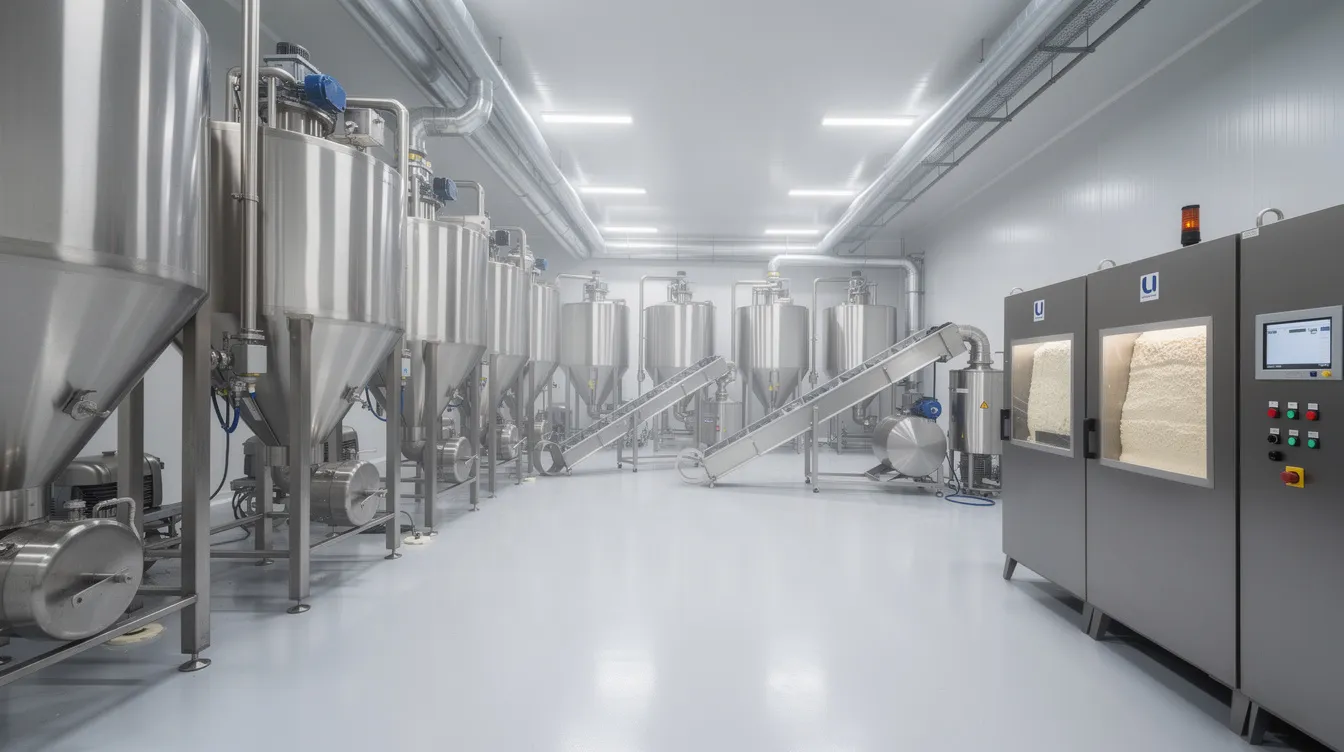
A specialty flour plant is not a single machine but a coordinated set of flour mill equipment and supporting utilities where each module affects product quality and production efficiency. For smaller blending units, not all categories apply, but this list helps plan for future expansion.
Raw Material Receiving and Handling Equipment
Typical arrangements include manual bag unloading or bag dump stations with dust control, screw conveyors for horizontal transfers, bucket elevators for vertical lift and small silos or stainless steel storage bins for grain type wise segregation. Food-grade construction is needed for flour-contact elements. For micro-ingredients (premix, vitamins), sealed containers and dosing hoppers prevent moisture and contamination.
Grain Cleaning and Destoning Machinery
This block is essential when the plant processes whole wheat or other grains but optional when raw materials are purchased as milled flour. Specialty flour requires advanced cleaning and grading technology. Standard machines include a pre-cleaner for large impurities, vibratory separator for fine dust and chaff, destoner for heavier stones and magnetic separator for ferrous metal. Cleaning and grading machines are essential for specialty grain processing; cleaning efficiency directly affects mill life and flour quality.
Grinding and Milling Machinery
Specialty flour production often requires specific milling technology. The choices include:
- Stone chakki mills for whole wheat atta or organic specialty flours (stone milling produces whole-grain flour with intact bran and germ)
- Roller mills for refined flour and high capacity operations (roller milling machines can process 1 to 100+ tons per hour)
- Hammer milling machines, which are versatile for various grains, legumes and spices
- Disc milling machines, which are compact and energy-efficient for small scale operations
For an integrated plant, the entire milling process involves break and reduction passages with sifting between stages. Heat generation, dust and noise need control via cooling air and dust collection. Food-grade stainless steel components cost more than mild steel alternatives but are preferred for contact surfaces in producing flour for retail.
Flour Blending and Mixing Machinery
Blending is the heart of a specialty flour blending plant. A ribbon blender is most common for free-flowing powders and multigrain atta. Paddle mixers suit gentler handling. Batch blending systems offer flexible recipes while continuous blending systems suit standardised products like fortified wheat flour. Effective batch volume, typical mixing times of 8-15 minutes and stainless steel inner surfaces for food contact are the key design parameters.
Micro-Ingredient and Fortification Dosing Systems
Micro-dosing is critical in fortified wheat flour and health blends where vitamins, minerals or nutraceuticals are added at ppm levels. Common systems include precision gravimetric or volumetric dosing feeders, small screw feeders integrated above the ribbon blender and separate vitamin premix dosing machines with interlocks. PLC-based recipe control can store multiple formulations for quick changeover, which is useful when the plant manufactures multiple specialty flours on the same line.
Sieving, Screening and Quality Inspection Equipment
After blending, flour passes through vibro sifters with appropriate mesh, inline flour sieves for continuous production, magnets and metal detectors before packing. Mesh size differs between multigrain atta (slightly coarser) and refined fortified wheat flour (finer), and sieve area must match line capacity.
Automatic Weighing and Packaging Machinery
Packaging decisions drive machine selection. Options include semi-automatic flour packing machines with weigh hopper, fully automatic FFS machines for 1-5 kg pouches, open-mouth bag filling machines for 10-50 kg B2B sacks and batch coding printers. Packaging speeds of 10-20 bags per minute are typical depending on pack size and automation.
Dust Collection and Material Handling Systems
Flour dust poses both hygiene and explosion risks. Centralised dust collection with bag filters or cartridge filters, local hooding at milling, sieving and packing points and flexible ducting designed for easy cleaning are standard solutions. Auxiliary equipment such as dust control systems adds to total costs but is critical for safe, efficient operation.
Electrical Panels and Industrial Automation
Even a semi-automatic plant needs a main LT panel, motor starters or VFDs, emergency stops and interlocks between critical machines. PLC automation for a flour blending plant enables recipe control, start/stop sequencing, alarm logging and dosing error prevention. The level of automation can affect initial equipment costs; high-capacity flour plants often require automation for efficiency and reliable operation.
Specialty Flour Plant Machinery Cost in India
Prices vary by capacity, material of construction, automation, brand and inclusion of controls. The following table shows indicative 2025-26 cost ranges for MSME-scale plants in India. Costs are in ₹ lakh, ex-works, exclusive of GST, freight, civil work, electrical cabling and local taxes. MoFPI cost norms for fully automatic atta plants provide useful anchoring; for example, machinery for a 0.5 TPH plant is normed at ₹17.15 lakh and for 1.0 TPH at ₹22.70 lakh.
| Machinery / Equipment | Function | Indicative Cost (₹ Lakh) | Key Cost Drivers |
|---|---|---|---|
| Grain cleaning line (pre-cleaner, destoner, magnet) | Remove impurities before milling | 3-6 | Number of cleaning stages, capacity |
| Small hammer mill / pulverizer (5-10 HP) | Grinding pulses, millets, minor grains | 1.5-3.5 | SS contact surfaces, motor brand, mesh fineness |
| Medium roller mill group | Break and reduction passages for wheat flour | 15-30 | Number of grinding rolls, purification stages, capacity |
| Flour pulverizer for oats, millets | Fine grinding of different grains | 2-4 | Capacity, fineness range, cooling |
| Ribbon blender (500-1000 kg batch) | Blending flour, fibre, grains | 2-5 | Volume, SS interior, batch controls |
| Micro-ingredient dosing system | Fortification or precise low-% additions | 1-2 | Precision, automation, channels |
| Vibro sifter / vibro separator | Sieving, grading, foreign particle removal | 0.8-2 | Sieve area, mesh quality, vibration motor |
| Semi-automatic packing machine (1-5 kg) | Retail pack filling | 1.5-3 | Speed, sealing type, material |
| Automatic FFS packing machine | High speed retail packing | 3-6 | Pack size range, speed (bags/min) |
| Bag filling machine (10-50 kg) | B2B bulk packing | 2-4 | Weighing accuracy, sack type |
| Dust collection system (bag/cartridge filter) | Hygiene, safety, product recovery | 1.5-3 | Flow rate, filter media, number of hoods |
| Conveyors, bucket elevators | Material transfer between units | 1-2.5 | Length, height, SS vs MS, capacity |
| Electrical panel + PLC automation package | Plant control, recipe, safety interlocks | 1-3 | Number of drives, PLC complexity, remote monitoring |
| Utilities (compressed air, fans, drives) | Support for packing, conveying, cleaning | 0.5-1.5 per subsystem | Pressure, capacity, electric voltage rating |
Production capacity influences machinery costs; the per-ton machinery investment falls as capacity increases because fixed costs (motors, control panels, installation) spread over more volume. Integrated turnkey flour mill quotations may appear higher but often include engineering, erection, commissioning and full automation, reducing hidden costs.
Capacity-Wise Specialty Flour Plant Machinery Cost
Indian specialty flour units for MSMEs typically fall in the 5-20 TPD band. The table below assumes 16 operating hours per day and 300 working days per year.
| Plant Capacity | Configuration | Approx. Machinery Investment (₹ Lakh) | Automation Level | Approx. Connected Load (kW) | Direct Manpower | Typical Business Profile |
|---|---|---|---|---|---|---|
| 5 TPD | Blending-only | 35-55 | Semi-automatic | 20-40 | 4-6 | Local brand, test market |
| 10 TPD | Blending + partial milling | 60-90 | Semi to medium automation | 50-80 | 6-10 | Regional brand, contract manufacturing |
| 20 TPD | Integrated milling + blending | 130-180 | Higher automation | 80-150 | 10-18 | Established brand, multi-SKU range |
Unit investment cost for small mills is $2,000-$3,000 per ton per day, while unit investment cost for large mills is $1,500-$2,500 per ton per day, reflecting economies of scale. A 5 TPD blending-only plant suits a first-time entrepreneur testing a brand with limited capital. A 10 TPD unit balances investment and scalability. A 20 TPD integrated plant demands a detailed feasibility study due to higher term loan requirements and the need for confirmed market demand. Aligning target markets can increase project success rates by over 30%.
Product-Wise Specialty Flour Machinery Requirements
Core equipment (blender, sifter, packing) is common across specialty flours, but each variant has product-specific needs.
Multigrain Atta Manufacturing Plant Machinery
Requires individual storage for each grain type, a small hammer mill for grains purchased whole, multiple weighing scales for batching and a high-capacity ribbon blender. Metal detectors are important for organised retail supply. The multigrain flour mill project report covers detailed machinery sizing and project cost.
Fortified Wheat Flour Manufacturing Plant Machinery
Accurate premix dosing is central, requiring micro-dosing feeders for low feed rates, proper premix storage under dry conditions and a well-designed ribbon blender for even distribution. Basic quality control equipment (lab sieves, moisture meter) and fortification level testing arrangements are needed for suitable compliance.
High-Fibre Atta Manufacturing Plant Machinery
High-fibre atta includes additional wheat bran, oats fibre or other fibre concentrates affecting flow characteristics. Careful particle size control via pulverizer and sifter avoids gritty mouthfeel. An efficient ribbon blender with proper filling level and adequate mixing time is critical. The high-fibre atta manufacturing plant project report covers profitability and raw material planning.
Organic Atta Manufacturing Plant Machinery
Organic projects often use stone flour mills or dedicated roller mills for lower throughput but higher perceived quality, with dedicated bagging machines and storage for organic SKUs. Machines should allow easy access for more frequent cleaning and validation. Semi-automatic packing maintains flexibility over short organic runs.
Automatic vs Semi-Automatic Specialty Flour Plant Machinery
| Parameter | Semi-Automatic | Automatic (PLC-based) |
|---|---|---|
| Machinery investment | Lower by 20-40% | Higher; full automation adds premium |
| Labour requirement | Higher (8-15 operators) | Lower (4-8 operators) |
| Batch consistency | Operator-dependent | Repeatable, recipe-controlled |
| Traceability | Manual batch records | Automated logging |
| Recipe flexibility | Manual changeover | Stored recipes, quick changeover |
| Maintenance skill | Basic electrical | PLC-trained technician needed |
| Suitable capacity | 2-8 TPD | 10-20+ TPD |
Operational costs can be reduced by 15%-25% with advanced configurations through lower labour, reduced downtime, fewer errors and better production efficiency. Automation does not guarantee higher profits by itself; project viability must consider product margins, market reach, flour mill utilisation and finance cost.
Specialty Flour Plant Machinery Power and Utility Requirements
Connected load and average running load differ. A 5 TPD blending-only unit may have 20-40 kW connected load mainly for mixers, sifters and packers. A 10-20 TPD integrated milling unit may require 80-150 kW depending on the number of roller mills, hammer mills and automation. Energy-efficient systems can lower operational costs by 15%-25%. Compressed air is needed for automatic packing machines and pneumatic gates. Adequate earthing, cable sizing, ventilation and delivery time for backup power (diesel generator) should be factored into planning.
Machinery Layout and Installation Planning
A well-planned flour mill layout reduces manual handling, avoids cross-flow of raw and finished goods and supports hygienic manufacturing. Key zones include raw material receiving, grain cleaning and milling (integrated plants), blending and sieving, packaging line, and finished goods warehouse. Gravity-based material flow (mills on upper floor, packing below) reduces conveying costs. Separate walkways for staff and adequate space around major machines for maintenance are practical requirements.
Machinery Quality, Food Safety and Regulatory Considerations
For wheat flour and specialty flour processing, FSSAI licensing and GMP influence machinery selection. Contact parts should be food-grade material, preferably stainless steel. Smooth welds and crevice-free design prevent flour accumulation. Proper dust extraction prevents airborne flour and combustible fine dust risks. Magnets and metal detectors before packing are recommended. Organic and fortified products have additional documentation, traceability and testing expectations; machinery should facilitate compliance.
Hidden Machinery and Installation Costs Entrepreneurs Should Consider
First-time investors often budget for visible flour mill machine prices but underestimate supporting costs by 15-30%. Typical hidden costs include:
- Freight and transit insurance
- Foundations, pedestals and floor reinforcement for heavy mills
- Electrical cabling, panels, earthing and lighting
- Dust collection ducting and civil openings between floors
- Initial spares, consumables and tools
- Commissioning trials and operator training
When comparing supplier quotations, verify whether they cover machinery only ex-works, machinery plus erection and commissioning, or turnkey including utilities. A realistic 8-12% contingency margin on machinery in the DPR is advisable.
How to Select Specialty Flour Machinery Manufacturers in India
Evaluate each supplier on experience in wheat flour and specialty flour projects, reference installations of similar capacity, ability to conduct flour milling or blending trials, clarity of scope and material of construction. Obtain like-for-like quotations from at least 2-3 capable manufacturers. Project Report Bank can support entrepreneurs in interpreting technical offers from a financial and risk perspective.
Machinery Investment Planning for a Specialty Flour Plant DPR
In my practice, machinery quotations directly feed into total project cost, means of finance, depreciation schedules, interest during construction, working capital and DSCR calculations within the DPR. Realistic capacity utilisation assumptions (50-60% in year 1, progressing to 75-80% by year 3) drive sales projections, operating cost estimates (power, labour, maintenance) and loan repayment schedules.
Banks typically verify authenticity of machinery quotations, reasonableness of plant capacity for the proposed market and loan repayment capacity relative to projected cash flows. Customized solutions can reduce payback period by 15%-25% and can increase profitability by 18%-28% when process design is matched to specific needs and market range. Professional bank finance DPR and loan proposal assistance and CMA Data preparation services help present banker-ready numbers based on project-specific machinery and capacity choices.
Common Machinery Selection Mistakes in Specialty Flour Projects
- Finalising capacity and machine list before defining product mix and target market
- Confusing low-cost domestic atta chakki machines with industrial flour mill equipment for continuous production at medium to high capacity
- Under-specifying dust collection, then facing hygiene and performance issues
- Ignoring micro-dosing accuracy for fortified wheat flour, creating compliance risks
- Over-automating a very small plant without clear utilisation, straining cash flows
- Neglecting ease of cleaning and changeover when multiple SKUs run on the same line
- Relying on generic profitability assumptions not aligned with actual flour milling yields and by-product (bran, meal, cornmeal) values
- Preparing financial projections without realistic capacity utilisation
Cross-check machinery decisions with a DPR and feasibility study before placing non-refundable orders.
Frequently Asked Questions
What basic machinery is required for a small specialty flour blending unit?
Core items include storage bins, a ribbon blender, vibro sifter, weighing scales, semi-automatic packing machine, small dust collector and basic electrical panel. An optional micro-dosing system is needed for fortification or health ingredients. This configuration avoids the cost of grain cleaning and milling equipment and is suitable for 2-10 TPD blending operations.
How much does machinery for a 10 TPD specialty flour plant typically cost in India?
Approximately ₹55-75 lakh for a 10 TPD blending-only plant and ₹80 lakh to ₹1.2 crore for an integrated milling plus blending plant, ex-GST, subject to exact specification and supplier. Actual pricing requires current quotations from manufacturers.
Can one line handle both multigrain atta and high-fibre atta?
Technically yes, if the blending and sieving system allows easy cleaning between recipes. Recipe changeovers, allergen risks (e.g., soya, cakes mixes) and production scheduling must be managed. Separate bins or separate small pulverizers for specific needs may be advisable for efficient operation.
Do banks insist on turnkey machinery suppliers for term loan approval?
Banks do not typically mandate any particular supplier. They expect clear, authentic quotations and a coherent machinery list demonstrating the business case. A professional DPR and CMA Data presentation supports loan appraisal more effectively than turnkey branding alone.
Is a DPR required for obtaining bank finance for a specialty flour processing unit?
Banks and financial institutions require a Detailed Project Report covering project cost, means of finance, production capacity, working capital, projected financials and DSCR analysis before appraising term loan proposals. A professionally prepared DPR with realistic assumptions is a standard requirement for manufacturing project finance.
Conclusion
Specialty flour plant machinery cost in India spans a wide band depending on plant type, capacity, automation and product mix. The core investment decision is whether to set up a blending-only unit or an integrated milling and blending plant. Each choice carries different machinery requirements, capital intensity and operating economics.
Machinery selection should be driven by business objectives: realistic demand, flour quality requirements and financial viability. Prioritising reliable operation, food safety and appropriate capacity over the lowest upfront price protects long-term returns.
Careful process design, financial modelling and bankable DPR preparation remain essential before committing capital. Treat machinery procurement as part of an integrated investment decision covering process, finance and long-term growth potential.
Professional DPR and Project Finance Assistance
I am CA Manish Gugliya (FCA, DISA, ICAI), with over 20 years of professional experience in DPR preparation, CMA Data, project finance, financial projections and MSME manufacturing advisory. Project Report Bank supports entrepreneurs with customised specialty flour plant DPRs (blending or integrated flour mill), machinery cost assessment and quotation comparison, financial projections, DSCR analysis, loan structuring and bank loan documentation.
If you are planning a specialty flour manufacturing or blending project, reach out via WhatsApp for an initial discussion about your proposed project. For a deeper evaluation of capacity planning, machinery selection and project viability, schedule a professional consultation.
Project Report Bank does not guarantee loan sanctions or project profitability. The focus is on realistic, data-backed project planning and documentation that supports informed discussions with banks and investors.