Key Takeaways
- A high-fibre atta manufacturing plant is a value-added flour mill project that enriches whole wheat flour with controlled wheat bran or other permitted fibre sources to achieve higher total dietary fibre content. Typical capacity options range from 5 TPD to 20 TPD, and commercial viability depends on verified demand, competitive pricing, adequate working capital and compliance with FSSAI “high fibre” labelling norms.
- This article is written from the professional perspective of CA Manish Gugliya (Project Report Bank) and covers the complete scope of a bankable project report – including plant setup cost, machinery, manufacturing process, financial projections, DSCR, working capital and project feasibility for high-fibre atta manufacturing in India.
- Both standalone high-fibre wheat flour plants and add-on blending lines attached to existing flour mills or atta chakkis are covered, with separate treatment of integrated milling operations versus blending and packaging units.
- Readers will find practical guidance on land and building requirements, licences (FSSAI, Udyam, GST), investment risks, raw material planning and step-by-step preparation of a DPR, CMA Data and business plan for bank finance.
- The article includes three professional CTAs: an early invitation for a customised project report, a mid-article CTA for bankable DPR and CMA Data, and a closing CTA for complete feasibility and project finance advisory.
Introduction – High-Fibre Atta Manufacturing Business Opportunity in India
High-fibre atta is whole wheat flour that has been enriched with controlled levels of wheat bran or other FSSAI-permitted fibre sources to deliver a higher total dietary fibre content than conventional atta. With lifestyle diseases such as diabetes and obesity becoming increasingly common among Indian consumers, dietary fibre has moved from a niche nutritional concern to a mainstream purchasing consideration, particularly in urban and semi-urban markets.
The difference between conventional atta and high-fibre atta is not merely a label change. High-fibre variants typically have a darker colour, denser dough characteristics and a different chapati texture compared to standard wheat flour sold by traditional flour mills. India produces over 70 million tonnes of wheat annually, yet only a fraction of this is processed into value-added flour food products carrying specific nutritional claims. There is a growing consumer shift toward health and functional foods, and wheat flour demand is increasingly moving toward packaged 5 to 10 kg packs in urban households.
Demand drivers include health-conscious urban consumers, premium retail channels in metros and Tier 1–2 cities, e-commerce brands that have gained traction since 2022, and institutional buyers such as diet kitchens and health-focused bakeries producing bread and other baked goods. However, consumer interest does not automatically translate into a profitable flour mill business. Price sensitivity remains strong, competition from established national brands is intense, and product differentiation can command a premium price only when backed by genuine quality and compliance.
A Detailed Project Report (DPR) outlines project objectives, includes market research and feasibility studies, assesses project costs and financial projections, and is essential for securing bank finance and investments. Before committing capital to a high-fibre atta manufacturing plant, promoters should evaluate commercial feasibility through a structured DPR and realistic business plan rather than relying on market enthusiasm alone.
At Project Report Bank, CA Manish Gugliya assists entrepreneurs with project cost assessment, financial modelling and DPR preparation for speciality flour mills and value-added wheat processing units across India.
Planning a High-Fibre Atta Manufacturing Plant? Get professional assistance in preparing a customised project report, financial projections and project cost assessment. Contact us via WhatsApp or visit www.projectreportbank.com.
What Is High-Fibre Atta and How Is It Manufactured?
High-fibre atta is whole wheat flour with an elevated total dietary fibre content, achieved either by reintroducing controlled quantities of wheat bran during milling or by blending the flour with legally permitted fibre ingredients such as oat fibre or psyllium husk. Standard whole wheat atta from a typical atta chakki or roller flour mill contains approximately 17–18 g of dietary fibre per 100 g on a dry basis. High-fibre atta is blended with grains or bran to boost dietary fibre to 20–25 g per 100 g or more, depending on formulation.
It is important to understand how this product differs from related categories. Regular whole wheat atta retains endosperm, germ and bran in natural proportions. Bran-enriched atta involves reintroducing extra bran beyond natural levels. Multigrain atta blends wheat with other cereals and grains such as oats, barley or millets. Fortified wheat flour adds micronutrients like iron, folic acid and zinc, without necessarily changing fibre content.
| Product Type | Key Ingredients | Typical Fibre Level (g/100g) | Typical Use |
|---|---|---|---|
| Regular Whole Wheat Atta | 100% wheat (bran present) | ~17–18 | Daily household chapatis |
| High-Fibre Atta | Wheat + added bran or fibre | 20–25+ | Health-focused retail, premium segment |
| Multigrain Atta | Wheat + millets, oat, legume | 18–22 | Urban buyers seeking grain variety |
| Fortified Wheat Flour | Wheat flour + micronutrients | Same as base flour | Welfare programmes, general retail |
Product formulation directly affects consumer acceptance. Excessive bran – typically above 20–25% addition – can make rotis hard, gritty or slightly bitter, reducing repeat purchases. Colour becomes darker, water absorption increases, and chapati puffing may reduce. These trade-offs must be balanced through careful formulation and consumer testing.
The term “high fibre” on a flour pack is legally regulated by FSSAI. Under the Advertising and Claims Regulations, 2018, a solid food must contain at least 6 g of dietary fibre per 100 g to carry a “high fibre” claim. This must be supported by lab-tested nutritional data from an accredited laboratory before printing on labels or marketing material.
A flour mill machine – whether a traditional atta chakki or a roller mill – combined with downstream blending equipment forms the core of a commercial high-fibre atta processing unit. The atta manufacturing process for high-fibre variants adds bran separation, grading and controlled reintroduction as additional steps beyond standard milling.
Market Potential and Business Opportunities for High-Fibre Atta in India
The Indian packaged atta market has grown steadily, reaching approximately INR 95.1 billion in 2025 and projected to grow to around INR 286.4 billion by 2034, at a CAGR of approximately 12.6–13%, according to IMARC market research. Within this, premium and health-variant flour segments are among the fastest growing.
Key demand opportunities include:
- Urban households and working professionals buying packaged 5–10 kg fibre-rich packs through supermarkets and modern retail
- E-commerce and D2C brands on platforms like Amazon, Flipkart and quick-commerce apps
- Institutional segments such as diet tiffin services, hospitals, corporate canteens and health bakeries
- Private-label manufacturing for retailers and online brands who outsource flour production
- Existing flour mills looking to introduce value-added product lines alongside standard atta
The competitive landscape includes large branded flour mills – national brands like ITC Aashirvaad and Fortune have introduced high-fibre and multigrain atta variants – as well as regional flour mills and small atta chakki businesses. New entrants must differentiate through quality, verified nutrition claims, appropriate packaging and effective distributor support.
At a high level, typical MRP for high-fibre atta is 10–20% above standard atta. Distributor margins may range from 8–12% in modern trade, with additional costs for slotting fees, introductory schemes and promotional discounts. High distribution and promotional costs, awareness-building requirements and returns risk for a perishable (though dry) food product are real go-to-market challenges.
A realistic project report must factor in achievable market share, a sales ramp-up period and a practical sales mix (branded versus private-label versus institutional) rather than assuming full plant utilisation from the first month.
High-Fibre Atta Manufacturing Plant Capacity Planning
Promoters should align plant size with targeted geography, confirmed sales channels and available working capital. Oversizing a wheat flour mill without secured demand leads to underutilisation and high fixed-cost burden.
The distinction between installed capacity (tonnes per day of wheat or flour processed) and effective output (finished high-fibre atta after bran blending, sieving and process losses) is important. A flour mill can process 150–200 kg per hour at small scale, and production capacity builds over 3–5 years as markets develop.
Three illustrative scenarios:
- 5 TPD line: Suited for a regional city plus online brand; simpler civil works; manageable working capital; often a blending and packaging unit purchasing base flour from an existing wheat flour mill.
- 10 TPD plant: Mixed B2B and B2C supply across multiple districts; retail packs plus small private-label contracts; requires moderate storage and packaging infrastructure.
- 20 TPD plant: Typically tied to an integrated roller flour mill or multi-state distribution; higher machinery, building and logistics investment.
Illustrative Capacity Planning – 10 TPD Base Case
| Parameter | Assumption |
|---|---|
| Installed capacity | 10 TPD (finished atta) |
| Operating days per year | 300 |
| Year 1 capacity utilisation | 60% |
| Year 2 | 70% |
| Year 3 onwards | 80% |
| Year 1 annual production | ~1,800 tonnes |
| Approximate wheat input (at ~70% extraction + bran re-addition) | ~14 TPD wheat |
| Raw wheat warehouse (15–30 days stock) | ~200–400 tonnes storage |
| Finished goods warehouse (10–20 days) | ~60–120 tonnes storage |
| Annual packaging (1 kg / 5 kg / 10 kg mix) | ~1,800 tonnes equivalent |
| Minimum annual sales volume | Match production to avoid excess inventory |
These are illustrative assumptions for a project report. Actual production depends on the selected milling, bran enrichment and blending arrangements.
Raw Materials Required for High-Fibre Atta Manufacturing
Core raw materials include:
- Food-grade milling wheat of suitable hard or semi-hard varieties
- Wheat bran (from own mill or external suppliers)
- Optional permitted fibre sources (oat fibre, psyllium husk) depending on product positioning
- Packaging materials (laminated pouches for retail, HDPE/PP woven bags for institutional packs)
- Legally permissible processing aids, if technically necessary
Wheat quality parameters matter significantly. Moisture content should be below 12–13% at procurement to minimise storage losses, mould and insect infestation. Grain hardness, test weight, protein content and gluten strength affect dough behaviour and chapati quality. Seasonal wheat prices impact raw material costs and profitability for flour mills – procurement strategy should account for harvest cycles and price volatility.
Bran quality requires equal attention. Particle size (too coarse creates gritty mouthfeel), moisture level (below 10–12%), and fibre content consistency are critical. Inconsistent bran quality can alter the final dietary fibre percentage and chapati texture, directly affecting brand reputation and repeat purchases.
High fibre flour may require special packaging to prevent rancidity, since bran contains oil that can oxidise during storage. Retail packs in 1 kg, 5 kg and 10 kg SKUs need moisture-barrier laminated pouches with proper sealing, while 25 kg or 50 kg institutional bags may use woven PP or laminated HDPE.
Raw material inventory guidance: Maintain 15–30 days of wheat inventory, 7–15 days of packaging materials, and separate stores for bran and any additional fibre ingredients. These stock levels feed directly into working capital calculations in the DPR.
High-Fibre Atta Manufacturing Process and Flow Chart
There are two broad configurations for high-fibre atta production. An integrated flour mill handles wheat cleaning, conditioning, milling and bran reintroduction in-house. A blending and packaging unit purchases base wheat flour from a roller flour mill and enriches it with bran or fibre using mixers and sifters, with further processing limited to blending, sieving and packing.
The manufacturing process includes cleaning, conditioning, milling, blending, and packaging. Here is the step-by-step flow:
- Wheat procurement and inspection at weighbridge and quality lab
- Cleaning using pre-cleaner, destoner, aspiration and magnetic separator to remove stones, dust, insects and foreign particles
- Conditioning or tempering of wheat (if using roller mill technology) to optimise moisture for milling
- Grinding and milling using stone chakki, roller mills or a combination
- Bran separation, grading and precise reintroduction at the target ratio
- Preparation and sieving of any additional fibre ingredients
- Controlled blending in a ribbon blender or industrial mixer, with batch records maintained
- In-process quality checks – moisture, ash content, fibre content sampling
- Final sieving, metal detection and transfer to packaging hopper
- Weighing, filling, sealing and coding of retail or bulk packs
- Palletisation, finished goods storage and dispatch
Process Flow: Wheat Receipt → Cleaning → Conditioning → Milling → Bran Separation → Blending with Bran/Fibre → Sieving & Metal Detection → Packing → Storage & Dispatch
Quality control is essential for testing moisture, gluten, and dietary fibre levels at multiple stages. Calibration of ingredient dosing, periodic lab testing for total dietary fibre and microbiological parameters, and sampling protocols for each batch are necessary. Meeting FSSAI’s fibre claim requirements depends on tested finished-product composition, not merely on the percentage of bran ground and reintroduced into the flour.
High-Fibre Atta Manufacturing Plant Machinery and Equipment
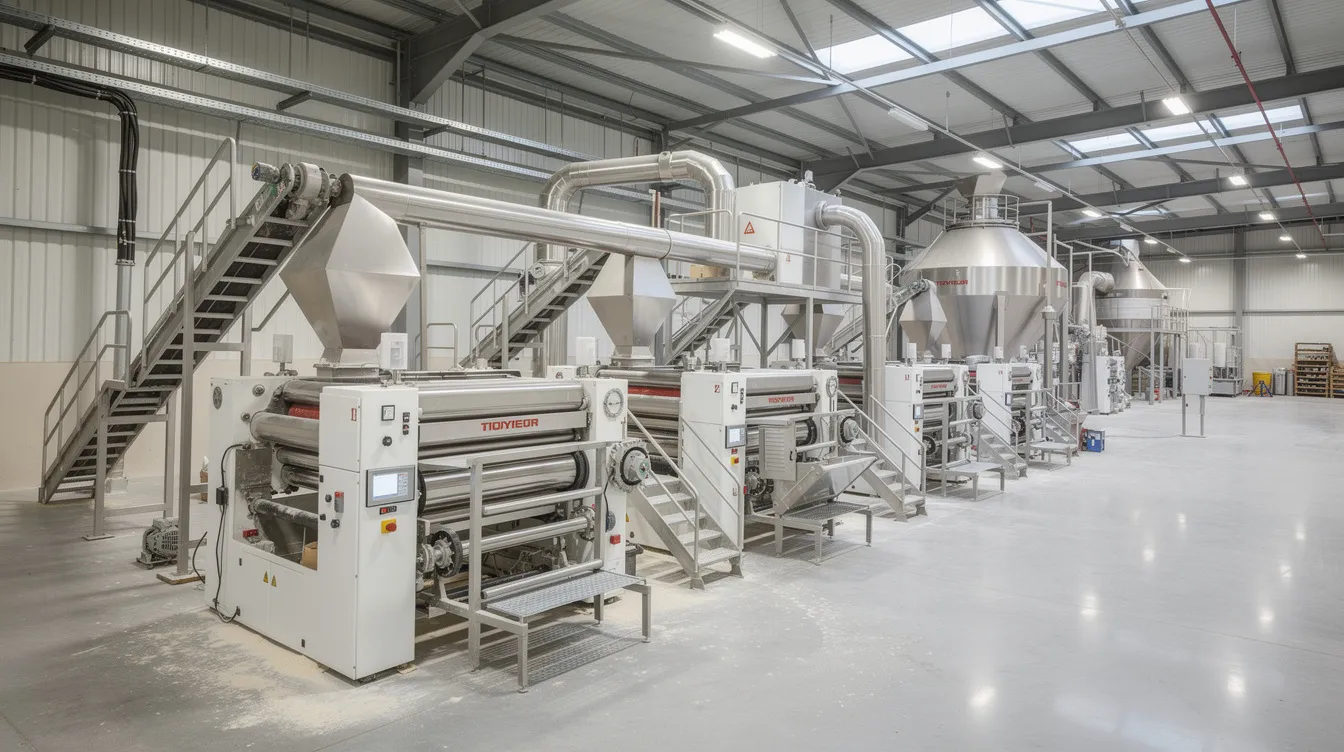
The machinery layout differs significantly between a full wheat flour mill plant with integrated grain cleaning, conditioning and roller milling versus an add-on high-fibre blending and packing line attached to an existing flour mill or atta chakki plant.
Typical Equipment for a High-Fibre Atta Plant
| Equipment | Purpose |
|---|---|
| Pre-cleaner and aspirator | Remove dust, chaff and light impurities |
| Destoner | Separate stones and heavy particles |
| Magnetic separator | Remove metallic contaminants |
| Conditioning bins | Temper wheat for optimal milling (roller mill projects) |
| Flour mill machine (chakki / roller mill) | Grind wheat into flour |
| Bran sifter and handling system | Separate, grade and store bran |
| Ribbon blender / industrial flour mixer | Blend flour with bran/fibre at controlled ratios |
| Ingredient dosing system | Precise measurement of bran and fibre additions |
| Vibro sifter / plansifter | Final sieving for uniform particle size |
| Dust collection and aspiration | Worker safety and plant hygiene |
| Metal detector | Food safety compliance |
| Automatic weighing and packaging machine | Fill, seal and code retail or bulk packs |
| Conveyors and elevators | Material handling |
| Laboratory equipment | Moisture meter, ash oven, fibre testing support |
When selecting a flour mill plant manufacturer, check track record in flour mills, after-sales support, spares availability and capacity match with the business plan. Equipment with sturdy construction and energy-efficient motors reduces long-term maintenance costs. Machinery choices influence operational costs and product quality in flour mills – automated systems increase efficiency and quality consistency in flour production, but also raise the initial investment.
For reference, a 500 kg capacity flour mill costs approximately ₹3 lakh to ₹5 lakh. At the smaller end, a 10 HP Swastik Atta Chakki costs nearly ₹6,500, while Crompton flour mill prices range from ₹26,500 to ₹35,000. For a 10–20 TPD blending and packaging line, machinery cost ranges from approximately ₹15–30 lakh. A roller flour mill for 30–50 TPD may cost ₹60–90 lakh to ₹1.5 crore or more depending on automation. These are indicative ranges subject to vendor quotations and specific needs.
High-Fibre Atta Manufacturing Plant Setup Cost in India
Total project cost covers both fixed assets and working capital margin and varies significantly by capacity, location and level of automation. Capital expenditure for a flour mill includes costs for machinery and site development, along with civil works, electrical infrastructure, utilities and pre-operative expenses.
Major fixed cost heads include:
- Land purchase or long-term lease and site development
- Factory building, godowns, blending and packaging hall, laboratory and office
- Plant and machinery (as described in the previous section)
- Electrical installation (transformer, panels, wiring, lighting)
- Material handling (conveyors, forklifts, pallet trucks)
- Laboratory setup and basic QA instruments
- Utilities (compressor, dust extraction, water system, DG set if required)
- Installation, commissioning and initial training
- Furniture, computers, basic software
Preliminary and pre-operative expenses include company registration, legal fees, DPR preparation, engineering consultants, interest during construction, trial production, initial marketing expenses and a contingency margin of 5–10% of project cost. A DPR typically includes project timelines and milestones covering these implementation stages.
Illustrative Project Cost – 10 TPD High-Fibre Atta Plant (Blending + Packaging Line with Existing Flour Supply)
| Cost Head | Indicative Amount (₹ Lakh) |
|---|---|
| Land and site development | 30–50 |
| Building and civil works | 40–60 |
| Plant and machinery | 25–40 |
| Electrical and utilities | 8–12 |
| Laboratory and QA | 3–5 |
| Material handling | 4–6 |
| Preliminary and pre-operative expenses | 8–12 |
| Contingency (5–7%) | 6–10 |
| Working capital margin | 15–25 |
| Total Estimated Project Cost | 139–220 |
For a standalone integrated flour milling plant with high-fibre atta line at 20 TPD, total project cost can be substantially higher. A CFTRI-based 20 TPD mini flour mill project profile indicated machinery cost of approximately ₹1.21 crore and total capital investment of approximately ₹4.85 crore including civil works and utilities. All figures above are illustrative and must be refined using actual supplier quotations and local construction rates.
Land, Building, Factory Layout and Infrastructure Requirements
Land requirements depend on plant capacity and configuration. For 5–10 TPD projects, approximately 8,000–15,000 sq ft of industrial land is a reasonable indicative range. For 20 TPD integrated plants, the requirement increases further. Multi-storey layouts can reduce the footprint but add structural costs. A small flour mill needs 200 to 300 square feet for the milling section alone. Medium commercial flour mills require 500 to 1,000 square feet of space for processing. Large flour milling operations use 2,000 to 3,000 square feet for their production areas. Government guidelines suggest at least 200 square meters for flour mills, though actual requirements depend on the complete plant layout.
Major functional zones in the factory layout:
- Raw wheat receiving and covered storage
- Cleaning and milling section (if integrated flour mill)
- Bran handling and fibre ingredient store
- Blending and sifting area
- Packaging hall with controlled dust and hygiene
- Finished goods warehouse and dispatch bay
- Laboratory and QA office
- Utility block (compressor, DG, electrical room)
- Staff amenities and administrative office
Smooth process flow is essential: minimal backtracking, separate clean and dusty areas, and proper segregation between raw material and finished product movement to avoid contamination. Infrastructure requirements include 3-phase power load (estimated based on motors, packaging machines and lighting), water for cleaning and domestic use, drainage, ventilation and dust collection systems for worker safety. Fire-fighting equipment, emergency exits, pest control contracts and food-grade flooring and wall finishes should be planned as far as commercially practical.
High-Fibre Atta Manufacturing Plant Project Cost and Means of Finance
Project cost for bank appraisal typically includes fixed assets plus margin for working capital. Bank loans for manufacturing projects require detailed project reports that present both components clearly.
The typical financing pattern for MSME flour mills in India involves:
- Promoter contribution (equity): normally 20–35% of project cost
- Bank term loan: balance of fixed asset cost
- Separate working capital limits (cash credit, overdraft) against stocks and receivables
Illustrative Means of Finance – 10 TPD Plant (₹ Lakh)
| Source | Amount (₹ Lakh) |
|---|---|
| Promoter’s equity contribution (25–30%) | 40–60 |
| Bank term loan | 80–130 |
| Working capital facility (sanctioned separately) | 15–30 |
| Total | 135–220 |
Banks evaluate the proposal based on promoters’ capital, net worth and experience, projected DSCR, security (collateral, mortgage of factory land and building, hypothecation of machinery and stock) and the commercial viability of the high-fibre atta market. Loan structuring is crucial for obtaining bank finance – repayment schedules must align with projected cash flow and revenue ramp-up. Government schemes may provide funding support for MSME projects in India, and promoters should explore applicable subsidies.
A professional, bankable DPR and loan proposal must present these financing arrangements with internally consistent assumptions. No consultant can guarantee loan sanction, but a well-structured business proposal significantly strengthens the application.
High-Fibre Atta Plant Working Capital Requirements
Even a fully installed flour mill plant cannot operate without adequate working capital. Working capital assessment is necessary for loan eligibility, and banks evaluate this separately from fixed asset financing.
Key working capital components:
| Component | Holding Period | Basis |
|---|---|---|
| Wheat and bran inventory | 15–30 days | Production consumption |
| Finished high-fibre atta stock | 10–20 days | Sales cycle |
| Packaging materials | 7–15 days | Monthly consumption |
| Debtors (trade receivables) | 15–45 days | Credit to distributors |
| Less: Creditors (supplier credit) | 15–30 days | Wheat and packaging suppliers |
Hypothetical Working Capital Example – Year 1 (10 TPD Plant at 60% Utilisation)
| Item | Monthly Value (₹ Lakh) | Days | Amount (₹ Lakh) |
|---|---|---|---|
| Wheat and bran inventory | 35–40 | 20 | ~24–27 |
| Finished goods stock | 40–45 | 15 | ~20–22 |
| Debtors | 45–50 | 30 | ~45–50 |
| Less: Creditors | 35–40 | 20 | ~(23–27) |
| Net Working Capital Requirement | ~66–72 |
Wheat price fluctuations and seasonal stocking patterns (pre-harvest versus post-harvest) significantly affect working capital. Raw material costs constitute a significant portion of operational costs in flour production – often 60–65% of cost of goods sold. CMA Data is essential for bank loan applications and must be periodically updated to reflect changing inventory levels and credit cycles. Project Report Bank provides CMA Data preparation services to support these periodic assessments.
High-Fibre Atta Plant Financial Projections, Revenue and Profitability
Financial projections for a high-fibre atta plant are built over 5 years, aligning with capacity, cost and financing assumptions established earlier. Forecasting cash flows is crucial for managing financial stability during project implementation.
Revenue modelling links installed capacity, year-wise utilisation, product mix and average selling price. For the 10 TPD illustrative case, Year 1 production of ~1,800 tonnes at an average realisation of ₹38–42/kg yields approximate revenue of ₹6.8–7.6 crore.
Major cost heads include raw material consumption (wheat, bran, fibre ingredients), packaging material costs, power and fuel, direct and indirect labour, repairs and maintenance, selling and distribution expenses, and administrative overheads. A well-run plant can achieve relatively low operating costs through efficient procurement and energy management.
Illustrative 5-Year Financial Summary (10 TPD Plant)
| Parameter | Year 1 | Year 2 | Year 3 | Year 4 | Year 5 |
|---|---|---|---|---|---|
| Capacity utilisation | 60% | 70% | 80% | 80% | 85% |
| Annual production (MT) | 1,800 | 2,100 | 2,400 | 2,400 | 2,550 |
| Net revenue (₹ Cr) | 6.8 | 8.2 | 9.6 | 9.9 | 10.7 |
| Total expenses (₹ Cr) | 6.2 | 7.3 | 8.4 | 8.5 | 9.1 |
| EBITDA (₹ Cr) | 0.6 | 0.9 | 1.2 | 1.4 | 1.6 |
| PBT (₹ Cr) | 0.15 | 0.45 | 0.75 | 0.95 | 1.15 |
| PAT (₹ Cr) | 0.11 | 0.34 | 0.56 | 0.71 | 0.86 |
Net profit margins for standard flour processing plants range from 8.5% to 12%. High-fibre atta may achieve marginally better margins in premium channels but faces higher distribution and marketing costs. These figures are modelling assumptions – actual results depend on execution, wheat prices, selling price realisations and market conditions.
High-Fibre Atta Manufacturing Plant DSCR, ROI, IRR and Break-Even Analysis
These financial indicators help promoters and bankers assess whether a high-fibre atta manufacturing project is viable and sustainable.
- DSCR (Debt Service Coverage Ratio) = Cash Available for Debt Service ÷ Total Debt Service (principal + interest). Banks generally expect an average DSCR of 1.5x or above over the loan tenor.
- ROI (Return on Investment) = Average Annual Profit ÷ Average Project Investment. Indicates the return generated per rupee invested.
- Project IRR = The discount rate at which the net present value of all project cash flows equals zero. Equity IRR isolates returns to the promoter’s own investment.
- Payback Period = Time taken to recover initial investment from cumulative net cash flows.
- Break-Even Point = The capacity utilisation or sales volume at which contribution equals fixed costs. Breaking even typically requires 40% to 45% capacity utilisation in flour facilities.
Sensitivity analysis is important for evaluating risks in financial projections. Key variables to test include:
- A 5–10% increase in wheat procurement prices
- Lower-than-expected selling price realisations due to competitive discounts
- Slower capacity utilisation ramp-up or machinery downtime
A project that remains financially sustainable after moderate adverse changes in these variables is more resilient. Realistic DSCR and IRR – not inflated projections – help secure bank confidence and allow prudent decision-making.
Licences, Registrations and Regulatory Compliance
High-fibre atta manufacturing is a food business and requires compliance with FSSAI and other applicable regulations. Flour mills must comply with local zoning regulations, and exact requirements may vary by state and scale.
Typical registrations and approvals:
- Business entity registration (proprietorship, partnership, LLP or company)
- Udyam registration for MSME benefits where applicable
- FSSAI registration and compliance is necessary for food safety in high fibre atta production – licence category depends on manufacturing capacity and turnover
- GST registration if turnover crosses applicable threshold or for inter-state supply
- Factory-related registrations depending on workforce and machinery
- Local municipal NOC, fire safety NOC as required
- Pollution control consents for air (dust) and noise, where mandated
Legal Metrology and packaged commodity rules require standard pack sizes, proper MRP, batch number, net quantity and best-before date printing on every pack.
For the “high fibre” claim specifically, FSSAI’s nutrition and health claims regulations mandate a minimum of 6 g dietary fibre per 100 g for solids. A mandatory nutrition facts panel including total dietary fibre must appear on the label. The FSSAI standards for milled flour were re-operationalised from mid-2023 for relevant flour categories. Lab testing from an accredited laboratory is required before printing any fibre claims on packaging or marketing material.
Internal food safety systems – Good Manufacturing Practices (GMP), Good Hygiene Practices (GHP), and HACCP if targeting modern trade – should be established and documented.
High-Fibre Atta Plant Feasibility Study and Investment Risks
A project feasibility study for a high-fibre atta plant must address technical feasibility (machinery, process, utilities), market feasibility (demand, competition, pricing) and financial feasibility (cash flow, DSCR, ROI).
Major business risks include:
- Wheat price volatility reducing gross margins, especially during off-season procurement
- Inconsistent wheat or bran quality affecting product performance and fibre content
- Moisture and storage losses leading to quantity and quality degradation
- Consumer sensitivity to taste and texture differences compared to regular atta, affecting repeat sales
- Competition from established atta brands adding their own fibre variants to the market
- High distribution costs in modern retail and e-commerce channels
- Underutilisation of plant capacity due to weak or delayed market entry
- Excessive credit to distributors causing cash flow stress and increased working capital burden
- Machinery downtime due to poor maintenance or power supply issues
- Regulatory non-compliance, particularly misuse of “high fibre” claims without supporting lab evidence
Risk mitigation measures include diversified wheat procurement, robust QA/QC procedures, piloting products in limited markets before scaling, conservative capacity assumptions in the project report, adequate working capital buffers, strict credit control policies and annual review of costing and pricing models.
The feasibility study should be documented as part of the DPR and business proposal shared with lenders and potential investors, including sensitivity and scenario analysis.
How to Prepare a Bankable DPR for a High-Fibre Atta Manufacturing Plant
A bankable Detailed Project Report is a professional, coherent document that banks, financial institutions and investors evaluate before sanctioning finance. It is fundamentally different from a generic template or a collection of machinery quotations.
Core components of a strong DPR include:
- Promoter profile, experience in food or trading businesses and financial background
- Detailed project description and product profile (high-fibre atta, any variants)
- Market study including competitor analysis and target customer segments
- Technical details: plant capacity, flour mill machines, blending equipment, process flow, utilities
- Land and building details, layout description and implementation schedule
- Project cost estimate and means of finance
- Working capital assessment methodology and assumptions
- 5–7 year financial projections (Profit & Loss, Balance Sheet, Cash Flow)
- DSCR, IRR, ROI, break-even and sensitivity analysis
- Risk factors and mitigation strategies
CMA Data is essential for bank term loans and working capital limits and must align precisely with the financial projections and project report. All assumptions – capacity utilisation, wheat cost, selling price, credit period, interest rate – must be clearly justified, internally consistent and capable of withstanding bank scrutiny.
For promoters evaluating related flour mill investments, the atta chakki plant project cost and means of finance structure provides a useful reference point, though high-fibre atta adds formulation, compliance and quality testing layers beyond standard milling.
Why Professional DPR Preparation Is Important
Setting up a high-fibre atta plant is not simply about purchasing a flour mill machine or a ribbon blender. It demands integrated planning of production capacity, raw material strategy, working capital structure and sales channel design – all connected through a coherent financial model.
In my experience preparing project reports for flour mill businesses and food processing units, the most common weaknesses in DPRs include over-optimistic sales forecasts that assume full capacity from Year 1, underestimated working capital that ignores seasonal wheat price spikes, incomplete treatment of FSSAI compliance and labelling requirements, and a lack of sensitivity analysis to demonstrate how the project performs under adverse conditions.
A professionally prepared DPR from Project Report Bank translates technical decisions – such as choosing between a 10 TPD and 20 TPD flour mill plant, or between semi-automatic and fully automatic packaging – into structured financial implications. It links plant layout and machinery to manpower planning and overheads, and aligns repayment schedules with realistic cash flow projections.
Need a Bankable DPR for Your High-Fibre Atta Project? Project Report Bank assists with CMA Data, financial projections, DSCR analysis, working capital assessment and bank finance documentation. Contact us via WhatsApp or visit www.projectreportbank.com.
While professional documentation strengthens a bank proposal, no consultant can guarantee loan approval or project success. Project outcomes ultimately depend on execution, market response and management discipline.
Frequently Asked Questions
The following questions address common practical doubts from entrepreneurs evaluating whether to invest in a high-fibre atta flour mill or blending plant in India.
What is the cost of starting a high-fibre atta manufacturing plant in India?
The total project cost depends on capacity, configuration and location. A 10 TPD blending and packaging unit may require ₹1.4–2.2 crore including land, building, machinery, utilities and working capital margin. An integrated flour mill with high-fibre atta line at 20 TPD can cost ₹4–5 crore or more. These are indicative figures; actual costs must be estimated through vendor quotations and site-specific engineering for your specific needs.
Can I start with a small pilot high-fibre atta unit before investing in a full-scale flour mill plant?
Many entrepreneurs begin by outsourcing base wheat flour from an existing flour mill and installing only blending, sieving and packaging equipment at 1–2 TPD scale to test local and online markets. This reduces initial capital commitment while validating product acceptance and distribution channels before committing to an integrated plant. A scaled-down project report can support bank finance even for such pilot operations.
Is contract manufacturing a good option for high-fibre atta brands?
New brands can tie up with established flour mills as contract manufacturers, using their capacity, licences and infrastructure while focusing on formulation, branding and marketing. The trade-off is lower margin but significantly lower fixed investment. This approach is particularly relevant for D2C and e-commerce brands entering the market.
How can a traditional atta chakki upgrade to a high-fibre atta manufacturing business?
A local atta chakki can expand from loose flour retail to packaged high-fibre atta by adding a small ribbon blender, sifter, basic packing machine and FSSAI-compliant labelling. The atta chakki plant setup cost for such an upgrade is modest. A scaled-down DPR covering the incremental investment, working capital and projected revenue can support a bank loan application for the expansion.
What FSSAI requirements apply to high-fibre atta?
FSSAI requires that any “high fibre” claim on packaged flour must be supported by lab-tested dietary fibre content of at least 6 g per 100 g of the finished product. The nutrition facts panel must declare total dietary fibre. Standards for milled flour have been re-enforced from 2023. Manufacturers must obtain an appropriate FSSAI licence, maintain labelling compliance under packaged commodity rules and ensure that marketing claims are substantiated by accredited laboratory reports.
What financial projections should be included in the DPR?
A comprehensive DPR should include 5–7 year projected Profit & Loss statements, Balance Sheets, Cash Flow statements, DSCR analysis, break-even analysis, IRR calculations and sensitivity analysis. CMA Data must be prepared separately for bank working capital and term loan applications. All projections should be built from consistent operational assumptions – capacity, pricing, raw material cost and credit terms – rather than arbitrary revenue targets.
Conclusion – Planning a Financially Viable High-Fibre Atta Manufacturing Project
High-fibre atta manufacturing is a promising value-added wheat flour opportunity for both existing flour mills and new entrants. However, it requires disciplined project planning, realistic financial projections and strict quality and regulatory compliance. The market for health-oriented food products is growing, but the competitive landscape demands genuine product differentiation, efficient operations and careful financial management.
Project decisions should be based on verified market potential, compliant formulation supported by lab testing, carefully chosen flour mill plant machinery, adequate working capital and conservative DSCR targets. An investment of this nature should be supported by a professionally prepared DPR that connects manufacturing realities with bank finance expectations.
Get Your Customised High-Fibre Atta Manufacturing Plant DPR
Contact CA Manish Gugliya for project feasibility, DPR preparation, financial modelling and project finance advisory. Over 20 years of professional experience in project reports, CMA Data, financial projections and bank finance advisory.