Key Takeaways
- This article serves as a practical fortified wheat flour manufacturing plant project report outline for India, covering commercial viability, regulatory compliance and bank finance from the perspective of CA Manish Gugliya (Project Report Bank).
- It addresses the fortified wheat flour manufacturing process, plant setup, machinery, capital costs, working capital, profitability, DSCR and loan structuring for realistic Indian MSME scales (10–50 TPD), though all figures are indicative and must be customised through a detailed DPR.
- FSSAI flour fortification standards, food fortification regulations and proper quality control are central to every aspect of project design.
- Professional DPR preparation, CMA Data, financial modelling and feasibility analysis are strongly recommended before committing significant investment in a fortified atta plant.
Fortified Wheat Flour Manufacturing Plant Project Report – Introduction
A fortified wheat flour manufacturing plant project report is the strategic blueprint for any entrepreneur or flour miller planning to produce wheat flour enriched with iron, folic acid and vitamin B12 in compliance with FSSAI norms. Unlike traditional wheat flour, fortified atta contains added vitamins and minerals not naturally present in sufficient quantities, addressing widespread nutritional deficiencies across Indian diets.
Flour fortification is a cost-effective public health intervention with deep historical roots-wheat flour fortification began in 1941 with iron and B vitamins, and today 82 countries have legislation mandating flour fortification, while eight countries fortify over half their wheat flour voluntarily. In India, fortification mandates are driven by public health initiatives and government regulations aimed at reducing iron deficiency anaemia. Mandatory fortification of wheat flour significantly reduces anemia prevalence at population level, and fortified flour can help prevent iron deficiency anemia at negligible consumer cost-as low as $0.01 per 5 kg.
For project promoters, two distinct opportunities exist:
- Existing roller flour mills and atta chakki units can add a fortification and blending line with modest capital investments.
- New entrepreneurs can establish a greenfield fortified wheat flour plant as a value-added food processing venture.
In either case, a professionally prepared DPR, CMA Data and financial model are critical for realistic capital costs estimation, bankable loan appraisal and sound investment decisions. If you are planning a fortified atta manufacturing business in India, Project Report Bank provides customised DPR and project finance advisory-reach out through the WhatsApp enquiry option on www.projectreportbank.com.
What Is Fortified Wheat Flour and How Is It Manufactured?
Food fortification means adding selected micronutrients to widely consumed staple foods to improve their nutritional value. In flour fortification specifically, wheat flour is commonly fortified with iron and folic acid, along with vitamin B12 and sometimes zinc. The result is flour that provides approximately 364 kcal per 100 g serving with enhanced micronutrient content that can contribute to the reduction of neural tube defects and anaemia.
It is important to distinguish between:
- Ordinary wheat flour (atta or maida) – no added nutrients beyond what wheat grains naturally contain.
- Nutrient-fortified wheat flour – iron, folic acid, vitamin B12 (and sometimes niacin, riboflavin and other b vitamins) added via premix blending.
- Multigrain or high-fibre atta – blends of wheat with other grains like maize, bajra or millets, adding fiber and variety but serving a different purpose than micronutrient fortification.
The premix is a standardised blend from specialised suppliers containing the required fortificants and carriers. A micro doser machine adds premix to flour at pre-determined rates-typically measured in grams per 100 kg of flour produced.
Two typical routes exist for fortification:
- Integrated fortification within the milling process, where the dosing system sits on the flour meal line inside a large roller flour mill.
- Post-milling blending in a separate mixer, suitable for smaller units that source pre-milled wheat flour.
Quality assurance must include protocols for testing incoming wheat and flour, verifying premix batch quality via Certificate of Analysis, checking mixing homogeneity and testing finished-product micronutrient levels. The exact micronutrient formulation and levels must strictly follow current FSSAI Fortification of Foods Regulations.
Fortified Wheat Flour Manufacturing Business Opportunities in India
Fortified atta is gaining traction in India due to rising health awareness, increasing organised retail presence for packaged foods, and institutional interest in food fortification. The global convenience food market reached $511.1 billion in 2024, and within India, the packaged wheat flour segment continues to grow alongside consumption of baked goods, bread and other food products that use fortified flour as an ingredient in baking and industrial food processing.
Specific business models include:
- Branded retail fortified atta in 1 kg, 5 kg, 10 kg and 25 kg packs for kirana stores and modern trade.
- Private-label manufacturing for regional brands and supermarket chains.
- Institutional and B2B supplies to bakeries, QSR chains, catering units and industries using flour for bread, biscuits and other baked goods.
- Bulk bags (30–50 kg) for wholesalers and food manufacturers.
Over 82 countries mandate fortification of industrially milled cereal grains, and eligible Indian producers may participate in government or institutional procurement programmes, though no specific contracts can be assured. Market analysis should assess both local and national demand for fortified wheat flour, and a project report should evaluate market demand, competition, and target customers before finalising financial projections. Promoters must validate expected selling prices, distributor margins, likely monthly offtake and credit terms in their target geography.
Fortified Wheat Flour Manufacturing Plant Capacity Planning
Capacity planning in the fortified wheat flour plant DPR defines the scale of investment, machinery selection, working capital and expected turnover. Production capacity planning must consider market demand and operational costs. Three illustrative scales are relevant:
- 5–10 TPD: Small commercial operations focused on local retail and institutional sales-suitable for entrepreneurs entering flour production with limited capital.
- 20–30 TPD: Medium-scale plants supplying multiple districts, where mills generally achieve better economies and branding reach.
- 50 TPD and above: Larger industrial operations, often integrated with a roller flour mill, serving regional or national markets.
The difference between installed capacity and achievable capacity is critical. A DPR should model operating shifts (single or double), 300–330 working days per year, and progressive capacity utilisation. The implementation schedule should define clear milestones for project completion.
| Parameter | Year 1 | Year 2 | Year 3 | Year 4 | Year 5 |
|---|---|---|---|---|---|
| Installed Capacity (TPD) | 30 | 30 | 30 | 30 | 30 |
| Capacity Utilisation | 50% | 60% | 70% | 75% | 75% |
| Working Days | 300 | 320 | 330 | 330 | 330 |
| Annual Production (MT) | 4,500 | 5,760 | 6,930 | 7,425 | 7,425 |
| Premix Consumption (MT/year) | ~9.0 | ~11.5 | ~13.9 | ~14.9 | ~14.9 |
Packing line capacity must match output-for instance, if daily production is 15 MT, the bagging equipment must handle the corresponding number of packs per hour across all formats.
Fortified Wheat Flour Manufacturing Process and Flow Chart
A DPR must clearly describe the fortified wheat flour manufacturing process. The manufacturing process of fortified wheat flour includes cleaning, milling, blending, and packaging, flowing as follows:
Wheat Procurement → Cleaning → Conditioning → Milling → Flour Collection → Micronutrient Premix Dosing → Uniform Mixing → Sampling & Quality Testing → Packaging → Storage → Dispatch
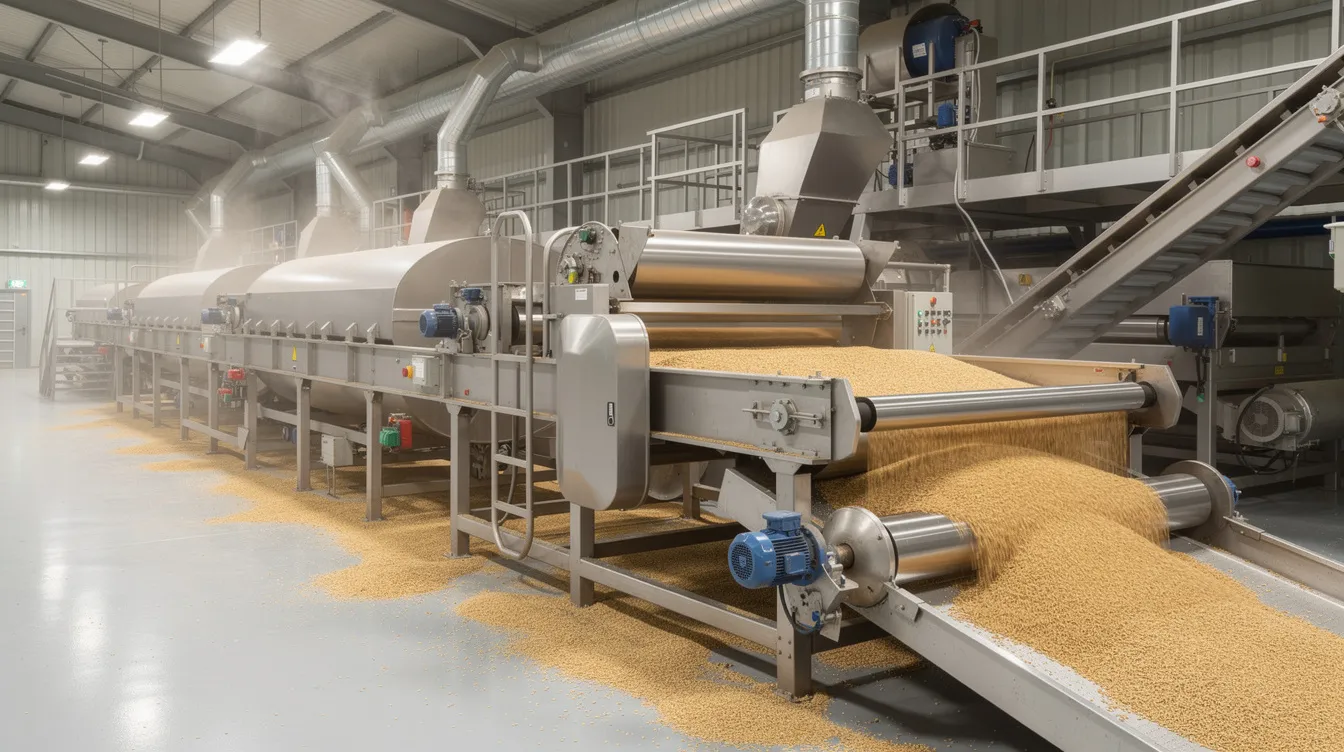
- Wheat cleaning and conditioning: Grain cleaners remove stones, dust and chaff from wheat grains; moisture is adjusted through conditioning to optimise the milling process.
- Milling: Roller mills or atta chakki mills break wheat into flour. Grain cleaners and roller mills are essential for flour production at any commercial scale.
- Flour handling: Conveyors, elevators and silos transfer and store intermediate flour before fortification.
- Premix dosing: Micro-feeders are crucial for accurate micronutrient fortification. Screw feeders are the most common type for flour fortification. Mills need one feeder per flour line to fortify flour accurately. The number of feeders needed depends on the number of production lines and flour output rates. The most common way to dose premix uses a revolving disk or screw mechanism that adds premix at calibrated rates.
- Mixing: Ribbon blenders or paddle mixers ensure homogeneous distribution. The manufacturing layout should minimize cross-contamination in the processing stages.
- Quality control: In-process sampling, retention samples and batch traceability from premix lot to finished flour batch. Calibration protocols are necessary to ensure accurate dosing of fortification ingredients.
Where a standalone blending plant sources pre-milled wheat flour from an external mill, the process begins at the premix dosing stage.
Fortified Wheat Flour Manufacturing Plant Machinery and Equipment
Machinery selection must align with chosen capacity, degree of automation and quality requirements. A detailed project report should include machinery specifications and procurement strategies. Machinery costs are the largest portion of capital expenditure in most fortified atta plants.
| Machinery | Function | Key Selection Factors |
|---|---|---|
| Pre-cleaner, destoner, magnetic separator | Wheat cleaning | Throughput, food-grade contact materials |
| Roller mill / chakki mill, plansifter | Flour milling | Extraction rate, energy efficiency |
| Pneumatic/screw conveyors, silos | Flour handling | Capacity, cleaning ease |
| Micro-dosing feeder (screw/loss-in-weight) | Premix dosing | Accuracy, calibration, automation |
| Ribbon blender / paddle mixer | Uniform mixing of fortificants | Batch size, homogeneity performance |
| Weighing and packing machine | Retail/bulk packing | Speed, pack-size flexibility |
| Metal detector, checkweigher | Safety and compliance | Sensitivity, integration |
| Lab instruments | Flour and nutrient testing | Accuracy, FSSAI method compatibility |
| Electrical panels, PLC, VFD | Process control | Reliability, supplier support |
Capital costs for flour mills range from $3,000 to $35,000 depending on the feeder type: a volumetric manual operation feeder costs $3,000 to $10,000, while automatic feeders can cost between $15,000 and $35,000. For a greenfield plant, the full equipment list spans from grain reception to packing; for an existing mill, only the fortification line (dosing, mixing, packing) may be needed. Imported equipment offers higher automation but greater cost, while indigenous suppliers provide competitive pricing. Maintenance and preventive measures should be implemented to ensure machinery functionality. For detailed wheat milling machinery and equipment cost analysis, readers may refer to our related guides.
Fortified Atta Plant Setup Cost in India
Fortified atta plant setup cost depends heavily on capacity, level of integration and location. For an illustrative 30 TPD integrated plant:
| Cost Head | Approx. Range (₹ Lakhs) |
|---|---|
| Land & Site Development | 30–60 |
| Building & Civil Works | 80–120 |
| Plant & Machinery (Milling + Fortification) | 80–150 |
| Utilities & Electricals | 15–30 |
| Lab & QC Equipment | 5–10 |
| Other Fixed Assets | 5–10 |
| Preliminary & Pre-operative Expenses | 10–20 |
| Contingency | 10–15 |
| Margin for Working Capital | 40–70 |
| Total Indicative Project Cost | 275–485 |
Recurring costs for premix are under $3 per metric ton of flour, making fortification economically viable. Operating costs increase significantly by the fifth year of operations as capacity utilisation, wages and materials scale up. An add-on fortification line for an existing mill may cost only ₹15–40 lakh versus ₹275+ lakh for a greenfield facility. All figures are indicative-actual costs depend on supplier quotations and project-specific factors.
Land, Building and Infrastructure Requirements
A small-to-medium fortified wheat flour plant typically requires 0.5–1.5 acres depending on capacity and integration. Key building zones include raw wheat storage, milling hall, fortification and blending section with controlled hygiene, a dedicated premix store (cool, dry and separate from strong-odour materials), finished goods warehouse, packaging and dispatch dock, quality control laboratory, and administrative facilities.
Technical infrastructure must cover adequate electrical connected load, ventilation and dust collection systems, compressed air for packing equipment, water supply for sanitation, and fire safety provisions. A well-designed plant layout minimises cross-contamination risks and optimises material flow from raw material intake to finished goods dispatch.
Raw Materials and Micronutrient Premix Requirements
An accurate raw material plan is vital for working capital estimation and uninterrupted flour production. Primary materials include wheat grains (or purchased wheat flour), micronutrient premix for iron, folic acid and vitamin B12, packaging materials (laminated pouches, HDPE/PP bags, labels) and secondary consumables.
Premix procurement requires selecting reputed suppliers with FSSAI-compliant formulations, demanding Certificates of Analysis per batch, maintaining proper storage conditions and FIFO rotation, and recording premix batch traceability against each flour batch. For a 30 TPD plant at 70% utilisation, daily premix consumption at 0.2% dosing rate is approximately 42 kg. Buffer stocks of 15–30 days for wheat and premix must be factored into working capital, especially given seasonal wheat price fluctuations.
FSSAI Requirements and Regulatory Compliance
Fortified wheat flour manufacturing must comply with the Food Safety and Standards Act and the Food Safety and Standards (Fortification of Foods) Regulations. Key statutory approvals include FSSAI license and BIS certification for fortified products. Wheat flour fortification must adhere to legal and nutritional standards as per local guidelines, and regulatory compliance is necessary to secure licenses for manufacturing and selling fortified wheat flour.
Operational factors must be addressed to ensure compliance with regulatory standards in food fortification, including prescribed micronutrient levels, permitted chemical forms of iron (three types are commonly used: ferrous sulphate, NaFeEDTA and ferric pyrophosphate), conditions for using the +F logo, and comprehensive labelling including nutritional information, batch details and FSSAI licence number. For global context, EU Regulation No 1925/2006 governs food fortification practices in European countries, while India follows its own FSSAI framework. Additional compliances include factory licence, pollution control consents, fire safety NOC and GST registration for taxes and commercial invoicing. Voluntary certifications like ISO 22000 or FSSC 22000 may enhance market acceptance.
Fortified Wheat Flour Plant Project Cost and Means of Finance
A credible fortified wheat flour plant DPR must present realistic project cost and balanced means of finance. Project financing requires detailed assessments of working capital, operating costs, and expected profitability. Financial viability analysis is essential for securing project financing and bank loans.
| Means of Finance | Approx. Share |
|---|---|
| Promoter’s Contribution (Equity) | 30–35% |
| Bank Term Loan | 55–65% |
| Working Capital Margin | 5–10% |
The exact structure depends on lender policies and risk assessment. Promoter contribution must be adequate to maintain comfortable debt-equity ratios. For detailed flour milling project cost and means of finance examples, readers may review our related analyses.
Working Capital Requirements for Fortified Atta Manufacturing
Working capital covers money blocked in raw material stocks, premix inventory, packaging materials, finished goods and trade receivables, less supplier credit. For a fortified atta plant, typical holding periods include 15–30 days of wheat inventory, 30–60 days of premix stock, 7–15 days of finished goods, and 30–45 days of receivables from distributors.
At full capacity for a 30 TPD plant, monthly raw material consumption alone may exceed ₹50–60 lakh depending on wheat prices. Bank working capital limits are assessed based on drawing power against stock and receivables, with margin money provided by the promoter. The interaction between working capital, profitability and loan servicing capacity is explained further in our guide on wheat milling financial projections and DSCR.
Fortified Wheat Flour Plant Financial Projections
Financial projections are the heart of every fortified wheat flour plant DPR. The report establishes technical feasibility and compliance with food safety standards while financial projections should include profit and loss statements and break-even analysis across 5–7 years.
Key statements include projected P&L, balance sheet, cash flow, fund flow, production and sales projections, depreciation schedule and term loan repayment schedule. Assumptions must cover capacity utilisation ramp-up, wheat and premix cost escalation, average realisation per kg by pack size, and operating expenses including power, manpower and marketing overheads.
Promoters requiring bank-ready Excel models and CMA Data customised to their proposed fortified atta plant can explore financial projections and financial modelling services from Project Report Bank. If you are preparing to approach banks for a fortified wheat flour project, connect with us through www.projectreportbank.com for customised DPR and CMA Data preparation.
Fortified Wheat Flour Plant Profitability, ROI, IRR and DSCR
Beyond projected profit, lenders and investors examine ROI, IRR, payback period and DSCR. A bankable project report should combine technical design, market research, and financial projections to present a credible risk-return profile. Risk management strategies should address potential fluctuations in wheat prices and sales volumes through sensitivity analysis.
| Scenario | DSCR (Avg.) | IRR |
|---|---|---|
| Base Case | 1.45–1.60 | 18–22% |
| Wheat Price +15% | 1.20–1.35 | 14–17% |
| Selling Price –10% | 1.10–1.25 | 12–15% |
These illustrative figures demonstrate how even modest changes in input costs or realisation can materially affect viability. No figures should be interpreted as guaranteed returns-actual results depend on execution, market conditions and cost control across all relevant factors.
Fortified Wheat Flour Manufacturing Plant Feasibility Study
A comprehensive feasibility study precedes and underpins a detailed DPR. It must evaluate:
- Technical feasibility: Machinery suitability, process flow, premix dosing accuracy and scalability.
- Market feasibility: Demand assessment, competition mapping, pricing strategy and customer segments.
- Financial feasibility: Investment versus projected cash flows, margins, IRR, DSCR and liquidity.
- Operational feasibility: An operational project requires a structured staffing plan and organizational hierarchy. Human resource planning must include training for safety and quality control standards. A fortified wheat flour manufacturing plant should include quality control protocols for raw materials and final products.
- Regulatory feasibility: Ability to obtain and maintain FSSAI licence and all relevant local permissions.
For a deeper understanding of feasibility methodology, readers may refer to our wheat flour processing project feasibility study guide. Medium and large-capacity plants especially benefit from professional project feasibility study services to avoid underestimating capital or overestimating market potential.
Bank Loan and Project Finance for a Fortified Atta Plant
Banks appraise manufacturing projects based on promoter background, project cost, means of finance, projected DSCR, collateral security and regulatory compliance. Key documents expected include the DPR, CMA Data for at least 5 years, net worth details, land documents, machinery quotations, FSSAI and GST registrations, projected DSCR, sensitivity scenarios and existing borrowing details.
Term loans finance fixed assets over 5–8 years, while working capital facilities (cash credit/overdraft) are assessed separately based on stock and receivables. Interest rates, sanction amounts and collateral requirements vary by bank and borrower profile. Promoters preparing to approach banks may consider bank finance DPR and loan proposal assistance tailored specifically for fortified atta manufacturing projects.
Key Risks and Challenges in Fortified Flour Manufacturing
A realistic fortified wheat flour manufacturing plant project report must address risks with practical mitigation measures:
- Wheat price volatility: Diversify sourcing, maintain buffer stocks and plan seasonal procurement.
- Inaccurate premix dosing: Invest in reliable micro-dosing equipment with regular calibration; the efforts required to maintain dosing accuracy are non-negotiable.
- Quality and shelf-life issues: Control moisture, ensure packaging integrity and conduct regular testing in adequate facilities.
- Competition: Established branded atta players and unorganised flour millers create pricing pressure; differentiate through consistent quality and the +F logo.
- Working capital strain: High inventory and receivable cycles strain cash flows; enforce tight credit policies.
- Capacity underutilisation: Phase capacity build-up realistically; explore contract manufacturing.
- Regulatory non-compliance: Conduct periodic compliance audits and ensure accurate labelling per current regulations.
How CA Manish Gugliya Can Assist with DPR and Project Finance
I am CA Manish Gugliya, a practising Chartered Accountant with over 20 years of professional experience in DPR preparation, project finance, CMA Data and manufacturing project advisory. Through Project Report Bank, I offer:
- Bankable DPR preparation covering technical, financial and regulatory aspects of fortified atta plants
- Customised financial projections and CMA Data for proposed capacity, market positioning and cost structure
- Project cost estimation, means-of-finance planning and DSCR/IRR/ROI analysis
- Working capital assessment and sensitivity analysis
- Bank loan proposal documentation and guidance on responding to banker queries
Advisory services are delivered from Ratlam, Madhya Pradesh, online across India. Promoters planning a fortified atta manufacturing business anywhere in India can connect via the WhatsApp enquiry option on www.projectreportbank.com.
Frequently Asked Questions
Can I start a small fortified wheat flour unit without owning a full roller flour mill?
Yes. You can source standard wheat flour from an existing mill and set up only fortification, blending and packing facilities. This significantly reduces capital costs. However, you still need an FSSAI licence, proper quality control protocols and compliant packaging and labelling.
What is the typical implementation timeline for a fortified atta manufacturing plant?
For a medium-scale plant, the timeline from land finalisation through building construction, machinery ordering, installation, trial runs and commercial production is typically 6–12 months. Larger integrated plants with imported equipment may take longer.
Do I need in-house laboratory facilities for a small fortified wheat flour plant?
At minimum, basic in-house testing for moisture, ash content and premix dosing verification is advisable. Periodic external laboratory analysis for micronutrient levels (iron, folic acid, vitamin B12) provides additional compliance assurance, even at MSME scales.
How often should premix dosing equipment be calibrated?
Practical recommendations include calibration at installation, after any maintenance work, and at defined regular intervals such as monthly or per your documented SOPs. Documentation of each calibration event is essential for quality assurance and regulatory compliance.
What should a fortified wheat flour plant DPR include?
A comprehensive DPR should cover project description, manufacturing process, machinery specifications, project cost, means of finance, production and sales projections, raw material and premix planning, financial statements (P&L, balance sheet, cash flow), working capital assessment, DSCR analysis, break-even point, sensitivity analysis and regulatory compliance details.
Conclusion – Planning a Bankable Fortified Wheat Flour Manufacturing Project
- The business case for fortified wheat flour manufacturing in India is supported by a growing health-conscious consumer base, value-added product positioning, alignment with national food fortification efforts, and expanding institutional demand across countries prioritising nutritional intervention.
- Success depends on technically sound milling and fortification, compliant premix dosing, strong market linkages, disciplined working capital management and realistic financial projections built on defensible assumptions.
- Each fortified wheat flour plant DPR must be customised for capacity, location, product mix, funding structure and risk profile rather than relying on generic templates.
Planning a Fortified Wheat Flour Manufacturing Plant in India? Get professional assistance with a Detailed Project Report, project cost, financial projections, working capital assessment, CMA Data and bank loan proposal preparation.
CA Manish Gugliya Manish Gugliya & Company, Chartered Accountants Ratlam, Madhya Pradesh | Online Services Across India Website: www.projectreportbank.com
WhatsApp Us for DPR & Project Finance Assistance