Key Takeaways
- The specialty flour manufacturing process in India follows either an “integrated milling + blending” or a “blending-only” route; this choice drives machinery investment, plant layout and project cost.
- Multigrain atta, fortified wheat flour, high-fibre atta, organic atta and bakery flour each require controlled grain milling, accurate ingredient dosing, specialised blending and strict quality control across every stage.
- A practical process flow chart covers raw material procurement, cleaning, milling, sieving, intermediate storage, blending, fortification, packaging and dispatch, with a shorter flow for blending-only plants.
- FSSAI standards, fortification norms, organic certification and food-safety systems must be built into the manufacturing process from the project-planning stage.
- Correct process design directly affects project cost, working capital, profitability, DSCR and the bankability of a Detailed Project Report (DPR).
Introduction: Why Specialty Flour Manufacturing Matters in India
India’s wheat flour and atta market has moved well beyond basic whole wheat flour. Consumers, commercial bakeries and professional bakeries now seek multigrain atta, fortified wheat flour, high-fibre atta, organic atta and customised bread flour or cake flour with specific protein levels and consistent performance. Urban retail formats, e-commerce and quick-commerce channels have accelerated this shift, alongside growing demand for gluten free baking options using rice, almond and chickpea varieties.
The specialty flour manufacturing process is a structured combination of wheat milling, fine flour classification, ingredient blending and process controls designed to achieve specific functional or nutritional properties. Specialty flour production involves a precise multi-stage manufacturing sequence, and the primary goal is functional performance tailored for baking applications ranging from bread baking to pastries and cakes. Some plants install a complete flour mill and do wheat milling on-site; others operate a specialty flour blending plant using purchased flour and milled ingredients.
Project Report Bank, led by CA Manish Gugliya, FCA, DISA (ICAI), prepares customised DPRs and project-finance advisory for entrepreneurs planning specialty flour processing plants across India. This article covers manufacturing flow charts, step-by-step processes, product-wise methods, machinery, quality, cost implications and DPR relevance.
Types of Specialty Flour Manufacturing Processes
Not all specialty flours are made the same way, even if they look similar in retail packs. Different flours behave differently in industrial mixers, and each must meet specific nutritional and functional requirements.
| Product | Manufacturing Approach | Important Process Consideration |
|---|---|---|
| Multigrain Atta | Milling and/or blending multiple grains | Formulation, uniform mixing, grind size of non-wheat grains |
| Fortified Wheat Flour | Wheat flour production or blending with micronutrient premix | Accurate micro-dosing and blending uniformity |
| High-Fibre Atta | Milling or blending fibre-rich ingredients | Fibre content, texture, chapati softness |
| Organic Atta | Processing certified organic raw materials | Segregation, traceability, NPOP compliance |
| Specialty Flour Blends | Combining formulated flour ingredients | Weighing accuracy and homogeneous blending |
Multigrain atta may involve integrated milling plus blending of millets, pulses and oats, or a pure blending route. Fortified wheat flour follows standard milling or procured wheat flour, then precise premix dosing. High-fibre atta depends on fibre ingredient selection and grind size. Organic atta requires strict segregation from conventional flour. Specialty flour blends and bakery flour rely on accurate weighing for bread baking, biscuits, cakes or gluten free lines using ingredients like rye, ancient grain flours and leavening agents alongside baking powder, sugar, salt and yeast where recipes demand fermentation control.
Entrepreneurs should decide early whether their project will be integrated milling + blending or blending-only, as this changes project cost and feasibility assumptions.
Specialty Flour Manufacturing Process Flow Chart
Lenders, investors and plant engineers expect a clear specialty flour manufacturing flow chart in any professional project report. Below is an illustrative integrated manufacturing flow:
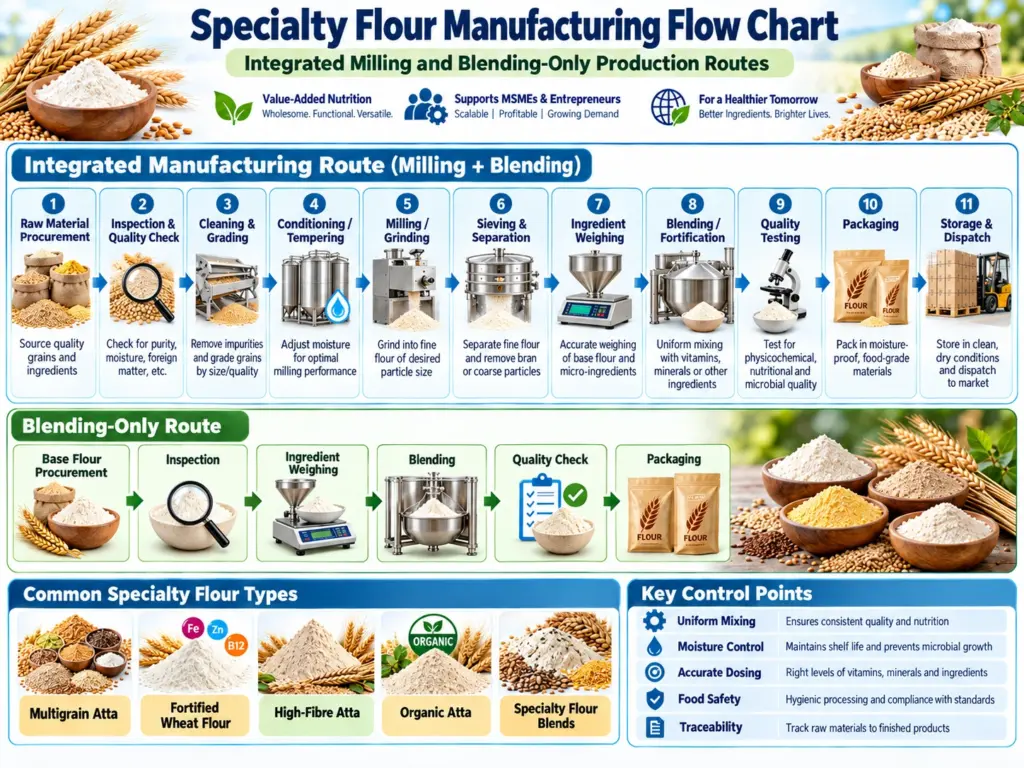
Integrated Manufacturing Flow:
Raw Material Procurement ↓ Raw Material Receipt and Inspection ↓ Grain Cleaning and Foreign Material Removal ↓ Grading and Sorting ↓ Conditioning or Tempering ↓ Grain Milling and Grinding ↓ Sieving and Particle Size Classification ↓ Intermediate Flour Storage ↓ Ingredient Weighing and Formulation ↓ Additional Ingredient / Premix Dosing ↓ Flour Blending and Homogenisation ↓ In-Process Quality Testing ↓ Final Sieving / Metal Detection ↓ Packaging and Batch Coding ↓ Finished Product Storage ↓ Dispatch and Distribution
Blending-Only Flow:
Flour & Ingredient Procurement → Receipt & Quality Check → Ingredient Weighing & Formulation → Flour Blending & Homogenisation → In-Process Quality Check → Final Sieving / Metal Detection → Packaging & Coding → Finished-Goods Storage → Dispatch
Fortified wheat flour premix is typically added after milling through a micro-dosing system. Organic atta requires full segregation of material flow. Small MSME units may implement a simplified version with more manual handling. Specialty flour production often involves more process adjustments and validations than standard atta. These charts are illustrative and should be refined during plant-specific DPR preparation.
Step-by-Step Specialty Flour Manufacturing Process
This section breaks the flow into practical steps relevant for most specialty flours, from grain to finished pack. Each subsection describes typical Indian plant practices without prescribing fixed recipes.
Raw Material Procurement and Selection
Raw grains are received, sampled and tested for moisture and protein before acceptance. Wheat procurement targets 11-13% moisture; excess moisture increases microbial risk and affects storage stability. Hard wheats are higher in protein for bread making, while soft wheats are ideal for pastries and cakes. Specialty bakery flour focuses on selecting the right raw wheat variety for the intended application.
For multigrain atta, millets (jowar, bajra, ragi), oats, pulses (chana, soybean) and fibre sources (wheat bran, oat fibre, psyllium husk) must each meet established safety and quality standards before processing. Specialty flour manufacturing often emphasises identity preservation and sourcing, with supplier approval systems, consistent specs and documentation for traceability. Long-term wheat and grain procurement planning affects working capital and bank finance requirements. For wheat flour mill projects, raw material sourcing directly shapes DPR assumptions.
Cleaning and Grading
Incoming grains pass through receiving pits, pre-cleaners, vibrating screens, aspiration channels, destoners and magnetic separators. Vibrating screens and separators remove stones and oversized debris. Cleaning equipment like aspirators and destoners remove impurities from grains, while magnetic separators extract stray metallic fragments. Cleaning removes dust, chaff, metal pieces and weed seeds; these contaminants affect flour colour, ash content, equipment life and food safety.
Grading separates cleaned wheat or other grains by size, ensuring uniform behaviour during conditioning and milling. Even blending-only plants receiving milled flour should use sieving and magnets to eliminate lumps and metallic contamination.
Conditioning and Milling
Conditioning adjusts the moisture content of grains for effective milling. Clean wheat is brought to the desired moisture level and rested in tempering bins so the bran becomes tougher and separates in large flakes, protecting the inner endosperm. Moisture affects milling performance and storage stability of flour.
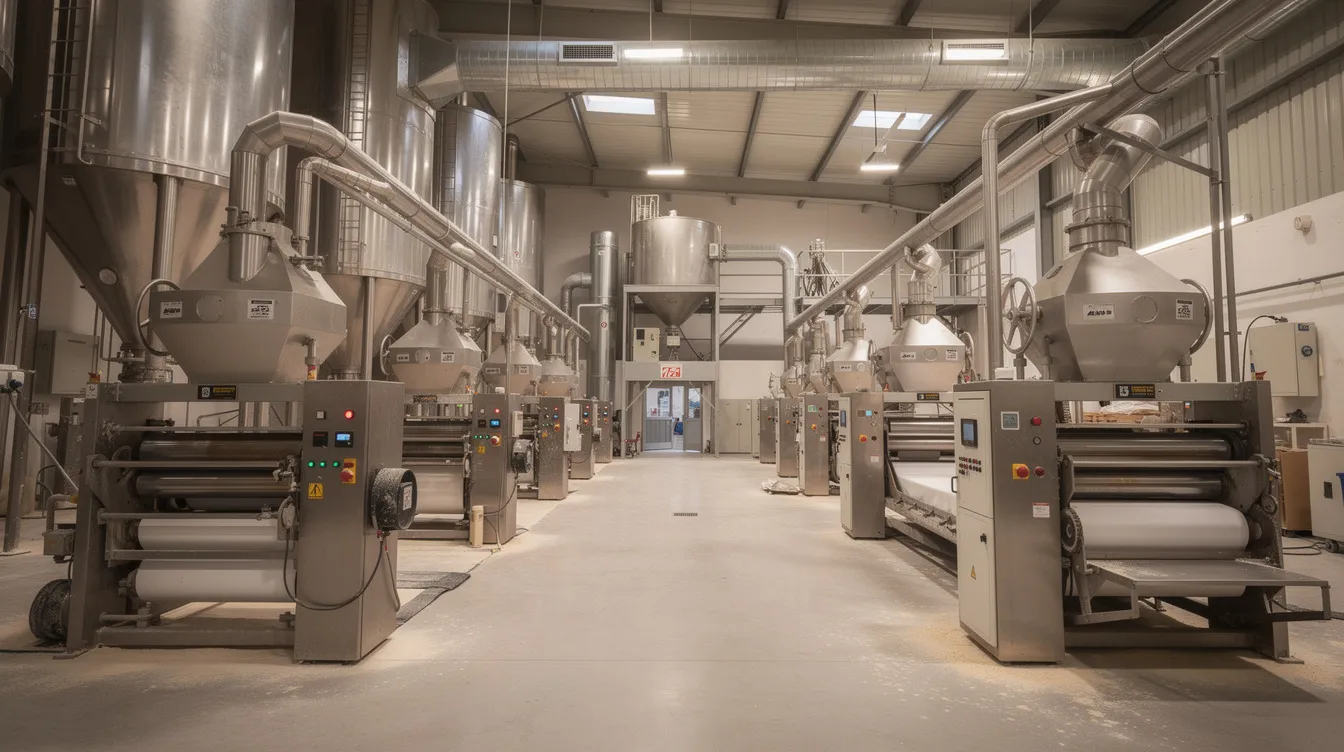
The milling process separates bran, germ and endosperm through mechanical breakdown of raw material into fine particles. Roller milling replaced stone milling during the industrial revolution, and modern milling uses multiple stages for precise flour quality control. Conditioned wheat moves through break rolls, reduction rolls and sifters in a roller flour mill. Flour milling processes control protein levels and starch damage. From 100 pounds of wheat, approximately 75 pounds of flour are extracted; the remainder becomes bran and germ fractions, often sold as animal feed.
Heat generation during milling can ruin heat-sensitive oils and vitamins, so specialty flours require specialised milling setups to avoid heat degradation. Temperature management during processing prevents alteration of functional properties. The choice of milling technology depends on material hardness and desired particle size. Enzymes activated during processing can alter the nutritional properties of flours. Some plants use hammer mills or pulverisers for non-wheat ingredients to achieve the desired grind for multigrain atta. For detailed atta manufacturing process and flow chart guidance, millers can refer to our dedicated article.
Sieving and Particle Size Control
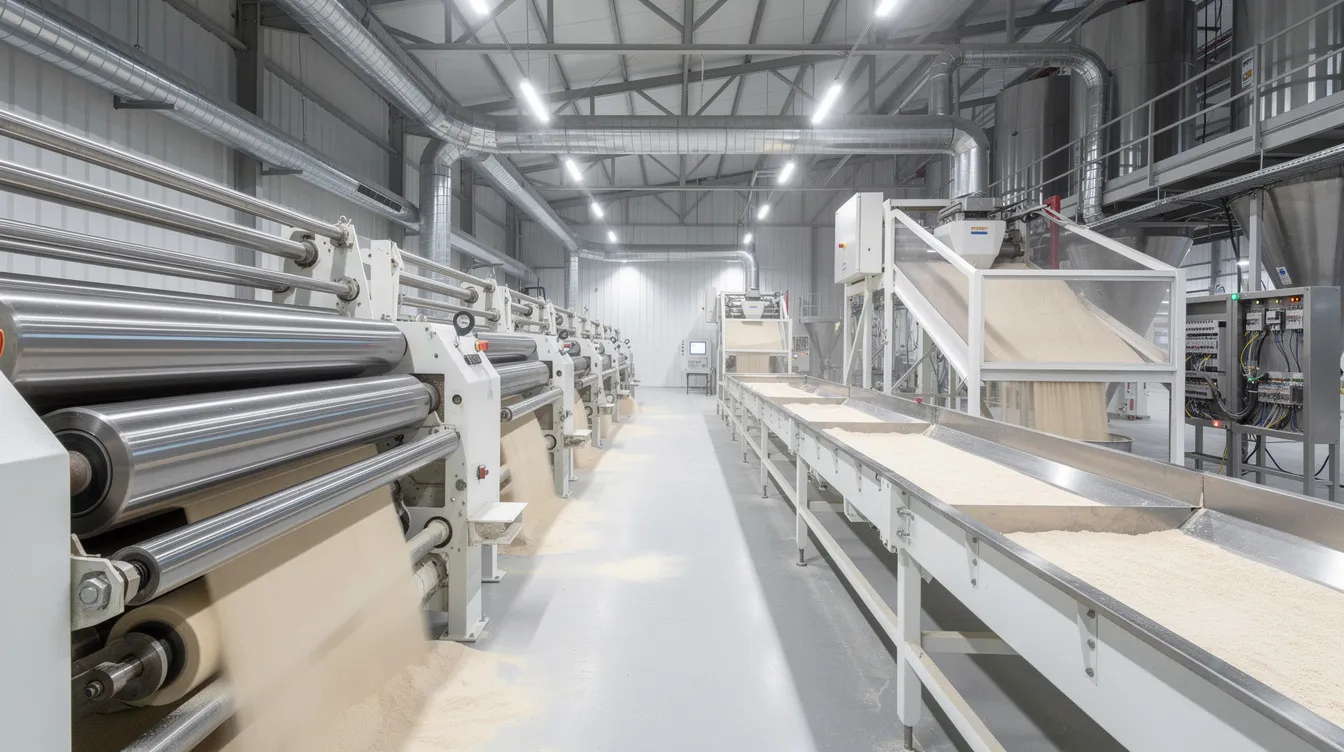
Plansifters and vibro sifters classify flour into different particle sizes. Sifting separates coarse bran fragments from fine flour. Air classification separates flour particles based on size and density, enabling production of white flour, semolina and bran fractions from the same wheat. Uniform particle size is critical for consistent water absorption in dough handling, bread volume and industrial baking performance.
Ingredient Formulation and Weighing
Each specialty flour product has a defined formulation specifying proportions of wheat flour, other grains, bran, fibres and permitted additives. Accurate weighing via electronic platform scales or load cells is essential. Consistent flour quality ensures stable water absorption in baking; flour quality affects dough elasticity and baking performance. Written SOPs, batch cards and formulation controls protect commercial recipes. For organic atta, only certified organic ingredients may be used, and batch records must support traceability.
Specialty Flour Blending
Most specialty flours are produced in ribbon blenders, paddle mixers or ploughshare mixers. Base wheat flour, milled multigrain components and functional ingredients are loaded in a defined sequence to minimise segregation. Practical considerations include blender fill level, mixing time, rotation speed and the risk of demixing during conveying. High-performance flours that enhance baking efficiency and quality require homogeneous mixing verified through sampling. Automated plants may use PLC and recipe management systems for traceable batch reports, which support lender and customer audits.
Fortification or Functional Ingredient Addition
Fortified wheat flour is produced by dosing a premix of vitamins and minerals (iron, folic acid, vitamin B12 as per FSSAI norms) through a micro-dosing system. High-fibre atta may include wheat bran, oat fibre or protein concentrates. Controlled thermal treatment can improve shelf life and functional properties where applicable. Specialty flours may require additional processing to improve shelf life. Inclusion percentages must be developed through product trials and regulatory review.
Quality Control and Testing
Quality control is essential throughout specialty flour manufacturing processes. Quality control testing focuses on basic parameters like moisture and ash content. Testing for mycotoxins and contaminants is important for food safety. Specialty flour manufacturing requires specialised diagnostic testing for allergen control; cross-contamination controls are vital for gluten free or allergen-sensitive products.
Flour quality affects the structure and texture of baked goods. Microbiological testing (total plate count, yeast and mould) is expected by larger industrial baking customers. Bakers and millers rely on sampling plans and retention samples for traceability.
Packaging and Storage
Typical Indian specialty flour packaging includes 1 kg, 2 kg, 5 kg and 10 kg retail pouches, plus 25 kg and 50 kg bags for B2B customers. Packaging lines include form-fill-seal machines, metal detection and batch coding. Moisture protection in packaging is critical for maintaining flour quality. Specialty flours can improve texture and shelf life of baked goods when properly packaged with barrier materials. Storage must be low-moisture, pest-free and follow FIFO inventory management.
Product-Wise Specialty Flour Manufacturing Methods
While the generic process remains similar, each specialty flour has specific raw material and process nuances affecting project planning.
Multigrain Atta Manufacturing Process
Multigrain atta uses wheat as the main base along with millets, oats, soya and chana. Each grain is individually cleaned, sometimes roasted for flavor development, then milled and mixed to target formulation. Grind size of non-wheat components must be fine enough to avoid gritty texture in pancakes or chapatis. Oil content in oats or soya increases rancidity risk. Entrepreneurs evaluating a dedicated project can refer to our Multigrain Atta Manufacturing Plant Project Report & DPR.
Fortified Wheat Flour Manufacturing Process
Fortified wheat flour starts with standard wheat milling to produce atta or refined flour, followed by addition of a scientifically formulated micronutrient premix. FSSAI prescribes iron at 20 mg/kg, folic acid at 1,300 µg/kg and vitamin B12 at 10 µg/kg. Process controls include calibrating dosing devices and maintaining premix batch traceability. Readers can explore the Fortified Wheat Flour Manufacturing Plant Project Report & DPR for bankable DPR preparation.
High-Fibre Atta Manufacturing Process
High-fibre atta can be produced by retaining more bran during milling or blending additional fibre sources into wheat flour. Maintaining chapati softness while increasing fibre content requires fine grinding and controlled fibre particle size. Water absorption and dough mixing time change for high-fibre products, making pilot trials essential. The High-Fibre Atta Manufacturing Plant Project Report & DPR covers feasibility analysis for such products.
Organic Atta Manufacturing Process
Organic atta manufacturing focuses on certified-organic raw material sourcing and strict segregation rather than different milling technology. Certified organic wheat and millets must be procured from accredited suppliers, stored in dedicated bins and processed to meet NPOP standards. Documentation requirements include organic certificates, transaction certificates and periodic audits. The Organic Atta Manufacturing Plant Project Report & DPR addresses both organic-only and mixed plant configurations.
Specialty Flour Blending Process
Some investors choose a blending-only model where they buy wheat flour, fine flour and milled ingredients from existing flour mills, then create value-added formulations through blending, fortification and packaging. Advantages include lower capex and faster commissioning, but dependence on stable suppliers and quality agreements is higher.
Specialty Flour Manufacturing Machinery and Equipment
Machinery configuration varies depending on whether the project includes wheat milling, only blending, or both.
| Equipment | Function | Required For |
|---|---|---|
| Grain cleaners, destoners | Remove foreign material, stones | Integrated Milling |
| Magnetic separators | Extract metallic fragments | Both |
| Roller flour mills | Break rolls, reduction rolls for grain milling | Integrated Milling |
| Hammer mills / pulverisers | Grinding millets, pulses, bran | Both |
| Vibro sifters / plansifters | Particle size classification | Both |
| Ribbon blenders / paddle mixers | Flour blending and homogenisation | Both |
| Micro-dosing systems | Premix / fortification addition | Both |
| Screw conveyors, bucket elevators | Material transfer | Both |
| Dust collectors | Dust control and recovery | Both |
| Packaging machines | Form-fill-seal, sealing, coding | Both |
| Metal detectors | Final safety screening | Both |
| Lab equipment | Moisture, ash, protein, gluten testing | Both |
Automation levels (manual bagging vs. automatic form-fill-seal, basic batch controllers vs. PLC systems) heavily influence investment cost and labour productivity. The specialty flour plant machinery, equipment and cost article provides detailed discussion of equipment options and approximate investment ranges.
Plant Layout and Production Flow Considerations
Plant layout should follow a logical one-direction material flow: raw material in, cleaning and milling, blending, packing, finished goods out. This reduces cross-movement and contamination risk. Key areas include raw material receiving bay, cleaning and milling section, intermediate flour storage bins, ingredient weighing room, enclosed blending room, QC laboratory, packaging hall and finished-goods warehouse. Dust-generating operations require dust collection and ventilation. Organic atta and allergen-sensitive ingredients need separate storage, colour-coded equipment and dedicated transfer lines.
Quality Control, Food Safety and Compliance
Specialty flour manufacturing in India is governed by FSSAI regulations, fortification standards and organic certification rules. Plants must hold the correct FSSAI licence category, adhere to contaminant limits and implement Good Manufacturing Practices and GHP. HACCP-based food safety management systems cover hazards like foreign matter, microbial contamination and allergen cross-contact. Organic claims require traceability from farm to pack. Mandatory requirements include licensing and basic standards; advanced certifications like ISO 22000 are best practices that support market entry and financier confidence.
Production Efficiency and Process Optimisation
In specialty flour production, efficiency improvements directly impact cost per kg and DSCR projections. Consistent raw material quality reduces machine adjustments and milling losses. Appropriate milling settings control starch damage and energy consumption. Monitoring indicators such as flour extraction rate, blending variance, packaging speed, rework percentage and energy consumption per ton helps management refine processes. Preventive maintenance, optimised batch sizes and coordination between blending and packaging avoid bottlenecks.
Manufacturing Process and Its Impact on Project Cost
An integrated wheat milling + specialty flour plant requires higher capital expenditure on roller mills, silos, civil work and electrical load. A 30 TPD basic roller flour mill costs ₹60-90 lakh for machinery alone; a 100 TPD fully equipped plant reaches ₹2.0-3.5 crore. A blending-only plant at 5 TPD costs ₹50-80 lakh in machinery. Process configuration influences capacity planning, labour, QC lab investment and overall fixed and variable manufacturing costs.
Working capital dynamics differ: integrated mills stock raw wheat and by-products, while blending plants tie capital in purchased flour and ingredients. Both routes affect project cost estimation, means of finance, promoter contribution, profitability and DSCR. The specialty flour plant setup cost in India article provides an overview of cost elements and investment planning.
Importance of Manufacturing Process in a Bankable DPR
Banks review the manufacturing process chapter to assess technical feasibility and commercial soundness. Lenders examine choice of technology, suitability of machinery, installed capacity versus achievable capacity, capacity-utilisation ramp-up and estimated process losses. Raw material availability, logistics and supplier dependency are scrutinised to confirm reliable flour production over the loan tenure. Revenue, gross margin and DSCR projections must be consistent with the chosen process route and realistic selling prices. At Project Report Bank, each DPR is prepared with project-specific technical and financial assumptions rather than generic templates.
Common Mistakes in Specialty Flour Manufacturing Projects
Many promoters focus on brand and marketing but underestimate process planning:
- Selecting raw materials purely on price, ignoring moisture, fungal load and wheat variety properties, which later affects product quality and customer complaints.
- Choosing under-sized milling or blending equipment that cannot achieve required particle size or homogeneity, resulting in inconsistent products and rework.
- Weak formulation controls causing batch variability in fibre content, fortification levels and water absorption.
- Inadequate segregation for organic grains or allergen-containing ingredients, risking compliance failures.
- Underestimating packaging material cost and working-capital needs for inventory of flour, grains and finished stock.
- Planning a full wheat milling line when a flexible blending-only model would have been more appropriate for the promoter’s resources and market.
Early technical-financial planning with a professional DPR can prevent each of these problems.
Frequently Asked Questions
What is the specialty flour manufacturing process in simple terms?
Specialty flour manufacturing involves cleaning and, where applicable, milling wheat and other grains, then accurately blending them with fibres, micronutrients or functional ingredients to achieve targeted properties for bread baking, chapati making or industrial baking. The process can be grain-to-flour (integrated) or flour-to-specialty-flour (blending-only).
Can I manufacture specialty flour without a complete wheat milling plant?
Many MSMEs choose a blending-only model, purchasing standard wheat flour and other milled ingredients from established mills. This reduces capex and technical complexity but requires strong supplier relationships and quality-control systems to maintain consistent output.
What is the difference between flour milling and flour blending?
Flour milling refers to grinding and separating grains into flour and by-products like bran, using break rolls and reduction rolls. Flour blending refers to mixing already-milled flours and ingredients in defined proportions to create value-added specialty flours. Many large plants combine both; smaller units may focus exclusively on blending.
How does the manufacturing process influence working-capital and bank finance needs?
Integrated mills stock raw wheat and maintain in-process inventory, while blending plants tie working capital in purchased flour and ingredients. Cycle length, credit terms and process yields all affect working-capital assessment in a bank loan proposal, making accurate process mapping essential for realistic CMA Data and DPR preparation.
What quality tests are needed for specialty flours supplied to industrial bakeries?
Typical tests include moisture, ash content, gluten performance, protein content, particle size, falling number, microbiological parameters and fortification levels where applicable. Individual industrial customers may require performance trials such as bread volume or dough-handling tests before approving regular supplies.
Conclusion and Professional Advisory
Successful specialty flour manufacturing in India depends on selecting the right combination of wheat milling, blending technology, quality systems and capacity planning, aligned with target products. Manufacturing process design is a financial decision as much as a technical one, influencing capex, operating cost, working capital, profitability and DSCR.
Planning a Specialty Flour Manufacturing Plant in India?
CA Manish Gugliya, FCA, DISA (ICAI), provides professional assistance with Detailed Project Reports, project feasibility studies, financial projections, CMA Data preparation and bank finance proposals for manufacturing projects. For project-related enquiries, connect through Project Report Bank at www.projectreportbank.com. WhatsApp is available through the existing contact options on the website for initial project discussions.