By CA Manish Gugliya | FCA, DISA (ICAI) | 20+ Years of Professional Experience
Key Takeaways
- Initial investment for small-to-medium specialty flour setups ranges from ₹15 lakh to over ₹2 crore, while a fully automatic flour mill plant can exceed ₹2 crore in India. Globally, flour mill setup costs range from USD 0.5–10 million depending on scale.
- The total project cost varies based on production scale and level of automation – not just equipment cost. Machinery accounts for 45%–55% of total flour mill costs, with building costs, civil works and working capital forming the balance.
- Specialty flour manufacturing (multigrain, fortified, high-fibre, organic) demands higher machinery requirements and quality-control investment than a basic flour mill plant.
- All figures here are indicative estimates; accurate flour mill project cost requires supplier quotations and a customised Detailed Project Report.
- Project Report Bank, led by CA Manish Gugliya, provides professional DPR preparation, project cost estimation and bank finance advisory for specialty flour projects.
Introduction – Understanding Specialty Flour Plant Setup Cost in India
Setting up a specialty flour plant in India requires careful financial planning that goes well beyond buying a milling machine. The specialty flour plant setup cost in India depends on whether you are producing multigrain atta, fortified wheat flour, high-fibre atta, organic atta or customised bakery blends – each with distinct cost drivers. Specialty flour blends include high-protein and organic options that the flour mill industry increasingly demands. Standard wheat flour plants typically produce atta, maida and suji, but specialty products need additional blending, dosing and quality infrastructure.
Two broad project models exist. A blending-only plant purchases base flour from a roller flour mill and invests primarily in mixers, dosing systems and packaging units. An integrated specialty flour mill plant handles grain cleaning, milling, blending and packing under one roof – requiring substantially higher initial investment, power consumption and building layout complexity.
How Much Does It Cost to Set Up a Specialty Flour Plant in India?
Flour mill setup costs range from ₹10 lakh to ₹2 crore for most small-to-medium Indian specialty flour projects. For larger capacities, a 50 TPD flour mill costs between USD 0.5–3 million, and construction for a 100 TPD flour mill costs USD 2–3 million. Costs vary based on plant scale and automation level.
| Plant Capacity | Machinery Investment (₹ Lakh) | Infrastructure (₹ Lakh) | Total Indicative Setup Cost (₹ Lakh) |
|---|---|---|---|
| 1 TPD (blending) | 8–15 | 7–10 | 15–25 |
| 5 TPD (semi-auto) | 15–35 | 20–45 | 35–80 |
| 10 TPD (integrated) | 40–100 | 75–145 | 115–245 |
| 20 TPD (higher automation) | 80–150 | 70–150 | 150–300+ |
Estimates assume land owned; exclude GST; working capital margin included in broad ranges. For a 150-ton/day plant, machinery alone may require USD 400,000–550,000.
A blending-only specialty flour plant at the same capacity typically costs 30–50% less than an integrated flour mill plant because it eliminates grain cleaning machines, roller mills and heavy civil works. Proper budgeting requires at least 2–3 comparable supplier quotations and a customised DPR before final investment decisions.
Major Components of Specialty Flour Manufacturing Plant Setup Cost
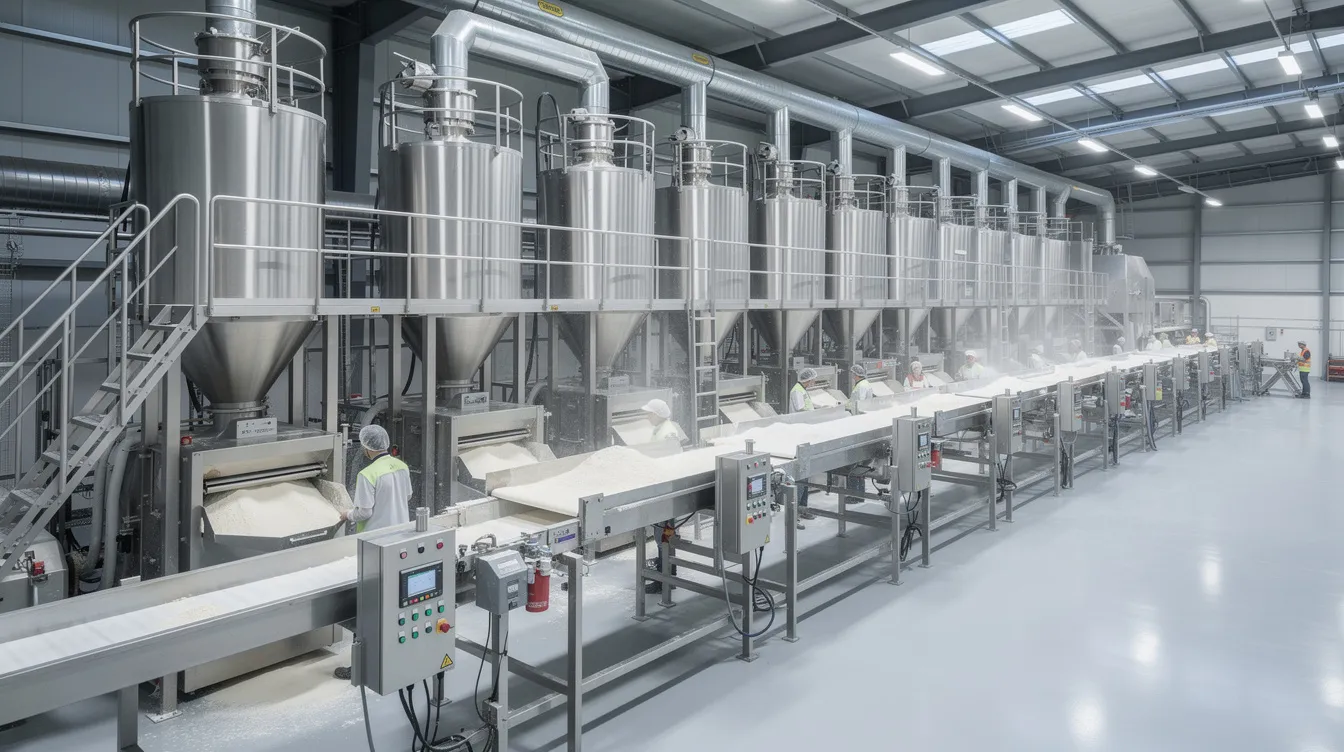
Plant and machinery costs can depend on processing capacity and required technology, but the full flour mill project cost includes many more heads. Construction and infrastructure development costs vary based on location and plant capacity.
Key cost components for a 5–10 TPD plant typically break down as follows:
| Component | Indicative Range (₹ Lakh) | Share of Total |
|---|---|---|
| Plant & machinery | 15–100 | 35–45% |
| Factory building & civil works | 15–60 | 20–30% |
| Electrical installations & utilities | 5–20 | 5–10% |
| Storage & material handling | 3–15 | 3–7% |
| Lab, QC & packaging equipment | 3–12 | 3–6% |
| Pre-operative expenses & contingency | 3–15 | 3–8% |
| Working capital margin | 10–25 | 8–15% |
A higher automation level, dust-free plant design and food-safety infrastructure push both civil and equipment cost significantly above a basic atta chakki plant.
Specialty Flour Plant Machinery and Equipment Cost
Typically required machinery includes cleaning systems, specialized millers and packaging equipment. Flour milling includes cleaning, conditioning, milling and sifting stages. Cleaning machines remove impurities from raw grains. Roller mills ensure fine and uniform grinding of wheat. Sifters separate different flour textures for quality control. Automated packing machines maintain hygiene and reduce handling. Storage silos hold raw grains and finished flour efficiently. A fully automatic flour mill can process various grains like wheat and maize.
Core equipment includes ribbon blenders, micro-dosing systems for fortification premixes, conveying equipment, dust collection systems, PLC automation panels, metal detectors and weighmetric packing machines. The cost depends on whether you choose Indian-made or imported advanced machinery, mild-steel or stainless-steel contact parts, and manual versus automated batching. Evaluate detailed specifications, warranty and spare parts availability – not just headline price.
Land, Building and Infrastructure Cost
Land costs range from ₹10 lakh to ₹1 crore in industrial areas across India, varying enormously between rural areas and tier-1 cities. A 1–5 TPD blending unit may need 1,500–3,000 sq. ft. built-up area, while 10–20 TPD integrated plants require larger plots with higher ceiling height for vertical material flow. Space utilization and building layout should accommodate separate zones for raw material storage, processing, packing, finished goods and a QC lab – especially crucial for organic and fortified products requiring contamination prevention.
Leasing premises in industrial estates reduces upfront building costs but limits plant design flexibility. Utilities costs include electricity and water for plant operations, plus transformer installation, internal wiring and water treatment.
Setup Cost Comparison for Different Specialty Flour Products
While core flour mill plant machinery may overlap, each specialty product carries unique cost drivers.
| Product | Machinery Complexity | Additional Investment Drivers | Typical Model |
|---|---|---|---|
| Multigrain atta | Medium–High | Multiple grain bins, recipe control | Integrated |
| Fortified wheat flour | Medium | Precision dosing, FSSAI compliance | Integrated |
| High-fibre atta | Medium | Upgraded sifters, dust control | Integrated |
| Organic atta | Medium | Separate storage, certification | Either |
| Specialty blending | Low–Medium | Branding, packing lines | Blending-only |
Multigrain Atta Manufacturing Plant Setup Cost
Multigrain atta blends wheat with other grains like jowar, bajra, ragi and oats, demanding multiple storage bins, separate cleaning lines and robust ribbon blenders. Equipment cost rises with recipe flexibility and product changeover frequency. For detailed financials, see the Multigrain Atta Manufacturing Plant Project Report & DPR.
Fortified Wheat Flour Plant Setup Cost
Fortified flour plants add micronutrient premixes using high-precision, low-dose feeding systems and require strict FSSAI fortification compliance. QC lab investment is moderately higher. Explore the Fortified Wheat Flour Manufacturing Plant Project Report & DPR for plant-specific economics.
High-Fibre Atta Manufacturing Plant Setup Cost
High-fibre atta involves higher bran content and coarse grain fractions, influencing milling and sifting configurations. Packaging materials with moisture-barrier properties are essential. Details are available in the High-Fibre Atta Manufacturing Plant Project Report & DPR.
Organic Atta Manufacturing Plant Setup Cost
Organic atta requires segregated storage, farm-to-pack traceability and NPOP certification – adding recurring audit and documentation costs. Review the Organic Atta Manufacturing Plant Project Report & DPR for certification cost guidance.
Specialty Flour Blending Plant Setup Cost
Blending-only plants buy base flour from external mills and invest in blenders, packaging units and branding rather than heavy milling equipment – substantially reducing plant cost and power load. See the Specialty Flour Blending Plant Project Report & DPR.
Broader wheat-processing options including conventional milling are covered in the Roller Flour Mill Project Report & DPR.
Specialty Flour Plant Capacity Planning and Investment Requirements
Capacity selection is crucial to balance flour mill setup cost, production capacity utilisation and debt exposure. A 50 TPD plant produces 8,000–10,000 tons annually, while a 300 TPD plant operating at 80% utilization produces 72,000 tons annually. A 500 TPD facility can scale to over 150,000 tons. Investment recovery periods typically range from 3 to 5 years for well-planned projects.
For most MSME promoters entering specialty flour, 5–10 TPD is a practical starting scale. Oversizing the plant inflates interest burden and lowers DSCR during the crucial early years when the target market and distribution are still developing.
Working Capital Requirements for Specialty Flour Manufacturing
Working capital is essential for purchasing raw materials and covering initial operational costs. Raw material procurement costs can represent a significant portion of total operating expenses. For a 5–10 TPD specialty flour plant, working capital requirement typically falls between ₹10–25 lakh, covering grain inventory, premixes, packaging materials, finished goods and trade receivables – net of supplier credit.
Operational expenses for flour production can include raw material costs, utilities and manpower. Retail branded flour operations generally require higher working capital than B2B bulk supply due to longer receivable cycles and wider SKU inventory. Banks typically expect 20–25% margin from promoters on sanctioned working capital facilities.
Specialty Flour Plant Project Cost and Means of Finance
A bankable DPR aligns all cost heads into a structured project cost and means of finance table. For a sample 10 TPD integrated specialty flour plant:
| Head | Amount (₹ Lakh) |
|---|---|
| Total Project Cost | 180 |
| Promoter’s Contribution (30%) | 54 |
| Bank Term Loan (55%) | 99 |
| Working Capital Finance (15%) | 27 |
Actual debt-equity structure depends on bank norms, promoter financials, collateral and project risk profile. Project Report Bank prepares bankable DPRs and loan proposals customised to each specialty flour project.
Financial Projections, Profitability and DSCR Considerations
Financial modeling is crucial for projecting cash flows and profitability before committing capital. Market demand influences pricing and profitability in specialty flour production. Labor costs typically represent 12%–15% of total operational expenses, while electricity consumption averages 55–65 kWh per ton of flour produced.
DSCR analysis, break-even capacity, return on investment and sensitivity testing should be part of every serious flour mill project evaluation. Premium specialty products do not automatically guarantee long term profitability – success depends on cost control, capacity utilisation and distribution efficiency. Project feasibility studies assess the viability of new manufacturing initiatives before investors commit funds.
Licences, Registration and Regulatory Requirements
FSSAI registration is mandatory for food safety compliance in India. Licensing and regulatory approvals are necessary for food processing operations in India. Statutory approvals may require budgeting for lab testing and compliance costs. Key registrations include GST, Udyam (MSME), factory licence, state pollution control NOC, Legal Metrology compliance for packaged goods and – for organic products – NPOP certification from accredited bodies. Fortified flour must comply with FSSAI fortification standards.
Government Subsidies and Bank Loan Opportunities
Government schemes like the PMFME scheme provide financial support for micro food enterprises. State-specific incentives, CGTMSE credit guarantees and interest subvention programmes may also apply, but eligibility is project- and location-specific. Treat subsidy as a possible upside rather than the primary budget justification for your investment.
Factors That Can Increase or Reduce Specialty Flour Plant Setup Cost
The cost depends on integrated milling versus blending-only operations, automation level (fully automatic versus semi-automatic), indigenous versus imported machinery, product variety, factory location, packaging formats and plant size. Packaging is important for maintaining the quality and shelf-life of specialty flours and can significantly influence packing-line investment.
Investment planning checklist: clarity on target market and demand, realistic production capacity, decision on integrated versus blending model, automation expectations, comparable supplier quotations, provision for phased expansion and expert guidance from a project finance professional.
Common Investment Planning Mistakes
Many flour mill projects face stress from planning errors rather than weak market demand:
- Underestimating working capital for branded retail operations
- Selecting oversized machinery based on optimistic projections
- Ignoring installation, commissioning and trial-run costs
- Comparing machinery quotes without matching specifications and maintenance costs
- Assuming immediate full-capacity utilisation
- Neglecting packaging, distribution and marketing in the budget
- Applying for a bank loan without a robust DPR and CMA Data
Each mistake is avoidable through phased capacity expansion, pre-launch market validation and realistic financial projections prepared with professional support.
Why a Detailed Project Report Is Important Before Investment
A DPR is a decision-making tool – not just a bank formality. A well-prepared specialty flour DPR covers plant capacity, detailed breakdown of machinery and civil works costs, working capital assessment, 5–7 year financial projections, break-even, DSCR and sensitivity analysis. Realistic assumptions on input costs, selling prices, capacity utilisation and credit terms are essential for defensible projections.
Project Report Bank provides project feasibility studies and bank-ready financial documentation for specialty flour projects.
Planning to establish a specialty flour manufacturing plant in India? CA Manish Gugliya provides professional assistance with Detailed Project Reports, project cost estimation, financial projections, CMA Data and bank loan proposals. Connect through Project Report Bank on WhatsApp to discuss your proposed investment.
Frequently Asked Questions
What is the typical specialty flour plant setup cost in India for a new entrepreneur?
For a small scale flour mill or blending unit (1–5 TPD), total setup cost typically ranges from ₹15–80 lakh, depending on whether you choose a blending-only or integrated flour mill plant. This generally covers machinery, basic civil works and electricals but excludes land purchase, GST and full working capital. A customised DPR with supplier quotations is essential for accurate budgeting.
How much investment is needed specifically for a 5 TPD specialty flour plant?
A 5 TPD semi-automatic specialty flour plant typically requires ₹35–80 lakh in total investment, assuming leased or owned premises. The exact figure depends significantly on automation level, machinery specifications and whether the plant includes grain cleaning and milling or only blending and packing operations. Detailed supplier quotations are necessary before finalising the flour mill setup cost.
Is it cheaper to set up a specialty flour blending plant instead of an integrated flour mill?
Yes, blending-only plants require lower equipment cost, simpler factory building, smaller electrical load and less civil works – often 30–50% less capital than integrated milling. However, they depend on reliable external roller flour mills for base flour supply and may have different margin structures. The choice should align with your business model, scale and target market strategy.
Can I get bank finance for specialty flour plant setup cost without a DPR?
While very small scale flour units may occasionally obtain finance on simplified documents, banks generally require a structured project report with cost estimates, CMA Data and cash-flow analysis for term loans. A professionally prepared bankable DPR substantially improves sanction prospects and is a profitable investment in proper planning.
How much land is required for a small specialty flour manufacturing unit?
A 1–5 TPD blending-only unit may need 1,500–3,000 sq. ft. built-up area on a modest plot. Integrated flour milling with grain storage requires larger land. Efficient plant design and vertical material flow can reduce land requirements. In India, land costs for flour mills can range from ₹10 lakh to ₹1 crore depending on location and whether you choose industrial estates or rural areas.
Conclusion – Planning a Financially Viable Specialty Flour Manufacturing Plant
Specialty flour plant setup cost in India is shaped by capacity, manufacturing model, automation, building quality, civil works, utilities and working capital – not machinery price alone. Promoters must evaluate operational expenses, loan repayment capacity and realistic demand before committing capital.
Project Report Bank, led by CA Manish Gugliya, supports entrepreneurs through customised DPR preparation, project cost estimation, financial modelling, CMA Data and bank loan proposal assistance. If you are serious about establishing a specialty flour manufacturing or blending plant, connect with Project Report Bank via WhatsApp for professional, project-specific advisory support.