
Key Takeaways
- Besan plant power requirement is not a fixed number. It depends on plant capacity (kg/hr or TPH), process route (chana dal vs whole gram), machinery selection and automation level. A small besan plant operating at 1 TPH capacity typically requires around 30 kW of connected load for core equipment, while medium besan plants need around 100 kW and large besan plants operate efficiently at 200 kW energy load.
- For a 1 TPH automatic besan plant using chana dal, total connected load including dust collection, packing and auxiliaries may reach 35–45 kW. Final figures must always be confirmed from actual supplier quotations.
- Connected load (kW), maximum demand (kW/kVA) and energy consumption (kWh) are three distinct concepts. Confusing them leads to errors in transformer sizing, tariff estimation and bankable DPR projections.
- A properly designed besan plant dust collection system is not optional. It directly affects product recovery, worker safety, hygiene compliance and specific energy consumption per tonne of gram flour produced.
- Project Report Bank, led by CA Manish Gugliya, FCA, DISA (ICAI), integrates electricity, dust extraction and utility costs into customised DPRs, financial projections and CMA Data for besan manufacturing projects across India.
1. Introduction: Why Besan Plant Power Requirement Planning Comes First
Before finalising any automatic besan plant or besan making machine, an entrepreneur must understand besan plant power requirement, dust collection and utilities. These drive both capital expenditure (electrical infrastructure, transformers, wiring, dust extraction systems) and operating expenditure (monthly energy bills, compressed air, maintenance). Getting the utility plan wrong affects everything from transformer sanctioning to monthly profitability.
Power, dust collection and utilities must be planned together with plant layout, land requirement and factory layout, not added at the last minute after purchasing besan plant machinery. A common problem in DPRs and bank loan proposals is that promoters quote only the pulveriser HP or flour mill motor power and ignore auxiliary loads such as elevators, blowers, lighting, packing equipment and air compressors.
This article focuses on a 1 TPH besan manufacturing plant (about 1,000 kg/hr) as an illustration, but the same methodology applies to smaller 100–500 kg/hr mini besan plants and larger fully automatic besan gram flour units. Besan plants can process 100 kg/hr to 2000 kg/hr depending on configuration. At Project Report Bank, under the guidance of CA Manish Gugliya, we prepare customised, bankable DPRs where utility planning is fully integrated into financial projections, not treated as an afterthought.
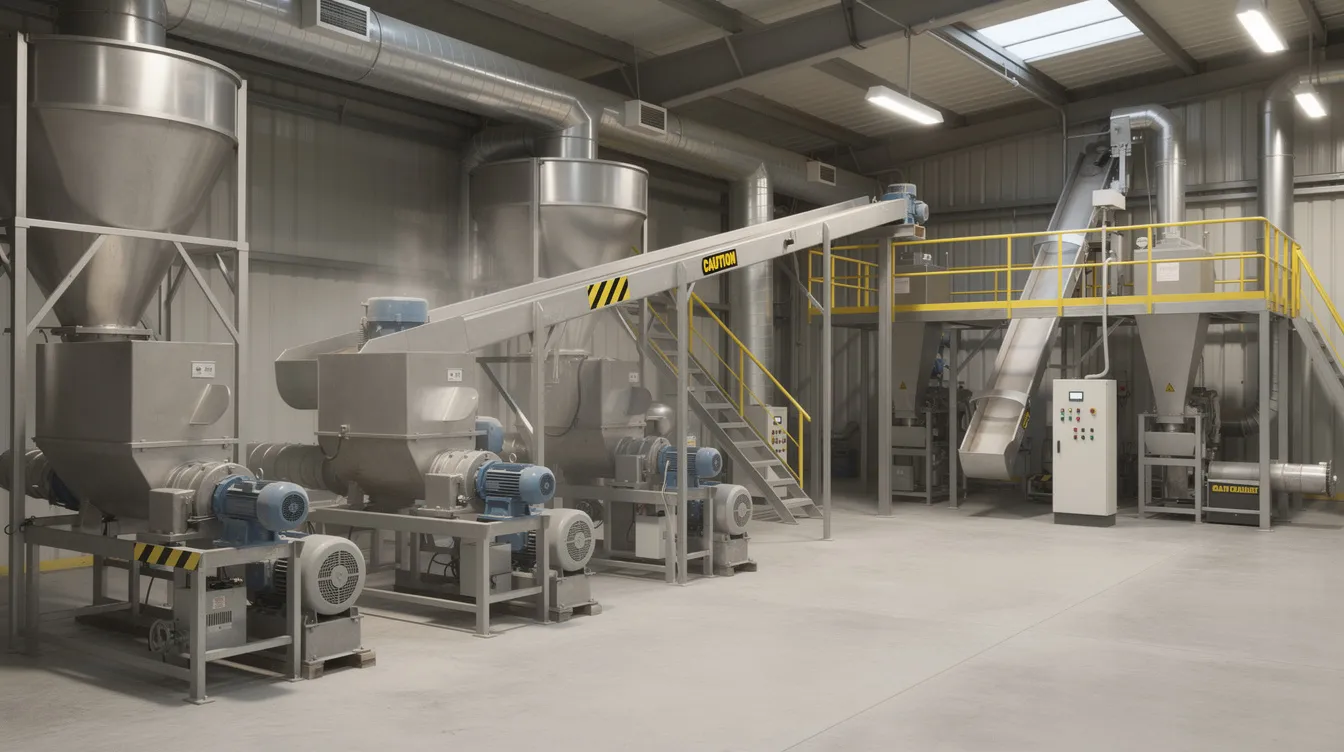
2. What Determines Besan Plant Power Requirement?
There is no single standard power figure for every besan plant. The power requirements for a besan plant depend on production scale and automation level, along with several process-specific variables.
Main determinants:
- Installed capacity versus realistic throughput and utilisation. A small besan plant operates at 1 TPH, medium besan plants typically handle 3 TPH production, and large besan plants can achieve 6 TPH production capacity. Energy consumption varies from 30 to 200 kW based on capacity.
- Process route: purchasing chana dal and grinding directly versus an integrated dal mill route processing whole Bengal gram, which requires extra dehusking, splitting and grading machines and meaningfully increases connected load. The comparison of chana dal vs whole gram for besan discusses cost and viability implications.
- Quality targets and fineness of fine besan (mesh size, multiple grinding passes, re-milling loops) directly affect kWh per tonne. Finer grinding requires more energy per unit of gram flour.
- Type of besan grinding machine: impact pulverizers are commonly used for besan production, while pin mills are used for fine grinding. Air classifier mills (ACMs) and roller mills also exist, each with different specific energy characteristics.
- Feed characteristics: hardness of chickpea, moisture level and conditioning requirements change grinding energy and power consumption.
- Operation mode and operating pattern: single versus multiple shifts, hours per day, continuous running versus frequent start-stop cycles all affect maximum demand and three phase power consumption.
Auxiliary loads often ignored:
- Dust extraction system (bag filter, cyclone, ID fan) and conveying fans contribute meaningful kW to the total.
- Elevators, screw conveyors, vibro sifters, rotary sieves and small motors collectively add significant load.
- Gram flour packing machines, pneumatic systems and air compressors add to electrical load.
- Office loads, laboratory, lighting and ventilation in mill plant buildings.
Key electrical concepts:
- Connected load (kW) is the sum of rated motor outputs of all equipment installed. For reference, connected load for a small-scale besan plant is typically 3 HP to 20 HP, a medium-scale besan plant requires 10 HP to 35 HP, and large-scale besan processing plants need 40 HP to 150 HP.
- Actual demand (kW/kVA) and energy consumption (kWh) determine what the utility bills for, based on simultaneous machine operation, loading and daily operating hours.
Sections below show an illustrative 1 TPH besan plant power requirement calculation, which can be refined using actual supplier data from besan manufacturing machinery specifications.
3. Equipment-Wise Electrical Load Planning for a Besan Mill Plant
A proper load schedule lists each machine, quantity, motor power rating (kW or HP) and whether it runs continuously or intermittently. Below is an illustrative table for a 1 TPH automatic besan plant. All motor ratings are planning assumptions for illustration, not standard specifications.
| Equipment / Section | Typical Motor Rating (kW) | Qty | Operating Pattern |
|---|---|---|---|
| Pre-cleaner, screen grader, aspiration fan | 5 kW (total) | 1 set | Continuous during production |
| Destoner | 1.5 kW | 1 | Continuous |
| Magnetic separator | 0–0.5 kW | 1 | Continuous (permanent magnet type may draw no power) |
| Impact pulveriser / pin mill (besan grinding machine) | 18–22 kW | 1 | Continuous – largest single load |
| Vibro sifter / centrifugal sieving machine | 2–3 kW | 1 | Semi-continuous |
| Bucket elevators and screw conveyors | 3–4 kW (total) | 2–3 | Continuous / intermittent |
| Dust extraction fan + bag filter accessories | 5–7 kW | 1 | Continuous when grinders run |
| Gram flour packing machine | 2–3 kW | 1 | Intermittent |
| Air compressor (if used) | 2–3 kW | 1 | Intermittent |
| Lighting, ventilation, office, lab | 1.5–2 kW | Various | During working hours |
Centrifugal machines help in sieving besan effectively and are often preferred for consistent quality in the flour separation stage. Major energy-consuming machinery includes impact pulverizers and pin mills, which together typically account for more than half the total connected load.
Key points around this table:
- Some magnetic separators are permanent magnet type (no motor), while drum-type units draw a small motor load. The load list must reflect actual equipment selection.
- Some drives may be shared (single motor driving multiple shafts). Avoid double-counting when aggregating loads.
- The grinding section is often the single largest motor in a 1 TPH besan mill plant. Load planning must consider starting current and feeder breaker sizing.
This equipment-wise load schedule becomes the backbone for your electricity connection sanctioning application and internal panel-board design, cable sizing and transformer capacity assessment.
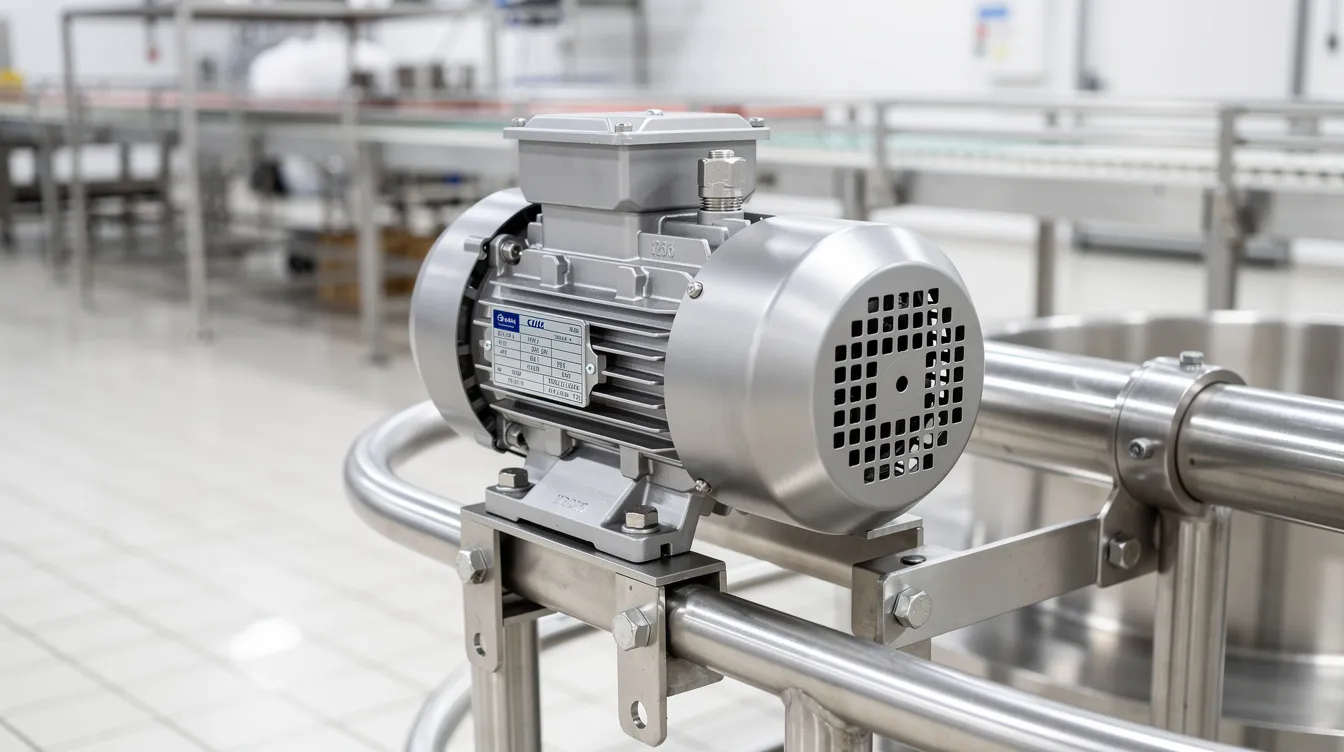
4. Illustrative Power Calculation for a 1 TPH Besan Plant
Assumptions for this example:
- Plant capacity: 1 TPH (1,000 kg/hr) besan gram flour
- Raw materials: purchased chana dal (no dehusking line)
- Automation level: semi to fully automatic besan plant with mechanical conveying, central dust extraction, basic pneumatic packing
- Working schedule: 16 operating hours per day, 300 working days per year
| Equipment Group | Assumed Load (kW) | Qty | Total kW | Simultaneous Factor |
|---|---|---|---|---|
| Cleaning & grading | 5 | 1 | 5 | 0.90 |
| Grinding (pulveriser) | 20 | 1 | 20 | 0.85 |
| Sifting | 3 | 1 | 3 | 0.80 |
| Elevators & conveyors | 3.5 | 1 set | 3.5 | 0.70 |
| Dust extraction fan + filter | 6 | 1 | 6 | 0.90 |
| Packing machine | 2.5 | 1 | 2.5 | 0.50 |
| Compressor | 2.5 | 1 | 2.5 | 0.40 |
| Lighting, ventilation, office | 1.5 | – | 1.5 | 0.90 |
| Total Connected Load | 44 kW |
A small besan plant at 1 TPH consumes around 30 kW for core milling equipment alone. When auxiliary loads are included, total connected load rises to approximately 40–45 kW.
Calculation steps:
- Total connected load = 44 kW (sum of all installed motor ratings).
- Apply a coincidence factor of approximately 0.75, reflecting that not all motors draw full rated power simultaneously. Simultaneous operating load ≈ 33 kW.
- Daily consumption (kWh) = Σ [equipment input power (kW) × operating load fraction × operating hours]. At an average operating load of roughly 30 kW over 16 hours: approximately 480 kWh per day.
- Daily production = 1,000 kg/hr × 16 hours × ~0.90 utilisation ≈ 14.4 tonnes.
- Specific energy consumption (kWh/tonne) = 480 ÷ 14.4 ≈ 33 kWh/tonne.
Specific energy consumption for besan production averages 15 to 25 kWh per tonne considering only grinding energy, but rises to 30–50 kWh/tonne when all auxiliary loads are included. Power consumption in besan processing facilities can range from 2.5 kWh to 45 kWh per hour depending on plant size and equipment configuration. Electricity consumption in besan processing varies based on machinery and production hours.
Important warnings:
- Do not simply multiply total connected load by operating hours. Motor efficiency, partial loading and idle running must be considered.
- Motor nameplate output (kW) differs from electrical input (kW), and power factor affects kVA demand for transformer and DG sizing.
- Detailed calculations should ultimately use actual motor curves and supplier-confirmed data for a bankable DPR.
Realistic utilisation assumptions (perhaps 60–70% in year one) materially change kWh/tonne and unit production cost. See besan plant capacity planning for further guidance.
5. Electricity Cost, Tariff Structure and Financial Projections
Besan plant electricity consumption feeds directly into cost of production per kg, working capital requirements and DSCR projections in bank finance DPRs.
Typical tariff components for an MSME besan mill in India:
- Energy charges in ₹/kWh based on consumption slabs
- Demand or fixed charges levied on sanctioned or recorded kW/kVA
- Power factor incentives or penalties where applicable
- Surcharges, taxes and electricity duty increasing the effective per-unit cost
Electrical connections for a besan plant usually require three-phase power supply. Power factor correction is essential to avoid penalties in besan plant operations and sometimes earns tariff incentives.
Illustrative cost example (assumed tariff of ₹8/kWh for illustration only):
- Daily electricity cost = 480 kWh × ₹8 = ₹3,840
- Monthly cost (26 working days) ≈ ₹99,840
- Besan plant utility cost per tonne = approximately ₹240/tonne for the electricity component alone
When actual production is lower than planned, fixed demand charges and minimum electricity costs spread over fewer tonnes, increasing power cost per kg. High idle running of machinery (conveyors running empty, excessive no-load operation) directly increases kWh per tonne.
In our DPR practice, we model power cost based on plant-specific kWh/tonne and realistic capacity ramp-up rather than a flat percentage of sales. Sensitivity analysis is performed for tariff increases and lower utilisation to test project resilience.
6. Besan Plant Dust Collection System – Design, Power and Recovery
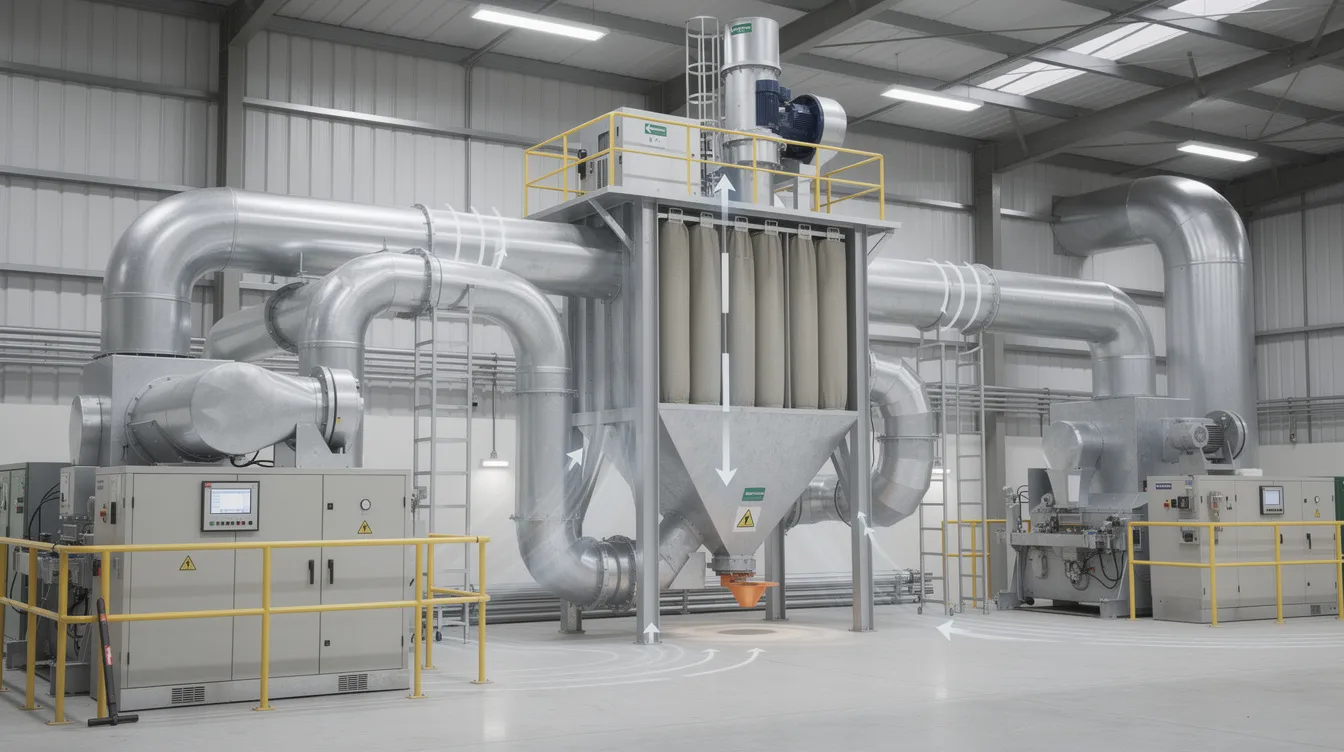
Gram flour particles are fine and easily airborne, making a besan plant dust collection system essential for hygiene, product recovery and worker safety. Dust extraction itself has noticeable power requirement through fans, bag filters and sometimes rotary valves.
Dust generation points in a typical besan manufacturing process:
- Grain receiving and unloading
- Cleaning, grading and de-stoning where foreign material and impurities are removed
- Dal feeding and intermediate transfer points (elevators, conveyors)
- Grinding section outlets and sifter discharges
- Flour conveying to intermediate bins and packing machines
System components:
- Suction hoods designed close to dust sources, capturing particles at origin rather than relying only on room ventilation
- Ducting network connecting multiple hoods to a main header, sized for required airflow and acceptable pressure losses
- Cyclone separator (where used) as a pre-cleaner reducing load on the main bag filter
- Bag filter with pulse-jet cleaning system using compressed air, dust collection hopper and rotary valve discharge
Engineering calculations and power:
Required airflow (m³/hr or CFM) and fan static pressure depend on hood design, duct routing, filter pressure drop and number of points operating simultaneously. Fan motor HP/kW cannot be standardised even for 1 TPH plants; it must be engineered case by case. Budget estimates from specialist suppliers indicate that small single-line systems (2,000–10,000 CFM) cost ₹3 lakh to ₹15 lakh.
Product recovery and financial impact:
A well-designed system reduces airborne flour losses and improves overall yield, directly impacting cost of production and profitability. The aim should approach zero waste from the flour stream. DPRs should quantify expected dust losses with and without efficient extraction, as discussed in besan manufacturing recovery, yield and process losses.
Dust collector motors form part of total connected load and maximum demand. Ignoring them can understate transformer size and DG backup requirements.
7. Dust Safety, Hygiene and Product Recovery in Gram Flour Plants
Gram flour is both a food product and a fine organic dust. Utility and dust collection planning therefore overlaps with safety, hygiene and regulatory compliance.
Worker exposure and hygiene:
- Excessive airborne besan dust causes respiratory discomfort and poor working conditions. Source extraction plus general ventilation is required.
- Dust deposition on floors, machinery and beams increases manual cleaning time, downtime and risk of contamination.
- Good housekeeping, smooth cleanable surfaces and controlled air use support food-safe production in food processing industries. Robust construction of ductwork and equipment improves long-term reliability.
Dust safety considerations:
- Many food dusts can be combustible under certain conditions. Flour dust layers near ignition sources (sparks, hot motors, faulty wiring) could pose risks.
- Earthing and bonding of ductwork and equipment reduces static charge build-up.
- Whether advanced protective measures (explosion vents, isolation) are required must be decided case by case by competent engineers.
Filter inspection and maintenance:
- Routine inspection for bag damage, abnormal pressure drop, pulse-jet performance and hopper discharge maintains airflow and energy efficiency. Low maintenance requirements depend on proper initial design.
- Clogged filters increase fan energy consumption and reduce capture efficiency.
- Maintenance planning and spares should be included in operating expenses in the DPR.
Product recovery and re-use:
Whether dust collected in bag filters can be returned to the product stream depends on where it was captured, hygiene controls and traceability. Dust from raw grain cleaning may be more appropriate as cattle feed raw material. Customer specifications and food safety requirements should drive these decisions, as discussed under besan quality parameters.
8. Other Besan Manufacturing Plant Utilities Beyond Power
Beyond electrical power and dust extraction, a besan manufacturing plant requires several other utilities. Though modest compared to power, they must be costed correctly.
Compressed air:
- Typical usage application includes pneumatic packing machines, pulse-jet cleaning of bag filters and occasional pneumatic conveying in fully automatic besan plants.
- Demand should be estimated in Nm³/hr at the required pressure (typically 6–8 bar), then converted into compressor kW with leakage allowance.
- Air quality matters if compressed air contacts food or packaging interiors (oil-free or filtered air with appropriate dryers).
- Compressor motor load must be included in besan plant power requirement and monthly utility cost.
General ventilation:
- General room ventilation using exhaust fans and roof vents improves worker comfort but does not replace localised dust capture at grinders and sifters.
- Include realistic kW provisions for exhaust and air circulation fans in the load schedule.
Water and sanitation:
- A typical dry besan gram flour plant does not require process water for grinding. Water needs are mainly for staff facilities, cleaning of floors and equipment, and sanitation.
- Integrated whole gram processing with conditioning may need limited water for tempering. Budget for borewell or municipal connection, storage tanks, pumps and basic treatment.
Electrical distribution infrastructure:
- LT panels, motor control centres, sub-distribution boards, starters and VFDs where justified. Construction mild steel warranty and precision in panel fabrication matter for durability.
- Cable trays, cabling, earthing, lightning protection and protective devices sized for connected load and starting currents of major grinders.
- Transformer capacity or sanctioned supply must consider future expansion margin.
DG backup and fire protection:
A diesel generator is often recommended for backup power in besan plants. Many MSME besan plants opt for limited DG backup sized for essential loads (grinding, critical conveying, lighting), not necessarily the entire connected load. Fire protection arrangements should be integrated with utility layouts, and DG and compressor rooms need proper ventilation and safety clearances.
9. Utility Infrastructure and Project Cost Budgeting
In a realistic besan plant DPR, plant and machinery and utilities must be budgeted separately to avoid both underestimation and double-counting.
Budgeting checklist:
- Electrical panels (MCC, PCC, control wiring, instrument panels)
- Internal power cabling, cable trays, junction boxes, earthing systems
- Lighting fixtures for production, storage, office and external areas
- Dust collection system: hoods, ducts, cyclone, bag filter, fan, rotary valve, structural supports and installation
- Compressed air system: compressor, receiver, dryer, filters, air piping
- Water system: borewell/connection, pumps, storage tanks, plumbing
- DG set where chosen: generator, AMF panel, fuel tank, exhaust system
Typical omissions from machinery quotations:
Many besan plant machinery suppliers quote only core machines (cleaner, pulveriser, sifter, elevators) and a basic panel, leaving out external cabling, building electrification, earthing and utility piping. Dust extraction and bag filter systems may be offered as optional items.
A fully automatic besan plant costs approximately ₹30,00,000 for core machinery, but total project cost including utilities is materially higher. Setup costs for a 25 HP besan mill plant start from around ₹7,00,000 for machinery alone. The setup cost varies based on capacity and automation level. A medium besan plant (3 TPH) requires about 10,000 sq. ft. of built-up area. For a broader view of capital cost ranges, see besan manufacturing plant setup cost in India.
At Project Report Bank, we use supplier quotations, recent project benchmarks and client-specific assumptions to build realistic utility capex budgets, customised for each DPR.
10. Energy Efficiency and Operating Controls in Besan Gram Flour Plants
Energy efficiency in a besan mill plant is about correct sizing, disciplined operation and monitoring, all of which improve kWh/tonne and profitability.
Equipment sizing and process selection:
- Avoid over-sized pulverisers and fans that run under-loaded, reducing high efficiency potential.
- Select appropriate technology based on required fineness, throughput and specific energy data from the supplier or leading manufacturer.
- Design dust extraction ducts and bag filters for acceptable air velocities and pressure drops.
Operational practices:
- Implement planned maintenance for bearings, belts, sieves and filters to avoid increased friction and wasted power.
- Minimise idle running: switch off elevators, conveyors and grinders when material flow stops. Operational efficiency of besan plants can reach up to 95% with disciplined scheduling.
- Optimise production scheduling to run equipment at steady loads, reducing maximum demand peaks and mechanical stress.
Controls and VFDs:
- Use variable frequency drives selectively where load is variable and speed control materially saves energy, such as on large dust extraction fans.
- Not every small motor economically justifies a VFD; payback analysis should be part of DPR financial modelling.
- Power factor correction capacitors should be planned as part of electrical infrastructure.
Monitoring:
- Install submeters on major sections (grinding, dust extraction, packing) to track kWh/tonne and identify abnormal increases.
- Real operating data from the first 6–12 months can refine forward projections in CMA Data and future expansion DPRs.
11. Common Planning Mistakes in Besan Plant Power and Utilities
Many project reports understate power and utility needs, creating later cost overruns or production bottlenecks.
- Considering only the main grinder HP and ignoring cleaning, conveying, dust extraction, packing and compressor loads.
- Confusing kW, kVA and kWh; using kVA as if it were kWh in cost calculations or neglecting power factor impact.
- Estimating energy consumption by multiplying total connected load by hours without load factors or utilisation assumptions.
- Using nameplate plant capacity (e.g. 1 TPH) as if the plant will always operate at that rate, instead of basing kWh/tonne on realistic throughput.
- Underestimating dust collector pressure drop and fan HP, or omitting dust extraction from the load list entirely.
- Ignoring demand or fixed charges in electricity bill projections and focusing only on energy charges per unit.
- Selecting panel boards, cables and breakers without considering starting currents of large motors and future capacity expansion.
- Treating general ventilation fans as a suit-able substitute for proper hooded dust extraction at grinders and sifters.
- Not providing clear access and maintenance space around bag filters, compressors and electrical panels in the plant layout.
A professionally prepared DPR integrating utilities with process equipment greatly reduces these errors and leads to cleaner discussions with banks and investors.
12. Utility Planning in a Besan Plant Detailed Project Report (DPR)
In a bankable DPR for a besan plant, power and utilities are fundamental drivers for project cost, working capital and loan servicing capacity.
How utility assumptions appear in DPR sections:
- Technical chapter: description of besan manufacturing plant utilities (power, dust collection, compressed air, water) and their capacities
- Project cost chapter: capital cost for electrical works, dust extraction system, compressors, DG set and other utility installations
- Operating cost chapter: electricity consumption (kWh/tonne), compressed air power, DG diesel and water charges reflected under manufacturing and factory overheads
- Financial projections: monthly and annual utility expenses included in profit and loss, affecting EBITDA and DSCR
- Cash flow and working capital: variation in monthly electricity bills influencing cash flow and bank limit sizing
Roles of financial and technical experts:
CA Manish Gugliya and Project Report Bank specialise in financial modelling, CMA Data preparation, loan structuring and integrating utility costs into bankable projections. Detailed electrical design, dust system engineering and machinery selection must be undertaken by qualified engineers and equipment suppliers. Projections are based on assumptions and engineering data; they are not guaranteed outcomes.
The choice of process route materially affects utility costs. Utility planning is closely linked with topics like production capacity planning and the besan manufacturing process itself. Our DPRs include sensitivity analysis for higher-than-expected specific energy consumption, future tariff increases or lower plant utilisation, giving bankers and promoters a transparent picture of risk.
13. Frequently Asked Questions on Besan Plant Power Requirement & Utilities
Below are concise answers to common questions entrepreneurs ask when planning besan plant power requirement, dust collection and utilities.
Q1. Is there a standard kW requirement for a 1 TPH besan plant?
There is no single fixed figure. Connected load depends on whether the plant grinds only chana dal or runs an integrated dal mill with dehusking, as well as on pulveriser type, dust collector size, packing automation and compressor usage. Many 1 TPH besan plants show core connected loads around 30 kW, rising to 40–45 kW with full auxiliaries. Treat any generic thumb rule as preliminary guidance and always validate with machinery quotations before finalising transformer or DG capacities. Fully automatic besan plants are available in a wide range of configurations from various manufacturers and each exporter or supplier may quote differently.
Q2. What is the difference between connected load and actual consumption?
Connected load (kW) is the total of all installed motor ratings. Actual consumption (kWh) is what the plant uses over time, determined by how many machines run simultaneously, their loading and operating hours. Connected load determines your sanctioned supply and panel sizing. Energy consumption determines your monthly electricity bill. These are different and must not be confused in DPR projections.
Q3. Does a besan plant need a dust collection system?
Yes. Even smaller mini plants generate fine airborne dust at grinders and sifters. Some level of dust control is necessary for worker comfort, cleanliness, product hygiene and regulatory compliance. Skipping dust extraction may appear to reduce initial cost but leads to chronic housekeeping issues, higher wastage and potential non-compliance with food safety norms.
Q4. How can utility costs be reduced in besan processing?
Correct equipment sizing, preventive maintenance, minimised idle running, efficient production scheduling, VFDs on variable-load equipment where justified and power factor correction capacitors all contribute. Monitoring actual kWh/tonne through submetering helps identify inefficiencies. The industry as a whole is widely appreciated for its growing adoption of these practices, and high quality besan production is increasingly linked with efficient operations. Products manufactured with precision and consistent quality command better market acceptance. An excellent quality range of gram flour depends as much on milling discipline as on raw material selection.
Q5. How can Project Report Bank help me with power and utility planning for my besan plant?
Project Report Bank, under the guidance of CA Manish Gugliya, helps entrepreneurs by:
- Translating technical machinery lists and tentative motor loads into structured utility cost projections, kWh/tonne estimates and realistic monthly energy expense forecasts.
- Incorporating these into customised DPRs, CMA Data and financial models suitable for term loans, working capital and MSME schemes in India.
- Running sensitivity scenarios for tariff changes, utilisation variations and energy-efficiency measures, so banks and investors see a professionally analysed business case.
If you are planning a besan manufacturing unit and need a customised DPR, financial projections or CMA Data that properly accounts for power, dust extraction and utility costs, share your tentative plant capacity, process route and machinery quotations with us over WhatsApp for a professional discussion.
CA Manish Gugliya FCA, DISA (ICAI) Project Report Bank – www.projectreportbank.com