
Key Takeaways
- This article covers commercial besan manufacturing from ready chana dal (not whole chana), including plant setup cost, machinery, manufacturing process, working capital and profitability with illustrative financial assumptions.
- India’s besan market is valued at ₹32,000 crore, with branded packaged besan growing at 12-15% annually; 70% of the market remains with unorganised mills, creating entry opportunities for quality-focused manufacturers.
- A 500 kg/day besan plant has ₹20-45 lakh investment, while larger units require ₹70 lakh to ₹1.5 crore; raw material (chana dal) accounts for 65-75% of production costs.
- Proper market research, a realistic business plan and a bankable project report are non-negotiable before committing capital to a besan mill plant.
- Project Report Bank, led by CA Manish Gugliya, FCA, DISA (ICAI), provides customised DPRs, CMA Data and project finance advisory for besan manufacturing projects across India.
Overview of Besan Manufacturing from Chana Dal
Besan is primarily made from grinding chana dal, the split and dehusked form of Bengal gram (desi chickpea, Cicer arietinum). Indian households, sweet shops, namkeen manufacturers, street food vendors and snack manufacturing units consume besan throughout the year in dishes ranging from pakoras and kadhi to laddoos, sev and dhokla. Besan is a staple in daily household consumption across India, cutting across income segments and regional food habits.
Chickpea flour sold internationally under the label “chickpea flour” can originate from kabuli or desi varieties, and the two differ in colour, protein content and cooking behaviour. Chana dal besan has a characteristic nutty flavor preferred in traditional Indian foods and contains higher dietary fiber than kabuli chickpeas. Chana dal flour is gluten-free and contains more plant protein than wheat flour. Chana dal also provides exceptional water-absorption capacity and fat-binding properties, making it the preferred base for batters and snack coatings. Its nutritional density is enhanced by the biochemical composition of chana dal, including a low glycemic index that aids in gradual glucose release.
Starting with chana dal simplifies processing in besan manufacturing due to its pre-split nature. The core business model covered in this article involves purchasing ready chana dal and converting it into gram flour through cleaning, grinding, sieving and packing, without in-house dehusking or splitting operations. For an integrated dal mill setup that begins from whole chana, the investment, equipment and process differ materially. The sections that follow cover plant setup, investment structure, financial projections, working capital, bank finance and risks, all grounded in the standalone besan manufacturing from chana dal model.
Market Opportunity and Industry Context for Gram Flour
India’s besan market is valued at ₹32,000 crore. Besan demand grows at an annual rate of 12-15%, driven primarily by the branded packaged segment as consumers in urban and semi-urban India shift from loose besan purchased at the local chakki to hygienically packed, branded gram flour. The domestic food processing industry increasingly uses besan as a primary ingredient in snacks, sweets and ready-to-cook mixes.
Despite this growth, 70% of the besan market is still unorganised, consisting of local mills and small grinding units that sell loose flour without standardised quality or packaging. This gap between rising consumer expectations and fragmented supply creates space for new entrants who can deliver consistent quality, proper packaging and reliable supply.
Consumption is strongest in states like Rajasthan, Gujarat, Madhya Pradesh, Maharashtra and Uttar Pradesh, which also overlap with major Bengal gram cultivation belts, offering procurement advantages. Besan demand is consistent and non-seasonal year-round, making production planning more predictable than for many seasonal food products.
Promoters should not treat broad demand as a guarantee of sales. Actual revenue depends on product positioning, buyer relationships, pricing competitiveness and distribution reach. Validating demand with specific buyer conversations and local market research before committing investment is essential.
Choosing the Right Business Model for a Besan Plant
A besan mill requires a comprehensive business plan, and the starting point is deciding which sales channel the plant will serve. Each model carries different implications for packaging expenditure, credit periods, branding costs and working capital.
- Bulk B2B supply: Selling besan in 25-50 kg bags to namkeen manufacturers, sweet shops, caterers and other food processors. Packaging and branding costs are low, but margins per kg are thinner and volume commitments drive profitability. Minimum order quantity expectations from buyers can be high.
- Institutional and contract supply: Supplying large snack brands, HORECA distributors or institutional kitchens under formal contracts. Quality specifications and documentation are stringent; credit terms can stretch to 30-60 days, tying up working capital.
- Private-label manufacturing: Producing under a retailer’s or regional brand’s label. This model helps utilise capacity without heavy marketing spend, but per-kg margins are compressed and the manufacturer bears quality-compliance costs.
- Own-brand retail: Packing in consumer units (500 g, 1 kg, 5 kg) in laminated pouches with proprietary branding. This requires investment in packaging design, distribution through distributors and retailers, and active marketing. Working capital needs increase due to finished-goods inventory and trade credit.
A practical hybrid strategy, for instance allocating 60-70% of output to bulk B2B and the balance to branded retail, helps stabilise capacity utilisation while building brand equity over time. The product mix choice directly influences packing-line selection, SKU planning and the financial model in a besan manufacturing project report.
Raw Materials Planning: Chana Dal and Other Inputs
The quality of chana dal impacts the flavor, colour and texture of besan. Chana dal is the primary input for besan production, and chana dal accounts for 65-75% of production costs. Poor raw material selection cannot be corrected downstream.
Desired specifications for procurement:
- Variety: Bengal gram (desi type), uniform grain size
- Moisture: 10-12% (indicative working range for safe storage and grinding)
- Foreign matter: minimal stones, dust, husk remnants
- Broken grains: limited, as excessive broken dal affects grinding uniformity and colour
- Free from insect infestation and mould
Procurement options include local mandis, commission agents, large traders and farmer-producer organisations. Promoters should establish connections with farmers and suppliers for consistent chickpea supply and diversify across multiple sources. Establish strong supply chains for sourcing chickpeas, particularly in states with high Bengal gram production.
Chana is a rabi crop harvested between February and April. Post-harvest prices tend to be lower; during lean months (August-December), prices can rise 15-25%. This seasonality affects stocking strategy and working capital. Promoters must budget for carrying costs during off-season months when building inventory at favourable prices.
Storage requires dry warehouses with raised pallets, periodic fumigation as per applicable regulations, moisture monitoring and FIFO stock rotation to prevent caking and infestation. Whole chana can be used for specific product grades, but the standard model assumes purchased split dal.
Secondary inputs include packaging films (BOPP/laminated for retail, PP/HDPE bags for bulk), corrugated boxes, labels, stitching thread and pallets. Typical besan is 100% gram flour with no additives. Consistent raw material specifications and vendor contracts help maintain standardised besan quality and reduce process variations.

Manufacturing Process Flow for Besan from Chana Dal
The base model assumes purchase of ready chana dal. In contrast, an integrated chana dal mill removes husk from whole chana as the first stage, requiring additional splitting and dehusking machinery. This article covers only the standalone grinding process.
Step-wise process flow:
- Receipt and inspection: Chana dal consignment arrives; visual inspection and sampling for moisture, colour, foreign matter.
- Pre-cleaning: Vibratory screeners remove dust, dirt and loose husk particles. Raw chana dal is passed through air aspirators and magnetic separators to remove impurities.
- Destoning: Destoners remove stones and heavy particles if present in the lot.
- Sorting and grading: The cleaned dal is sorted based on size, colour and soundness to maintain consistency.
- Conditioning (if required): Conditioning may involve adding moisture to reduce brittleness during grinding, depending on ambient humidity and dal moisture content.
- Grinding: Chana dal is ground into fine flour using impact pulverizers to preserve natural aroma. Flour mills grind split chana into besan powder at controlled feed rates.
- Sieving: Rotary sifters separate fine besan from coarse particles. Oversize fractions are re-ground and reintroduced.
- Quality checks: Fineness (mesh size), moisture content, colour, taste/odour and metal contamination checks.
- Weighing and packing: Packaging machines fill besan in packs ranging from 250g to 50kg.
- Dispatch.
Dust extraction is essential at feed points, pulveriser discharge, sieving stations and transfer conveyors. Proper cleaning, storage and milling control contamination in chana dal besan. Dust collection systems (cyclones, bag filters) protect worker health and meet pollution norms.
Temperature control: Grinding generates heat. Elevated temperatures degrade besan colour and flavour. Solutions include controlling feed rate, ensuring adequate cooling air flow, selecting appropriate mill design and avoiding overloading the pulveriser.
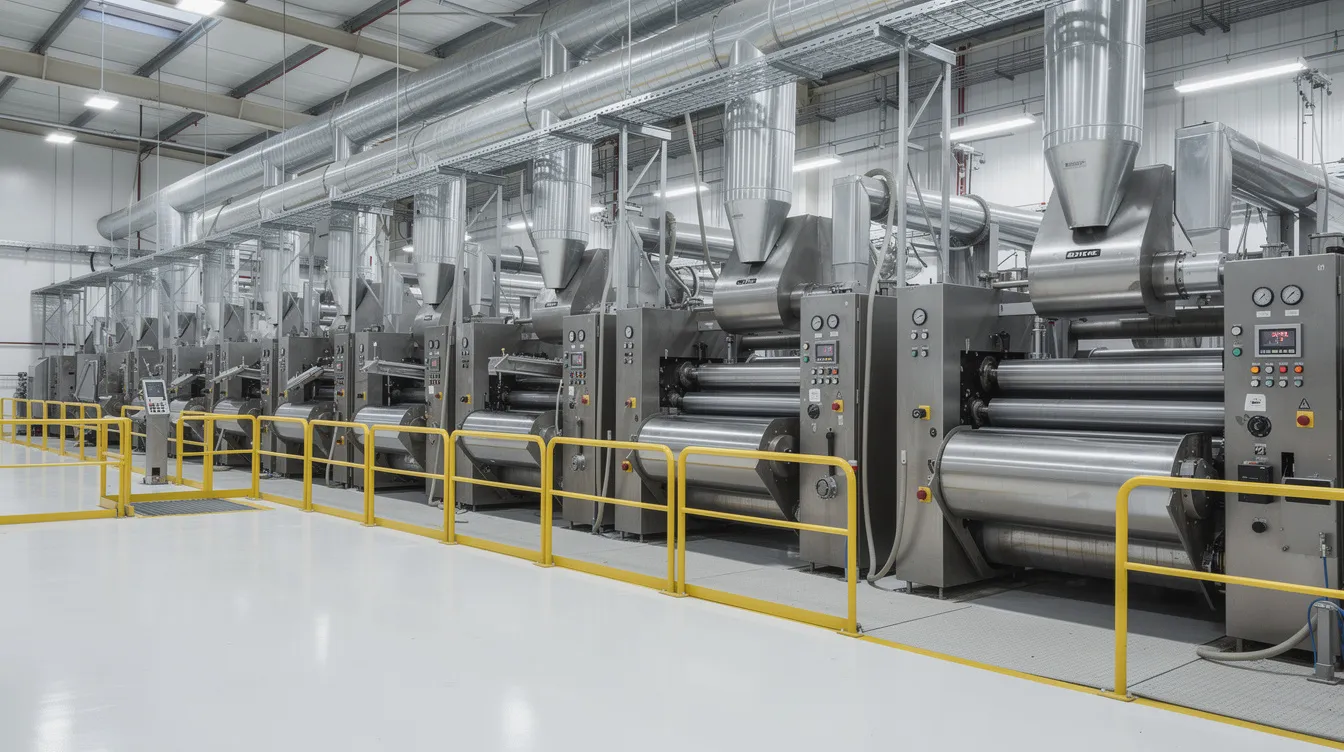
Machinery and Equipment for a Besan Plant
Machinery selection depends on desired output capacity (1, 2 or 5 TPH), automation level and whether the plant packs bulk or consumer units. A fully automated besan plant can process 2000 kg/day at the entry level of automated systems.
| Equipment / System | Primary Function | Key Selection Considerations |
|---|---|---|
| Bucket elevators, conveyors | Material transfer between stages | Capacity match with plant throughput; food-grade construction |
| Vibratory pre-cleaner | Remove dust, dirt, loose husk | Screen size; throughput rating |
| Destoner | Separate stones and heavy particles | Adjustable air flow; capacity |
| Magnetic separator | Extract ferrous metal fragments | Magnet strength; cleaning access |
| Impact pulveriser / pin mill | Grind chana dal into fine flour | kW rating; screen mesh options; temperature rise; SS contact parts |
| Rotary / vibro sifter | Classify ground flour by fineness | Mesh sizes; throughput; ease of mesh change |
| Dust collection system | Capture airborne flour dust | Cyclone + bag filter; air volume; compliance with emission norms |
| Intermediate bins / hoppers | Buffer storage between stages | Capacity; dust-tight seals |
| Packing machine (bulk) | Fill 25-50 kg bags | Accuracy; speed; bag type compatibility |
| Packing machine (retail) | Fill 250g-5 kg pouches | Pouch type (BOPP/laminate); sealing quality; automation level |
| Metal detector | Detect non-ferrous metal contaminants | Sensitivity; required for organised food brand supply or export |
| Lab equipment | Moisture meter, sieve sets, balances | Accuracy; calibration support |
For plants supplying organised food brands, metal detection at the packing stage is recommended beyond magnetic separation. Equipment should be compared on rated capacity vs practical output, material of construction (stainless steel for product-contact parts), energy consumption, after-sales service and spare-parts availability. Similar principles apply to specialty flour plant machinery selection.
Capacity Planning and Output Calculations
Oversizing locks capital in idle equipment and raises fixed costs per kg. Undersizing creates bottlenecks and missed orders. Rated capacity (TPH under ideal conditions) differs from actual annual saleable output.
Illustrative annual output derivation (2 TPH plant):
- Operating hours: 16 per day
- Working days: 300 per year
- Theoretical annual input: 2 x 16 x 300 = 9,600 MT
- Year 1 capacity utilisation: 70%
- Actual input processed: 6,720 MT
- Recovery (besan from chana dal): approximately 95-97% (accounting for dust, screenings, handling losses)
- Saleable besan Year 1: approximately 6,384-6,518 MT
Year 2-3 utilisation may rise to 75-85% as production stabilises and distribution matures. The difference between theoretical and realistic ms capacity is constrained by maintenance downtime, changeovers, manpower availability and raw material procurement timing.
Husk revenue does not apply in this standalone model. Any coarse fraction from sieving is typically re-ground rather than sold separately.
Land, Building and Plant Layout Considerations
| Plant Scale | Indicative Built-up Area | Total Land (incl. yard, parking) |
|---|---|---|
| 1 TPH | 3,000-4,000 sq ft | 5,000-8,000 sq ft |
| 2 TPH | 6,000-8,000 sq ft | 10,000-15,000 sq ft |
| 5 TPH | 12,000-18,000 sq ft | 20,000-30,000 sq ft |
Functional zones include: raw material godown, pre-cleaning and grinding hall (dusty zone), sieving area, packing hall (clean, low-dust), finished goods storage, QC lab, utility room (electrical panel, compressor), office and staff amenities, and loading/unloading bays.
Material flow should be unidirectional: chana dal moves from receipt to cleaning to grinding to sieving to packing to dispatch, with no backward cross-traffic. Packing should be physically separated from the grinding hall to reduce dust contamination. Floors should be pucca and washable; walls in process areas smooth and impervious; ventilation adequate; pest-proofing measures in place at all entry points.
Layout drawings are typically prepared with machinery suppliers and a qualified engineer, then annexed to a detailed besan manufacturing project report for bank submission.
Utilities, Power Requirement and Manpower Planning
Besan manufacturing from chana dal is a dry milling process. It requires substantial electric power but no process water. Water is needed only for equipment cleaning, sanitation and staff use. Effluent generation is minimal.
Indicative connected load (illustrative):
- 1 TPH: approximately 30 kW
- 2-3 TPH: approximately 80-100 kW
- 5 TPH: approximately 150-200 kW
Running load is typically 60-75% of connected load. Promoters should account for the difference when estimating electricity bills vs sanctioned power from the distribution company. Power costs 15-25 units per tonne of output, varying with equipment efficiency and local tariffs.
Other utilities include compressed air (for pneumatic packing machines and automation), dust extraction fans and basic ventilation systems. In areas with unreliable power supply, a backup generator may be necessary.
Manpower (indicative for 2 TPH plant): 2-3 machine operators, 3-4 helpers/loaders, 2-3 packing line staff, 1 QC technician, 1 maintenance technician, 1 storekeeper, 1-2 admin/accounts staff. Training in hygiene, food safety, equipment operation and basic maintenance is essential for both product quality and plant uptime.
Besan Plant Setup Cost and Investment Structure
Actual costs depend on location, specifications, supplier negotiations and automation level. The following are illustrative planning figures.
| Cost Component | Micro Unit (500 kg/day) | Medium (2 TPH) | Large (5 TPH) |
|---|---|---|---|
| Land (separate) | Site-dependent | Site-dependent | Site-dependent |
| Civil construction | ₹5-10 lakh | ₹30-50 lakh | ₹60-100 lakh |
| Plant & machinery (incl. GST) | ₹8-18 lakh | ₹40-60 lakh | ₹80-150 lakh |
| Electrical & utilities | ₹2-4 lakh | ₹8-15 lakh | ₹15-25 lakh |
| Dust collection & environment | ₹1-2 lakh | ₹4-8 lakh | ₹8-15 lakh |
| Lab, furniture, office | ₹1-2 lakh | ₹3-5 lakh | ₹5-8 lakh |
| Pre-operative & contingency | ₹2-4 lakh | ₹5-10 lakh | ₹10-20 lakh |
| Working capital margin | ₹3-5 lakh | ₹15-25 lakh | ₹30-50 lakh |
| Indicative total project cost | ₹20-45 lakh | ₹1.0-1.7 crore | ₹2.0-3.5 crore |
Investment for a micro besan unit ranges from ₹8-18 lakh for machinery alone. A 500 kg/day besan plant has ₹20-45 lakh investment including working capital. A typical investment for a large unit is ₹70 lakh to ₹1.5 crore for machinery and equipment. These are broad planning numbers; serious promoters should obtain multiple machinery quotations and civil-cost estimates, then seek a customised besan mill project report for bank submissions.
Production Cost per Kilogram of Besan
Understanding per-kg cost is essential for pricing, evaluating contracts and negotiating with buyers.
Manufacturing cost components (per kg, illustrative for bulk B2B model):
- Chana dal consumption: 1.1-1.15 kg of chana dal per kg of besan, at assumed ₹65-75/kg = ₹71.50-86.25/kg
- Power: ₹1.50-2.50/kg
- Direct labour: ₹1.00-2.00/kg
- Monthly packaging cost is ₹0.8-1.5 per kg of finished product (bulk bags)
- Repairs, maintenance, consumables: ₹0.50-1.00/kg
- Factory overheads and depreciation: ₹1.50-3.00/kg
- Total manufacturing cost: approximately ₹77-96/kg
Above manufacturing cost, business-level costs include marketing, distribution, freight, interest on working capital and administrative overheads. Besan production cost is 65-75% from chana dal. The contribution margin equals selling price minus total variable cost per kg. In a bulk model with besan selling at ₹100-110/kg, the contribution per kg is narrow, making volume and cost discipline critical.
These calculations form the core of financial projections in a bankable besan manufacturing business plan and CMA Data prepared for lenders.
Recovery, Material Balance and Process Losses
Material balance principle: input (100%) must equal saleable besan plus screenings, dust and handling losses. For every 1,000 kg of chana dal input:
- Saleable besan: approximately 950-970 kg
- Dust collected in filters: 10-20 kg
- Screenings and spillage: 10-30 kg
1.1-1.15 kg of chana produces approximately 1 kg of besan. Unlike integrated plants, a standalone besan plant using purchased chana dal does not generate husk or bran with commercial value. Oversize fractions from sieving are typically re-ground, improving overall recovery but adding to power consumption. Proper sieving mesh selection and equipment calibration control the ratio of fine besan to rejected fractions.
Working Capital Assessment for a Besan Manufacturing Unit
Besan manufacturers often face liquidity pressure rather than machinery problems. Working capital planning is as important as fixed investment.
Key components:
- Raw material inventory: 15-30 days of chana dal stock (higher during post-harvest buying season)
- Finished besan inventory: 7-15 days
- Receivables: 15-30 days for B2B; 30-60 days for branded retail through distributors
- Less: Supplier credit for chana dal and packing materials (7-15 days)
- Less: Advances from customers (if any)
Total working capital requirement is estimated in the project report. Banks typically finance 70-75% of assessed working capital through cash credit/overdraft limits; the promoter contributes the margin (25-30%). The impact of business model choice is direct: branded retail with distributor credit ties up far more working capital than advance-based B2B. Project Report Bank prepares detailed working capital assessments and CMA Data aligned with RBI formats and bank appraisal practices.
Revenue, Profitability and Financial Viability
All figures below are illustrative assumptions for a 2 TPH besan plant operating at 70% utilisation in Year 1, selling primarily in bulk B2B.
- Annual saleable output: approximately 6,400 MT
- Revenue (at ₹105/kg average): approximately ₹6.72 crore
- Variable costs (raw material, power, packing, labour): approximately ₹5.90 crore
- Contribution: approximately ₹82 lakh
- Fixed costs (salaries, depreciation, insurance, admin): approximately ₹35 lakh
- EBITDA: approximately ₹47 lakh
- Finance cost + depreciation: approximately ₹20-25 lakh
- Profit before tax: approximately ₹22-27 lakh
- Cash accrual (PAT + depreciation): higher than PBT due to non-cash depreciation add-back
Lenders evaluate cash generation, not just profit. Key metrics: break-even capacity utilisation (typically 40-55% for a well-structured plant), DSCR (banks require a DSCR of at least 1.25 for loan approval), ROI, IRR and payback period. Custom DPRs from Project Report Bank are built on project-specific assumptions with care taken to maintain internal consistency between capacity, revenue and expense lines.
Sensitivity Analysis and Risk of Margin Compression
Sensitivity analysis tests viability under adverse changes rather than assuming favourable conditions persist.
The critical variable is the chana dal to besan price spread. A 5% increase in chana dal procurement price, with selling price unchanged, can reduce EBITDA by 15-20% in a bulk model. Scenarios every project report should test:
- Chana dal price up 5-10%: margin and DSCR impact
- Besan selling price down 3-5%: contribution squeeze
- Capacity utilisation 10-15% lower than projected: fixed-cost absorption weakens
- Buyer credit extended by 15 days: additional interest on working capital
- Higher packaging costs in branded model: film and carton price increases
Projects that remain viable across a reasonable range of these variations have a stronger foundation. Borderline projects may show DSCR below 1.25 or negative cash flows under modest stress. A good besan manufacturing project report includes at least 2-3 sensitivity scenarios for promoter and lender review.
Quality Standards, Packaging and Shelf Life Management
Consistent quality and hygienic packaging differentiate organised besan manufacturers from local mills.
Critical quality parameters:
- Fineness: mesh size appropriate for target application (finer for snacks, slightly coarser for sweets batters)
- Uniform cream-yellow colour
- No off-odours or rancidity
- Moisture within FSSAI-permitted limits
- Absence of foreign matter, insect fragments and metal particles
Packaging options range from bulk HDPE/PP bags for B2B supply to laminated BOPP pouches for retail. Finished besan is packed into moisture-barrier bags to extend shelf life. Labelling must comply with FSSAI and Legal Metrology rules: product name, ingredients, net quantity, batch number, MRP, FSSAI licence number, manufacturing and best-before dates, storage instructions and customer-care details.
Shelf life depends on moisture control, packaging material barrier properties and storage conditions. Promoters should not assign arbitrary shelf life without supporting validation data. Storage and distribution should follow FIFO in cool, dry warehouses, protected from odour transfer and infestation.
Licences, Registrations and Regulatory Compliance
Regulatory requirements evolve. Promoters must confirm current rules with official authorities or professional advisers. Legal compliance includes obtaining necessary licenses and permits before commencing commercial production.
- Business registration: Proprietorship, partnership, LLP or company formation; PAN; GST registration; MSME/Udyam registration if qualifying
- Food safety: FSSAI licence appropriate to plant size and distribution area; periodic renewal mandatory
- Factory-related: Factory Act registration or Shop & Establishment registration (state-specific); local trade licence; fire safety NOC; building and land-use permissions
- Environmental: Dust-emission control, noise management; State Pollution Control Board classification and consent, if applicable
- Packaged commodities: Compliance with Legal Metrology (Packaged Commodities) Rules for pre-packed besan
- Labour laws: ESI, PF and other welfare regulations where workforce size triggers applicability
Bank Finance, CMA Data and Besan Manufacturing Project Report
Banks evaluating a besan plant loan proposal assess promoter competence, realistic project cost, market arrangements, financial viability and collateral adequacy. A bank-ready DPR is crucial for securing loans.
A professional besan manufacturing project report includes: project background, market overview, technical details of the besan plant, capacity and process flow, infrastructure requirements, detailed cost estimates, means of finance and implementation schedule. The DPR must include a detailed manufacturing process description and transparent assumptions. A detailed project report includes financial projections for 5 years, covering projected P&L, balance sheet, cash-flow statements, DSCR analysis, break-even and sensitivity.
CMA Data (Credit Monitoring Arrangement) in standard RBI format summarises past performance (if any) and future projections of working capital for bank appraisal. CMA data is mandatory for loans above ₹10 lakh. Banks require DSCR of at least 1.25 for loan approval.
A high-quality DPR and CMA Data improve proposal credibility but do not guarantee automatic loan approval. Final decisions depend on each bank’s independent assessment and risk appetite. Project Report Bank and CA Manish Gugliya’s team prepare customised, bank-ready DPRs, financial models, CMA Data and loan-structuring plans for besan manufacturing units across India.
Main Risks and Common Mistakes in Besan Manufacturing Projects
Even technically straightforward projects can fail if commercial and financial risks are underestimated.
Technical and operational mistakes: Buying oversized or inappropriate food processing machines, inadequate dust collection, poor layout causing cross-contamination between raw and packed areas, and deferred maintenance leading to frequent breakdowns.
Quality risks: Inconsistent fineness or colour, fluctuating moisture, contamination incidents and lack of documented quality systems. These issues damage reputation with institutional or retail buyers quickly and are expensive to recover from.
Commercial and financial risks: Over-optimistic sales projections, heavy reliance on a few large buyers, granting extended credit without limits, and misaligned product mix. Working capital stress from underestimating inventory and receivables is a common cause of failure in the industry.
Conservative planning, sensitivity analysis and phased capacity expansion reduce these risks. Starting with a moderate-sized plant and expanding based on demonstrated demand is preferable to commissioning an unnecessarily large besan mill plant from day one.
Step-by-Step Implementation Roadmap for a Besan Plant
- Market validation: Conduct market research; hold discussions with potential buyers (namkeen units, sweet shops, distributors); understand local price levels and competitive landscape.
- Business model selection: Decide bulk B2B, branded retail or hybrid; determine initial capacity.
- Preliminary planning: Shortlist sites based on logistics, power availability and raw material proximity; estimate project cost and working capital.
- Quotations and layout: Obtain multiple machinery quotations; finalise plant layout with supplier and engineer input.
- DPR and finance: Prepare detailed project report and CMA Data with professional assistance from Project Report Bank; submit loan proposal to banks.
- Post-sanction execution: Place machinery orders; commence civil construction; arrange power connection, compressed air and other utilities.
- Recruitment and training: Hire key operators, QC technician and maintenance staff; conduct training on hygiene, safety and equipment operation.
- Working capital setup: Arrange working capital limits; procure initial chana dal inventory and packaging materials.
- Trial production: Commission machinery; run trials; validate product quality; obtain FSSAI inspection and final clearances where applicable.
- Commercial ramp-up: Begin sales with confirmed buyers; stabilise production and distribution over 6-12 months; monitor quality, costs and cash flow.
Frequently Asked Questions (FAQs)
What capacity of besan manufacturing plant is suitable for a first-time entrepreneur?
For first-time entrants, a 1 TPH or 2 TPH plant offers a practical starting point. The choice depends on local demand, available capital, raw material access and marketing plan. Starting at moderate capacity with space for future expansion avoids locking up capital in idle equipment. A 1 TPH plant operating 16 hours per day can produce approximately 4,500-4,800 MT per year at full utilisation, which is sufficient for a regional B2B operation. Promoters should match capacity to validated demand, not aspirational projections.
Can I use the same besan plant to produce other pulse flours or value-added products?
Most besan plants based on impact pulverisers can grind other cleaned dals or grains with appropriate cleaning and changeover. Products like moong dal flour, urad dal flour or mixed pakora flour are possible diversifications. Cross-contamination and allergen management must be addressed through thorough equipment cleaning between batches. Product-specific quality parameters (fineness, colour, taste) differ, so each product needs separate process validation. Such diversification can improve capacity utilisation and revenue, as discussed in the context of pulse dal mill operations.
Is an integrated plant (from whole chana to besan) more profitable than buying ready chana dal?
An integrated plant adds dal milling equipment (dehusking, splitting, grading) and can capture margins from husk and broken dal sales. However, it requires higher investment, more space, additional technical know-how and separate raw material procurement (whole chana vs ready dal). The economics depend on local chana and chana dal pricing, husk/by-product realisations and scale. Each option needs separate feasibility analysis. This article’s core model is standalone besan manufacturing from chana dal.
How long does it typically take to set up a commercial besan plant?
For a moderate-sized unit (1-2 TPH), a realistic timeline from final planning to commercial production is 6-12 months. This breaks down roughly into: approvals and finance tie-up (2-4 months), civil work (2-3 months), machinery delivery and installation (2-3 months), and trial runs (2-4 weeks). Delays commonly arise from land or approval issues, late finance sanction, or machinery delivery schedules. Interest during construction should be budgeted in the project cost.
What support can Project Report Bank provide for my besan manufacturing project?
Project Report Bank, led by CA Manish Gugliya, FCA, DISA (ICAI), provides customised DPR preparation for besan manufacturing from chana dal, including capacity and project-cost planning, detailed financial projections and financial modelling, CMA Data in bank formats, working capital assessment, loan structuring and project finance advisory. Interested promoters can contact the firm through the official website at projectreportbank.com for project-specific consultation.
Conclusion and Professional Assistance
Besan manufacturing from chana dal is technically accessible but commercially sensitive. Margins depend on the chana dal to besan price spread, raw material management discipline, market positioning and financial planning. The business rewards consistent quality, cost control and prudent working capital management rather than scale alone.
A realistic besan manufacturing business plan, careful machinery and capacity selection, and a bankable project report form the foundation for securing finance and operating sustainably. Structured financial analysis covering DSCR, break-even, IRR and sensitivity helps promoters and lenders evaluate viability before committing long-term capital. Promoters who treat the project report as a decision-making tool rather than a formality are better positioned to navigate the commercial realities of this industry.
For professional DPR preparation, CMA Data, feasibility studies and project finance advisory for your proposed besan plant, readers may approach CA Manish Gugliya and Project Report Bank with confidence through the official website.