
A masoor and pea flour manufacturing project report serves one purpose: to help a promoter determine whether a proposed pulse flour plant can recover its investment, service its debt, and generate adequate returns under realistic operating conditions. This article covers plant setup cost, machinery, the manufacturing process, production capacity, raw material planning, profitability, and bank finance for a masoor flour manufacturing plant and pea flour manufacturing plant in India.
The demand for pulse flours is driven by rising consumer interest in high-protein alternatives to wheat flour. Both red lentil (masoor) flour and yellow pea flour have specific applications in snack manufacturing, bakery formulations, ready-to-cook mixes, sports nutrition, and gluten-free products. Pulse flour is also used in plant-based protein formulations, making it relevant to a growing segment of food manufacturers.
Key Takeaways
This article walks through every section a promoter needs to evaluate before committing capital to a masoor and pea flour mill in India.
- The masoor and pea flour manufacturing process involves cleaning, dehulling, grinding, sieving, and packaging, with flour extraction rates of approximately 82–87% depending on pulse type and particle size.
- Illustrative project cost for an MSME-scale flour mill plant (1–2 TPH) ranges from approximately ₹50 lakh to ₹2.5 crore or more, depending on capacity, automation level, and infrastructure. A fully automated large-scale plant can exceed ₹3 crore in setup costs. Investment in flour processing equipment can account for 40%–55% of total costs.
- Raw material prices, flour recovery percentages, and capacity utilisation are the three variables with the largest effect on profitability. Even a 2–3% change in extraction rate can shift margins.
- Labor costs, monthly raw material costs, and electricity bills for flour mills vary with production capacity and can together constitute the bulk of operating expenses.
- A customised, bankable Detailed Project Report (DPR), financial projections, and CMA Data Preparation and Assistance are necessary before approaching banks or investors. Project Report Bank, led by CA Manish Gugliya, provides professional DPR, feasibility, and project finance advisory for masoor and pea flour manufacturing projects across India.
Masoor & Pea Flour Manufacturing Business Overview
A pulse flour mill focused on masoor and pea flour converts whole or dehulled red lentils and field peas into flour of defined particle size and quality for industrial and consumer use.
- Masoor flour is ground from Lens culinaris (red lentil). Yellow pea flour is ground from Pisum sativum (field peas). The pea flour market includes yellow, green, and maple pea flour, available in both organic and conventional forms.
- Fine flour (below 200 µm / 80 mesh) suits bakery and instant mixes. Coarser grits serve extruded snack and namkeen applications. Finished flour specifications are agreed with buyers before production.
- Whole-pulse flour retains the husk, resulting in higher fibre, darker colour, and stronger taste. Dehulled-pulse flour (from splits with husk removed) is lighter in colour, blander, and absorbs more water, which changes flour processing behaviour for baked goods and gravies.
- Raw material grades for masoor and peas are assessed on moisture (target below 14%), foreign matter (below 5%), damaged grains (below 10%), colour uniformity, and size consistency.
- B2B supply in 25–50 kg sacks or 1-tonne jumbo bags is the primary revenue model. Branded retail packaging (500 g, 1 kg pouches) commands higher margins but requires more investment in packaging machinery, labelling compliance, and working capital. Distribution channels include supermarkets, convenience stores, and online stores for retail-grade products.
- Diversification into blended pulse flours, multi-grain mixes, fortified flours, or instant batter mixes can improve asset utilisation. Promoters interested in related pulse flour products can refer to the Moong & Urad Flour Manufacturing Project Report for comparison.
- Domestic demand is concentrated in snack and bakery clusters in Gujarat, Maharashtra, and West Bengal. Export opportunities exist for yellow pea flour through ports like Nhava Sheva and Mundra, targeting buyers in the Middle East, Europe, and USA seeking clean label, non-GMO, and high protein pulse ingredients.
Market Demand and Business Opportunities in India
Masoor and pea flour demand is primarily B2B, linked to the processed food and health foods industry. A comprehensive market analysis identifies target consumer segments and demand fluctuations before a plant is designed.
Snack and namkeen manufacturers use pea flour and red lentil flour as protein-enriching ingredients in sev, bhujia, coated peanuts, and extruded snacks. Pulse flour is utilised in extruded snack manufacturing as a binding and texturing agent, often blended with chickpea flour (besan) or rice flour. Pulse flours are also in high demand in gluten-free baking, where they serve as wheat substitutes in cookies, crackers, bread, and protein bars.
Ready-to-cook segments (instant dosa/idli mixes, soup powders, instant gravies) use pea flour as a natural thickener and protein booster. In sports nutrition and meal-replacement powder formulations, yellow pea flour functions as a plant-based high protein ingredient, sometimes combined with soy or rice protein.
Institutional buyers such as large catering firms, HORECA suppliers, cloud kitchens, and central kitchens for mid-day meals or hospital diets require standardised pulse flour ingredients in bulk. The pea flour market is projected to grow from 2026 to 2033, driven by these applications.
The competitive landscape includes existing besan and pulse flour mills diversifying into masoor and pea flour, trader-cum-millers, and importers of yellow peas who also operate milling lines. Understanding the competitive landscape assists in formulating differential pricing strategies.
Buyers expect consistent particle size, controlled moisture, low microbial load, and supply reliability under annual or half-yearly contracts. Selling prices are sensitive to raw masoor and pea procurement costs. Implementing a structured marketing and distribution strategy is essential for reaching B2B and retail buyers at viable margins.
Masoor & Pea Flour Manufacturing Plant Capacity Planning
Correct capacity planning determines whether a flour mill can cover its fixed costs and generate adequate returns. The principles are similar to those described in besan plant capacity planning, adapted here for masoor and pea flour.
Daily processing capacity affects flour mill pricing and the scale of business each unit can serve. Typical commercial input-processing capacities are:
- 500 kg/hour: suits local and small regional supply
- 1 tonne/hour: serves regional B2B customers
- 2 tonnes/hour: supports multiple customer contracts and wider distribution
- 5 tonnes/hour: national or export-scale operations
Installed capacity is the theoretical maximum throughput. Practical capacity accounts for cleaning, changeovers, and maintenance. Actual capacity utilisation reflects market offtake and operational constraints. The capacity utilization rate influences financial sustainability and project viability directly.
Most MSME flour mills operate in two 8-hour shifts across 300 working days per year. Continuous 20–22 hour running is uncommon for small units and introduces higher maintenance and labour costs.
Input capacity (kg/hour of whole masoor or peas) exceeds finished flour output due to cleaning losses (approximately 2%), dehulling losses (8–10%), and milling by-products (bran, shorts). For red lentil, research shows flour recovery of approximately 82–85%; for yellow pea at coarser settings, recovery reaches approximately 86.86%.
| Capacity (TPH Input) | Shift Pattern | Annual Input (tonnes) | Flour Output at 83% Recovery | At 60% Utilisation | At 70% Utilisation | At 80% Utilisation |
|---|---|---|---|---|---|---|
| 0.5 | 2 × 8 hrs, 300 days | 2,400 | 1,992 | 1,195 | 1,394 | 1,594 |
| 1.0 | 2 × 8 hrs, 300 days | 4,800 | 3,984 | 2,390 | 2,789 | 3,187 |
| 2.0 | 2 × 8 hrs, 300 days | 9,600 | 7,968 | 4,781 | 5,578 | 6,374 |
| 5.0 | 2 × 8 hrs, 300 days | 24,000 | 19,920 | 11,952 | 13,944 | 15,936 |
Key bottlenecks include dehulling machine throughput, primary grinder capacity, sifter area, and packaging line speed. When planning layout and utilities, oversizing these by 15–20% allows future expansion without complete reconfiguration.
Masoor & Pea Flour Manufacturing Process
The masoor and pea flour manufacturing process follows a sequence from raw pulse receipt through cleaning, dehulling, grinding, sieving, quality testing, and packaging. The overall flow resembles the besan manufacturing process but differs in dehulling behaviour, colour sensitivity, and grinder settings for masoor and peas.
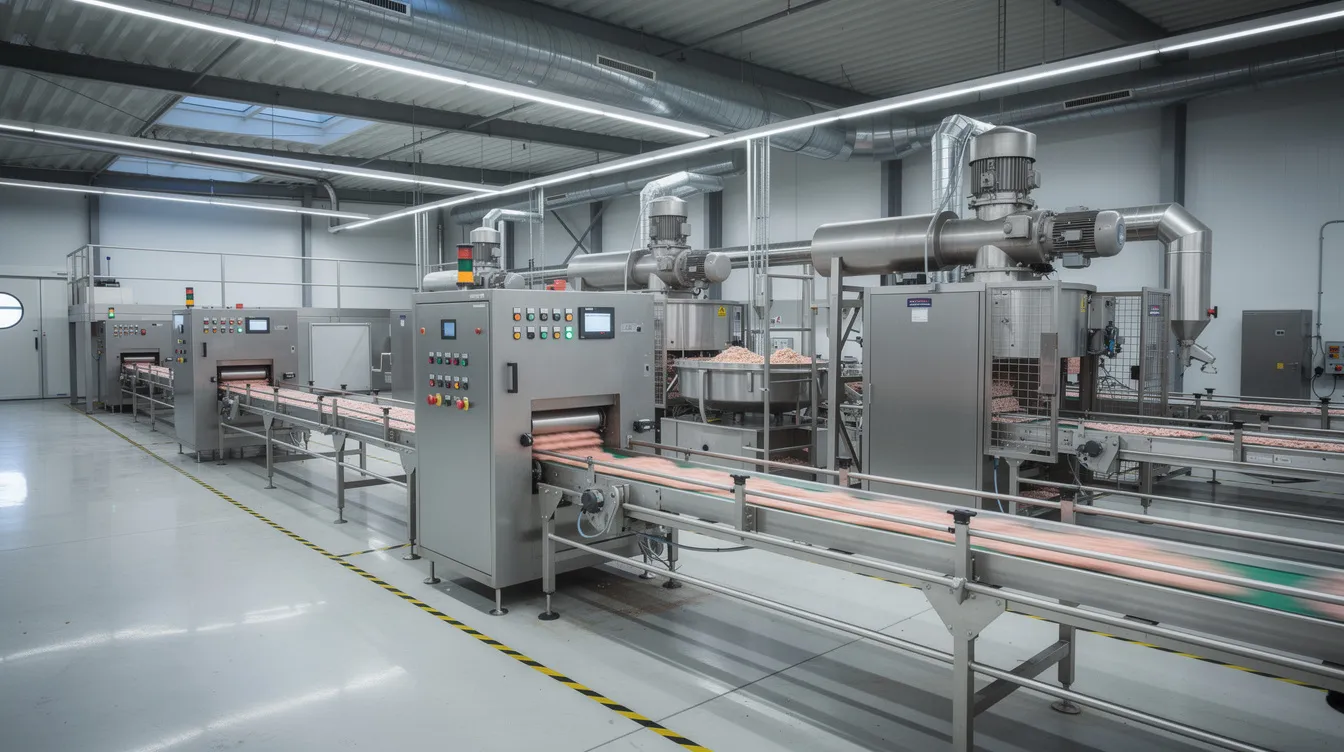
Raw material procurement and inspection. Whole masoor or yellow peas arrive from mandis, aggregators, or importers. Each lot is inspected for moisture (target 10–14%), foreign matter, damaged grains, and colour uniformity.
Cleaning and grading. Cleaning machines remove impurities from raw grains before milling. Pre-cleaners, vibratory sieves, and aspirators separate dust, husk fragments, undersized grains, and lightweight foreign matter.
Destoning and magnetic separation. Destoners remove stones and heavy particles. Magnetic separators extract metal contaminants. These steps are critical for food safety and protecting downstream equipment.
Dehulling or splitting. For dehulled masoor or yellow pea flour, a dehulling machine removes the outer husk. Yellow peas are larger and harder than red lentils; roller gap and feed rate must be adjusted accordingly. Research indicates tempering pulses to approximately 12% moisture for 18 hours improves dehulling efficiency and bran separation.
Conditioning or drying. Where incoming pulse moisture exceeds the target band, aeration or hot-air drying reduces it. Moisture control is critical in flour storage and processing to prevent spoilage and microbial growth.
Grinding or pulverising. Hammer mills are ideal for coarser grinding needs like maize flour and pulse grits. Pin mills and impact pulverisers produce finer pulse flour. Roller mills are commonly used for wheat flour production but are sometimes used in multi-pass pulse flour milling for controlled particle size reduction.
Sieving and particle-size classification. Rotary sifters or plansifters separate flour into fine, medium, and coarse fractions. Bran, shorts, and oversize particles are routed back for regrinding or sold as by-products. Particle size directly affects texture and functional properties of the finished flour.
Quality testing. Moisture, protein content (approximately 25.5% for red lentil flour), particle size distribution, colour, and microbial load are tested against buyer specifications. Quality control measures must ensure compliance with food safety standards for flour production.
Packaging, storage, and dispatch. Automated packing machines weigh and seal flour accurately into 25–50 kg bags for B2B or smaller pouches for retail. Storage silos or warehouses store raw grains and finished flour efficiently under dry, ventilated conditions to maintain extended shelf life.
Process flow: Raw Masoor/Peas → Cleaning → Destoning → Dehulling → Grinding → Sieving → Quality Check → Packaging → Dispatch
Dust control systems maintain cleanliness in flour milling operations and reduce dust explosion risk. Proper aspiration, cyclone separators, and bag filters are essential, following good flour mill safety and utilities practices.
Cross-contamination control is particularly important if the same line processes wheat or other allergens. Dedicated production scheduling, thorough cleaning between batches, and allergen declarations on packaging are standard practice.
Machinery Required for Masoor & Pea Flour Manufacturing
Machines vary in functions, but core equipment for a pulse flour processing line includes mills, sifters, and packaging units. The table below provides an indicative list adapted from common besan manufacturing machinery configurations.
| Machinery Name | Function/Purpose | Typical Capacity Range | Notes |
|---|---|---|---|
| Intake hopper & bucket elevator | Raw material feeding | Matched to plant TPH | Manual or automated feed |
| Pre-cleaner & vibro-sieve | Removing dust, oversized matter | 0.5–5 TPH | Multiple screen decks |
| Aspirator | Separating light impurities | Inline with cleaner | Air-suction based |
| Destoner | Stone and heavy particle removal | 0.5–5 TPH | Gravity-based |
| Magnetic separator | Metal contaminant removal | Inline | Permanent or electromagnetic |
| Gravity separator/grader | Grading by density and size | 0.5–3 TPH | Optional for premium lines |
| Dehulling/splitting machine | Husk removal from masoor/peas | 1–8 TPH | Gap setting critical for each pulse |
| Conditioning bin or dryer | Moisture adjustment | Batch or continuous | Used if moisture exceeds target |
| Hammer mill / pin mill | Primary grinding to flour | 200 kg–2 TPH per unit | Multiple units for higher capacity |
| Plansifter / rotary sifter | Particle-size separation | Matched to grinder output | Multiple mesh sizes |
| Screw/pneumatic conveyor | Material transfer | Inline | Food-grade construction |
| Weighing and bagging machine | Filling and sealing bags | 2–10 bags/min | Semi-auto or fully automatic |
| Stitching/sealing machine | Bag closure | Matched to bagger | Manual or conveyor-fed |
| Dust collection system | Cyclone + bag filter | Matched to plant size | Essential for safety and hygiene |
| Air compressor | Pneumatic valve actuation, packing | 5–15 HP | If pneumatic systems used |
| Lab equipment | Moisture meter, sieve set, scales | As needed | Protein analyser for premium QC |
Semi-automatic lines require more manual bag handling, feeding, and stitching. Fully automatic pulse flour lines use PLC or SCADA control panels, reducing labour requirements but increasing capital cost. Automation level can increase equipment costs by 30%–50%.
Procurement priorities: locally serviceable machines, available spares, food-grade contact surfaces, and energy efficiency. A well-designed line can process both masoor and pea flour using the same equipment, with proper cleaning and changeover procedures between batches to produce customized solutions for different buyers.
Land, Building and Factory Layout Requirements
Land and building requirements depend on target capacity, automation, storage volume, and local regulations. The approach is similar to besan plant land and layout planning, adapted for pulse flour operations.
For an MSME-scale pulse flour mill (1–2 TPH), typical requirements include approximately half an acre to one acre of land and 8,000–15,000 sq. ft. of built-up area. These figures are illustrative; actual needs depend on machinery dimensions and storage design. The project report should specify infrastructure requirements including utilities and land area for each specific plant configuration. Land costs range from ₹10 lakh to ₹1 crore depending on location and industrial zone.
Key functional zones:
- Raw material warehouse (dry, ventilated, rodent-proof)
- Cleaning and pre-processing section
- Dehulling and milling section (dust-controlled)
- Finished flour packaging and storage
- Utilities room (electric panels, compressor, dust collection equipment)
- Quality-control laboratory
- Administrative office, staff amenities, loading-unloading area
Layout should follow linear material flow from dirty (raw material) to clean (packaging) areas. Smooth washable floors, adequate ventilation, LED lighting, fire safety arrangements (extinguishers, escape routes), and pest control measures are expected under FSSAI hygiene norms. Design with provision for future expansion to add grinder lines or storage without complete construction rework.
Masoor & Pea Flour Manufacturing Plant Setup Cost in India
The estimated project cost encompasses land, building, machinery, and operational needs. This section presents an illustrative framework for a 1 TPH masoor and pea flour mill plant operating in two shifts, 300 days per year. Actual cost varies with location, construction standard, machinery selection, and automation level.
| Cost Head | Illustrative Range (₹ Lakh) |
|---|---|
| Land and site development | 10–60 |
| Factory building and civil works | 25–80 |
| Plant and machinery (incl. taxes, transport) | 40–120 |
| Electrical installation and power distribution | 5–15 |
| Dust collection and utilities | 3–10 |
| Laboratory and quality-control equipment | 2–5 |
| Furniture and office equipment | 1–3 |
| Preliminary and pre-operative expenses | 3–8 |
| Contingency (5–10%) | 5–15 |
| Margin money for working capital | 15–40 |
| Total illustrative project cost | 109–356 |
Flour processing equipment prices can vary by 50% or more between suppliers and automation levels. Machinery costs for small plants range from ₹15–25 lakh for basic setups. A small-scale flour mill may cost ₹15–25 lakh for machinery alone, while a small-scale flour mill may require ₹30–50 lakh to set up including basic infrastructure. Large-scale flour mills can exceed ₹2 crore in equipment costs. A fully automated flour mill can exceed ₹3 crore in setup costs when all components are included.
Plant and machinery plus electricals typically form 40–55% of total fixed investment. Building cost accounts for approximately 20–30%. Working capital margin is a separate but essential component. Stainless-steel food-contact construction and higher automation reduce labour and hygiene risk over time but increase the upfront investment.
Raw Material Requirements and Production Yield
Raw material prices, quality, and recovery rates are among the most critical drivers of project viability. Raw material sourcing needs careful planning to ensure quality and cost efficiency. The principles parallel those in besan yield and recovery analysis, with different crops and extraction rates.
Masoor is grown in Madhya Pradesh, Uttar Pradesh, Bihar, and West Bengal. Yellow peas are both domestically sourced and imported (Canada, Russia). Imported peas often provide more uniform size and colour, which improves consistency of the finished flour for export or premium buyers.
Buying whole pulses and dehulling in-house adds equipment cost and labour but gives control over husk quality and by-product recovery. Buying pre-split pulses reduces processing steps but limits by-product revenue.
Sample material balance (illustrative, 1,000 kg whole masoor input):
| Stage | Output (kg) | Loss/By-product (kg) |
|---|---|---|
| Pre-cleaning and grading | 980 | 20 (dust, stones) |
| Dehulling | 882 | 98 (husk) |
| Milling and sieving (flour at ~83%) | 732 | 150 (bran, shorts, fines) |
| Finished flour | ~732 |
Husk, brokens, and shorts can be sold as cattle feed or low-grade ingredients where local market exists. By-product revenue is modest but improves overall resource utilisation.
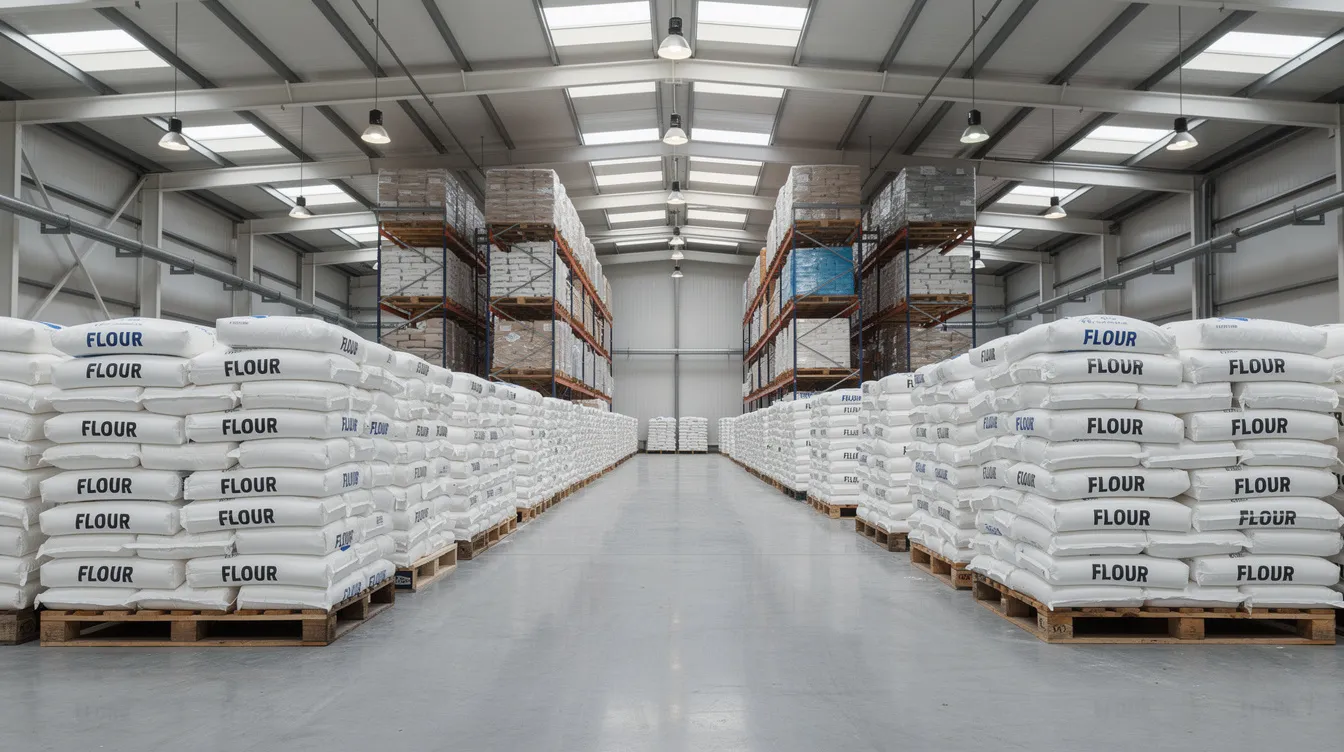
Raw material storage planning should account for 1–3 months of buffer inventory, warehouse conditions (dry, ventilated, fumigated), and the working capital tied up in stocks. Procurement and inventory principles similar to paddy raw material planning for rice mills apply here, adjusted for pulse seasonality and cash-credit requirements.
Power, Labour and Utility Requirements
Pulse flour milling is electrically intensive. Connected electrical load for a 1–2 TPH plant typically falls in the 50–100 kW range; a 5 TPH integrated unit may require 80–150 kW. Electricity bills for flour mills can range from ₹1–5 lakh monthly depending on scale, tariff, and daily output.
Manpower categories: plant supervisor, skilled machine operators (cleaning, grinding, packaging), electrician/fitter, unskilled helpers for bag handling, QC analyst, storekeeper, and administrative staff. For a 5 TPD unit, approximately 8–12 staff are typical; a 10 TPD unit may need 18–25. Monthly labor costs can range from ₹2–10 lakh depending on production capacity and local wage levels. Labor costs for a mini flour mill can vary based on production capacity and automation level.
Other utilities include compressed air (for pneumatic valves and packing machines), water for sanitation and cleaning (not used in the product), and preventive maintenance planning. Annual maintenance contracts for grinders and critical machines reduce unplanned downtime in continuous flour processing operations.
Masoor & Pea Flour Production Cost per Kg
The cost structure of masoor and pea flour production determines whether the business can sustain viable margins. Monthly raw material costs for a mid-scale unit may reach ₹10–50 lakh depending on throughput and pulse prices.
| Cost Component | Category | Approximate Share |
|---|---|---|
| Raw material (masoor/peas) + inward freight | Variable | 55–65% |
| Power and fuel | Variable | 5–8% |
| Direct labour | Semi-variable | 5–8% |
| Packing material | Variable | 3–5% |
| Repairs, maintenance, consumables | Fixed/semi-variable | 2–4% |
| Factory overheads (insurance, QC, misc.) | Fixed | 2–4% |
| Selling, freight outward, commission | Variable | 3–6% |
| Finance cost (interest on TL + WC) | Fixed | 3–6% |
Raw material contributes the largest share. A 2–3% change in masoor or pea procurement price, or in flour recovery percentage, can shift the margin between profit and loss. For context, raw material costs for wheat range from ₹22–30 per kg; masoor and yellow peas trade at different price points depending on origin, season, and quality.
At low capacity utilisation, fixed costs per kg are high. As utilisation improves toward 75–80%, fixed costs spread over more units and reduce overall cost per kg. The methodology is consistent with the approach described in besan production cost and margin analysis.
Profit Margin and Revenue Model
Profitability depends on product mix, customer profile, capacity utilisation, and raw material cost discipline. Revenue channels include:
- Bulk B2B sales to food manufacturers (primary revenue source)
- Contract manufacturing for branded food companies
- Private-label production for retailers or health-food brands
- Own consumer brand in regional markets
- Speciality segments: gluten-free, high protein, fortified, or clean label pulse flours commanding premium prices
By-product revenue (husks, brokens) adds modest incremental income. Credit terms offered to B2B buyers affect effective profitability. Extended receivable periods of 45–90 days increase interest costs and working capital strain. Sales margins fluctuate with raw material cycles, competition, and plant efficiency. No fixed margin should be assumed in projections.
Project Cost and Means of Finance
Managing working capital is crucial due to the purchase of raw materials before selling finished products. The means of finance for a masoor and pea flour plant typically includes:
| Source | Illustrative Share |
|---|---|
| Promoter’s equity contribution | 25–35% of total project cost |
| Term loan (bank/FI) for building and machinery | 65–75% of fixed assets |
| Working capital limits (cash credit, OD) | Assessed separately against stock and receivables |
Actual ratios depend on bank policy, risk appraisal, promoter track record, and available collateral (primary security: machinery and building; collateral: additional property or guarantees). The approach follows principles discussed in project cost and means of finance planning for flour mills.
An integrated DPR and financial model should align the disbursement schedule with plant construction, machinery delivery, and trial production timelines. Business plans must outline fundraising needs and specify potential government schemes for support where applicable.
Financial Projections, CMA Data and DSCR Analysis
Banks in India require comprehensive financial projections and CMA Data for sanctioning term loans and working capital limits for a flour mill. Effective financial modeling entails projecting cash flow and profitability metrics over time. Financial projections in project reports should include annual sales, profits, and break-even points.
A professional DPR for 5–7 years includes:
- Projected profit and loss, balance sheet, and cash flow
- Term-loan repayment schedule
- Working capital assessment (stock, receivables, creditor cycle)
- DSCR computation: banks expect a comfortable average DSCR over the loan tenure, not just one strong year
- Break-even analysis: expected break-even utilisation for a typical masoor and pea flour plant, influenced by selling price and raw material cost
- Investment-return metrics: ROI, IRR, and payback period, using the analytical framework described in project feasibility, ROI, IRR and sensitivity analysis
A realistic capacity ramp-up (50–60% utilisation in year 1, 65–70% in year 2, 75–80% from year 3) is critical for credible DSCR and cash-flow projections. CMA Data Preparation and Assistance involves compiling financials, forecasting performance, and structuring information in the standard banking format, consistent with financial projection and CMA Data approaches.
Feasibility and Viability Assessment
Requirements for a robust manufacturing project report include technical feasibility, financial viability, and regulatory compliance. Project finance advisory should assess the overall feasibility of the project before initiating investments.
Technical feasibility: suitability of selected machinery for masoor and peas, adequate production capacity, layout design, utilities sizing, and food-safety compliance.
Commercial feasibility: demand mapping, buyer feedback, competition analysis, logistics cost to major customers, and dependence on specific crop availability.
Financial viability: projected profitability, DSCR above lender thresholds, break-even utilisation at 60–65%, and acceptable IRR under reasonable assumptions.
Sensitivity analysis helps determine a project’s financial resilience against variable market conditions. Downside scenarios to test include:
- 10–15% higher raw material procurement cost
- 3–5% lower flour recovery than assumed
- 5–10% lower selling prices due to competition
- 15–30 day longer receivable collection period
- 1–2% higher borrowing interest rate
In my professional experience as a Chartered Accountant preparing industrial DPRs, such sensitivity analysis often shifts promoter decisions on plant size, automation level, and product mix before full capital is committed.
Licences, Registrations and Regulatory Compliance
Compliance with the FSSAI is mandatory for food-processing businesses in India. Strict regulatory compliance is essential for food safety in flour production. Licensing costs typically range from ₹50,000 to ₹5 lakh depending on categories and scale.
Common registrations and approvals:
- FSSAI licence for food manufacturing
- GST registration
- Udyam registration for MSME benefits
- Factory licence under state factories rules (where workforce and power thresholds apply)
- Pollution control board consent for air emissions (dust)
- Fire safety NOC where applicable
- Legal Metrology compliance for packaged commodities
FSSAI standards for pulse flours require moisture, purity, and labelling compliance. Retail packs need ingredient declarations, nutritional information, and allergen warnings. Import-Export Code (IEC) is required for exporting yellow pea flour. Large buyers may require ISO 22000, HACCP, or BRC certification.
Exact requirements depend on location, scale, and processes. Consulting local authorities for up-to-date requirements is recommended.
Government Schemes and MSME Support
Central and state-level MSME loan schemes through banks may support pulse flour projects through credit-guarantee backed loans or interest subvention programmes. Eligibility is conditional on project merit, scheme norms, and budget availability.
Food-processing-focused schemes (historically under the Ministry of Food Processing Industries) have supported plant and machinery or infrastructure for units like flour mills. The PM Formalisation of Micro Food Processing Enterprises (PMFME) scheme has offered support up to ₹10 lakh for eligible micro food-processing units. Entrepreneurs must verify whether these schemes are open, modified, or closed when they actually apply.
Registered MSMEs may access benefits such as preference in tenders, cluster-based facilities, technology-upgradation support, and marketing assistance. Neither subsidy sanction nor bank loan approval can be guaranteed.
Major Risks in Masoor & Pea Flour Manufacturing
Monitoring and managing project risks is essential for successful implementation.
Procurement risks: Raw masoor and pea prices fluctuate with harvest cycles, import policy changes, and currency movements. Supply shortages due to crop failure or export/import restrictions can disrupt operations.
Production and quality risks: Inconsistent flour particle size, microbial issues from high-moisture pulses, hygiene lapses, and dust explosion hazards if dust collection is inadequate. Quality inconsistency in raw pulses directly affects finished flour quality and buyer acceptance.
Commercial and financial risks: Customer concentration on a few large B2B buyers, intense price competition with established pulse flour mills, extended credit periods causing working capital strain, and underutilised capacity leading to poor absorption of fixed costs.
Risk-mitigation measures:
- Diversified sourcing of masoor and peas from multiple suppliers and origins
- Forward contracts or hedging where practical
- Rigorous quality control with in-house testing
- Product and customer diversification across food manufacturers, bakery, and catering segments
- Conservative leverage and adequate working capital limits
Why a Professional DPR Is Important Before Investment
A manufacturing project report requires a structured layout. The project report structure should encompass executive summary, market analysis, and financial projections. Detailed Project Reports support entrepreneurs in securing bank financing for new projects. Investor-ready documentation enhances the likelihood of securing funding for new ventures.
A comprehensive DPR for a flour mill should include:
- Market and demand analysis for masoor and pea flour
- Technical configuration and machinery list with capacity planning
- Detailed project-cost estimation and implementation schedule
- 5–7 year financial projections, production cost analysis, break-even and sensitivity analysis
- DSCR computation, loan repayment plan, and working capital assessment
- CMA Data Preparation and Assistance for banks
From my professional experience, a customised DPR avoids overestimation of margins, underestimation of working capital, and unrealistic capacity utilisation, which are among the most common reasons for financial stress in new flour mill projects.
Professional DPR and Bank Finance Advisory by CA Manish Gugliya
CA Manish Gugliya, FCA, DISA (ICAI), is the founder of Manish Gugliya & Company, Chartered Accountants, and Project Report Bank. With more than 20 years of professional experience, the practice provides customised DPR, financial modelling, and project finance advisory for manufacturing and food-processing projects across India.
Professional services for masoor and pea flour manufacturing projects include:
- Bank Finance DPR and Loan Proposal Assistance, starting from approximately ₹25,000
- Financial Projections and Modelling, starting from approximately ₹25,000
- Feasibility Study and Project Viability Analysis, starting from approximately ₹50,000
- Investor-Ready DPR and Fundraising Documentation, starting from approximately ₹75,000
Fees depend on project complexity, capacity, scope, and deliverables. Engagements typically cover project-cost estimation, means-of-finance planning, projected profit and loss, balance sheet, cash flow, DSCR analysis, CMA Data Preparation and Assistance for banks, working capital assessment, and support in responding to banker queries during appraisal.
Project Report Bank is a professional advisory platform providing customised assumptions, practical industry insights, and realistic financial evaluation tailored to each promoter’s masoor and pea flour project.
Planning a Masoor or Pea Flour Manufacturing Plant? CA Manish Gugliya & Company provides professional DPR preparation, financial projections, CMA data assistance, feasibility evaluation and bank finance proposal support. Contact us through WhatsApp to discuss your proposed plant capacity, investment requirements and financing plan.
Frequently Asked Questions
The following FAQs address practical points that promoters commonly raise while planning a masoor and pea flour manufacturing project report.
What is a practical minimum capacity for a commercial masoor and pea flour plant?
For B2B supply with reasonable cost efficiency, capacities below 300–500 kg/hour often struggle to cover fixed costs and compete on price with established mills. A 500 kg/hour to 1 TPH range is a common MSME starting point. The exact capacity should follow a customised feasibility study that evaluates target customers, location, raw material availability, and the combination of products planned for the line.
Can one flour mill line process both masoor and yellow pea flour?
A well-designed pulse flour line can process multiple pulses using the same cleaning, dehulling, and grinding machinery. Proper batch scheduling, thorough cleaning between products, and quality-control procedures prevent cross-contamination. Adjustments to dehulling gap and grinder settings are needed because yellow peas are larger and harder than red lentils; these changeovers typically take a few hours per switch.
How much working capital is typically required for a pulse flour mill?
Working capital covers raw material stock (often 1–3 months of buffer), finished goods inventory, and receivables from B2B buyers. For an MSME unit, this can equal several months of operating costs. A tailored cash-credit assessment and CMA Data exercise based on actual inventory holding periods, creditor terms, and receivable days is essential rather than relying on generic rules of thumb.
What information is required to prepare a bankable DPR for this project?
A professional DPR requires: proposed plant location, target capacity, product mix (masoor flour, pea flour, or both), machinery shortlist or quotations, land ownership or lease details, promoter background and financial position, expected customer base, and raw material sourcing plan. Once these details are shared, a DPR with financial projections and CMA Data can typically be prepared within a few weeks.
How are DSCR and project feasibility calculated for a pulse flour plant?
DSCR is calculated as net cash available for debt service (profit after tax plus depreciation plus interest on term loan) divided by total debt service (principal repayment plus interest). Banks look for average DSCR above 1.25–1.50 over the loan tenure. Feasibility is assessed by checking whether projected profitability, cash flows, break-even utilisation, and IRR remain acceptable under both base-case and downside scenarios involving higher raw material costs or lower selling prices.