Key Takeaways
- A moong flour manufacturing project report should cover plant setup cost, machinery selection, capacity planning, raw material procurement, and profitability analysis before any capital is committed.
- This guide is written from the perspective of Project Report Bank, a CA-led project finance advisory, focusing on practical bankable details for entrepreneurs planning dal mill and flour mill projects in India.
- The article covers moong dal flour manufacturing as the primary focus, with notes on processing other pulses like chana dal, urad dal, masoor dal, matar dal, and toor dal on the same line.
- Financial projections, CMA Data preparation, and bank loan proposal structuring for food processing entrepreneurs in India are addressed with FY 2025-26 assumptions.
- Concrete cost ranges, process flows, and recovery norms replace generic placeholders throughout.
Introduction to Moong Flour Manufacturing Project Report
Moong flour, produced from raw green gram (moong dal) through several mechanical steps including cleaning, milling, and packaging, serves a wide range of applications in Indian cuisine and the food processing industry. Papad manufacturers, namkeen factories, instant dosa and idli batter producers, baby food companies, and gluten-free product brands all use moong flour as a core ingredient. Moong flour is high in protein and gluten-free, which places it among healthy food ingredients with growing demand across both B2B supply chains and retail markets.
A detailed project report for moong flour production should cover technical and financial aspects, from machinery specifications and process flow to project cost, means of finance, working capital assessment, DSCR, and sensitivity analysis. A detailed project report ensures proper business setup by forcing the promoter to think through every operational and financial assumption before investing money.
This complete guide outlines the structure and contents of a professional moong flour manufacturing project report for entrepreneurs planning a small or medium flour mill in India in FY 2025-26, with bank finance and MSME schemes in mind. Moong flour can be part of an integrated dal mill plant that also handles urad, chana dal, masoor dal, or toor dal, but the primary focus here is moong flour.
A bankable moong flour manufacturing project report must normally contain:
- Market assessment and target customer identification
- Product specifications and quality parameters
- Plant capacity and production technology details
- Machinery list with budgetary cost
- Project cost and means of finance
- Raw material planning and yield assumptions
- Financial projections, CMA Data, and DSCR computation
- Registration and licensing requirements
- Risk analysis and sensitivity testing
Market Overview and Business Opportunity
The pulse flour market in India stands at the intersection of traditional food products, health-conscious consumer trends, and institutional demand from food processing companies. Moong flour pricing can fluctuate based on seasonal crop yields; as of October 2026, retail moong dal prices average approximately ₹114 per kg, and the MSP for moong has risen over 507% from 2004-05 to 2023-24, reflecting both policy support and rising production costs. Project reports should assess market potential and demand for moong flour products before committing capital.
Major demand drivers include:
- Increased use of moong flour in namkeen factories and papad manufacturing units, where consistency in particle size and low moisture improve product quality
- Growing demand for gluten-free blends, instant dosa/idli mixes, and institutional catering supply
- Urban consumers seeking packaged, FSSAI-compliant flours through modern trade and e-commerce
B2B opportunities involve supplying bulk 25-50 kg bags to food processing units, while B2C requires branded retail packs (500 g, 1 kg) with proper packaging materials and labelling. Regional opportunities are concentrated in Gujarat and Rajasthan (snacks, papad), Maharashtra and Karnataka (ready mixes), and North India (traditional foods). The project report should describe target customers, competitor dal mill and flour mill operators in the area, and positioning; for example, premium low-moisture moong dal flour for namkeen manufacturers.
Types of Moong Flour and Related Pulse Flour Products
A moong flour manufacturing unit can focus only on moong dal flour or also process other pulses on the same line with proper cleaning and changeover. Many entrepreneurs explore combining moong with urad dal, chana dal (including kala chana variants), masoor dal, matar dal, or toor dal to build a wider product mix and improve capacity utilisation.
Main commercial variants of moong-based flour:
- Whole green moong flour (skin + kernel)
- Yellow moong dal flour (dehusked), commonly used in snacks
- Roasted moong flour for specific flavour profiles
- Customised blends for industrial customers
Related pulse flours often considered in the same project: urad dal flour for idli/dosa batter, chana dal besan for snacks, and wheat-pulse flour blends for nutritional products.
Ensuring consistent flour quality and fine texture is crucial for customer satisfaction in moong flour products. Moong flour must meet various quality parameters, including moisture content (below 12% for safe storage), particle-size distribution (fine for batter, coarse for papad), protein level, colour, and absence of foreign matter such as stones. Different end users specify different characteristics; a multigrain flour mill brand owner may need different specs than a papad maker.
Plant Capacity Planning for Moong Flour Mill
Realistic capacity planning is central to any moong flour manufacturing project report because it directly influences project cost, machinery selection, and working capital requirements. The production capacity of a moong flour mill can vary based on operational demands and market conditions.
Typical installed capacities a promoter might evaluate:
| Hourly Capacity | Daily Output (8-hr shift) | Annual Installed (300 days) | Year 1 Utilisation | Year 3 | Year 5 |
|---|---|---|---|---|---|
| 250 kg/hr | 2,000 kg | 600 tonnes | ~50% | ~70% | ~80% |
| 500 kg/hr | 4,000 kg | 1,200 tonnes | ~50% | ~65% | ~80% |
| 1,000 kg/hr | 8,000 kg | 2,400 tonnes | ~45% | ~65% | ~75% |
A 2 Ton/hr dal mill plant processes pulses into edible dal and flour at larger scales, but most new entrepreneurs start at 250-500 kg/hr. Installed capacity (kg of cleaned dal processed per hour) differs from saleable output (kg of moong flour after cleaning, sieving, and minor process loss). Promoters familiar with besan plants can refer to the besan mill project report on Project Report Bank for a consistent planning approach adapted from chana dal to moong.
Moong Flour Manufacturing Process Flow
The manufacturing process of moong flour includes cleaning, milling, and packaging as core stages. Dal milling involves cleaning, dehusking, splitting, and grading before the flour milling step. Here is the typical process:
Raw Moong → Pre-cleaner → Destoner → Grader → Dehusker (optional) → Conditioner/Dryer → Pulveriser → Vibro Sifter → QC Testing → Packing → Storage → Dispatch
If the unit sources already cleaned and graded moong dal from another dal mill, the early cleaning, destoning, and dehusking stages are skipped, and operations start directly at milling. Cleaning machines remove impurities before milling grains, and setting optimal milling parameters is essential to preserve the quality of moong flour during processing.
Process-control elements that a project report should address:
- Maintaining moisture below 12% before milling to prevent caking and spoilage
- Controlling flour temperature during pulverising (friction generates heat)
- Minimising cross-contamination when switching between moong and urad or chana dal
- Following FSSAI hygiene guidelines and food safety protocols
Machinery and Equipment for Moong Flour Manufacturing
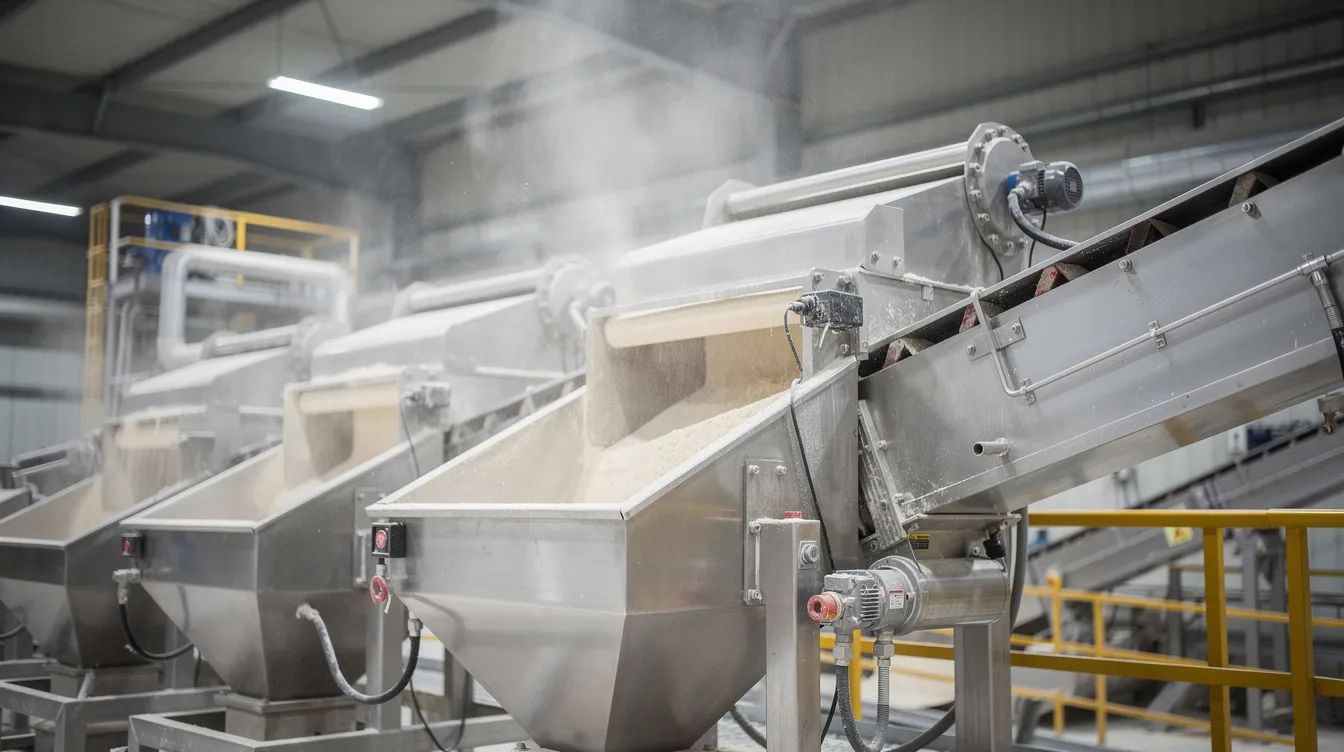
The project report must present a clear list of machinery for a moong flour mill along with indicative capacity and budgetary cost ranges. Modern dal mills can operate in semi-automatic or fully-automatic modes, with minimal manual intervention in automated plants. A dal mill requires modernized milling machinery for efficiency.
Primary machines:
- Raw material elevator and conveyors
- Pulse pre-cleaner and aspirator
- Destoner
- Gravity separator and grader
- Dehusker (if whole green moong is used)
- Impact pulveriser or hammer mill (roller mills are commonly used for fine grinding in flour mills)
- Cyclone separator and dust collection system; dust control systems maintain cleanliness in milling operations
- Vibro sifter
- Screw conveyors and bucket elevators
Auxiliary equipment: magnetic separator, metal detector (for food safety), weighing scales, packaging machines that seal flour in pre-defined quantities, stitching machines, compressor, electrical control panel, and basic lab equipment for moisture and sieve analysis. Quality assurance requires various testing instruments in dal milling. The connected electrical load for a 500 kg/hr plant typically ranges between 50-80 kW depending on automation level; electricity costs per kg decrease as plant scale grows.
For details on equipment selection logic and dust control, the approach used in the besan machinery and utilities guide provides a useful reference framework.
Land, Building and Factory Layout for a Moong Flour Mill
Plant layout and material circulation matter for food safety, efficiency, and future expansion. A suitable site is needed for the factory; ideal locations are urban or semi-urban areas where access to supplies and trained workers is crucial. The factory should be in a safe industrial neighborhood.
Indicative built-up area planning:
- Micro unit (~500 kg/day): 3,000-4,000 sq. ft., commonly on rented premises
- Small unit (2 tonnes/day): 6,000-8,000 sq. ft. on a 10,000-12,000 sq. ft. plot
- Medium unit (5+ tonnes/day): 12,000-15,000 sq. ft. built-up on 20,000+ sq. ft. of land
Key internal zones: raw moong storage space for raw materials and finished goods, cleaning and grading area, dehusking and milling area, packing room, finished goods godown, QC lab corner, utility area (panel, compressor, DG set), and small office. Local building by-laws, fire exits, and pollution control norms must be complied with. The exact layout should come from the machine supplier’s GA drawings and an architect’s plan.
Project Cost Estimate for Moong Flour Unit
This section of the project report consolidates fixed capital requirements for a greenfield moong flour manufacturing unit as of FY 2025-26. All amounts below are illustrative, not verified quotations.
| Cost Head | Approximate Range (₹ Lakh) |
|---|---|
| Land and site development | 10-100 (location-dependent) |
| Factory building and civil works | 8-25 |
| Plant and machinery | 15-25 (small-scale) |
| Electricals and utilities | 3-8 |
| Lab and testing equipment | 1-2 |
| Furniture and office | 1-2 |
| Preliminary and pre-operative expenses | 1-3 |
| Licensing and legal costs | 0.50-5 |
| Contingency | 2-5 |
| Working capital margin | 5-15 |
Land costs can range from ₹10 lakh to ₹1 crore depending on location. Machinery costs for a small-scale plant range from ₹15-25 lakh. For reference, total fixed capital for a micro dal mill can total approximately ₹7.96 lakhs, and the working capital requirement for a dal mill can reach ₹15.45 lakhs in smaller setups. A multi-pulse dal mill cum flour mill plant where additional dehusking and grading machines are required will push the total budget higher than a moong-only flour unit.
For a structured approach to building project cost tables, the besan manufacturing project cost framework provides a comparable methodology.
Raw Material Planning: Moong Dal and Other Pulses
Raw material; primarily whole green gram (moong beans) or cleaned yellow moong dal; is the single largest component of production cost for a moong flour unit, commonly representing 60-75% of total cost. Establishing direct relationships with suppliers can help stabilize raw material prices.
Procurement sources include local mandis, APMC markets, tie-ups with traders and large dal millers, and seasonal stocking immediately post-harvest to average out price volatility. Key procurement parameters: moisture %, proportion of damaged or discoloured grains, foreign matter, and grading by size. Moong flour absorbs moisture easily, necessitating moisture-proof packaging with multi-layered bags to extend shelf life. Entrepreneurs handling other pulses such as chana dal, urad, masoor, and matar dal on the same line should account for their seasonal pricing and storage behaviour in the project report.
For a comparative framework on procurement and inventory planning, the chana dal procurement approach for besan provides a useful reference, adapted here for moong dal.
Manufacturing Recovery, Yield and Process Losses
Bankers frequently test the robustness of a project report by examining raw material-to-finished goods recovery norms. Two scenarios apply:
Scenario A: Whole green moong From 1,000 kg received: ~20-30 kg rejected as stones, dust, and foreign matter (2-3%); ~80-100 kg as husk during dehusking (8-10%); leaving ~870-900 kg of clean dal. After milling and sieving, ~850-880 kg of saleable moong flour.
Scenario B: Already dehusked moong dal From 1,000 kg: ~20-30 kg cleaning and minor process loss (2-3%); ~950-970 kg saleable flour output.
Even a 1% change in recovery can affect gross margin per kg by ₹1-1.50 when raw material is ₹100+/kg. The project report must explain the technical basis for the chosen yield assumption. For similar recovery logic applied to chana dal, the besan recovery and yield analysis is a useful reference, keeping in mind that pulse varieties behave differently.
Production Cost per Kg and Profitability Analysis
This part of the moong flour manufacturing project report converts technical assumptions into per-kg production cost and profitability estimates. Moong flour is used in baking, snacks, baby foods, and traditional culinary preparations, giving it multiple market channels.
Illustrative per-kg cost structure (FY 2025-26, 500 kg/hr plant at 65% utilisation, B2B bulk sale):
| Component | ₹ per kg (approx.) |
|---|---|
| Raw material (moong dal input adjusted for yield) | 105-115 |
| Packing material | 1.50-3.00 |
| Power and fuel | 2.00-3.50 |
| Direct labour | 1.50-2.50 |
| Repairs and maintenance costs | 0.50-1.00 |
| Factory overhead | 1.00-2.00 |
| Administrative and selling expenses | 2.00-4.00 |
| Total production cost | ~115-130 |
| Selling price (B2B bulk) | 130-145 |
| Contribution margin | 10-20 |
At 50% utilisation, overhead absorption per kg rises and margins thin. At 80%, per-kg fixed cost drops, improving profitability. Financial projections for moong flour production should include CAPEX and working capital needs alongside these per-kg economics.
Means of Finance, Term Loan and Working Capital
A moong flour project report should structure the funding pattern without double-counting working capital once in project cost and again in bank finance. Funding sources include banks, rural cooperatives, and venture capitalists.
Typical financing for MSME units:
- Promoter’s equity contribution: 25-35% of fixed capital cost
- Bank term loan: 65-75% of fixed assets
- Separate cash credit limit on stocks and receivables, with 25-40% margin money from the promoter
Banks evaluate DSCR, debt-equity ratio, fixed asset coverage, and projected cash flows. For example, if total project cost is ₹80 lakh, the promoter may need ₹20-28 lakh as own contribution, with ₹52-60 lakh financed through a term loan. Actual sanction depends on bank policy and appraisal. For structuring logic, the atta chakki plant financing approach illustrates comparable MSME project finance structures.
Working Capital, Inventory and Cash Cycle
Working capital is particularly important in a pulse-based flour mill due to high raw material stocking requirements during harvest seasons and credit offered to B2B buyers. Working capital requirement totals ₹15.45 lakhs for small-scale operations.
Key components: raw moong dal inventory (30-60 days depending on seasonal stocking), packaging material stock (15 days), finished flour inventory (7-15 days), trade receivables (15-45 days for B2B), and trade payables (15-30 days). A simplified operating cycle: total inventory days (45) + receivable days (30) minus payable days (20) = 55 days of net operating cycle. At a daily cost of ₹40,000, the working capital requirement is approximately ₹22 lakh, of which the promoter must fund the margin (25-40%) and the balance is available as cash credit drawing power.
Financial Projections, CMA Data and DSCR for Moong Flour Project
For bank finance, a 5-7 year financial projection is normally prepared along with CMA Data format. This forms an integral part of a professional moong flour manufacturing project report. Statements to be projected include year-wise Profit and Loss account, Balance Sheet, Cash Flow statement, term loan repayment schedule, interest calculation, DSCR computation, break-even analysis, and key ratios.
Projections are based on specific assumptions regarding capacity utilisation, moong dal price, selling price, interest rate, and power tariff. Banks expect these assumptions to be disclosed and justified. DSCR is calculated as net cash accrual divided by annual debt service (principal + interest); bankers typically expect average DSCR above 1.50 over the loan tenure. Consult experts to compile your project report with these projections prepared on a defensible, assumption-driven basis. Production technology for dal can be acquired from government agencies, which can support the technical assumptions.
Licences, Registrations and Compliance Requirements
A project report includes registration and licensing requirements applicable to the specific plant. Statutory compliance includes necessary food manufacturing licenses such as FSSAI registration. Moong flour production requires adherence to food safety regulations and quality control.
Key registrations:
- Business constitution (proprietorship, partnership, LLP, Pvt. Ltd.)
- Udyam Registration under MSME
- GST registration
- FSSAI licence (food manufacturing; central licence if turnover exceeds ₹12 crore)
- Factory licence (state-specific)
- Fire safety NOC
- Food labelling compliance under FSSAI Packaging and Labelling Regulations
- Legal Metrology approvals for weighing and packaging machines
Pollution control consents and boiler approvals depend on the specific processes and utilities at that plant. Promoters should verify with local government agencies as on the date of implementation.
Project Risks and Mitigation for Moong Flour Manufacturing
A balanced project report highlights key business risks instead of promising guaranteed success.
| Risk | Mitigation |
|---|---|
| Raw moong price volatility | Diversified sourcing, post-harvest stocking, direct farmer/trader relationships |
| Selling price pressure from competition | Quality differentiation, B2B contract customers, retail branding |
| Quality issues (high moisture, inconsistent granulation) | Strict QC protocols, proper storage, calibrated milling parameters |
| Infestation and spoilage in stored pulses | Fumigation, moisture-proof packaging, FIFO inventory rotation |
| Machinery breakdown | Preventive maintenance schedules, spare parts inventory |
| Inadequate working capital | Conservative credit terms, sufficient margin money, realistic inventory planning |
Sensitivity analysis covering changes in raw material cost (±10-20%), selling price (±5-10%), and plant utilisation (±15%) should be included as a separate annexure. The analytical style adopted in the besan feasibility and sensitivity analysis provides a reference for framing these scenarios for moong flour.
Conclusion
- A well-prepared moong flour manufacturing project report brings together technical planning (plant capacity, machinery, process), commercial assessment (market and raw material), and financial analysis (project cost, profitability, DSCR) into one defensible document.
- Moong flour and related pulse flour manufacturing can be a viable MSME opportunity in India if approached with realistic assumptions, adequate working capital, and disciplined quality control.
- Project Report Bank, under the guidance of CA Manish Gugliya (FCA, DISA, 20+ years of experience), specialises in customised, bankable DPRs, CMA Data, and project finance advisory for dal mill and flour mill projects across India. Bank Finance DPR and Loan Proposal Assistance starts from ₹25,000, with fees depending on project scope and complexity.
Serious promoters may share basic project details via WhatsApp or email to obtain a customised, professionally analysed moong flour manufacturing project report suited to their location and capacity.
Frequently Asked Questions
What is the minimum viable capacity for a new moong flour mill?
A 250 kg/hr plant running a single 8-hour shift can produce about 600 tonnes annually at full capacity. For a new entrepreneur without confirmed B2B contracts, starting at 250-500 kg/hr allows manageable investment (₹40-80 lakh total project cost depending on land ownership) while leaving room to grow by adding shifts or upgrading equipment. Starting easy at a smaller scale reduces the risk of underutilisation in the first two years.
Can the same pulveriser handle both moong dal and chana dal?
Yes, the same impact pulveriser or hammer mill can process moong dal, chana dal, urad dal, and other pulses. The key operational step is thorough cleaning of the hopper, conveyor, and sieve mesh between batches to prevent cross-contamination. Changeover typically takes 30-60 minutes on semi-automatic machines. The project report should account for this downtime when calculating effective daily capacity for a multi-pulse flour mill plant.
How long does it take to prepare a bankable project report and CMA Data for a moong flour unit?
A customised DPR with CMA Data, financial projections, and supporting schedules typically requires 7-15 working days after the promoter provides basic information: confirmed machinery quotations, land and building details, proposed capacity, raw material pricing, and intended market. The process involves building and validating assumptions, not filling a template.
Does combining moong flour with other pulse flour lines affect bank appraisal?
Banks generally view multi-product lines favourably because product diversification reduces the risk of dependence on a single raw material or customer segment. The appraisal will, however, test whether the combined capacity utilisation assumptions are realistic and whether working capital is sufficient to carry inventory for multiple raw materials. Each additional pulse line (urad, masoor, toor) adds to the machinery budget, so the project cost and means of finance must reflect the expanded scope accurately.
What is the difference between a dal mill and a moong flour manufacturing unit?
A dal mill primarily cleans, dehusks, splits, and grades whole pulses into dal for consumption. A moong flour manufacturing unit takes this a step further by milling the dal into flour of specified fineness. Some entrepreneurs operate an integrated dal mill cum flour mill, handling the full chain from whole beans to finished flour. The project report for each model differs in machinery requirements, recovery assumptions, and working capital structure. The tur dal mill project report on Project Report Bank illustrates how a dal-focused project is structured differently from a flour-focused one.