This article focuses on the financial returns and ROI of a besan plant – not on basic “how to start” information. If you are evaluating whether besan manufacturing is worth the capital commitment, the discussion ahead covers ROI, IRR, payback, break-even and the practical factors that determine whether a besan mill plant delivers adequate returns.
Key Takeaways
- A well-planned besan plant can be a profitable venture if ROI, IRR, payback and cash flow are analysed properly before committing investment. A well-managed besan processing plant can target an annual ROI of 15% to 30%, depending on scale, location and market strategy.
- An illustrative small automatic besan mill plant of around 8 TPD capacity can require investment in the range of a few crore rupees and may target a project IRR of 20–25% under realistic assumptions – but actual returns depend heavily on chana dal prices, capacity utilisation and working capital discipline.
- Raw material constitutes 70% to 80% of operational costs for a besan plant. Even modest fluctuations in chana dal procurement cost can shift margins significantly.
- ROI for a besan manufacturing plant generally ranges between 25% and 40% in well-structured projects with favourable input costs and steady demand – but these figures must be validated through sensitivity analysis, not accepted at face value.
- Project Report Bank, led by CA Manish Gugliya, prepares customised DPRs, CMA Data and financial models for besan mill projects across India, helping promoters and banks evaluate project viability with defensible assumptions.
Introduction – Besan Plant as a Profitable Venture & Why ROI Matters
Besan (gram flour) is a staple in Indian households and the commercial food industry. India’s besan market is valued at ₹32,000 Cr, with branded packaged besan growing at 12–15% annually. Approximately 70% of the besan market remains with unorganised local mills, which creates a meaningful opportunity for quality-focused, organised manufacturers. Besan demand is consistent and non-seasonal year-round, and households are the core consumers of besan products – making this a dependable demand base for manufacturing businesses in India.
Setting up a besan manufacturing plant is a lucrative food processing business, but mere focus on machinery cost is not enough. Investors must evaluate the production process, project cost, working capital requirement and detailed financial viability before committing capital. ROI – Return on Investment – measures the percentage return earned on the capital deployed. This article will guide how to think about besan plant ROI, payback and overall project feasibility from the professional lens of Project Report Bank.
Overview of a Typical Besan Mill Plant Setup
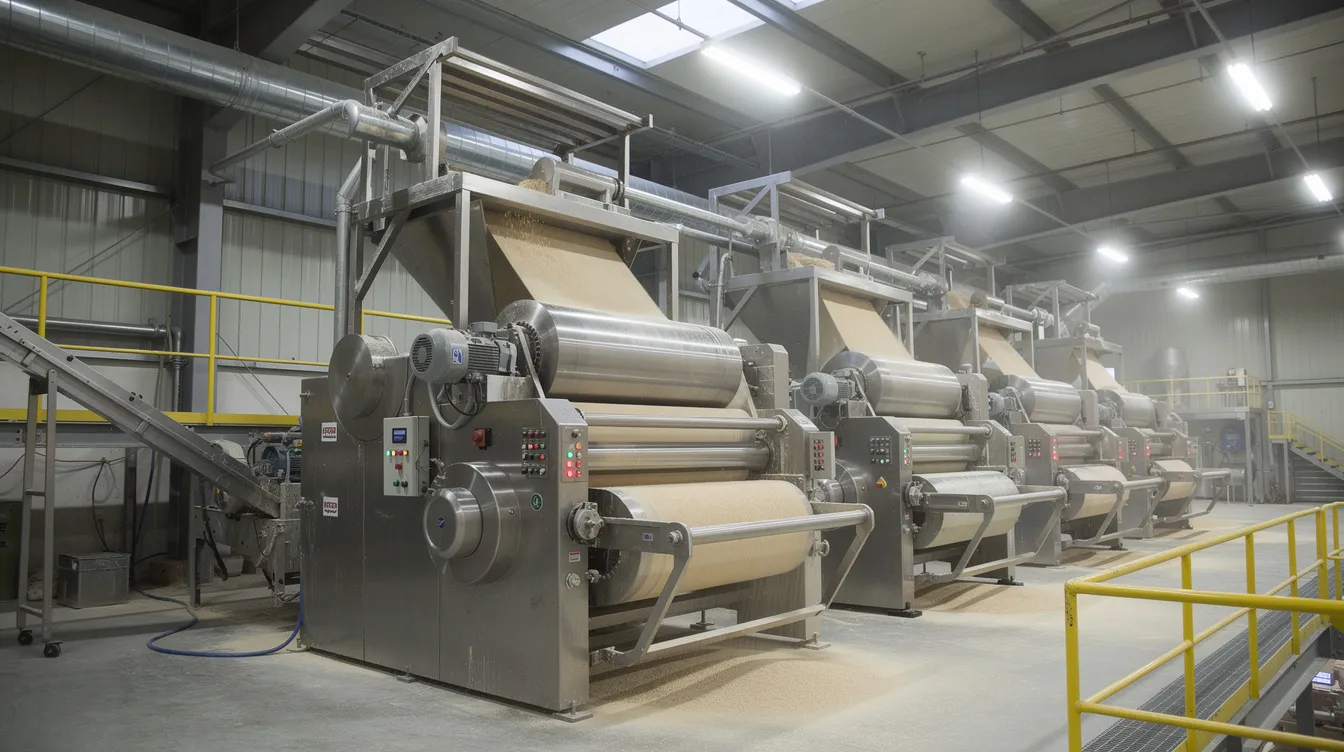
A besan mill plant is an integrated unit designed to clean, dehusk and grind chana dal into fine besan (gram flour). Plant capacity can range from micro units of 100–300 kg/day to fully automatic plants of 8 tons/day and above. A 500 kg/day besan plant requires an investment of ₹20–45 lakh, while larger automatic units require significantly higher capital.
The main plant sections include:
- Raw material storage – for Bengal gram or chana dal
- Cleaning and grading – to remove foreign material, stones and dust
- Dehusking and splitting – a besan plant requires a chana dal mill for dehusking
- Grinding – flour mills grind split chana into besan powder using plate mills or hammer mills
- Sieving – rotary sifters separate fine besan from coarse particles
- Blending and packing – packaging machines fill and seal bags from 250g to 50kg
Elevators and conveyors move grain and flour between processes. Equipment selection directly influences product quality, recovery percentage, power consumption and ultimately ROI. Food safety compliance, such as FSSAI registration, is essential for any besan plant entering organised distribution.
Investment Components & Project Cost Structure of a Besan Plant
ROI begins with understanding what you actually invest. For an 8 TPD automatic besan plant, the principal cost heads include:
| Cost Head | Description |
|---|---|
| Land & site development | Prepared industrial plot |
| Factory building & civil works | Processing hall, storage, office |
| Plant & machinery | Dal mill, besan mill, sifters, conveyors, dust collection |
| Electricals & utilities | Power installation, transformers, backup |
| Quality-control lab | Testing equipment for moisture, fineness |
| Pollution / dust collection systems | Aspiration, cyclone separators |
| Vehicles & miscellaneous assets | Material handling, transport |
| Preliminary & pre-operative expenses | Licences, consultancy, trial runs |
| Working capital margin | Raw material, labour, receivables |
Fixed capital covers long-term assets. Working capital covers the operating cycle – raw materials, power, labour, packing and receivables. A professionally prepared Detailed Project Report for a besan mill breaks these costs into a bankable investment schedule aligned with term loan and promoter’s equity. The total capital investment varies widely by location, capacity and automation level, but for an 8 TPD unit, the range typically runs into a few crore rupees.
Production Process, Plant Capacity & Their Impact on ROI
The besan production process flows from receipt of chana dal through cleaning, conditioning, dehusking, splitting, grinding, sieving, blending and final packing. Each stage carries scope for process losses – dust, husk, moisture and burning during high-speed milling.
Capacity utilisation directly impacts the profitability of a besan manufacturing plant. Installed capacity (e.g., 8 tons per day) differs from achievable output, which depends on shift hours, maintenance schedules and equipment efficiency. Market demand and recovery rates largely determine the return on investment for a besan plant.
Typical conversion requires 1.10–1.15 kg of chana dal to produce 1 kg of high quality besan, depending on husk removal and process losses. Higher milling recovery, optimum moisture conditioning and efficient dust control reduce losses, improving contribution margin and overall besan production ROI. Under-utilised capacity raises fixed cost per kg and lowers ROI, while a realistic capacity ramp-up in the business plan gives a more accurate profitability picture.
Revenue Drivers, Raw Materials & Operating Costs
The main revenue drivers for a besan plant are plant capacity utilisation, selling price per kg, product mix (standard besan, superfine besan, branded vs bulk) and market linkages to distributors and customers.
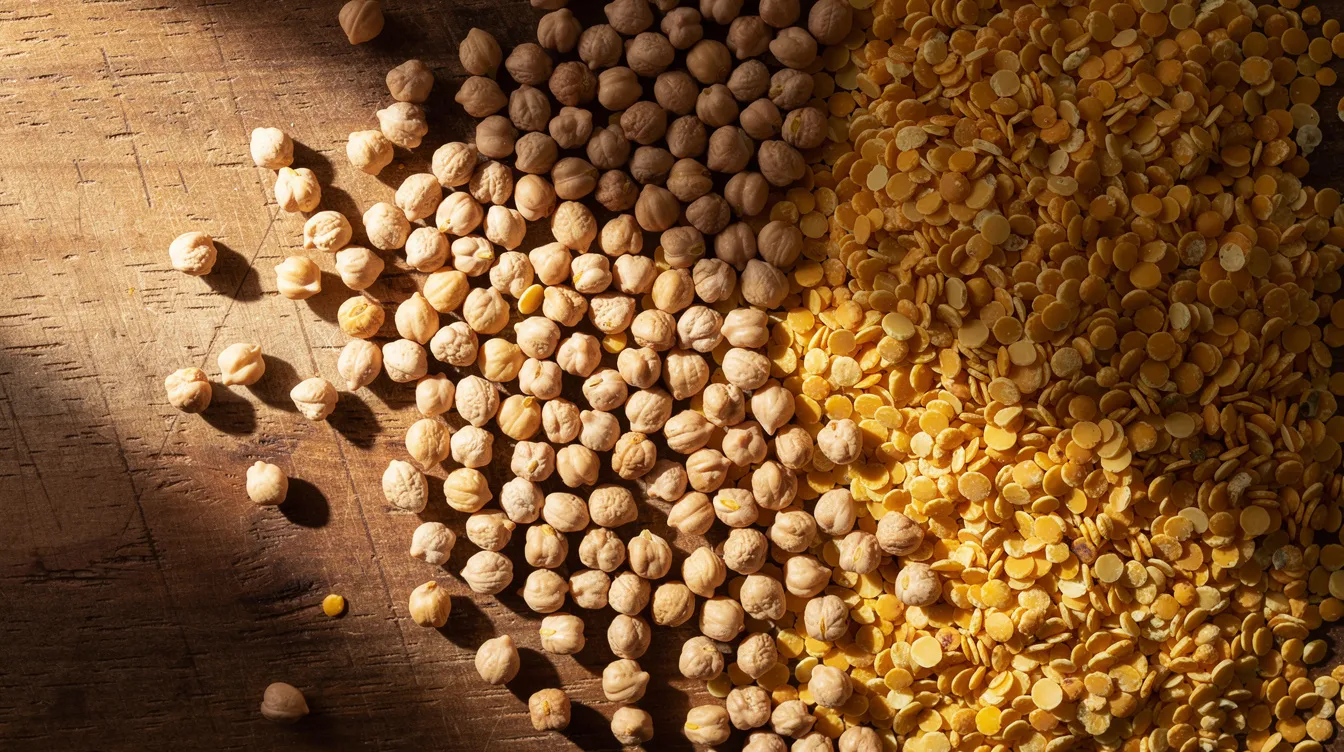
The primary raw material is chana dal, and chana dal constitutes 65–75% of the production cost. Chickpeas are subject to seasonal price fluctuations affecting profitability – sourcing during harvest season at lower prices and maintaining supplies through seasonal stocking can help manage this risk. Selling bulk besan yields lower profit margins compared to packaged retail products, and the choice between these channels significantly affects overall returns.
Other major operating costs include:
- Power and fuel – electricity costs can significantly impact operating margins in grain processing
- Direct labour and supervision
- Repairs and maintenance
- Packing material
- Factory overheads and selling expenses
By-products from the milling process, such as husk and coarse residues, can serve as cattle feed, adding a small but useful supplementary revenue stream. A robust business plan should include realistic assumptions for raw material procurement, supplier credit terms and energy efficiency measures. Similar cost-structure analysis applies to related food processing projects such as snacks manufacturing.
Business Plan & Financial Modelling for Besan Plant ROI
A credible besan plant business plan must integrate technical assumptions – plant capacity, recovery, operating days – with financial projections covering sales, expenses, profit and cash flow. Effective working capital management is essential for besan plant operations, and the financial model must reflect this.
A 5–7 year financial model normally includes projected income statements, cash flow statements and balance sheets. Financial projections include P&L, Balance Sheet, and Cash Flow – all three are necessary for a complete picture. Banks expect realistic capacity ramp-up in financial projections, not immediate full utilisation.
Key metrics a promoter and banker will examine include gross profit margin, EBITDA, net profit, break-even point, DSCR, IRR and payback period. Analyzing pricing, costs, and recovery rates is crucial for financial planning in processing plants. Project Report Bank builds customised financial models reflecting project-specific assumptions, and this modelling is the foundation for calculating besan plant ROI, IRR, payback and sensitivity to different market scenarios.
How to Calculate Besan Plant ROI in Practice
A practical ROI formula for a besan plant:
ROI (%) = (Average Annual Profit After Tax ÷ Total Project Cost) × 100
There is an important distinction between project-level ROI (returns on total capital invested) and equity ROI (returns only on the promoter’s contribution). A project financed with higher debt may show higher equity ROI but also carries higher financial risk.
Illustrative example:
| Parameter | Value |
|---|---|
| Total project investment | ₹3.50 Cr |
| Expected average annual PAT | ₹80 lakh |
| Indicative project ROI | ~22.9% |
This figure should be measured after considering realistic interest, depreciation and tax – not just gross margin. ROI for a besan manufacturing plant generally ranges between 25% and 40% in favourable conditions, but actual returns depend on chana dal prices, capacity utilisation, production efficiency and output capacity achieved. Professional DPRs from Project Report Bank include ROI analysis under base, optimistic and conservative scenarios, similar to the approach used in atta chakki plant financial analysis.
Payback Period, IRR & Break-Even – Complementing ROI
ROI tells you the percentage return, but investors also want to know how quickly the initial investment is recovered.
Simple Payback Period = Total Initial Investment ÷ Average Annual Net Cash Inflow
The average expected payback period for a besan plant is approximately 2.5 to 3.5 years, depending on scale, utilisation and market conditions.
Internal Rate of Return (IRR) is the discount rate at which the present value of all future cash inflows equals the initial investment. A project IRR exceeding the cost of capital indicates value creation. However, higher IRR does not automatically make a project superior if investment scale, risk or assumptions differ between alternatives.
The break-even point is usually achieved at 40% to 50% capacity utilisation for a well-structured besan plant. The break-even quantity is calculated as:
Break-Even Quantity (kg) = Annual Fixed Costs ÷ Contribution per Kg
Payback alone is insufficient for long-term project appraisal. It ignores cash flows beyond the payback point and the time value of money. A complete evaluation requires ROI, IRR, NPV and break-even together.
Factors That Influence Besan Plant ROI (Practical Levers)
Plant-level factors: Better layout, energy-efficient machinery engineered for consistent quality output, effective dust control and minimal downtime improve output per unit of fixed cost. Optimizing machinery efficiency enhances profit margins in besan manufacturing.
Process factors: Improved cleaning and grading, optimised moisture conditioning, adjusting plate mills or hammer mills to increase recovery and reduce waste. Consistency in production is essential for producing fine besan that commands better prices.
Commercial levers: Sourcing raw materials during harvest season, negotiating long-term supply contracts with suppliers, targeting higher-value branded retail segments alongside bulk supply. Understanding customer demand patterns helps maintain steady production.
Financial levers: Choosing an appropriate debt–equity ratio, availing eligible subsidies – besan manufacturing qualifies for 15–35% capital subsidy under PMEGP, and government schemes like PMEGP and PMFME offer capital subsidies for project finance. Structuring repayment to match projected cash flows avoids unnecessary financial stress.
Sample Besan Plant Economics – High-Level Illustrative Scenario
All figures below are illustrative assumptions, not verified market quotations or guaranteed outcomes.
| Parameter | Assumed Value |
|---|---|
| Installed capacity | 8 TPD besan |
| Operating days | 300 per year |
| Capacity utilisation (Year 2) | 70% |
| Annual production | ~1,680 tonnes |
| Chana dal required (~1.12 kg/kg besan) | ~1,882 tonnes |
| Chana dal cost (assumed) | ₹85/kg |
| Total raw material cost | ~₹16.0 Cr |
| Selling price (weighted average, ex-GST) | ₹102/kg |
| Annual revenue | ~₹17.1 Cr |
| Other operating costs (power, labour, packing, overheads) | ~₹0.55 Cr |
| EBITDA | ~₹0.55 Cr |
| Depreciation + Interest | ~₹0.30 Cr |
| Profit Before Tax | ~₹0.25 Cr |
Net profit margins for besan processing typically range between 5% to 12%, and this illustration falls within that band. From these figures, an indicative ROI, payback period and DSCR can be computed. Actual project reports prepared by Project Report Bank contain far more detailed multi-year projections, sensitivity modelling and machinery cost breakdowns.
Role of DPR, CMA Data & Bank Finance Advisory in Maximising ROI
A Detailed Project Report for a besan manufacturing plant combines technical, market and financial details to present a complete investment case. A bank-ready DPR includes CMA data and financial projections. CMA data is mandatory for loans above ₹10 lakh, and it transparently shows how sales, costs and cash flows are projected in RBI-prescribed formats.
Banks require a DSCR of at least 1.25 for loan approval. A professionally prepared DPR highlights the besan plant’s potential ROI, DSCR, break-even point and debt repayment capacity. Banks require internally consistent financial projections in DPRs – if revenue in one statement does not match another, credibility suffers. DPRs must include a detailed business and promoter profile alongside the financial analysis.
Project Report Bank, under CA Manish Gugliya (FCA, DISA ICAI), specialises in customised DPRs, CMA Data preparation, financial modelling and feasibility studies for besan mill plants and other agro-processing projects. Engaging a financial advisory expert at the planning stage can help avoid underestimating working capital or overestimating plant capacity – both of which heavily influence realised ROI.
Need a Bankable Besan Manufacturing DPR or Financial Feasibility Study?
CA Manish Gugliya (FCA, DISA ICAI), practising Chartered Accountant since 2006, provides professional assistance with Detailed Project Reports, CMA Data, financial projections, ROI/IRR analysis, sensitivity modelling and bank finance proposals.
DPR & Bank Finance Proposal Assistance: Starting from ₹25,000, depending on project scope and complexity.
Website: https://projectreportbank.com/
Enquiries: Contact through the WhatsApp enquiry option available on the website.
No guaranteed funding approvals or guaranteed investment returns are implied.
Frequently Asked Questions
What is the minimum viable plant capacity for a decent besan plant ROI?
A 500 kg/day besan plant requires ₹20–45 lakh investment and can generate reasonable returns for a micro or small enterprise. However, economies of scale improve at 2–5 TPD and above. The ideal choice depends on available capital, market access and the promoter’s experience in the food processing industry. While automated tools like Finline generate DPRs in under 10 minutes, a customised professional DPR provides far more reliable financial analysis for serious investment decisions.
How do branded retail sales affect besan plant profitability compared to bulk sales?
Branded retail besan gram flour commands a selling price premium of 10–15% or more over bulk sales to distributors. However, branded sales require higher packaging costs, marketing expenditure, longer trade credit and greater working capital. The money invested in branding improves margins per kg but increases the overall scope and complexity of operations.
How often should ROI assumptions be reviewed after a besan plant is commissioned?
ROI assumptions should be reviewed at least annually, and more frequently if chana dal prices or market conditions shift materially. Monitoring actual recovery rates, capacity utilisation, power consumption and receivable days against DPR projections helps identify early whether the plant is tracking toward its projected returns or requires operational adjustments.
Can a besan plant be profitable on paper but still face cash flow problems?
Yes. A besan plant may show accounting profit but experience cash shortages if working capital is poorly managed – for example, if raw material is purchased on cash but finished goods are sold on extended credit, or if seasonal procurement requires large upfront payments. Profitability and liquidity are distinct, and both must be evaluated in a prepared financial model.
What is the difference between ROI and IRR for a besan manufacturing project?
ROI is a simple ratio of annual profit to total investment, expressed as a percentage. IRR is the discount rate at which the net present value of all project cash flows equals zero, accounting for the time value of money across the entire project life. Both ratios are essential – ROI gives a quick snapshot while IRR provides a more rigorous measure of project attractiveness over time.