Key Takeaways
- Commercial sorghum (jowar) milling plants range from 1 TPH to 10 TPH raw grain input, with project components spanning land, civil works, machinery, utilities, and working capital – all of which must be sized and costed in a professional sorghum milling plant project report before capital is committed.
- Sorghum is a drought resistant, nutritious cereal grain that is naturally gluten free when properly segregated, and demand for jowar flour is rising across health-food retail, multigrain blends, bakeries, snacks, and export channels.
- Project viability hinges on raw materials procurement strategy, realistic milling recovery (typically around 85% for whole-grain flour), electricity and labour costs, and achievable selling prices across bulk and branded product lines.
- Project Report Bank, led by CA Manish Gugliya (FCA, DISA, ICAI), prepares customised jowar flour processing plant project reports, financial models, CMA Data, and bankable DPRs for Indian entrepreneurs and industrial investors.
- Sections below cover machinery selection, sorghum flour manufacturing plant cost structure, working capital, DSCR, break-even analysis, IRR, and practical bank-loan documentation requirements.
Introduction: Sorghum Milling Plant Project Report in India
A commercial sorghum (jowar) milling and flour processing plant is an industrial facility that receives raw grain sorghum in bulk, processes it through cleaning, optional decortication, milling, classification, and packaging stages, and dispatches finished jowar flour and by-products to the market. Preparing a sorghum milling plant project report is the essential first step before committing capital to such a venture.
Sorghum is one of India’s important food grains – used for flour, porridges, multigrain atta, and as feedstocks for industrial ingredients including starch, sugar substitutes, and beverage applications. Unlike a household chakki or tiny job-work operation, a commercial flour mill requires structured capacity planning, technology selection, quality control systems, and proper financial analysis.
Demand for sorghum products is driven by health-conscious consumers seeking gluten free options, and this positioning – when processed on dedicated lines with strict cross-contact controls – creates opportunities in diabetic, celiac, and specialty food segments. The shift from loose jowar grain sales toward professionally milled, branded flour sold through modern retail, e-commerce, and institutional channels is accelerating.
Investors need a robust DPR to size capacity, estimate procurement needs, quantify sorghum flour manufacturing plant cost, structure term loans and working capital, and assess profitability. The rest of this article follows the structured approach used by Project Report Bank when preparing a sorghum processing plant feasibility study.
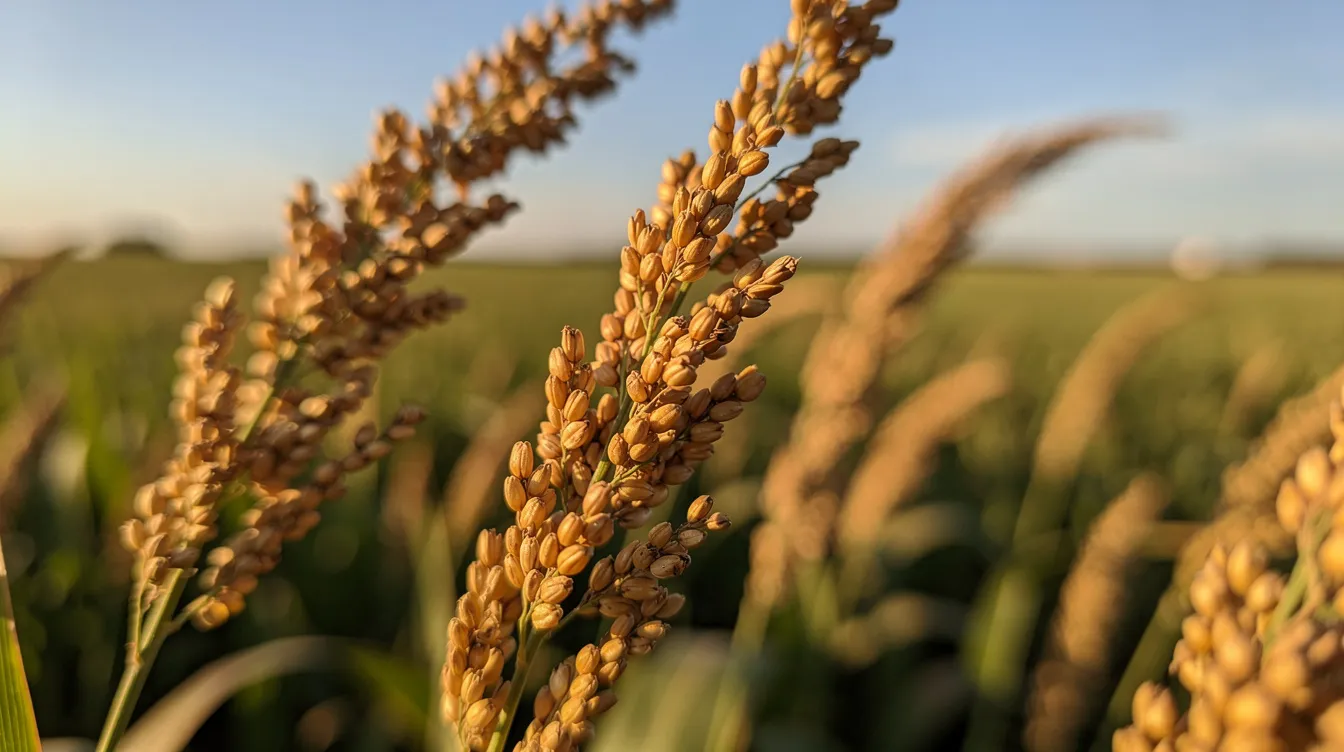
Sorghum Processing Industry and Market Opportunities in India
India produced approximately 3.81 million metric tonnes of sorghum in 2022-23 across about 3.53 million hectares, rising to an estimated 4.40 million tonnes in 2023-24. Major producing states include Maharashtra, Karnataka, Telangana, Madhya Pradesh, and Rajasthan. Rabi sorghum alone accounted for roughly 63% of production, with Maharashtra contributing about 63.5% of that share.
These production centres create procurement advantages for plants located near sorghum belts, with access to APMC mandis, FPOs, and aggregators. Market analysis should identify target customer segments – household consumption (packaged atta), wheat flour blends, ready mixes, snack and bakery manufacturers, breakfast cereals, and institutional catering. Market research should also analyze competitors and existing pricing strategies in each target geography.
The sorghum market benefits from macro trends: rising urban interest in millets, government promotion of millet-based food production, and growing demand from organised food brands. However, competition from wheat flour, maize, corn-based products, rice flour, bajra, and ragi remains significant. Sorghum flour is often positioned within multigrain blends rather than as a standalone product.
Export potential exists – Indian sorghum flour export prices ranged from USD 0.82 to USD 1.89 per kg in 2024, depending on grade, organic status, and packaging. Commercial challenges include seasonal production, variability in grain quality, storage constraints, and demand fluctuations that influence long term contracts and working capital planning.
Types of Sorghum Processing and Flour Manufacturing Projects
Investors can choose among several plant concepts depending on target markets and capital budget. Each type will be reflected differently in a jowar flour processing plant project report.
- Conventional jowar flour milling: Basic cleaning, milling, and selling loose or simple packaged whole-grain flour to local markets.
- Automatic sorghum cleaning and milling plants: Full pre-cleaning, destoning, magnetic separation, automated feeding, and higher throughput for regional flour brands.
- Whole-grain sorghum flour projects: Retaining bran for higher fibre content, targeting health and multigrain segments.
- Decorticated sorghum milling: Partial removal of outer layers to improve taste, colour, and shelf life, with higher machinery cost but better sensory acceptance.
- Sorghum grits and specialty ingredients: Additional sizing and classification equipment for snacks, breakfast cereal, brewery, or industrial users.
- Integrated multi-grain plants: Handling sorghum alongside wheat, maize, and other millets on separate processing lines. Promoters exploring broader grain portfolios may refer to the Integrated Millet Processing Plant Project Report.
| Project Type | Product Outputs | Process Complexity | Typical Customers | Value-Addition |
|---|---|---|---|---|
| Conventional flour milling | Whole jowar flour | Low | Local retailers, consumers | Low |
| Automatic cleaning + milling | Cleaned whole-grain flour | Medium | Regional brands, distributors | Medium |
| Whole-grain flour | High-fibre flour, multigrain blends | Medium | Health-food brands, bakeries | Medium-High |
| Decorticated milling | Refined flour, bran | High | Food manufacturers, exporters | High |
| Grits and specialty | Grits, semolina, flour | High | Snack makers, beverage industry, cereal producers | High |
| Integrated multi-grain | Multiple grain flours | Very High | National brands, institutional buyers | Very High |
Sorghum Milling Plant Capacity Planning
Capacity in this context refers to tonnes per hour (TPH) of raw sorghum input. Saleable flour output will be lower after sorting, dust removal, moisture loss, and bran separation – the material balance must always distinguish between raw materials intake and finished product output.
Small-scale sorghum mills process 5–20 tons per day, medium sorghum mills handle 20–100 tons per day capacity, and large-scale mills exceed 100 tons per day. These translate roughly to reference plant sizes of 1 TPH, 2 TPH, 5 TPH, and 10 TPH of raw grain input.
Selection criteria include assured grain availability, expected demand, power connection size, storage infrastructure, transportation access, and promoter financial strength.
| Parameter | 1 TPH | 2 TPH | 5 TPH | 10 TPH |
|---|---|---|---|---|
| Daily input (10 hrs) | 10 tonnes | 20 tonnes | 50 tonnes | 100 tonnes |
| Annual working days | 300 | 300 | 300 | 300 |
| Capacity utilisation (Yr 1) | 60% | 60% | 65% | 70% |
| Annual grain input (Yr 1) | 1,800 T | 3,600 T | 9,750 T | 21,000 T |
| Flour output at 85% recovery | 1,530 T | 3,060 T | 8,288 T | 17,850 T |
| Market scope | District | State/regional | Multi-state brand | National/export |
Assumptions are illustrative; actual figures depend on grain quality, utilization ramp-up, and operating schedule.
Complete Sorghum Milling and Flour Manufacturing Process
The industrial process flow for a commercial flour mill follows this sequence:
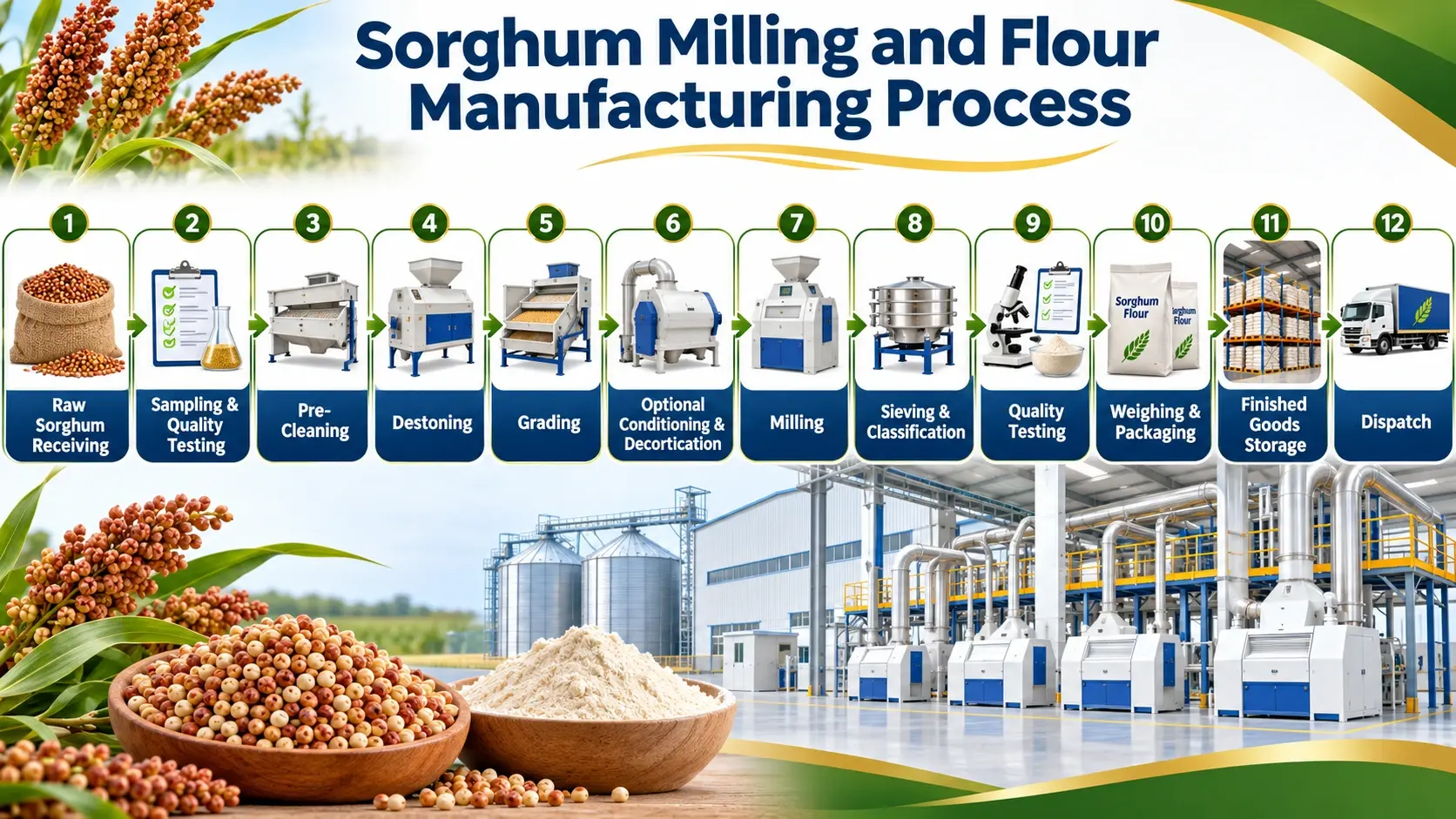
Raw Sorghum Receiving → Sampling & Quality Testing → Pre-Cleaning → Destoning → Grading → Optional Conditioning & Decortication → Milling → Sieving & Classification → Quality Testing → Weighing & Packaging → Finished Goods Storage → Dispatch
Receiving and testing: Raw grain arrives in trucks, is weighed, and sampled for moisture (target ~12%), foreign matter, damaged grains, and mycotoxin risk. Sorghum cleaning machines remove dirt and impurities at intake.
Pre-cleaning and destoning: Aspirators and pre-cleaners remove dust, chaff, and light impurities. Magnetic separators trap ferrous particles. Destoners and grading equipment separate stones, sand, and off-size grains. These steps directly improve downstream milling performance and food safety.
Conditioning and decortication (optional): Where the plant targets decorticated flour, controlled moisture addition and tempering prepare the grain for abrasive removal of outer layers. This increases bran yield but produces lighter-coloured flour with better consumer acceptance.
Milling: Roller mills, hammer mills, or emery-type mills reduce grain to flour. Technology choice affects particle-size control, energy use, heat generation, and end-product texture. High-speed sorghum milling machines have adjustable settings to accommodate different sorghum varieties and target specifications.
Sieving and classification: Plansifters and sieves separate fine flour, grits, and bran to meet jowar flour specifications – for example, semolina at ~1000 µm, medium flour at ~500 µm, and fine flour at ~250 µm. For detailed flow-chart guidance on similar atta manufacturing operations, promoters may refer to the Atta Manufacturing Process & Flour Mill Flow Chart Guide.
Quality control: In-process and finished-product checks cover granulation, colour, moisture, microbiological safety, and packaging integrity. Dust extraction, housekeeping, and HACCP-compliant sanitation are essential throughout.
Packaging: Flour is weighed and packed in bulk (25–50 kg bags) and retail (500 g–5 kg pouches) using automatic form-fill-seal machines. Packing material quality affects shelf life.
By-products: Screenings and bran are segregated for sale to feed manufacturers or other downstream users.
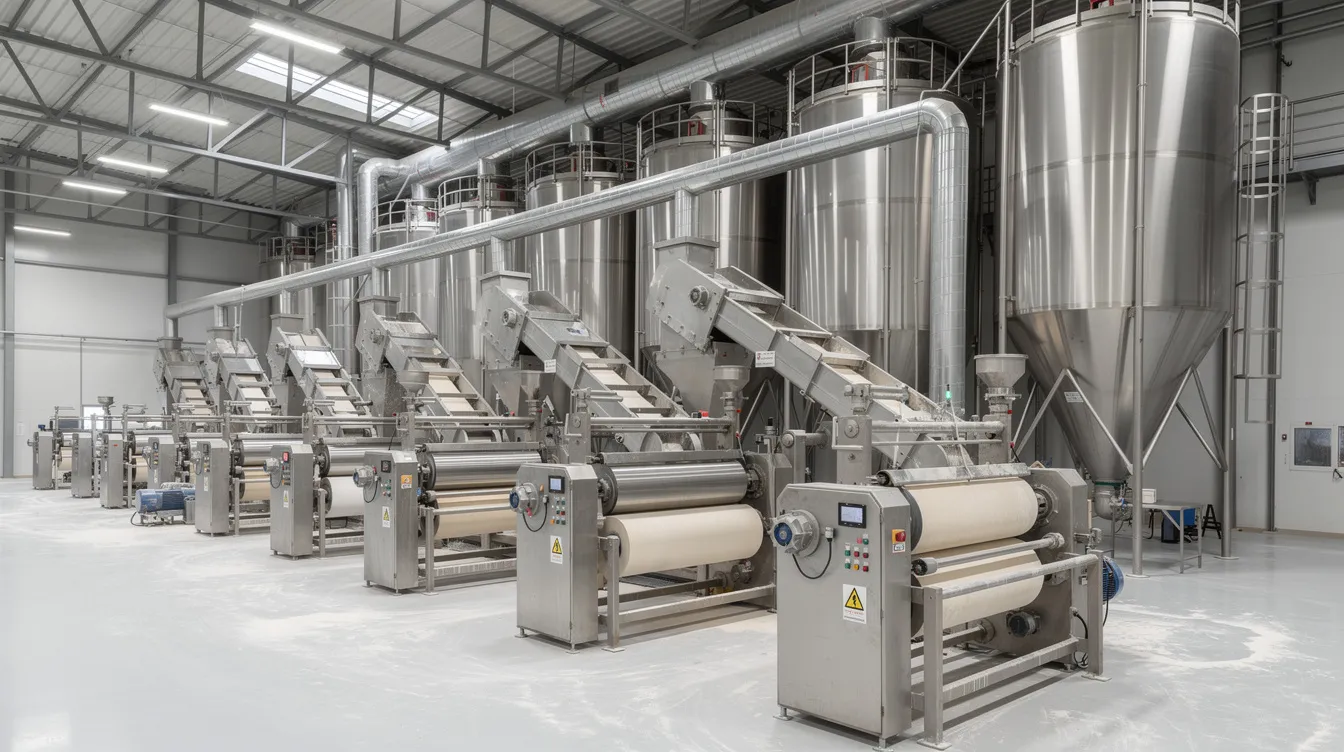
Jowar Milling Plant Machinery and Investment
Machinery configuration depends on capacity, product mix (whole vs decorticated flour, grits), and automation level. A detailed jowar milling plant machinery and investment schedule is a core component of any DPR.
Main process equipment: grain intake hopper, pre-cleaner and aspirator, magnetic separator, destoner, grading and sieving units, conditioning bins, decorticator, main flour mill (roller or hammer type), plansifter, conveyors and bucket elevators.
Support systems: dust-collection units, airlocks, cyclones, blower fans, compressed air (if required), flour storage bins, bag filters, and centralised control panels. Reliable electricity is essential for sorghum milling operations, and DG set backup should be planned for areas with inconsistent power supply.
Finishing and QA equipment: online or offline metal detector, moisture meter, laboratory balances, and automatic weighing and packing machines. Milling machinery includes grain cleaners and flour sifters as standard components. Compact and energy-efficient machine series like the M6FY are available from leading manufacturers for smaller-capacity lines.
Regular maintenance prevents downtime in sorghum milling operations, and training staff on equipment operation reduces operational risks. Automation options include PLC-based controls, level sensors, and energy metering for efficient processing. For detailed equipment pricing references, see the Specialty Flour Plant Machinery & Equipment Cost guide.
| Equipment | Function | Investment Impact |
|---|---|---|
| Pre-cleaner & aspirator | Remove dust, chaff | Low–Medium |
| Destoner | Remove stones, sand | Low |
| Magnetic separator | Trap ferrous particles | Low |
| Decorticator | Remove outer husk layers | Medium |
| Roller/hammer mill | Core milling | High |
| Plansifter & classifier | Flour/grits separation | Medium |
| Conveyors & elevators | Material handling | Medium |
| Dust collection system | Hygiene, efficiency | Medium |
| Packaging line | Weighing, FFS packing | Medium–High |
| Electrical panels & automation | Process control | Medium–High |
Other investment components such as freight, erection, commissioning, trial runs, and operator training are often underestimated in basic project profiles.
Land, Building and Plant Layout
Land area and building size scale with capacity, storage policy, and automation level. Choose a site near sorghum-growing regions to reduce inbound transportation costs and improve access to raw grain supply.
Functional zones include: raw grain intake and truck movement area, raw materials storage (bags or silos), milling hall, packaging hall, finished-goods warehouse, utilities (transformer, DG set, compressor), quality-control laboratory, and administrative block. Hygienic zoning must separate raw grain, processing, packaging, and finished-goods areas to minimise contamination. Compliance with local zoning laws and factory inspectorate expectations is mandatory.
For a 2–5 TPH plant, indicative land requirements range from approximately 2,000 to 5,000 square metres including storage and circulation space, though actual requirements depend on layout optimisation, vertical vs horizontal material flow, and local by-laws. Fire safety provisions, ventilation, and dust-control design should comply with FSSAI and local factory regulations.
Sorghum Flour Manufacturing Plant Cost in India
A project cost assessment evaluates both fixed and working capital investments. The total sorghum flour manufacturing plant cost includes fixed capital (land, building, plant and machinery), pre-operative expenses, and working-capital margin – not just machinery prices.
Small-scale sorghum mills require approximately $10,000–$50,000 in initial investment. Medium-scale sorghum mills need $50,000–$200,000 investment. Large-scale sorghum mills exceed $200,000 in investment. These ranges vary considerably based on equipment configuration, automation, location, and civil construction costs.
| Cost Head | Approximate Share of Total Project Cost |
|---|---|
| Plant & machinery | 35–45% |
| Civil construction & building | 20–25% |
| Land & site development | 8–15% |
| Electrical & utilities | 5–8% |
| Pre-operative & indirect expenses | 3–5% |
| Working-capital margin | 10–15% |
| Contingency | 3–5% |
Percentages are indicative and vary by capacity, location, and project scope. Project Report Bank uses current vendor quotations and bank norms to refine cost estimates in customised DPRs rather than relying on generic templates.
Raw Material Procurement and Storage Strategy
A sourcing strategy for raw materials should ensure a steady supply of sorghum grain throughout the year, given the seasonal nature of harvests. This is central to production continuity, quality, and working-capital exposure in any sorghum processing plant feasibility study.
Procurement channels include direct purchase from farmers and FPOs, traders and commission agents in APMC mandis, and spot-market buying. Long-term contracts with farmers stabilize sorghum prices and reduce procurement risk. Diversifying suppliers mitigates risks from localised disasters or crop failures. Maintaining a 1–2 month reserve stock buffers against price spikes and supply interruptions.
Quality parameters at procurement should cover variety, moisture, foreign matter, damaged grains, and fungal infection. Environmental conditions during storage directly impact grain quality – aeration, fumigation, pest control, and FIFO practices are essential. Longer inventory holding improves supply security but increases finance costs and physical shrinkage risk, which must be captured properly in working-capital calculations.
Sorghum Milling Recovery Rate and Production Economics
Milling recovery is the ratio of saleable flour and by-products to input raw grain weight. Research indicates approximately 85% recovery for whole-grain sorghum flour using hammer mill and screening, with the remainder being bran, screenings, and process loss.
Illustrative material balance per 1,000 kg raw sorghum (whole-grain flour):
| Output | Quantity (kg) |
|---|---|
| Whole-grain flour | 840–860 |
| Bran and screenings | 100–120 |
| Dust and process loss | 30–50 |
For decorticated flour, the flour output drops to approximately 75–80%, with higher bran and by-product yield but improved colour, taste, and shelf life.
By-products such as bran and screenings have commercial value in animal feed markets. For promoters considering downstream integration, the Grain-Based Animal Feed Manufacturing Project Report outlines how milling by-products can be utilised to reduce waste and improve overall project economics.
Electricity consumption per tonne, man-hours per tonne, packing ratios, and reject rates are all critical production-economics parameters that should be fine-tuned in the DPR’s financial model.
Manufacturing and Operating Cost Analysis
Variable costs include raw grain sorghum purchase, inbound freight, electricity linked to production volume, packaging materials, and consumables. Fixed or semi-fixed costs include salaries, lease or depreciation on building, insurance, minimum power demand charges, and administrative overheads.
Selling and distribution costs cover outbound freight, distributor margins, marketing, trade promotions, and GST compliance for packaged flour. Operating-cost escalation due to inflation, salary increments, and power-tariff changes should be factored into multi-year projections at conservative annual rates.
| Cost Component | Approximate Share |
|---|---|
| Raw sorghum grain | 55–65% |
| Electricity and fuel | 8–12% |
| Labour and supervision | 5–8% |
| Packaging and packing materials | 4–6% |
| Repairs, maintenance, spares | 2–3% |
| Factory and admin overheads | 3–5% |
| Selling and distribution | 3–5% |
Revenue Model and Profitability
Revenue streams include wholesale bulk jowar flour, contract toll-milling, private-label packaging for retailers, own-branded retail packs, specialty gluten free mixes, and by-product sales (bran for animal feed). Pricing is typically benchmarked against wheat flour and other millet flours, with differentiation based on quality, organic certification, and channel.
Bulk wholesale jowar flour trades at approximately ₹37–52/kg, while branded retail packs command ₹155–205/kg depending on positioning. Basic sorghum flour sales yield approximately 10–15% profit margins at wholesale level. Exporting certified organic sorghum flour can yield 25–35% margins, though compliance and certification costs are substantial.
Profitability depends on capacity utilization, raw grain cost control, milling recovery, power efficiency, and the promoter’s ability to maintain selling prices despite competitive pressure. Product mix – the proportion of bulk sacks versus premium small packs – significantly influences average realisation and income per kg.
Financial Projections for a Sorghum Milling Plant
Financial projections are crucial in a DPR for assessing project feasibility. Project Report Bank prepares 7–10 year financial projections as part of a bankable sorghum milling plant project report tailored to the promoter’s scale and location. Expected profitability statements should project figures over 3 to 5 years minimum, with extended analysis for larger projects.
Core components include: project cost estimate, means of finance (equity, term loan, subsidies if applicable), phased capacity utilization assumptions, projected profit and loss statements, projected balance sheets, cash-flow projections, loan-repayment schedules, and DSCR calculations.
Debt Service Coverage Ratio (DSCR) assesses a project’s ability to repay loans and is a key metric banks review before sanctioning finance. Break-even analysis calculates the capacity needed to cover fixed and variable costs. Key performance indicators often include Internal Rate of Return (IRR) and payback period. Sensitivity analysis should test the impact of changes in raw material price, selling price, recovery rate, and utilization on project viability.
Working Capital Requirements
Working capital covers the funding needed to hold sorghum raw grain, packaging, work-in-progress, finished flour, trade receivables, and minimum cash balances for day-to-day operation. Inventory-holding periods for raw sorghum may range from several weeks to months depending on seasonal procurement strategy.
Receivable periods vary by customer category – institutional buyers and distributors may require 30–90 days of credit, while cash-and-carry channels involve minimal receivables. Common bank working-capital facilities include cash-credit limits with drawing power calculated based on stock and receivables. CMA Data preparation aligns working-capital assessment with term-loan projections.
Bank Loan and Project Finance for Sorghum Milling Plants
Typical capital structures combine promoter equity with term loans for fixed assets and separate working-capital limits for operations. Banks evaluate total project cost, means of finance, technical feasibility, market potential, financial projections, DSCR, break-even, and management background.
Documentation requirements include a detailed project report, CMA Data, projected financial statements, KYC documents, collateral details, and regulatory approvals or applications. Statutory approvals include FSSAI license and MSME registration (Udyam). Government support schemes such as PMFME, PLISMBP, and PMKSY may be relevant for agro-processing units, but promoters should verify current eligibility guidelines – neither loans nor subsidies are guaranteed.
A bankable DPR with realistic assumptions often makes the difference between quick bank appraisal and repeated queries or delays. For promoters also evaluating wheat-based projects, the Wheat Flour Mill Project Report provides a useful comparison framework.
Licences and Regulatory Compliance
Compliance requirements vary by state, capacity, and layout. Key requirements include:
- FSSAI central or state licence under cereal flour category
- GST registration for interstate sales of packaged flour and bran
- Udyam registration for MSME recognition
- Factory Act registration, ESI, EPF, and professional tax as applicable
- Environmental consents from State Pollution Control Boards where required
- Fire-safety NOCs, building approvals, and municipal trade licences
- Legal Metrology compliance for weights, measures, and MRP labelling on packaged goods
- Voluntary certifications such as ISO 22000, HACCP, or FSSC 22000 that enhance credibility with institutional buyers and export customers
Sorghum Processing Plant Feasibility Study
A comprehensive sorghum processing plant feasibility study integrates technical, market, financial, and risk perspectives – going well beyond a simple market note or generic profile.
Technical feasibility covers technology availability, local skills, power and water supply as utilities are crucial for plant operations, land suitability, and utility loads. Market feasibility examines regional sorghum supply, competing mills, potential demand, and channel access. Financial feasibility tests include NPV, IRR, DSCR, break-even, sensitivity analysis, and stress-testing downside scenarios. The study addresses food security considerations and sustainable sourcing.
| Risk | Impact | Mitigation |
|---|---|---|
| Raw material availability | High | FPO contracts, multi-source procurement |
| Price volatility | High | Buffer stock, long-term contracts |
| Demand risk | Medium | Diversified product mix, multiple channels |
| Milling recovery shortfall | Medium | Quality control at procurement, equipment maintenance |
| Contamination/mycotoxin | High | Lab testing, FSSAI compliance, storage controls |
| Capacity underutilization | High | Phased ramp-up, realistic demand assessment |
| Working-capital squeeze | Medium | Adequate sanctioned limits, CMA Data accuracy |
| Machinery breakdown | Medium | Preventive maintenance, spares inventory |
| Competitive pricing pressure | Medium | Brand development, quality differentiation, waste reduction |
| Regulatory changes | Low | Compliance monitoring, professional advisory |
Sorghum Milling vs Other Millet Processing Projects
Sorghum, bajra, and ragi are all millets but differ in grain characteristics, consumer familiarity, processing requirements, and market positioning. Jowar flour is popular for specific rotis and multigrain atta; bajra has strong regional demand for winter consumption; ragi is well-positioned in health food, baby food, and malt products.
Processing differences include dehulling and decortication importance, typical sieve sizes, fat content affecting shelf life, and adaptability of equipment across different grains. Breeding improvements and new sorghum varieties continue to improve yield and milling characteristics, though India’s average cultivation yield remains modest at around 1 tonne per hectare.
Promoters evaluating alternative or complementary millet projects can refer to the Bajra Processing Plant Project Report and the Ragi Processing Plant Project Report for detailed project-level guidance.
How to Prepare a Bankable Sorghum Milling Plant DPR
Preparing a Detailed Project Report (DPR) requires a structured blueprint – not a generic template. A comprehensive DPR covers technical feasibility, market potential, and financial viability. Key components of a DPR include an executive summary and project profile, detailed machinery lists with vendor quotations, process flow documentation, capacity and product mix analysis, and project-implementation schedules.
The financial section must contain detailed project cost, means of finance, year-wise production and sales projections, cost assumptions with project-specific data on local power tariffs, wage levels, and raw grain prices, along with projected financial statements, DSCR, IRR, and sensitivity scenarios. An ideal DPR should reflect customized analysis and practical financial assessments rather than broad national averages.
Professional DPR and Financial Feasibility Services
Project Report Bank is a Chartered Accountant-led professional advisory platform specialising in manufacturing and food-processing project finance documentation across India. CA Manish Gugliya (FCA, DISA, ICAI), with more than 20 years of professional experience, guides financial modelling, DSCR analysis, working-capital assessment, and loan-structuring decisions for sorghum milling and grain-processing clients.
Professional financial analysis provides insight into project viability and funding options. Services for jowar flour projects include customised DPR preparation, sorghum processing plant feasibility study, CMA Data preparation, bank loan proposal support, financial projections, sensitivity analysis, and investor-ready documentation including business plans and pitch decks.
Serious promoters of sorghum and multi-grain flour mills are invited to contact Project Report Bank through the website or WhatsApp enquiry facility for a project-specific consultation and proposal.
Frequently Asked Questions
What is a realistic starting capacity for a new jowar flour mill in India?
Many new entrants begin with 1–2 TPH plants, which balance the initial investment with the ability to serve district- and state-level markets. The ideal capacity depends on assured sorghum supply, identified target customers, available capital, and local power infrastructure. A phased approach – starting at moderate utilization and scaling up – reduces risk.
Can sorghum flour be produced in the same plant that processes wheat flour?
Technically, the same factory building can host both lines. However, dedicated equipment, separate storage, and strict cleaning protocols are required if the promoter wishes to label sorghum products as gluten free. Without rigorous segregation, cross-contact with wheat gluten is likely, and the gluten free claim cannot be made legitimately.
How long does it typically take to set up a sorghum milling plant?
Timelines vary, but an MSME-scale plant often needs 6–12 months from land finalisation to commercial production, covering design, civil work, machinery delivery from suppliers, installation, trial runs, and obtaining regulatory approvals. Larger industrial projects may take 12–18 months.
Is it necessary to install silos for grain storage in a jowar flour project?
Silos are not mandatory for small plants that can operate with bag storage in godowns. However, silos become attractive for 5–10 TPH plants that procure large seasonal quantities, as they improve handling efficiency, enable better moisture and pest control, and support long-term grain quality management.
How can I get a customised Sorghum Milling Plant Project Report for bank finance?
Promoters can share basic project details – location, proposed capacity, product range, estimated budget, and target bank – with Project Report Bank through its website or WhatsApp. Based on this, the team prepares a proposal for a tailored DPR, financial projections, and CMA Data aligned to the specific project requirements and bank appraisal standards.