Key Takeaways
An integrated processing plant for quinoa, amaranth and buckwheat addresses rising consumer demand for gluten free foods, high-protein ingredients and specialty flours in India and export markets.
- Quinoa, amaranth and buckwheat are high-value pseudocereals that can be processed in a single integrated grain processing plant using shared front-end equipment alongside product-specific lines for desaponification, dehulling and milling.
- Major capital investment components include plant and machinery, land and building, civil works, utilities, and working capital for raw material inventory and receivables.
- Technical feasibility (process design, machinery and technology requirements, capacity planning) and financial feasibility (capital expenditure, working capital, DSCR, IRR, net present value) must be validated through a professionally prepared Detailed Project Report before committing funds.
- Raw material costs typically account for 65–75% of total operating expenses, making procurement planning, yield assumptions and price volatility analysis critical to project economics.
- Project Report Bank, led by CA Manish Gugliya, FCA, DISA (ICAI), prepares customised, bankable project reports and financial models for specialty grain processing plants across India.
Introduction to Quinoa, Amaranth & Buckwheat Processing Projects in India
Quinoa, amaranth and buckwheat are pseudocereals – broadleaf crops botanically distinct from true cereal grains like wheat, rice or maize. All three are naturally gluten-free, carry high nutritional value in terms of protein, fibre and micronutrients, and have become prominent in the health foods segment globally. In India, consumer preference for plant-based, high-protein and health focused foods has created a niche but growing market for these specialty grains and their processed derivatives.
However, there is an important distinction between simply trading or repackaging imported grains and establishing a commercially viable processing plant that performs cleaning, grading, dehulling, milling and packaging at industrial scale. The latter demands careful evaluation of raw material availability, machinery requirements, capital costs, process yields and market access – none of which can be assumed.
An integrated specialty grain processing plant can share common front-end equipment (pre-cleaning, destoning, magnetic separation, grading) while operating dedicated modules for quinoa saponin removal, buckwheat dehulling and amaranth-specific handling. This design improves capital efficiency and production capacity utilisation, provided the product mix and throughput are planned realistically.
The purpose of a quinoa, amaranth and buckwheat processing plant project report is precisely this: to help investors understand machinery requirements, capital expenditure, infrastructure costs, working capital, profitability, risk factors and commercial viability before committing funds. A Detailed Project Report serves as a master blueprint for project feasibility, combining technical configuration with financial analysis in a format that supports both investment decisions and bank finance proposals.
Project Report Bank, led by CA Manish Gugliya, FCA, DISA (ICAI), specialises in preparing customised DPRs, financial projections and feasibility studies for food and grain processing projects in India, drawing on more than 20 years of professional experience in project finance and financial modelling.
Market Opportunity for Quinoa, Amaranth & Buckwheat Processing in India
The market for gluten-free, high-protein foods is on the rise globally and in India, though demand remains niche and price-sensitive compared to mainstream cereals. The global amaranth market alone was valued at approximately USD 11.5 billion in 2025, reflecting rising global demand for nutrient-dense pseudocereals. In India, quinoa cultivation area grew from roughly 46 hectares in 2009–10 to about 8,630 hectares by 2017–18, signalling growing domestic supply interest.
Key demand segments include modern trade retail (packaged grains and specialty flours), e-commerce health food brands, institutional buyers such as bakeries, snack manufacturers and breakfast cereals producers, and export buyers seeking cleaned grains and industrial ingredients. Market analysis in a DPR identifies target segments such as health food brands, ingredient suppliers and private-label packers, and a DPR should analyse both local and export demand for food products.
These pseudocereals complement millet, sorghum and barley products in the broader specialty grain ecosystem. Promoters planning integrated grain facilities may find useful parallels in the Integrated Millet Processing Plant Project Report and the Sorghum Milling Plant Project Report for understanding multi-product plant design.
It is essential to distinguish between a comprehensive market overview and project-specific verified demand. Market opportunity does not automatically translate into confirmed purchase orders. Competitive pressures from imported finished products, existing domestic processors and private-label packers must be assessed. A promoter’s positioning – B2B ingredient supply, B2C brand, contract manufacturing or export focus – will materially influence plant capacity, product mix and financial viability. Industry trends and price trends should be documented using identifiable sources, and market segmentation assumptions in the DPR must be explicitly stated.
Quinoa, Amaranth & Buckwheat – Raw Material Characteristics and Processing Requirements
Each of these three pseudocereals presents distinct processing challenges. Quinoa requires specific processing for de-bittering to remove saponins present in its outer pericarp. Buckwheat has a thick hull constituting roughly 25–30% of grain weight, which must be removed to produce groats. Amaranth seeds are extremely small and fragile, requiring fine screening, gentle handling and specific air-flow settings to separate light impurities without excessive loss.
Quality control tests for grains should include moisture content and foreign matter inspection at the point of raw material intake. Typical arrival moisture for these grains ranges from 10–14%, and conditioning or drying may be required before processing. Raw material sampling and lab testing for broken grains, microbial load and variety identification are essential quality assurance steps before any processing begins.
| Parameter | Quinoa | Amaranth | Buckwheat |
|---|---|---|---|
| Grain size & shape | Small, disc-shaped (~2 mm) | Very small, spherical (~1 mm) | Triangular, medium (~5–7 mm) |
| Outer layer / hull | Saponin-rich pericarp | Thin seed coat | Thick fibrous hull (~25–30% by weight) |
| Main processing steps | Cleaning, desaponification, drying, milling | Cleaning, fine grading, popping or milling | Cleaning, conditioning, dehulling, milling |
| Cleaning & grading challenges | Small size, colour variation | Extremely small seeds, dust | Hull fragments, size variation |
| Dehulling / coat removal | Saponin removal (dry abrasion or wet washing) | Generally not dehulled | Mechanical or hydrothermal dehulling |
| Milling suitability | Roller or hammer mill for flour | Fine screens to avoid overheating | Roller or hammer mill for flour |
| Typical products | Cleaned grain, flour, flakes | Flour, popped grain, cleaned seed | Groats, flour, grits |
| Key storage considerations | Moisture control, insect prevention | Fragile, moisture-sensitive | Hull integrity, moisture ≤12% |
While some machinery (intake, pre-cleaning, destoning, magnetic separation) can be shared across all three grains, machine settings, screen sizes and downstream equipment must be tailored separately for each material. Processing pseudocereals often requires specialised machinery and techniques that differ significantly from conventional wheat or rice milling.
Product Portfolio of an Integrated Specialty Grain Processing Plant
Product-mix planning is central to the processing plant project report because it drives machinery selection, capital expenditure, raw material consumption and ultimately profitability. An integrated facility can target multiple product categories across quinoa, amaranth and buckwheat, but each product line must be evaluated for technical feasibility and achievable margins.
| Product Category | Quinoa | Amaranth | Buckwheat |
|---|---|---|---|
| Cleaned & graded grain | ✓ | ✓ | ✓ |
| Dehulled groats | – | – | ✓ |
| Desaponified grain | ✓ | – | – |
| Flour | ✓ | ✓ | ✓ (buckwheat flour) |
| Popped / puffed grain | – | ✓ (dedicated popper) | – |
| Flakes | ✓ (if flaking line installed) | – | – |
| Consumer retail packs | ✓ | ✓ | ✓ |
| Bulk industrial ingredient | ✓ | ✓ | ✓ |
| By-products | Saponin-rich bran, fines | Fines, screenings | Hulls (potential animal feed), fines |
Buckwheat hulls, quinoa bran and screening residues can potentially be used as animal feed or sold as by-products, contributing modestly to revenue. Final product selection should be driven by raw material quality, buyer specifications and margin analysis.
Quinoa, Amaranth & Buckwheat Processing Plant Manufacturing Process
The integrated manufacturing process follows a general sequence of various unit operations:
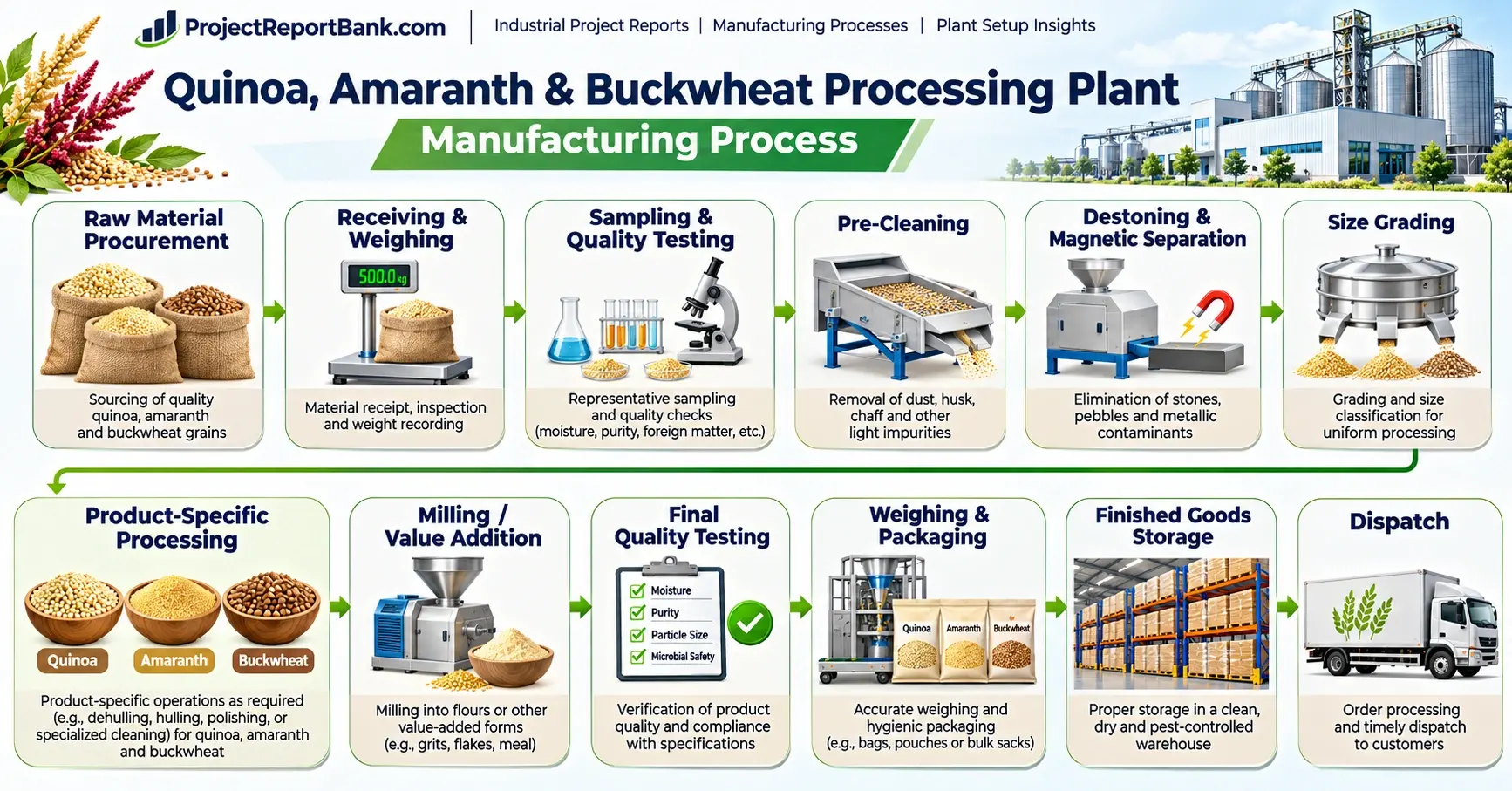
Raw Material Procurement → Receiving & Weighing → Sampling & Quality Testing → Pre-Cleaning → Destoning & Magnetic Separation → Size Grading → Product-Specific Processing → Milling / Value Addition → Final Quality Testing → Weighing & Packaging → Finished Goods Storage → Dispatch
The unit operations involved diverge after size grading, depending on the grain being processed:
- Quinoa processing: Grading → saponin removal through dry scouring (scarification) or wet washing → drying (if wet method used) → optical sorting → optional milling into flour → packaging. Quinoa processing includes wet washing or dry scouring methods for saponin removal. Dry abrasion using a commercial scarifier can handle approximately 450 kg/h, while wet methods require soaking tanks, recirculation and subsequent drying – adding both time and energy cost.
- Amaranth processing: Grading with fine-mesh screens → optional popping using a dedicated hot-air popper → milling with fine screens to avoid overheating → sieving → quality testing → packaging.
- Buckwheat processing: Buckwheat processing involves cleaning, dehulling, milling and packaging. Conditioning (moisture adjustment to ≤6%) → dehulling using stone, abrasive or roller dehullers → hull separation via aspiration → groat grading → optional milling into buckwheat flour → packaging.
Effective grain processing enhances product quality and consistency, but process losses are inevitable. Buckwheat groat recovery ranges from roughly 45–60% with mechanical dehulling, improving to 60–65% with hydrothermal pretreatment, though colour changes may affect buyer acceptability. Quinoa desaponification causes some abrasion loss, with typical cleaned grain recovery of 90–95%. Grain processing plants maximise yield while minimising resource waste through careful process design and realistic recovery assumptions in the DPR.
Key process-engineering considerations include dust control and aspiration systems, waste management systems for hulls and fines, cross-contamination prevention during product changeovers, food safety checkpoints (moisture verification, saponin residual testing, metal detection) and in-process quality testing. Final process design and yields must be validated through vendor trials and pilot runs rather than relying solely on brochure capacities.
Plant and Machinery Required for Specialty Grain Processing
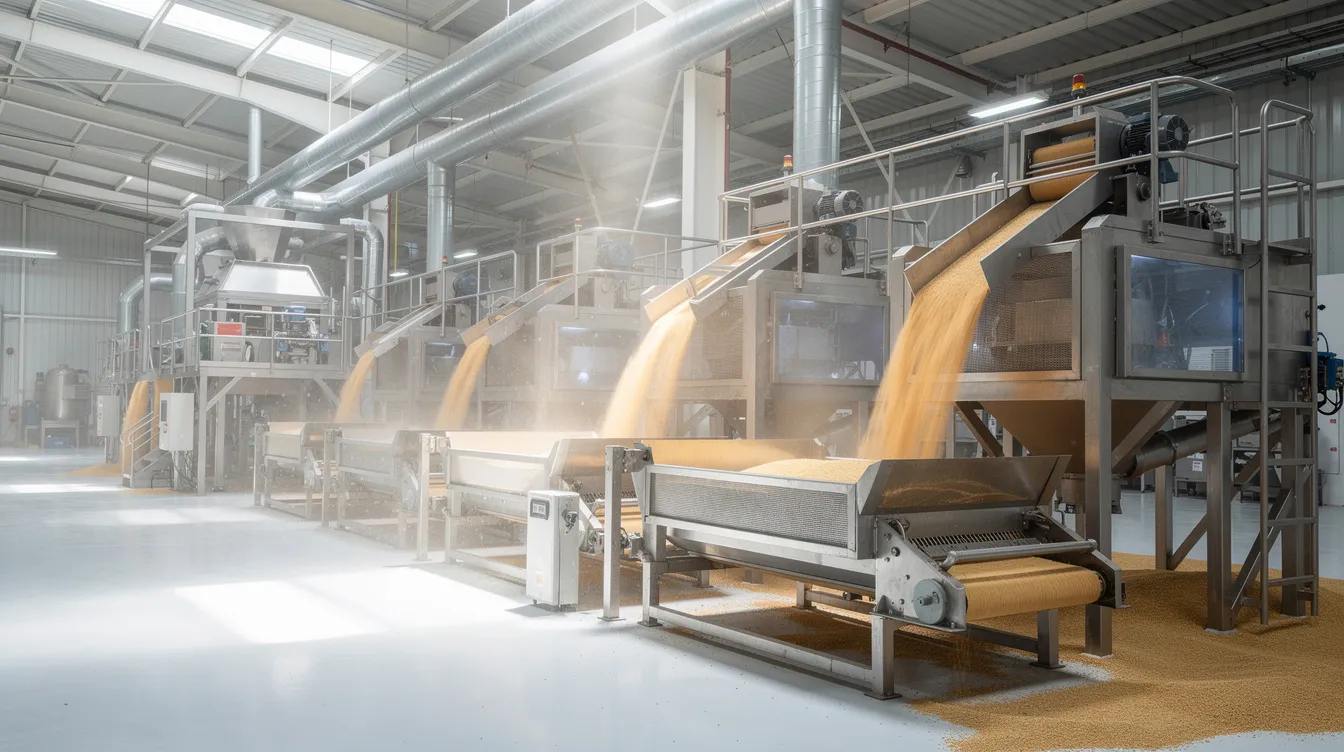
A buckwheat processing plant, quinoa line and amaranth line share many front-end machines but require dedicated essential equipment for product-specific operations. Modern grain processing plants utilise advanced automation technologies where justified by scale. Key machinery includes cleaning, dehulling, milling and packaging machines.
| Machine | Function | Common / Dedicated |
|---|---|---|
| Raw material intake hopper & conveyor | Receiving and feeding grain | Common |
| Pre-cleaner (air-screen type) | Removing coarse impurities | Common |
| Vibratory separator | Size-based separation | Common (screen change per grain) |
| Destoner | Removing stones and heavy foreign matter | Common |
| Magnetic separator | Removing metal contaminants | Common |
| Gravity / density separator | Density-based grading | Common |
| Quinoa desaponification system | Saponin removal via abrasion or washing | Dedicated – Quinoa |
| Fluidised bed / tray dryer | Post-wash drying | Dedicated – Quinoa (if wet method) |
| Buckwheat dehuller | Hull removal from buckwheat grains | Dedicated – Buckwheat |
| Hull separator (aspiration) | Separating hulls from groats | Dedicated – Buckwheat |
| Optical colour sorter | Colour-based defect removal | Common (recalibrated per grain) |
| Hammer mill / roller mill | Flour milling | Common (screen/roll gap adjustment) |
| Plansifter | Flour classification by particle size | Common |
| Amaranth popping machine | Hot-air popping of amaranth | Dedicated – Amaranth |
| Packaging machines (FFS, bag stitcher) | Weighing and packing finished products | Common |
| Dust collection & aspiration system | Dust control throughout plant | Common |
| Pneumatic conveying | Inter-machine material transfer | Common |
| Lab equipment | Moisture, sieve analysis, saponin testing | Common |
| Electrical panels & PLC controls | Process control and automation | Common |
Grain processing requires machinery for cleaning, milling and packaging, but the level of automation significantly affects capital costs. PLC-controlled batching, fully automatic packaging and advanced optical sorters increase capital expenditure but reduce labour cost and quality variation. Comparative machinery configurations for cleaning and grading are discussed in the Small Millet Processing Plant Project Report, while abrasion and separation technology parallels are covered in the Industrial Barley Pearling and Milling Plant guide.
The ICAR-CIPHET buckwheat dehuller, designed for small-scale operations at ~40 kg/hr and costing approximately ₹40,000, demonstrates that entry-level dehulling is achievable but commercially scalable plants require higher-capacity machines – potentially imported or custom-built to Indian crop specifications.
Processing Plant Capacity Planning
Realistic capacity planning prevents both underutilised large plants and undersized units that fail to serve institutional buyers. Throughput must be evaluated separately for quinoa, amaranth and buckwheat, as recovery rates and processing speeds differ by grain type. Amaranth processing plants can produce 500 to 2,000 tons annually depending on capacity and utilisation levels.
| Parameter | 1 TPH Line | 2 TPH Line | 5 TPH Line |
|---|---|---|---|
| Installed capacity (raw input) | 1 TPH | 2 TPH | 5 TPH |
| Operating hours per day | 16 | 16 | 20 |
| Operating days per year | 300 | 300 | 280 |
| Annual raw input (tonnes) | 4,800 | 9,600 | 28,000 |
| Year 1 capacity utilisation | ~50% | ~50% | ~45% |
| Year 3 capacity utilisation | ~70% | ~75% | ~70% |
| Year 5 capacity utilisation | ~85% | ~85% | ~85% |
| Indicative saleable output (at 85%) | ~2,400–2,850 t | ~4,800–5,700 t | ~14,000–16,600 t |
Illustrative yield calculation: If a 2 TPH line processes 1,000 kg of buckwheat grains, approximately 250–300 kg becomes hull, 50–100 kg is broken grains or fines, and roughly 500–650 kg is saleable hulled groats. The DPR must explicitly show these recovery assumptions per product rather than treating rated machine throughput as guaranteed finished-product output.
Product-mix allocation – how much line time is dedicated to quinoa versus amaranth versus buckwheat – influences annual output and revenue significantly. Seasonal campaigns (e.g., buckwheat harvest windows) and toll processing for other grains can improve capacity utilisation during lean periods.
Land, Building, Layout and Infrastructure
Proper plant layout improves material flow, hygiene, safety and future expansion options. Proposed plant layouts should optimise workflow to prevent contamination, with a linear process flow from raw material intake to finished goods dispatch, maintaining strict separation between raw and finished goods zones.
Major built-up components include: raw material godowns, pre-cleaning and main processing hall, dedicated quinoa desaponification and drying area, buckwheat dehulling section, flour milling and sieving area, packing hall, finished goods warehouse, quality control laboratory, utilities block (dust collectors, compressors, electrical room), staff amenities and office.
Infrastructure requirements include internal roads, weighbridge (for larger plants), water supply (especially important if wet quinoa desaponification is used), power connection with backup DG set, ventilation, lighting and fire-fighting systems. Storage facilities must accommodate seasonal raw material procurement patterns, with climate-controlled or well-ventilated godowns to maintain grain quality.
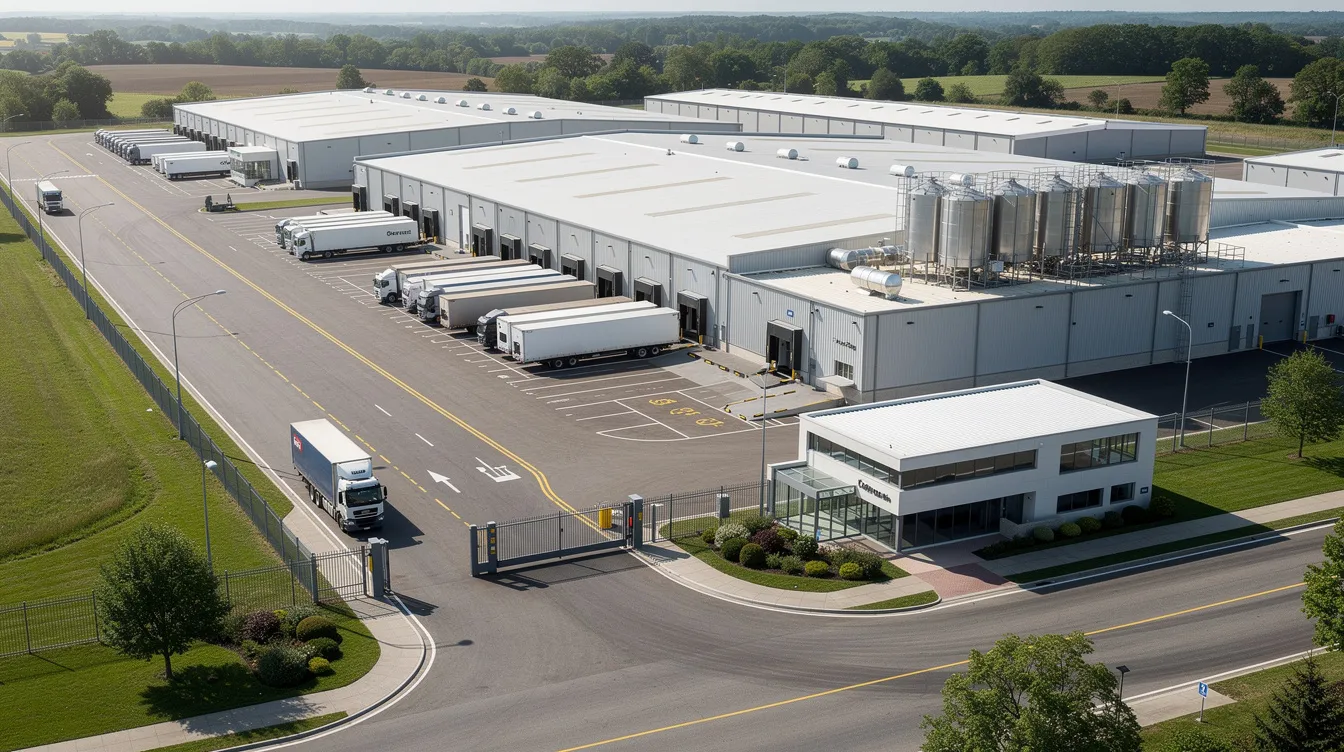
For a small 1–2 TPH plant, land requirements typically start from approximately 1,500–3,000 sq. m, while a larger 5 TPH integrated facility may require 5,000–10,000 sq. m or more. Final area depends on detailed layout engineering, machinery configuration, stacking heights and site development plans.
Quinoa, Amaranth & Buckwheat Processing Plant Setup Cost in India
Total project cost includes land and site development, civil construction, plant and machinery, utilities, electrification, preliminary expenses and margin for working capital – not merely “machinery price.” Plant setup costs vary based on scale and technology level. The project cost assessment should include land, machinery and operating expenses as separate components.
| Investment Component | Description |
|---|---|
| Land & site development | Land acquisition or leasehold, grading, fencing, internal roads |
| Building & civil works | Processing hall, godowns, packing area, lab, utilities block, office |
| Plant & machinery | Common cleaning/grading equipment + dedicated quinoa, amaranth, buckwheat lines |
| Electrical installation | Power distribution, panels, wiring, transformer, DG set |
| Utilities & auxiliary equipment | Compressed air, dust extraction, water treatment (if wet desaponification) |
| QC laboratory | Moisture meter, sieve analysis, saponin testing, basic microbiology |
| Installation & commissioning | Erection, alignment, trial runs, typically 10–15% of equipment cost |
| Preliminary & pre-operative expenses | Project development, licensing, interest during construction |
| Contingency | Provision for unforeseen costs (~10% of fixed capital) |
| Working capital margin | Initial funding for raw material inventory, WIP, receivables |
For indicative reference, specialty flour plant machinery for a 5 TPD unit costs approximately ₹35–55 lakh ex-works, scaling to ₹1.3–1.8 crore for a 20 TPD integrated milling and blending setup. For a 1–2 TPH integrated quinoa-amaranth-buckwheat plant with predominantly Indian equipment, total project cost (including land, civil works, machinery, working capital margin and pre-operative expenses) may fall in the ₹2–4 crore range. A 5 TPH facility with optical sorting, imported desaponification systems and higher automation could require ₹6–10 crore or more.
It is important to distinguish between machinery cost, fixed capital investment, total project cost and total funds required (including working capital). These distinctions are critical in any comprehensive business plan and bank loan proposal.
Serious investors should obtain a capacity-specific investment and feasibility assessment before ordering machinery. Contact Project Report Bank for a customised cost breakdown and feasibility-linked quinoa, amaranth and buckwheat processing plant project report.
Raw Material Procurement and Working Capital Requirements
Domestic sourcing patterns vary: amaranth and buckwheat are cultivated in specific Indian states (Rajasthan, Himalayan regions, parts of Maharashtra), while quinoa cultivation remains limited though expanding. Where local supply is insufficient, importing grains may be necessary, adding transportation costs and import compliance requirements.
Procurement models include buying through aggregators and traders, direct farmer procurement, contract farming and long-term supply agreements. Clear specifications covering moisture, impurities, variety, grain size and raw material requirements must be established pre-season to ensure consistent supply at predictable prices. Raw material availability and seasonal harvesting patterns mean that storage facilities for several months of inventory may be needed to operate the grain processing plant year-round.
Working capital assessments cover raw materials, labour and operational costs. A simple working capital assessment framework for a bank DPR considers typical holding periods for raw materials (30–90 days depending on seasonality), work-in-process (3–7 days), finished goods (15–30 days), average credit allowed to customers (30–60 days) and average credit received from suppliers (15–30 days). The working capital gap, calculated as current assets minus current liabilities excluding bank finance, determines the funding requirement.
Quinoa, amaranth and buckwheat prices can be volatile due to limited cultivation, weather dependence and market fluctuations. Sensitivity analysis on raw material cost and finished-goods realisations is essential in the financial model.
Production Cost and Operating Economics
Production cost per kg of finished product depends on raw material price, processing yield, utility requirements, labour, packaging requirements and overheads. Raw material costs account for 65–75% of total operating expenses in grain processing. Operating costs for amaranth processing similarly run at 65–75% raw material expenses. Comparing only selling price without understanding the complete operating cost structure and cost breakdown is a common analytical error.
| Cost Component | Description |
|---|---|
| Raw materials | Quinoa, amaranth, buckwheat grain procurement |
| Power & fuel | Electricity, drying fuel, compressed air |
| Consumables & spares | Screens, stones, belts, lubricants |
| Direct labour | Machine operators, helpers, loaders |
| Supervisory & administrative staff | Production supervisor, QC, accounts |
| Packing materials | Bags, pouches, cartons, labels |
| Repairs & maintenance | Scheduled and breakdown maintenance |
| Quality control | Testing consumables, external lab fees |
| Factory overheads | Insurance, rent, water, miscellaneous |
| Selling & distribution costs | Transportation requirements, commission, marketing |
Separate contribution margins should be computed for major product groups – quinoa products, amaranth products, buckwheat groats and flours – to understand which lines truly drive profit and which are retained to utilise capacity or serve strategic customers. Amaranth processing plant gross profit margins range from 30–40% under favourable conditions. Variable costs (raw material, packaging) scale with production volume, while fixed costs (salaries, building, interest, insurance) remain largely constant, meaning higher capacity utilisation generally improves unit economics.
Financial Projections and Profitability Analysis
Detailed 7–10 year income and expenditure projections are essential for a bankable plant project report 2026, particularly when seeking term loans and investor participation. Detailed Project Reports typically include financial projections and business feasibility analysis covering project cost, means of finance, revenue build-up and debt servicing capacity. Financial projections typically include profit and loss statements and cash flow analysis.
Key financial analysis components in a professionally prepared DPR include:
- Projected profit and loss account (year-wise)
- Cash flow statement
- Projected balance sheet
- Fixed-asset and depreciation schedules
- Working capital requirement projections
- Interest schedule and loan repayment schedule
- Break-even analysis (volume and value)
- DSCR (year-wise and average, target ≥1.25)
- IRR and net present value (discount rate typically 12–15%)
- Payback period
- Sensitivity analysis on key variables
Break-even for amaranth processing typically ranges from 3 to 6 years depending on scale, capacity utilisation and market realisations. Profitability depends on validated assumptions about sales volume by product, realisation per kg, raw material consumption, recovery rates, operating expenses and financing terms. Generic claims about profit margins without detailed backing should be avoided.
Preparing for bank finance or investor discussions? Contact Project Report Bank for detailed financial modelling, CMA Data preparation and a comprehensive business plan tailored to your chosen capacity, product mix and project funding structure.
Bank Loan DPR and Project Finance Requirements
A Detailed Project Report for a grain processing plant is a structured document combining technical, commercial and financial details for lender appraisal. Core DPR components include promoter background, project rationale, market analysis, technical configuration, capacity planning, machinery quotations, project cost estimate, means of finance and implementation schedule. Establishing a buckwheat plant – or any specialty grain facility – requires careful financial planning supported by credible documentation.
CMA Data and projected financial statements are used by Indian banks to assess term loan and working capital proposals, with particular attention to DSCR, security coverage and promoter contribution. Loan structuring considerations include appropriate debt-equity ratio (typically 70:30 for MSME plants), moratorium period, repayment term, interest assumptions and how these influence cash flow projections and project viability.
A strong DPR and sound financial projections improve proposal quality, but they do not guarantee bank sanction. Regulatory requirements, collateral adequacy and internal risk assessments by the lending institution also apply. Human resource requirements, manpower requirements and technological requirements should be documented clearly within the report.
Government Schemes, Incentives and Regulatory Approvals
Regulatory approvals and potential incentives differ by state, project size and location. Promoters must verify current rules at the time of investment.
Statutory approvals for food processing include FSSAI licensing and environmental clearances. Key regulatory procedures and key certifications required for commercial operations include:
- FSSAI licence or registration (mandatory for food processing)
- Factory licence and labour-law registrations
- GST registration
- Udyam registration for MSME status
- Fire and building safety approvals
- Legal metrology and packaging compliance (weights, MRP, batch codes) for retail products
- Pollution control board consent where boiler, significant dust emission or effluent from wet desaponification is involved
Environmental impact management involves handling waste from food processing operations, including hull disposal, dust emissions and wastewater from wet processing. Food safety standards include HACCP and ISO 22000 certifications, which may be required by institutional buyers and export markets. The Codex standard CXS 333-2019 defines processed quinoa quality requirements for international trade.
Government schemes support agro-processing and food startups financially through various central and state-level programmes, but eligibility, subsidy quantum and conditions must be verified against official notifications and should not be assumed in the base DPR. Investment opportunities linked to scheme benefits require independent confirmation.
Major Risks and Mitigation Strategies
Specialty grain projects carry specific technical, market and financial risks which must be evaluated in the feasibility study and reflected through sensitivity analysis. Risk assessments identify factors such as raw material price fluctuations and market demand uncertainty.
| Risk Factor | Mitigation Strategy |
|---|---|
| Raw material price volatility and limited sourcing | Diversify suppliers, explore contract farming, build strategic inventory, sensitivity-test DPR |
| Quinoa desaponification under-performance | Validate with vendor trials, pilot-test equipment with target varieties, maintain quality checkpoints |
| Buckwheat dehulling losses and broken groats | Optimise seed moisture (≤6%), test dehuller settings, consider hydrothermal pretreatment |
| Lower-than-expected capacity utilisation | Offer toll processing, maintain flexible product mix, phase capacity additions |
| Demand slowdown in premium retail | Diversify into B2B ingredients, institutional supply, export channels |
| Competition from imported brands and products | Focus on cost efficiency, freshness advantage, local sourcing, certification |
| Working capital shortages | Conservative inventory planning, credit management, adequate WC facility |
| Food safety non-compliance | Implement HACCP, regular audits, trained QC staff |
| Equipment incompatibility with Indian crop varieties | Insist on vendor trials with local grain samples before purchase |
| Export market disruptions | Maintain domestic market base, diversify export destinations |
Process-specific risks – variability in recovery rates, colour defects in buckwheat groats, amaranth popping yields – require pilot trials and vendor testing. Numerical risk assessment through best-case, base-case and worst-case scenarios on sales realisations, input prices and capacity utilisation strengthens the financial model and provides a complete roadmap for risk management.
Feasibility of an Integrated Multi-Grain Processing Plant
Comparing a standalone quinoa processing plant project report, a separate amaranth processing plant project report and a dedicated buckwheat processing plant project report against an integrated multi-grain facility reveals important trade-offs.
Integration benefits include shared intake, pre-cleaning, grading, colour sorting and milling infrastructure; better utilisation of common utilities and buildings; and the ability to shift production between products based on seasonal raw material availability and demand patterns. Grain processing plants can handle multiple grain types efficiently when designed with appropriate changeover protocols.
Challenges include more complex scheduling, rigorous cleaning between product runs, higher investment in segregated storage and the risk of management spreading focus across too many SKUs.
An integrated specialty grain processing plant is preferable when the promoter targets B2B ingredients across several health-food categories, has a strong distribution network and can secure consistent supply of multiple raw materials. A focused single-grain facility may be more prudent initially for promoters with limited capital or uncertain demand. Multi-grain facility design principles discussed in the Integrated Millet Processing Plant Project Report and Industrial Barley Malting Plant Project Report provide useful structural parallels, though processing technologies differ.
Why a Professional DPR Is Essential Before Investing
A professional DPR is not a bank formality – it is a decision-making tool for promoters to test assumptions and understand risk. For a specialty grain processing project involving quinoa, amaranth and buckwheat, the technical and financial variables are too numerous and interconnected to evaluate informally.
A professionally prepared quinoa, amaranth and buckwheat processing plant project report provides validated process configuration, realistic machinery sizing, layout-linked cost estimates, detailed project cost and means of finance, product-wise profitability projections and sensitivity analysis covering key variables. A sample report structure and financial modelling framework should be discussed with the advisory team before finalising scope.
A Chartered Accountant–led team brings DSCR analysis, break-even and sensitivity analysis, cash-flow stress testing, IRR and NPV calculations, and loan structuring recommendations grounded in practical banking experience. Customised DPRs consider local raw material conditions, promoter strengths, buyer feedback, technology choices and government-scheme applicability rather than relying on generic templates.
Professional DPR and Feasibility Study Services by ProjectReportBank.com
CA Manish Gugliya, FCA, DISA (ICAI), leads Project Report Bank with more than 20 years of professional experience in project finance, DPR preparation and financial modelling for MSME and industrial projects across India.
Services relevant to specialty grain processing include:
- Customised Detailed Project Reports for quinoa, amaranth, buckwheat and other grain processing plants
- Technical and financial feasibility studies
- Project cost estimation, capital investment planning and capacity evaluation
- Financial projections, CMA Data for bank loans and DSCR analysis
- Term-loan structuring, working capital assessment and break-even analysis
- IRR, NPV and sensitivity analysis for key variables including raw material price and selling price
- Investor-ready DPRs, financial models and fundraising documentation
Planning a specialty grain processing plant? Serious project promoters and investors are invited to contact ProjectReportBank.com via the website or WhatsApp for a discussion on customised DPR and financial advisory requirements.
Frequently Asked Questions
The following FAQs address common practical questions that arise when evaluating a quinoa, amaranth and buckwheat processing plant project.
What is a practical minimum capacity for a quinoa, amaranth and buckwheat processing plant?
For commercial viability with institutional buyers, a minimum front-end capacity of approximately 1 TPH raw input is generally considered. Micro-scale units can be smaller but may struggle with equipment availability and unit economics. Optimum production capacity depends on confirmed demand, available budget, raw material sourcing and location advantages.
Can quinoa, amaranth and buckwheat be processed on exactly the same machinery line?
Pre-cleaning, destoning, magnetic separation and generic grading equipment can be shared. However, quinoa desaponification and buckwheat dehulling require dedicated machinery with different operating parameters. Changeover cleaning between products is essential to prevent cross-contamination and maintain quality assurance standards.
How long does it typically take to implement a specialty grain processing plant project?
Timelines vary with capacity and civil-construction scope. A realistic range from initial concept, DPR preparation and bank sanction through to commissioning is approximately 9–15 months, assuming timely regulatory approvals and machinery deliveries. Land acquisition and site development timelines can extend this further.
Is contract processing (job work) feasible for quinoa, amaranth and buckwheat?
Many integrated grain processing plants use spare capacity for toll processing – offering cleaning, dehulling, milling and packing as job work for brands and traders. This improves capacity utilisation and contributes to distribution costs recovery. Contracts should factor in throughput, labour, power and equipment wear.
Which quality certifications are relevant for exporting specialty grain products?
Domestic compliance requires FSSAI licensing. Depending on target markets and buyer requirements, additional certifications such as ISO 22000, FSSC 22000, HACCP, organic certification or Halal may be necessary. Exporters should verify destination-market norms before investing in certification.
Conclusion
An integrated quinoa, amaranth and buckwheat processing plant can address growing but niche demand for gluten-free and health-focused grain products in Indian and export markets, provided that raw material sourcing, technology selection and market access are carefully validated. The opportunity is real but not unconditional – it requires rigorous technical and commercial planning.
Tailored processing routes – quinoa desaponification, buckwheat dehulling, amaranth-specific handling – demand appropriate grain processing plant machinery selection, realistic capacity planning, strong food-safety systems and validated yield assumptions. Understanding capital expenditure, working capital, cost of production, DSCR and risk through a detailed, professionally prepared quinoa, amaranth and buckwheat processing plant project report is essential before committing significant funds.
Serious entrepreneurs, MSME manufacturers and investors planning a specialty grain processing venture in India are invited to connect with ProjectReportBank.com for customised DPRs, feasibility studies and project-finance advisory – grounded in practical financial analysis and more than two decades of professional experience.