Setting up a millet based biscuits manufacturing plant in India requires careful evaluation of formulation, machinery, project cost, market positioning and financial feasibility before capital is committed. A Detailed Project Report (DPR) outlines technical, financial and commercial viability, helping promoters make informed investment decisions. This article covers the essential planning considerations for entrepreneurs and project promoters evaluating industrial-scale millet biscuit and millet cookies production in India.
Key Takeaways
- The Indian packaged biscuits market was valued at approximately ₹513 billion in FY 2023 and is projected to reach ₹903 billion by FY 2029. Millet snacks represent a fast-growing niche within this market, with the millet snacks market growing at 18–22% annually across India.
- Realistic plant capacity options range from 1 MT/day to 10 MT/day, with indicative total project investment from approximately ₹1 crore for a semi-automatic line to ₹5 crore or more for an automated integrated plant. All figures are planning assumptions and must be validated with vendors and location-specific inputs.
- Millet based biscuits are not automatically gluten free, sugar-free or premium. Commercial viability depends on actual formulation, ingredient cost, market pricing and distribution strength rather than the word “millet” alone.
- Working capital, capacity utilisation, marketing investment and distribution reach are as critical as machinery selection in determining project success.
- Project Report Bank, led by CA Manish Gugliya, FCA, DISA (ICAI), prepares customised project report DPR, CMA Data and financial models for millet based biscuit, millet cookies and millet snacks manufacturing plants across India.
Introduction to Millet-Based Biscuits Manufacturing in India
India’s 2023 International Year of Millets campaign brought significant visibility to nutri-cereals such as ragi, bajra, jowar and barnyard millet. The campaign accelerated consumer awareness and policy support, but converting that awareness into commercially sustainable food manufacturing projects requires a different level of analysis. Millet based biscuits – products where millet flour replaces part of wheat or refined flour to create differentiated, value-added SKUs – represent one of the most industrially suited product categories for millets, alongside millet breakfast cereals, instant mixes and millet extruded snacks.
Biscuit and cookie manufacturing lines can run high volumes with standardised recipes and deliver long shelf life, making them well-suited for organised retail and institutional distribution. Millet processing for biscuits requires moderate capital investment compared to some other food processing categories, while the baking technology and packaging formats are well-established. Over 600 new millet-based packaged foods were launched globally from 2022 to 2024, reflecting broad industry interest in this category.
Business models in this sector include launching an own brand, contract manufacturing for established FMCG companies, private-label production for retailers, and institutional supplies to canteens, hostels, hospitals and government nutrition programmes.
For promoters considering backward integration into grain processing, the integrated millet processing plant project report and specific guides for ragi processing or bajra processing provide relevant context on raw-material preparation.
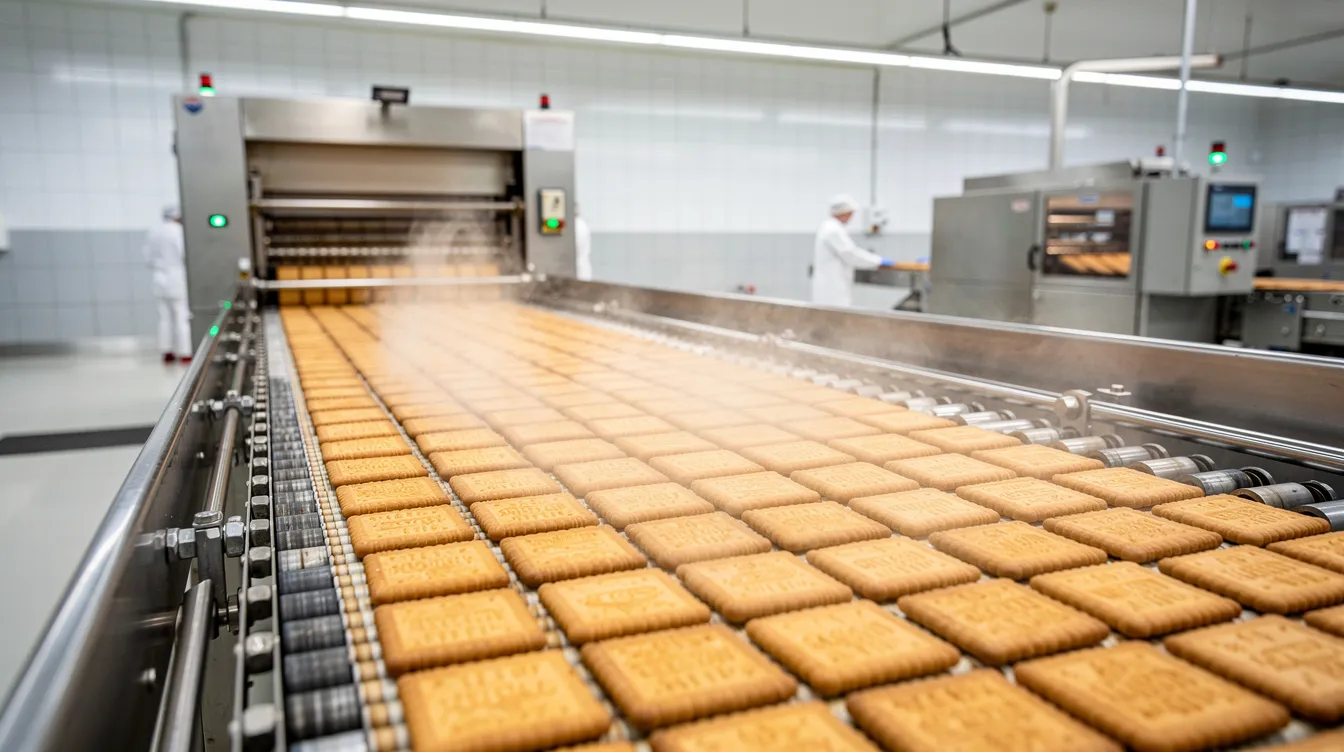
Market Opportunity and Demand for Millet-Based Biscuits
The Indian packaged biscuits market reached approximately ₹551 billion in FY 2024, with projected growth to ₹903 billion by FY 2029 at around 10.4% CAGR. Within this, health and functional biscuit varieties – including digestive, oat, multigrain and millet formulations – have been growing faster than the core biscuit segment. Sales of packaged foods with over 15% millet under government incentive schemes rose from ₹345.73 crore in FY 2023 to ₹1,845.25 crore in FY 2025, indicating growing commercial traction. The Asia Pacific region holds a 42.8% revenue share in the millet-based food market globally, with India as a significant contributor.
Demand drivers include rising health awareness among urban consumers, interest in traditional foods and alternative grains for children, and institutional interest in millet based products under government nutrition schemes. Millet snacks, multigrain biscuits and high-fibre cookies occupy a premium or “better-for-you” niche, with stronger traction in metro, tier-1 and tier-2 cities and modern trade outlets.
Key sales channels include general trade via distributors, modern retail and supermarkets, e-commerce and quick-commerce platforms, institutional catering, and private-label supply to established bakery brands. Export opportunities exist but require compliance with destination-market standards.
However, competition from large biscuit manufacturers like Britannia, ITC and Parle – already offering multigrain and millet cookies – is real. New plants must differentiate through recipe quality, taste, competitive pricing, packaging and channel strategy. Consumer interest should not be confused with proven commercial demand. The business plan should include market-testing of formulations, pilot sales data and realistic volume assumptions. Entrepreneurs considering portfolio diversification may also evaluate related categories such as millet extruded snacks and millet breakfast cereals, which are among the fastest-growing segments in millet-based food.
Types of Millet-Based Biscuits and Cookies That Can Be Manufactured
Selecting the right product mix is a strategic decision that affects formulation cost, market positioning and plant configuration. The following commercially relevant product types can be considered:
- Ragi biscuits: Positioned for nutritional benefits, especially calcium content. Higher ragi flour cost (MSP-linked price around ₹52/kg) and earthy flavour require careful recipe balancing. Often targeted at children and health-conscious families.
- Bajra biscuits: Pearl millet offers a nutty flavour at a lower cost than ragi (MSP around ₹29/kg). Suitable for digestive-style and mass-market formulations in tier-2 and tier-3 cities.
- Jowar biscuits: Lighter flavour profile, suitable for combining with wheat or oats. Growing interest from consumers exploring reduced-wheat options.
- Multimillet biscuits: Combining two or more Indian millets to balance cost, taste and nutrition. More complex formulation and flour blending requirements.
- Millet digestive-style biscuits: Lower sugar, higher fibre, moderate fat – targeting mass health-conscious consumers.
- Premium millet cookies: Including nuts, chocolate, butter – higher margins but significantly higher ingredient and packaging costs. Millet-based health bars also target the fitness and sports nutrition market.
- Millet-and-oat biscuits: Combined fibre and whole-grain marketing claims. Requires testing for dough handling and cost implications.
- Low-sugar / high-fibre SKUs: Aimed at adults with diabetes awareness or dietary preferences.
An important clarification: most commercial biscuit formulations still use wheat flour for structure and dough handling. Millet based biscuits are not automatically gluten free unless the formulation specifically eliminates wheat and uses dedicated gluten free controls, alternate binders, and separate processing lines. Health, fibre, and glycaemic index claims must be supported by laboratory testing and comply with FSSAI labelling regulations.
Millet-Based Biscuits Manufacturing Plant Capacity Planning
Plant capacity should be aligned with realistic market reach, working-capital strength and distribution bandwidth. Below are nominal capacity scenarios based on 300 working days per year:
| Plant Capacity | Daily Finished Output | Annual Output (300 Days) |
|---|---|---|
| 500 kg/day | 0.5 MT | 150 MT |
| 1,000 kg/day | 1 MT | 300 MT |
| 2,500 kg/day | 2.5 MT | 750 MT |
| 5,000 kg/day | 5 MT | 1,500 MT |
| 10,000 kg/day | 10 MT | 3,000 MT |
Annual production capacity for established millet plants typically ranges from 2,000 to 5,000 MT at full utilisation, depending on shift pattern and product mix. These are nominal, single-product reference figures; actual multi-SKU lines may vary.
Rated capacity differs from achievable capacity. Single-shift operations, oven throughput limitations, downtime for changeovers and easy cleaning, and preventive maintenance typically reduce effective output by 10–20% compared to rated capacities. Baking is usually the key bottleneck in biscuit manufacturing process lines – oven throughput must match mixing and forming capacity.
Capacity utilisation assumptions in the project report should reflect realistic ramp-up: approximately 45–55% in Year 1, 60–70% in Year 2, and 75–80% from Year 3 onwards, depending on market development and channel expansion.
For plants at 2.5–5 MT/day scale, integrating a separate millet processing unit for in-house flour production can improve quality control and margins. Details on milling equipment are covered in the sorghum milling plant project report and bajra flour milling guide. At automated 2.5–5 MT/day scales with in-line packing and basic in-house millet processing, integrated investment can reach or exceed ₹5 crore.
Raw Materials Required for Millet Biscuit Manufacturing
Raw-material selection directly impacts taste, texture, shelf life, cost of production and FSSAI compliance. DPR assumptions must specify exact ingredients and expected costs.
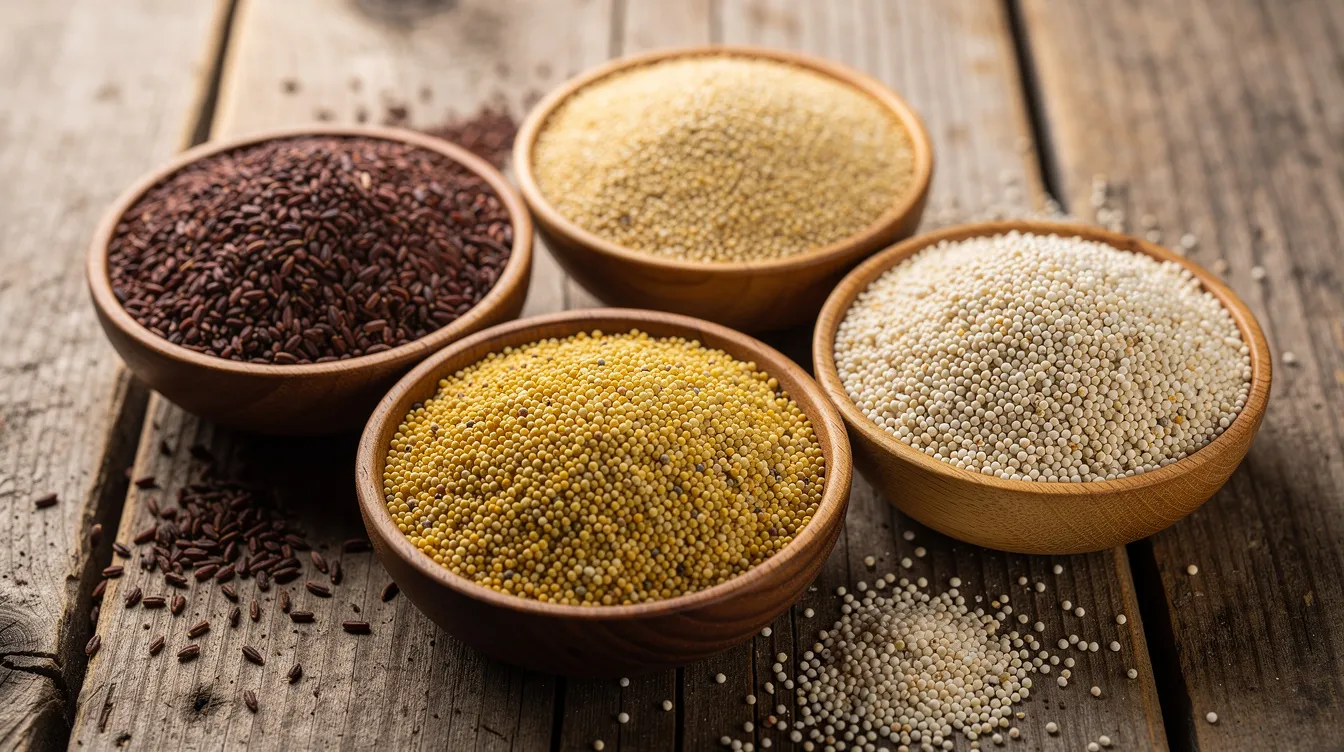
Main grains: Ragi (finger millet), bajra (pearl millet), jowar (sorghum) and small millets such as barnyard millet, foxtail and kodo. These can be procured as cleaned grains for in-house millet processing or as ready flour from approved suppliers. Key sourcing regions include Madhya Pradesh, Rajasthan, Karnataka, Maharashtra and Telangana. Tie-ups with farmer producer organisations (FPOs) or MSP-based procurement can support supply stability.
Wheat flour or refined flour remains a significant cost component in many millet based biscuits, providing gluten structure for dough handling. Rice flour may be used in specific formulations.
Other core ingredients: Edible fats (palm oil, bakery shortening, butter for premium millet cookies), sugar, liquid glucose, jaggery syrup for specialty variants, leavening agents (baking powder, ammonium bicarbonate), salt, milk solids, cocoa, flavours, emulsifiers and permitted improvers. These ingredients are rich in cost impact – raw materials account for 60–70% of operating expenses in a typical biscuit plant.
Packaging materials: Duplex cartons, printed laminated pouches, trays, wrappers and corrugated shippers. Packaging share in total cost is high, especially for small pack sizes (100 g, 150 g formats).
Raw-material risks include millet moisture variation, fungal contamination (aflatoxins), pesticide residues and inconsistent flour granulation. Pre-procurement specifications, sampling and QC protocols are essential. The project report DPR should model realistic per-kg ingredient costs and run sensitivity scenarios for 10–15% increases in millet and edible-oil prices. For flour-related processing equipment, the specialty flour plant machinery guide provides useful reference.
Millet-Based Biscuits Manufacturing Process and Flow Diagram
The manufacturing process for millet based biscuits follows a systematic flow from raw material intake to finished packed product. Advanced processing techniques improve taste and shelf life of millet products, but each formulation must be lab- and pilot-tested before scaling to production.
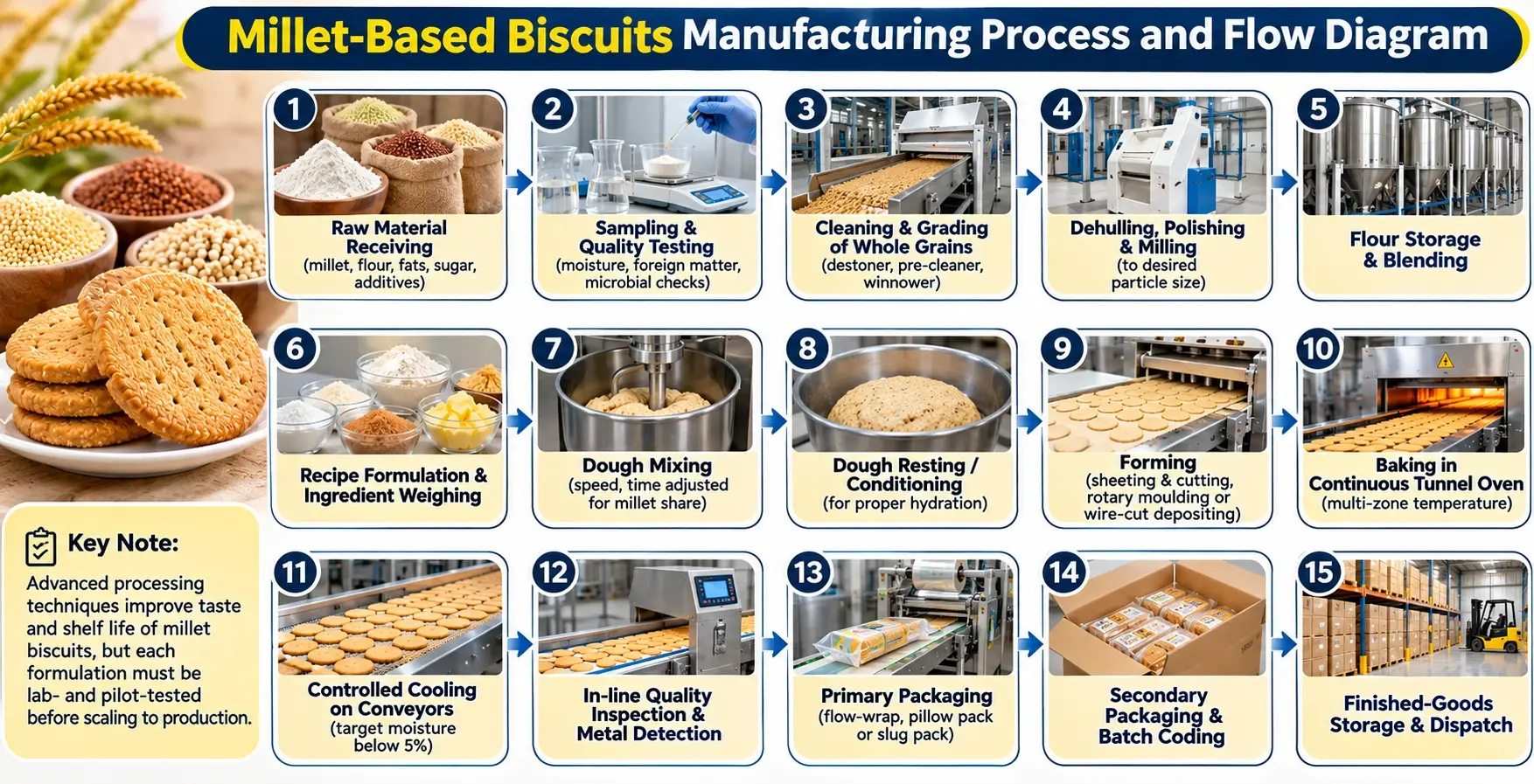
Process Flow:
- Raw material receiving (millet grain or flour, wheat flour, fats, sugar, additives)
- Sampling and quality testing (moisture, foreign matter, microbial checks)
- Cleaning and grading of whole grains (destoner, pre-cleaner, winnower)
- Dehulling, polishing and milling to desired particle size
- Flour storage and blending
- Recipe formulation and ingredient weighing
- Dough mixing (speed, time adjusted for millet share)
- Dough resting or conditioning for hydration
- Forming: sheeting and cutting, rotary moulding, or wire-cut depositing
- Baking in continuous tunnel oven (multi-zone temperature profiles)
- Controlled cooling on conveyors (target moisture below 5%)
- In-line quality inspection and metal detection
- Primary packaging (flow-wrap, pillow pack or slug pack)
- Secondary packaging and batch coding
- Finished-goods storage and dispatch
Plants that buy ready millet flour skip steps 3–4, reducing capital investment and floor space. Integrated units that handle millet processing in-house gain quality control advantages but require additional equipment as described in the integrated millet processing plant guide.
Dough rheology considerations: Higher millet content reduces gluten availability, leading to increased brittleness, altered water absorption and changed spread characteristics. Fat type, emulsifier levels and mixing time need adjustment. This is where formulation trials become essential – the same machinery processes dough differently depending on millet percentage.
Forming options: Rotary moulders suit plain and semi-sweet biscuits. Sheeting and cutting lines work for crackers and thin biscuits. Wire-cut or depositor machines handle premium millet cookies. The choice affects line speed, product range and changeover convenience.
Baking and cooling: Multi-zone tunnel ovens allow temperature profiling specific to each formulation. Residence time may range from 5 to 20 minutes depending on product thickness and fat content. Cooling conveyor length must be adequate to bring moisture to target levels and avoid condensation before packaging.
Trial production and testing are essential pre-operative expenses for project implementation and should be budgeted in the DPR.
Plant and Machinery Required for Millet Biscuit Manufacturing
Machinery selection should be driven by desired capacity, product mix, automation level and energy efficiency, supported by supplier quotations in the DPR. Millet processing requires specialized machinery for flour and flakes preparation, while automatic processing lines enhance efficiency in millet snack production. Machinery costs account for a significant portion of total project investment.
| Equipment Category | Key Machines | Purpose |
|---|---|---|
| Millet processing | Cleaner-grader, dehuller, hammer/roller mill, sifter | Grain cleaning, dehulling, flour milling |
| Flour handling | Silos, bins, screw conveyors | Storage and transfer |
| Mixing | Industrial dough mixer, weighing system | Ingredient dosing and dough preparation |
| Forming | Rotary moulder / sheeter-cutter / wire-cut machine | Dough forming into biscuit shape |
| Baking | Continuous tunnel oven (multi-zone) | Baking with controlled temperature profiles |
| Cooling | Cooling conveyor with ambient control | Moisture reduction before packing |
| Quality control | Metal detector, moisture analyser, water-activity meter | In-line and lab QC |
| Packaging | Form-fill-seal / flow-wrap, cartoner, shrink-wrap | Primary and secondary packaging |
| Utilities | Air compressor, boiler/steam, DG set | Process support |
Imported ovens and packaging lines may offer better energy efficiency and higher speeds but come with higher capital cost and service dependency. Local manufacturers in Gujarat, Maharashtra and Tamil Nadu provide cost-effective lines with simpler controls and easier after-sales support.
All machinery cost figures in this article are ballpark planning numbers based on 2025–2026 levels for India. Entrepreneurs must validate with at least two to three vendors before finalising budgets. For milling equipment details, the multigrain flour mill project report offers relevant context.
Factory Building, Land and Layout Requirements
Hygienic flow, separation of raw and finished zones, and provision for future capacity expansion are critical design considerations. Food processing plants require segregated zones for different operations to meet food safety audit requirements.
Main functional areas include raw-material receiving bay, millet and wheat flour storage, other ingredient stores, milling section (if applicable), dough preparation room, forming and baking hall, cooling and packing area, finished-goods warehouse, QC lab, utilities (boiler room, compressor room, electrical room), staff amenities, administration and dispatch area. The cost of utilities for a biscuit plant includes electricity and water, and these must be sized to match capacity.
For a medium industrial plant (2.5–5 MT/day automated line), a plot of 1–2 acres with 15,000–25,000 sq.ft. built-up area is illustrative. Actual requirements depend on plot shape, floor space index, multi-storey options, and infrastructure like drainage, ventilation, temperature control around cooling sections, adequate lighting, pest control provisions and fire-safety design.
Layout should follow unidirectional movement from raw material to finished goods, with controlled entry, change rooms and hygiene stations. Proximity to raw-material clusters and major consumption centres helps optimise logistics cost – a factor that should be covered in the business plan and site selection analysis.
Millet Biscuits Manufacturing Plant Setup Cost in India
Estimating the total project cost requires a comprehensive breakdown of capital expenditure. Cost estimation for a millet-based biscuit plant includes fixed capital and working capital. Below are three indicative capacity-based scenarios:
| Cost Component | Scenario A: ~1 MT/day Semi-Auto (Bought Flour) | Scenario B: ~2.5 MT/day Auto + Basic Milling | Scenario C: ~5 MT/day Integrated |
|---|---|---|---|
| Land & site development | Excluded (leased) | ₹40–60 lakh | ₹80–120 lakh |
| Civil & building works | ₹20–30 lakh | ₹60–90 lakh | ₹120–180 lakh |
| Main biscuit production line | ₹50–70 lakh | ₹100–140 lakh | ₹180–250 lakh |
| Millet processing equipment | Not applicable | ₹15–25 lakh | ₹30–50 lakh |
| Packaging machinery | ₹10–15 lakh | ₹20–35 lakh | ₹40–60 lakh |
| Electricals & utilities | ₹8–12 lakh | ₹15–25 lakh | ₹25–40 lakh |
| Lab, furniture, vehicles | ₹3–5 lakh | ₹8–12 lakh | ₹10–15 lakh |
| Installation, commissioning | ₹5–8 lakh | ₹10–15 lakh | ₹15–20 lakh |
| Preoperative & contingency | ₹5–8 lakh | ₹12–18 lakh | ₹20–30 lakh |
| Margin for working capital | ₹10–15 lakh | ₹25–40 lakh | ₹45–70 lakh |
| Indicative Total | ₹1.1–1.6 crore | ₹3.0–4.5 crore | ₹5.5–8.0 crore |
Notes: All figures are preliminary planning assumptions based on FY 2025–26 price levels for India and are not supplier-confirmed quotations. GST, duties, freight and insurance must be captured from vendor proforma invoices and integrated into CMA Data for bank-finance proposals. Choices like imported tunnel ovens or high-speed packing machines can significantly increase budgets.
Phasing options – starting with a smaller line with provision for adding a second oven or packing line later – can be covered in the project report DPR under expansion planning.
Working Capital Requirement for Millet Biscuit Plants
Working capital covers day-to-day operations until revenue generation stabilises. This requirement is frequently underestimated by new promoters.
Key components include raw-millet and flour inventory, edible oils and fats, sugar and minor ingredients, packaging material, work-in-progress (dough and baked but unpacked biscuits), finished-goods stock, trade receivables from distributors and modern trade, and minimum cash balance.
Illustrative calculation for a 2.5 MT/day plant (annual production ~600 MT at 80% utilisation):
| Component | Assumed Days | Approximate Value |
|---|---|---|
| Raw materials inventory | 30 days | ₹18–22 lakh |
| Packaging material | 20 days | ₹5–7 lakh |
| Work-in-progress | 2 days | ₹1–2 lakh |
| Finished goods | 15 days | ₹10–14 lakh |
| Trade receivables | 45 days | ₹30–40 lakh |
| Less: trade creditors | 20 days | (₹12–15 lakh) |
| Net working capital | ₹52–70 lakh |
Banks typically finance a portion through cash-credit or working-capital limits, with the balance funded by promoter margin as part of the project’s means of finance. Seasonal factors – building inventory before festive seasons when biscuit sales peak – may require temporary enhanced limits.
Inadequate working capital is a key reason otherwise profitable biscuit units struggle with creditor payments and debt servicing. Stress-testing cash flows under slower collection scenarios is essential in any professionally prepared DPR.
Cost of Production per Kilogram of Millet Biscuits
The cost of production directly informs pricing, break-even analysis and profitability assessment. An illustrative per-kg cost build-up for a standard millet biscuit formulation at a 2.5 MT/day plant might look as follows:
| Cost Component | Approximate ₹/kg |
|---|---|
| Millet flour (30% of recipe) | 18–25 |
| Wheat flour (35% of recipe) | 12–15 |
| Edible fat and sugar | 25–35 |
| Leavening agents, minor ingredients | 5–8 |
| Packaging materials | 15–22 |
| Power and fuel | 6–10 |
| Direct labour | 4–6 |
| Factory overhead, maintenance, QC | 8–12 |
| Process loss and breakage allowance | 3–5 |
| Total variable + allocated fixed cost | ₹96–138/kg |
These are indicative for a mass-market product. Premium millet cookies with butter, cocoa or nuts will have materially higher costs. Factors that strongly influence production cost include millet percentage in the recipe, small versus family pack formats, oven fuel type and efficiency, and geographic power-tariff differences. Raw materials account for 60–70% of operating expenses across most formulations.
Promoters should avoid assuming fixed profit margins per kg. Instead, scenario analysis in the DPR should vary selling price, utilisation and raw-material inflation by ±10–15%.
Financial Projections and Project Profitability Analysis
Bankable and investor-ready millet biscuit projects require integrated financial statements, not rough margin estimates. Detailed project reports aid in securing bank loans and government grants by presenting coherent financial logic. Financial projections should cover profitability and cash flow statements over five years at minimum.
Key financial statements include projected profit and loss (5–7 years), projected balance sheet, cash-flow statement, depreciation schedule, term-loan repayment schedule, working-capital assessment, and detailed sales and production assumptions.
Illustrative 5-Year Operating Summary (3 MT/day plant, 300 working days):
| Parameter | Year 1 | Year 2 | Year 3 | Year 4 | Year 5 |
|---|---|---|---|---|---|
| Capacity utilisation | 50% | 65% | 78% | 82% | 85% |
| Annual production (MT) | 450 | 585 | 702 | 738 | 765 |
| Net sales (₹ lakh) | 585 | 760 | 912 | 959 | 994 |
| EBITDA margin (%) | 12% | 16% | 19% | 20% | 21% |
| DSCR | 1.10 | 1.35 | 1.65 | 1.80 | 1.95 |
Assumptions: average realisation ₹130/kg, annual 3% price escalation, raw-material cost escalation 2–3%/year, term loan at 10.5% p.a., repayment over 7 years after 1-year moratorium.
Millet-based food plant gross profit margins generally range from 40–50% at reasonable utilisation, though net margins are significantly lower after factory overheads, depreciation, interest and selling expenses.
From a project-finance perspective, even profitable plants on paper can face cash-flow stress due to delayed receivables, raw-material price spikes or under-utilisation. Sensitivity analysis should test the impact of lower selling price (–10%), slower volume growth, higher packaging cost (+15%) and higher interest rate on DSCR and IRR. A project’s financial structure often includes both promoter’s contribution and bank loans, and DSCR must remain above bank-prescribed thresholds across scenarios.
Financial projections include capital investment and operating costs, and must reconcile with engineering capacity assumptions.
Bank Loan, Term Finance and CMA Data for Millet Biscuit Projects
A typical funding structure combines promoter equity (25–30% of project cost), term loan for fixed assets and working-capital limits for day-to-day operations. The millet based biscuits manufacturing plant project report documents technical feasibility, market potential, detailed cost estimates, implementation schedule and realistic financial projections aligned with lender expectations.
Banks typically expect: DPR, KYC and financials of promoters, land and building documents, machinery quotations, projected CMA Data for 5–7 years, repayment schedule, collateral details and any buyer tie-up letters. CMA Data is structured financial information summarising balance sheet, profit and loss, fund-flow and working-capital assessment – it must be internally consistent with DPR assumptions.
Term loan appraisal focuses on DSCR targets (average DSCR above 1.25–1.30 over loan life), promoter contribution norms and banking track record. The PM-FME Scheme provides a credit-linked subsidy of up to 35% for eligible individual micro food-processing enterprises (subject to cap and current guidelines). Other food-processing support programmes may offer interest subvention or credit guarantees – promoters should verify current eligibility before assuming any subsidy in projections.
Project Report Bank does not guarantee loan sanctions but helps structure the project, prepare DPR and CMA Data, and align projections with realistic repayment capacity.
Food Safety, Licences and Regulatory Compliance
Millet biscuit plants must comply with food safety law and product-specific regulations. FSSAI standards dictate compliance for food-grade manufacturing facilities. Key requirements include:
- FSSAI licensing: State or Central licence depending on annual turnover and distribution scope. Licences and registrations include FSSAI and GST registration for food businesses.
- Product standards: Biscuit definitions under FSSAI permit cereal and millet flours. Permitted additives, fortification levels and contaminant limits apply.
- Labelling: Ingredient list by descending order, vegetarian logo, nutrition facts table, allergen declarations (wheat, milk, nuts), best-before date, batch coding and net quantity under Legal Metrology rules.
- GST: Correct HSN classification for biscuits. GST on biscuits was reduced to 5% for many categories from September 2025.
- Factory registrations: Factory Act, EPF, ESIC, fire NOC, building permissions and State Pollution Control Board consent as applicable.
Promoters should consult qualified professionals for current legal requirements, as regulations and thresholds change over time. Millet cultivation practices and sourcing also affect pesticide residue compliance.
Quality Control, Product Shelf Life and Packaging
Consistent quality and adequate shelf life are central to commercial viability. Packaging plays a critical role in extending the shelf life of millet products, especially for distant markets and export.
Incoming QC: Moisture and impurities in millet and wheat flour (moisture target below 12%), micro and aflatoxin checks, fat and sugar quality, and packaging-material conformity.
In-process controls: Dough consistency monitoring, piece weight checks, oven exit moisture and colour, breakage levels, and routine metal detection. The production team should be trained on easy cleaning protocols and batch changeover procedures.
Finished-product QC: Moisture and water activity testing, texture and sensory evaluation, microbiological testing, pack integrity and formal shelf-life validation studies. Shelf life should be determined through appropriate product and packaging validation rather than assumed – particularly important when distributing to hot-climate regions. Packaging choices (laminate structure, nitrogen flushing, tray formats) involve cost versus protection trade-offs reflected in the business plan. B vitamins and iron content claims, where relevant, must be backed by laboratory analysis.
Traceability and batch coding systems allow tracking and recall, a point of importance for modern trade and institutional buyers.
Business Models for Millet Biscuit Manufacturing
The same plant can serve multiple business models. Choosing the right mix affects profitability, working-capital needs and operational complexity.
| Business Model | Typical Margin | Marketing Cost | Working Capital Intensity | Suitable For |
|---|---|---|---|---|
| Own branded retail | Higher per kg | High (brand building) | High (receivables) | Established promoters with distribution |
| Contract / toll manufacturing | Lower per kg | Minimal | Moderate | New promoters seeking utilisation |
| Private-label (retailers/e-commerce) | Moderate | Low | Moderate | Plants with consistent quality and flexibility |
| Institutional / B2B bulk | Competitive | Low | Moderate (payment terms vary) | Capacity-driven promoters |
| Premium millet cookies brand | Highest per kg | High | High | Niche market players |
| Export-oriented | Variable | Moderate | High (compliance cost) | Plants with certifications |
New promoters may initially tailor their approach toward private-label or B2B supply to stabilise capacity utilisation before investing heavily in own-brand marketing. End use industries for millet biscuits range from retail consumers to institutional canteens and convenience-focused channels. Established food processors can combine models for risk diversification across millet based products and conventional snacks lines.
Major Risks in Millet Biscuit Manufacturing Projects and Mitigation
Despite attractive positioning, millet biscuit projects carry real risks that must be analysed in the project report DPR:
- Raw-material price volatility: Millet MSP prices have been rising (bajra ₹29/kg, ragi ₹52/kg). Edible oil prices remain volatile. Mitigation: multi-supplier contracts, forward procurement, sensitivity modelling.
- Flour quality inconsistency: Varies across suppliers and seasons. Mitigation: pre-procurement specifications, in-house milling for larger plants, regular QC testing.
- Formulation and texture challenges: Higher millet share causes brittleness and changed dough behaviour. Mitigation: pilot-scale trials, systematic recipe development, emulsifier and fat optimisation.
- Consumer price sensitivity: Mass-market consumers may not pay premium for millet biscuits. Mitigation: competitive pricing, multiple SKU sizes, value-focused positioning.
- Under-utilisation of capacity: Initial years often see 45–55% utilisation. Mitigation: conservative projections, phased expansion, contract manufacturing to fill capacity.
- Packaging cost inflation: Laminate and flexible film costs are subject to import duty and supply chain factors. Mitigation: standardised pouch formats, supplier negotiation.
- Financial risks: Over-leveraging, insufficient working capital, delayed receivables. Mitigation: adequate promoter contribution, DSCR-focused loan structuring, contingency provision in project cost.
- Regulatory and quality risks: Labelling errors, inadequate shelf life, or food safety non-compliance. Mitigation: robust QC systems, professional regulatory guidance, shelf-life validation.
A robust sensitivity-and-risk section is a hallmark of a professionally prepared millet based biscuits manufacturing plant project report. The factors acknowledged above should be stress-tested quantitatively.
How to Prepare a Bankable Millet Biscuits Manufacturing Plant DPR
A comprehensive DPR should include an analysis of market viability and technical specifications. Core components include:
- Executive summary
- Promoter background and experience
- Detailed product description (millet percentage, SKU definitions)
- Market and competition analysis with realistic demand projections
- Capacity justification linked to distribution reach
- Raw-material analysis and sourcing plan
- Detailed manufacturing process description
- Plant layout and utilities planning
- Machinery list with vendor quotations
- Project cost and means of finance
- Implementation schedule
- Working-capital assessment
- Cost of production analysis
- Projected profit and loss, balance sheet, cash flow (5–7 years)
- Break-even analysis, DSCR, IRR, NPV
- Sensitivity analysis (millet price, packaging cost, utilisation, price realisation)
- Regulatory compliance roadmap and supporting documents
All technical capacity numbers must logically tie into financial projections – oven capacity must reconcile with projected tonnage, a point often overlooked in generic templated reports. Supporting documents should include land documents, architectural layouts, machinery quotations, key management CVs and any preliminary buyer interest.
Project Report Bank, under CA Manish Gugliya, specialises in synchronising engineering assumptions with bank-compliant financial modelling and CMA Data for millet snacks and food-processing projects, including noodles, flakes, bread and related convenience food lines.
Professional DPR and Financial Feasibility Services by CA Manish Gugliya
CA Manish Gugliya, FCA, DISA (ICAI) leads ProjectReportBank.com – a Chartered Accountant-led project finance and DPR advisory firm with more than 20 years of professional experience.
Relevant services for millet biscuit projects:
- Customised millet based biscuits manufacturing plant project report DPR
- Millet processing and millet snacks feasibility studies
- CMA Data preparation for bank loan applications
- Financial projections and financial modelling
- Investor-ready DPR and fundraising documentation
- Working-capital assessment and loan structuring for biscuit and snacks plants
Indicative professional fees:
| Service | Starting From |
|---|---|
| Financial Projections | ₹25,000 |
| Feasibility Study | ₹50,000 |
| Investor-Ready DPR & Fundraising | ₹75,000 |
Final fees depend on project complexity, scope and deliverables.
Advisory approach: Project-specific assumptions, supplier quote integration, realistic market and capacity utilisation assumptions, DSCR-focused loan structuring, and practical recommendations – not generic templates.
To discuss your project, share the following details via WhatsApp:
- Name and organisation
- Proposed project location
- Planned capacity (e.g., 1–5 MT/day)
- Product mix (ragi, bajra, multi-millet biscuits, millet snacks, fruits-based variants)
- Approximate investment budget
- Existing or new business status
- Funding requirement (term loan, working capital, equity)
Serious promoters can also share available machinery quotations, draft layouts or previous project documents for review.
Frequently Asked Questions
What is the approximate minimum viable capacity for a commercial millet biscuit plant?
While very small units can operate at a few hundred kg per day using manual labor and batch ovens, a professionally viable plant targeting organised trade typically starts around 1 MT/day finished biscuits. This scale supports a semi-automatic to automatic line with reasonable per-unit economics. Scaling to 2.5–5 MT/day becomes relevant as market and distribution networks develop, with sustainability of operations depending on consistent utilisation.
Can existing wheat biscuit plants be adapted to produce millet based biscuits?
Most conventional biscuit machinery – mixers, rotary moulders, ovens and packing lines – can handle millet based formulations with recipe adjustments. However, attention is needed on dough handling (millet doughs tend to be more brittle), baking profiles, and possibly additional sieving or blending equipment for millet flour. Entrepreneurs with existing biscuit or rusk manufacturing capacity can often add millet SKUs with limited incremental investment. A food technology consultant should validate recipes before commercial launch.
Are millet biscuits always more profitable than regular biscuits?
No. Profitability depends on formulation cost, selling price, brand strength and production scale. Millet ingredients (especially ragi) and premium packaging can increase costs, so margins are not automatically higher unless the market accepts a higher price point. The expected margin should be modelled through detailed cost-of-production analysis rather than assumed.
How long does it typically take to set up a millet biscuits manufacturing plant?
An indicative implementation window is 9–15 months from land acquisition and financing closure to commercial production. This depends on civil-construction scope, machinery delivery lead times, utility setup and regulatory clearances. Projects using leased sheds with ready infrastructure may commission faster.
Do I need a separate millet processing unit before starting a biscuit plant?
It is not mandatory. Many biscuit plants begin with purchased millet flour from approved suppliers and consider backward integration into millet processing later. The small millet processing plant project report provides guidance on grading, dehulling and milling equipment for promoters considering this addition as volume and quality-control needs justify the investment.
Conclusion
Millet based biscuits manufacturing in India presents a genuine value-added food processing opportunity, supported by growing consumer interest, policy encouragement and an expanding market for millet products. However, the opportunity must be evaluated through the lens of realistic production economics, working-capital requirements, distribution capacity and competitive positioning – not general market enthusiasm alone.
Selecting the correct product mix, manufacturing capacity and business model are foundational decisions. A professionally prepared millet based biscuits manufacturing plant project report – incorporating CMA Data, sensitivity analysis, DSCR assessment and practical financial projections – is an essential step before large capital commitments or bank loan applications.
Serious entrepreneurs and MSMEs planning millet biscuit or related millet snacks projects are invited to contact Project Report Bank for customised DPR preparation, feasibility studies, financial modelling and bank-finance advisory.
Disclaimer: All investment figures, costs, financial illustrations and market data discussed in this article are indicative planning assumptions based on publicly available information and industry experience. They must be validated for the specific project, location, time of investment and current vendor quotations. This article does not constitute a guarantee of project profitability, funding approval or regulatory clearance.